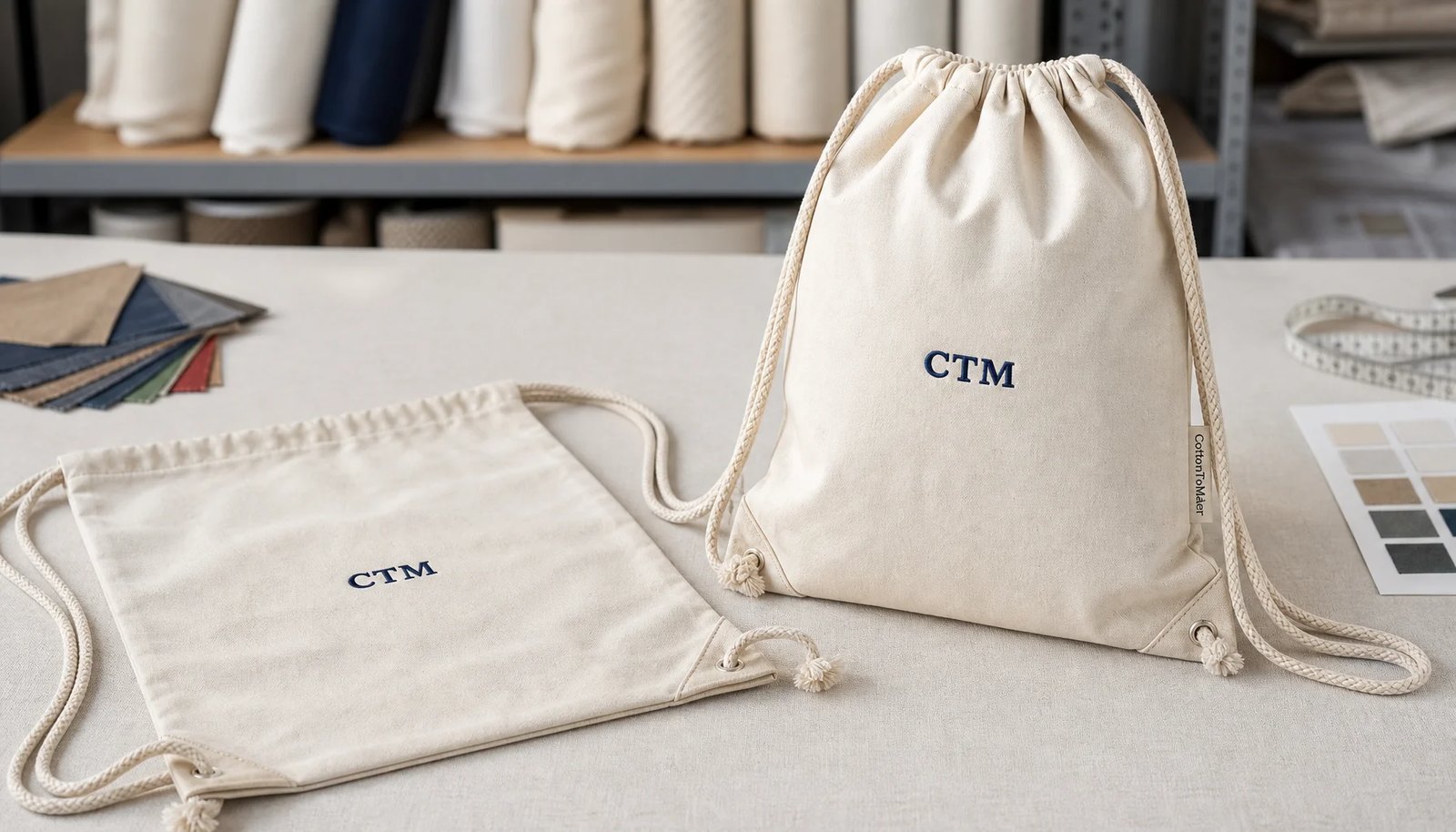
Start the RFQ With Use Case, Not Just Bag Name
A cotton drawstring backpack can be a low-cost orientation giveaway or a retail item that sits beside sweatshirts and drinkware in a university bookstore. Those two orders should not be quoted the same way. The RFQ should tell the factory whether the bag will be resold, packed into welcome kits, bundled with apparel, or distributed at a one-day campus event. That one detail changes fabric weight, print durability, packing, barcode needs, and inspection strictness.
For university bookstore procurement, the safest RFQ opening is a short commercial brief followed by a locked specification table. Do not write only “cotton drawstring backpack with logo.” That leaves the factory to choose the cheapest fabric, smallest dimensions, and simplest corner construction. A clear brief lets suppliers quote the same product instead of competing on hidden downgrades.
- State the sales channel: bookstore resale, event giveaway, orientation kit, department promotion, or alumni merchandise.
- State expected contents: apparel only, notebooks, water bottle, light textbooks, or mixed welcome-kit items.
- State order type: one-time seasonal program, reorderable core item, multi-campus rollout, or licensed merchandise.
- State required look: natural cotton, dyed school color, premium canvas feel, eco-positioned cotton, or budget promotional style.
Fabric Weight Choices That Change Cost and Durability
Fabric weight is usually the biggest material decision in a cotton drawstring backpack RFQ. Many low quotes use thin cotton in the 4 oz to 5 oz range, which may be acceptable for a short event but often feels weak for bookstore retail. For a campus buyer, 6 oz cotton is a practical entry point, while 8 oz cotton canvas gives better structure, opacity, and perceived value. If the bookstore expects the bag to carry notebooks, water bottles, or apparel purchases, the RFQ should request pricing for both 6 oz and 8 oz instead of only asking for “cotton.”
GSM and ounce weight should both be written because suppliers may use either standard. As a rough commercial reference, 6 oz cotton is often around 200 gsm, and 8 oz cotton is often around 270 gsm, but mills and finishing methods vary. Bleached, dyed, washed, and natural cotton can also feel different at the same nominal weight. The approved sample should become the standard, not only the number written in the quotation.
- Use 5 oz cotton only for very cost-sensitive giveaways with light contents and short use expectations.
- Use 6 oz cotton when balancing bookstore quality, foldability, and freight efficiency.
- Use 8 oz cotton canvas when the bag is a retail product or must support repeated campus use.
- Avoid comparing quotes unless each supplier states GSM, fabric finish, color process, and shrinkage expectation.
Size, Cord, and Reinforcement Details Buyers Often Miss
Finished size affects both buyer satisfaction and supplier cost. A few centimeters can change fabric consumption enough to create a noticeable unit price difference. For university bookstore use, common finished sizes around 34 x 42 cm or 35 x 45 cm work well for apparel, notebooks, and event materials. If the RFQ only gives an approximate size, some suppliers may quote a smaller finished bag while others quote the buyer’s intended size, making the comparison unfair.
The drawcord and lower corners deserve the same attention as the fabric body. Cotton cord gives a natural appearance and matches unbleached cotton bags, while polyester cord can be smoother, stronger in color, and easier to match to school colors. The weak point is often the lower corner tab or channel where the cord takes the load. For bookstore-grade bags, specify reinforced fabric tabs, bartacks, or a proven corner construction instead of allowing the cheapest unreinforced solution.
- Write finished dimensions after sewing, not cutting dimensions before sewing.
- Include size tolerance, commonly plus or minus 1 cm for standard production unless the program requires tighter control.
- Specify cord material, cord color, diameter or width, and whether cord ends are knotted, tipped, or heat sealed.
- Require reinforced lower corners for bags expected to carry books, bottles, or retail merchandise.
Print Method and Artwork Limits
Most university bookstore cotton drawstring backpacks use screen printing because it is cost-efficient for solid school logos, department names, and event graphics. Screen printing works best when the artwork has clear lines, controlled color count, and a defined print area. Large solid ink panels on cotton can feel stiff, and very fine lines can close up if the mesh, ink, and fabric texture are not matched properly. The RFQ should include vector artwork, print dimensions, placement, and color references before the supplier prices the job.
Heat transfer can be useful for small runs, multi-color graphics, or artwork with gradients, but it may not match the handfeel expected on natural cotton. Digital printing may fit certain designs but depends heavily on fabric pretreatment, color expectations, and washing requirements. For licensed university marks, the print approval process should be formal: digital proof, strike-off or printed sample, buyer sign-off, and then bulk production. Do not approve bulk printing from a screen-view mockup alone.
- State print method preference but allow the factory to propose alternatives with durability notes.
- Provide actual logo size in centimeters, not only a visual mockup.
- Define placement from top edge and side centerline to reduce skew and inconsistent positioning.
- Request a printed strike-off when the logo has small text, distressed texture, tight registration, or official color standards.
MOQ Logic Behind a Serious Factory Quote
MOQ is not one number. For cotton drawstring backpacks, the practical MOQ can come from fabric availability, dyeing minimums, cord color, label production, print setup, cutting efficiency, or packing labor. A supplier may offer a low MOQ if the buyer accepts natural cotton, stock cord colors, and simple screen print. The same supplier may require a higher MOQ for custom dyed school-color fabric, PMS-matched cord, woven labels, retail hangtags, or individual barcoded polybags.
A useful RFQ separates the base product MOQ from customization MOQ. This helps procurement teams understand where cost is created and which specification can be adjusted if the order quantity is not high enough. If a quote says “MOQ 500 pcs” without explaining assumptions, it may be based on stock material. That is not wrong, but it should not be compared directly with another supplier quoting custom dyed fabric and private-label finishing.
- Ask for MOQ using stock natural cotton with standard cord and one-color print.
- Ask for MOQ using dyed fabric matched to a school color.
- Ask for MOQ using custom cord color, woven label, hangtag, or retail barcode.
- Request price breaks at realistic order levels such as 500, 1,000, 3,000, and 5,000 pieces.
How to Read Cost Drivers in Competing Quotes
The lowest unit price is often not the lowest delivered cost. A quote using thinner fabric, smaller size, bulk production without inspection, and oversized cartons may look attractive but create quality complaints and freight inefficiency. For campus retail buyers, compare the quote line by line: fabric weight, print color count, cord type, labels, packing, carton volume, sample charges, screen charges, and inspection support. A fair comparison needs all suppliers quoting against the same RFQ assumptions.
Some costs should be separated instead of hidden in the unit price. Screen setup, PMS matching, pre-production sample, courier sample freight, hangtag attachment, barcode sticker, and individual polybagging can all change the final landed cost. For importers and distributors, carton CBM is especially important because drawstring backpacks are light but can take space when packed loosely. A slightly higher unit price with better carton efficiency may win after freight is calculated.
- Separate product unit cost from setup charges, sample costs, packing costs, and local export charges.
- Compare carton quantity, carton dimensions, gross weight, and total CBM before judging price.
- Treat unusually low prices as a signal to verify fabric weight, finished size, and reinforcement method.
- Request alternate quotes for bulk pack and individual polybag pack so the buyer can decide with full cost visibility.
Sample Approval Should Lock the Real Production Standard
A cotton drawstring backpack sample is not only for appearance. It should prove the factory can execute the fabric weight, print, stitching, cord function, label placement, and packing method intended for bulk production. Many production disputes happen because the buyer approved a sales sample made from available fabric, while the bulk order used a different fabric lot or different cord. The RFQ and purchase order should state whether the sample is a reference sample or an approved pre-production sample made with actual materials.
For bookstore programs, the pre-production sample should be reviewed like a small inspection. Measure the finished size, weigh the fabric if possible, pull the cords repeatedly, load the bag with realistic contents, rub the print, and check whether the logo placement looks correct when the bag is both flat and cinched closed. If the bag will be sold in-store, review hangtag position, barcode scanability, and how the folded bag looks in a carton or retail bin.
- Approve actual fabric color and handfeel, not only a photo.
- Approve actual print size, ink color, registration, and handfeel before bulk printing.
- Approve cord movement, cord length, corner reinforcement, and seam strength with realistic loading.
- Keep one signed or sealed approval sample with the buyer and one with the factory for final inspection reference.
QC Thresholds for Bookstore-Grade Production
Quality control should define what is acceptable before production starts. For this product, the main risks are wrong size, thin fabric, weak seams, uneven printing, cord slippage, dirty natural cotton, loose threads, and packing shortages. AQL inspection can be used for final shipment control, but the product-specific defect list matters more than the generic inspection label. The buyer should tell the factory which defects are critical, major, and minor for the intended selling channel.
For resale, visible print defects and poor sewing are more serious than they would be for a one-day giveaway. A crooked logo on a university mark can make the bag unsellable even if the bag still functions. Functional checks should include repeated opening and closing, cord pull, seam stress at lower tabs, and a simple load check using expected contents. If the order uses dark print on natural cotton, dry rub and tape checks help catch weak ink adhesion before the goods leave the factory.
- Major defects should include wrong fabric weight, wrong finished size beyond tolerance, damaged fabric, broken seams, weak tabs, and unacceptable logo position.
- Print defects should include obvious color mismatch, bleeding, pinholes, cracking, poor registration, skewing, and ink transfer.
- Functional checks should cover cord smoothness, equal cord length, knot security, and resistance to tearing at lower corners.
- Packing checks should reconcile inner bundle count, carton count, carton marks, barcode labels, and gross weight.
Packing Decisions Affect Cost, Plastic Use, and Receiving
Packing is often treated as an afterthought, but it changes unit cost, carton CBM, warehouse labor, and sustainability reporting. University bookstores may not need each cotton drawstring backpack in an individual polybag if the product will be displayed in bins or used for event kits. Bulk packing in bundles of 25, 50, or 100 pieces can reduce plastic and speed receiving. However, retail barcodes, hangtags, or fulfillment requirements may still require individual packaging.
The RFQ should define carton quantity, inner bundling, carton marks, label format, and maximum carton weight. Cotton bags can be compressed, but over-compression may wrinkle printed areas or distort the product. If the order includes multiple designs, campus names, or department logos, carton segregation becomes critical. A mixed-design shipment without clear carton marks can create receiving errors and delay distribution to bookstore locations.
- Use bulk pack when the bookstore or distributor can count by bundle and does not require individual retail protection.
- Use individual polybag only when needed for retail cleanliness, barcode scanning, e-commerce fulfillment, or kit assembly.
- Specify carton marks with PO number, item number, design name, quantity, carton number, gross weight, and country of origin.
- Request carton dimensions and total CBM in the quote so freight impact is visible before order confirmation.
Lead Time Risks in Campus Buying Calendars
University bookstore orders often have fixed receiving windows tied to orientation, back-to-school, homecoming, graduation, or seasonal merchandise resets. Missing the date can turn a good product into dead inventory. Lead time should be broken into artwork review, sample production, sample shipping, sample approval, material preparation, bulk cutting, printing, sewing, packing, inspection, and export handover. A single line saying “30 days production” is not enough for a time-sensitive campus program.
The highest schedule risks are custom dyed fabric, delayed artwork approval, print revisions, late deposit, packaging changes, and inspection rework. If the buyer needs a guaranteed event date, build a buffer before the factory handover date and another buffer before campus receiving. Air freight can rescue small urgent orders, but cotton backpacks are bulky enough that freight cost may become painful. Planning the RFQ early is cheaper than repairing the schedule later.
- Allow time for artwork cleanup before the sample clock starts.
- Add sample revision time if school color, logo scale, or print handfeel is sensitive.
- Treat custom dyed fabric and custom cord as longer-lead items than natural cotton and stock cord.
- Schedule final inspection before the required ship date, not on the same day as cargo handover.
Specification comparison for buyers
| Spec decision | Recommended option | When it fits | Buyer risk to check |
|---|---|---|---|
| Fabric weight | 6 oz to 8 oz cotton canvas for campus retail | Bookstore merchandise, orientation kits, alumni events, and branded giveaways that need better handfeel than thin promotional cotton | Quotes based on 4 oz or 5 oz cotton may look cheaper but can feel flimsy, show contents through the fabric, and shrink more visibly after washing |
| Bag size | Approx. 34 x 42 cm or 35 x 45 cm with tolerance stated | Fits notebooks, campus apparel, water bottles, light textbooks, and event packets without becoming an oversized sack | Factories may quote a smaller bag to reduce fabric consumption unless the RFQ locks finished dimensions and tolerance after sewing |
| Drawcord material | Cotton cord or polyester cord depending on budget and feel | Cotton cord supports a natural look; polyester cord gives smoother pulling and stronger color consistency for school colors | Cheap flat cords can twist, fray, or cut into lower tabs; require cord diameter, color, and pull test expectation |
| Lower corner reinforcement | Self-fabric triangular tabs or bartacked corner channels | Needed when the bag will carry books, retail merchandise, or reusable campus items | Unreinforced eyelets or weak tabs can tear under load, especially on heavier 8 oz cotton bodies |
| Print method | Screen print for solid logos; heat transfer only for multi-color small runs | School logos, bookstore marks, department names, and event art with 1 to 4 spot colors | Large ink coverage on natural cotton can feel stiff; fine lines may fill in if the artwork is not checked at actual print size |
| MOQ structure | Separate MOQ for blank body, dyed fabric, custom cord, and printed order | Useful when comparing true factory capability instead of only one headline MOQ | A low MOQ may rely on stock fabric and stock cord; custom PMS fabric or cord can push MOQ and lead time higher |
| Packing method | Bulk pack 100 pcs per export carton or individual polybag only when required | Bookstores receiving cartons for backroom storage usually prefer bulk pack with barcode carton labels | Individual polybags add cost, labor, plastic reporting issues, and carton volume; confirm whether retail hangtags need separate packing |
| Inspection standard | AQL-based final inspection plus functional pull and load checks | Orders for resale, licensing programs, or multi-campus distribution where defects create returns | Visual inspection alone misses cord slippage, weak seams, print crocking, and carton shortage problems |
Buyer checklist before sampling
- Define finished bag size, fabric GSM or ounce weight, fabric color, cord type, corner reinforcement, and acceptable measurement tolerance in the RFQ.
- Attach vector artwork and specify print size, placement from top edge, ink color standard, and whether the logo must pass rub, tape, or wash checks.
- Request separate pricing for 6 oz, 8 oz, and any organic or recycled cotton option instead of accepting one vague cotton quote.
- State whether the order is for resale, orientation giveaway, bookstore bundle, or event kit because the durability and packing requirements differ.
- Require a pre-production sample with actual fabric, actual cord, actual print, actual label, and the intended packing method before bulk cutting.
- Ask the factory to identify all cost assumptions: MOQ, sample fee, mold or screen cost, carton size, units per carton, net/gross weight, and lead time by stage.
- Confirm fabric shrinkage, colorfastness, seam strength, cord pull strength, print adhesion, and needle detection requirements when applicable.
- Decide whether individual polybags are necessary; if not, use bulk packing with inner bundles to reduce cost, plastic use, and receiving time.
- Reserve enough calendar time for artwork proofing, sample revision, fabric dyeing if needed, bulk printing, inspection, and shipping handover.
- Compare quotes using landed-cost data, not unit price alone: carton volume, duty code assumption, packing labor, defect allowance, and freight impact all matter.
Factory quote questions to send
- What exact fabric weight are you quoting in GSM and ounces, and is it greige, bleached, dyed, or natural cotton?
- What is the finished bag size after sewing, and what measurement tolerance will your QC team use?
- Is the quoted cord cotton, polyester, recycled polyester, or other material, and what diameter or width is included?
- How are the lower corners reinforced, and can you provide a pull-strength reference or internal test method?
- Which print method is included, how many colors are priced, and what is the maximum print area without a surcharge?
- Are screen setup charges, sample charges, PMS matching charges, labels, hangtags, and packing labor included or listed separately?
- What MOQ applies for stock fabric, custom dyed fabric, custom cord color, and private label production?
- What is the sample lead time, bulk production lead time, and earliest shipment date after sample approval and deposit?
- What carton dimensions, units per carton, net weight, gross weight, and total CBM are assumed in the quote?
- What defects will be treated as major defects during inspection, and what AQL level do you normally support for this product?
Quality-control points to confirm
- Finished size should stay within the agreed tolerance, commonly plus or minus 1 cm unless a tighter retail requirement is written into the PO.
- Fabric weight should match the approved swatch and sample; large variation changes handfeel, durability, and carton weight.
- Main seams, side seams, and bottom seams should be straight, locked properly, and free from skipped stitches or loose thread tails.
- Lower corner tabs or cord channels should withstand repeated pulling without tearing, slipping, or distorting the fabric.
- Drawcords should move smoothly through the top channel and be equal length after closing the bag.
- Print position should match the approved proof, with no obvious skewing, pinholes, bleeding, cracking, or unacceptable shade variation.
- Ink should not transfer easily during dry rub or tape checks, especially on dark prints over natural cotton.
- Labels, hangtags, barcodes, and country-of-origin markings should match the bookstore receiving and compliance instructions.
- Cartons should meet the agreed quantity, inner bundling, carton marks, and weight limits so warehouse receiving can count efficiently.
- Final inspection should include visual defects, measurements, functional cord checks, packing verification, and a carton count reconciliation.