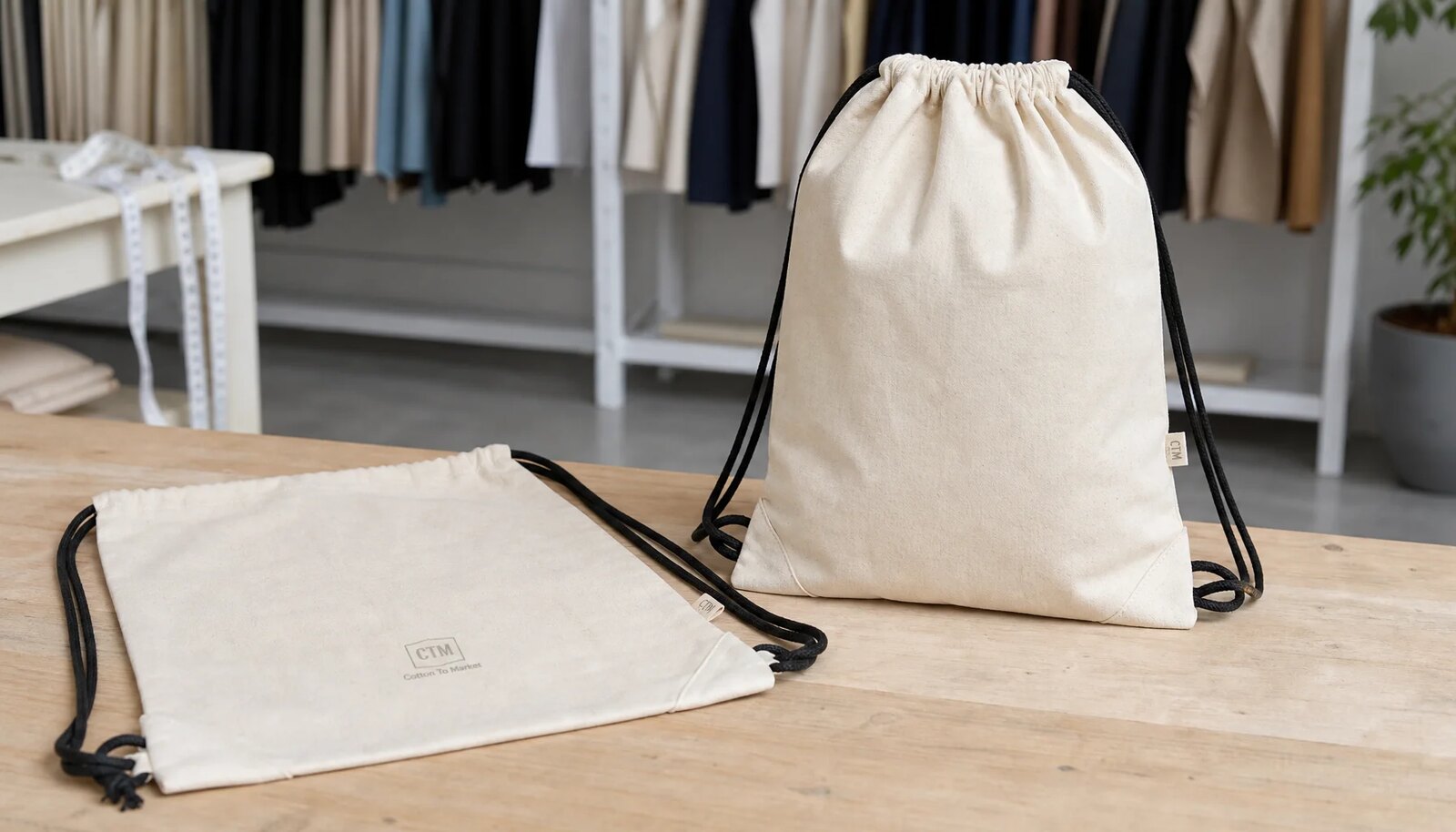
Start with the real craft fair use case
A cotton drawstring backpack for a craft fair has a different job from a school promo sack, gym giveaway, or simple shopping pouch. Visitors move through crowded aisles. They pick up flyers, catalogs, paper prints, candles, jars, small ceramics, T-shirts, sponsor samples, or workshop supplies. The bag has to open easily, sit evenly on the shoulders, show the logo clearly, and hold up for a day of use without looking disposable. That is why the RFQ should start with the use case, not with the lowest unit price.
Separate the program before asking for quotes. A free visitor giveaway may need a clean one-color print, fast bulk unpacking, and a practical cost target. A sponsor kit usually needs a neater finish because bags may be placed on registration tables, photographed, or handed to VIP visitors. A paid merchandise bag needs more body, stronger reinforcement, retail labeling, and sometimes individual packing. A workshop kit may need sorting by class, instructor, date, or booth, plus enough strength for tools and materials.
The expected contents tell the supplier more than a phrase like high quality cotton backpack. Write what the bag must carry, the approximate load, the event duration, the target appearance, and whether the buyer expects reuse after the fair. A bag holding one leaflet and a postcard can be lighter. A bag carrying a paperback, candle, and ceramic mug needs a sturdier specification. When those assumptions are visible, suppliers quote the same product and procurement can compare prices with fewer surprises.
- Visitor giveaway: prioritize efficient cost, one-color logo clarity, bulk bundles, and fast venue distribution.
- Sponsor kit: prioritize consistent shade, neat logo placement, inner labels, and clean carton separation by sponsor.
- Paid merchandise: prioritize 8-10 oz fabric, stronger reinforcement, barcode or hangtag options, and retail presentation.
- Workshop kit: prioritize usable capacity, seam strength, sorting accuracy, and delivery by class, booth, or event day.
- RFQ rule: specify expected contents and load before deciding fabric weight, cord diameter, or reinforcement.
Define fabric weight before price comparison
Fabric is the first specification that should be locked. Terms such as cotton, canvas, calico, muslin, duck, and cotton fabric are too broad for B2B sourcing. Two suppliers can use the same word and quote very different goods. Ask for fabric weight in GSM or ounces, and ask whether the weight is measured before or after finishing. That one detail can explain major differences in price, handfeel, print result, carton weight, and durability.
For very light handouts, 120-150 GSM cotton can be acceptable, but buyers should expect a thinner feel. It may also show contents more easily and place more stress on the lower cord exits. For most reusable craft fair programs, 180-240 GSM, roughly 5-7 oz, is a practical commercial range. It keeps cost under control while giving enough body for event use. For paid merchandise, sponsor kits, or heavier contents, 270-340 GSM, roughly 8-10 oz, gives a more substantial handfeel and better perceived value.
Color matters as much as weight. Natural cotton gives the warm off-white shade, seed specks, and slubs that often fit handmade markets. Bleached cotton gives a cleaner background and sharper logo contrast. Dyed cotton supports brand-color programs, but it adds lab dip approval, shade control, and colorfastness checks. Recycled cotton blends or organic cotton should be written precisely because composition, certification needs, availability, and pricing can differ from conventional cotton.
Do not compare a natural 6 oz bag with a dyed 8 oz bag as if they are the same item. They have different material costs, finishing steps, shade risks, and freight impact. If shade consistency matters, approve a fabric swatch or lab dip before the pre-production sample. If natural cotton is selected, approve the normal level of seed specks and slubs on a real swatch. A retouched product photo is not a reliable quality standard.
- State GSM or oz; do not accept cotton canvas as the only fabric description.
- Use 180-240 GSM for most reusable craft fair backpacks and 270-340 GSM for premium or heavier-use programs.
- Approve natural cotton seed specks, slubs, shade, and handfeel as part of the signed standard sample.
- For dyed cotton, require lab dip approval and basic dry-rub assessment before bulk cutting.
- Ask whether finishing, steaming, washing, or shrinkage may affect final dimensions or handfeel.
Set dimensions around what must fit
A common adult drawstring backpack size is 34 x 42 cm. It is a useful starting point, not an automatic answer. If the fair program includes A4 sheets, sponsor folders, catalogs, or packaged art prints, usable internal width is more important than the advertised outside size. A 30 x 38 cm bag can work for light giveaways, but it may bend documents or leave materials sticking out. A larger bag may look generous, yet it also increases fabric use, carton volume, freight cost, and storage space at the venue.
Most cotton drawstring backpacks are flat and ungusseted. That means extra height does not always solve capacity problems for boxed candles, ceramics, jars, or bulky handmade goods. Ask the event team what visitors are likely to put inside. Measure the largest expected item and add clearance. If the backpack is part of a sponsor kit, check the actual inserts rather than relying on nominal folder size.
The RFQ should define how finished size will be measured. The usual method is flat measurement, seam to seam, without stretching the fabric. For this product category, +/-1 cm on width and height is often practical, though buyers can request tighter or wider tolerance depending on the contents and price level. If the bag must fit a specific sample kit or retail item, write that requirement directly into the RFQ.
Construction also affects usable space and appearance. A top folded channel is common, but it must be wide enough for the selected cord diameter so the bag closes smoothly. Side seams should be straight enough that the bag hangs evenly when worn. If the print is centered on the front panel, define whether placement is measured from the top edge, bottom edge, centerline, or side seams. Small measurement rules prevent long arguments during inspection.
- Use 34 x 42 cm as a practical adult starting point, not as an automatic final specification.
- Confirm usable internal width when A4 inserts, catalogs, folders, or flat art prints must fit.
- State finished-size tolerance, commonly +/-1 cm for standard cotton drawstring backpacks.
- Measure samples flat from seam to seam without stretching the fabric.
- Avoid oversizing without checking carton count, CBM, freight cost, and venue handling impact.
Specify cords, channels, and stress points
The drawcord is a small component, but visitors feel it immediately. A 5-7 mm cotton cord usually suits a natural craft fair look and feels more substantial on the shoulders than a very thin cord. Polyester cord can reduce cost, provide brighter colors, and support some brand-color requests. It may, however, look less natural next to unbleached cotton. Write the cord material, diameter, color, length, end treatment, and tolerance into the RFQ. If the factory swaps in a thinner cord, the bag may close poorly, dig into shoulders, or look cheaper than the approved sample.
Cord color should be treated as a controlled component, not an afterthought. Natural, black, and dyed cords change the finished appearance. They can also affect lead time and cost. Colored cords should be checked for dry rub transfer, especially against natural or bleached cotton and white printed logos. End finishing also matters. Depending on the material, cord ends may be knotted, heat sealed, wrapped, tipped, or left raw. Uneven knots and fraying ends make the whole bag feel careless.
The lower cord exits carry the load when the backpack is worn. For light handouts, a simple construction may be enough. For craft fairs, visitors often add purchases during the day, so reinforcement is safer. Fabric triangle reinforcement, bar tacks, or properly set metal eyelets can reduce failure risk at the lower corners. Metal eyelets should not be specified casually on thin cotton; poor setting can cut the fabric or pull out under load.
Ask suppliers to show the inside construction. A front product photo rarely reveals how the lower corners are sewn. For heavier programs, request a practical pull or load check using the approved construction. The test does not need to be complicated, but the supplier should know what the bag is expected to hold and which failures are unacceptable.
- Specify cord material, diameter, length, color, end finish, and acceptable tolerance.
- Use thicker cotton cord when natural feel and shoulder comfort are important.
- Check dyed cords for dry rub transfer against light cotton panels and light print areas.
- Require fabric triangles, bar tacks, or suitable eyelets for bags carrying books, jars, candles, or ceramics.
- Request inside-corner construction photos, not only front-view product photos.
Choose the print method by artwork, not habit
Most cotton drawstring backpacks for craft fairs use screen printing. It is practical for one-color to three-color artwork, sponsor names, bold event logos, and simple illustrations. It also works well on cotton when the artwork has clear shapes and enough line weight. Still, the supplier cannot quote accurately from a logo file alone. The RFQ should state print size in centimeters, print side, placement, number of colors, Pantone or brand references, and whether screens or setup are included.
Heat transfer is better for gradients, full-color art, photographs, or detailed illustrations that cannot be separated cleanly for screen print. Buyers should approve the transfer feel, edge appearance, rub performance, and appearance on textured cotton. Embroidery can work for a small premium logo, but large embroidery can distort lighter panels and raise cost quickly. For many craft fair programs, a clean screen print on natural cotton looks more integrated than a glossy transfer. The right choice still depends on the artwork, budget, and brand position.
Production artwork should be ready before sampling. Vector files are preferred for screen print. Very fine reversed text, thin rules, and small sponsor marks can fill in on rougher canvas. If brand color matters, approve the printed result on the actual bag fabric, not only on a digital proof. Natural cotton shade and ink absorption can change perceived color.
Multi-sponsor programs need extra control. One base bag sample may be enough, but each artwork version should still have an approval trail. At minimum, confirm print file, print size, placement, print color, and carton label for every sponsor or design. When the program is complex, a strike-off for each artwork can reduce release risk.
- Provide vector artwork where possible and define print size in centimeters.
- State print side, placement reference point, number of colors, and Pantone or brand color references.
- Use screen print for bold spot-color logos and heat transfer for full-color or gradient artwork.
- Set print placement tolerance, commonly +/-5 mm for standard production unless stricter alignment is required.
- Avoid tiny reversed text, thin strokes, and detailed sponsor logos on coarse canvas.
Price MOQ by base bag and design split
MOQ is not just the total number on the purchase order. Factory efficiency depends on fabric color, fabric weight, finished size, cord type, reinforcement, print method, artwork version, and packing method. A 5,000-piece order in one natural fabric with one logo is simple. A 5,000-piece order divided across ten sponsor logos, three cord colors, and different carton marks is not. The total quantity may look identical, but the second order carries more setup, proofing, sorting, inspection, and packing risk.
For distributors, event agencies, and multi-sponsor craft fairs, use a base bag plus artwork schedule. The base bag locks fabric, size, cord, reinforcement, print method, and packing style. The artwork schedule lists each sponsor or design, quantity, print file, print colors, carton mark, destination, and any label requirement. This lets the supplier quote the common production base and then show design-specific costs separately.
Ask for a price ladder instead of one quantity only. Price points at 1,000, 3,000, 5,000, and 10,000 pieces help procurement see where production efficiency improves. If the program includes split designs, ask whether MOQ applies per design, per fabric color, per cord color, per packing method, or to the total order. Hidden split-design costs often appear after a buyer has already compared headline unit prices.
Keep the base bag common whenever possible. Changing cord color for every sponsor may look attractive in a presentation, but it adds material control and packing complexity. If the branding value is real, quote it. If not, a shared cord color and consistent bag body usually make the order easier to produce, inspect, and distribute.
- State quantities by artwork, fabric color, cord color, destination, and packing method.
- Keep one common base bag when possible to reduce setup, sorting, and QC risk.
- Expect separate setup, screen, proofing, or packing charges for distinct artwork versions.
- Avoid changing cord color by sponsor unless the branding value justifies the operational complexity.
- Request a price ladder so procurement can compare small, mid-size, and bulk order scenarios.
Build a quote sheet suppliers can actually price
A strong cotton drawstring backpacks RFQ template makes suppliers quote the same product. Include fabric weight, fabric color, finished size, cord details, reinforcement, print method, print size, quantity by design, packing, carton data, Incoterm, lead time, and required arrival date. If one supplier quotes EXW while another quotes FOB, the unit prices are not comparable. If one includes individual polybags and another quotes bulk bundles, the comparison is also flawed.
Ask each supplier to separate the cost components. At minimum, request sample fee, setup or screen charge, unit price, packing cost, split-design surcharge, carton dimensions, gross weight, net weight, CBM, lead time, Incoterm, port, and quote validity. Clear quote structure makes negotiation easier and reduces the risk of late add-ons.
Landed cost matters more than factory unit price. Cotton drawstring backpacks are not fragile, but they can become bulky once packed. Carton dimensions, pieces per carton, gross weight, and CBM affect freight, warehouse handling, local delivery, and event labor. A cheaper bag packed inefficiently may cost more by the time it reaches the venue. Request carton data with the quote, not after production is finished.
Delivery wording must be exact. Factory completion is not the same as forwarder handover, port delivery, warehouse arrival, or venue-ready delivery. Craft fairs have fixed dates, and bags often need to arrive early for receiving, sorting, booth allocation, and registration setup. State the required arrival date and whether partial shipment is acceptable. Rush schedules should not remove sample approval or inspection steps unless the buyer knowingly accepts that risk.
- Compare quotes only after matching fabric, size, print method, reinforcement, packing, and Incoterm.
- Request sample fee, setup charge, unit price, packing cost, carton size, gross weight, net weight, and CBM.
- Ask whether cartons are single-wall or double-wall and whether palletization or special labeling is required.
- Define delivery as warehouse arrival, venue arrival, forwarder handover, port delivery, or another exact milestone.
- Require quote validity and list excluded charges such as duties, tax, customs clearance, or local delivery.
Approve samples with measurable comments
The pre-production sample becomes the physical buying standard. Do not approve it from a front-view photo only. It should confirm fabric handfeel, shade, weight, sewing method, cord diameter, channel function, lower-corner reinforcement, print color, print placement, and packing presentation. Measure it. Pull the cords. Look inside the seams. Load it with realistic fair contents. A polished photo can hide weak corners, thin cord, rough stitching, low print placement, or uneven closure.
Sample feedback should be specific enough for production and inspection. If the fabric and print are approved but the cord is too thin, say so and list the required cord diameter. If the bag is undersized, state the corrected finished size and tolerance. If the print sits too low, give the placement reference point and target measurement. Comments such as make stronger or improve quality are not useful because the factory cannot act on them consistently.
For multi-sponsor programs, buyers may approve one base bag sample and then approve artwork proofs, color references, or strike-offs for each design. A physical sample for every sponsor is not always practical, but the approval trail still needs to control print file, print size, placement, color, and packing label. Keep one signed approved sample available for final inspection.
When the sample is approved with changes, confirm whether the factory will make a revised sample or proceed with written corrections. For important changes to fabric, reinforcement, print method, or cord, a revised physical sample is safer. For a minor carton mark or label change, written confirmation may be enough if the buyer accepts the risk.
- Measure finished width and height flat, seam to seam, without stretching.
- Compare fabric weight, shade, cotton specks, slubs, and handfeel against the approved swatch.
- Pull the drawcord repeatedly and confirm both sides close evenly without snagging.
- Load the bag with expected contents for a practical stress and shoulder-comfort check.
- Approve print color on actual cotton fabric, not only on a digital proof or paper printout.
Plan packing for the venue team
Packing should match how the backpacks will be used at the craft fair. Individual polybags are useful for retail resale, barcode control, e-commerce fulfillment, or premium sponsor kits. For free visitor handouts, they often slow the team down and add plastic and labor. Bulk inner bundles of 25 or 50 pieces are usually more practical for entrance tables, registration desks, and booth staff.
Define inner bundle quantity in the RFQ. Also state whether bundles need labels by sponsor, SKU, artwork, room, date, or destination. If an event team has to open cartons and sort designs on the morning of the fair, the packing plan has failed. Venue-ready packing is not just neat; it saves labor when timing is tight.
Carton weight deserves attention. Dense packing may look efficient for freight, but cartons that are too heavy can be hard to move through event halls, temporary storage rooms, elevators, and booth aisles. Many buyers set a manual-handling target such as 12-18 kg gross per carton, depending on local handling rules and venue conditions. Ask for carton dimensions, pieces per carton, gross weight, net weight, and CBM before shipment.
Packing accuracy becomes critical when multiple designs ship together. Mixed sponsor versions in unlabeled cartons can delay setup and cause the wrong bags to be distributed. Carton marks should show purchase order, item name, design or sponsor name, quantity, destination, carton number, and total carton count. For complex orders, request packing photos before release and include packing-list checks in final inspection.
- Use bulk bundles for handouts and individual polybags for resale, barcode control, or premium presentation.
- Set inner bundle quantity, commonly 25 or 50 pieces, based on event team workflow.
- Mark cartons by design, sponsor, PO, quantity, destination, carton number, and total carton count.
- Set a practical carton gross-weight target for manual venue handling.
- Request packing photos when multiple designs, destinations, or sponsor versions are included.
Write QC terms before the PO
QC terms should be agreed before the purchase order is confirmed. Waiting until defects appear puts the buyer and supplier in a weak position. Cotton drawstring backpacks are simple sewn goods, but the important failures are specific: wrong artwork, wrong fabric, incorrect size, non-functioning drawcord, open seams, missing reinforcement, stains, severe print smudges, poor registration, cord color transfer, mixed designs, and incorrect carton quantities.
Many B2B buyers use AQL-based final inspection for promotional sewn goods. A common starting point is Critical 0, Major 2.5, Minor 4.0, unless the buyer’s internal policy requires something different. AQL alone is not enough. The supplier also needs written defect examples. Wrong logo, missing reinforcement, broken drawcord, open seam, severe stain, or incorrect packing should normally be treated more seriously than a small loose thread that can be trimmed.
In-line checks reduce the chance of a final inspection failure. Fabric weight and shade should be checked before cutting. Print strike-off should be approved before mass printing continues. Sewing should be reviewed for seam security, channel function, and lower-corner reinforcement before the full run is packed. Final inspection should verify size, print, seams, drawcords, packing, carton labels, and quantity.
Give the inspector the right references. The approved sample, artwork proof, packing specification, purchase order, and defect classification should all be available. Without those documents, inspection becomes subjective. With them, release decisions are based on the standard both sides agreed to before production.
- Define Critical, Major, and Minor defects before production starts.
- Use AQL only with written defect examples and an approved physical sample.
- Check fabric weight and shade before cutting, not only after bags are sewn.
- Inspect print strike-off, registration, placement, and color before mass printing continues.
- Verify packing accuracy, carton marks, and mixed-design separation before shipment release.
Specification comparison for buyers
| Spec decision | Recommended option | When it fits | Buyer risk to check |
|---|---|---|---|
| Fabric weight | 180-240 GSM, about 5-7 oz cotton canvas, for most reusable craft fair programs; 270-340 GSM, about 8-10 oz, for paid merchandise or heavier kits | 5-7 oz balances cost, handfeel, printability, and event giveaway durability; 8-10 oz supports higher perceived value and heavier contents | Quotes that only say cotton, canvas, or calico are not comparable; 120-150 GSM can be acceptable for light handouts but may feel thin and stress at cord exits |
| Fabric color | Natural cotton for handmade positioning; bleached cotton for cleaner logo contrast; dyed cotton only with lab dip and colorfastness approval | Natural suits maker markets and craft fairs; bleached suits bright artwork; dyed suits brand-color programs | Natural cotton has seed specks and shade variation; dyed cotton can extend lead time and should be checked for dry and wet rub where relevant |
| Finished size | 34 x 42 cm adult standard with +/-1 cm tolerance unless the contents require tighter control; 30 x 38 cm for light handouts | 34 x 42 cm usually holds A4 inserts, catalogs, T-shirts, small boxed goods, and visitor purchases without looking oversized | Oversizing increases fabric cost and carton volume; undersizing creates complaints when catalogs, sponsor folders, or purchases do not fit |
| Drawcord material | 5-7 mm cotton cord for natural programs; polyester cord for lower cost, brighter colors, or stronger shade matching | Cotton cord improves natural feel and perceived value; polyester cord can support branded colors and lower budgets | Thin cords can dig into shoulders; colored cords may bleed or transfer; cord diameter, length, color, and end finish must be written into the RFQ |
| Print method | Screen print for 1-3 spot colors; heat transfer for gradients or full-color art; embroidery for small premium logos only | Screen print is usually the most practical bulk method for event logos, sponsor marks, and simple illustrations on cotton panels | Fine lines can fill on rough canvas; request print size, Pantone or brand references, artwork file type, registration tolerance, and placement tolerance |
| Reinforcement | Fabric triangle reinforcement or bar tacks at lower cord exits; metal eyelets only with suitable fabric weight and verified setting quality | Recommended when visitors may carry books, candles, jars, small ceramics, workshop supplies, or multiple booth purchases | Unreinforced lower exits are cheaper but are a common stress point; ask for inside-corner photos and define pull or load-check expectations |
| MOQ logic | Quote by base bag plus artwork schedule; combine designs only when fabric, size, cord, print method, and packing remain the same | Useful for distributors and event agencies managing multiple sponsor logos under one craft fair program | Many small designs increase screen setup, sorting, inspection, carton marking, and packing workload; confirm MOQ and surcharge per design |
| Packing method | Bulk inner bundles of 25 or 50 pcs for handouts; individual polybag only for resale, barcode control, fulfillment, or premium kits | Bulk packing lowers plastic use, unpacking labor, and venue setup time; individual packing improves retail presentation | Carton weight should be manageable, often capped around 12-18 kg gross for manual handling; labels must prevent mixed sponsor versions |
| Inspection standard | Use agreed defect classes with AQL, commonly Critical 0, Major 2.5, Minor 4.0 for promotional sewn goods unless buyer policy differs | Fits B2B orders where the buyer needs objective release criteria before shipment | AQL alone is not enough; define major defects such as wrong artwork, missing reinforcement, open seams, non-functioning drawcord, stains, and severe print defects |
Buyer checklist before sampling
- Define the use case: free visitor giveaway, sponsor kit, paid merchandise, workshop kit, exhibitor welcome pack, or reusable shopping bag.
- List expected contents and estimated load, such as A4 catalogs, T-shirts, candles, jars, books, small ceramics, or workshop tools.
- State finished width and height, measurement method, tolerance, and whether the bag must hold A4 documents without bending.
- Specify fabric weight in GSM or oz, fabric construction if known, cotton type, color standard, and whether natural seed specks and slubs are acceptable.
- Define drawcord material, diameter, color, length, end finish, channel construction, and lower cord exit reinforcement method.
- Attach production artwork with print size, print position, number of colors, Pantone or brand references, file format, and required proof approval steps.
- Clarify quantity by artwork, fabric color, cord color, destination, packing label, and shipment instead of giving only one total program quantity.
- Request a pre-production sample covering fabric handfeel, finished size, sewing, drawcord pull, logo placement, print color, reinforcement, and packing method.
- State packing style, inner bundle quantity, carton weight limit, carton marks, SKU or sponsor labels, and whether venue-ready sorting is required.
- Ask for a quote breakdown including sample fee, setup or screen charge, unit price, packing cost, carton dimensions, gross weight, CBM, lead time, Incoterm, port, and quote validity.
Factory quote questions to send
- What exact fabric weight will you use, in GSM and/or oz, and is the weight measured before or after finishing?
- Is the quoted fabric natural cotton, bleached cotton, dyed cotton, recycled cotton blend, organic cotton, or cotton-poly blend, and can you provide the composition?
- What is the finished bag size tolerance, and will inspection measure the bag flat from seam to seam without stretching?
- What cord material, diameter, color, length, and end finish are included, and what cord tolerance can you control in bulk?
- Are fabric corner reinforcements, bar tacks, or metal eyelets included in the unit price, and can you provide photos of the inside construction?
- Which print method is included, and how many colors, positions, screens, transfers, or print areas are covered?
- What artwork file type do you need, and can you provide a digital proof showing print size, position, color references, and placement tolerance before sampling?
- What is the MOQ per artwork, per fabric color, per cord color, per packing method, and per shipment, and what surcharge applies for split sponsor versions?
- How many days are required for lab dip, artwork proof, pre-production sample, sample shipping, bulk production, inspection, packing, and export handover?
- What carton dimensions, pieces per carton, gross weight, net weight, CBM, inner bundle quantity, and packing style are used for the quoted price?
Quality-control points to confirm
- Bulk fabric weight should match the approved range, with random GSM checks taken from production fabric before cutting; buyers can define an acceptable tolerance such as +/-5% unless their program requires tighter control.
- Fabric color, cotton specks, slubs, weave appearance, and handfeel should match the approved sample or lab dip standard, especially for natural and dyed cotton.
- Finished bag size should stay within the agreed tolerance, commonly +/-1 cm for width and height on this type of sewn cotton bag unless the buyer specifies tighter control.
- Cut panels should be aligned with the fabric grain where practical so the bag does not twist noticeably after sewing or during use.
- Drawcord channels must pull smoothly without skipped stitches, trapped cord, uneven opening width, twisted channel construction, or excessive friction.
- Lower cord exits must match the approved reinforcement method, including fabric triangles, bar tacks, or metal eyelets where specified.
- Cord material, diameter, color, length, knot size, and end finish should be checked against the approved sample so the bag closes evenly and can be worn comfortably.
- Print position should follow the approved artwork layout, with a practical placement tolerance such as +/-5 mm for standard production unless the artwork requires a different limit.
- Screen print should show no major pinholes, smudges, ink cracking, heavy ghosting, poor registration, wrong color, or color drift beyond the approved standard.
- Dyed fabric and colored cords should be checked for dry rub transfer, especially against natural cotton panels, white printed logos, or light-colored apparel.