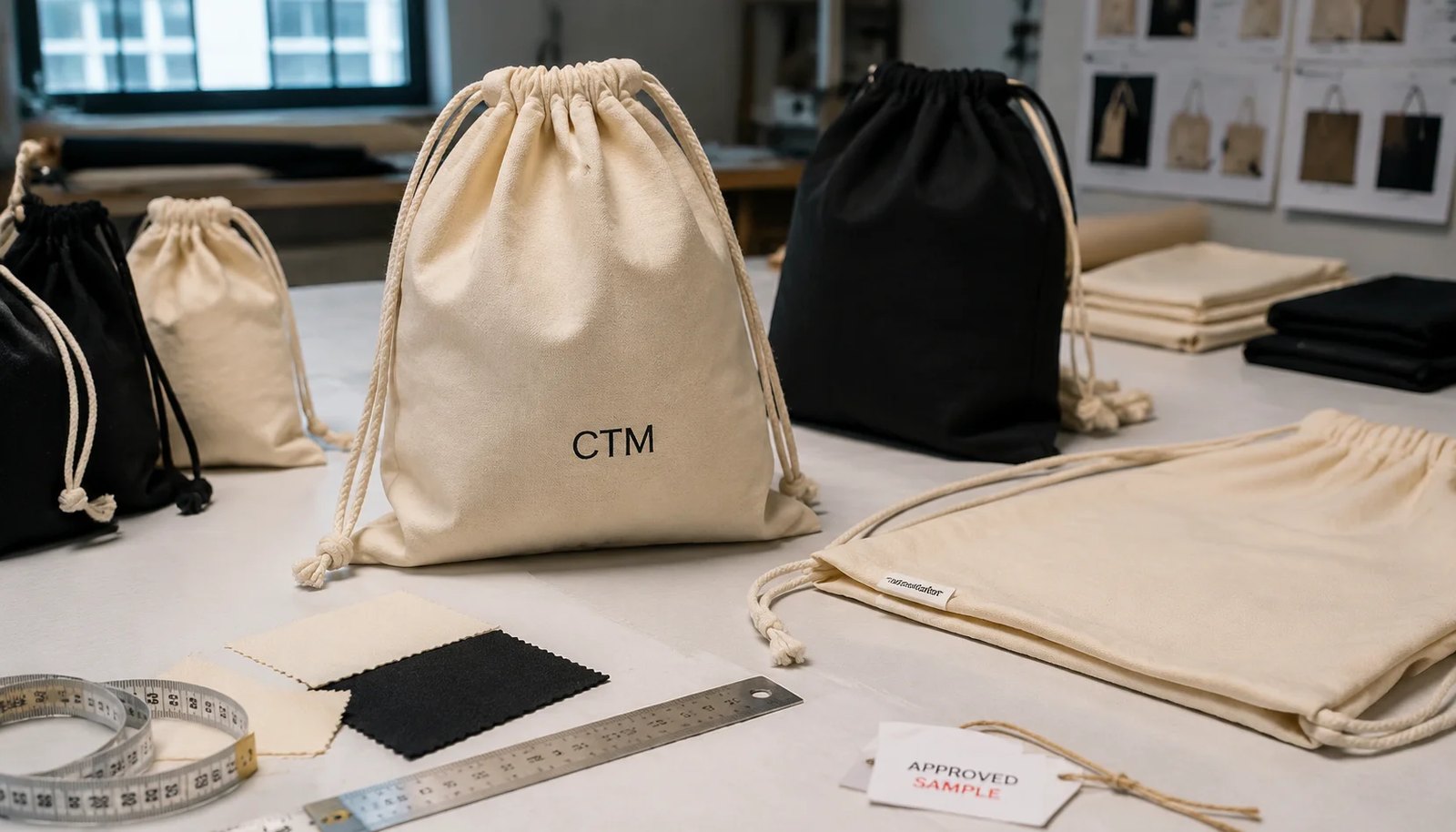
Why skincare brands need a stricter backpack QC standard
Cotton drawstring backpacks used by skincare brands are rarely just giveaway bags. In many programs they act as secondary packaging, influencer mailer packaging, event gift packaging, or a retail add-on that sits next to premium products. That means the bag is judged against the finish level of cartons, labels, and bottles. A backpack that is slightly crooked, too thin, or badly printed can make a serum or cream set look lower value even if the products inside are good.
The buying problem is usually not whether a supplier can sew a drawstring backpack. Most can. The real problem is that quotes often hide material downgrades, print shortcuts, or packing assumptions that only appear after approval. For skincare buyers, the bag also has to work around leakage risk, friction against printed cartons, and a brand image that usually depends on clean natural tones, soft hand feel, and logo clarity on unbleached or dyed cotton.
- Main failure points in skincare programs: fabric too thin, logo rub-off, cord lint, oil marks, wrong natural shade, and poor presentation after unpacking
- A backpack carrying glass bottles or jars needs better corner reinforcement than one carrying only sample sachets
- Natural cotton variation is normal, but obvious lot mismatch should still be controlled by approved tolerance
Start with the right fabric weight instead of a generic cotton spec
For skincare brand use, a practical starting range is 8 oz to 10 oz cotton canvas, roughly 270 to 340 GSM. This gives enough body for the bag to hold shape when packed with cartons, pouches, or a small towel, and it still folds efficiently for export. Lighter fabrics around 140 to 200 GSM can work for low-cost event handouts, but they often look translucent, wrinkle heavily, and distort under the pressure of bottle corners. Buyers who approve a nice-looking showroom sample made from heavier stock sometimes receive bulk made in lighter cloth if the RFQ only says 'cotton drawstring backpack.'
Fabric weight also affects printing and seam performance. Heavier canvas gives better support under screen print and usually reduces puckering around the logo area. It also improves the cord channel, where a weak fabric can stretch and wrinkle after the first few uses. If your skincare line uses premium positioning, the hand feel matters as much as the number on the spec sheet. A softer combed canvas may cost more than a rough stock cloth, but it often presents better in unboxing and retail display.
- Entry promotional use: about 180 to 240 GSM if budget is tight and load is light
- Mainstream skincare gift set use: about 270 to 340 GSM
- Heavier premium use: 350 GSM and up only if the bag itself is meant to feel substantial and reusable
- Add fabric tolerance in quote request: for example plus or minus 5 percent GSM
- Request weave and yarn info if consistency matters across repeat orders
Build the spec around actual pack load and product shape
A common mistake is choosing dimensions from a standard backpack template without considering the shape of skincare packs. Skincare programs often contain rigid cartons, pump bottles, glass jars, headbands, or bundled travel sets. A soft flat bag can look acceptable empty but strain at the lower corners once the contents are inserted. That strain then causes diagonal distortion on the printed logo and early seam failure where the cords pull the side channels inward.
Instead of sizing by approximate volume, build the bag around the largest packed unit and how it will be inserted. If the set uses two or three rectangular cartons, a bottom gusset may improve loading and presentation. If contents are mostly soft and lightweight, a flat body is usually cheaper and easier to pack. Suppliers can quote both versions quickly if your RFQ includes a packed-item photo, dimensions, and estimated total weight.
- Include target load weight in kilograms on the RFQ
- Note whether products have sharp carton corners or glass edges that press into the fabric
- For rigid gift sets, specify if a gusseted base must stand upright when filled
- For promotional mailers, note if the bag will be folded into another box before shipping
Print method selection matters more on cotton than many buyers expect
Most skincare logos on cotton drawstring backpacks are best handled by screen printing, especially for simple one-color or two-color artwork. Water-based screen print usually gives a softer hand and more natural finish than plastisol-heavy prints, which can feel thick and crack over repeated folding. On natural cotton, however, screen print opacity depends on both the ink system and the fabric surface. A supplier quoting a very low price may reduce print layers or curing quality, leading to faded logos or rub-off in transit.
Heat transfer printing can be useful for gradient artwork or small multi-color runs, but it should not be treated as a premium default. Transfers may create a plastic patch feel on a breathable cotton bag, and edge lifting is a real risk if application temperature, pressure, or storage conditions are poor. For skincare brands that want a clean understated look, an embroidery logo or woven side label can also work, but both should be reviewed against fabric weight because lighter cloth may pucker around dense stitches.
- Screen print is usually the best cost-to-quality choice for simple brand marks
- Use Pantone references and note if exact shade matching is critical on natural cotton
- Set print position tolerance, for example within plus or minus 5 mm from approved centerline
- Request a rub test standard suitable for packed export goods
- If using embroidery, specify backing and stitch density to avoid fabric puckering
How MOQ logic changes the best quote, not just the unit price
MOQ for cotton drawstring backpacks is not only about the factory's sewing minimum. It is shaped by fabric sourcing, dye lot, print setup, and packing style. A factory may quote 500 pieces, but the price at 500 can include inefficient fabric usage, manual cutting, and a high setup charge per piece. At 2,000 or 3,000 pieces, the same style may move to a lower cost band because fabric can be bought in a more economical lot and print setup is spread over more units.
For skincare brands running seasonal campaigns, the best decision is often to compare cost per delivered usable unit, not just ex-factory price. A slightly higher MOQ may lower print cost and improve consistency if it allows one full fabric lot and one stable production run. On the other hand, if there are multiple SKUs with different logo colors, splitting a moderate total volume into many small variants can increase setup waste and invite color drift.
- Quote request should show total quantity, quantity per color, and quantity per artwork
- Small-run surcharges usually come from print setup, fabric waste, and handwork inefficiency
- Stock natural canvas may support lower MOQ than custom-dyed fabric
- A lower unit price is not useful if it creates mixed lots, weak print quality, or late delivery
Use sample approvals to lock quality before bulk, not to admire appearance
A sample should answer production questions, not just confirm that the bag looks attractive in a photo. For skincare buyers, the most useful sequence is digital artwork layout, then a physical pre-production sample in final fabric, final cord, and final print method. If the sample is made from substitute fabric because the factory is trying to move quickly, note that clearly and do not approve hand feel, opacity, or structure based on it.
During sample review, load the bag with the actual intended contents or dummy weights that match them. This reveals whether corners protrude, whether the drawstring closes smoothly, and whether the logo distorts when the bag is full. It also helps validate carton planning later because a bag that looks compact flat may become much bulkier once filled. Sample approval should include marked measurements, approved photo angles, and any exceptions accepted by the buyer.
- Physical sample should match final GSM, final cord, final print, and intended sewing construction
- Review logo readability on filled and empty bag conditions
- Measure width, height, channel width, cord length, and gusset if applicable
- Photograph acceptable seam appearance and acceptable natural cotton shade for reference
- Record what was not approved so the factory cannot treat silence as approval
Quality inspection points that actually catch shipment failures
Final inspection often focuses too much on counting defects and not enough on functional failures. For cotton drawstring backpacks, the most expensive issues are those that survive casual visual review but fail during packing or retail handling. Examples include channel seams that open when the cord is tightened, side seam mismatch that twists the body, and prints that look fine in the factory but abrade against adjacent bags in a dense export carton.
A practical inspection plan combines inline review with final random inspection. Inline checks should confirm cut panel symmetry, print alignment before assembly volume builds up, and consistent cord insertion. Final checks should include loaded function tests, measurement verification, stain review under good light, and carton-level confirmation that bag bundles are dry and clean. If the goods are going into retail distribution, barcode placement and assortment accuracy deserve the same attention as sewing quality.
- Measure at least width, height, and gusset against approved tolerance
- Pull cords repeatedly to ensure smooth closure and no channel tearing
- Inspect lower corners and cord exits for reinforcement if specified
- Rub adjacent printed panels lightly to detect poor curing or offset transfer
- Open random cartons from top, middle, and bottom stack positions to detect compression or moisture issues
- Smell inspection matters for skincare packaging; strong chemical odor can trigger retail complaints
Packing choices affect both appearance on arrival and landed cost
Packing is often treated as an afterthought, but it changes freight cost, unpacking labor, and the first impression of the goods. For most bulk skincare programs, individual polybags are not automatically necessary. They add material, labor, and carton volume. If the bags are going directly to a fulfillment center for use as kit packaging, bundle packing by dozen in a clean master carton is often enough, provided the fabric is dry, the cartons are lined if needed, and the print has cured properly.
Retail channels may still require individual protection, especially if each bag is sold as a reusable accessory or carries a barcode sticker. In that case, specify polybag thickness, suffocation warning requirements, barcode placement, and whether cords must be tied to prevent tangling. Carton dimensions also matter. Over-compressed packing can crease print areas and flatten cord channels. Under-filled cartons can collapse during stacking and damage bag shape.
- Set carton gross weight limit, commonly kept manageable for warehouse handling
- Specify whether individual bag folding method is standardized
- Require dry packing and moisture protection in humid seasons or ocean freight routes
- State if barcode labels go on product polybag, hangtag, or export carton only
- If using silica gel, note whether it should be in each polybag or only the outer carton
Lead time risk usually sits in fabric, print, and approvals
Many delays blamed on sewing actually begin earlier. If the factory is using stock natural canvas and a simple one-color print, production can move quickly once artwork is approved. But if the order needs custom dyeing, special cord color, exact Pantone logo, or multiple SKUs with different pack assortments, the bottleneck often becomes material readiness and approval timing. A buyer who approves artwork late but still expects the original ship date is usually forcing the factory into rushed print and packing stages where defects increase.
A realistic schedule breaks the order into approval and production gates. Example timing may include a few days for artwork confirmation, around a week or more for a proper pre-production sample depending on materials, and then bulk production time based on quantity and season. Peak periods before holiday gifting, beauty launches, and promotional events can add queue time even when actual sewing hours are short. The safest RFQ compares standard lead time and rush lead time as separate assumptions.
- Clarify whether lead time starts from PO date, deposit date, or final sample approval date
- Separate material lead time from sewing lead time in supplier quotes
- Request milestone dates for sample submission, material in-house, inline review, packing completion, and ex-factory date
- Peak season capacity is a quote variable; do not assume low-season lead time applies year-round
How to compare quotes without being misled by a low ex-factory number
Two suppliers can both quote a cotton drawstring backpack and still be offering different products. One may include 300 GSM canvas, cotton cord, and screen print with proper curing. Another may price a lighter fabric, thinner cord, and cheaper print process. Unit prices then look far apart, but the gap is not supplier margin alone. Procurement teams should normalize the quote before comparison by listing fabric GSM, size tolerance, print method, number of colors, packing method, sample inclusion, and lead time basis side by side.
It also helps to compare landed-cost impact from packaging and carton efficiency. A heavier bag increases product cost and freight weight, but poor packing can increase cubic shipping cost even more. If a factory proposes oversized cartons or unnecessary individual polybags, the ex-factory number may still look good while total delivered cost worsens. The better quote is the one that produces the fewest hidden corrections after arrival and the most stable repeatability on future orders.
- Normalize all quotes to one spec sheet before selecting a supplier
- Identify whether sample cost is refunded in bulk order or charged separately
- Compare carton quantity, carton dimensions, and estimated gross weight
- Separate one-time setup cost from repeat-order unit cost
- Treat remake risk and defect handling policy as part of commercial value, not an afterthought
Specification comparison for buyers
| Spec decision | Recommended option | When it fits | Buyer risk to check |
|---|---|---|---|
| Base fabric weight | 8 oz to 10 oz cotton canvas, about 270 to 340 GSM | Best for skincare gift sets, launch kits, and retail reuse where the bag must hold boxed products without looking flimsy | Below about 220 GSM often twists, prints through, and sags when bottles are packed; above 380 GSM can raise cost and shipping weight without adding much value for light skincare sets |
| Cotton type | Combed or carded cotton canvas with stated yarn count and weave density | Suitable when brand teams need cleaner print surface and more consistent batch appearance | Suppliers quoting only 'cotton' may switch fabric lots; request construction details and tolerance on shade, weight, and shrinkage |
| Drawstring material | Cotton cord 5 mm to 8 mm with heat-cut or knotted ends | Fits premium skincare kits where tactile feel matters and plastic-looking cords weaken brand perception | Loose braid, excessive lint, or cord shedding can contaminate packed cartons and rub against printed surfaces |
| Printing method | Water-based screen print for solid logos; heat transfer only for fine multicolor artwork | Screen print works for most skincare branding and keeps unit cost stable at bulk volumes | Heat transfer may crack after repeated tightening; poor curing on screen print causes rub-off during transit |
| Lining choice | Unlined body unless products are heavy glass or leak-sensitive | Good for standard promotional or secondary packaging where cost and lead time need control | A lining can hide seam allowance but may trap odor or increase drying time after fabric washing; require leak policy if oils are included |
| Bottom construction | Flat single-panel base for soft kits; boxed bottom only if pack contents are rigid and rectangular | Use boxed bottom when fitting cartons, bottle trays, or retail shelf presentation needs a stable footprint | Some factories quote gussets but do not maintain symmetry; uneven bottom panels create leaning bags and poor carton efficiency |
| Sample approval route | Digital mockup plus pre-production physical sample in final fabric and print | Best when color, hand feel, and print opacity are important to the brand team | Approving only a photo sample leaves room for substitution in GSM, cord thickness, and stitching density |
| Packing method | Individual polybag only if required by retail channel; otherwise stack-packed by dozen in export carton | Works for importers balancing presentation and freight cost | Overpacking increases cubic volume; underpacking can cause dust marks, moisture pickup, and cord tangling |
| Inspection stage | Inline sewing review plus final random inspection before shipment | Useful when order includes custom print, multiple SKUs, or strict retail packaging | Final-only inspection finds defects too late to correct efficiently; inline review catches panel mismatch and logo position drift early |
Buyer checklist before sampling
- State finished bag size with tolerance in centimeters and whether measurements are taken flat or filled
- Specify fabric weight in GSM or oz and note whether tolerance is acceptable within plus or minus 5 percent
- Define cotton fabric type, weave, color standard, and whether recycled or organic content is required
- List intended product load in kilograms and whether the bag will carry glass bottles, jars, cartons, or soft items only
- Approve drawstring material, diameter, color, and tie style with reference photos
- Set logo size, print location, print method, Pantone reference, and opacity expectations for natural cotton fabric
- Require a pre-production sample in bulk fabric, not only a sample made from substitute stock cloth
- State seam construction, stitches per inch or per 3 centimeters, bartack points, and acceptable loose thread level
- Define smell, stain, and fabric flaw acceptance criteria before packing
- Confirm packing format, carton size limit, carton gross weight limit, shipping marks, and barcode label position
Factory quote questions to send
- What exact fabric construction are you quoting, including GSM, yarn count, weave, and coloring method?
- Is the quoted fabric stock-supported or woven to order, and how does that affect MOQ and lead time?
- What print method is included, and how many print colors and print positions are covered by the quote?
- Does your price assume one size only, one artwork only, and one fabric color only, or are there setup charges per SKU?
- What is the minimum economical order quantity for the quoted spec, and what cost changes if the order drops below that volume?
- Can you provide a pre-production sample in the same bulk fabric, cord, and print process as mass production?
- What sewing details are standard in your quote: seam allowance, stitch density, bartacks, backtacks, and thread type?
- How do you control print alignment and bag size variation during cutting and stitching?
- What defects are screened inline before final packing, especially stains, holes, print smudging, and wrong cord length?
- What packing method is included in the quote: individual polybag, bundle packing, silica gel, carton liner, and carton weight limit?
Quality-control points to confirm
- Fabric GSM matches approved standard within agreed tolerance and feels consistent across sampled cartons
- Body panels are cut on grain and bag shape is not twisted when laid flat or lightly filled
- Finished size stays within approved tolerance for width, height, and any bottom gusset depth
- Color matches approved standard under daylight conditions with no obvious lot-to-lot panel mismatch
- Print position is centered within approved tolerance and logo edges are sharp, not fuzzy or double-hit
- Print opacity is acceptable on natural cotton with no major pinholes, bleeding, or color contamination
- Print passes dry and light wet rub expectations suitable for retail handling and carton transit
- Cord length is consistent pair to pair and draw closes smoothly without snagging in side channels
- Cord ends are properly knotted, heat-cut, or capped according to approved sample with no fraying
- Side seams, top hem, and cord channels use consistent stitch density with no skipped stitches