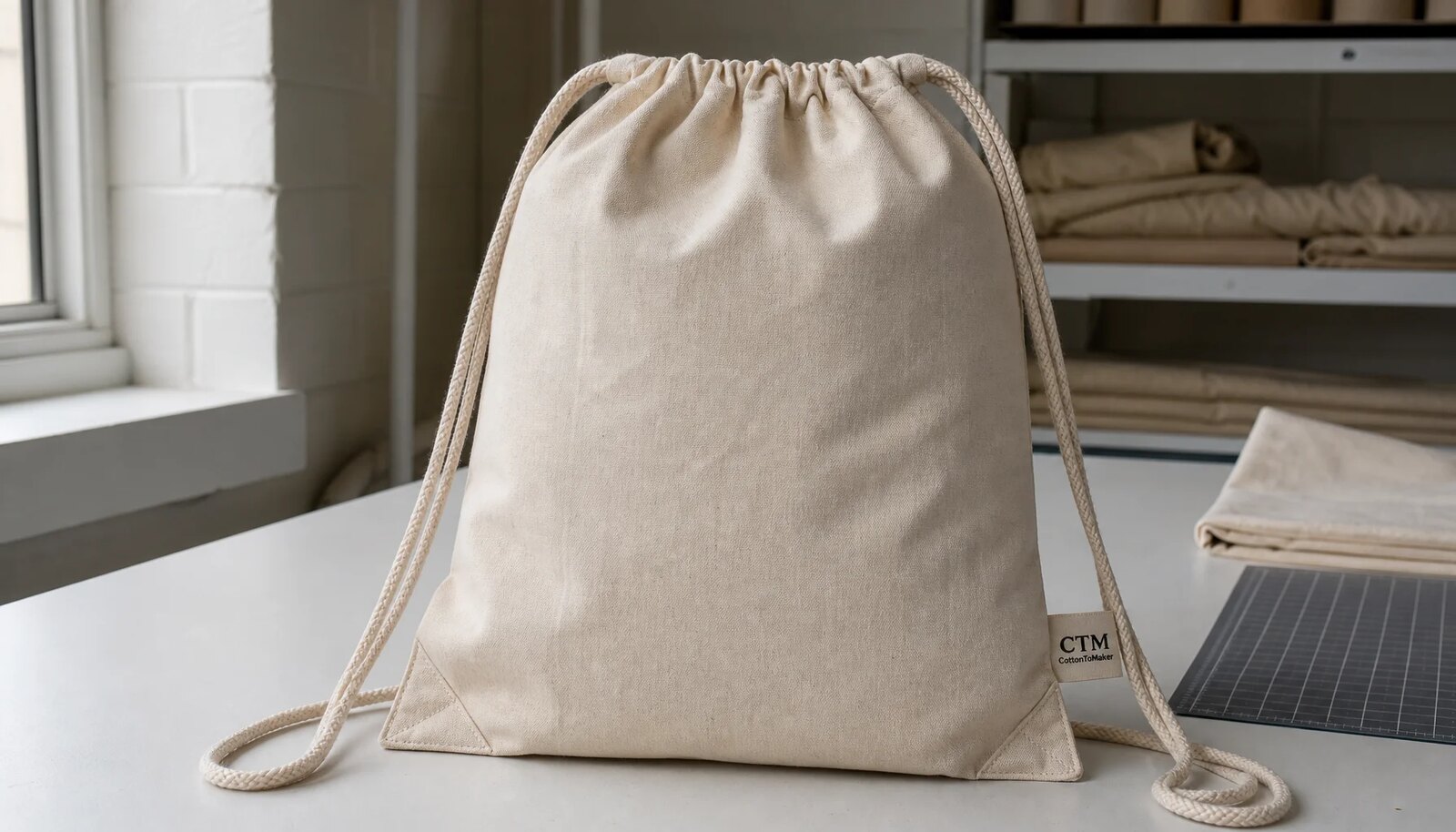
Start With the Market Job
A cotton drawstring backpack for farmers market vendors has to do more than hold a logo. It may be handed to shoppers at an opening weekend, sold as reusable market merchandise, packed into a vendor welcome kit, or used by stall teams to carry supplies between booths. Those jobs sound similar in a catalog, but they need different construction. A leaflet giveaway can be lighter. A paid retail bag should feel sturdier in the hand, hang neatly, and survive repeated folding. A bag expected to carry jars, produce, or packaged foods needs stronger stress points and a cord that is comfortable enough to pull all day.
Procurement should describe the intended use before asking for price. Tell the supplier what will go inside the bag, how it will be displayed, and how it will reach vendors. A bag stacked on a booth table needs clean folds and good front-panel presentation. A bag hung by its cords needs balanced cord length and reinforced exits. A bag distributed by carton to dozens of stalls needs clear carton marks and reliable count control. When the use case is vague, suppliers often quote the closest low-cost blank, then leave buyers to discover the mismatch during receiving.
The most useful cotton drawstring backpacks quality inspection checklist for farmers market vendors starts with language that can be checked later. Instead of asking for a natural cotton drawstring backpack with logo, write the target load, display method, fabric range, cord type, logo method, and acceptable tolerance. This gives the factory a real production target. It also keeps quote comparisons honest, because a supplier cannot quietly remove reinforcement, reduce fabric weight, or pack the bags too tightly without creating a visible difference from the approved spec.
- Define the role: giveaway, resale item, vendor supply bag, loyalty reward, market kit, or produce carry bag.
- State the expected load, such as brochures, light produce, jars, packaged foods, apparel, or mixed purchases.
- Describe display and distribution: folded stacks, hanging rack, booth bundles, association cartons, or vendor-specific kits.
- Decide whether the program values lowest unit cost, sturdier hand feel, retail presentation, faster replenishment, or lower defect risk.
- Put these decisions in the RFQ before asking suppliers to quote.
Make Fabric a Measured Spec
Fabric is where many similar-looking quotes split into different products. For farmers market programs, 140-180 GSM cotton is a practical buying range. A 140-160 GSM plain weave can be acceptable for short promotions, light samples, and simple one-color branding. A 160-180 GSM fabric gives the bag more body and a better feel, which matters when vendors sell the bag or when shoppers carry produce, jars, flowers, baked goods, or several small purchases. Heavier fabric can be useful, but it also increases unit cost, carton weight, freight volume, and sometimes shrink or drying concerns.
GSM is only one part of the fabric decision. Weave, yarn quality, finish, and color process all influence the finished bag. A loose weave may feel soft but can distort around print edges or seams. A tighter plain weave or light canvas usually holds shape better and gives cleaner logo results. Natural cotton may vary from cream to beige between lots. Dyed cotton adds color matching and crocking risk. Bleached cotton can look crisp, but it also shows dirt, oil, and carton marks quickly. A physical swatch, labeled and kept with the purchase order, is more useful than a catalog sentence.
Shrinkage should be discussed even when the bag is not sold as washable. Customers may wash reusable cotton bags. Vendors may wipe them down, steam wrinkles, or store them in damp outdoor conditions. If the fabric shrinks too much, the finished dimensions change, the opening may tighten, and the logo can pucker. Ask whether the fabric is pre-shrunk, what shrink test data exists, and what tolerance the factory recommends. Procurement does not need to over-engineer a simple bag; it needs the delivered material to match the sample that was approved.
- Use 140-160 GSM for light-duty promotional use and short campaign windows.
- Use 160-180 GSM for paid resale, heavier market purchases, better drape, and stronger perceived value.
- Request swatches labeled with GSM, weave, color reference, finish, supplier lot, and date.
- Ask how the factory prevents shade mixing when natural or dyed cotton is pulled from multiple fabric rolls.
- Include shrinkage expectations if bags may be washed, steamed, stored in humidity, or displayed outdoors.
Engineer the Stress Points
Drawstring backpacks tend to fail in the same places: cord exits, top hem channels, bottom corners, side seams, and points where the cord rubs against fabric. Farmers market use makes those weak areas show up faster. Shoppers may load one side with jars and the other with greens. Vendors may pull the opening hundreds of times during a weekend. Bags may be hung from hooks, packed into cartons, dragged across tables, or reused after the first visit. A flat sample can look fine and still fail once the cord starts sawing into a weak channel.
The construction spec should be exact enough for a sewing line and an inspector. Include finished size, top hem depth, seam allowance, stitch type, stitch density, cord diameter, bottom corner design, and reinforcement method. A 4-5 mm cotton cord or braided rope usually feels more substantial than a thin string and is easier to grip. The channel still needs enough space for smooth movement. If the top hem is narrow, overstitched, or misaligned, the bag will bunch when opened and frustrate users even if the fabric itself is acceptable.
Small finishing details are part of strength. Loose internal threads can catch on packaged goods. Rough cord ends may fray inside cartons. Uneven cord lengths make the backpack hang badly and look cheap. Needle damage around dense stitch areas can turn into tears under load. The buyer should not treat these as cosmetic extras. They are early signals of whether the production line understood the bag as a working item or only as a promotional blank.
- Specify cord material, cord diameter, cord color, end finish, and acceptable left-right length tolerance.
- Require reinforcement at cord exits, bottom corners, and high-stress seam intersections.
- Measure top hem depth and confirm the cord slides without jamming, bunching, or excessive drag.
- Inspect inside seams for open sections, loose thread clusters, skipped stitches, and poor trimming.
- Load-test a sample using realistic market items, then recheck corners, cord exits, seams, and logo area.
Match Branding to Wear
Branding is usually why the order exists, but decoration should be chosen for the way the bag will be handled. Screen printing is often the best fit for cotton drawstring backpacks when artwork is bold, colors are limited, and the order quantity supports setup. It gives strong visibility and repeatable placement. For farmers market vendors, a clean one- or two-color mark often performs better than a complex design because it is easier to print on textured cotton and easier to judge during bulk inspection.
Woven labels and sewn patches work when the buyer wants a more durable identity detail or a cleaner front panel. They are also useful when one common bag body serves several vendor groups with different small identity elements. Inspection changes in that case. Instead of checking only ink opacity and registration, the buyer must check spelling, label size, orientation, placement, edge finish, thread color, and stitch density. A crooked or poorly sewn label can make a good cotton bag look careless.
Heat transfer and embroidery can be right for some programs, but they deserve a proof on the actual fabric. Heat transfer can handle fine details, yet it may show gloss mismatch, edge lift, or cracking if the film and heat settings are not matched to cotton. Embroidery can look premium on heavier fabric, but it may distort soft panels or leave backing on the inside. Whatever method is chosen, inspect after folding and rubbing. A logo that only looks good while perfectly flat has not been tested for a market booth.
- Use screen print for bold artwork, limited colors, strong visibility, and efficient bulk production.
- Use woven labels or patches when abrasion resistance, small branding, or a cleaner front panel matters.
- Set placement tolerance from fixed reference points, such as top seam and side seam, rather than by eye.
- Approve artwork version, color target, ink finish, label size, thread color, and orientation before production.
- Fold, rub, and lightly load the decorated sample before approving bulk production.
Turn Samples Into Standards
The sample stage is not a formality. It is where the buyer turns the RFQ into a physical standard. A useful pre-production sample should show the actual fabric, finished dimensions, cord type, reinforcement, print or label method, fold style, and packing approach. If the factory cannot reach the written spec in sample form, bulk production is unlikely to correct itself without clear notes and a second approval round.
Measure the sample. Record finished width and height, top hem depth, cord length on both sides, logo position from the top and side edges, label dimensions, and visible seam details. Photograph the front panel, cord exits, bottom corners, inside seams, and packing fold. If revisions are needed, name them clearly: first sample, revised sample, approved sample. Confusion between sample versions is one of the easiest ways for an otherwise simple order to drift.
A practical sample test takes little time. Open and close the bag 20-30 times. Load it with the kind of items vendors expect shoppers to carry. Hang it by the cords. Check whether the channel jams, corners pucker, cords fray, seams open, or print cracks across fold lines. These checks are simple, but they catch weaknesses before fabric is cut and cartons are booked. Keep one approved physical sample as the golden sample, then make sure the factory and inspector know which version controls production.
- Approve a physical sample when fabric feel, cord function, logo quality, or display appearance matters.
- Record measurements for finished size, top hem, cord length, print position, label position, and fold method.
- Keep one signed or clearly identified approved sample as the production reference.
- Test repeated opening and closing before approving the sample.
- Document every correction in writing before allowing bulk material purchase or cutting.
Write Defect Rules Early
Final inspection goes better when defect rules are written before the factory starts production. For cotton drawstring backpacks, the defects that matter most are functional failures, visible brand mistakes, contamination, wrong materials, and packing errors. A broken bartack, open seam, missing cord, wrong logo, severe stain, mold odor, or incorrect carton mix should not become a debate at shipment time. These problems affect usability, saleability, or brand presentation.
AQL can be helpful, especially for larger orders, but AQL is only a sampling method. It does not define quality by itself. The checklist has to say what inspectors should look for. Stitching quality is too broad. No skipped stitches longer than the approved limit at cord exits, side seams, and bottom corners is more useful. Logo looks clean is subjective. Correct artwork version, centered within tolerance, no smearing, no major opacity gaps, and no transfer marks after folding is inspectable.
Separate critical, major, and minor defects. Critical defects may include sharp foreign objects, mold, unsafe contamination, or completely wrong product. Major defects may include open seams, broken reinforcement, nonfunctional cords, wrong artwork, size outside tolerance, severe stains, or major print failure. Minor defects may include small trim threads, light creasing, or acceptable natural slubs if the bag remains clean, usable, and saleable. This classification gives the supplier a fair target and gives procurement a consistent basis for release decisions.
- Classify mold, contamination, unsafe foreign objects, and completely wrong product as critical defects.
- Classify open seams, broken reinforcement, missing cords, wrong artwork, wrong size, and severe stains as major defects.
- Define minor defects carefully so small thread or crease issues do not hide functional problems.
- Inspect random cartons from different parts of the shipment, not only factory-selected top cartons.
- Require defect photos with carton, SKU, and batch reference whenever possible.
Inspect Packing as Product
Packing can ruin an otherwise acceptable cotton bag. Drawstring backpacks absorb odor, dust, moisture, and pressure marks. If cartons are packed too tightly, cords can press into the printed panel or leave dents in the top hem. If cartons are too loose, bags shift, rub, and arrive wrinkled or dirty. For farmers market vendors, presentation matters because the bag may go straight from the carton to a booth table.
Specify the fold method, bundle count, carton count, and carton marks. A consistent fold helps vendors stack or display the bags quickly. Bulk packing can be efficient and reduce unnecessary material, but it still needs clean bundling and moisture control. If paper bands, hangtags, SKU stickers, or vendor-specific bundles are required, show where they go. A hangtag that covers the logo or tangles in the cord creates extra labor at receiving.
Carton details also affect landed cost. Ask for pieces per carton, carton dimensions, gross weight, net weight, outer carton material, carton marks, and pallet requirements. If the order includes multiple logo versions or fabric colors, define whether cartons can be mixed and how the mix will be labeled. Receiving errors often start with vague packing instructions, not with sewing mistakes. Treat packing as part of the product specification, because that is how the customer first sees the bag.
- Specify fold direction, bundle quantity, pieces per carton, carton dimensions, gross weight, net weight, and carton marks.
- Avoid fold lines or cord pressure directly across printed logos when display quality matters.
- Confirm bulk packing, paper bands, hangtags, individual bags, SKU labels, or vendor-specific bundles before production.
- Use moisture protection when transit route, season, warehouse storage, or outdoor delivery creates humidity risk.
- Check carton count, SKU mix, and packing list accuracy during final inspection.
Clarify MOQ and Cost Drivers
MOQ is rarely about the bag shape alone. Fabric roll minimums, dye lots, print screens, label production, cord sourcing, cutting efficiency, labor setup, and carton packing can each create their own minimum. A supplier may quote 1,000 pieces for a natural cotton bag with a one-color screen print. The same supplier may need a higher quantity if the buyer requests custom dyed fabric, several logo versions, special cord colors, woven labels, hangtags, or separate vendor packs.
For many custom cotton drawstring backpack orders, a practical production range starts around 1,000-3,000 pieces, depending on the supplier and specification. The important question is what the MOQ attaches to. Is it per color, per artwork, per label, per size, per cord color, or total combined quantity? Four colors at 500 pieces each may not meet a 2,000-piece MOQ if the minimum is per fabric color. Ten vendor logos may create ten screen setups even when the bag body is the same.
Ask for a quote that separates the cost drivers. Break out the blank bag, decoration, setup charges, label or patch cost, cord upgrades, sample fees, packing upgrades, inspection support, and freight basis. This helps procurement see whether a low quote is genuinely efficient or simply thinner in construction. It also makes compromise easier. One fabric color with different woven labels may be more manageable than several dyed bag bodies. A simpler print may free budget for better fabric. The best price is the one that protects usable quality and timing, not just the lowest number in a spreadsheet.
- Ask whether MOQ is per fabric color, size, logo version, label version, cord color, packing format, or total order.
- Request price breaks at realistic volumes such as 1,000, 2,500, 5,000, and 10,000 pieces when relevant.
- Separate bag body cost from print, setup, label, cord, packing, sampling, inspection, and freight assumptions.
- Compare custom production with stock-bag decoration when timing is tight or volume is small.
- Calculate landed cost by accepted usable unit, not only quoted unit price.
Control Lead Time Inputs
The sewing time for a basic drawstring backpack is not always the bottleneck. Delays often come from fabric availability, color approval, artwork proofing, screen making, label production, strike-offs, sample revisions, carton planning, inspection scheduling, and shipment booking. A supplier who gives one broad lead time without naming these inputs may be skipping the parts that actually create schedule risk.
Ask for a timeline that starts from the real trigger point. Is lead time counted from deposit, final artwork approval, sample approval, fabric approval, or receipt of labels? Those dates are not interchangeable. If a buyer changes logo size, print color, label placement, SKU mix, or packing allocation after sample approval, the factory may need new screens, new proofs, or revised packing instructions. Custom dyed fabric and special cords can also add outside supplier delays.
Farmers market programs often have fixed windows: opening weekends, harvest promotions, holiday markets, vendor onboarding, and community events. A late bag may still be physically usable, but its campaign value drops quickly. Build in time for sample correction and final inspection, especially for a first order with a new factory. For repeat orders, keep the approved sample, artwork files, color references, packing photos, and inspection report. Good records shorten the next production run because the factory is not recreating the order from memory.
- Break lead time into artwork proof, material sourcing, sample approval, bulk production, decoration, packing, inspection, and shipment.
- Ask which materials are stock and which require new purchase, dyeing, label production, or special sourcing.
- Require written approval for fabric, cord, label, print, carton, or packing substitutions.
- Add extra time for first orders because sample revisions and factory calibration are more likely.
- Keep approved samples and inspection notes for repeat orders so reorders start from a controlled standard.
Compare Suppliers by Landed Risk
The lowest unit price is not always the lowest-cost sourcing choice. A cheaper cotton drawstring backpack may use lighter fabric, weaker cord, fewer reinforcement stitches, unstable print, or tighter carton packing. Those savings can show up later as vendor complaints, rework, replacement shipments, receiving labor, missed event dates, or bags that cannot be sold at the expected price. Procurement should compare suppliers by landed risk: the cost of receiving usable, correctly branded bags on time and in the agreed condition.
Different supplier routes can work, but they carry different controls. A direct cut-and-sew factory is useful when the buyer needs repeatable construction, custom fabric, controlled reinforcement, integrated printing, and consistent packing. A trading company can help when a program includes several related products and the buyer needs coordination. A local decorator using imported blanks can support urgent small runs, but the buyer should understand that bag-body quality and decoration quality are controlled by different parties. The right route depends on control needs, timing, and defect tolerance.
A strong supplier quote makes inspection easier. It names the fabric, construction, cord, reinforcement, decoration method, MOQ logic, sample process, packing plan, lead time, and shipping terms. It also answers tolerance questions without treating them as unusual. If a supplier offers only beauty photos, avoids fabric details, or cannot explain how defects are handled, the buyer should treat the low price carefully. For farmers market vendors, the goal is straightforward: clean bags, smooth cords, correct branding, strong seams, accurate cartons, and an order that is easy to distribute.
- Compare landed cost by order, carton, and accepted usable unit.
- Include setup charges, inspection cost, freight, duty, receiving labor, defect replacement, and delay exposure.
- Choose the supplier route based on control needs, timing, SKU complexity, and inspection support.
- Ask for production photos, packing photos, and inspection records before balance payment or shipment release.
- Keep a backup supplier or stock-bag option when the market season cannot absorb a late custom shipment.
Specification comparison for buyers
| Spec decision | Recommended option | When it fits | Buyer risk to check |
|---|---|---|---|
| Supplier route | Direct cut-and-sew factory with controlled printing, sewing, finishing, and carton packing | Seasonal market programs, association orders, repeat vendor supplies, and branded resale bags that need consistent construction | Confirm which steps are in-house, which are outsourced, and who owns correction if fabric, print, sewing, or packing fails inspection |
| Fabric weight | 140-180 GSM cotton plain weave or light canvas, selected by expected load and price position | 140-160 GSM for light giveaways; 160-180 GSM for resale, produce carry, jars, packaged foods, and stronger brand presentation | Verify GSM from bulk fabric, not only catalog copy; compare hand feel, opacity, shrinkage, and shade against the approved swatch |
| Fabric finish | Natural, dyed, or bleached cotton with controlled shrinkage, clean surface, and no strong odor | Bags handled near produce, food stalls, packaged goods, flowers, or market welcome kits | Check lint, dye streaks, oil marks, mildew odor, excessive slubs, shade variation, and shrinkage that changes finished dimensions |
| Decoration method | Screen print for simple logos; woven label or sewn patch for abrasion-resistant identity | Vendor-facing branding that must stay readable after folding, carton packing, booth display, and repeated handling | Inspect ink opacity, edge sharpness, registration, color match, label spelling, label orientation, and stitch density around patches |
| Cord construction | 4-5 mm cotton cord or braided rope with even left-right length and clean cut ends | Backpacks opened and closed all day by vendors and shoppers carrying mixed purchases | Check fraying, cord twist, rough ends, uneven pulls, tight channels, weak knots, and any cord color transfer onto light cotton |
| Reinforcement | Bartacks or dense reinforcement at cord exits, bottom corners, top hem stress points, and side seam intersections | Orders intended for real carry use, not only flat display or leaflet distribution | Reject skipped bartacks, weak single-pass corners, loose tension, seam puckering, needle damage, and reinforcement that misses the stress point |
| MOQ route | Custom production around 1,000-3,000 pcs when specs are stable, with MOQ separated by color, artwork, label, cord, and packing | Market associations, multi-vendor launches, seasonal promotions, and repeat private-label inventory | Clarify whether MOQ is per SKU, fabric lot, logo version, label version, cord color, or total combined quantity before comparing prices |
| Sample approval | Physical pre-production sample approved for fabric, size, cord, print, reinforcement, labels, and fold method | Any order where hand feel, logo placement, cord function, or retail presentation matters | Do not approve by photo alone; record measurements, tolerances, revision number, artwork file, approval date, and signed sample location |
| Packing method | Controlled bulk carton packing with consistent folds, clean bundles, carton lining when needed, and optional paper bands or hangtags | Orders distributed by carton to vendors or sold directly from booths without individual retail packaging | Verify carton count, SKU mix, gross weight, carton strength, moisture protection, fold marks, and whether cords press into the printed panel |
Buyer checklist before sampling
- Define the bag role first: giveaway, paid retail item, vendor supply bag, market welcome kit, produce carry bag, or association merchandise.
- State the expected load in plain terms, such as brochures only, light produce, jars and packaged foods, or mixed purchases from several stalls.
- Lock finished size, fabric GSM, weave, color, shrink expectation, cord diameter, hand feel, and target price tier before asking for final quotes.
- Ask every supplier to quote the same construction: top hem depth, seam allowance, side seam finish, bottom corner style, cord route, and reinforcement method.
- Approve a physical pre-production sample with measured width, height, top opening, cord length, seam spacing, print position, and fold method.
- Specify decoration method, artwork file version, print colors, logo placement, color tolerance, label details, and acceptable registration drift in writing.
- Classify defects as critical, major, or minor before production so shipment decisions are not negotiated carton by carton.
- Require practical pull and load checks on cords, cord exits, side seams, and bottom corners using items similar to what vendors expect shoppers to carry.
- Confirm whether MOQ applies by fabric color, bag size, logo version, label version, cord color, packing format, or total combined order.
- Separate the quote into bag body, decoration, labels, cords, accessories, packing, sample charges, setup charges, inspection assumptions, and freight basis.
Factory quote questions to send
- What exact fabric are you quoting: weave type, GSM, yarn count if available, color process, shrink behavior, and accepted tolerance?
- Will the bulk fabric come from existing stock or a new purchase, and can you reserve the same lot after sample approval?
- Is the quoted price based on direct factory production, or are printing, label sewing, cord sourcing, finishing, or carton packing outsourced?
- What is the MOQ by fabric color, finished size, logo version, label version, cord color, packing format, and total order quantity?
- Which decoration method is included, how many colors are included, what print area is assumed, and what setup or screen charges apply?
- Can you provide a print strike-off, sewn label proof, or decoration sample on the actual cotton fabric before bulk production starts?
- What reinforcement is included at cord exits, top hem, side seams, and bottom corners, and can you share close-up photos from a real sample?
- What finished size tolerance, cord length tolerance, print placement tolerance, color tolerance, and stitch quality standard will you accept in bulk?
- How will inspectors identify critical, major, and minor defects, and what correction process applies if inspection fails?
- How will the bags be folded, bundled, packed, counted per carton, and protected from moisture, dirt, odor, or transfer marks during transit?
Quality-control points to confirm
- Finished width and height stay within the purchase order tolerance, commonly plus or minus 1 cm for standard cotton drawstring backpacks unless the buyer sets another limit.
- Fabric GSM, weave, color, hand feel, opacity, and finish match the approved reference swatch and do not vary noticeably between cartons.
- Bulk fabric has no oil stains, dirt, holes, heavy slubs, dye streaks, mildew odor, foreign fibers, or contamination marks on visible panels.
- Top hem depth is consistent and wide enough for smooth cord movement without bunching, tight channels, twisted openings, or cord drag.
- Side seams and bottom seams are straight, secure, and free from skipped stitches, broken thread, loose tension, puckering, open sections, and needle damage.
- Cord exits, bottom corners, and other stress points include the approved bartacks or dense reinforcement stitching in the correct position.
- Cord diameter, color, texture, cut finish, and length match the approved sample; both sides of the drawstring pull evenly.
- Cords slide smoothly through the top channel after repeated open-close cycles and do not fray, jam, twist badly, or stain light fabric.
- Printed logos are centered to the agreed position, sharp at the edges, opaque enough to read, and within approved color and placement tolerance.
- Prints show no cracking, pinholes, smearing, ghosting, misregistration, heat marks, scorch marks, or ink transfer after normal folding and handling.