Start with the actual buying risk
A cotton drawstring backpack can be a simple event giveaway, a retail add-on, a footwear bag, a school kit item, or a branded pack shipped with apparel. Those products may look almost identical in a product photo. In production, they are different orders. Fabric weight, weave, cord quality, seam strength, logo process, packing method, and inspection level all change the cost and the defect risk.
The trouble usually starts with a vague RFQ. If the brief only says cotton drawstring backpack, the supplier has to fill in the missing details. One factory may assume light cotton and a basic cord. Another may quote heavier twill, reinforced corners, and a cleaner carton pack. Both quotes may be technically responsive, but they are not pricing the same bag.
Eco apparel brands have less room for a disposable-feeling result. The bag often becomes part of the customer's first touch with the apparel program. Thin fabric, a fuzzy logo, crooked print, loose threads, a strong odor, or cords that do not pull evenly can make a thoughtful product line feel unfinished. Procurement has to translate a simple product name into measurable standards before price comparison begins.
A useful cotton drawstring backpacks quality inspection checklist for eco apparel brands should begin at the sourcing stage, not at the final inspection table. It should define what is quoted, what is sampled, what is measured, what can vary, and what will be rejected. Final QC then becomes confirmation of an agreed product, not a debate over expectations.
- Define the use case: giveaway, retail accessory, apparel bundle, footwear bag, school kit, gym bag, or event pack.
- State the target quality tier: basic promotional, durable merch, or retail-ready accessory.
- Separate must-have specifications from optional upgrades so suppliers quote the same baseline.
- Send artwork, target finished size, cord preference, reinforcement standard, packing format, and inspection expectations with the RFQ.
Write a fabric spec that survives inspection
Fabric drives hand-feel, opacity, durability, print result, carton weight, and price. That makes it too important to describe casually. Terms such as natural cotton canvas or eco cotton bag are not precise enough for B2B buying. One supplier may use a loose 120 GSM plain weave. Another may quote a tighter 160 GSM twill or drill. Both can look acceptable in a small photo, but they will not print, sew, fold, or wear the same way.
For many apparel programs, 140-180 GSM is a practical working range. Around 120-130 GSM can be acceptable for low-cost event distribution, where the bag is not expected to carry much weight or feel retail-grade. Around 140-160 GSM often gives a better balance of price, foldability, print clarity, and opacity. Around 170-180 GSM can feel more substantial, but it may raise material cost, needle resistance, carton weight, and freight volume.
GSM needs to be checked from actual production fabric. A mill spec sheet or sales sample is useful, but it is not enough by itself. Ask how GSM is measured, whether the value is before or after finishing, and what tolerance is included in the quote. If the order depends on a tight shade match, repeat color, or exact logo appearance, approve a swatch or lab dip and keep it available for bulk comparison.
Sustainability claims should be handled with the same discipline. If the bag is described as organic cotton, recycled cotton, undyed, unbleached, plastic-reduced, or printed with water-based ink, ask what documentation is available through the supplier's normal compliance process. A material claim does not replace a construction spec. The bag still needs the right GSM, weave, shrinkage control, surface quality, and inspection criteria.
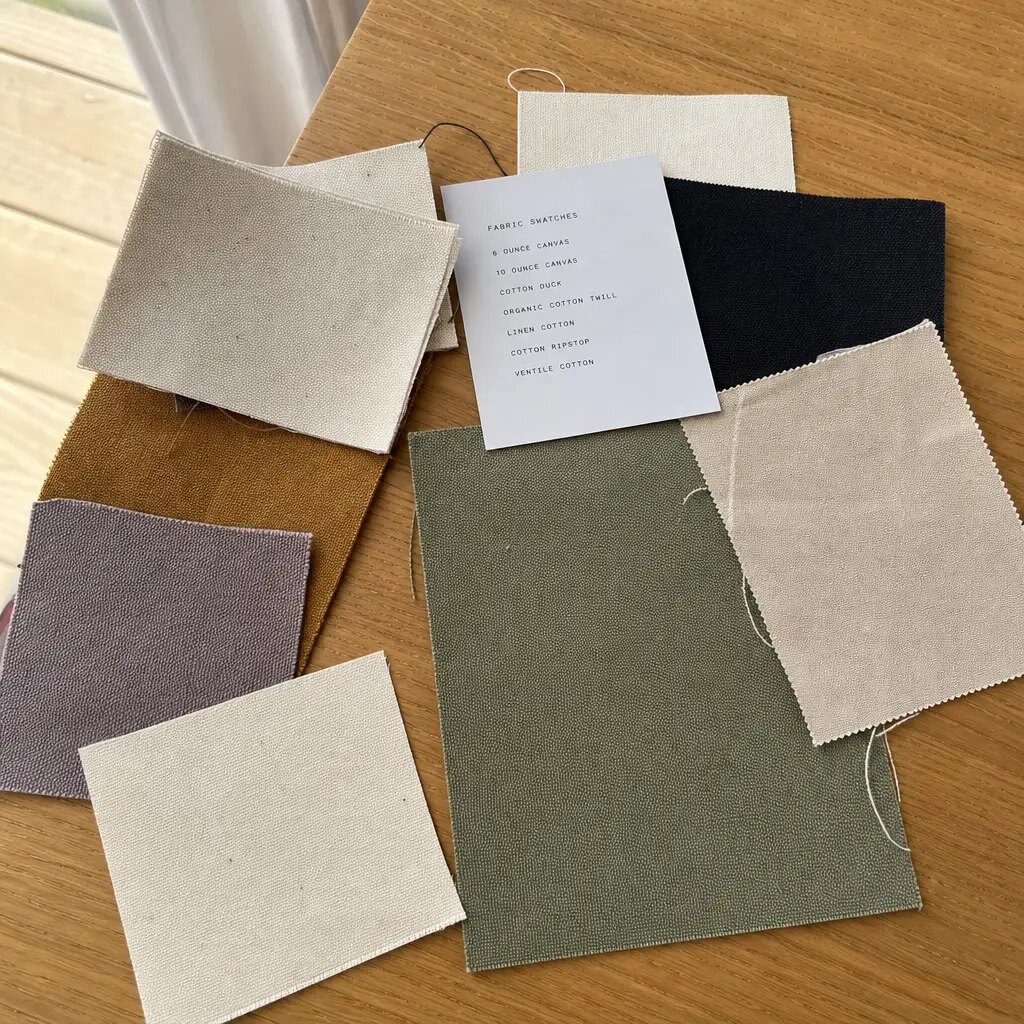
- Request fabric swatches labeled with GSM, weave, composition, color reference, finish, and supplier lot reference.
- State whether GSM is quoted before or after finishing, washing, or shrinkage control.
- Use an approved swatch, lab dip, or defined color reference for shade approval.
- Record GSM from bulk roll samples during inspection and compare it with the agreed tolerance.
- Reject holes, stains, oil marks, severe yarn faults, mixed shade panels, or slubs that distort the logo area.
Lock finished dimensions before cutting
Drawstring backpacks are easy to measure, which is exactly why measurement disputes are frustrating. Most problems come from measuring different stages of the same item. Cutting size is not finished size. Seam allowance consumes width. Cotton can shrink. Pressing changes the way the bag lies flat. Packing can compress or crease the finished piece.
The purchase order should state finished width and finished height measured after sewing and pressing. For stricter programs, also define top channel depth, bottom seam shape, cord length, logo size, logo placement, and packed dimensions. These details matter when the bag is part of a retail set, a footwear program, a warehouse slot, or an apparel bundle with insert cards and barcode labels.
Tolerances should be realistic and written in centimeters or millimeters. Avoid approximate language. A small tolerance may be fine for a soft cotton bag, but the buyer and factory must agree where to measure. Width might be measured flat across the body below the drawstring channel. Height might run from the top edge to the bottom seam. Cord length might be measured with the bag fully open or fully closed, depending on the design.
Logo placement deserves its own tolerance. A bag can be slightly larger or smaller within spec and still have a correctly placed logo if the factory uses fixed seam reference points. Visual centering alone is risky on soft goods because fabric can shift during printing, sewing, and folding. Record the approved sample measurements with photos so final inspection compares like with like.
- Specify finished width, finished height, channel depth, cord length, and logo size in the purchase order.
- Define measurement points, such as width measured flat below the drawstring channel and height from top edge to bottom seam.
- Use fixed seam references for logo placement rather than visual centering only.
- Record sample measurements with photos before bulk approval.
- Measure a sample set during final QC instead of checking only one display piece.
Engineer the predictable failure points
Most cotton drawstring backpacks fail in familiar places: the top channel, cord exit points, side seams, bottom corners, and reinforcement areas. These zones take the pulling, friction, and load. A clean front panel does not prove the bag is ready for use. Inspect the parts that users actually stress when they open, close, wear, and load the bag.
The construction spec should name stitch type, stitch density, seam allowance, thread type, thread color, bartack placement, and reinforcement method. A basic lockstitch may be enough for light promotional use. Bags expected to carry shoes, folded apparel, samples, books, bottles, or gym items need stronger bottom corners and dependable reinforcement near the cords.
Cord channels need particular attention. The channel should allow smooth movement without severe twisting, bunching, or cutting into the cotton. Cord exits should be neat and durable. If metal eyelets are used, they should be set cleanly and should not rust, crack, loosen, or cut the fabric. If the design avoids metal hardware for a softer eco look, the stitched reinforcement has to do the work that hardware would otherwise perform.
Terminology varies between factories, so the sample should show the exact construction. Do not rely only on words such as reinforced, heavy duty, or premium seam. Ask where the bartacks are placed, how the seam allowance is folded or secured, and what thread is used. Then make those points visible in the inspection brief.
- Inspect side seams for skipped stitches, broken threads, open seams, puckering, seam slippage, and uneven allowance.
- Check bottom corners under light load for distortion, stress marks, and opening seams.
- Require bartacks or reinforcement where cords pull against the bag body.
- Pull both cords repeatedly to confirm balanced length, smooth closure, and secure knots.
- Check that cord ends, knots, or tips cannot slip into the channel during normal use.
Choose logo methods with real acceptance rules
Logo quality is often the first thing a buyer, retailer, or end user notices. Cotton texture affects ink edge, coverage, and color. A logo that looks sharp in a digital mockup can bleed on a loose weave, crack if under-cured, or look crooked after the bag is folded. Approve the logo on the actual bag fabric and construction, not only on artwork files.
Screen printing is usually a strong option for simple logos, solid shapes, and repeat programs. It can be consistent when mesh, ink, curing, and placement jigs are controlled. Heat transfer or digital transfer may be better for short runs, gradients, detailed artwork, or many colors. Those methods still need checks for edge lift, adhesive overflow, cracking, scorching, registration, and hand-feel. A transfer that feels too plastic may conflict with an eco apparel brand even when the graphic is accurate.
Woven labels, patches, and side tabs can reduce ink coverage and create a quieter retail detail. They also introduce separate MOQs, setup time, placement tolerances, and sewing checks. If the label is part of the brand presentation, inspect it like the print: position, orientation, stitching, color, fraying, and consistency across the lot.
Acceptance criteria should be measurable. Define logo width and height, placement from the top seam or side seam, color matching method, acceptable deviation, and rejection points. If the approved fold crosses the artwork, check whether the fold causes hard creases, ink transfer, cracking, or surface damage after reasonable handling.
- Approve logo size, color, position, and method on a physical pre-production sample.
- Measure placement from fixed seam points, not by eye.
- Check screen prints for clean edges, solid coverage, curing, pinholes, ghosting, tackiness, and bleed.
- Check transfers for edge lift, bubbles, cracks, scorching, registration, adhesive overflow, and hand-feel.
- Keep the approved printed sample available for inline inspection and final inspection comparison.
Make supplier quotes truly comparable
The lowest unit price may simply be the least complete specification. One supplier may include 150 GSM cotton, reinforced corners, cotton cord, one-color screen print, folding, carton marks, and export cartons. Another may quote 120 GSM fabric, minimal reinforcement, a cheaper cord, bulk packing, and no carton label control. On a spreadsheet, the second quote looks attractive. In receiving, it may become the expensive one.
A strong RFQ breaks the product into cost drivers: fabric body, cutting and sewing, drawcord, logo method, label or patch, sample fee, setup fee, packing, carton, compliance documents, inland freight, and inspection support. This gives procurement useful levers. If the target cost is tight, the buyer can decide whether to adjust GSM, print size, packing, or label type instead of unknowingly losing seam strength or material quality.
Clarify what is included before deposit. Artwork revisions, screen charges, Pantone matching, woven labels, barcode stickers, special folding, and individual packing often create extra costs or time. So can packed carton photos, inspection support, or rework after failed QC. Written scope protects both sides because the supplier knows what to prepare and the buyer knows what price is actually being compared.
For eco apparel brands, product claims also need clean separation from construction. If the quote mentions organic cotton, recycled content, unbleached fabric, plastic-free packing, or water-based ink, ask exactly what paperwork is included and which standard the supplier is referencing. Broad sales wording is not enough for retailer, marketplace, or internal compliance review.
- Ask suppliers to quote the same GSM, weave, finished size, cord type, seam standard, logo method, and packing method.
- Request line-item costs for bag body, logo, label, accessory, packing, carton, sample, and setup.
- Confirm whether artwork setup, screen charges, Pantone matching, sample revisions, and barcode labels are included.
- Ask for carton dimensions, gross weight, net weight, and quantity per carton before comparing freight cost.
- Require written responsibility for subcontracted printing, labeling, packing, or inspection rework.
Treat MOQ as several minimums, not one
MOQ is rarely a single clean number. The bag body may have one minimum, fabric dyeing another, screen printing another, woven labels another, custom cords another, and special cartons another. A low advertised MOQ may apply only to stock fabric, stock cord, simple one-color print, and bulk packing. Once the buyer adds custom color, multiple logos, side labels, or retailer pack-out, the real minimum can move.
Ask how MOQ changes by fabric color, logo version, print color, label type, cord type, and packing configuration. One color at 1,500 pieces is not the same as three colors at 500 pieces each. Multi-color assortments also increase inspection work because shade control, carton labels, assortment ratios, and mixed-color prevention all need attention.
Small launch orders can still be managed well, but the structure must be honest. If the supplier uses stock fabric to reduce MOQ, ask whether that shade can be repeated later. If woven labels are ordered in a higher quantity than the first bag run, decide who stores the balance and how it will be tracked. If print screens can be kept for reorders, confirm how long and under what conditions.
The best MOQ is not always the lowest number. It is the lowest quantity that can be produced with the required material control, construction quality, packing discipline, and documentation. A smaller order that removes sampling, reinforcement, or inspection support may create more risk than it saves.
- Confirm MOQ by total quantity, per color, per logo, per label, per cord, and per packing format.
- Ask whether stock fabric reduces MOQ and whether that shade can be repeated later.
- Separate setup charges from repeat-order unit cost.
- Check whether leftover labels, cords, or print screens can support reorders.
- Avoid accepting a low MOQ that removes reinforcement, sampling, packing control, or inspection support.
Use samples to answer production questions
Samples should do more than confirm appearance. A cotton drawstring backpack can look fine in a photo while still having weak corners, short cords, shallow channels, poor fold behavior, or a logo placed too close to the drawstring. The sample process should answer material, construction, logo, and packing questions before bulk begins.
An early prototype is useful for size and shape. It should not release production unless it uses actual materials and processes. The true pre-production sample should include approved bulk fabric, final cord, final logo method, final label, final seam construction, and intended packing. If anything is substituted, the supplier should state it clearly and provide a plan for final confirmation before cutting or printing bulk goods.
Sample approval should be documented in a way an inspector can use. Measure width, height, channel depth, bottom shape, cord length, logo size, logo placement, label placement, and packed dimensions if relevant. Photograph the front, back, inside seams, top channel, cord exits, label, logo detail, and packing. A signed sample without measurements leaves too much room for interpretation.
Rejected samples are useful too. Keep photos and written correction notes. If a cord is too short, say the approved finished length. If a print is too close to the top channel, give the correct measurement point. If a seam opens under light tension, state the reinforcement change. Clear revision history prevents the same issue from returning during mass production.
- Use prototypes for early shape review only, then require a true pre-production sample before bulk.
- Approve actual fabric, actual cord, actual logo method, actual label, and final construction together.
- Mark the approved sample with date, version, supplier, style number, and buyer sign-off.
- Record measurements and placement points in the sample approval file.
- Do not release bulk from a rendering when print durability, fabric feel, or construction strength matters.
Inspect by tolerance and defect class
Inspection works better when defect classes are agreed before production. Without written tolerances, every finding becomes a negotiation. Buyers should define critical, major, and minor defects according to their receiving rules and product risk. The categories do not need to be complicated, but they need to be clear.
Critical defects may include mold, unsafe contamination, severe odor, wrong product, prohibited materials, or unsupported sustainability claims. Major defects may include wrong GSM, wrong size outside tolerance, open seams, failed cord function, incorrect logo, severe print defects, missing labels, wrong carton count, or visible stains. Minor defects may include trimmed thread tails or small cosmetic variation within the approved standard.
An AQL-style sampling plan can be useful, but the inspection level should match the order. First orders, new suppliers, new artwork methods, tight launch dates, and retailer-bound shipments deserve closer review. Inline inspection is especially helpful for drawstring backpacks because many defects repeat. If a print jig is wrong or sewing tension is poor, catching it early can prevent the whole lot from carrying the same problem.
Final inspection should combine measurement, visual review, functional checks, and packing verification. Measure finished dimensions, compare fabric shade, check seams under light tension, pull cords, inspect print adhesion, count cartons, and verify carton labels. Photos should show both acceptable units and defects, with quantities and carton references. If goods are reworked, inspect the reworked units before shipment release.
- Define critical, major, and minor defects in the purchase order or inspection brief.
- Use inline inspection for first orders, complex artwork, new print methods, or urgent launch calendars.
- Measure a sample set for finished size, logo placement, cord length, and carton count.
- Record defect photos with carton reference, quantity affected, and recommended rework action.
- Release shipment only after failed items are sorted, repaired where possible, and rechecked.
Make packing part of quality control
Packing affects freight cost, receiving speed, product presentation, and defect rate. Cotton drawstring backpacks are often flat packed because it saves space and makes counting easier. Poor folding, however, can create random creases, press marks across the logo, mixed orientations, or slow unpacking at the warehouse. Packing should be approved as part of the product.
Specify whether bags are bulk packed, individually polybagged, paper-banded, tagged, barcoded, or packed in inner cartons. If polybags are used, confirm size, warning text, ventilation holes where required, and material requirements. If the brand wants reduced-plastic packing, define the acceptable alternative and check whether it still protects against dust, moisture, and counting errors. Removing plastic is a handling decision, not just a packaging preference.
Carton rules should be finalized before bulk packing starts. Confirm pieces per inner pack, pieces per master carton, carton dimensions, gross weight, net weight, carton strength, tape method, and carton marks. Carton labels should show style, color, quantity, PO number, destination, and barcode or retailer details when required.
A good bag in the wrong carton can still create trouble. Mixed colors slow receiving. Incorrect counts affect inventory. Weak cartons can crush during freight. Missing marks can delay warehouse processing. Final QC should open random cartons, count pieces, compare the packing list, inspect folded goods, and confirm that cartons match the approved pack-out.
- Approve fold direction and confirm whether the fold crosses the logo.
- Define bulk pack, individual pack, inner carton, master carton, carton label, and pallet requirements where relevant.
- Ask for packed carton dimensions early so freight quotes use realistic volume.
- Open random cartons during inspection and count pieces against the packing list.
- Check for moisture, odor, dust, crushed cartons, weak tape, mixed colors, and incorrect carton markings.
Specification comparison for buyers
| Spec decision | Recommended B2B baseline | When it fits | Buyer risk to verify |
|---|---|---|---|
| Fabric weight | 140-180 GSM cotton twill, drill, or light canvas; agree whether tolerance is +/-5% or another written range | Eco apparel merch, retail add-ons, school programs, footwear bags, event kits, and repeat brand campaigns where opacity and hand-feel matter | A low-GSM quote can reduce unit cost while creating see-through fabric, poor print coverage, seam stress, and a product that feels too temporary for an apparel brand |
| Fabric shrinkage | Pre-shrunk or controlled-shrink cotton with the method recorded and a buyer-approved shade standard attached to the order | Printed bags, retail packs, repeat colorways, or orders where finished size and logo placement must stay consistent | Uncontrolled shrinkage can shorten the bag, twist seams, shift logo placement, and make reorders difficult to match |
| Finished size | Width, height, top channel depth, and cord length measured on finished goods after sewing and pressing; tolerance stated in cm | Bundled apparel sets, retail insert programs, warehouse slotting, and projects using insert cards, hangers, or barcode labels | Cut size is not finished size; unclear tolerances create disputes when goods arrive shorter, narrower, or unevenly packed |
| Print method | Screen print for simple repeat logos; heat or digital transfer for detailed low-MOQ artwork; woven label, patch, or side tab for quieter branding | Screen print suits repeat programs; transfers suit complex artwork; woven labels suit premium low-ink eco branding | Ink bleed, poor curing, transfer edge lift, scorching, incorrect Pantone matching, and logo placement drift on soft cotton |
| Cord system | Cotton rope, braided cord, or flat cotton cord with matched length, reinforced channel, secure knots, and smooth closure movement | Daily-use backpacks, footwear bags, gym kits, event packs, school kits, and branded apparel bundles | Cord abrasion, uneven cord length, weak knots, torn exit points, twisted channels, and cords that jam under normal pulling |
| Seams and reinforcement | Lockstitch construction with defined stitch density, seam allowance, thread type, and bartacks or reinforcement at load points | Any order expected to carry shoes, folded apparel, books, samples, bottles, or event materials | Skipped stitches, seam slippage, weak bottom corners, loose thread tails, top-channel tearing, and inconsistent sewing by line |
| Sourcing route | Factory or coordinated supplier with written ownership for sewing, printing, labeling, packing, and final QC | Best when the buyer needs traceability, sample revisions, and consistent bulk standards across reorders | If printing or packing is subcontracted, defect responsibility must be assigned before deposit and production release |
| MOQ structure | MOQ broken down by fabric color, logo version, print color, label, cord type, and packing format | Useful for small launches, multi-color assortments, private label programs, and repeat replenishment | A low bag MOQ can hide separate dyeing, print screen, woven label, accessory, or carton minimums |
| Packing method | Approved fold method, inner quantity, master carton count, carton markings, moisture controls, and barcode rules if needed | Importers managing freight cube, warehouse receiving, retail allocation, and order allocation by style or color | Bulky packing increases freight volume; mixed cartons slow receiving; folding across logos can create permanent creases or print damage |
Buyer checklist before sampling
- Confirm finished width, finished height, top channel depth, target GSM, weave type, fabric color standard, and finished-size tolerance before requesting quotes.
- Ask every supplier to quote the same construction: stitch density, seam allowance, cord type, cord length, reinforcement method, logo method, label placement, fold method, and carton quantity.
- State whether the product is a giveaway, retail accessory, footwear bag, school kit, apparel bundle, or daily-use backpack so the factory does not choose a weak default build.
- Approve one physical pre-production sample made with the actual bulk fabric, actual drawcord, actual logo process, actual label, and final seam construction.
- Measure the approved sample in width, height, channel depth, bottom seam shape, cord length, logo size, logo distance from fixed seam points, and packed dimensions if relevant.
- Define print acceptance criteria for color match, curing, placement deviation, cracking, bleeding, pinholes, ghosting, scorching, adhesive overflow, and transfer edge lift.
- Require written standards for bartack locations, bottom-corner reinforcement, thread color, thread type, thread trimming, seam allowance, and seam slippage checks.
- Ask for bulk fabric shade confirmation and GSM measurement from the actual production roll, not only a mill spec sheet or sales sample.
- Set packing rules before bulk starts: fold direction, individual polybag or plastic-free alternative, warning text if applicable, inner quantity, master carton quantity, carton marks, and barcode labels.
- Schedule inline inspection after first output from cutting, printing, and sewing so repeated stitching, placement, or cord defects can be corrected before the full lot is finished.
Factory quote questions to send
- What fabric GSM, weave type, fiber composition, shrinkage expectation, dyeing or finishing process, and GSM tolerance are included in the quoted price?
- Is the MOQ based on total bag quantity only, or are there separate MOQs for fabric color, dye lot, print color, screen setup, woven label, cord type, carton size, or individual packing?
- Which print or branding method is included, and how does the price change for extra colors, larger coverage, Pantone matching, water-based ink, transfer film, woven label, patch, or repeat artwork setup?
- What finished-size tolerances do you recommend for this style, and do you measure width and height after sewing, pressing, and packing or before those steps?
- What stitch density, seam allowance, thread type, bartack positions, and reinforcement method do you recommend for side seams, bottom corners, and cord exit points?
- Are sewing, printing, labeling, and packing done in-house or subcontracted, and who accepts cost and schedule responsibility if a print or construction defect is found during final inspection?
- Can you provide a measured pre-production sample, signed bulk fabric swatch, inline production photos, GSM measurement evidence, and one packed carton photo before shipment release?
- What checks do you perform for cord pull strength, seam slippage, stitch security, print adhesion, shade consistency, odor, carton count accuracy, and mixed-color prevention?
- What is your realistic timeline for sample making, sample revision, bulk material booking, cutting, printing, sewing, trimming, packing, inspection, rework, and shipment booking?
- If bulk goods fail inspection, what rework process, timeline, reinspection process, and cost responsibility will you accept in writing before production starts?
Quality-control points to confirm
- Bulk fabric GSM is measured from actual production rolls and recorded against the approved specification and tolerance, not judged only by touch or supplier description.
- Fabric surface is suitable for the approved logo method, without holes, stains, oil marks, excessive slubs in print areas, loose yarns, shade panels, or visible roll-to-roll variation.
- Fabric shade is checked against the approved swatch, lab dip, or Pantone reference under consistent lighting, with mixed dye lots separated where required.
- Finished bag width, height, top channel depth, bottom shape, and cord length match the approved pre-production sample within the agreed centimeter tolerance.
- Logo print or label placement is measured from fixed seam reference points and remains within the approved deviation across inspected pieces.
- Screen print has clean edges, solid coverage, proper curing, no bleeding, no pinholes in large solids, no ghosting, no tacky surface, and no color contamination.
- Heat transfer or digital transfer shows no edge lift, bubbling, cracking, scorching, adhesive overflow, poor registration, or visible misalignment after reasonable handling checks.
- Top hem, side seams, bottom corners, and cord exit areas are reinforced according to the approved sample, with no skipped stitches, broken threads, open seams, or seam slippage.
- Stitch density, seam allowance, thread color, thread tension, and trimming quality are consistent across the inspected lot and do not change by sewing line or operator.
- Drawcord length, symmetry, knot security, cord ends, and closure movement are consistent; cords do not slip, twist badly, abrade the channel, or cut into cotton during tug checks.