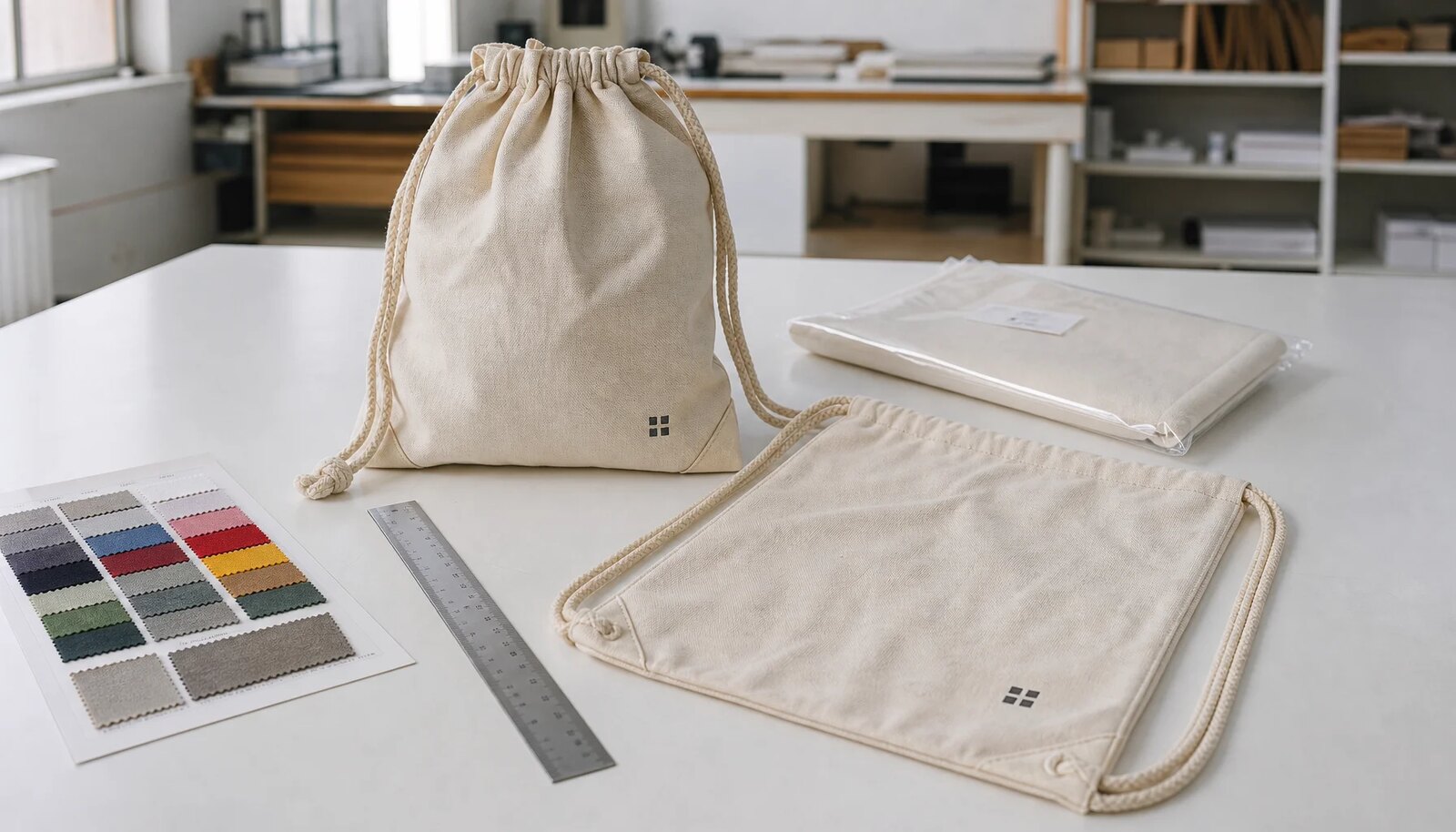
Define the Hotel Retail Use First
A cotton drawstring backpack can be a paid souvenir, spa kit, beach towel carrier, minibar bundle, conference item, or gift-with-purchase. Those uses do not require the same standard. A lobby shop product needs a cleaner face panel, better print consistency, stronger perceived value, and more controlled packing than a one-day giveaway.
Put the retail job in the RFQ before asking for price. If the supplier receives only quantity and artwork, they must guess the fabric, reinforcement, packing, and inspection level. That makes supplier comparisons unreliable because two quotes can both say cotton drawstring backpack while describing very different products.
The intended contents matter as much as the sales channel. Slippers, amenity bottles, towels, sunscreen, and guest purchases create different load and abrasion conditions. Print proofing should therefore be approved on the finished construction, not only on a flat fabric swatch.
- Paid lobby retail: prioritize sharp print, front-panel cleanliness, hangtag readiness, and shelf presentation.
- Spa or beach use: prioritize cord comfort, bottom reinforcement, seam strength, and tolerance for damp or sandy handling.
- Conference use: prioritize delivery date, artwork version control, carton sorting, and bulk distribution accuracy.
- Gift-with-purchase: prioritize perceived value, barcode accuracy, campaign consistency, and packing that supports the offer.
Choose Fabric for Feel, Print, and Load
Fabric drives cost, hand feel, print result, carton weight, and guest perception. Cotton drawstring backpacks are often quoted as 4 oz, 5 oz, 6 oz, 8 oz, or 10 oz; some factories quote only GSM. Ask for both units and confirm whether the fabric is plain weave, canvas, or another construction.
For many hotel retail programs, 6 oz cotton is a practical starting point. It feels more substantial than very light promotional fabric while keeping cost and freight controlled. For resort shops, spa retail, beach programs, and destination merchandise, 8 oz cotton canvas usually gives better body and a stronger retail feel.
Very light cotton can meet a tight unit price but may wrinkle heavily, twist at the seams, show weak opacity, or make the print look less saturated. If the backpack will be sold, displayed, or photographed as merchandise, avoid choosing fabric by lowest price alone.
- 4 to 5 oz cotton: use mainly for low-cost amenity or event programs, not premium paid retail.
- 6 oz cotton: balanced choice for moderate hotel retail, bundles, and controlled cost targets.
- 8 oz cotton canvas: stronger shelf presence, better opacity, and better support for solid logos.
- 10 oz cotton canvas: premium hand feel, but confirm sewing quality, carton bulk, and freight impact.
- Quote control: require oz, GSM, weave, finish, shrinkage expectation, and stock or custom fabric status.
Approve Shade and Cotton Character
The base fabric changes the logo result. Natural unbleached cotton gives a relaxed hotel, spa, or coastal look, but it normally includes seed flecks, warm tone, and shade variation. Bleached white cotton supports cleaner logo color but shows dirt and carton abrasion more easily. Dyed cotton can match a property palette, but it needs better shade control.
Approve the fabric before final print proofing. A beige logo on natural cotton may look refined in a render and disappear under warm lobby lighting. A bright logo on dark dyed cotton may need a white underbase, which improves opacity but adds ink thickness and cost.
Discuss natural cotton variation directly. Are flecks acceptable on the print panel? Are darker slubs allowed away from the logo? Is a warmer bulk shade acceptable if it remains within an approved range? These decisions prevent normal fabric character from becoming a shipment dispute.
- Natural cotton: approve seed flecks, shade range, and logo contrast before production.
- Bleached white cotton: add controls for dirt, handling marks, and storage discoloration.
- Dyed cotton: require lab dip, approved swatch, or shade band before cutting.
- Dark fabric: confirm underbase, opacity, hand feel, curing, and unit price impact.
- Retail lighting: judge fabric and logo contrast under the lighting where the item will be sold.
Lock Finished Size and Construction
Quote finished sewn size, not cutting panel size. The bag changes after hemming, side seams, top channel folding, cord insertion, pressing, and packing. A common reference is about 34 x 42 cm for light retail or amenity use and about 38 x 45 cm for resort or towel programs. The PO should state target size, measurement points, and tolerance.
Construction affects durability and print appearance. The top channel changes how the bag gathers and where the logo sits when closed. Bottom cord entry points carry much of the load when the guest wears the backpack. A retail program should approve the final seam construction, not a simplified prototype.
Drawcord choice also affects perceived quality. Cotton cord supports a natural product story. Polyester cord may slide more smoothly and resist moisture better. Thin cord can dig into the shoulder, while thick cord adds bulk. Metal eyelets can look finished, but they add cost and require checks for setting strength and finish consistency.
- Finished size: measure after sewing and cord insertion; define tolerance in the PO.
- Top channel: specify height, seam type, and smooth cord movement without tearing or puckering.
- Bottom corners: approve triangle reinforcement, bar tacks, double stitching, eyelets, or another stress-point method.
- Cord specification: approve material, diameter, color, finished length, knot size, and shoulder feel.
- Print clearance: keep artwork clear of seams, channels, and bottom stress points unless edge placement is intentional.
Match Print Method to Artwork
Screen printing is usually the practical bulk method for cotton drawstring backpacks with solid hotel logos, icons, property names, and short slogans. It is cost-effective at volume, but every added color increases screen setup, registration work, production time, and variation risk.
Heat transfer or digital print may fit gradients, full-color destination graphics, or complex seasonal artwork. These options solve some artwork issues but introduce other checks: hand feel, edge lifting, cracking, rub resistance, pressure marks, and carton transfer. Embroidery can work for small premium marks, but it can distort lightweight cotton when used for large front artwork.
Review artwork at final size before choosing the method. Fine lines can break on canvas, reversed text can fill in, and QR codes can become unreliable if too small or distorted by fabric texture. Ask the supplier for minimum line thickness and minimum text height on the selected cotton.
- Screen print: best for solid logos, one to four colors, repeat orders, and predictable brand graphics.
- Heat transfer: useful for complex art; proof edge durability, hand feel, cracking, and carton pressure marks.
- Digital print: consider for complex short runs; confirm color strength, fabric compatibility, and rubbing performance.
- Embroidery: reserve for small badges, initials, or premium marks rather than large front panels.
- Fine detail: sample QR codes, reversed text, small property names, and thin lines at final size.
Set Measurable Print Proof Criteria
A useful print proofing checklist for hotel retail cotton drawstring backpacks must be measurable. The supplier needs vector artwork, Pantone references, final print dimensions, placement measurements, color count, artwork code, and an approved layout drawing. For multi-property programs, each logo should have a separate artwork code.
Most print issues are cheaper to fix before bulk production: off-center logos, weak ink coverage, color drift, uneven edges, registration shift, and poor curing. A logo can look centered when the bag is flat but appear too low after the top channel gathers. Under-cured ink may feel slightly tacky and then transfer to nearby bags inside compressed cartons.
Acceptance standards should define critical, major, and minor defects. Wrong artwork, unreadable property names, unsafe components, severe stains, or major color errors are serious for retail. A small natural cotton fleck away from the logo may be minor if natural variation was approved.
- Placement: define distance from top edge and center line; ±5 mm is a common retail-sensitive starting point.
- Color: approve Pantone direction on the selected cotton and state whether a close commercial match is acceptable.
- Registration: set limits for multi-color outlines, icons, crests, and small text.
- Opacity: reject obvious pinholes, streaks, dry edges, or heavy fabric show-through in the logo.
- Curing: check tackiness, dry rub, light scratch, blocking, and transfer before carton packing.
- Legibility: confirm small text, QR codes, website lines, and destination names at final printed size.
Control Samples and Approval Versions
Sampling should move from development to production approval. A development sample confirms size, fabric hand feel, cord style, and construction concept. A print strike-off checks color direction, line quality, opacity, registration, and fabric interaction. The pre-production sample should then use nominated fabric, actual print method, actual drawcord, final reinforcement, labels, hangtags, barcode, and intended packing.
Hotel retail approvals often involve procurement, brand, retail operations, and property teams. Reduce sample rounds by sending complete artwork, Pantone references, target size, construction details, barcode rules, and packing instructions at the start. Comments should be exact: “move logo 20 mm upward” is useful; “make it more premium” is not.
Every approved sample should be traceable. Keep one reference with the factory and one with the buyer, inspection agent, or QC contact. For property-specific artwork, approve a strike-off or finished sample for each version before bulk production.
- Development sample: checks fabric weight, size, cord feel, construction, and logo scale.
- Print strike-off: checks color, line thickness, edge quality, opacity, registration, and fabric behavior.
- Pre-production sample: confirms final fabric, print, construction, labels, barcode, hangtags, and packing.
- Sample label: record date, artwork code, fabric weight, print method, revision number, and approval status.
- Reference control: inspect bulk goods against the sealed sample and written specification, not an old mockup.
Build MOQ Around Real SKU Splits
MOQ is rarely just one total quantity. The true minimum depends on fabric availability, dyeing, cutting efficiency, print setup, sewing schedule, packing format, and SKU split. A 3,000-piece order with one natural fabric, one size, one logo, and one destination is simple. The same total split across six properties, three colors, two placements, and two packing formats is a different production job.
For hotel groups, ask the supplier to separate base fabric MOQ from artwork setup. The factory may be able to buy one fabric lot and run separate screens for each property logo. That keeps shade more consistent while making artwork charges visible.
Clear MOQ structure prevents late surprises. Some quotes show a low headline MOQ and add screen fees, lab dips, small-run surcharges, packing charges, or sorting fees after sample approval. Procurement should require a quote table showing total quantity and quantity per SKU.
- Lowest-cost setup: one fabric, one color, one size, one artwork, one print method, and standard packing.
- Higher-cost setup: custom dyed fabric, multiple property logos, low quantity per design, and separate carton labels.
- Quote requirement: show MOQ by artwork, fabric color, size, print color count, packing type, label version, and destination.
- Negotiation point: combine base fabric purchasing while itemizing screens, setup, and sorting by artwork.
- Risk control: do not compare suppliers until setup, sample, packing, and carton mark charges are visible.
Plan Packing for Retail and Receiving
Packing affects cost, waste, shelf readiness, warehouse accuracy, and defect risk. Individual polybags protect cotton from dust and moisture but add material and labor. Paper bands can support a natural retail look but protect less against humidity and carton abrasion. Bulk packing is efficient for back-of-house amenity use but can create creasing, dust exposure, and counting errors for paid retail stock.
Hotel retail orders need SKU control. If the same backpack is produced for different properties, cartons should not mix artwork unless a written mixed-carton plan is approved. Carton marks should include item name, PO number, artwork code, fabric color, quantity, destination, and carton number.
Packing should match the delivery route. A direct resort shipment may need a different carton plan from a consolidated order distributed to several properties. Inner cartons can reduce picking errors but add cost and volume. Carton size and gross weight should be manageable for hotel receiving teams.
- Individual polybag: best for protection and clean retail stock, with higher material cost.
- Paper band: stronger natural presentation, with lower protection against dust and humidity.
- Bulk pack: lowest cost for amenity use, but risky for paid retail presentation and counting.
- Hangtag or barcode: approve artwork, placement, attachment, scan quality, price rules, and SKU data.
- Carton control: pack by artwork, color, size, and destination unless mixed cartons are approved in writing.
Inspect Before Shipment
Quality control should be written before the purchase order is released. For hotel retail goods, inspection should cover workmanship, measurement, print appearance, construction strength, odor, cleanliness, packing, carton marks, and quantity. An AQL plan can be used, but defect definitions still need plain language.
Measurement checks should follow the agreed method. Finished height and width should be measured flat after sewing and cord insertion. Print placement should be measured from the top edge and vertical center line on an ungathered bag. Drawcord length should be measured consistently on both sides.
Print inspection needs the approved sample, artwork file, Pantone direction, and placement drawing. Inspectors should check opacity, edge sharpness, registration, tackiness, cracking, transfer, and legibility. Packing checks should verify artwork code, color, quantity, hangtag, barcode, unit packing, carton count, and destination marking.
- Critical defects: wrong artwork, unsafe component, mildew, broken needle contamination, or non-scanning barcode.
- Major defects: severe off-center print, wrong color direction, open seam, front-panel stain, mixed cartons, or weak cord attachment.
- Minor defects: small loose threads or approved natural cotton slubs that do not affect retail presentation.
- Load check: test bottom stress points and cord pull for programs carrying towels, slippers, or retail purchases.
- Inspection records: keep photos, defect counts, measurements, barcode scans, carton checks, and sample references.
Specification comparison for buyers
| Option to compare | Best fit for hotel retail | What to ask the supplier | Procurement risk |
|---|---|---|---|
| 6 oz cotton, screen print | Amenity bundles, gift-with-purchase, conference retail, and moderate lobby shop programs where cost control matters | Confirm GSM equivalent, weave, shrinkage expectation, print area, ink opacity, and finished size tolerance | May feel too light for paid resort retail if the bag carries towels, sandals, or heavier purchases |
| 8 oz cotton canvas, screen print | Resort shops, spa retail, beach programs, destination merchandise, and repeat hotel-branded SKUs | Ask for current fabric swatch, stitch density, cord diameter, bottom reinforcement, carton weight, and sample using bulk fabric | Higher unit and freight cost than 6 oz; thick seams and dense fabric require cleaner sewing control |
| Natural unbleached cotton | Relaxed, organic, wellness, coastal, spa, or boutique hotel positioning | Approve seed flecks, base shade range, logo contrast, and whether specks are acceptable in the print panel | Logo colors can look warmer or duller than on screen; natural variation may be mistaken for defects without approval standards |
| Bleached white cotton | Clean logo color, bright retail presentation, minimalist city hotels, and high-contrast branding | Check dirt control, storage discoloration risk, packing protection, and Pantone appearance on white cotton | Shows handling marks, carton abrasion, and stains more easily than natural cotton |
| Dyed cotton | Property-color programs, seasonal retail capsules, resort zone identification, and premium visual merchandising | Request lab dip, shade band, bulk shade approval, underbase requirement, and dye lot minimum | Shade drift and dye MOQ can increase lead time, cost, and complexity across property splits |
| Screen print | Solid hotel logos, icons, slogans, one to four colors, and repeat bulk orders | Ask color count, screen charges, maximum print area, minimum line thickness, curing checks, and registration tolerance | Fine text, gradients, QR codes, and dark fabric may need extra proofing or another print method |
| Heat transfer or digital print | Full-color destination graphics, gradients, photographic art, or lower quantities with complex artwork | Proof hand feel, edge durability, cracking, rub resistance, pressure marks, and carton transfer | Can feel less integrated with cotton fabric and may show durability issues if not tested on the actual bag |
| Supplier quote by total quantity only | Simple one-property orders with one artwork, one fabric, one packing format, and one destination | Ask whether MOQ changes by artwork, color, size, packing, barcode, carton mark, and destination | A low headline MOQ can hide screen, sorting, packing, lab dip, and small-SKU charges |
| Supplier quote by SKU split | Multi-property hotel groups, seasonal launches, retail bundles, and separate delivery destinations | Provide quantity per artwork, fabric color, print method, packing type, barcode, and ship-to location | More complete upfront work, but it prevents wrong cost comparisons and late production surprises |
Buyer checklist before sampling
- Define the commercial role: paid lobby retail, spa kit, beach towel carrier, in-room amenity, conference merchandise, retail bundle, or gift-with-purchase.
- Specify finished sewn size after hemming and cord insertion; common references are about 34 x 42 cm for light use and 38 x 45 cm for resort or towel programs.
- State fabric weight in oz and GSM, weave type, finish, shrinkage expectation, approved shade, and whether natural cotton flecks are acceptable on the print face.
- Provide vector artwork with Pantone references, final print dimensions, placement from top edge and center line, color count, artwork code, and minimum line or text requirements.
- Flag proofing risks early: gradients, fine reversed text, QR codes, metallic ink, puff ink, dark fabric underbase, large ink blocks, or very small property names.
- Approve drawcord material, diameter, color, finished length, knot style, channel opening, shoulder comfort, and bottom corner reinforcement.
- Request a physical pre-production sample using nominated fabric, actual print method, actual cord, final reinforcement, labels, hangtags, barcode, and intended unit packing.
- Set measurable print criteria for placement, color direction, registration, opacity, curing, rubbing, cracking, edge sharpness, legibility, and carton transfer.
- Set sewing criteria for side seams, top channel seams, stitch density, skipped stitches, loose threads, seam allowance, stress points, and cord pull performance.
- Clarify MOQ by artwork, fabric color, size, print method, print color count, packing type, label or barcode version, and shipment destination.
Factory quote questions to send
- What exact cotton fabric weight in oz and GSM is quoted, and is the fabric plain weave, canvas, or another construction?
- Is the quoted fabric natural, bleached, or dyed, and what swatch, lab dip, shade band, or bulk approval process applies?
- What finished sewn size, top channel height, seam allowance, cord length, and measurement tolerance are included?
- Which print method is included, how many print colors are priced, what print area is allowed, and when do screen or coverage charges change?
- What minimum line thickness, reversed text height, and QR code size do you recommend for the selected fabric and print method?
- For dyed or dark cotton, is a white underbase required, and how will it affect opacity, hand feel, curing time, and price?
- Will the pre-production sample use actual bulk fabric, actual print process, approved cord, reinforcement, labels, hangtags, barcode, and packing?
- What is the MOQ per artwork, fabric color, size, print color count, packing format, label version, and destination?
- Which charges are separate from unit price: screen, setup, sampling, lab dip, packing, barcode, hangtag, inner carton, carton marking, sorting, or documentation?
- Can production cartons be packed by artwork code, property, destination, and retail SKU, and what mixed-carton rules must be confirmed in writing?
Quality-control points to confirm
- Measure finished bag size after sewing, top channel formation, and cord insertion; a practical starting tolerance is ±1 cm unless the approved spec states otherwise.
- Check print placement from the top edge and vertical center line against the approved drawing; retail-sensitive artwork often uses ±5 mm placement tolerance.
- Judge Pantone direction on the approved cotton fabric under agreed lighting, not from a monitor, email proof, or coated paper chip alone.
- Inspect ink opacity for pinholes, streaks, dry edges, fabric show-through, muddy detail, or inconsistent ink deposit on the main retail face.
- Confirm curing with dry rub, light scratch, blocking, and packing transfer checks before shipment; tacky ink can mark adjacent bags inside cartons.
- Check multi-color registration around outlines, icons, crests, small property names, and fine borders because small shifts are visible on retail merchandise.
- Verify fine text and QR codes at final printed size on the finished bag; enlarged artwork files or paper proofs are not enough.
- Inspect side seams, top channel seams, and bottom cord attachment points visually and with a reasonable pull or load check at stress points.
- Match stitch density to the approved sample or written spec; many cotton bag programs use about 8 to 10 stitches per inch depending on fabric and seam type.
- Confirm drawcord length, diameter, color, knot size, and shoulder feel against the approved sample, with no excessive loose loops or uneven draw.