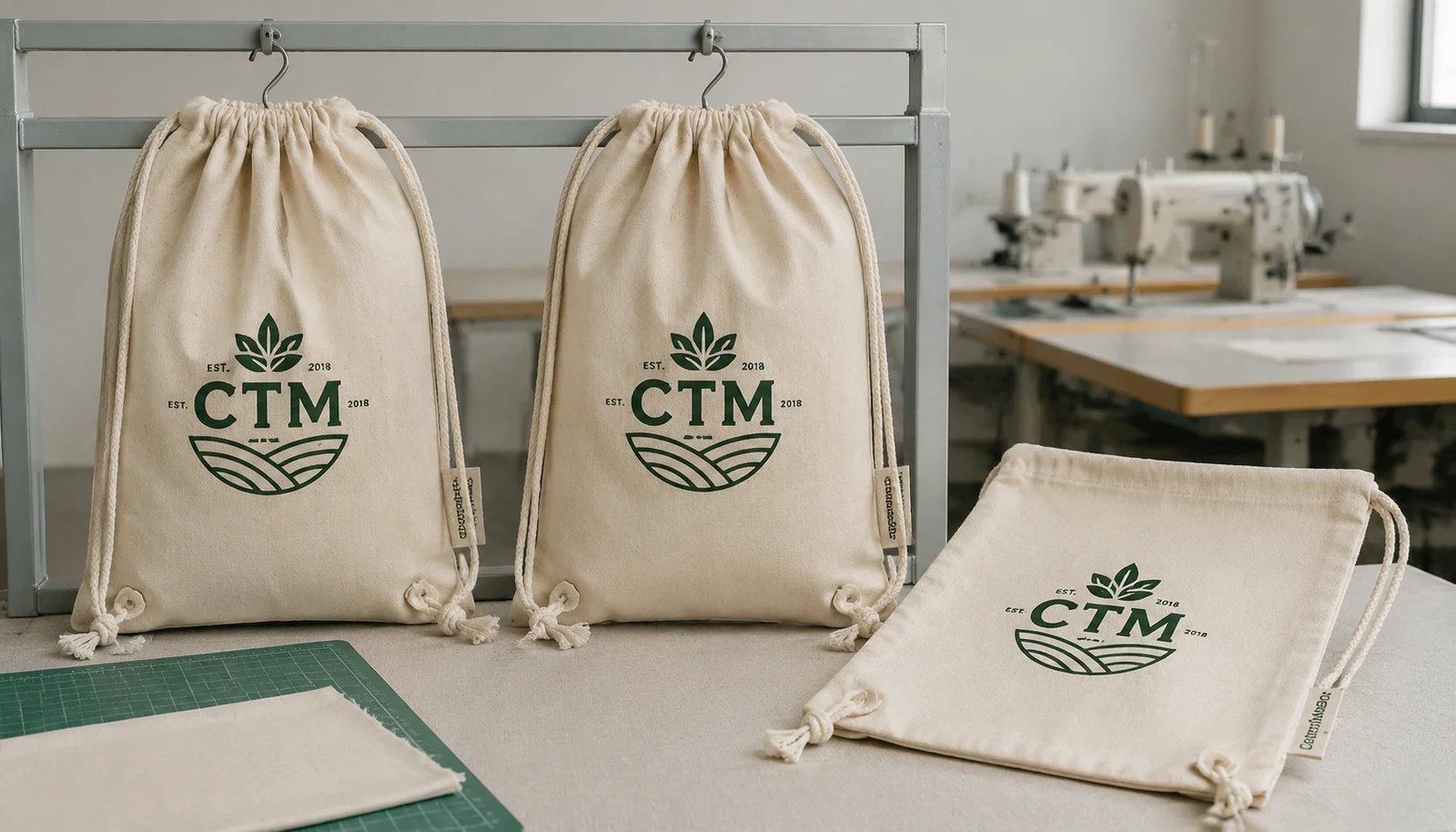
Why print proofing fails more often on cotton drawstring backpacks than buyers expect
Natural grocers usually want a clean, low-plastic look, so cotton drawstring backpacks seem straightforward. The problem is that cotton backpacks are not a flat poster surface. The print sits on a sewn product with a drawcord channel, corner stress points, and a woven surface that absorbs ink differently from smooth paper proofs. When buyers approve artwork without tying it to the actual fabric and bag construction, the finished logo can look softer, darker, off-center, or smaller than expected even when the factory followed the file supplied.
The most common failure is not dramatic misprinting. It is a stack of small misses that make the bag look lower grade at store level: natural fabric too yellow for the approved green ink, logo creeping too close to the cord channel, thin lines closing up in screen print, or the artwork appearing crooked because the side seam was used as a print reference on a slightly shifting sewn panel. For natural grocer programs where branding needs to feel honest and premium, those details matter more than on a one-time event giveaway.
- Paper proof does not predict ink absorption on textured cotton
- Natural cotton shade variation affects perceived print color
- Large front prints can distort if the panel is not stabilized before printing
- Corner cord tension can make an otherwise good bag feel cheap if reinforcement is weak
- A low quote often hides thinner fabric, smaller print size, or less sample control
Start with the right bag spec before discussing artwork
Print proofing is easier when the bag itself is stable. For most natural grocer promotions, loyalty sign-up programs, produce accessory packs, or reusable store merchandise, 8 oz to 10 oz cotton canvas is the safer starting point. In metric terms, that is roughly 270 to 340 GSM depending on weave and finish. This range gives enough body for cleaner screen printing and better shelf feel while keeping freight and unit cost under control. Very light cotton, such as 120 to 180 GSM muslin, can be used for budget packs, but buyers should expect more panel show-through, more wrinkling, and a less solid print face.
Size and construction also influence proofing. A common finished size around 35 x 40 cm works for grocery accessory use, but if the buyer wants taller bags for produce, wellness kits, or branded event packs, the printable area should still avoid the drawcord casing and side seams. Reinforced lower corners are not optional on a usable backpack. If the RFQ only says cotton drawstring bag with logo, quote comparisons become meaningless because one factory may be pricing a thin dust-bag style while another prices a proper backpack construction.
- Recommended starting spec: 8 oz to 10 oz cotton canvas, natural color, reinforced corners
- Typical size range: 35 x 40 cm to 38 x 45 cm depending on use
- Cord options: cotton rope for natural look, polyester cord for strength and color consistency
- Construction details that affect price: hem width, cord channel depth, corner patch layers, side label, inside care label
- Useful RFQ language: include size tolerance, GSM tolerance, and seam-safe print area drawing
Choose the print method by artwork behavior, not by habit
For natural grocer branding, 1-color or 2-color screen printing is usually the best commercial route. It handles simple logos, icons, and short messaging well, gives predictable unit pricing at volume, and is easier to control across repeated orders. It also suits natural cotton because a slight organic texture in the print often feels acceptable for the category. Where buyers get into trouble is using the same artwork prepared for coated paper labels or web graphics. Very fine lines, small reverse text, distressed textures, and soft gradients may not survive cleanly on cotton canvas without simplification.
Heat transfer or DTG can be useful for multi-color artwork or short runs, but they change the product feel and can add surface film or softer edge definition depending on process. For retail-facing natural grocery brands, that can either help or hurt. A transfer may achieve stronger image fidelity, but if the product is supposed to signal simple sustainability, a plasticky hand feel is a mismatch. A merchandiser should compare not only print appearance on day one but how the logo behaves after folding, packing, and normal handling.
- Screen print fits bold logos, 1 to 2 colors, and medium to high volume
- Heat transfer fits short runs or detailed multicolor art, but hand feel may be less natural
- DTG suits image-heavy art on cotton, though consistency and cost can vary by factory setup
- Fine line artwork needs minimum line thickness specified in the proof stage
- Always request a print test on the actual bulk fabric, not on a smoother substitute panel
Build a proofing workflow that catches color and placement issues early
A usable workflow has three approval stages. First, approve the bag specification and fabric swatch. Second, approve a digital artwork proof that shows final dimensions, print location, seam-safe margins, and Pantone references. Third, approve a physical pre-production sample printed on the intended fabric and bag construction. Skipping the fabric-first step is expensive because a perfect digital logo can still fail visually if printed on a warmer or hairier cotton surface than expected.
The physical sample is where commercial buyers should be strict. It should show the real print scale, not a reduced sample. Placement should be measured from defined reference points such as panel centerline and top seam below the cord casing. If the buyer only approves a photo of a sample, important faults disappear: edge roughness, ink bleed into weave gaps, strike-through on the inside face, and fabric skew. These are exactly the issues that produce claims later because they affect store presentation and resale confidence.
- Approval order: fabric swatch, digital proof, physical printed pre-production sample
- Proof file should include finished print size in mm, not percentages only
- State placement references from the sewn bag, not from cut panels unless production prints before sewing
- Request daylight and indoor light photos only as support, not as sole approval basis
- Keep signed approvals in one version-controlled file to avoid production using an older logo
How MOQ logic changes your print strategy and quote comparability
Buyers often treat MOQ as a simple number, but factories build MOQ around setup loss, print screens, fabric sourcing, and packing complexity. For cotton drawstring backpacks, the lowest workable MOQ may be possible only if you accept standard fabric, one print color, one size, and bulk packing. Once you split by multiple store banners, different slogans, or mixed pack destinations, the unit cost changes because setup hours and overrun risk increase. A quote that looks cheaper may simply assume one universal logo while another supplier priced the real assortment.
For natural grocer groups with several regional identities, a good strategy is to hold bag construction constant and split only print colorway when feasible. That allows better material efficiency while controlling branding variation. Buyers should request line-item pricing for screen setup, unit price by volume break, sample charge, and any split-pack surcharge. Without that structure, you cannot compare suppliers accurately or understand whether a lower MOQ is truly efficient or just subsidized by weaker specs.
- MOQ works best when fabric, size, and construction stay fixed
- Each additional print color or artwork version can trigger screen and handling cost
- Smaller runs usually mean higher waste percentage and wider print cost per unit
- Split delivery packing for multiple stores adds labor even if unit count is unchanged
- Request quote tiers such as 1,000 / 3,000 / 5,000 pcs with the same spec basis
Read the quote like a production document, not just a price offer
A buyer-oriented quote should tell you exactly what the factory thinks it is making. If the quotation says cotton backpack, one-color print, bulk pack, FOB, that is not enough. The missing details are often where margin disappears after approval: actual GSM, natural versus dyed fabric, one side or two side printing, print size, cord type, reinforcement patch, sample inclusion, and carton count. If those are not written into the offer, the supplier has room to choose the cheapest interpretation while still claiming compliance.
This is also where landed-cost planning begins. A heavier bag with cleaner print may cost more ex-factory but pack more densely if folded properly, or it may justify higher retail sell-through. Conversely, an oversized bag with thick cord can push carton cube and freight cost beyond what the unit price suggests. Serious importers compare quotes at the same print coverage, same packing ratio, and same approval route. Otherwise the cost discussion is fictional.
- Minimum quote fields: size, GSM, fabric type, print method, print size, color count, cord spec, packing, Incoterm
- Separate one-time charges from repeat-order costs
- Request estimated carton dimensions and net/gross weight per carton
- Clarify whether wastage allowance and spare quantity are included
- Make sure sample fees and sample freight are stated separately
Set QC thresholds for print appearance before bulk production starts
Print quality disputes usually happen because the buyer approved a concept, not a measurable standard. For cotton backpacks, you need acceptance criteria that match what can actually be controlled in textile printing. Color should be judged against an approved visual standard under consistent lighting, not against a monitor. Placement tolerance should be stated in millimeters. Minor natural specking in unbleached cotton may be acceptable, but random stains, strong shade variation, and heavy slub lines through the logo should not be.
Factories also need to know what counts as a reject. A tiny edge softness on coarse weave may be normal; a broken letter in the main logo is not. If the product will be retailed in folded stacks, interior strike-through may not matter much. If stores hang the bags open, strike-through and backside show-through may matter more. Match the QC standard to real shelf presentation, otherwise the inspection team may pass units that technically function but hurt brand perception.
- Define acceptable print color variance by approved standard sample
- Set print placement tolerance, commonly plus or minus 5 mm
- Reject criteria should include smudging, double print, missing ink, major pinholes, and logo distortion
- Define how many visible fabric specks or slubs are acceptable in the print zone
- State whether inside-face ink penetration is acceptable and to what extent
Sample approval should include use testing, not only visual sign-off
A pre-production sample is the best point to test whether the backpack behaves like merchandise instead of only a printed souvenir. Load the bag with typical grocery weight for short carry simulation, open and close the drawcord repeatedly, and fold the bag the way it will be packed. Watch what happens to the print. Some inks crack at fold lines sooner than expected, especially on thicker deposits. Some corner reinforcements hold visually but start puckering under tension, making the front print look skewed when worn.
It is also useful to test odor and handling. Certain inks or rushed drying processes leave a smell that is acceptable in a factory but not in a natural grocer retail environment. If the item will be packed for seasonal promotions, leave a folded sample bag in a polybag for several days and reopen it. This simple test can reveal blocking, offset transfer, or unwanted sticking if the print cure was incomplete.
- Load test sample with realistic everyday contents, not extreme abuse only
- Open and close cords 20 to 30 cycles to inspect corner stress and channel stitching
- Fold and pack sample as bulk will be packed to inspect print cracking or offset
- Smell test after bagging to catch curing or chemical residue issues
- Re-measure print placement after handling to see if panel skew hides earlier defects
Packing details can change both damage rate and landed cost
Packing is often treated as an afterthought, yet it directly affects print finish and inbound accuracy. For cotton drawstring backpacks, the lowest-cost route is usually bulk inner packing in fixed counts such as 25 pieces per inner bundle and 100 or 150 pieces per export carton, depending on fabric weight and size. That works if the bags are distributed centrally and do not require individual retail barcodes. However, if the natural grocer wants each unit shelf-ready or hygienically packed, individual polybagging and barcode labels may be necessary. That adds material, labor, and carton cube.
The print surface also needs protection from rubbing in transit. Freshly printed bags stacked face-to-face can transfer ink if curing is borderline or humidity is high. Interleaving is not usually required for standard one-color prints, but buyers should at least confirm curing standard and packing orientation. Carton gross weight should stay practical for warehouse handling, often below about 15 to 18 kg depending on the buyer's DC rules. This is a small detail until a distributor starts charging manual handling fees or reporting damaged cartons.
- Choose between bulk packing and individual polybag based on retail handling needs
- Confirm carton count, carton dimensions, and gross weight in the quote
- State whether barcode label goes on bag, polybag, or carton only
- Request dry, fully cured packing to prevent print offset during sea transit
- If shipping to multiple DCs, define carton marks clearly by SKU and destination
Lead time risk usually sits in approvals and materials, not in sewing
For a standard program, a realistic timeline might be 3 to 5 days for artwork setup, around 7 to 10 days for a printed pre-production sample, and about 25 to 35 days for bulk production after final approval, depending on season and order size. Sewing capacity for basic cotton backpacks is rarely the main bottleneck. Delays more often come from fabric availability, revised logos, unresolved color comments, or waiting for couriered sample sign-off. If the buyer measures lead time from deposit date instead of final approved sample date, the schedule will look safer on paper than it is in reality.
Natural grocer calendars add another layer because many programs align with store openings, Earth Month promotions, or reusable bag campaigns. Missing the date reduces value sharply. A good purchase order should therefore identify approval cutoffs: latest artwork freeze, latest swatch approval, latest sample sign-off, and latest shipping date by mode. This turns schedule risk into a managed process instead of a dispute after the vessel cutoff is missed.
- Use ex-factory date counted from final approval, not just PO issue
- Reserve extra time if buying during pre-holiday production peaks
- Fabric sourcing can delay otherwise simple backpack orders
- Courier sample transit time should be included in your internal calendar
- Put promotion launch date and latest acceptable ship date directly on the PO
Specification comparison for buyers
| Spec decision | Recommended option | When it fits | Buyer risk to check |
|---|---|---|---|
| Fabric weight | 8 oz to 10 oz cotton canvas, about 270 to 340 GSM | Best balance for grocery promotion bags that need better body than thin muslin but still fold flat | Below 200 GSM often prints through unevenly and feels too light for repeat grocery use |
| Fabric color base | Natural unbleached cotton with fabric swatch approved against print ink | Works for natural grocer positioning and lowers dye lot complexity | Natural fabric tone varies by batch, which can shift brand green, brown, or cream ink appearance |
| Print method | Pantone matched screen print, 1 to 2 colors | Most cost-effective for bold grocery logos and clean large artwork on cotton | Fine lines, distressed artwork, and halftones may fill in or break unless mesh and underbase are specified |
| Artwork size | Front panel print within 22 x 28 cm or similar safe area | Large enough for store logo visibility without entering seam distortion zones | Oversized art near side seams or drawcord channel can skew during sewing and printing |
| Cord style | Cotton rope or polyester cord with reinforced corner tabs | Suitable for daily grab-and-go use in stores, events, and loyalty programs | Low-cost thin cords can cut into fabric corners and cause early failure in transit or store use |
| Proofing route | Digital artwork proof plus one pre-production printed sample on actual fabric | Good for branded retail giveaways where print color and placement matter | Paper proofs alone do not show ink soak, fabric specks, or artwork loss on textured cotton |
| MOQ structure | Split by print colorway only if same fabric, same size, same construction | Useful for regional grocer chains with several store banners under one spec | Mixed sizes or construction changes usually restart setup cost and reduce volume efficiency |
| Packing format | Individual flat packing in polybag only if retail hygiene or barcode needs it; otherwise bulk inner packs of 25 | Controls packing cost while keeping store distribution manageable | Over-packing adds landed cost and carton cube; under-defined packing creates count errors at DC level |
| Lead time plan | 7 to 10 days for pre-production sample, 25 to 35 days bulk after approval | Typical for standard cotton backpack programs outside peak holiday congestion | If fabric or ink approval drifts, production queue can slip even when sewing capacity is available |
Buyer checklist before sampling
- Approve actual fabric swatch with GSM tolerance before artwork color approval
- State finished bag size, print area, and seam-safe margins in the RFQ drawing
- List print colors by Pantone reference and note whether acceptable visual tolerance is lab dip match or visual match
- Specify print method, mesh expectation for line art, and whether underbase is allowed on natural cotton
- Require one pre-production sample printed on bulk-intended fabric, not substitute stock
- Define acceptable print placement tolerance, for example plus or minus 5 mm from approved centerline
- Confirm drawcord material, diameter, knot style, and corner reinforcement construction
- Set fabric defects tolerance for slubs, seed marks, stains, and shade variation on natural cotton
- State packing method by unit, inner pack, carton count, barcode, and carton gross weight limit
- Lock ex-factory date from final approval, not from deposit date alone
Factory quote questions to send
- What exact fabric composition and GSM are you quoting, and what is your acceptable production tolerance?
- Is the quote based on muslin, plain weave cotton, or canvas construction, and does that change print sharpness?
- What print method is included in the price: screen print, heat transfer, DTG, or pigment print?
- How many print colors, print locations, and setup screens are included in the quote?
- What is the maximum printable area without seam distortion for this backpack size?
- Will you provide a digital proof only, or a physical pre-production sample on actual bulk fabric?
- What carton pack, carton size, and estimated GW per carton are included in your quote?
- What is the MOQ per colorway and can quantities be split if size and fabric remain the same?
- What is the lead time for sample, bulk production, and reprint if approval revisions are needed?
- What AQL level or in-house QC standard do you apply to print placement, print adhesion, and sewing defects?
Quality-control points to confirm
- Fabric GSM within agreed tolerance, commonly plus or minus 5 percent against approved swatch
- Fabric shade on natural cotton visually consistent within approved batch standard
- Print color visually aligned to approved Pantone target under standard lighting
- Print placement within agreed tolerance, commonly plus or minus 5 mm horizontally and vertically
- No major ink pinholes, smudging, ghosting, double print, or obvious mesh marks on logo areas
- No severe print strike-through or excessive hand feel cracking on folded test pieces
- Drawcord securely anchored with no skipped stitches at corner reinforcement points
- Finished size within agreed tolerance after sewing and pressing
- Carton count accurate with packing ratio matching approved packing list
- No mildew odor, oil marks, wet cartons, or mixed colorway cartons without outer identification