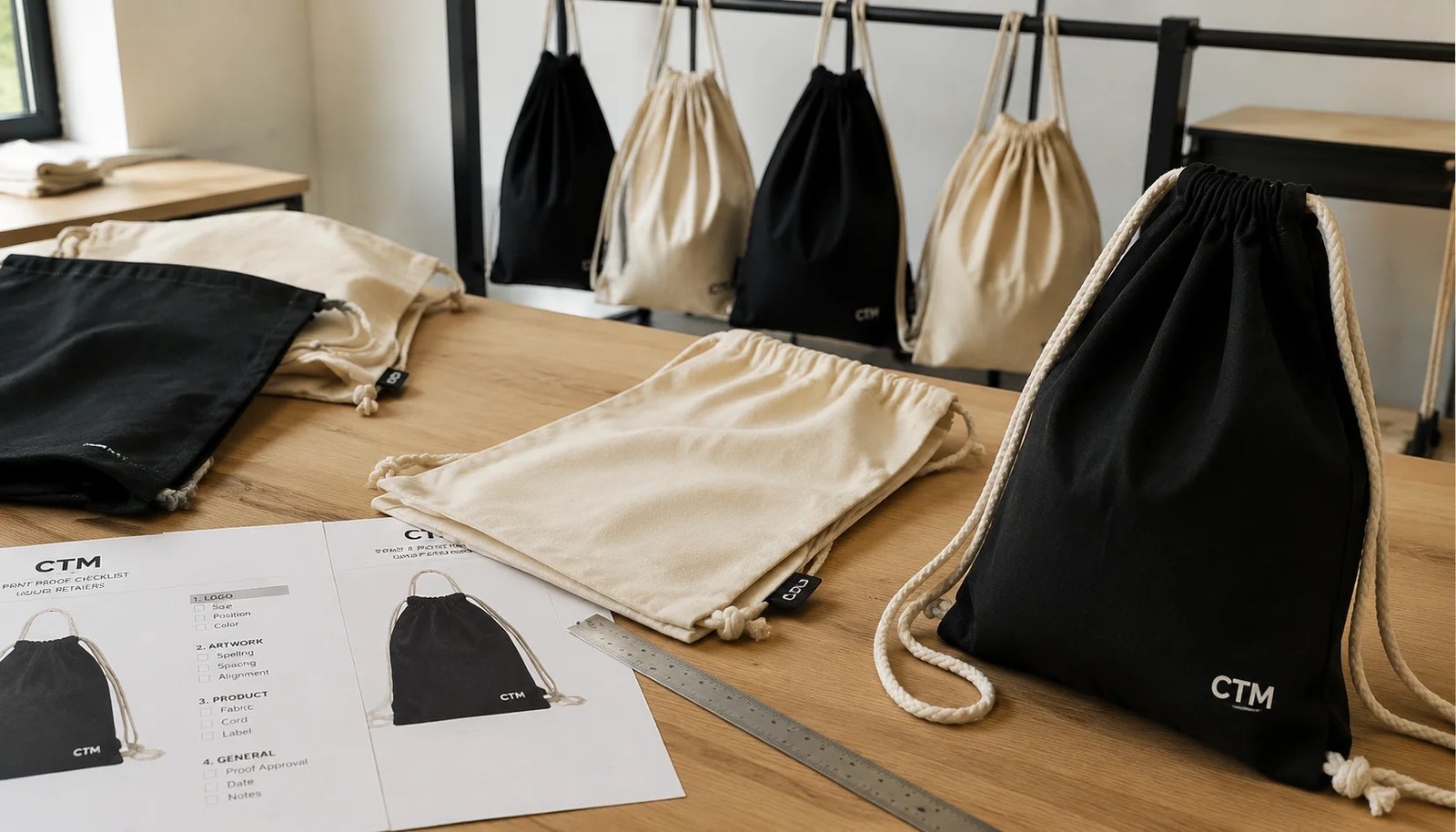
Why liquor retailers need a stricter print proofing checklist for cotton drawstring backpacks
Cotton drawstring backpacks can look simple on paper. In liquor retail, they rarely behave like a simple promo item. They may sit beside a premium bottle, carry a seasonal gift set, support a tasting event, or act as a branded add-on during a short sales window. That raises the standard immediately. Buyers are not only purchasing a bag. They are protecting shelf presentation, logo consistency, and the customer’s first physical contact with the promotion.
That is where many orders go wrong. The logo gets approved first, while the actual bag spec is still moving. Fabric weight changes. The top channel depth changes. Corner reinforcement is added later. The sample that looked centered on a flat table no longer looks centered once the sewn shape is finalized. On cotton, even the substrate changes the result: natural cloth warms the ink, lighter fabric can show more texture, and heavier canvas may print more cleanly but sew differently.
For procurement teams, the real task is repeatability. A desk sample that looks acceptable is not enough if the bulk order cannot be inspected against the same standard. The print proof should connect artwork, fabric, construction, packing, and tolerance notes into one approval path. If those pieces are approved separately, disputes become messy. The factory may follow the artwork file and still deliver a bag that feels commercially off.
A practical cotton drawstring backpacks print proofing checklist for liquor retailers should answer four plain questions. What exact bag is being bought. What exact print result is being approved. What variation is acceptable in bulk. And how the shipment will be checked before release. Once those answers are written down, quote comparison becomes clearer and claims become easier to prevent.
- Liquor retail complaints usually focus on visible issues: off-center logo, weak corners, dull ink on natural cotton, crooked hang, and print rub after transit.
- Bottle-related use creates more stress than a standard flyer giveaway, so sewing and reinforcement affect overall appearance.
- A digital mockup does not show seam skew, hem loss, panel twist, or how the bag looks once lightly loaded.
- Proofing works best when sourcing, brand, packaging, and operations all review the same approval record.
Lock the base bag specification before you approve artwork placement
If the bag specification is still open, the print proof is not really final. This is one of the most common sourcing gaps in this category. Buyers approve a layout, then the supplier adjusts GSM, cord type, or finished size to match stock availability or target cost. The artwork may still be technically correct, but the finished product is no longer the one that was visualized. For B2B procurement, the base spec should be fixed before final logo approval and attached to the RFQ, preproduction sample, and purchase order.
Start with fabric. For many giveaway programs, 140-170 GSM cotton is workable and budget-friendly. It keeps freight lower and can suit light accessories or event use. But if the bag is meant to carry a 750 ml bottle, a brochure plus gift item, or a more premium retail set, 210-250 GSM cotton canvas is usually the safer choice. It gives better body, a flatter print surface, and a more substantial feel in hand. The tradeoff is obvious: higher unit price and heavier cartons.
Then lock finished dimensions and the measurement method. A note such as 370 x 410 mm ±10 mm measured flat, excluding drawcord length, before packing removes a surprising amount of ambiguity. It also protects print scale. Small size differences can make the same logo look too large, too low, or too close to the channel. Buyers should also define net printable area after deducting top hem, side seams, and any lower corner reinforcement. Using the full front panel as the assumed print zone is a frequent mistake.
Fabric ground color needs equal clarity. Natural cotton is not interchangeable with bleached white, and neither behaves like black or navy dyed fabric. Natural cloth can vary in warmth and speck level by lot, which changes how brand color reads. If the program needs stronger brand-color control, bleached or dyed fabric is often safer. If the retailer wants a natural look, approve the substrate itself as part of the proofing record so later color discussions stay grounded in the agreed base cloth.
Finally, freeze the construction details that shape the front panel: top hem fold depth, side seam structure, corner reinforcement, and drawcord type. These are not side notes. They influence how straight the face hangs, how the logo sits visually, and how the bag performs once it carries weight.
- Typical B2B body specs include 100% cotton 150 GSM ±5% and cotton canvas 220 GSM ±5%.
- Common finished sizes include 340 x 420 mm, 370 x 410 mm, or custom dimensions based on bottle and insert requirements.
- Define net printable area separately, such as 240 x 260 mm, rather than assuming the entire panel is printable.
- State whether dimensions are measured flat, unfilled, before packing, and excluding drawcord length.
- Document drawcord material, diameter, and length because cord changes can alter the bag’s overall retail look.
Choose the print method around the real artwork, fabric behavior, and order size
Screen printing remains the standard choice for many cotton drawstring backpack orders, and for good reason. It is often the most efficient route for one- to three-color logos on medium or large runs. For store branding, event marks, and seasonal retail campaigns, it usually offers the best balance of cost and appearance. But it should still be chosen for a reason, not by default.
Cotton is a textured surface. Artwork that looks crisp in a vector file may soften once ink hits woven fabric. Fine serif lines, narrow outlines, tiny legal copy, and reverse spaces inside crest-style logos are especially vulnerable. Lower-GSM cotton tends to absorb ink less evenly and reveal more weave texture, while heavier canvas generally supports better edge definition. Buyers should ask the factory to confirm minimum printable line width and minimum reverse text gap for the chosen fabric and method before screens are made.
Transfer-based methods such as DTF or heat transfer can be useful when the order includes many colors, gradients, or lower-volume regional versions. They can also simplify short-run sample making. Still, they change the finished look. The print area may feel heavier, film edges may be visible, and the overall effect can differ from a natural cotton merchandising concept. That difference is not automatically bad, but it needs to be approved intentionally.
Dark fabric brings another decision point: underbase. On black, navy, or deep green cotton, a white underbase often improves opacity and readability. It also affects hand feel, setup time, and price. If one supplier includes underbase and another does not, the quotes are not comparable. The same goes for samples. A factory sample printed without underbase can mislead the buyer about final color strength on dark cloth.
The practical rule is simple. Test the actual logo at actual size on the actual substrate. That one step reveals far more than a polished mockup. It shows edge softness, color shift, hand feel, and whether the method still suits the retail positioning of the promotion.
- Screen print generally suits spot-color logos and bulk runs.
- DTF or heat transfer can work for multicolor art or lower-volume variations, but hand feel and edge visibility differ.
- Natural and lighter-weight cotton often softens edges more than bleached heavy canvas.
- Ask the factory to state minimum line width and reverse gap in millimeters, not in vague terms.
- Confirm whether white underbase is included in both the quote and the approval sample where applicable.
Build a proof package, not just a single PDF approval
A usable proof for B2B buying is a document set, not just a screenshot of the artwork on a bag outline. At minimum, it should combine the bag specification, print method, artwork size, placement measurements, substrate reference, and tolerance notes that will later be used during inspection. Without that package, the approval can look formal while still leaving too much open to interpretation.
The digital proof should show exact logo size in millimeters, front and back view if relevant, and placement measured from fixed sewing references such as top hem seam and left side seam. It should also identify fabric color, print method, and whether a white underbase applies. If the logo sits near the top channel, side edge, or reinforced lower corner, the layout should make that clear. A centered image on a blank rectangle is not enough for a sewn textile product.
For most liquor retail programs, a physical preproduction sample is strongly recommended. It should use the same or nearest approved bulk fabric, the same print scale, and the same construction details, including cord and reinforcement. A showroom sample on smoother cloth can create false confidence because the print may look cleaner than what bulk production will actually deliver. The sample record is stronger when it includes ruler photos and close-ups of the print edge, top hem, corners, and cord exits.
One detail worth adding is the viewing condition for visual approval. A logo that looks centered on a flat table can appear too low once a bottle shape is inside the bag and the lower corners are under tension. Buyers should note whether the bag is approved flat, hanging empty, or lightly loaded with a representative item. That closes a common loophole where measurements pass but store presentation still disappoints.
Version control matters too. Every proof and sample sheet should carry a date, revision number, and approval status. That sounds administrative, but it is practical protection. It reduces the chance that the supplier prints bulk from an outdated file after comments have already been agreed elsewhere.
- A strong proof pack includes print size, placement dimensions, bag spec, fabric color, and print method.
- The preproduction sample should match bulk intent in GSM, construction, cord, and actual print scale.
- Add ruler photos and detail close-ups to create measurable evidence, not just visual impressions.
- State whether appearance is approved flat, hanging, or lightly loaded.
- Use revision numbers so artwork comments, sample changes, and bulk release stay aligned.
Write color, artwork, and tolerance standards that an inspector can actually use
A surprising number of disputes start with instructions that sound strict but cannot be measured. Phrases like match artwork exactly or keep the logo centered do not give a factory or inspector much to work with. Cotton varies. Sewing shifts dimensions. Ink reacts to the substrate. Good B2B approvals need language that is both commercially realistic and easy to check on the line, during final inspection, and on arrival at the warehouse.
Color approval begins with the fabric, not the Pantone book alone. Ink on natural cotton will not look the same as ink on bleached cloth, coated paper, or a monitor. If brand-color control matters, approve color on the intended substrate under normal daylight conditions. Pantone references still help, but the approved cloth must be part of the standard. If the buyer chooses natural cotton for aesthetic reasons, the approval should explicitly note that the base tone can warm the final ink appearance.
Artwork should also be adjusted for textile production before release. If the logo contains very fine lines, small legal copy, or narrow reverse details, ask the supplier to identify what falls below production limits. A practical note might define a minimum positive line width and a minimum reverse gap suitable for the chosen method and fabric. The exact threshold will vary by factory and artwork, but getting that recommendation in writing before setup is far better than discovering filled-in details after bulk printing starts.
Placement tolerance should be numeric. Many buyers use around ±5 mm from agreed reference points for this type of product, while print size may also carry its own tolerance. Those numbers should be reviewed alongside seam symmetry and overall bag shape, because a technically correct print can still look visually off if the sewn body is skewed.
It also helps to spell out rejectable defects rather than relying on broad statements about workmanship. Unreadable text, obvious smudging, severe ink spread, broken image areas, strong color deviation from the approved sample, visible double image, or cracked transfer film where not acceptable should all be listed clearly. The clearer the defect language, the stronger the factory self-check and the better the outside inspection result.
- Approve color on the real fabric substrate, not only against digital artwork.
- Write placement tolerance and print-size tolerance into the PO and approval sheet.
- Ask the supplier to flag artwork details below its print capability before production.
- Judge print color under consistent lighting conditions where possible.
- Separate normal fabric texture show-through from actual print defects in the acceptance standard.
Construction details shape both the print appearance and carrying performance
The print sits on a sewn bag, not on a flat board. That sounds obvious, yet construction is often reviewed too late. Uneven side seams, a twisted body panel, a puckered top channel, or weak bottom corners can make a correctly printed logo look cheap or misaligned. For liquor retailers, this matters even more because the bag may carry rigid, relatively dense contents rather than light giveaway items.
Start at the top. A double-fold top hem usually gives a cleaner look and a more stable opening than a single narrow fold. It also creates a better reference point for logo placement. If the fold depth varies too much from piece to piece, the same measured logo position may still look inconsistent across the order. That is why buyers should review hem quality itself, not just placement measurements from the top seam.
Bottom corners are the other major pressure point. If the bag may hold a bottle, gift pack, or a bottle plus inserts, the lower corners will take meaningful stress. Reinforcement options may include folded corner strengthening, patches, or bartacks at the stress area. When the corners pull unevenly under load, the front panel can distort and the logo can appear skewed. A flat inspection alone will not reveal that risk.
Drawcord quality also affects both function and perceived value. An 8-10 mm cotton rope often suits retailer gifting better than a thin synthetic cord because it feels more substantial and looks more consistent with a cotton body. But cord quality needs control just like fabric quality. Diameter, length, knotting, fray level, and colorfastness all matter. A cheaper substituted cord may still work mechanically while still lowering the retail impression.
A useful preproduction review includes close-up photos of the top hem stitching, lower corner reinforcement, and cord exits. Those details often predict complaint risk better than a full-bag hero shot because they show whether the product can hold shape and stay presentable in real use.
- Double-fold top hem usually gives a cleaner retail finish and a more stable channel.
- Corner reinforcement should be specified if the bag will hold bottle-related weight.
- If bartacks are required, note their location and count in the product spec.
- Drawcord quality affects function and perceived value, so avoid open-ended substitution.
- Check the bag hanging empty and lightly loaded to reveal seam skew or panel twist.
Use a quote comparison sheet so suppliers are pricing the same bag
Unit price on its own tells very little in this category. Two factories can send similar-looking bag photos and very different prices because they are not quoting the same product. One may assume 150 GSM natural cotton with a simple one-color screen print. Another may assume 220 GSM dyed canvas with a white underbase and reinforced corners. Unless the buyer standardizes the RFQ, the comparison is weak from the start.
Fabric is usually the biggest cost variable. A 150 GSM natural cotton bag and a 220 GSM dyed canvas bag are not interchangeable, even if the dimensions are close. Dyeing, heavier weight, and stock availability affect both unit cost and MOQ. Print cost is the next major swing factor. Screen printing may involve per-color screen setup; transfer methods shift the cost structure; and underbase on dark fabric adds complexity. Without line-item clarity, a lower quote may simply mean missing inclusions.
Construction and packing also deserve line-by-line review. Reinforced corners, bartacks, heavier cotton rope, special folding instructions, inner bundling, and print-protection orientation all add either labor or materials. Some factories include export carton markings, gross weight control, or standard QC documentation as normal practice. Others add them later as extras. If those assumptions are hidden, budget control becomes difficult.
Repeat-order terms matter too, especially for seasonal liquor promotions that may return each year. Ask whether screens can be retained, whether repeat setup charges apply, and whether the same fabric color can be reordered with stable MOQ. If the retailer expects rolling replenishment, those repeat conditions may matter almost as much as the first-order price.
The cleanest way to compare suppliers is to issue one written specification, then require every factory to confirm inclusions, exclusions, tolerances, and lead-time stages against that same document. It takes more discipline up front, but it saves time and argument later.
- Main quote drivers include GSM, fabric color, bag size, print colors, underbase, reinforcement, cord quality, and packaging.
- Always ask what is excluded: sample fees, screens, underbase, carton marks, revised artwork, or QC support.
- Heavier canvas may raise ex-factory cost moderately but freight cost more sharply at scale.
- Request both first-order and repeat-order pricing where possible.
- Use one common RFQ sheet so every supplier quotes the same basis.
Follow a practical approval workflow: digital proof, preproduction sample, then bulk-start release
A structured sample workflow is one of the best controls available for cotton drawstring backpack sourcing. It keeps comments organized and prevents approval drift. A simple and effective sequence is digital proof approval first, physical preproduction sample approval second, and final bulk-start release only after all open comments are closed.
The digital proof stage is where geometry and information should be corrected. Check artwork size, placement from fixed references, print method notes, underbase notes if relevant, and the underlying bag specification. This is the right time to catch logos that sit too close to the channel, art that ignores seam loss, or dimensions that do not suit the intended bottle use. It is not the stage to treat color and fabric texture as fully approved.
The preproduction sample is where commercial risk gets tested in real life. Measure bag dimensions, print width and height, and placement from the approved references. Then review the bag flat, hanging empty, and lightly loaded with a representative object. If the intended use is one 750 ml bottle, test that condition or something similar. It quickly reveals front-panel twist, visual drop in the logo position, and whether corners and cord exits feel strong enough.
A simple buyer-side rub check can also be useful at this point. Fold the printed area against another cotton surface and apply moderate pressure by hand. This does not replace process validation, but it can expose obvious curing or heavy-ink issues before bulk starts. For larger or more brand-sensitive orders, buyers may also request first-off bulk photos or a short approval video before the full print quantity proceeds.
All comments should be closed on a single approval sheet with dates, revision numbers, and named sign-off. Scattered email approvals are easy to misread later. Once the sample is approved, link that exact version to the purchase order and the inspection brief so the same standard follows the order through shipment.
- Use the digital proof to verify dimensions, placement logic, and method notes.
- Measure the physical sample rather than relying on annotation text alone.
- Review the sample hanging and lightly loaded, not only laid flat.
- Run a basic rub check to catch obvious set-off risk before bulk release.
- Freeze versions and approval dates before the factory starts full production.
Set QC and packing controls around the failures that actually generate claims
Final inspection matters, but it works best when supported by in-line controls. For this product, the common failure points are straightforward: inconsistent fabric, print defects, incorrect placement, weak construction, and transit damage caused by poor packing. Buyers should ask whether the factory checks first-off print, measures random pieces during sewing, and monitors top hem consistency, corner assembly, and cord installation during production rather than only at the end.
Print inspection should look beyond color. On cotton drawstring backpacks, typical concerns include smudging, ghost image, severe mesh marks, unreadable fine detail, exposed underbase where not approved, and edge spread that changes logo clarity. Placement should be measured from the agreed sewing references, not judged only by eye. For more brand-sensitive retail programs, first-off bulk photos with a ruler can provide a useful checkpoint before the full run continues.
Packing deserves more attention than it often receives. Many complaints show up only after transport. If printed faces are packed directly against each other before the print is fully stable, set-off, scuffing, or shiny rub marks may appear on arrival. Even when individual polybags are not wanted, risk can still be reduced through correct curing, controlled bundling, alternating fold direction, or keeping printed faces oriented outward in bundles. Those choices should be decided before the packing line starts, not improvised at the end.
Carton planning is another practical issue. Heavier canvas, cotton rope, and dense packing can push gross carton weight above comfortable warehouse handling limits. For that reason, many buyers set a carton gross weight ceiling and confirm units per carton in advance. Carton dimensions and shipping marks should also be agreed early so warehouse receiving and distribution planning stay simple.
If a third-party inspection is used, the inspection brief should mirror the same tolerances and defect criteria already approved during sampling. The closer those documents match, the less room there is for interpretation at shipment stage.
- Confirm in-line checks for first-off print, sewing balance, and finished measurements.
- Inspect placement from top hem and side seam references rather than relying only on visual judgment.
- Decide bundle orientation in advance to reduce print-to-print rubbing during storage and transit.
- Set carton gross weight and count requirements before production closes.
- Use the same approved sample and tolerance sheet for factory QC and third-party inspection.
Plan lead time from the in-store date backward, not from the factory’s sewing estimate
Lead time on printed cotton drawstring backpacks is often underestimated because buyers focus on sewing capacity while the real delays happen earlier. Artwork clarification, fabric sourcing, dye approval, sample revisions, and print scheduling often consume more time than expected. A stock natural cotton bag with a one-color screen print may move reasonably fast. A dyed canvas bag with underbase, multiple logo versions, or revised construction will not move on the same timeline.
Ask the supplier to break lead time into stages: digital proof, preproduction sample, fabric procurement or dyeing, print setup, bulk printing, sewing, packing, and readiness for inspection or handover. A single total lead-time number hides too much. Stage-level timing helps procurement explain internal dependencies and makes it easier to see how delayed approvals can push the ship date.
For seasonal liquor promotions, backward planning is essential. Start from the in-store date, then work back through domestic delivery, customs if relevant, ocean or air transit, warehouse receipt, inspection timing, ex-factory date, and sample approval. If the artwork is new, the fabric is dark, or the bag construction is customized, build in at least one correction loop on samples. That buffer is usually cheaper than trying to recover schedule with rushed production and weaker controls.
Before issuing the purchase order, close the remaining practical questions. Which approved version controls bulk. What happens if artwork changes after sample sign-off. How repeat orders will be handled. What inspection method applies. And what the corrective action path is if first-off bulk differs materially from the approved sample. These are not just legal terms. They are day-to-day sourcing controls.
A disciplined schedule turns proofing from a design task into a supply-chain milestone. That matters in liquor retail, where a delayed promotion can miss the selling window entirely, even if the bags themselves arrive in acceptable condition.
- Request lead time by stage instead of relying on one total number.
- Custom dyed fabric and dark-fabric underbase jobs usually carry more timing risk than stock natural cotton.
- Multiple logo versions can slow print setup more than many buyers expect.
- Build at least one sample correction loop into the plan for new artwork or custom construction.
- Tie the final approved sample version directly to the purchase order and inspection brief.
Specification comparison for buyers
| Spec decision | Recommended option | When it fits | Buyer risk to check |
|---|---|---|---|
| Base fabric weight | 140-170 GSM plain cotton | Promo programs, event giveaways, light accessories, lower freight budget | May feel soft or show fabric texture through print; not ideal for heavier bottle gift sets without reinforced corners |
| Heavier fabric upgrade | 210-250 GSM cotton canvas | Premium gift-with-purchase, repeat-use bags, cleaner print surface, better body | Higher unit cost and carton weight; confirm finished size tolerance after sewing on heavier fabric |
| Fabric color for print accuracy | Bleached white or Pantone-matched dyed fabric when brand color matters | Retailers with stricter logo color control or dark/light contrast requirements | Dyed lots need shade approval; dark fabrics may require white underbase and longer print setup |
| Natural cotton option | Greige/natural cotton with approved substrate swatch | Rustic, eco-style presentation and lower cost than dyed options in some markets | Base tone varies by lot; ink will read warmer and less bright than on bleached fabric |
| Print method for standard logos | Screen print, 1-3 spot colors | Most retailer logos, store campaigns, event branding, bulk orders | Fine lines, serif details, and reverse spaces can fill in if art is not production-adjusted |
| Print method for complex graphics | DTF or heat transfer for low-volume multicolor artwork | Short runs, gradients, regional artwork variants, sample visualization | Heavier hand feel, visible transfer edge, different durability profile than screen print |
| Drawcord style | 8-10 mm cotton rope, knotted ends | Better grip, more premium retail look, good match to cotton body | Cord length inconsistency, fraying, or color bleed can create appearance claims |
| Bag construction | Double-fold top hem, reinforced bottom corners, bartack at stress points where specified | Bottle-related gift packs, brochure plus accessory sets, repeat-use retail bag | Single-stitched corners and weak exits can fail under load even if flat sample looked acceptable |
| Individual packing | Bundle pack with print-protection orientation; no individual poly unless required | Bulk retail replenishment, sustainability-sensitive programs, better carton efficiency | If curing is weak or print faces rub together, scuffing or set-off can appear in transit |
Buyer checklist before sampling
- State finished bag size in millimeters or centimeters with tolerance, for example 370 x 410 mm ±10 mm, and confirm dimensions are measured flat before packing.
- Specify fabric composition and weight clearly, such as 100% cotton 150 GSM ±5% or 100% cotton canvas 220 GSM ±5%.
- Describe intended load use, for example one 750 ml bottle, bottle plus neck tag, or mixed gift set, so reinforcement can be quoted correctly.
- Define fabric ground color as natural, bleached white, black, or custom dyed shade, and require approval against a swatch or lab dip where relevant.
- State print method per artwork version: screen print, heat transfer, or DTF, rather than leaving method selection open.
- Mark the exact print area and placement from fixed sewing references, such as top hem seam and left side seam, in millimeters.
- Provide artwork in editable vector format and ask supplier to confirm minimum printable line width and minimum reverse text gap before screen making.
- Approve ink color by Pantone reference or signed physical sample, not by monitor screenshot alone.
- Decide whether a white underbase is permitted on dark fabric and note that it changes opacity, hand feel, and sometimes unit price.
- Confirm drawcord material, diameter, color, length, knot style, and whether metal tips or plastic tips are prohibited by retail policy.
Factory quote questions to send
- What exact fabric composition and GSM are included in the quote, and what bulk tolerance do you control to for fabric weight and finished size?
- Is the fabric stock natural, bleached, or custom dyed, and if dyed, what shade-approval process applies before cutting?
- Which print method are you quoting for this artwork, how many print colors are included, and is a white underbase included where applicable?
- What minimum printable line width and minimum reverse text gap do you recommend for this logo on this fabric?
- What is the net printable area after allowing for top channel, seams, bottom corner reinforcement, and panel distortion?
- What is the MOQ for this exact fabric color and print setup, and what MOQ or setup savings apply to repeat orders using the same screens or artwork?
- What sewing reinforcement is included as standard, and what is the cost impact for bartacks, corner patches, or heavier cord?
- How many calendar days are required for digital proof, preproduction sample, material preparation, bulk print, sewing, and final packing separately?
- How are units packed by bundle and carton, what are expected carton dimensions and gross weight, and how is print rubbing reduced inside the carton?
- What inspection standard do you follow for finished goods, such as AQL level and major checkpoints for print placement, color consistency, and sewing defects?
Quality-control points to confirm
- Fabric matches approved base cloth in composition, GSM tolerance, color, and hand feel; no major stains, holes, needle damage, mildew odor, or unacceptable panel shade variation.
- Finished body size is within approved tolerance, for example ±10 mm, and left-right seam balance allows the bag to hang straight.
- Net printable area and logo size match approved sample and proof sheet within agreed tolerance, commonly ±3-5 mm for print dimensions and ±5 mm for placement.
- Print position is measured from approved reference points such as top hem seam and side seam, not estimated visually only.
- Ink color is a reasonable visual match to approved sample or Pantone target on the approved substrate under normal daylight conditions.
- Print surface is free from obvious smudging, ghosting, pinholes, exposed underbase where not approved, severe mesh marks, double image, or cracked transfer film.
- Small text, counters, and reverse spaces remain legible at the approved viewing distance and are not filled in by ink spread.
- Top hem is evenly folded and sewn, drawstring channel remains open, and no skipped stitches, severe puckering, or broken threads are visible.
- Bottom corners, bartacks, and stress points match approved construction; reinforcement is secure and does not cut through the fabric.
- Drawcord diameter, length, color, and knot finish are consistent; ends are clean with no severe fraying, staining, or bleeding.