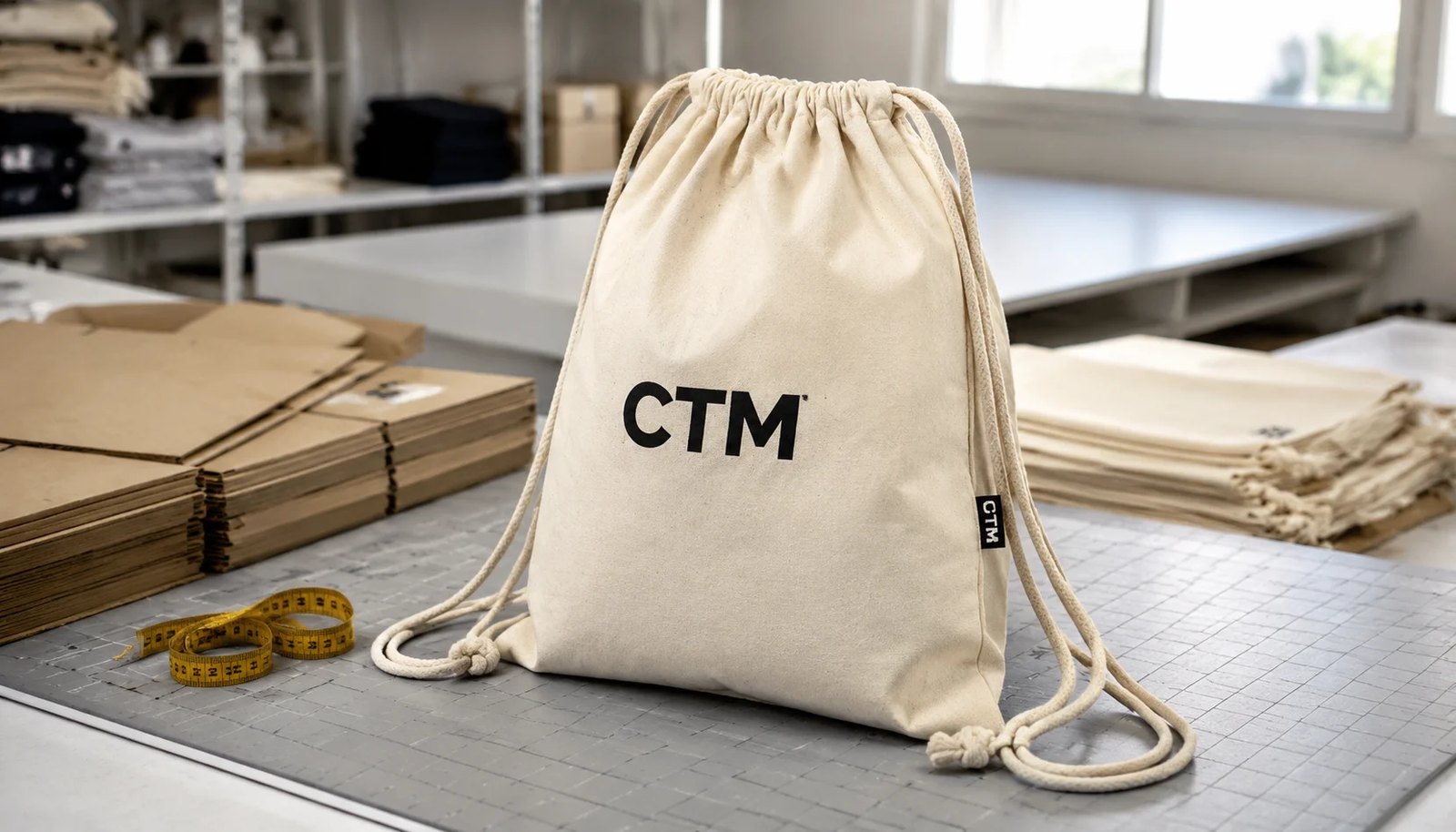
Why carton planning matters more than unit price for natural grocer programs
Cotton drawstring backpacks for natural grocers are often bought under tight promotional budgets, but the expensive mistake usually appears after the ex-factory quote is approved. A bag that is only a few cents cheaper can consume more cubic volume, load fewer pieces per carton, or create awkward cartons for store distribution. For natural grocer buyers, carton planning matters because these programs often move through a distributor warehouse, then out again to multiple stores in small allocations. The wrong pack format creates labor cost and handling complaints long after production is finished.
This product category sits between giveaway packaging and reusable retail merchandise. That means specification decisions have a direct effect on shipping density. Thicker canvas, larger bag dimensions, padded branding extras, and overprotective inner packing all increase carton size quickly. If your RFQ does not lock carton logic early, suppliers will optimize for sewing convenience or carton count assumptions that do not match your downstream warehouse. Good carton planning is not only a freight exercise; it is also a way to avoid wrinkled print, tangled cords, under-filled pallets, and store-level recounting.
- Best use of carton planning: reduce CBM per 1,000 pcs while protecting print and preventing cord tangling
- Most common hidden cost: low unit price offset by poor pieces-per-carton efficiency
- Natural grocer channel issue: store allocations often need clean inner-pack counts, not random master cartons
- Commercial rule: compare quotes by landed cost per usable packed piece, not ex-factory price alone
Start with the right bag specification before you calculate cartons
Carton planning only works when the core bag specification is stable. For cotton drawstring backpacks, begin with finished size, fabric GSM, cord type, and print area. For most natural grocer promotions, 140-180 GSM cotton sheeting is enough if the bag is intended for literature, branded produce promotions, event kits, or light goods. If the item will be sold in-store as a reusable accessory, 200-240 GSM canvas is a safer starting point because it gives better shape, improved print surface stability, and longer wear. This decision alone changes unit weight and carton count materially.
Buyers often write an RFQ around dimensions and artwork but leave fabric construction too open. That invites quotes that are not comparable. A 150 GSM plain weave cotton drawstring backpack with cotton cord packs very differently from a 220 GSM canvas version with thick braided cord. Likewise, a one-side screen print folds flatter than a two-side print with large coverage. If your team wants accurate carton assumptions, the spec must name the practical end use and the load expectation. A backpack promoted for organic snack samples and recipe cards does not need the same build as one used for bottles, heavy pantry sets, or repeated school use.
- Common spec range for promotions: 35 x 45 cm, 140-180 GSM, 1-color screen print, natural cotton cord
- Common spec range for paid retail: 35 x 45 cm or 38 x 45 cm, 200-240 GSM canvas, stronger seam reinforcement
- Cord suggestion: 8-10 mm cotton or polyester-cotton blend if consistent pull performance is more important than all-cotton feel
- Print impact: larger print areas create stiffer fold zones and can reduce efficient carton packing
How GSM and cord choices change carton density
Fabric weight is the largest technical driver of packed volume after finished size. In practice, moving from 150 GSM to 220 GSM does not simply add proportional unit weight; it also increases folded thickness. Cotton canvas retains more body, especially after printing, so fewer pieces sit cleanly in a layer. Thick cotton cords add another packing penalty because they create uneven corners and air gaps inside the stack. This is why buyers should request both net weight per piece and estimated folded pack thickness from the supplier when comparing offers.
Natural grocer programs often favor a simple natural cotton look, but not every all-cotton cord is the best carton choice. Soft twisted cotton cords can look premium and eco-forward, yet they compress unevenly and may tangle more than firmer braided alternatives. A polyester-cotton blend cord can create more uniform packing and stronger pull performance, though some buyers will reject it on material policy grounds. The commercial point is not that one is universally better; it is that the cord spec changes carton behavior and should not be treated as a minor trim.
- Approximate planning logic: heavier fabric usually reduces pieces per carton before gross weight becomes the limiting factor
- Braided cords usually pack neater than very soft twisted cords
- Printed canvas can spring back after folding, increasing carton bulge
- Request from supplier: piece weight, folded dimensions, and packed sample photo for the quoted spec
Print method and artwork layout can quietly increase freight cost
For cotton drawstring backpacks, the lowest-risk print method in bulk is usually one-color screen printing on one side. It is cost-efficient, durable enough for promotional use, and easy to fold without severe blocking when ink deposit is controlled. Problems start when buyers approve large flood areas, multiple print positions, or heavy white underbases on natural cotton. These add stiffness to the panel, trap fold memory, and raise the chance of print offset or rub during compression in export cartons. Even if the per-piece print cost looks acceptable, the packing efficiency may drop.
Digital printing and heat transfer solve multi-color artwork issues, but they also introduce different carton concerns. Transfers can create a plastic-like panel that does not breathe well in warm transit if packed too tightly. Digital prints may require more drying or post-process care depending on the ink system. When the artwork is central to the campaign, buyers should ask the factory to quote the same bag with two packing options: a denser carton and a lower-compression carton. That makes the freight-versus-finish tradeoff visible before approval instead of after claims.
- Most efficient default: 1-color screen print, one side, moderate coverage
- High-risk design feature: large solid block print extending near side seams or cord channel
- Sample requirement: printed strike-off on actual production fabric shade, not only paper proof
- Packing note: define fold line away from the heaviest ink deposit when possible
MOQ logic for carton efficiency, not only for fabric purchasing
Buyers usually think of MOQ as a factory rule tied to fabric and printing setup, but MOQ also affects carton planning. A supplier quoting 500 pieces on a custom spec may accept the order by combining materials from another run, using leftover cord lots, or assigning a non-standard packing ratio. That may solve the production minimum but create carton inconsistency. For warehouse programs supplying many stores, uneven carton counts are a real operating issue because they generate recounting, relabeling, and split-shipment errors.
For cotton drawstring backpacks in natural or stock colors, a practical MOQ is often 1,000-3,000 pieces per style depending on print complexity and cord choice. This range usually allows the supplier to cut fabric more efficiently, standardize inner packs, and produce a stable carton plan. If your order is below that level, request explicit confirmation that your packing ratio will still be dedicated to your PO and not adjusted after production. A low MOQ can still be commercially sound, but only if the quote shows where the surcharge sits and what operational compromises are being made.
- Natural fabric and simple print usually support lower MOQ than dyed fabric and custom cord color
- Mixed artwork by region can multiply effective MOQ if each print layout needs separate setup
- MOQ should be tied to style plus packing method if store allocation is important
- Low MOQ warning sign: supplier avoids giving fixed carton dimensions at quote stage
What useful quote data should look like in a buyer comparison sheet
A workable quote for this item needs more than price, sample time, and lead time. Procurement teams should compare unit weight, pieces per carton, carton size, gross weight, and estimated CBM per 1,000 pieces. Without those fields, the cheapest quote can easily become the most expensive once freight and warehouse labor are included. It is common for one factory to quote 200 pieces per carton while another quotes 120 for the same nominal bag size because their folded method, cord treatment, or print protection assumptions differ.
Build your comparison around landed cost drivers. For example, if Supplier A offers 150 GSM fabric at a lower unit price but packs inefficiently because of loose cord handling, Supplier B at a slightly higher ex-factory price may still win on ocean freight and inbound handling. The same applies to sample and tooling charges. A print screen fee is less important than whether the supplier can keep carton dimensions stable across repeat orders. Good quote data helps the buyer normalize these variables instead of relying on headline unit price.
- Minimum quote fields: unit price, piece weight, carton size, pieces per carton, gross weight, CBM per 1,000 pcs
- Useful secondary fields: inner-pack quantity, print method, cord spec, overrun policy, sample fee, carton mark charge
- Example quote logic: a 3 percent lower unit price can be offset by a 10-15 percent higher shipping volume
- Warehouse note: cartons near consistent dimensions palletize and label better than mixed-size cartons from split production
Sample approval should include a packing trial, not only product appearance
Many buyers approve the pre-production sample based on sewing, print, and logo placement, then discover during shipment prep that the approved bag does not fold or stack the way the quote assumed. For drawstring backpacks, packing should be tested at sample stage because cords, print surface, and seam bulk behave differently once the bag is folded repeatedly. A packed sample carton or at least a mini-pack trial is one of the fastest ways to catch unrealistic carton counts and prevent freight disputes.
The approval sample should also reflect the exact fabric and cord combination quoted. Switching from a development fabric to a slightly heavier bulk fabric can change carton count enough to matter. If your campaign is time-sensitive, request at least one printed sample folded in the final pack direction and left compressed for 24 hours. Then inspect for print blocking, creasing, cord migration, and panel distortion. This test is simple and cheap compared with reworking a full container or handling store complaints about presentation.
- Approve one real folded sample, not only a hanging showroom sample
- If possible, request a trial stack count showing how many units fit one layer and one full carton
- Inspect after compression: print rub, severe creases, cord knots pressing through fabric
- Use final polybag and carton board grade for the packing trial when freight planning is tight
Practical packing formats for distributor warehouses and retail rollout
Natural grocer programs often involve central distribution with later split allocation by store or region. That means export packing should support easy recounting and relabeling. A common format is 25 pieces per inner polybag and 4 to 8 inner bags per master carton depending on GSM and target carton size. This keeps counts manageable for warehouse staff and reduces the risk of tangled cords compared with dumping all pieces loose into one carton. Flat packing with cords tucked inward usually protects the bag surface best.
Carton dimensions should be selected around both freight efficiency and practical manual handling. There is no universal ideal size, but many buyers prefer cartons around the footprint of 55 x 40 cm, with height adjusted to the actual bag thickness. Oversized cartons may improve pieces-per-carton on paper but cube out containers and are less stable on pallets. At the same time, underfilled cartons collapse during stacking and can damage the printed product. Carton planning therefore needs a balance: enough compression for density, not so much that presentation or handling suffers.
- Typical inner pack: 25 pcs flat packed, same fold direction, cords tucked inside
- Typical master carton range: 100-200 pcs depending on GSM, size, and cord bulk
- Use export carton board suitable for stack loading; weak board causes top-crush and product creasing
- Carton marking should include PO, style, quantity, gross/net weight, made in country, and carton number
Lead time risk often comes from print and packing approvals, not sewing speed
Buyers new to this product often assume lead time is mainly sewing capacity. In reality, cotton drawstring backpack production is usually straightforward once materials are ready. The bigger schedule risks are print approval delays, fabric shade disputes on natural cotton, cord trim alignment, and late packing decisions. If the supplier finishes sewing before the final carton plan is approved, the goods can sit while the factory reworks folding, changes inner-pack counts, or sources a different carton size. That delay is avoidable if carton rules are fixed early in the order cycle.
For normal custom runs, a practical planning window may be something like 5-7 days for pre-production sample work and 25-40 days for bulk after approvals, depending on season, order size, and whether fabric is stock or made to order. This is not a delivery promise; it is a working framework for procurement planning. The RFQ should ask the supplier to break lead time into material booking, printing, sewing, packing, and ex-factory readiness. That reveals whether the critical path sits in fabric, print curing, or export packing.
- Lead time expands when artwork approval and carton approval happen in separate rounds
- Dyed fabric and custom cord color usually add more schedule risk than stock natural cotton
- Peak-season risk: carton sourcing can become a bottleneck if dimensions are custom rather than standard
- Best prevention: freeze product spec and packing spec together before bulk starts
QC thresholds that prevent store complaints and freight claims
Quality control for this product should focus on use-related defects, not cosmetic perfection alone. Natural grocer buyers need the backpacks to arrive count-correct, odor-free, and visually presentable. The most common claim categories are seam failure at the lower corners, uneven cords, print misplacement, and carton compression marks. These are controllable if the QC standard is written with measurable thresholds. For example, minor natural cotton specks may be acceptable, but oil stains, strong odor, and major print transfer are not.
Carton inspection is part of product QC here because poor carton construction causes product damage before arrival. The buyer should align AQL or inspection logic with the actual retail risk. A slightly off-center print may be acceptable for a free promotional bag, while cord length mismatch that makes the bag hang unevenly is more likely to generate complaints. The factory should inspect count accuracy, fold consistency, and carton gross weight as part of final random inspection, not as a warehouse afterthought.
- Reject conditions often include open seams, severe print smear, mildew odor, wrong count, and carton collapse
- Commercially acceptable conditions may include slight natural cotton seed specks if approved in advance
- Measure a pull-sensitive point: bottom corner seam and cord channel reinforcement
- Final inspection should verify both product quality and packing execution against approved sample
Specification comparison for buyers
| Spec decision | Recommended option | When it fits | Buyer risk to check |
|---|---|---|---|
| Fabric weight | 140-180 GSM cotton sheeting for most giveaway or grocery loyalty uses | Best when the backpack holds flyers, produce promotions, light pantry items, or children's kits | Under 140 GSM can distort after screen printing and may burst at cord channel if the bag is overfilled |
| Heavy-duty fabric | 200-240 GSM cotton canvas for paid retail or repeated reuse | Fits natural grocer stores selling the backpack as a branded reusable item near checkout | Heavier GSM increases packed carton weight and can push cartons above practical hand-loading limits |
| Bag size | Approx. 35 x 45 cm finished size with 8-10 mm cotton cord | Suitable for standard brochure, apparel, and light grocery promotional use | Large formats raise print registration variation and reduce units per carton more than many buyers expect |
| Print method | 1-color screen print on one side | Best value for store programs and regional promotions with medium to large volume | Large solid logos may show pinholes on natural cotton; approve print strike-off on actual fabric shade |
| Premium branding | Heat transfer or digital print only for small runs or multi-color artwork | Useful when artwork has gradients or many colors and lead time can absorb extra process steps | Digital print cost per unit rises fast, and colorfastness expectations must be defined before mass production |
| Inner packing | 25 pcs per polybag, then stacked flat in export carton | Works for distribution centers repacking by store count and reduces tangling compared with loose fill | If cords are tied too tight, creasing at print area can cause rub marks; specify fold direction |
| Carton size target | Keep export cartons around 55 x 40 x 35 cm or similar efficient footprint | Balances palletization, container loading, and manual handling for most import and retail DC setups | Oversized cartons cube out ocean freight and can trigger warehouse handling complaints even if unit price looks low |
| Carton quantity | 100-200 pcs per carton depending on GSM and cord bulk | Useful range for natural cotton drawstring backpacks without creating unstable carton stacks | Suppliers may quote high carton counts that compress bags too hard and create wrinkled print or twisted cords |
| MOQ structure | MOQ by fabric color and print design, often 1,000-3,000 pcs per style | Normal when using stock natural fabric with one print layout across several deliveries | Low MOQ offers can hide surcharge-heavy pricing, mixed production dates, or non-standard packing that weakens carton efficiency |
Buyer checklist before sampling
- Define whether the backpack is a free promotion, paid retail item, or store staff packer giveaway before setting GSM and carton quantity.
- State finished size tolerance, for example plus or minus 1 cm on width and height after sewing and cord insertion.
- Specify fabric type clearly: cotton sheeting or cotton canvas, natural color or dyed, and target GSM tolerance.
- Include print size, number of print colors, print location, and whether artwork crosses seams or drawstring channel.
- Set packing method: flat fold, cords tucked inside, pieces per polybag, and pieces per export carton.
- Request estimated carton dimensions, carton gross weight, and loaded quantity per 20 ft and 40 ft container in the quotation.
- Add acceptance criteria for odor, loose threads, oil marks, print rub resistance, seam security, and cord knot consistency.
- Approve a pre-production sample packed the same way as bulk if freight cost and carton compression matter.
- Match carton labeling to your warehouse system, including SKU, PO, country of origin, carton number, and quantity.
- Confirm whether the supplier calculates quantity by finished pieces or includes overrun allowance in the invoice.
Factory quote questions to send
- What fabric construction are you quoting exactly, including cotton content, weave type, and tested GSM range?
- Is the quoted fabric stock natural cotton or made to order, and how does that change MOQ and lead time?
- What finished bag size and seam allowance are included in your quote?
- What cord material, cord diameter, and cord color are included, and is the cord cotton, polyester, or blended?
- What print method is priced, and what is the maximum practical print area before cost or defect risk changes?
- How many pieces per inner pack and per export carton are included in the quoted price?
- What carton dimensions and gross weight do you expect for the quoted GSM and packing ratio?
- Can you provide estimated CBM per 1,000 pcs so freight comparisons are based on volume, not only unit price?
- Does the quote include needle detection, metal contamination control, or any retail compliance packing step if required?
- How are sample charges, print screens, and carton mark changes handled if the order is split by store region or language?
Quality-control points to confirm
- Fabric GSM should stay within the agreed tolerance; practical control is often within about plus or minus 5 percent for stable cotton lots.
- Finished dimensions should match approved sample within stated tolerance after sewing and cord insertion.
- Seams at bottom corners and drawstring channel should withstand normal pull without skipped stitches, open seams, or obvious seam grin.
- Cord length should be consistent pair to pair so the backpack hangs evenly when worn.
- Print placement should be centered to approved tolerance and free from major pinholes, smudges, ghosting, or severe shade drift.
- Natural cotton shade should be commercially consistent within the approved standard; note that slight seed specks can be normal unless prohibited.
- Cartons should pass drop and stack handling for the agreed weight range without crushing that damages print surface.
- Packing count per carton must match carton marking and PO quantity; mixed counts create downstream warehouse claims.
- No strong odor, mildew marks, oil stains, or damp fabric should be accepted before container loading.
- Polybag use, suffocation warning, country-of-origin marking, and barcode placement should follow the buyer's packaging rules exactly.