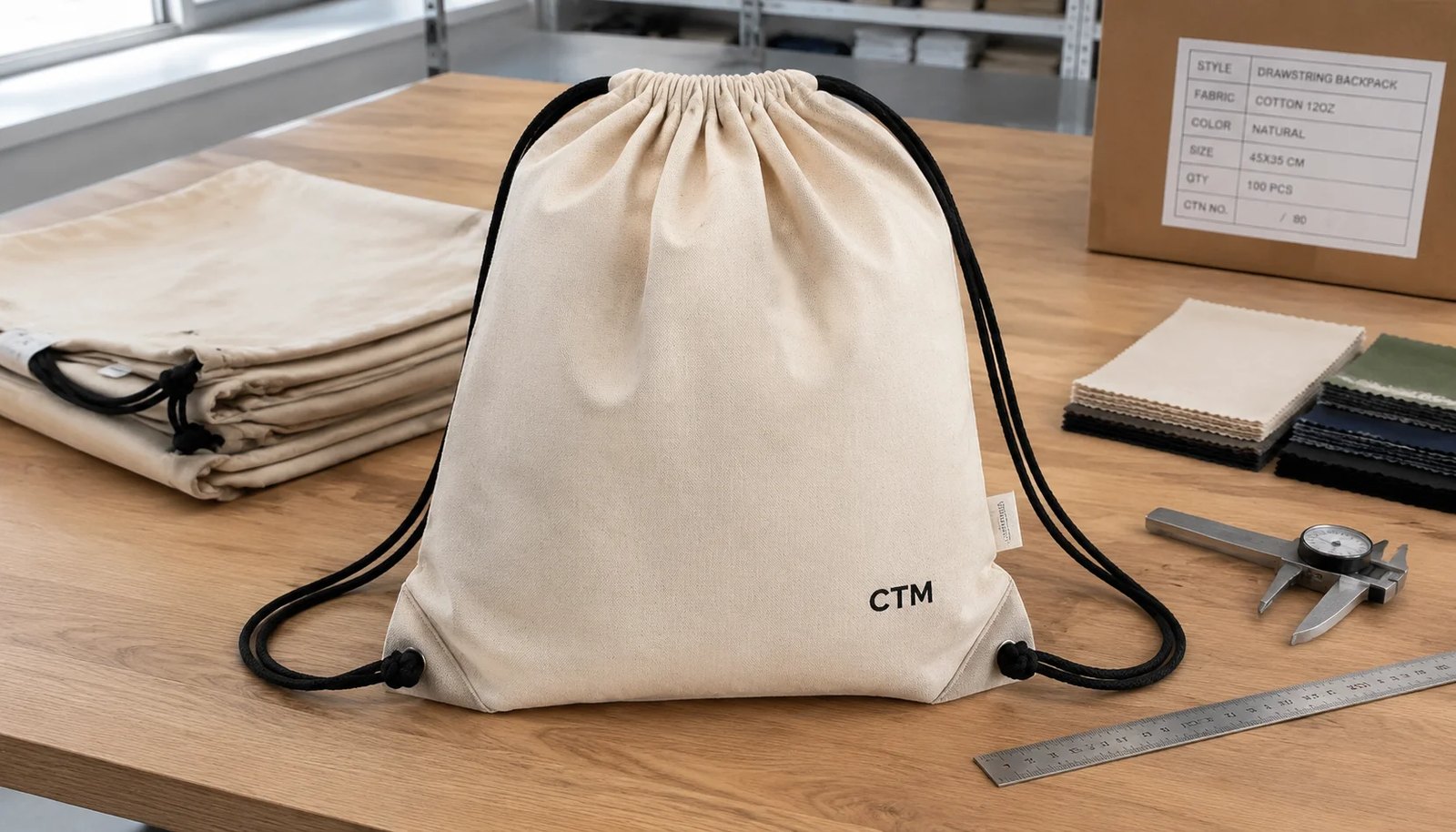
Why durability is the main buying issue for natural grocer drawstring backpacks
Natural grocers use cotton drawstring backpacks in a different way from one-day event promoters. The bag may carry produce, jars, snacks, supplements, water bottles, and weekly purchases. That means a light promotional gym sack specification often looks acceptable at first sample stage but fails in actual retail use. The weak points are rarely the center fabric panel. Most failures start at the drawcord exit corners, the top channel seam, or side seams where load and friction combine.
For procurement teams, the buying problem is not simply choosing a cotton bag. It is translating expected in-store use into testable construction standards before quotation. If the RFQ only says 'cotton drawstring backpack with logo,' suppliers will quote different fabric weights, different cords, and different seam methods. Prices become impossible to compare. A durability checklist fixes that by setting a shared minimum build standard and by making supplier evidence part of the quote.
- Typical failure point 1: drawcord cuts into bottom corner seam under load
- Typical failure point 2: top channel seam opens because stitch density is too low
- Typical failure point 3: print cracks or transfers because curing is weak
- Typical failure point 4: carton overpacking causes creasing, print rub, and shape distortion
Start with the right fabric weight instead of a vague cotton spec
For natural grocer use, fabric weight is the first durability filter. Light cotton sheeting around 140 to 180 GSM may work for giveaway bags that carry leaflets or small items, but it is usually too weak for repeated grocery use. A safer working range for cotton drawstring backpacks is 270 to 340 GSM, roughly 8 oz to 10 oz canvas. This gives better abrasion resistance, lower distortion under load, and better support for a front print area. Above that range, the bag becomes stiffer and shipping weight rises, so the best choice depends on whether the bag is meant for resale, loyalty promotions, or regular staff/store programs.
Do not let suppliers quote only by ounce weight without confirming GSM and weave. Some markets use oz based on fabric width assumptions, and that can create confusion. Also, two fabrics with similar GSM can perform differently if one has a looser weave or lower yarn quality. For repeat orders, note both GSM and the approved handfeel or weave character on the sample approval sheet. If wash shrinkage matters, ask whether the fabric is pre-shrunk or whether dimensions are cut to compensate.
- Light promo use: 180 to 220 GSM only if the load expectation is low
- Regular grocery reuse: 270 to 340 GSM is the most practical target
- Heavier resale bag: 340 GSM and above, but review shipping weight and sewing cost
- Always quote fabric in both oz and GSM, plus composition and weave
Construction details matter more than adding extra fabric alone
A thicker fabric does not solve weak construction. If the sewing method is poor, even a heavier canvas bag will fail at the stress points. For drawstring backpacks, the key construction areas are side seams, top folded channel seams, and lower corners where the cord exits and pulls upward. A practical baseline is lockstitch sewing with 8 to 10 stitches per inch, consistent seam allowance, and backtacks at start and finish points. Reinforcement at the drawcord exit can be bartacks, triangle stitching, or a separate inside patch depending on the supplier's standard method.
The cord itself also changes durability. Thin cords can act like a knife edge under repeated load. Braided cotton or cotton-poly cord in the 8 mm to 10 mm range usually gives better comfort and lower wear at the channel. If the bag will be sold at retail, also review cord feel in hand. Rough low-grade cords can create customer complaints even before breakage occurs. In quotations, isolate the cord spec instead of letting it remain hidden in a generic bag price.
- Recommended side seam allowance: enough to resist seam slippage under moderate load, commonly 1 cm or more depending on construction
- Cord exit reinforcement should be visually consistent on every bag, not added only on sample pieces
- Bottom corner shape should allow the cord to sit without twisting the seam line
- Backtack quality matters; loose reverse stitching is a common hidden defect
Choose a print method that survives flexing and repeated handling
Natural grocers usually want a simple logo, store program message, or eco-positioning graphic on the front panel. For most medium to large orders, water-based or plastisol screen printing is still the most practical choice, depending on the artwork and brand standards. Screen print usually gives the best cost efficiency once quantity rises and can hold up well if the curing is controlled. Large heavy ink coverage on flexible bags should be reviewed carefully because the print area will crease and flex whenever the bag is tightened or overfilled.
Heat transfer can work for smaller runs or multicolor artwork, but it adds a different failure mode: edge lifting, cracking, or stiff handfeel if the transfer film is not suitable for the fabric. Digital methods may look attractive for low MOQs, but they need the same durability review. Whatever method is chosen, include a simple flex test during sample approval: fold, crumple lightly, and rub the printed area by hand. It is not a lab test, but it quickly exposes under-cured or overly brittle print applications.
- Simple 1 to 2 color logo at volume: usually screen print
- Small MOQ or detailed artwork: consider transfer, but review feel and crack risk
- Large solid print block: ask for an actual sample on the final fabric weight
- Print placement tolerance should be written, commonly within 5 mm for standard front logos
Build a sampling plan that catches durability issues before bulk cutting
Many bag programs fail because the buyer approves a photo or a showroom sample that is not made with the final bulk materials. For a useful sample plan, separate the review into stages. First, approve fabric and color reference. Second, approve a pre-production sample made with the final fabric weight, final cord, actual print method, and intended seam construction. Third, if the order is high value or for multiple stores, keep a signed or sealed reference sample tied to the PO and inspection standard.
A strong pre-production sample review should include more than appearance. Load the bag with realistic contents. Pull the cords repeatedly. Check whether the top channel bunches cleanly. Measure print placement. Inspect the inside seam finish. If the supplier sends only beauty shots, request close-up images of stress areas. This is where many quote differences become visible. A cheaper quote often omits reinforcement or substitutes a thinner cord that is hard to detect in a front-facing product photo.
- Pre-production sample should match final artwork size and print method
- Use realistic test contents such as boxed goods, bottles, or jars to simulate store use
- Inspect stress points from inside and outside of the bag
- Keep one approved sample in purchasing files and one with QA or merchandising
Use practical durability acceptance criteria, not vague quality language
Words such as 'good quality,' 'strong stitching,' or 'heavy cotton' do not help during dispute resolution. Buyers need acceptance criteria that can be checked at incoming inspection or pre-shipment inspection. For cotton drawstring backpacks, this usually means a combination of material verification, workmanship review, and simple functional testing. Not every importer needs full laboratory protocols, but even a basic written standard will improve consistency across suppliers and repeat orders.
A practical approach is to define what counts as a rejectable defect at critical use points. For example, visible seam opening under moderate manual stress, missing reinforcement at one corner, cord knot pull-through, obvious print smudge, major shade variation within one carton, or dimensions outside agreed tolerance. This allows a third-party inspector or in-house QC team to evaluate bulk goods against the same standard used by purchasing.
- Critical defect examples: wrong fabric spec, missing logo, broken seam, wrong carton marking
- Major defect examples: print misplacement beyond tolerance, missing bartack, visible stain, severe shade mismatch
- Minor defect examples: light removable thread ends, slight fabric slub within approved natural cotton standard
- If using AQL, define it in the PO, but still list product-specific reject conditions
Understand MOQ logic so you do not pay custom prices for standard builds
Minimum order quantity on a drawstring backpack is not only about sewing. Fabric sourcing, dyeing, printing setup, and packing all create separate MOQ thresholds. If you need natural cotton with a simple black print, many factories can work from stock fabric and offer lower MOQs, sometimes starting around several hundred pieces depending on construction. If you need custom dyed fabric, woven labels, individual retail packaging, or exact branded cord color, the effective MOQ often rises because materials must be booked specifically for the order.
This is why buyers should request quote breaks at several volume levels instead of a single total price. The real cost difference between 500 and 1000 pieces may be small if printing and setup dominate. The difference between 1000 and 3000 pieces may be more meaningful if it unlocks custom dye lots or more efficient cutting. A supplier who cannot explain these breakpoints is harder to trust on costing transparency.
- Stock natural canvas generally supports lower MOQs than custom dyed cotton
- Single-color screen print usually has a lower setup burden than multi-position printing
- Individual retail polybagging and barcode labeling can raise effective MOQ or piece cost
- Ask for price breaks at 500, 1000, 3000, and 5000 pcs to see where the curve changes
Packing and carton planning affect damage rate and warehouse cost
Packing is often treated as an afterthought on bag orders, but it directly affects print condition, storage efficiency, and downstream handling at grocer distribution centers. Flat packing is standard, but buyers still need to decide inner pack quantity, whether bags are bundled with belly bands or tied cords, whether each unit needs a barcode sticker, and how many pieces should go in an export carton. The lowest freight cost per unit is not always the best option if cartons become too heavy or if the front print area rubs excessively during sea transit.
For cotton drawstring backpacks, many importers prefer 25 to 50 pieces per inner poly depending on bag thickness, then packed in outer cartons by gross weight limit. If a natural grocer has store-by-store allocation needs, pre-sorted carton counts may reduce domestic repacking costs. Also request carton dimensions in the quote. A small saving on unit price can disappear if inefficient carton sizing increases warehouse cube or container dead space.
- Specify whether cords should be tucked in, tied, or left loose inside the bag
- Set a carton gross weight ceiling suitable for your warehouse handling system
- If using retail stickers, define position to avoid damaging the print area when removed
- Carton marks should include PO, style, color, quantity, and destination code if using multi-store allocation
Lead time risk usually starts with material booking, not sewing capacity
Buyers often focus on the final quoted lead time but not on where delay risk sits inside it. For cotton drawstring backpacks, the slowest part may be fabric procurement, dyeing, print approval, or waiting for custom trims rather than the sewing itself. Natural canvas with one-color printing may move quickly if the factory holds stock fabric. Custom color matching, custom cord, woven labels, or special retail packs can add a week or more each depending on the supplier's sourcing network and current production load.
A practical way to manage schedule risk is to request a milestone breakdown instead of one total lead-time promise. Separate fabric readiness, print strike-off or pre-production sample timing, cutting, sewing, final inspection, and booking. This reveals whether the supplier is relying on assumptions. It also helps purchasing teams align with marketing launch dates and inbound warehouse windows. If one supplier is cheaper but starts fabric booking only after deposit, while another reserves stock earlier, the second quote may actually be safer.
- Stock fabric programs usually shorten risk compared with custom dye lots
- Printing approval delays are common when artwork size and Pantone expectations are unclear
- Peak season may affect carton supply and booking availability as much as sewing lines
- Request milestone dates in calendar form, not only '25 to 30 days after approval'
How to compare quotes on landed value instead of unit price alone
The cheapest quoted backpack is often the most expensive after claims, rework, or early product failure. A better comparison method is to normalize each quote against the same durability checklist. Convert every offer into a comparable grid: fabric GSM, cord thickness, reinforcement method, print method, sample stage included, packing format, carton data, and lead time assumptions. Then note which items are explicitly included and which are silent. Silence in a quote usually means room for downgrade or later upcharge.
Landed value also includes freight cube, defect exposure, and internal handling cost. A supplier using 320 GSM fabric with better reinforcement may cost more per unit but reduce return risk and support stronger customer satisfaction if the bag is sold in stores. Another supplier may offer a low ex-works price but pack 100 pieces into oversized heavy cartons that raise handling issues. Procurement teams should compare at least one durability-upgraded option and one cost-down option on the same spreadsheet before making the final sourcing decision.
- Normalize quotes by using the same finished size, GSM, print size, and packing basis
- Separate one-time setup costs from repeat-order running costs
- Estimate freight using carton dimensions, not only total weight
- Flag any quote that does not specify corner reinforcement, cord diameter, or packing details
Specification comparison for buyers
| Spec decision | Recommended option | When it fits | Buyer risk to check |
|---|---|---|---|
| Fabric weight | 8 oz to 10 oz cotton canvas, about 270 to 340 GSM | Best balance for grocery promotions, store merch, and repeat-use bag programs | Suppliers may quote 6 oz sheeting that looks similar in photos but fails faster at corners and channel seams |
| Fabric construction | Plain weave canvas with tighter pick count, pre-shrunk if possible | Needed when bags will hold jars, produce, supplements, or weekly in-store purchases | Loose weave fabric can pass basic appearance review but distort after wash or under load |
| Bottom corner reinforcement | Extra reinforcement patch or bartack at drawcord exit points | Recommended for heavier retail use and resale programs | Without reinforcement, most first failures start where cord friction concentrates on the corner seam |
| Drawcord material | 8 mm to 10 mm braided cotton cord or cotton-poly blend cord | Good for comfort, grip, and lower break risk than thin string cords | Thin low-cost cords cut into fabric channels, knot slip is common, and user comfort drops |
| Seam construction | Lockstitch with 8 to 10 stitches per inch and backtack at stress points | Suitable for medium-load backpacks used by shoppers or event participants | Low stitch density and weak backtacks often cause side seam opening before fabric itself fails |
| Print method | Water-based screen print for simple logos, heat transfer only for short runs or multicolor details | Screen print is more durable and usually lower cost at volume for natural grocer branding | Large ink coverage on flexible fabric can crack if print curing is inconsistent or bag is overstuffed |
| MOQ logic | Use stock fabric colors for 500 to 1000 pcs; custom dyed fabric normally from 2000 pcs up | Helps buyers control unit cost while still improving durability and appearance consistency | Very low MOQ custom requests often trigger fabric substitutions, mixed lots, or inflated piece pricing |
| Packing method | Flat packed, 25 to 50 pcs per polybag, export carton based on weight not only count | Works well for retail distribution centers and store allocation | Overpacked cartons crush print surfaces and raise carton burst risk during sea transit |
| Pre-shipment sample standard | Gold seal or signed approval sample tied to GSM, dimensions, print size, cord spec, and packing | Essential when multiple departments review the order and stores expect repeatable product | Verbal approvals lead to disputes on handle length, fabric handfeel, print tone, and final carton assortment |
Buyer checklist before sampling
- Set a target fabric range in both oz and GSM, not only 'cotton canvas'. For natural grocer use, 270 to 340 GSM is usually safer than light sheeting.
- State finished bag size with tolerance, for example 38 x 42 cm plus or minus 1 cm, and include whether measurement is taken laid flat before packing.
- Define intended load range in the RFQ, such as 4 to 6 kg regular use, because durability expectations change the seam and cord specification.
- Specify reinforcement at the drawcord exit corners, either bartack, triangle stitch, or reinforcement patch, and request close-up sample photos.
- Name the drawcord material, thickness, color, and knot style. Thin generic string is a common downgrade area in price-led quotes.
- Tie print method to artwork use: screen print for simple 1 to 2 color logos, transfer only if detail requirements justify it.
- Require bulk fabric GSM test data and seam pull test method before production approval, not only a photo of the pre-production sample.
- Approve a sample against a written construction sheet covering stitch density, seam allowance, print position, and cord channel width.
- Define packing by carton gross weight ceiling as well as pieces per carton to reduce transit damage and warehouse handling issues.
- Request production lead time split by lab dip or fabric booking, printing, sewing, final inspection, and booking to spot schedule risk early.
Factory quote questions to send
- What is the exact fabric composition and tested GSM of the quoted bag, and what is the acceptable GSM tolerance in bulk production?
- Is the quoted fabric stock canvas or custom woven fabric, and does the lead time assume greige stock, dyed stock, or new weaving?
- What stitch type, stitch density, and seam allowance are used on side seams, top channel seams, and bottom corners?
- How are the drawcord exit points reinforced, and can you provide close-up photos or a worn sample from previous production?
- What cord material, diameter, and construction are included in the quote, and is knotting done manually or by a fixed work instruction?
- Which print method is quoted, what ink system is used, and what curing or adhesion control is applied during production?
- What is the MOQ by fabric color, print color count, and packaging style, and where do price breaks occur at 500, 1000, 3000, and 5000 pcs?
- Can you quote separately for 270 GSM and 320 GSM fabric so the cost impact of durability is visible?
- What are the carton dimensions, pieces per carton, gross weight, and estimated container loading quantity for the quoted pack plan?
- What in-line and final inspections are included, and what defect criteria are used for seam opening, print misplacement, stains, and measurement tolerance?
Quality-control points to confirm
- Fabric GSM should stay within the approved tolerance, commonly plus or minus 5 percent if agreed, with test records from bulk fabric lots.
- Finished size should match approved specification within stated tolerance, commonly plus or minus 1 cm for body dimensions.
- Drawcord channels must be even and free of skipped stitches; channel width must allow smooth cord movement without excessive abrasion.
- Corner reinforcement must be present on every bag and positioned consistently at the drawcord exit stress points.
- Side seams and top seams should show no open stitches, loose thread clusters, or backtack failure under reasonable manual pull.
- Print location must match approved artwork placement tolerance, commonly within plus or minus 5 mm for simple front logos.
- Print surface should show no obvious pinholes, smudging, ghosting, or under-cured cracking when flexed by hand.
- Fabric should be free from major weaving bars, oil stains, mildew odor, and color shading beyond the approved standard.
- Carton packing count and carton markings must match the packing list, store allocation plan, and shipping marks exactly.
- Random packed cartons should be verified for gross weight to catch undercount, overpacking, or mixed-spec bags before shipment.