Start with the real grocery use case, not a generic backpack spec
Wholesale cotton drawstring backpacks for natural grocers are usually bought for one of four purposes: paid reusable merchandise, loyalty or membership gifts, store opening promotions, or vendor-funded sampling programs. Each purpose changes the correct specification. A paid retail bag needs a cleaner finish, stronger seams, better print registration, and more consistent fabric shade. A giveaway bag may accept a simpler hem and standard natural cotton if the logo looks good and the drawcord does not fail.
Procurement teams often receive quotes that look comparable because every line says 'cotton drawstring backpack'. In production terms, that phrase is too vague. A 140 GSM promotional cotton bag and an 8 oz cotton canvas backpack are different products with different strength, print behavior, carton volume, and customer perception. The RFQ should describe the carry load, expected retail or giveaway value, and distribution method before it describes artwork.
- For light sampling kits, 180-220 GSM cotton can be acceptable if the load is under about 2 kg.
- For natural grocery merchandise or loyalty bags, 220-260 GSM or 8 oz cotton canvas gives a more credible reusable feel.
- For heavier jars, bottles, books, or staff kits, use reinforced corners and consider 10 oz fabric if the target price allows.
- If the bag will be sold in-store, include hangtag, barcode label, and shelf presentation requirements in the first quote.
Fabric weight and construction drive both cost and customer perception
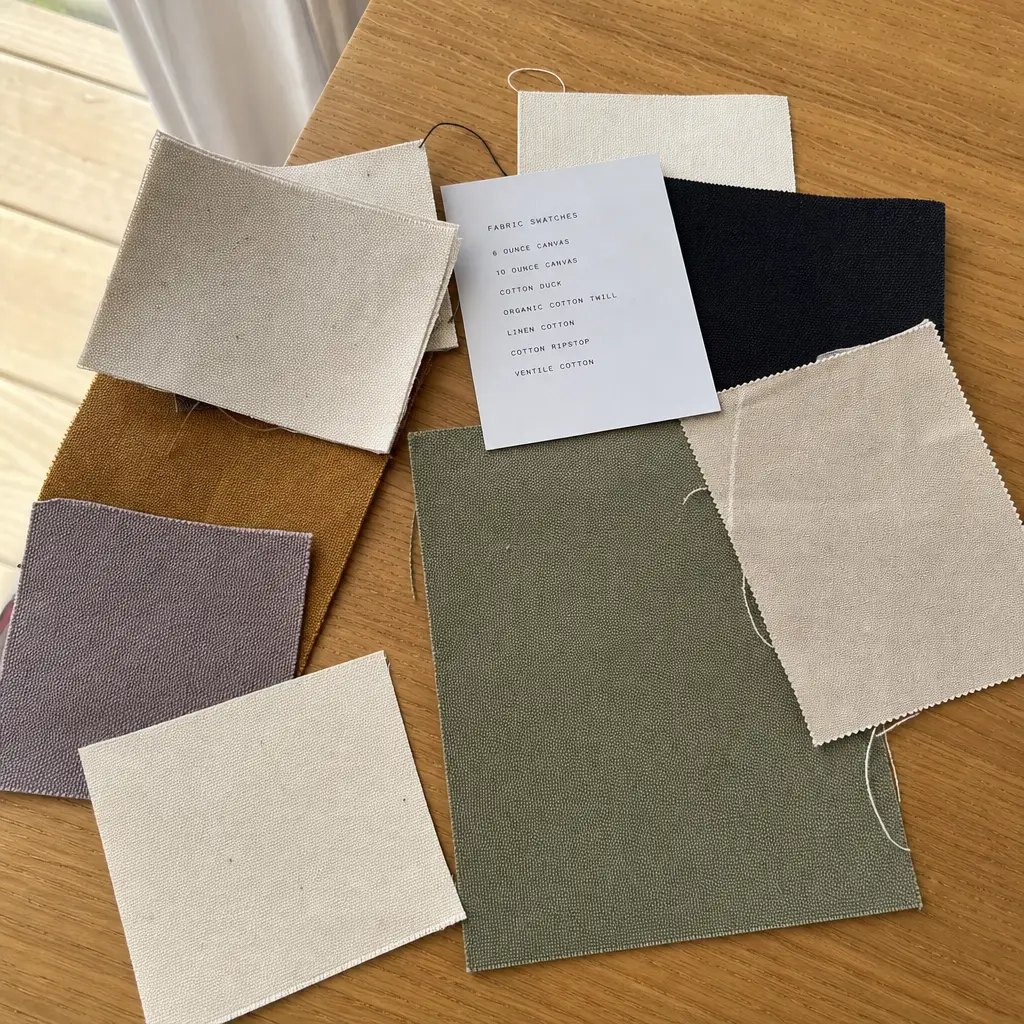
The fabric decision should be written as GSM or ounces plus fabric type. Cotton sheeting, cotton drill, and canvas do not behave the same way even at similar weight. Sheeting is softer and cheaper but can look thin. Drill has a diagonal texture and better body. Canvas feels sturdier and supports a more premium natural grocer message. Unbleached cotton also contains natural seed specks; these are not defects unless the approved standard says they are excessive.
Many price gaps between suppliers come from fabric substitution. One quote may use 6 oz cotton, another may use 8 oz canvas, while both descriptions simply say 'cotton'. A buyer comparing only unit price may award the order to a bag that cannot survive the intended load. The cleaner method is to require a fabric swatch with measured GSM and to attach that swatch or a photo reference to the signed sample approval.
- 140-160 GSM: low-cost event use, not ideal for heavy grocery items.
- 180-220 GSM: acceptable mid-range for light reusable programs and local promotions.
- 220-260 GSM: strong common range for natural grocer branding and repeat use.
- 10 oz cotton canvas: stronger handfeel, higher fabric cost, larger carton volume, better retail perception.
- Unbleached cotton: natural appearance, visible flecks, may reduce bleaching processing but has shade variation.
Size, drawcord, and reinforcement decide whether the bag actually works
A common finished size for cotton drawstring backpacks is around 34 x 42 cm. This size fits most promotional literature, light grocery items, wellness samples, and folded apparel without becoming too expensive in fabric consumption. Increasing both width and height by only a few centimeters can noticeably raise fabric usage across thousands of units, and it may push the order into larger cartons with worse freight efficiency.
Drawcord quality matters more than many RFQs suggest. A 3 mm cord may look fine in a photo but becomes uncomfortable on the shoulder and can cut into the top channel under load. For natural grocer programs, a 5-6 mm cotton cord or cotton blend cord is usually a better match. The lower corner construction is another failure point: a cord sewn only into a side seam can pull out, while a self-fabric triangle patch with bartack distributes stress.
- Specify finished size after sewing, not cutting size.
- Add tolerance such as +/-0.7 cm to avoid disputes over normal sewing variation.
- Use reinforced lower corners for any bag expected to carry canned goods, bottles, jars, or books.
- Define cord color and material; natural cotton cord, black cotton cord, and polyester cord have different appearance and pricing.
- Confirm whether the cord ends are knotted, tipped, heat sealed, or left raw; cotton cord is normally knotted rather than heat sealed.
Print method selection for natural cotton is a production decision
Most natural grocer drawstring backpack orders use screen printing because the artwork is usually a logo, store name, local produce graphic, or campaign slogan in one to three spot colors. Water-based screen print has a softer hand and fits a natural product message, but it needs proper curing. If the ink is under-cured, prints may feel tacky, smell strong, or transfer during packing. Pigment or plastisol-style alternatives can improve opacity but may feel heavier.
Natural unbleached cotton is not a pure white print base. Light green, yellow, cream, and pale blue ink can shift visually on the fabric. Large solid print areas can also reveal fabric texture and seed flecks. For brand owners with strict logo standards, the supplier should make a strike-off or printed pre-production sample on actual bulk fabric. Digital mockups are useful for placement, but they cannot prove ink absorption, opacity, curing, or handfeel.
- Use water-based screen print for simple logos where soft handfeel matters.
- Use higher-opacity ink for white or pale graphics on darker dyed cotton.
- Avoid very fine reversed text on coarse canvas unless a print test proves readability.
- Keep important artwork away from seams, cord channels, and heavy creases.
- State the print size in centimeters and placement from top seam or bottom edge.
MOQ logic: compare by color, design, and production setup
MOQ is rarely only about the total number of bags. Factories plan fabric purchasing, cutting, sewing, printing screens, ink mixing, and packing by version. An order for 5,000 pieces in one fabric color and one print is much simpler than 5,000 pieces split across five store regions, four print versions, and three cord colors. If the RFQ does not define version splits, the first quote may be low and the final proforma invoice may be higher.
For natural grocer buyers, the best MOQ conversation is built around the program plan. If each store needs a small carton quantity with different city names, a distributor or domestic printer may be better for the variable artwork. If the design is common across all stores and the quantity is stable, direct factory production usually gives better control of fabric, construction, and unit cost. The correct sourcing route depends on customization depth, not only total quantity.
- Clarify MOQ per fabric color, per print design, and per shipment split.
- Separate screen charges from unit cost when comparing many artwork versions.
- Expect custom dyed fabric or custom dyed cord to need higher MOQ than standard natural cotton.
- For repeat programs, request a re-order MOQ and ask whether screens or patterns can be kept on file.
- If the buyer needs mixed store allocations, quote bulk packing and store-level packing separately.
A useful quote must show the assumptions behind the unit price
A low unit price without quote data is not a buying advantage; it is an unanswered question. Cotton drawstring backpack quotes should show fabric weight, bag size, print method, number of print colors, print size, cord type, reinforcement details, packing method, carton information, sample cost, tooling or screen charge, and trade term. Without these items, the buyer cannot tell whether suppliers are quoting the same product.
Landed-cost comparison is especially important for bulky textile bags. A slightly heavier canvas bag may have a higher unit price but a better retail feel. A larger bag may cost only a little more in sewing but much more in ocean freight because cartons become bigger. Procurement should compare product cost, inland transport, export charges, ocean or air freight, duty, destination handling, and final distribution cost. A cheaper unit may not be cheaper at the store receiving dock.
- Quote line should state: 8 oz cotton canvas, 34 x 42 cm, 5 mm cotton cord, reinforced corners, one-color water-based print.
- Packing line should state: pieces per carton, carton dimensions, gross weight, net weight, and whether each bag is individually packed.
- Cost line should separate: unit price, screen charge, sample charge, hangtag/barcode charge, and special packing charge.
- Trade term should state: EXW, FOB port, CIF, DDP, or another agreed term, not just 'shipping included'.
- Lead time should be tied to sample approval and deposit date, not only to the date of inquiry.
Sample approval should test production reality, not just appearance
The approved sample is the contract reference for the factory floor. A good pre-production sample uses the actual fabric weight, actual drawcord, actual print method, actual stitch type, and intended folding method. If the sample is made from substitute fabric or a different cord because materials were not ready, that limitation should be written down. Otherwise, the production team may treat the temporary substitute as approved.
Buyers should review the sample in the same way a store customer will use it. Load it with typical grocery items, pull the cord repeatedly, wear it on the shoulder, rub the print face, and inspect the lower corners. Measure several points rather than one edge. Natural cotton may shrink or relax slightly during handling, so the approved tolerance matters. If the sample fails functionally but looks good in photos, it is not ready for bulk approval.
- Measure finished width, height, top channel depth, and cord length.
- Pull both cords firmly several times to see whether the lower corner stitching opens.
- Rub the print with a clean dry cloth and then a slightly damp cloth to detect poor curing or crocking.
- Check odor after the sample has been sealed in a bag for several hours.
- Photograph and sign the approved sample with date, version, and material notes.
Packing choices affect freight, store handling, and sustainability claims
Natural grocers often prefer reduced plastic packaging, but the packing plan still has to protect the print and fabric. Flat bulk packing is common: for example, 100 pieces per export carton, with a master poly liner only when moisture protection is needed. Individual polybags improve cleanliness and scanning control but add plastic, labor, and time. Paper bands or kraft belly bands may look better for retail presentation, but they need a separate quote and durability check.
Carton planning should be finalized before mass production because folding method can create permanent creases across the print. Heavy water-based ink should be fully cured before stacking. If bags are packed too soon or under too much pressure, print faces can block together. Carton strength also matters: cotton bags are not fragile, but heavy cartons can burst during export handling if the board grade is too weak or the carton is overfilled.
- For bulk distribution, use flat packing with print faces aligned to reduce random creasing.
- For retail sale, add barcode label, hangtag, or belly band requirements to the artwork pack.
- Avoid packing wet or warm prints directly into sealed cartons.
- Specify maximum carton weight if warehouse teams have manual handling limits.
- Request carton markings that match purchase order, SKU, color, quantity, and destination allocation.
Lead time risk comes from artwork, fabric, print curing, and shipment booking
A realistic timeline for custom cotton drawstring backpacks starts after artwork approval, not after the first email. A factory cannot prepare screens accurately without final vector artwork and print size. Fabric purchasing or dyeing cannot start confidently if the buyer is still changing natural, black, olive, or custom color options. Sample approval delays also compress the production window and increase the temptation to skip drying or inspection time.
For planning, buyers should separate sample lead time, material preparation, cutting and sewing, printing, curing, final inspection, packing, export customs, vessel or air booking, and destination receiving. Seasonal natural grocer programs often have fixed store launch dates, so late artwork is more dangerous than a normal production delay. Air freight can rescue some schedules but may destroy the budget because cotton backpacks are bulky relative to their unit value.
- Build extra time for first sample corrections if the logo color or print opacity is critical.
- Allow additional time for custom dyed fabric, custom dyed cord, or multiple print versions.
- Do not schedule final inspection on the same day printing is completed.
- Reserve shipment booking early during peak seasons or before long factory holidays.
- For store launches, include destination warehouse receiving and allocation time, not only port arrival date.
Supplier evidence should prove control of sewing, printing, and packing
A capable supplier should be able to show more than a catalog image. For cotton drawstring backpacks, useful evidence includes fabric swatches by GSM, close photos of corner reinforcement, print samples on natural cotton, packing photos, carton data from similar constructions, and a clear explanation of inspection points. If a supplier cannot explain the difference between fabric weights or print methods, the buyer may be dealing with a trader who is quoting without production control.
This does not mean every order must go direct to a factory. Distributors can be valuable when the buyer needs a very small quantity, fast domestic delivery, or decoration after import. Direct factory sourcing is stronger when the buyer needs exact fabric, custom construction, private label packing, export carton planning, or repeatable cost control. The RFQ should identify which route is being used so the quote is judged fairly.
- Request real sample photos showing stitching and cord attachment, not only front-view catalog shots.
- Look for consistency between quoted GSM and the handfeel of submitted swatches.
- Review whether the supplier can provide carton dimensions before production, not after packing.
- For importers, confirm export documentation capability and product description consistency.
- For brand owners, confirm the supplier can protect artwork files and repeat approved placement in future orders.
Specification comparison for buyers
| Spec decision | Recommended option | When it fits | Buyer risk to check |
|---|---|---|---|
| Fabric weight | 8 oz cotton canvas or 220-260 GSM cotton drill | Reusable natural grocer giveaway, staff event bag, member reward, or paid reusable bag program | Below 180 GSM may look limp, show contents, and tear faster at drawcord stress points |
| Bag size | Approx. 34 x 42 cm with 0.7-1.0 cm tolerance | Fits produce, boxed snacks, light groceries, event materials, or wellness samples | Oversized bags increase fabric consumption and freight volume; undersized bags may not fit standard folders or product bundles |
| Drawcord | 5-6 mm cotton cord or recycled cotton blend cord | Natural look, comfortable shoulder carry, good match for grocer sustainability positioning | Thin cord cuts into shoulders; synthetic cord may conflict with natural material claims |
| Corner reinforcement | Self-fabric triangle patch with bartack or dense backstitch | Orders expected to carry cans, glass jars, produce, or trade show samples | Decorative stitching without reinforcement can fail even if the fabric body is strong |
| Print method | Water-based screen print for 1-3 spot colors | Most natural grocer logos, local event art, produce graphics, or store opening campaigns | Large solid coverage on unbleached cotton can look uneven unless ink, mesh, and curing are tested |
| Color choice | Natural unbleached cotton, black, olive, or kraft-like dyed cotton | Natural grocer retail themes and low-risk inventory use across multiple stores | Dyed cotton needs colorfastness review; natural cotton has seed flecks that must be accepted in the standard |
| Packing method | Flat packed 100 pcs/carton with inner polybag only if required | Lower packing labor, efficient carton use, easier store-level distribution | Over-compressed packing can create print blocking or hard creases on heavy ink areas |
| Supplier route | Direct factory for custom MOQ; distributor for urgent small replenishment | Factory route suits seasonal programs and private label specs; distributor route suits emergency repeats | Distributor stock may limit fabric GSM, logo area, and compliance documentation traceability |
Buyer checklist before sampling
- Define the program purpose before quoting: paid retail bag, loyalty gift, vendor-funded promotion, staff kit, or event giveaway.
- Specify fabric construction by weight and type, such as 8 oz cotton canvas or 220-260 GSM cotton drill, not only 'cotton'.
- State finished bag size with tolerance, drawcord thickness, cord material, and whether the lower corners need reinforced patches.
- Send vector artwork with Pantone references, print size, placement distance from top seam, and whether natural cotton flecks are acceptable behind light ink.
- Choose print method based on artwork: water-based screen print for simple logos, pigment print for stronger opacity, heat transfer only when fine gradients are essential.
- Request a pre-production sample using actual fabric, actual cord, actual print inks, and intended packing fold method.
- Set functional acceptance points for seam strength, cord pull resistance, print curing, crocking, odor, size tolerance, and needle damage.
- Clarify MOQ by color, artwork version, and shipping split; do not compare one supplier's total MOQ against another supplier's per-design MOQ.
- Require carton dimensions, gross weight, net weight, pieces per carton, and any store-level bundle packing before approving the final quote.
- Build the timeline around artwork approval, sample remake time, production slot, print curing, final inspection, export booking, and destination receiving schedule.
Factory quote questions to send
- What fabric options can you quote for this bag: GSM, weave, shrinkage range, and whether the cotton is bleached, unbleached, dyed, or recycled blend?
- Is your MOQ based on total order quantity, each fabric color, each print design, or each shipping destination?
- What drawcord diameter, cord material, and cord color are included in the base quote, and what is the surcharge for custom dyed cord?
- How are the lower corners reinforced, and can you provide a seam photo or construction diagram before sampling?
- Which print method do you recommend for our artwork and cotton color, and what is the maximum print area included in the quoted price?
- Are screen setup charges, PMS matching charges, sample charges, carton printing, hangtags, and barcode labels included or listed separately?
- What are the sample lead time and bulk lead time after sample approval, assuming our order quantity and number of artwork versions?
- What carton size, gross weight, net weight, and packing method are assumed in the quotation?
- What inspection standard do you use for size tolerance, print defects, stains, loose threads, skipped stitches, and drawcord function?
- Can you quote FOB, EXW, and delivered terms separately so our team can compare product cost against freight and duty impact?
Quality-control points to confirm
- Finished size tolerance should normally stay within +/-0.7 cm for width and height unless a different tolerance is approved.
- Fabric weight should be checked against the approved swatch; large variation from approved GSM changes handfeel, strength, and cost.
- Drawcord must slide smoothly through the top channel without fraying, knot slipping, or tearing the side seam opening.
- Lower corner reinforcement should withstand repeated pull testing by hand without stitch popping or fabric tearing around the bartack.
- Print color should match the approved standard under consistent light; natural cotton ground color variation must be judged against an agreed tolerance sample.
- Ink must be fully cured, with no tackiness, blocking, strong odor, or visible cracking after reasonable flexing.
- Stains, oil marks, dark yarn contamination, broken needles, and sharp trimming residue should be treated as critical or major defects depending on severity.
- Carton packing must protect the print face from abrasion and moisture while avoiding unnecessary plastic if the buyer has reduced-packaging rules.