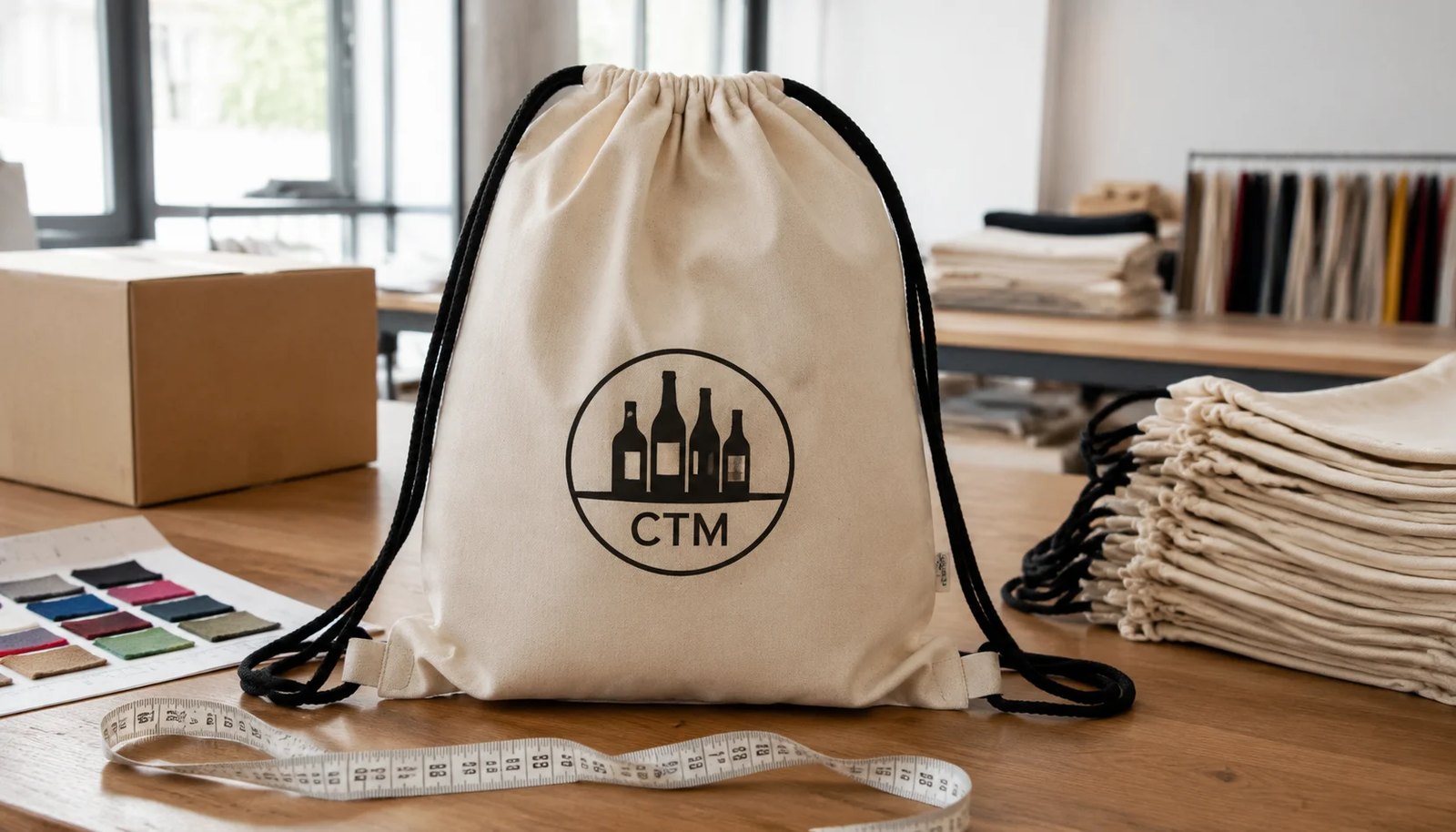
Why MOQ is harder for liquor retail than for general promo bags
Liquor retail programs often look simple on paper: a cotton drawstring backpack, one logo, one season, one shipment. In production, the order is usually tied to campaigns, gift sets, or regional store groups, which means the buyer wants flexibility in quantity, artwork, and delivery timing. That is exactly where MOQ becomes difficult. A factory can sew a simple backpack at a moderate minimum, but once the order adds custom dyed fabric, regional barcode labels, gift-ready inserts, or multiple logo versions for different brands in the same group, the practical minimum goes up even if the total annual volume is healthy.
The other issue is product use. Liquor retailers are not buying these bags only as cheap giveaways. Some use them for bottle gift packaging, membership rewards, holiday bundles, or branded store merchandise. That means the bag cannot feel too thin, print quality cannot look washed out, and the cord and seams cannot fail after one use. Buyers who negotiate MOQ only from unit price often end up forcing a low minimum on a specification that really needs better fabric, better reinforcement, or stricter packing control. The smarter route is to negotiate around the cost drivers inside the MOQ, not just against the MOQ itself.
- Campaign-based demand often creates split quantities by artwork or delivery window
- Bottle-related retail use usually needs stronger fabric than low-cost event sacks
- Retail presentation pushes buyers toward better print and more controlled packing
- MOQ discussions should separate sewing minimum from fabric, print, and packing minimums
Start with the spec that gives you room to negotiate
If the buying target is MOQ flexibility, the easiest product to negotiate is a natural cotton canvas drawstring backpack in 8 oz to 10 oz fabric, roughly 220 to 280 GSM, with a one-color screen print and stock cord. This is the industrial middle ground: heavy enough to feel retail-worthy, light enough to fold and carton efficiently, and common enough that many factories can source and sew it without booking a specialty fabric run. It also keeps print setup simple, which matters more than many buyers expect because print setup cost is often the hidden reason a small custom order gets rejected or heavily marked up.
Fabric weight should be chosen from actual usage, not from generic preference. A 140 to 170 GSM cotton body may look attractive in a quote, but it can become too soft when loaded with a boxed opener set, tasting cards, or compact bottle accessories. At the other end, a 320 GSM heavy canvas backpack may feel premium, but if your program is a seasonal liquor retail promotion, that heavier cloth can increase cutting waste, sewing time, and fabric MOQ. For many liquor buyers, the practical sweet spot is 220 to 280 GSM with reinforced stress areas and a front print that does not interfere with the drawstring channel.
- Most MOQ-friendly build: natural cotton, 220-280 GSM, one-color print, stock cord
- Lower GSM can reduce cost but often weakens retail feel and load stability
- Higher GSM improves body and durability but increases sewing time and material cost
- Keep artwork below channel area to reduce wrinkling and print distortion
Understand what part of the order is actually creating the MOQ
Many buyers treat MOQ as a single factory rule, but it is usually a stack of minimums from different production stages. The fabric mill may have a minimum booking for dyed canvas. The printer may require a setup threshold to make a custom Pantone mix worthwhile. The sewing line may only be efficient if the order runs long enough to avoid repeated setup losses. The packaging supplier may have a separate minimum for printed hangtags, barcode stickers, or custom polybags. If you ask only for the total MOQ, you lose the chance to redesign the order so it fits real factory economics.
A better negotiation method is to request line-by-line MOQ logic. For example, a factory may be able to sew 800 bags, but custom black fabric might require a 1,500-bag fabric commitment. If the same order is switched to stock natural cotton with black print, the MOQ could drop sharply. Or the factory may accept a lower total quantity if two logo versions use the same fabric, same print color, and same bag dimensions, because the line can run them back-to-back. This is why procurement teams should negotiate on spec simplification and component commonality before pressing harder on price.
- Fabric color is often the biggest MOQ trigger, especially custom dye lots
- Printing setup can outweigh sewing cost on small artwork runs
- Custom labels, inserts, and retail packs may each carry their own minimum
- Shared fabric and shared dimensions across variants usually improve MOQ flexibility
Best negotiation levers when your quantity is below the factory target
When your program volume is smaller than the factory's preferred run, the first lever is spec standardization. Instead of asking for a lower MOQ on a fully custom item, keep standard natural fabric, stock drawcord, and standard export carton packing, then put brand differentiation into the print only. A one-color front print is much easier for the factory to absorb at lower volume than a custom dyed body with woven label, hangtag, and individual insert card. This matters for liquor retailers because campaign deadlines are usually more expensive than a small loss in packaging flair.
The second lever is commercial structure. Factories are more open to lower MOQ if the buyer offers something that protects production planning: flexible delivery window, combined PO for multiple SKUs using the same material, deposit timing that allows early raw material booking, or a replenishment forecast. Even an estimate of repeat demand is useful if it helps the factory carry some leftover stock material responsibly. Procurement teams should frame this honestly. Do not promise annual volume you cannot support. Instead, provide a realistic forecast range and ask the factory how that changes fabric booking, print preparation, and line allocation.
- Reduce custom features before requesting MOQ exception
- Use one stock fabric across multiple liquor programs where possible
- Offer shared production windows for related SKUs to improve factory planning
- Forecast ranges are more credible than inflated annual commitments
Print and branding choices that quietly change both MOQ and defect risk
For cotton drawstring backpacks, print selection is not just a branding matter; it changes your minimums, your quality risk, and your rework rate. Standard screen printing is usually the most MOQ-friendly option for liquor retail because one-color artwork on cotton canvas is stable, repeatable, and easy to compare across factories. It also keeps lead time predictable. Heat transfer can work for detailed graphics, but on textured canvas it may affect handfeel, adhesion, and cost. Embroidery can look premium, yet it raises labor time and may distort lighter fabric bodies unless the panel is properly stabilized before sewing.
Logo placement is another hidden risk. Buyers often approve artwork based on a flat digital layout without considering drawstring channels, seam allowance, and post-sewing shape. If the logo sits too high, the print can wrinkle into the casing area. If it sits too low on a soft fabric, the bag may collapse visually when filled. For a liquor retail backpack, center-front placement below the channel is usually safest. If the bag is intended for premium gifting, a small woven side label can be cleaner than adding extra front decoration, and it often carries less registration risk than a second print location.
- One-color screen print is usually best for lower MOQ and stable quality
- Heat transfer suits detail but can raise cost and adhesion risk on canvas texture
- Embroidery adds labor and can pucker lighter cotton panels
- Keep artwork clear of the drawstring channel and seam stress areas
Sample approval should test factory understanding, not only visual appearance
In MOQ-sensitive orders, sampling is where many production mistakes can still be prevented cheaply. A good pre-production sample should prove more than the front logo. It should verify actual fabric weight, panel shape, cord thickness, opening function, print scale, and the way the finished bag sits when loaded. If the backpack is meant to carry a bottle accessory kit or a small boxed item, send the fill dimensions or a surrogate sample so the factory can test fit and stress points before bulk cutting. This prevents a common failure where the finished size is technically within tolerance but practically too tight.
Approval comments should be objective. Instead of writing 'make stronger' or 'print larger,' define measurable corrections. For example: increase body width by 1 cm, use 5 mm cotton cord instead of 4 mm, move logo 2 cm below channel seam, or raise fabric to 240 GSM minimum. These details help the merchandiser lock the production file and reduce dispute risk later. If you are comparing multiple suppliers, use the same sample scorecard so each factory is judged on the same criteria, not on subjective impressions.
- Approve samples with real or simulated product load when possible
- Record actual GSM, finished size, cord diameter, and logo position
- Use measurable sample comments, not vague style preferences
- A standard scorecard improves supplier comparison during sourcing
How to compare quotes without being misled by a low opening price
Small differences in quote structure can hide major cost differences. One supplier may quote a low unit price based on thin fabric, loose size tolerance, and bulk packing without individual labels. Another may include a heavier 250 GSM body, better cord, print setup, and retail barcode application. If the procurement team compares only the top-line price, the cheaper quote often becomes expensive later through change charges, re-packing, or rejected goods. For cotton drawstring backpacks, the only clean comparison is a normalized quote sheet with separate lines for fabric, print, accessories, labels, packing, sampling, and any testing or inspection support.
Carton efficiency also matters. A slightly heavier backpack that folds cleanly may still produce a better landed cost than a lighter bag with awkward cord bulk and poor nesting. Ask for carton dimensions, quantity per carton, and estimated gross weight before awarding the order. For importers shipping mixed programs, this is especially important because warehouse handling and final distribution can cost more than small unit-price differences. MOQ negotiation should therefore be linked to landed-cost logic, not only ex-works or FOB price.
- Normalize quotes into line items before comparing suppliers
- Review whether sample cost is refundable against order or charged separately
- Include carton utilization and warehouse handling in cost comparison
- Low unit prices often exclude labels, inserts, or tighter QC expectations
Packing decisions can destroy MOQ savings if handled too late
Liquor retail buyers often finalize retail presentation after the bag order is already quoted, and that is where costs jump. A backpack packed in bulk by export carton is one factory process. A backpack folded with insert card, barcode, warning label, and individual polybag is another process with extra labor, materials, and verification points. If the retail team adds these requirements after MOQ negotiation, the supplier may accept the low quantity but recover margin through packing charges. The result is a bag that looked cheap in quote stage and expensive at shipment stage.
The practical solution is to decide early whether the bag is an in-store operational item or a retail-ready consumer unit. If it is retail-ready, state your folding method, barcode position, polybag requirement, suffocation warning language if needed, and carton assortment. If it is for in-house kitting, keep packing simple and move the extra work to your own distribution center if that is cheaper. For smaller liquor programs, standard bulk packing often gives the best MOQ flexibility because it avoids separate packaging material minimums.
- Bulk export packing is usually the most MOQ-friendly route
- Retail-ready folds and labels add labor and separate material minimums
- Carton count and gross weight limits should be defined before approval
- Late packing changes often erase any savings won in MOQ negotiation
Lead time risk rises when MOQ is pushed down too far
Lower MOQ is not automatically a good commercial result if it makes delivery unstable. Factories may accept a small order by inserting it between larger runs, waiting for stock fabric, or grouping your print with another similar ink setup. That can work, but the schedule becomes less protected. For liquor retail programs tied to holiday windows or promotional launches, a delayed small order can be more damaging than carrying a slightly higher quantity. Buyers should therefore discuss not only whether the factory can take the MOQ, but how the production slot will actually be secured.
A realistic lead time for a simple custom cotton drawstring backpack depends on sample approval, raw material status, printing queue, and packing complexity. Stock natural fabric with one-color print generally moves faster than custom dyed fabric with custom retail packing. Build time buffer around approval loops. Artwork revision, sample courier time, and final carton marking approval all create delay risk. When comparing suppliers, ask what parts of the lead time are fixed and what parts depend on outside subcontractors.
- Low-MOQ orders are often scheduled around larger factory commitments
- Stock natural cotton generally shortens raw material lead time
- Custom dyeing and retail-ready packing both lengthen critical path
- Protect campaign dates with approval and shipment buffer, not optimistic promises
QC thresholds that matter for this product in liquor retail use
Quality control for cotton drawstring backpacks should match end use, not generic bag standards. In liquor retail, the most common complaints are weak corners, inconsistent print, fabric that feels thinner than the approved sample, and bags that do not fit the intended promotional contents. A sensible QC plan starts with approved reference samples and measurable tolerances. That gives both buyer and factory a clear baseline. Without that, final inspection turns into opinion, and small low-MOQ orders are especially vulnerable because factories may not dedicate senior QA attention unless the requirements are clearly documented.
Inspection should cover both appearance and function. Visual checks should focus on print position, color consistency, stains, slubs, open seams, and drawcord symmetry. Functional checks should include opening and closing action, simple load testing, and carton count verification. If the backpacks are going into retail channels, barcode readability and assortment accuracy matter as much as the sewing itself. The point is not to create an overbuilt inspection regime; it is to prevent the specific failures that usually lead to claims, rework, or missed launch dates.
- Use approved sample as the reference standard for final inspection
- Measure actual fabric feel against agreed GSM range, not visual guesswork
- Run random load checks on seams and drawcord anchoring
- Verify assortment, barcode, and carton marks if retail packing is included
Specification comparison for buyers
| Spec decision | Recommended option | When it fits | Buyer risk to check |
|---|---|---|---|
| Fabric weight | 8 oz to 10 oz cotton canvas, about 220-280 GSM | Best balance for liquor gift-with-purchase, bottle accessories, and repeat retail programs needing better durability than thin muslin | Below about 180 GSM can look too light and distort around bottle-shaped contents; above 300 GSM raises MOQ pressure and sewing cost |
| Cotton grade | Conventional cotton canvas with stable weave and batch color control | Suitable when logo clarity, cost control, and repeat replenishment matter more than eco storytelling claims | Organic claims or recycled blends often raise fabric MOQ because mills require separate yarn or fabric booking |
| Bag construction | Single main compartment with reinforced bottom corners and self-fabric channels | Fits promo retail and in-store packaging where unit cost must stay controlled | Complex pockets, lining, or bottle dividers push factory line setup and usually block MOQ flexibility |
| Drawcord material | Cotton rope or polyester cord in standard stock colors | Good for lowering accessory MOQ and keeping assembly simple | Custom dyed cord can trigger separate dye lot minimums and shade variation claims if approved only from photo |
| Print method | 1-color screen print on one side | Best route for lower MOQ and cleaner quote comparison across factories | Large flood prints, metallic inks, or multi-color registration often create extra setup charges and higher defect risk |
| Logo position | Centered front print within standard print area | Works when retail display and shelf-facing branding matter but bag folding still needs to be easy | Oversized print near drawstring channel can wrinkle during sewing and lead to skew complaints |
| Packing route | Bulk packed by master carton with inner poly only if destination requires | Best for importers managing freight cost and in-house retail kitting | Individual retail-ready packing adds labor, carton volume, and often changes realistic MOQ negotiation room |
| Sampling route | Digital mockup plus pre-production sample in actual fabric before mass order | Suitable for new artwork, first liquor campaign, or supplier trial order | Skipping pre-production sample leads to disputes over GSM feel, print handfeel, cord thickness, and finished size tolerance |
| Supplier route | Factory with in-house cutting and printing, outsourced only for cord dyeing if needed | Best when buyer wants MOQ flexibility and fewer parties affecting lead time | Trader or assembler with fragmented subcontracting can quote low MOQ but lose control on print shade, packing consistency, and schedule |
Buyer checklist before sampling
- Define whether the backpack is for bottle gifting, retail merchandise, event promotion, or point-of-sale packaging before negotiating MOQ
- Specify target finished size, fabric weight in GSM or oz, and acceptable tolerance for width and height
- State bottle load expectation, such as one 750 ml bottle accessory set or light merchandise only, so fabric and seam strength can be quoted correctly
- Choose print method early: one-color screen print usually gives the best MOQ flexibility
- Separate true custom requirements from stock options, especially cord color, fabric color, label type, and retail packing
- Request sample approval in actual fabric and actual print size, not only a digital layout
- Set carton quantity, carton weight limit, and whether retail inserts or barcode stickers are needed
- Clarify if compliance documents are required for fabric composition, azo-free inks, or destination market packaging rules
- Compare MOQ by component: fabric, printing, labels, and packing, not just one total order minimum
- Reserve schedule buffer for pre-production sample approval and print color correction
Factory quote questions to send
- What is the MOQ based on: greige fabric purchase, dyed fabric lot, printing setup, or sewing efficiency?
- Can you quote both stock natural cotton and custom dyed fabric so we can compare MOQ and lead time impact?
- What GSM do you recommend for a cotton drawstring backpack carrying liquor-related retail contents, and what is the actual weight tolerance?
- Is the print done in-house or by a subcontract printer, and what artwork format do you need for accurate setup costing?
- What are the extra charges if we split one order into two artwork versions or two ship dates?
- How many bags fit per export carton at our target size, and what carton dimensions and gross weight should we budget for?
- What sample stages are included: blank sample, printed pre-production sample, and shipment sample?
- What seam reinforcement is standard at the bottom corners and cord exits?
- Can you provide separate line items for fabric, printing, accessories, labels, packing, and testing if requested?
- What defect limits do you apply for print position tolerance, size tolerance, and visible sewing issues at final inspection?
Quality-control points to confirm
- Fabric weight should match approved spec within an agreed tolerance, commonly around plus or minus 5 percent if buyer and factory align on method
- Finished size should be measured flat with defined tolerance for width and height, especially important if bottles or gift boxes need to fit
- Print color and opacity should match approved sample under agreed lighting, with no obvious pinholes, smearing, or major registration shift
- Drawcord length must be consistent pair to pair so backpack opening and carrying balance are even
- Seams at bottom corners and channel openings should be secure, with no skipped stitches, loose thread nests, or obvious seam grin
- Fabric should be free from major slubs, stains, holes, and strong shade variation within the same carton
- Packing quantity per carton must match PO, carton marks must be correct, and barcode placement must match approved layout
- Random load test on finished bags should confirm seams and cords hold intended retail contents without immediate failure