Start With The Event Brief, Not The MOQ
The strongest cotton drawstring backpacks MOQ negotiation starts with the event plan, not with a guess at a target price. Trade show buyers often ask for 300 or 500 pieces because that sounds close to attendance, then discover the quote becomes inefficient once fabric booking, print setup, sewing, packing, and export handling are all included. A better brief separates the order into actual demand buckets: booth giveaways, staff kits, press packs, VIP allocations, and replacement stock.
That separation matters because it tells the factory what is fixed and what can flex. If the body spec stays the same and only the artwork changes, the supplier can usually combine production more efficiently. If every version changes fabric, size, cord, label, and packing, the order turns into several small jobs with separate setup costs, separate QC steps, and less leverage on MOQ. Procurement teams should also define which pieces are for first-day distribution, which are reserved for the last day, and which are emergency overage, because those quantities influence how much risk buffer belongs in the order.
- Count confirmed distribution quantities before asking for a quote.
- Add realistic overage for damaged cartons, late registrations, and on-site replenishment.
- Tell the factory if this is a one-time show order or the first batch of a repeating program.
- Ask for price breaks at 500, 1000, 3000, and 5000 pieces so the team can see where unit cost improves.
- Identify whether the bags must support a registration desk, booth handout table, or a kitting workflow, because that changes the packing request.
Turn The Use Case Into A Measurable Spec
A drawstring backpack is only easy to buy when the spec is written in a way the factory can actually produce and inspect. For trade show use, the first questions are not about decoration but about fit and function: what will the bag carry, how flat should it pack, and how much structure does the buyer need when the bag is filled? A 34 x 42 cm or 38 x 45 cm finished bag can work well for many exhibitor programs, but the exact size should follow the contents, not a generic template.
Procurement teams should also define the bag as a flat measurement before filling and include tolerance. A simple allowance such as +/- 1 cm on finished size is easier to enforce than a vague request for consistent size. If the kit includes A4 brochures, a water bottle, and a sample item, the size, cord length, and opening width should be written into the RFQ. That gives the supplier a clear target and gives the buyer something measurable during inspection. If the bag needs to sit neatly in a conference seat, brochure rack, or retail bin, say that too, because those handling constraints influence the finished dimensions more than the artwork does.
- State the finished size in flat measurement and include tolerance.
- Specify the expected contents so the factory can judge whether the bag needs more structure.
- Confirm whether you need a narrow promotional pouch or a larger event kit bag.
- If multiple regions are involved, lock one body spec first and vary only the artwork.
- Tell the supplier whether the drawstring bag must fold flat for mailers or stay upright for on-site display.
Choose Fabric And Construction That Fit The Load
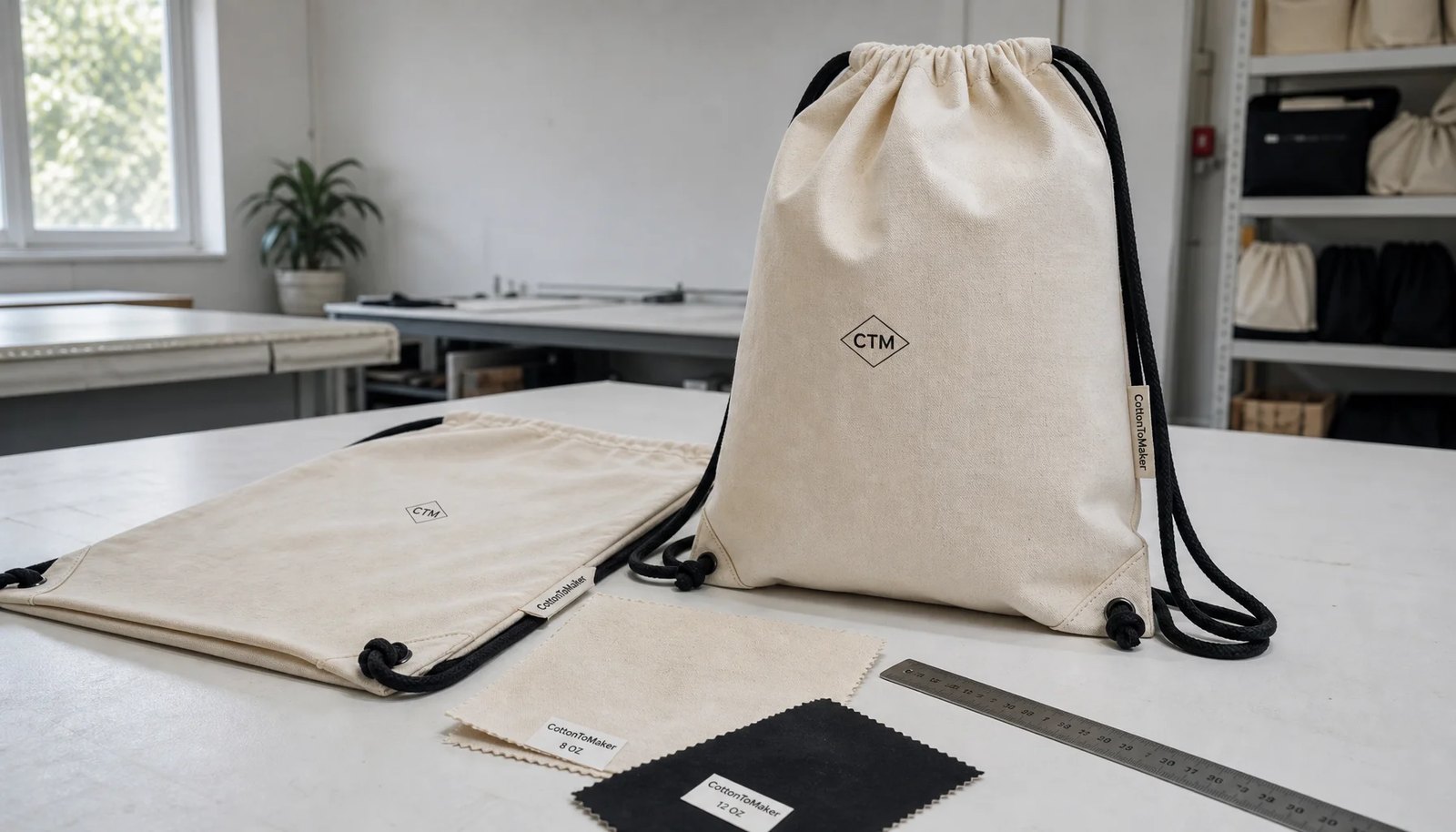
Most trade show buyers do not need a heavy retail backpack. For standard giveaways, 6 oz to 8 oz cotton canvas, roughly 180-240 GSM, is usually the most practical range because it feels substantial enough for branded events without pushing freight and sewing costs too high. If the bag is meant to be reused after the event or handed to VIPs, 10 oz cotton canvas, roughly 280-320 GSM, is a more appropriate premium option, but the landed-cost impact should be checked before approving it.
Construction matters as much as fabric weight. A top double-fold channel is the common, efficient choice for large event quantities, while reinforced lower corners or bar-tack stitching help the bag survive repeated loading. The buyer should ask how the cord passes through the channel, whether the cord ends are heat-sealed or knotted, and whether any metal eyelets are being used. Those details affect appearance, assembly time, and the failure rate at the cord exits. It is also worth asking whether the fabric is pre-shrunk or whether the supplier expects a small dimensional shift after washing, because that affects how tightly the size tolerance should be written.
- Use 5 oz to 6 oz only when the contents are light and flat.
- Use 6 oz to 8 oz for the most common trade show giveaway profile.
- Use 10 oz when the bag needs a premium hand feel or repeated reuse.
- Ask the supplier to send a measured swatch or sample with actual GSM reference.
- Request clear photos or a sample showing how the corners and cord exits are reinforced.
- Confirm whether the cord material is cotton or polyester and whether it matches the expected hand feel.
Negotiate MOQ By Removing Variation
The easiest way to lower a practical MOQ is to reduce the number of variables. A supplier can usually work more efficiently when the order keeps one body size, one fabric weight, one fabric color, one cord style, one print method, and one packing format. The factory can then cut, sew, inspect, and carton-pack one consistent product and change only the printed artwork where needed. That is very different from asking for five versions of a bag that each have a different structure and packing instruction.
Buyers should also separate the production MOQ from the commercial price break. A supplier may technically accept 300 pieces, but the unit cost can still be high because setup time, print plates or screens, and packing labor are spread across too few bags. By contrast, 1000 pieces may be easier for the factory to run and may reduce the per-unit cost enough to justify holding some safety stock for future events. A good negotiation is not just a lower minimum; it is a cleaner production structure. If the team needs sponsor changes or city-specific wording, ask the factory to keep the bag body identical and vary only the artwork file, because that usually preserves the best price structure.
- Combine regional or sponsor orders under one bag body specification.
- Keep custom fabric colors to a minimum unless the brand requirement is non-negotiable.
- Use the same carton pack and carton marking across all artwork versions.
- Accept a standard cotton weight if it already meets the load requirement.
- Ask whether setup charges can be shared across artwork versions when the bag body is unchanged.
- Remove label, trim, and packaging variation before you push for a lower MOQ.
Read The Quote Like A Procurement Document
Two factories can quote the same cotton drawstring backpack and still be pricing different products. One quote may include 8 oz fabric, screen setup, export cartons, realistic inspection time, and a workable schedule. Another may hide cost by quoting lighter fabric, a thinner cord, loose bulk packing, or a simplified timeline that assumes instant approval. The only way to compare the offers is to force both suppliers to disclose the same line items.
A usable quotation should break out unit price, tooling or screen charges, sample cost, packing method, carton size, gross weight, and the freight assumption. For trade show programs, carton data is not optional. Pieces per carton and carton volume affect warehouse handling, venue receiving, and final shipping cost. A lower unit price can easily become the more expensive option if the cartons are oversized or if the event contractor charges by volume rather than by weight. The buyer should also ask whether the quote includes labels, inner bundles, and destination marks, because those details often become change orders later if they were left vague at the start.
- Request fabric GSM, not only fabric description.
- Request the print method, number of colors, and all setup charges.
- Request cord material, cord diameter, and reinforcement method.
- Request carton quantity, carton size, gross weight, and carton marks.
- Request at least two or three price breaks using the same specification.
- Check whether freight, duties, and local delivery are included or excluded from the number on the page.
Treat Sample Approval As A Control Point
A digital mockup is useful for layout discussion, but it cannot prove hand feel, stitch quality, cord performance, or print behavior on cotton. Before bulk production, buyers should approve a physical sample or pre-production sample made with the intended fabric weight, cord, print method, and stitching construction. If the sample was made from different material or by a different process than the bulk order, it is only a concept sample, not a control sample.
The approval should be measurable. For example, the team can approve a 34 x 42 cm bag with +/- 1 cm tolerance, a front logo placed 10 cm below the top edge with +/- 5 mm tolerance, and a specific Pantone or signed print reference. Those numbers make inspection objective. Without them, bulk disputes become subjective, and event buyers do not have time for that kind of back-and-forth when the show date is fixed. If the order has more than one artwork version, sample each one that uses a different ink color, transfer method, or placement rule, because one approved version does not automatically validate another.
- Keep one signed sample with the buyer and one with the factory.
- Photograph the approved sample with a ruler and store it with the PO.
- Test the bag with the actual brochures, bottles, or kits it will carry.
- Pull the cords several times to check channel smoothness and stitch strength.
- Confirm whether the approved sample was made by hand or by the intended bulk process.
- Treat any artwork revision after approval as a formal change, not a casual update.
Set QC Tolerances Before Bulk Cutting Starts
QC for cotton drawstring backpacks should focus on functionality first and branding second, because both matter at a trade show. Critical defects include wrong artwork, wrong bag color, missing drawcords, severe contamination, and anything that creates a safety or usability issue. Major defects include broken stitches, holes, obvious stains, severe print smudging, or cord attachment failures. Minor defects can include loose thread ends or natural cotton flecks only if the buyer has already accepted them as part of the fabric appearance.
Version control is just as important as workmanship. These bags are often distributed quickly, and an error may only be noticed after cartons are opened at the venue. That is why carton labels, artwork version codes, and quantity checks should be part of the inspection plan. A buyer should not assume every carton is identical. The plan should include random carton opening, count verification, print version confirmation, and a simple load test using the real event contents or an agreed equivalent weight. If the customer has an internal QC standard, put it in writing before production, not after the first problem appears.
- Measure finished size on samples from multiple cartons.
- Rub the printed area lightly to check curing or transfer weakness.
- Inspect cord exits and lower corners for skipped stitches and weak reinforcement.
- Separate natural cotton flecks from unacceptable stains, oil marks, and dirt.
- Verify carton labels against PO number, artwork version, quantity, and destination.
- Check for consistent drawcord length so the bag closes evenly on both sides.
Pack For The Receiving Workflow, Not For The Factory
Packing should be designed around the person who receives the goods, not just the production line. Bulk pack is usually the most efficient format for trade show programs. Bags can be bundled in 25 or 50 pieces and packed into export cartons by artwork version, which supports fast counting and reduces handling waste. Individual polybags add cost and labor, but they may be justified for retail resale, kitting, or premium attendee packs that must look clean when opened.
The destination matters. If the shipment goes to a warehouse, standard export cartons may be enough. If it goes to a venue, a show contractor, or a staging warehouse, the carton marks need to be explicit because the receiving team may not know the product, version, or event reference. For multi-city programs, mixed cartons create avoidable errors. Correct carton marking is cheaper than sorting cartons at the venue. It also helps if the supplier tells you the carton dimensions and gross weight early, because that information affects palletization, warehouse booking, and carrier selection.
- Use inner bundles when booth teams need fast hand counting.
- Use individual polybags only when the workflow requires retail handling or clean presentation.
- Mark cartons with PO number, event name, artwork version, quantity, and destination.
- Avoid mixing logo versions in one carton unless the receiving team asked for it.
- Confirm pallet requirements if the bags go to a venue warehouse or fulfillment center.
- Ask whether carton labels can include a simple version code to reduce receiving errors.
Work Backward From The Event Date
Lead time risk on cotton drawstring backpacks is usually approval risk, not sewing risk. The schedule slips because artwork revisions take longer than expected, Pantone matching needs another round, courier transit for samples is underestimated, or packing instructions change after the sample has already been approved. When the show date is fixed, the buyer needs to work backward from the actual delivery deadline, not from the day the factory starts production.
The schedule should separate sample lead time from bulk lead time. Ask the supplier to break the timeline into material preparation, sample making, buyer approval, bulk sewing, inspection, packing, export documents, and freight cutoff. If the order uses dyed fabric, custom labels, multiple artwork versions, or venue-specific packing, the buffer should grow. Air freight can protect the schedule, but it should be treated as a contingency, not the base assumption, because it changes the landed cost materially. Buyers should also confirm the receiving window at the destination site, because an on-time shipment can still become a problem if the venue will not accept cartons on that day.
- Freeze artwork before sample production whenever possible.
- Set an approval deadline tied to the freight cutoff.
- Do not change fabric weight or print method after sample approval unless the schedule is recalculated.
- Keep air freight as a contingency instead of the primary cost assumption.
- Build extra buffer for venue receiving windows and multi-city distribution.
- Ask the supplier to highlight the longest dependency in the schedule so the team knows where the real bottleneck is.
Build The Order For Reuse, Not Just The First Show
Many trade show programs grow into repeat orders, so it pays to build the first buy in a way that supports reordering. If the bag is likely to come back for another city, another quarter, or another sponsor, keep the core spec stable and document it carefully. That means retaining the fabric reference, the approved print file, the carton marking format, and the packing count. When the next event comes up, the buyer can compare against a real production standard instead of rebuilding the spec from scratch.
A repeatable program also makes the supplier relationship easier to manage. If the factory understands that the bag body will stay the same and only the artwork or destination may change, they can plan fabric booking and production capacity more intelligently. That can improve quote speed and make MOQ negotiation more flexible on the next round. For procurement teams, the best first order is the one that can be reproduced without confusion. The file set should be complete enough that a different buyer on the same team could issue the next PO without having to reverse-engineer the first one.
- Archive the approved sample, spec sheet, and signed print reference.
- Store the final carton size, gross weight, and carton mark format for reorders.
- Keep the fabric and cord reference code in the PO file.
- Note any production issues so the next quote can address them directly.
- If multiple events will reuse the same bag, ask the factory to quote a repeat-order path.
- Keep the same body spec even when sponsor artwork changes, unless a functional change is required.
Specification comparison for buyers
| Spec decision | Recommended option | When it fits | Buyer risk to check |
|---|---|---|---|
| Fabric weight for standard exhibitor giveaways | 6 oz to 8 oz cotton canvas, roughly 180-240 GSM | Best for brochures, catalogs, light samples, and a reusable event bag that still needs to stay cost-controlled | Below 160 GSM can feel thin and crease easily; confirm actual GSM from a measured swatch, not only supplier description |
| Premium attendee kit bag | 10 oz cotton canvas, roughly 280-320 GSM, with reinforced lower corners | Good for VIP packs, sponsor kits, or event merchandise expected to be reused after the show | Heavier fabric increases sewing time, freight weight, and carton volume; ask for landed-cost impact before upgrading |
| Standard bag size | 34 x 42 cm or 38 x 45 cm finished size, depending on contents | Fits most trade show handouts, A4 materials, and one bottle plus flat inserts | Confirm whether measurements are taken flat before filling and whether tolerance is +/- 1 cm on cut and finished size |
| Logo method for simple artwork | Single-color or two-color screen print | Best for stable brand marks, booth names, sponsor logos, and event graphics with clean outlines | Ask for screen count, setup charge, and whether artwork placement is one side or both sides |
| Logo method for full-color artwork | DTF transfer or digital print after sample approval on the actual fabric | Fits gradients, small details, and designs that change by city, sponsor, or event | Color shift and hand feel can vary on textured cotton; do not approve from a mockup alone |
| Cord specification | Cotton cord or polyester cord matched to bag weight and channel width | Cotton gives a natural look; polyester usually runs smoother and resists lint on high-volume orders | Thin cord can cut into the channel; ask for cord diameter and pull test results on the sample |
| Construction detail | Top double-fold channel with bar-tack or reinforced corner stitching | Appropriate when the bag must survive repeated loading at events and in transit | Weak cord exits and bottom corners are the first failure points; request photo evidence on the sample |
| Packing format | Bulk carton pack with inner bundles of 25 or 50 pieces | Works well for warehouse receiving, venue delivery, and booth distribution | Mixed artwork cartons and unlabeled bundles cause sorting delays on-site; confirm carton marks and version codes |
| Labeling and traceability | Carton marks with PO, artwork version, quantity, and destination | Useful when the same bag is moving through a warehouse, fulfillment center, or venue contractor | Missing carton IDs make receiving slow and create disputes if versions are mixed |
Buyer checklist before sampling
- Define the use case first: booth giveaway, VIP kit, press pack, paid merchandise, or internal staff bag.
- State the finished bag size in centimeters or inches, confirm whether it is flat measurement, and add a tolerance such as +/- 1 cm.
- Specify the expected load, such as brochures, catalogs, a water bottle, sample products, or apparel.
- Choose the fabric weight by GSM or oz and ask the supplier to confirm the measured fabric reference used in the quote.
- Name the cotton type if it matters to the program: natural, bleached, dyed, recycled blend, or organic cotton with documentation.
- Keep the body spec stable and reduce artwork versions wherever possible; one bag body with multiple print files is easier to negotiate than many custom variants.
- Provide vector artwork, Pantone references, print size, print placement, and whether the logo appears on one side or both sides.
- Request a physical sample or pre-production sample that includes the real fabric, cord, stitching, print method, and packing label.
- Set acceptance tolerances before production starts for size, print placement, color shade, skipped stitches, stains, and drawcord function.
- Ask for a quote in a comparable format: MOQ, setup charges, sample cost, carton size, gross weight, lead time, and Incoterms.
Factory quote questions to send
- What is your standard MOQ for this bag size, and what part of the order drives it most: fabric booking, printing, sewing, or packing?
- Can different logo versions be combined under one fabric MOQ if the bag body, fabric color, cord, size, and packing method stay the same?
- What fabric weights do you stock or produce regularly, and what GSM tolerance should we expect in bulk?
- For this artwork, do you recommend screen print, DTF transfer, digital print, embroidery, or a woven label, and what are the setup charges for each?
- What is the smallest test order you can support without changing the quoted material quality or production method?
- How many working days do you need for material preparation, sample making, sample approval, bulk sewing, inspection, packing, and export documents?
- What carton dimensions, gross weight, and pieces per carton will you quote for bulk pack and for individual polybag pack?
- What inspection standard do you use for cotton bags, and which defects are treated as critical, major, or minor?
- If the event date is fixed, which approval deadline must we meet to keep sea freight, rail freight, or air freight realistic?
- Can you quote the same specification at 500, 1000, 3000, and 5000 pieces so we can compare price breaks on the same bag?
Quality-control points to confirm
- Check fabric weight by measured GSM or signed fabric swatch, not only by marketing terms such as thick cotton or premium canvas.
- Confirm finished size tolerance before cutting starts, commonly +/- 1 cm for simple drawstring backpacks unless the buyer requires tighter control.
- Measure logo placement from the top edge and side seam, and agree a practical tolerance such as +/- 5 mm for simple prints.
- Approve color against Pantone or a signed physical sample, then keep that reference with the purchase order.
- Test that the drawcord runs smoothly through the channel without snagging, twisting badly, or cutting into the fabric edge.
- Inspect cord exits, lower corners, and stress points for secure backstitching, bar-tacks, or other reinforcement that matches the intended load.
- Treat wrong artwork, wrong fabric color, missing drawcords, heavy stains, holes, and severe print smudging as critical or major defects.
- If your company uses AQL, define the standard before production starts, including how critical, major, and minor defects will be classified.
- Check that carton labels match PO number, artwork version, destination, and quantity before goods leave the factory.
- Open cartons from multiple locations in the shipment, not only the easiest-to-reach box on top.