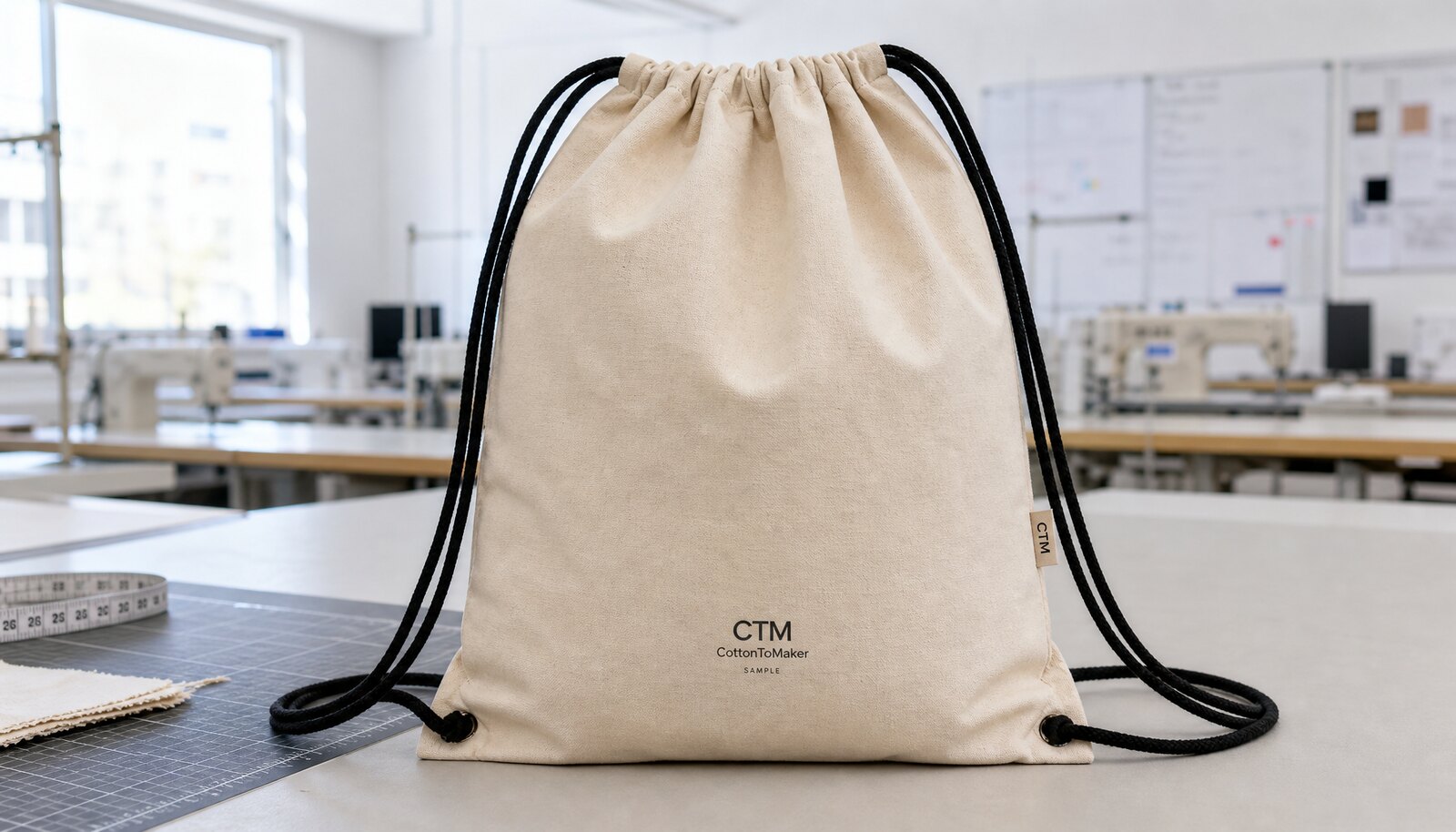
Start With the MOQ Question You Actually Need Answered
On cotton drawstring backpacks, MOQ is rarely a single number. A supplier may quote one minimum for the bag body, another for each colorway, another for the print setup, and a separate one if you want retail packing. That is why a generic request for "low MOQ" usually produces a vague answer. The factory is not hiding one magic number; it is trying to price the cost of change. Fabric procurement, cutting, sewing, print setup, labeling, and carton allocation each move the minimum in different ways.
For gift retail buyers, the real problem is not only unit price. It is assortment risk. A store may need a small test run in one market, then a seasonal color refresh, then a reorder of the winning graphic. If you negotiate against the wrong variable, you can get a low first order that is expensive or impossible to repeat. The better approach is to ask which inputs must stay fixed, which can change without a new setup, and which change forces a new MOQ. That turns the conversation from a sales guess into a production plan.
- Ask whether the MOQ is by total order, by colorway, by print design, or by packing format.
- Separate the trial order from the repeat order before you ask for pricing.
- Treat setup items as real cost drivers, not free extras.
- Keep the first run simple enough that the factory can repeat it without redesign.
Lock a Repeatable Spec Before You Negotiate
The easiest way to lower MOQ without damaging commercial quality is to choose a repeatable spec. For this product, a practical retail range is often 140 to 160 GSM cotton when price sensitivity is high, and 180 GSM when the bag needs more structure, better drape, and a stronger shelf feel. Thinner fabric can help the quote, but if the bag feels flimsy in hand, the buyer will notice it before the customer does. Heavier fabric usually looks better, but only if the stitching, cord channel, and print finish are built to match.
The same logic applies to size and decoration. A standard body size, one print area, and one closure style usually keep the quotation cleaner than custom proportions, lining, or all-over branding. If assortment is important, vary the artwork or cord color rather than the construction. That lets the factory reuse the cutting layout, minimize fabric waste, and keep the sewing line stable. Once the body spec changes, the supplier is no longer quoting a simple variation; it is quoting a new production problem.
- Use 140 to 160 GSM for entry-price or promotional retail programs.
- Use 180 GSM when the bag needs a firmer handfeel and better shelf presence.
- Keep one front print location for the first PO.
- Avoid custom lining, oversized dimensions, or complex trims unless they are commercially necessary.
Benchmark the Sourcing Route Before You Push for a Lower MOQ
Different sourcing routes behave differently, and the MOQ should be judged against the route, not in isolation. Stock blank plus local print is usually the fastest entry point. If blanks are available, buyers often see workable runs around 100 to 300 pieces per design because the fabric and sewing setup are already done. Direct factory custom orders usually start higher, often around 300 to 1,000 pieces per design or colorway, because the factory is carrying the full production setup. Trading company consolidation can sit in the middle if multiple SKUs are pooled into one order.
These ranges are not universal rules, but they are useful negotiation anchors. A low MOQ on a stock blank route may still be the right answer if you need speed and a short test run. A higher MOQ on a direct factory route may be the right answer if the bag is supposed to become a repeat line and the quality has to match from reorder to reorder. In practice, the winning route is the one that gives you the best combination of repeatability, pack control, and landed cost for the sales plan you actually have.
- Use stock blanks when speed matters more than strict batch consistency.
- Use a direct factory when you need repeat orders and tighter control over fabric and sewing.
- Use a trading company only if bundled SKUs or coordination is worth the transparency tradeoff.
- Favor routes that can keep the same fabric and pack structure for the reorder.
Write the RFQ So the Factory Can Quote One Defensible Number
A vague RFQ creates a vague quote. If you send only a logo and ask for best price, the supplier will protect itself with a wider MOQ range or a higher minimum. The factory needs enough detail to cost the order correctly: finished size, fabric GSM, color target, print method, print area, cord style, packing format, trade term, and target ship date. If you also want sample fee treatment, label requirements, or barcode placement, list those up front. The goal is to reduce guessing, not to push the sales contact into inventing a number.
The RFQ should also tell the supplier what you are optimizing for. If the first order is a market test, say that clearly and ask for a structure that can be repeated if the sell-through works. If shelf presentation matters more than unit cost, say that retail-ready packing is required and that you are willing to pay for it. When the factory understands the commercial priority, it can quote a tradeoff instead of a best-case fantasy. That is how you get a useful number instead of a sales lead that falls apart in production.
- Provide finished size, fabric weight, print dimensions, and cord or closure details.
- Specify whether the quote should include labels, hangtags, barcode stickers, and retail packing.
- Ask for separate pricing on sample, tooling, production, and freight.
- State the first-order quantity and whether a repeat order is likely within the same season.
Use Practical Price Breakpoints in the Negotiation
MOQ is easier to negotiate when you talk in breakpoints instead of pretending every unit costs the same. On this type of bag, a small first run may be most realistic when the spec stays close to the supplier's standard pattern and fabric stock. Once the order moves into a 300 to 500 piece range, the factory can usually spread screen or setup cost more efficiently. At 1,000 pieces and above, the per-unit price often improves further because cutting waste, material purchasing, and labor planning become easier to control. That does not mean a larger order is always better. It means the buyer should know where the price curve starts to flatten.
The most effective concessions are usually structural, not emotional. If you remove one colorway, keep the print method simple, or accept the supplier's standard fabric width, you are reducing real cost. If you add a second artwork, a new packing format, or a custom cord color on top of a small first order, you are asking the supplier to absorb several setup costs at once. A cleaner negotiation is to say: quote me at 200 pieces in one spec, then show me what changes at 500 and 1,000. That exposes the real cost drivers and prevents hidden margin later.
- Ask for break pricing at 200, 500, and 1,000 pieces if the program may scale.
- Use one body spec with multiple graphics instead of multiple body specs with one graphic.
- Keep the print method constant if you want to reuse setup.
- If you want a lower MOQ, offer a repeat-order forecast in writing.
Sample Before You Commit to the Production Run
Sampling is the cheapest place to discover a problem. On a cotton drawstring backpack, the issues that matter most are not abstract. They are handfeel, shape, cord tension, seam straightness, and print finish. A good process usually starts with a reference sample or an existing factory sample, then moves to a pre-production sample built with the exact fabric weight, artwork, and packing format you intend to buy. If you are testing several colors, approve the base color and print reference before the factory cuts bulk.
The sample should function as a control standard, not as a display piece. The buyer side should keep one sealed golden sample, and the factory should keep a matching reference so both sides are working from the same target. If the sample is off by a centimeter, if the print sits too high, or if the cord channel twists after filling, those are not cosmetic details. They are the first signs that the order will miss either the shelf expectation or the receiving spec.
- Approve artwork placement before the pre-production sample is cut.
- Use the sample to confirm size, color, stitching, and packing, not just appearance.
- Keep one sealed golden sample on both the buyer and factory side.
- Do not release mass production until the approved sample matches the agreed spec.
Set QC Criteria That Match How the Bag Will Be Sold
QC needs to be specific enough to stop avoidable failures, but not so loose that every shipment becomes a debate. A workable buyer spec usually starts with an AQL plan, then defines the critical dimensions and the appearance points that matter in retail. For this product, the high-risk areas are the cord channel, bottom corners, side seams, and the front print. Those are the points where a buyer can see quality loss without a lab, and where a customer will feel it in use. The inspection standard should reflect that reality.
Concrete criteria help prevent arguments at receipt. Set a size tolerance before production, define how much variation is allowed in fabric weight, and decide what counts as an acceptable print result. If the bag is sold as a premium item, tighten the cosmetic standard. If it is a lower-cost promotional item, keep the focus on structure, print legibility, and pack accuracy. The important thing is that the factory knows the threshold before the first piece is sewn, not after the carton arrives.
- Use AQL 2.5 for major defects and 4.0 for minor defects unless your program needs a tighter plan.
- Set body dimensions within +/-1 cm and cord length difference within 1 cm unless your spec calls for tighter tolerances.
- Require secure seams at the cord channel, side seams, and bottom corners with no skipped stitch run longer than 3 mm.
- Set a print placement tolerance of 2 mm from the approved position and reject visible bleeding, ghosting, or misregistration.
- Require a rub test result before shipment that shows no obvious lift, crack, or color transfer under agreed handling cycles.
- Keep zero tolerance for critical defects such as wrong SKU, severe structural failure, or pack mix-up.
Treat Packing as a Cost Driver, Not a Footnote
Packing changes MOQ faster than many buyers expect. A bulk-packed carton is simple for the factory and usually supports the lowest minimum. Add individual polybags, barcode stickers, hangtags, or retail cards, and the supplier has to source more materials, add labor, and inspect more steps. If the bags are going into gift shops, the simplest retail-ready solution is often a clean hangtag or barcode label rather than a full custom box. Every added pack element should be priced and approved as a real line item.
The safer approach is to quote the product and the packing separately. Ask for a standard export pack first, then price the retail-ready version as an option. That makes it obvious which part of the order is driving the MOQ. It also helps warehouse teams later, because carton counts, color separation, and label logic are easier to verify when the pack structure is stable. For mixed-store programs, carton and pack discipline are not administrative details. They are what keep receiving from turning into a manual sorting problem.
- Choose the simplest pack that still supports shelf presentation.
- Keep carton counts and mix ratios consistent across SKUs.
- Approve barcode placement, hangtag position, and carton marks before production starts.
- Treat every extra packing step as a cost item, not as a free service.
Plan Lead Time Around Material and Setup, Not Sewing Alone
A small MOQ can still miss the launch window if the supplier has to source fabric, open a print setup, prepare labels, and line up packing materials. Buyers often focus on sewing time because it looks like the main step, but the real delay is usually in raw-material availability and pre-production setup. If the factory already has the right cotton weight in stock, the quote may be faster and the MOQ may be easier to hold. If it does not, the minimum may rise because the supplier has to buy more fabric than your order consumes.
For seasonal assortment plans, the lead-time risk is amplified. Holiday runs, tourist-season launches, and event-based gift programs all have narrow arrival targets. A practical schedule starts from the store date and works backward through sample approval, material reservation, production, inspection, freight, and receiving. If you need both low MOQ and a short lead time, ask whether the supplier can reserve fabric for a repeat order or release a partial shipment. That usually matters more than shaving a few units off the first PO.
- Ask the factory to break lead time into fabric, print, sewing, packing, inspection, and dispatch.
- Confirm whether timing starts from deposit receipt or sample approval.
- Keep buffer time for freight, customs, and warehouse receiving.
- If the launch is seasonal, ask whether fabric can be reserved for the repeat run.
Compare Quotes on Landed Cost, Not Just Factory Price
A cheap factory quote can still be the wrong commercial choice. On cotton drawstring backpacks, the real comparison includes product price, print setup, labels, packing, carton handling, freight, duty, bank fees, and any sample deduction rules. If you compare only the per-piece number, the lowest MOQ supplier may look attractive even when the landed cost is higher. The right metric is gross margin on the shelf price, not the quote in isolation. That is especially true for gift retail, where packaging and presentation affect sell-through.
This is where sourcing route matters again. A direct factory may have the best recurring cost once the setup is spread across a stable order. A trader may offer easier communication but add markup. A local converter may win on speed but lose on consistency or material control. The clean way to compare is to normalize every quote to the same trade term, the same pack count, and the same quality expectation. If one supplier looks cheaper only because the fabric is thinner or the pack is simpler, the comparison is not real.
- Compare all quotes in the same currency and trade term.
- Separate one-time setup charges from recurring unit cost.
- Normalize carton count and packing before judging the price.
- Check whether the quote assumes a lower fabric weight or a different print method.
Specification comparison for buyers
| Spec decision | Typical MOQ range | Best when | Commercial edge / watch-out |
|---|---|---|---|
| Stock blank + local print | 100-300 pcs per design, sometimes lower on repeats | You need a quick test order or a short seasonal run | Lowest cash outlay, but blank quality and print consistency depend on two suppliers |
| Direct factory custom order | 300-1,000 pcs per design or colorway | You want repeatable quality and a cleaner long-term program | Best control over fabric and sewing, but setup discipline matters |
| Trading company consolidation | 200-500 pcs across mixed SKUs if combined | You need several variants or accessory packs in one PO | Convenient for mixed orders, but pricing and factory visibility can be less transparent |
| Shared fabric program | 300-800 pcs when the factory stocks the same fabric weight and color | You can work within the supplier's standard raw material window | Can lower raw-material risk, but only if stock is actually on hand during your order window |
| Pilot PO then repeat PO | 150-250 pcs for the test, 500+ on the repeat once spec is locked | You want to validate sell-through before committing inventory | Good for demand testing, but the repeat price and lead time must be written in advance |
| One artwork, multiple colors | 250-600 pcs total if artwork stays constant | You want assortment without multiple print setups | Efficient on print setup, but dyed body colors may still trigger per-color minimums |
| ODM base shape with branding | 200-400 pcs on a stock pattern with logo changes | You need speed without developing a full custom pattern | Fast and practical, but dimensions and cord length still need strict approval |
| Mixed-carton program | 500+ pcs total with agreed pack ratios | You supply multiple stores or distributors | Useful for allocation, but carton labels and SKU separation must be controlled tightly |
Buyer checklist before sampling
- Freeze the bag size, fabric weight, cord style, and print area before requesting price.
- State whether MOQ is by total order, by colorway, by artwork, or by packing format.
- Send print-ready artwork, placement dimensions, and Pantone or visual color targets with the RFQ.
- Ask for separate EXW, FOB, and if needed CIF pricing so freight does not hide the real product cost.
- Request a line-item breakdown for sample fee, screens or setup, labels, hangtags, and carton artwork.
- Confirm whether the sample fee is deductible from production and how many revisions are included.
- Approve a sealed golden sample before mass production starts.
- Get a written lead-time calendar that starts from sample approval and deposit receipt, not from verbal estimates.
Factory quote questions to send
- Is the MOQ quoted by total pieces, by color, by print color, or by each separate artwork?
- What changes in MOQ if we keep the same fabric weight and size but vary only the print design?
- What are the one-time costs for screens, setup, sampling, labels, and carton artwork?
- Can you quote the same order at EXW and FOB, and what is included in each price?
- If we switch from bulk pack to individual polybag or retail tag pack, how does the MOQ change?
- Is the sample fee refundable or deductible from production, and how many sample rounds are included?
- What is the confirmed production lead time after sample approval and deposit?
- Which fabric weights and colors are already in stock, and what is the shelf life of that stock for my order window?
- How do you pack the bags for export, and what is the carton quantity per size or color?
- Can you provide photos or inspection records from a recent similar order with the same fabric weight and print method?
Quality-control points to confirm
- Use an AQL plan before production starts, such as AQL 2.5 for major defects and 4.0 for minor defects, with zero tolerance for critical defects like wrong SKU or severe structural failure.
- Finished body dimensions should stay within +/-1 cm of the approved spec for height and width, with cord length variation between left and right straps kept within 1 cm.
- Fabric weight should be within an agreed tolerance, typically +/-5% of the target GSM, with no obvious handfeel drift across the lot.
- Side seams, bottom corners, and cord channels should show even stitching with no skipped stitch runs longer than 3 mm and no broken seam at stress points.
- Print placement should stay within 2 mm of the approved position, with no visible ghosting, bleeding, or misregistration on the front panel.
- Print durability should pass a buyer-agreed rub test before shipment, such as a minimum 3/5 dry rub result after repeated cycles and no obvious lift, crack, or color transfer under normal handling.
- Cord ends should be secured and cut cleanly, with no fraying that would affect use or shelf appearance.
- A sealed golden sample should be available at the factory and the buyer side so inspection can be judged against the same reference.
- Carton drop checks should include a 1 m drop on multiple faces for at least one sample carton, with no burst carton, broken contents, or label loss.
- Pack verification should confirm carton count, SKU label, barcode scan, color separation, and master pack ratio against the packing list before shipment release.