1. Treat MOQ as a production formula, not a supplier mood
For cotton drawstring backpacks, MOQ is the visible result of several hidden constraints: fabric availability, cutting efficiency, decoration setup, cord sourcing, label procurement, packing labor, inspection risk, and carton planning. A factory may be able to sew 300 bags, but that does not mean it can buy the right materials, set up screens, cut panels, print, sew, inspect, and pack 300 units profitably. When eco apparel brands ask for a lower MOQ, the useful question is not only “Can you do less?” It is “Which part of this specification is creating the minimum?”
That distinction matters because the cheapest-looking order can be the most expensive one to execute. A small trial run with custom dyed cotton, two logo versions, a special cord color, an inserted hangtag, and individual packing may look modest in unit count but heavy in production complexity. The supplier is not dealing with one MOQ. It is dealing with a stack of mini-MOQs inside the same order. If any component has a higher minimum than the bag quantity, the factory either charges more, absorbs the cost, or refuses the order.
A stronger procurement approach is to map MOQ by component before price negotiation starts. Ask for the minimum by fabric color, by artwork version, by label version, and by packing version. A supplier may accept 1,000 units total, but only if there are no more than two artwork versions and one fabric color. Another supplier may accept 500 units in natural cotton but require 1,500 units for custom dyed fabric. Those are not contradictory quotes. They are different production formulas.
For eco apparel brands, MOQ negotiation should protect both launch flexibility and reorder consistency. If the first run is a market test, keep the construction repeatable: standard size, stock fabric, simple print, controlled packing, and clear tolerances. If the bag is intended to become a permanent accessory, spend more time on the pre-production sample and quote structure, because that first approval will become the benchmark for future production.
- Ask MOQ by fabric color, print version, label version, and packing version.
- Identify the component creating the highest minimum before negotiating price.
- Avoid combining too many custom features in the first test order.
- Use a repeatable first-order spec if reorders are likely within the season.
2. Build the RFQ around finished specifications, not inspiration photos
A cotton drawstring backpack RFQ should read like a production brief. Inspiration photos are useful for style direction, but they do not give the supplier enough information to quote accurately. The RFQ should include finished size, fabric construction, finished GSM, drawcord material, cord diameter, print method, logo size, print placement, label details, packing method, carton requirements, destination, and trade term. Without those details, each supplier fills the gaps differently, which makes unit-price comparison misleading.
Finished size is especially important. A common simple backpack size is around 34 x 42 cm, 36 x 44 cm, or 38 x 45 cm, depending on the use case. If the bag must hold a folded hoodie, shoe box, apparel bundle, or mailer insert, measure the item and define the usable opening. If a gusset is needed, specify depth and construction. If no gusset is needed, say so. A supplier quoting a flat drawstring bag and a supplier quoting a gusseted backpack are not quoting the same product.
Tolerances should also be written into the RFQ. For simple cotton drawstring backpacks, a finished size tolerance of about +/- 1 cm is commonly workable, although tighter tolerance may increase inspection pressure and rework risk. Print placement may be specified at +/- 5 mm for simple front logos when brand presentation is important. GSM tolerance is often negotiated around +/- 5%, but the key is to define whether the target refers to finished fabric. Cotton can change after dyeing, washing, calendaring, or finishing.
The RFQ should also state what the buyer does not accept. If the brand will reject strong chemical odor, visible oil stains, crooked print, uneven cord lengths, loose thread nests, mixed SKU cartons, or unapproved fabric substitution, include those points early. Clear rejection criteria may feel strict, but they help serious suppliers quote the right construction instead of winning with a low price based on hidden shortcuts.
- Include finished size and tolerance, not only an approximate dimension.
- Specify whether GSM is finished fabric weight and what tolerance is acceptable.
- Define logo placement by measurements from the bag edges or centerline.
- State unacceptable defects before production, not after the shipment arrives.
- Ask suppliers to list all assumptions and exclusions on the quotation.
3. Choose fabric by use case: GSM alone is not enough
Fabric is usually the largest cost driver in a cotton drawstring backpack, but buyers often oversimplify it by asking only for GSM. GSM matters, but fabric construction, finishing, shrinkage, opacity, and hand feel matter too. A 160 gsm plain weave cotton can feel softer and less structured than a 160 gsm twill. A 200 gsm canvas can feel retail-ready but may increase sewing difficulty, carton weight, and freight cost. The correct choice depends on the sales channel and the expected load.
For event giveaways, subscription inserts, and light apparel packaging, 140-160 gsm plain cotton can be acceptable if the bag does not need to carry heavy goods and the brand accepts a softer drape. For retail accessories or gift-with-purchase programs where the bag represents the apparel brand visually, 180-220 gsm cotton canvas or twill is often a safer target. Above that range, the bag may feel premium, but MOQ, sewing cost, and carton weight can rise quickly.
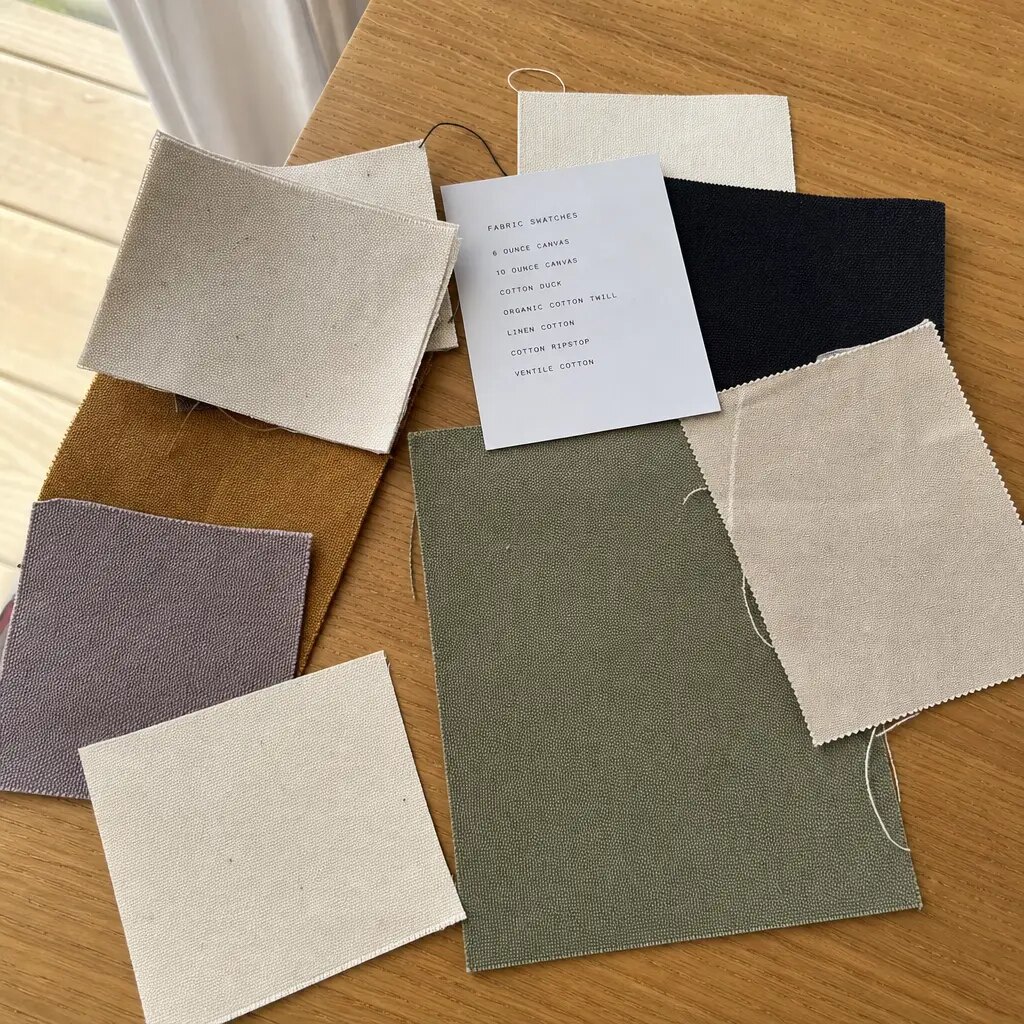
Eco apparel buyers should also be precise about “natural cotton.” Natural or ecru cotton often contains seed specks, small slubs, or shade variation. Those features may support a natural aesthetic, but they still need boundaries. Oil marks, mildew, strong odor, holes, dark stains, and weaving defects should not be treated as natural variation. If the brand wants an exceptionally clean natural surface for minimal logo printing, the supplier should know that before quoting.
Shrinkage is another sourcing issue that is often missed. If the bag may be washed by the end user, used near steam finishing, or packed with garments that require low odor and clean handling, ask whether the fabric is preshrunk or tested. Cotton shrinkage varies by construction and finishing. If washability matters, request a simple shrinkage test and specify the acceptable change. If the bag is not intended to be washed, do not let the supplier assume that no shrinkage or colorfastness checks are needed; at minimum, fabric stability should still be suitable for storage and transit.
- 140-160 gsm plain cotton: light use, lower cost, softer shape.
- 180-220 gsm canvas or twill: better structure and retail presentation.
- Natural cotton: define acceptable slubs and specks separately from defects.
- Custom dyed cotton: requires lab dips, shade approval, and clearer lot control.
- Ask for swatches from actual production fabric or from a known stock fabric lot.
4. Decoration choices can raise MOQ faster than the bag body
For most cotton drawstring backpacks for eco apparel brands, one-color screen printing is the most MOQ-friendly decoration method. It handles simple logos well, keeps setup manageable, and can be repeated on reorders if screens or artwork files are retained. Two-color screen printing is still practical, but it adds registration control and setup cost. More colors, gradients, oversized artwork, or edge-to-edge prints can push a simple bag program into a more complex production category.
The buyer should specify print size, print location, color reference, ink type if relevant, and acceptable placement tolerance. Pantone matching on cotton is not the same as Pantone matching on coated paper. Fabric color, texture, absorption, and ink curing all influence the final appearance. Instead of asking for “exact Pantone match” without context, define a realistic approval process: strike-off or print sample, visual approval under consistent light, and acceptable shade band if production variation occurs.
Embroidery, woven patches, woven labels, and heat transfers can all be valid, but they change the MOQ conversation. Embroidery adds digitizing, thread color management, backing, and possible puckering on lighter cotton. Woven labels and patches require their own tooling or label MOQ, which may exceed the bag order. Heat transfer can reproduce more complex art, but buyers should check hand feel, adhesion, edge lifting, and wash or abrasion resistance for the intended use.
Logo placement should be checked on a real bag, not only a digital mockup. Drawstring backpacks have a top channel, cord movement, side seams, and potential fold lines. Artwork placed too high may interfere visually with the cord channel. Artwork placed too low may fold during packing or be hidden when the bag is worn. A production-grade approval should show the logo measured from the finished top edge, side edge, or centerline, with tolerance stated in millimeters.
- Use one-color screen print when MOQ and repeatability matter most.
- Ask whether screens, digitizing files, or label tooling are reusable for reorders.
- Set print placement tolerance, such as +/- 5 mm for simple front logos when needed.
- Confirm print curing and rub performance before bulk shipment.
- Avoid complex decoration on very light fabric unless the supplier proves it on a sample.
5. Understand the real MOQ levers before negotiating
MOQ negotiation becomes productive when the buyer can separate fixed setup costs from variable unit costs. Fabric, decoration, trims, labels, packing, and cartons each have their own minimum logic. If a factory has stock natural cotton and standard cord, the workable MOQ can be much lower than a program requiring custom dyed fabric, special cord color, woven label, printed retail sleeve, and multiple artwork versions. The bag may look simple, but the production routing is not simple.
Start by asking the supplier to identify the MOQ bottleneck. If the bottleneck is fabric, consider stock fabric or a smaller approved color range. If the bottleneck is print setup, reduce print colors or consolidate artwork. If the bottleneck is woven labels, use a standard side label in the first run or buy extra labels for future orders if cash flow allows. If the bottleneck is retail packing, begin with bulk packing and add retail-ready packaging after sell-through is proven.
Buyers should avoid demanding a low MOQ while keeping every custom requirement. That usually produces one of three outcomes: a high unit price, a reluctant supplier, or unapproved substitutions. A better negotiation gives the supplier something operationally useful: confirmed artwork, a simple packing plan, fast sample feedback, consolidated shipment, or a credible reorder forecast. Suppliers respond better to reduced uncertainty than to pressure alone.
It is also useful to separate the pilot order from the reorder plan. The pilot can be built with stock fabric and simple decoration, while the reorder may move to custom color or upgraded packaging once demand is proven. Put that plan in writing. A supplier may be more flexible on the first MOQ if the specification is easy to run and the buyer shows a realistic path to higher-volume repeat business.
- Reduce MOQ pressure by using stock fabric, standard cord, and one print version.
- Negotiate by changing the cost driver, not only by asking for a lower number.
- Separate pilot-order specs from long-term program specs.
- Offer faster approvals and clean packing instructions as part of the negotiation.
- Be cautious if a supplier accepts every low-MOQ custom request without explaining constraints.
6. Compare quotes using line items and landed-cost inputs
A usable quote for cotton drawstring backpacks should show exactly what is included. At minimum, it should state finished size, fabric type, finished GSM, cord material and diameter, decoration method, print size, label type, packing method, units per carton, carton dimensions, gross weight, MOQ, sample cost, setup charges, production lead time, and trade term. If any of those fields are missing, two quotes may look comparable while representing different products.
Line-item transparency is especially important for MOQ negotiation. A bundled unit price may hide screen charges, label tooling, packing labor, or inland freight. If a supplier offers a lower unit price but packs fewer units per carton or uses a heavier carton configuration, the landed cost may be worse. For procurement teams, carton CBM, gross weight, and units per carton can matter nearly as much as the ex-factory unit cost, especially for bulky low-value accessories.
Trade terms should be kept separate from product specs. EXW, FOB, FCA, CIF, and DDP quotes are not directly comparable unless the buyer normalizes freight, export handling, duties, and local delivery. For early supplier comparison, many buyers prefer FOB or EXW plus carton data so freight forwarders can calculate cost consistently. Whatever term is used, the quote should not mix product upgrades and logistics assumptions in a way that hides the true bag cost.
Quote validity also matters. Cotton prices, exchange rates, freight markets, and labor availability can shift. Ask how long the quote is valid and whether the price assumes a specific fabric lot. If the supplier is quoting stock fabric, confirm whether that stock is reserved after deposit or subject to availability. A quote that cannot be repeated at order time is not a reliable procurement basis.
- Compare unit price together with carton CBM and gross weight.
- Separate sample, setup, tooling, packing, and carton charges where possible.
- Ask whether quoted fabric stock is reserved or only estimated.
- Normalize trade terms before choosing the lowest supplier.
- Require one quote per SKU or artwork version to avoid hidden averaging.
7. Use sampling to lock construction, not just branding
A sample should not be approved only because the logo looks acceptable. For a cotton drawstring backpack, the sample is the contract reference for fabric hand feel, structure, sewing, cord movement, print appearance, label placement, and packing. If the sample uses substitute fabric or a substitute cord, the supplier should mark that clearly. A visual mockup is useful for design review, but it should not be treated as a production approval sample.
The sample review should be physical and measurable. Measure the finished width and height, cord length on both sides, print position, print size, stitch density, and channel width. Pull the drawcord repeatedly to check smoothness and symmetry. Load the bag with a realistic weight for its intended use, such as folded apparel, a catalog set, or light daily-carry items. Inspect whether the bottom corners distort or whether the cord attachment starts to tear.
For retail or brand-facing programs, check the surface after folding and packing. Natural cotton can crease, and heavier canvas may hold fold marks. That is not automatically a defect, but the buyer should understand how the product will look after carton compression. If individual sleeves, bands, or labels are required, review them with the bag sample rather than after bulk production. Packaging can change the final presentation as much as the bag itself.
Approval should be written. Mark the sample status: approved, approved with corrections, or rejected. List required changes clearly and state whether another sample is needed before bulk. If the buyer approves by email but does not document tolerances, the factory may interpret the sample broadly. A signed and sealed sample, plus production photos at key stages, reduces later disputes.
- Measure the sample and record results against the RFQ.
- Check cord pull, corner strength, top-channel movement, and seam security.
- Confirm whether sample materials are production materials or substitutes.
- Approve packing together with the bag if retail presentation matters.
- Keep one sealed approval sample and require the supplier to keep one matching reference.
8. Specify packing early because it changes cost, QC, and freight
Packing is often treated as an afterthought, but it can affect MOQ, unit cost, carton volume, warehouse receiving, and defect visibility. Bulk packing is usually the most cost-efficient option: bags are folded, bundled, placed in an inner bag or master polybag, and packed into export cartons. For wholesale or internal distribution, this may be fully adequate. For retail, marketplace, or retailer-routing programs, individual packaging, barcode labels, hangtags, or paper bands may be required.
Each packaging upgrade has a production implication. Individual sleeves add material cost and labor time. Printed insert cards may have their own print minimum. Barcode labels require data accuracy and placement control. Mixed-SKU cartons can reduce logistics cost but increase receiving and inspection risk. If the packing plan is not confirmed until after sewing, the supplier may have to repack finished goods, which adds cost and delays shipment.
Carton planning should be part of the quote, not a post-production detail. Ask for units per carton, carton dimensions, gross weight, net weight, and total CBM estimate. Densely packed cotton bags may compress well, but over-compression can cause hard creases and make the product look poorly finished. Under-packed cartons waste freight volume. The correct balance depends on fabric weight, fold method, destination handling, and whether the product is retail-ready.
Traceability is another reason to control packing. Carton marks should show PO number, SKU, color, artwork version if relevant, quantity, carton number, and country of origin if required by the channel. If there are multiple artwork versions, avoid uncontrolled mixed cartons. If mixed cartons are necessary, require a clear inner-pack split and packing list format before production begins.
- Bulk pack for lower cost and simpler distribution.
- Use individual sleeves or paper bands only when the sales channel needs them.
- Confirm carton CBM before approving the final quote.
- Require SKU and carton-number traceability for multi-version orders.
- Approve barcode and retailer labels before mass packing starts.
9. Define QC standards before the factory cuts fabric
Quality control for cotton drawstring backpacks should begin before cutting. Once panels are cut and printed, many defects become expensive to fix. Fabric inspection should check shade consistency, weaving faults, holes, oil marks, stains, odor, slubs, and width. Natural cotton variation should be separated from unacceptable defects. If the buyer wants a clean retail surface, this must be defined before the supplier uses a lower-grade natural fabric lot.
In-process QC should cover cutting accuracy, print placement, print curing, sewing, cord attachment, and thread trimming. The top drawcord channel is a key area because twisting, uneven stitching, or blocked movement can make the bag frustrating to use. Bottom corners also need attention because the cord transfers load to those points. If the bag is meant for daily carry or retail sale, bar-tacks or reinforced stitching should be confirmed at stress points.
Final inspection should be measurable. For general consumer goods inspections, buyers often use AQL sampling, such as critical 0, major 2.5, minor 4.0, but the correct level depends on the buyer’s risk tolerance and channel requirements. Whatever standard is chosen, define it in the PO or inspection booking. Critical defects may include mold, sharp metal contamination, wrong artwork, wrong SKU, or serious safety concerns. Major defects may include open seams, severe stains, wrong size beyond tolerance, failed cord attachment, or unacceptable print flaws. Minor defects may include small loose threads or slight cosmetic variation within agreed limits.
Inspection should also verify packing and carton condition. Count units, check SKU separation, scan barcodes if applicable, verify carton marks, and compare gross weight against the packing list. If the order ships long distance or will be stacked in a warehouse, carton strength and compression should be considered. A good bag can still create a customer complaint if it arrives stained, crushed, mislabeled, or short-packed.
- Inspect fabric before cutting, especially for natural cotton lots.
- Measure finished size, GSM, cord length, and print placement on random units.
- Classify defects as critical, major, or minor before inspection.
- Use AQL or another written sampling plan rather than informal photo approval only.
- Do not approve shipment until packing counts, carton marks, and SKU separation are checked.
10. A practical negotiation sequence for procurement teams
The strongest MOQ negotiation follows a sequence. First, define the commercial use case and target channel. Second, write the production RFQ with finished specs and tolerances. Third, request quotes that show MOQ by component. Fourth, compare quotes using both product cost and landed-cost inputs. Fifth, sample the preferred construction. Sixth, negotiate the MOQ by simplifying the true bottleneck rather than weakening quality requirements.
For a new eco apparel brand program, the safest first-order route is often stock natural cotton, standard finished size, 180 gsm range if retail presentation matters, one-color screen print, cotton cord, bulk or simple individual packing, and clear carton labels. This combination keeps the bag aligned with an eco brand story without adding unnecessary dye-lot and trim complexity. Once demand is proven, the brand can add custom dyed fabric, upgraded labels, specialty packing, or more artwork versions.
Procurement teams should be cautious with suppliers who quote very low MOQ and low price without asking technical questions. A competent supplier will ask about fabric weight, artwork, packing, tolerance, and shipment term. Those questions are not obstacles; they are signs that the supplier understands production risk. If a supplier does not clarify the spec, the buyer must assume the quote is based on the cheapest interpretation.
Finally, document every agreed change. MOQ negotiation often happens across emails, chats, revised artwork files, and sample comments. Before deposit and production, consolidate the final spec into one purchase order or tech pack attachment. Include the approved sample reference, quote version, artwork file name, packing plan, tolerance table, inspection requirement, and shipment term. That discipline is what turns a negotiated MOQ into a reliable bulk order.
- Negotiate after identifying the MOQ bottleneck, not before.
- Simplify custom color, print versions, labels, or packing to reduce minimums.
- Keep quality tolerances firm even when reducing quantity.
- Consolidate final approvals into one written PO or tech pack.
- Plan the first order so it can be repeated without redesign.
Specification comparison for buyers
| Spec decision | Recommended option | When it fits | Buyer risk to check |
|---|---|---|---|
| Finished size | Common retail range: 34 x 42 cm to 38 x 45 cm; tolerance typically +/- 1 cm after sewing | Works for apparel inserts, light retail accessories, event merchandise, and lifestyle brand packaging | If size is quoted before shrinkage or without finished tolerance, the bulk bag may be too small for folded garments or mailer use |
| Fabric weight | 140-160 gsm plain cotton for light programs; 180-220 gsm cotton canvas or twill for retail-ready bags | Choose lighter weights for inserts and giveaways; choose heavier weights for better structure, opacity, and perceived value | Factories may quote nominal GSM; require acceptable GSM tolerance, such as +/- 5%, and confirm whether weight is greige, finished, or washed fabric |
| Fabric construction | Plain weave cotton for low-cost simple bags; twill or canvas for stronger hand feel and cleaner shape | Useful when the bag must support an apparel brand image rather than function as a disposable promo item | Different constructions at the same GSM can feel very different; compare hand feel and shrinkage, not GSM alone |
| Drawcord type | 5-7 mm cotton cord for eco positioning; cotton-poly blend when abrasion resistance and consistent diameter matter | Cotton cord supports natural material messaging; blended cord may pull more smoothly and fray less | Check cord diameter, finished length, end treatment, knot security, and whether metal eyelets are required or avoided |
| Reinforcement | Double-fold top channel, secure bottom corner cord attachment, bar-tack or reinforced stitch at stress points | Important for retail use, daily carry, campus programs, gift-with-purchase, and reusable packaging | Weak corner attachment and skipped stitches at the drawcord channel are common failure points during pull testing |
| Print method | 1-color or 2-color screen print for most MOQ-sensitive orders; heat transfer only when artwork requires it; embroidery for small simple marks | Screen print is usually the most repeatable option for cotton bag programs with flat logos | Ask for print size, screen charge, ink type, color tolerance, registration tolerance, curing method, and rub-test expectation |
| Color strategy | Natural, ecru, black, or supplier stock shades for first orders; custom Pantone dye only when brand color is critical | Stock fabric usually gives the lowest workable MOQ and fastest confirmation | Custom dyeing may require higher fabric minimums, lab dips, shade band approval, and more time; shade variation between lots must be defined |
| MOQ structure | Negotiate MOQ by fabric color, print version, and packing version separately | Best for brands with several logos, seasonal capsules, or retailer-specific packs | A supplier may accept 1,000 total units but require 500 per color or 300 per artwork; clarify the real constraint before comparing quotes |
| Packing method | Bulk pack 50-100 pcs per inner polybag or bundle for wholesale; individual FSC paper band or recyclable sleeve only when retail channel needs it | Bulk packing lowers cost and carton volume; individual packing improves presentation and barcode control | Individual packing can increase labor, carton volume, and inspection time; confirm carton dimensions and gross weight before approving |
Buyer checklist before sampling
- Define the use case first: apparel insert, gift-with-purchase, retail accessory, event merchandise, subscription packaging, or wholesale item.
- Confirm finished bag size, acceptable tolerance, gusset requirement, target loading weight, and whether the bag must fit a folded garment or mailer box.
- Specify fabric construction, finished GSM, acceptable GSM tolerance, color route, shrinkage expectations, and whether natural cotton specks or slubs are acceptable.
- State drawcord material, diameter, color, finished length tolerance, knot or end finish, and bottom-corner attachment method.
- Send vector artwork and confirm print size, placement measured from bag edges, Pantone reference, print method, and acceptable registration tolerance for multi-color work.
- Request a pre-production sample made with production-equivalent fabric, cord, stitching, print, label, and packing, or clearly mark any substitute materials in writing.
- Ask suppliers to quote MOQ by fabric color, print version, label version, and packing version rather than only giving a total-order MOQ.
- Require carton information before order confirmation: units per carton, carton dimensions, gross weight, net weight, carton marks, and mixed-carton rules.
- Confirm compliance and labeling needs early, including country of origin, fiber content label if required by the sales channel, barcode, hangtag, and retailer routing instructions.
- Set inspection checkpoints for dimensions, GSM, sewing, drawcord pull, print adhesion, stains, odor, shade consistency, packing count, and carton condition.
Factory quote questions to send
- What is the MOQ by fabric color, print artwork, label version, and packing style? Please do not quote only a combined total MOQ.
- Does the MOQ change if we use natural stock cotton versus custom dyed cotton? If custom dye is required, what is the fabric dye-lot minimum and lab-dip lead time?
- Please quote the bag with finished size, size tolerance, fabric construction, finished GSM, GSM tolerance, cord diameter, cord material, print method, packing style, carton quantity, and trade term shown separately.
- Is the fabric weight quoted as greige weight, finished weight, or washed finished weight? What testing method or internal check do you use to confirm GSM?
- What is the sample charge, what does it include, what materials may be substituted, how long does sampling take, and is the sample charge refundable or credited after bulk order?
- What are the separate charges for screen setup, embroidery digitizing, woven label tooling, printed insert cards, barcode labels, and custom carton marks?
- For screen printing, what ink type do you recommend for cotton canvas, what is the maximum print area, what is the color matching tolerance, and are screens reusable for reorder?
- What lead time is required after sample approval and deposit? Please break it down by fabric booking, dyeing if any, printing, sewing, packing, inspection, and export handover.
- Can you support mixed sizes, mixed artwork, or split shipments? If yes, what is the minimum per variant and what extra packing or administration cost applies?
- What are your normal tolerances for finished size, fabric GSM, cord length, print placement, print registration, and shade variation? How are out-of-tolerance goods handled?
Quality-control points to confirm
- Approve a sealed pre-production sample and record all measurable standards: finished size, GSM, cord diameter, cord length, print position, stitch type, packing, and carton mark.
- Use fabric inspection before cutting, especially for natural cotton where slubs, seed specks, oil marks, weaving faults, and shade bands must be separated from acceptable natural variation.
- Define finished size tolerance, commonly around +/- 1 cm for simple drawstring backpacks, and measure width and height after sewing, not only before cutting.
- Confirm fabric GSM tolerance, commonly +/- 5% unless otherwise agreed, and state whether the target is finished fabric weight.
- Check shrinkage risk if the bag is expected to be washable or exposed to steam finishing; cotton may shrink unless preshrunk or tested.
- Measure drawcord length left and right on random units; specify an allowable difference, such as within 2 cm per side, when symmetry matters for presentation.
- Inspect top channel sewing for twisting, skipped stitches, loose threads, uneven seam allowance, puckering, and blocked cord movement.
- Check bottom corner cord attachment with a pull check appropriate to the intended load; reinforced stitching or bar-tacks should not tear the corner fabric.
- Verify stitch density, thread trimming, seam allowance, and backstitch security at side seams, bottom seams, top hem, and reinforcement points.
- Confirm print placement with a ruler or template; define tolerance such as +/- 5 mm for simple front prints if the design requires consistent merchandising photos.