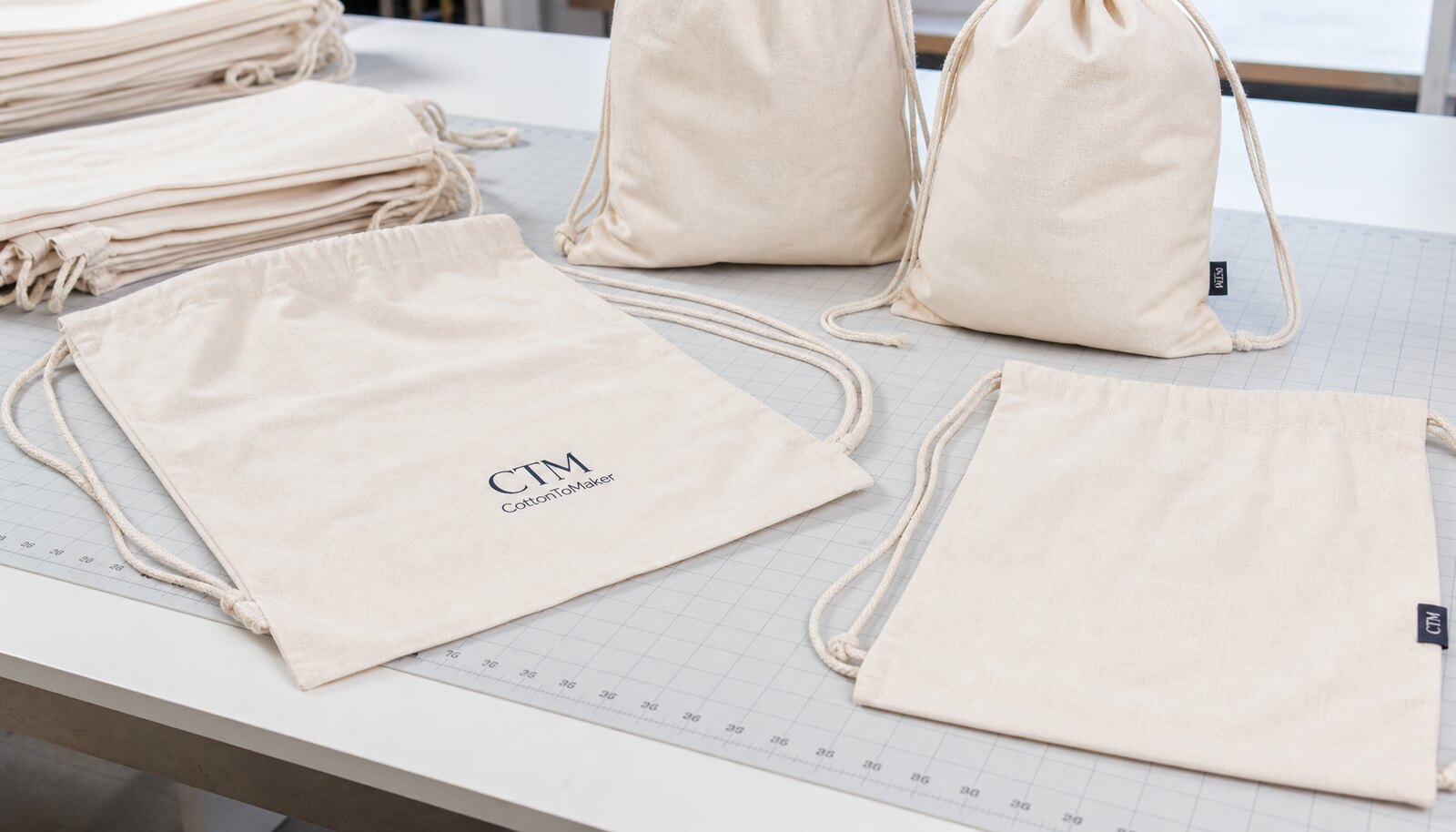
Why MOQ negotiation changes the real cost of a gifting bag
Cotton drawstring backpacks look like a simple promotional item, but MOQ negotiation can decide whether the order is commercially sensible or quietly expensive. The minimum order quantity is tied to fabric availability, cutting efficiency, print setup, cord sourcing, sewing line planning, packing labor, and carton configuration. For corporate gifting, there is another constraint: the bags usually need to arrive together, look consistent, and support a fixed event, onboarding, or campaign date.
A strong negotiation does not start with asking the supplier to reduce MOQ. It starts with finding which part of the specification creates the MOQ. A standard natural cotton bag with one-color screen print may be feasible at a much lower quantity than a custom dyed cotton bag with matching cord, woven label, insert card, and four artwork versions. The buyer who separates those choices can negotiate intelligently. The buyer who asks only for a lower unit price often receives a quote that changes later when the supplier discovers the real requirements.
For procurement teams, the useful goal is a quote that explains the tradeoffs. If the supplier says 1,000 units is the MOQ, ask what changes at 500, 800, 2,500, and 5,000 units. The answer should reveal whether the limit comes from fabric, printing, sewing, packing, or margin. That is where leverage lives.
- Negotiate MOQ, unit price, setup charges, sample timing, and packing format as one commercial package.
- Ask for quantity bands so the supplier shows where the price actually improves.
- Use standard fabric, standard cord, and fewer artwork versions when the deadline is more important than full customization.
- Compare landed cost per usable bag, not only the factory unit price.
Start with the specification that drives the MOQ
The most common reason cotton drawstring backpack quotes become messy is that the RFQ is too loose. A supplier may quote a low price for a lightweight natural cotton bag, while the buyer expects a heavier bag that can hold a notebook, bottle, and apparel item without looking thin. Both sides may believe they are discussing the same product, but the final cost will change once fabric gsm, print size, and packing are clarified.
For most corporate gifting programs, the core specification should include finished bag size, cotton gsm, fabric color, cord material, cord color, print method, print size, number of print locations, number of artwork versions, and packing. A 30 x 40 cm bag in 140 gsm cotton with one-color screen print is a different production job from a 35 x 45 cm bag in 220 gsm cotton with two-color print and individual polybags. The larger or heavier version consumes more fabric, changes carton volume, and may affect the minimum quantity the factory wants to run.
The best RFQ language is measurable. Instead of asking for a premium cotton drawstring bag, ask for 35 x 45 cm finished size, 180 gsm natural cotton, cotton or polyester drawcord, one front screen print up to 22 x 26 cm, bulk packed 100 units per carton, with quote alternatives for individual polybags. That gives the supplier enough information to quote consistently and gives procurement a defensible basis for comparison.
- Use 120-140 gsm for very cost-sensitive giveaways where light hand feel is acceptable.
- Use 140-180 gsm for most corporate gifting, conferences, employee welcome kits, and customer campaigns.
- Use 200-240 gsm when the bag needs a more substantial feel or will carry heavier gift contents.
- Avoid custom dye, custom cord color, and woven labels at low quantities unless the branding value justifies the MOQ increase.
Practical MOQ bands and what to negotiate at each level
MOQ guidance is only useful when it is connected to order size. Exact thresholds vary by supplier, fabric market, season, and decoration method, but many B2B buyers can think in practical bands. Below 300 units, you are usually in stock-product or local-decoration territory. At 300-800 units, the strongest route is often a stock blank bag with print customization. At 1,000-2,500 units, direct factory production becomes more realistic for standard cotton and simple printing. At 5,000 units and above, custom features become easier to discuss because the factory can spread setup, material handling, and line planning across more units.
The negotiation strategy should change with the band. For a 500-unit order, pushing for custom fabric color may create more friction than value. A better concession might be accepting standard natural cotton, one print location, and bulk packing while negotiating a lower setup charge or faster sample. For a 2,500-unit order, you may have room to negotiate better unit pricing, improved carton planning, or included pre-shipment inspection support. At 5,000 units, it is reasonable to ask for sharper price breaks, more detailed QC records, and tighter production scheduling.
Buyers should also watch artwork splits. A supplier may accept 1,000 total units but reject 250 units each across four designs because every artwork version adds setup, proofing, print control, and packing complexity. If the corporate gifting program has departments, regions, or languages, ask whether MOQ is per artwork, per bag color, or total order.
- 50-300 units: use catalog stock or local decoration; negotiate speed, artwork fee, and domestic packing more than factory customization.
- 300-800 units: ask for stock fabric or blank bag bodies; limit the order to one bag color and one or two artwork versions.
- 1,000-2,500 units: negotiate direct factory pricing, included sample, clearer carton data, and setup amortization.
- 2,500-5,000 units: request price breaks, tighter QC terms, and better packing options without assuming every custom trim is free.
- 5,000+ units: discuss custom fabric, repeat-order pricing, call-off shipments, and stronger inspection standards.
Use sourcing route as a negotiation lever
The sourcing route affects MOQ as much as the product specification. A direct factory may offer the best long-run price, but it may not want a small order with several artwork versions and complicated packing. A promotional distributor may accept a smaller order quickly, but the unit price will usually reflect stock holding, decoration coordination, and service margin. A sourcing office or trading partner sits between those models: often more flexible than a single factory, but less transparent on factory-level costs.
The right route depends on the buyer's risk. If the order is small and the event date is close, stock-based sourcing can be the safer choice because there is less product development. If the order is large, repeatable, or brand-sensitive, a factory route gives better control over gsm, construction, print approval, and inspection. If the program includes multiple gift items, several delivery locations, or multilingual packaging, a sourcing office may reduce coordination burden even if the unit price is not the lowest.
Procurement teams should ask suppliers to identify which route they are quoting. Are they manufacturing the bag, decorating a stock blank, buying through another workshop, or consolidating several components? The answer matters because it affects who controls fabric, who approves samples, who absorbs rejects, and who can fix problems before the deadline.
- Choose direct factory when the specification is stable and the quantity supports production efficiency.
- Choose stock blanks when the quantity is low, timing is tight, or the buyer can accept standard size and fabric.
- Choose a sourcing office when the bag is part of a larger kit or requires extra document control.
- Choose a distributor when speed, small quantity, and familiar invoicing matter more than factory transparency.
Worked negotiation scenarios for corporate gifting
A negotiation guide should help a buyer decide what to say when the supplier pushes back. Consider a 600-unit onboarding order with one logo, natural cotton, and a delivery deadline in four weeks. If the factory MOQ is 1,000 units, the buyer should not begin by demanding 600 at the 1,000-unit price. A more workable approach is to ask whether the factory has 140-180 gsm natural cotton in stock, whether a blank bag body is available, and whether screen setup can be charged separately. The concession is simple: the buyer accepts standard size and bulk packing in exchange for lower MOQ and faster production.
For a 1,200-unit event order split across three regional logos, the problem is not total quantity; it is artwork fragmentation. The buyer can ask for one common bag body and three print screens, then compare the cost of 400 units per artwork against 1,200 units with one universal logo plus regional insert cards. Sometimes an insert card is cheaper and safer than multiple print versions, especially when the event date is fixed.
For a 3,000-unit premium client gift, the buyer has more leverage but also more responsibility. It may be reasonable to request 200 gsm cotton, better cord finishing, a signed pre-production sample, and carton labels by destination. The negotiation should focus on included setup, inspection cooperation, carton optimization, and a price ladder for reorder quantities. A slightly higher unit price may be acceptable if it prevents air freight, rework, or inconsistent presentation across the shipment.
- If quantity is below MOQ, offer standard fabric, standard size, fewer artwork versions, or bulk packing before asking for a price exception.
- If artwork versions create MOQ pressure, compare separate prints against one shared print plus inserts or carton-level labeling.
- If the deadline is tight, protect the schedule by reducing custom features first, then discuss freight options.
- If the order is repeatable, ask for setup amortization, retained screens where practical, and reorder price validity.
How to read price breaks and cost scenarios
Price breaks can be misleading if setup, sampling, packing, and freight are not separated. A supplier may quote a lower unit price at 2,500 units, but if the buyer only needs 1,800 units, the excess inventory has a cost. Another supplier may show a higher unit price at 1,000 units but include screen setup and bulk carton packing, making the total project cost closer than it appears.
A simple comparison model helps. Suppose Supplier A quotes 1,000 units at 1.25 per bag, plus 80 screen setup, 60 sample charge, and 0.08 per unit for individual polybagging. Supplier B quotes 1,000 units at 1.38 per bag including setup and bulk packing, but polybags are 0.05 per unit. If the program requires individual polybags, Supplier A totals 1,420 before freight, while Supplier B totals 1,430 before freight. The apparent 0.13 unit difference almost disappears once required charges are added. If Supplier B also has smaller cartons or faster lead time, the landed cost may be better.
Now consider MOQ pressure. If the buyer needs 800 units and Supplier A insists on 1,000, the buyer pays for 200 extra units. At 1.25 per bag, that is 250 of unwanted inventory before packing and freight. A 1.45 unit quote at 800 units may be more efficient if the campaign does not need extras. The best procurement comparison is total landed cost divided by the number of usable required bags, with a clear note on whether surplus units have value.
- Always compare total order cost at the quantity you need and at the supplier's MOQ.
- Separate recurring unit cost from one-time charges such as setup, sample, screen, and proofing.
- Add packing cost and freight impact before choosing the apparent low unit price.
- Treat surplus quantity as useful only when the buyer has a real future use for it.
Sampling and approval records that prevent disputes
Sampling is the stage where most avoidable problems can be caught. A digital proof can confirm artwork size, logo placement, and basic layout, but it cannot confirm fabric hand feel, opacity, cord function, seam strength, or how ink behaves on the actual cotton surface. For new corporate gifting orders, the buyer should approve a physical pre-production sample whenever time allows.
The approval record should be clear enough that a different person could inspect against it. Record the quote revision, artwork file name, PMS or target color reference, bag size, fabric gsm, print method, print dimensions, logo position, cord material, packing format, and sample date. Keep front, back, side seam, cord channel, inside seam, print close-up, label, and packed-carton photos. For important programs, retain a signed physical sample and define whether the bulk shipment must match that sample for fabric shade, print opacity, and construction.
Avoid unnatural internal labels that read like keyword notes. The sample file does not need a phrase such as a cotton drawstring backpacks MOQ negotiation guide for corporate gifting record. It needs a buyer-usable name, such as 180 gsm natural cotton drawstring backpack, front screen print, approved sample, revision 2. Clear commercial naming helps both supplier and buyer trace the right version without making the approval file sound like an SEO artifact.
- Approve artwork layout first, then physical sample, then bulk production.
- Measure logo placement from agreed reference points, such as top edge and side seams.
- Load the sample with the actual gift contents before approving the bag size and seams.
- Keep the approved sample record tied to the purchase order and inspection checklist.
Print method choices that affect MOQ and risk
Screen print is usually the most practical decoration method for cotton drawstring backpacks used in corporate gifting. It works well for simple logos, one or two solid colors, and repeat programs. It also gives suppliers a predictable setup process, which makes MOQ and price breaks easier to understand. The buyer should still confirm ink opacity, registration, print edge sharpness, and whether the fabric surface is smooth enough for the artwork detail.
Heat transfer can be useful for short runs, multiple colors, gradients, or artwork that changes often. The tradeoff is that the hand feel may be less natural, and the transfer film must be checked for edge marks, cracking, and adhesion. Digital print can support complex artwork, but buyers should request realistic samples on the same fabric rather than judging from a computer mockup. Embroidery is possible on heavier cotton bags, but it can distort lighter fabrics and may not be sensible for large filled areas.
Decoration choice can also change MOQ. A supplier may accept a lower quantity for heat transfer because setup is simpler, while screen print may become more economical as quantity rises. For a low-volume executive gift, paying more per unit for heat transfer may be better than forcing a screen-print MOQ. For a 3,000-unit conference bag, screen print is usually easier to control and compare across suppliers.
- Use one-color screen print for economical, repeatable corporate logos.
- Use two-color screen print only when the registration risk and setup cost are justified.
- Use heat transfer when the quantity is low or artwork has many colors, but test adhesion and hand feel.
- Use embroidery mainly on heavier cotton bags and smaller logos where distortion is manageable.
Packing, carton planning, and deadline decisions
Packing is often where a low bag quote becomes a higher landed cost. Bulk packing is usually the most economical approach when the buyer or fulfillment partner will distribute the bags later. Individual polybags add material, labor, carton volume, and sometimes more handling time. Insert cards, barcode labels, destination labels, and mixed-SKU cartons add further work that should be quoted separately rather than assumed.
Carton planning should be requested before supplier selection. Ask for units per carton, carton dimensions, gross weight, net weight, and estimated total CBM. A cotton drawstring backpack is light, so freight cost can be driven by volume rather than weight. If individual polybags reduce packing density, the buyer may pay more in freight even when the bag unit price stays the same. For urgent corporate gifting, this matters because a missed production date can force air freight, which can erase the savings from a hard MOQ negotiation.
Buyers should set decision rules before the order is late. If sample approval slips by three days, decide whether to remove individual polybags, accept standard carton labels, use one shared logo instead of multiple versions, or shift from custom production to stock blanks. These choices are easier to make before people are under event pressure. A supplier should also state whether rush production changes QC risk, available print method, or packing options.
- Use bulk packing when the order is going to a warehouse, kitting partner, or distributor.
- Use individual polybags only when cleanliness, end-user presentation, or fulfillment requirements justify the cost.
- Confirm carton marks, barcode labels, destination sorting, and mixed cartons before production starts.
- For fixed event dates, simplify packing before sacrificing sample approval or inspection.
QC inspection standards for buyer-grade orders
Quality control for cotton drawstring backpacks should be specific because the product is simple enough that defects are easy to define. A good inspection standard covers material, dimensions, stitching, cord function, print appearance, cleanliness, packing, and carton condition. It should also classify defects by severity. A missing logo, wrong artwork, severe stain, mold odor, unsafe sharp object, or unusable closure should be treated differently from a slightly long thread that can be trimmed.
For dimensions, inspect finished size flat and define the tolerance. For fabric, confirm gsm against the agreed commercial tolerance and compare shade to the approved sample. For stitching, look at cord channel seams, side seams, bottom seams, bartacks if used, and thread trimming. For cord function, open and close the bag repeatedly and check whether both sides pull evenly. For print, inspect placement, opacity, registration, cracking, pinholes, bleed, smudging, and color consistency across cartons.
The buyer should also inspect the bag as a gift container. Put the actual contents inside and see whether the bag hangs correctly, whether the print distorts, and whether seams are strained. Corporate gifting is presentation-sensitive. A bag can technically hold contents but still look poor if the logo is too low, the fabric is translucent, or the cords are uneven. That is why the approved sample and inspection checklist should reflect real use, not only flat measurements.
- Define critical defects such as wrong logo, wrong bag color, mold, severe contamination, and broken closure.
- Define major defects such as off-center print beyond tolerance, open seam, missing cord, heavy ink smudge, or incorrect packing.
- Define minor defects such as trimable thread ends, slight shade variation within tolerance, or small non-front-facing marks.
- Require carton inspection for moisture, crushed edges, incorrect marks, missing labels, and count discrepancies.
Specification comparison for buyers
| Sourcing route | Typical MOQ behavior | Commercial tradeoff | Best fit for buyer |
|---|---|---|---|
| Direct factory | Usually strongest at 1,000+ units for standard cotton bags; lower may be possible with stock fabric and one-color print | Best unit price and production control, but requires clearer specs, faster approvals, and more buyer-side follow-up | Procurement teams with defined artwork, stable quantity, and enough time for sampling and inspection |
| Factory using blank stock base | Can sometimes support 300-800 units if the bag body already exists and only the print changes | Lower MOQ and faster sampling, but fewer choices for size, gsm, cord color, and fabric shade | Event orders, pilot gifting programs, or buyers testing a design before a larger reorder |
| Sourcing office or trading partner | Often flexible from 500-2,000 units because they can place work with several workshops or consolidate related orders | Higher margin than direct factory, but easier communication, document control, and issue escalation | Buyers managing several SKUs, mixed materials, or regional delivery requirements |
| Promotional distributor | Often starts at 100-500 units if using catalog stock, with decoration added separately | Fastest route for small runs, but limited customization, less factory transparency, and higher unit price | Rush gifting, small departments, sales events, or orders where speed matters more than custom construction |
| Local decorator using imported blanks | Can handle small quantities, often 50-300 units, depending on blank availability | Shorter delivery risk after blank stock arrives, but bag quality and stock consistency may vary by batch | Last-minute logo changes, domestic fulfillment, or low-volume executive gifting |
| Full custom factory run | Usually needs higher MOQ, often 2,000-5,000+ units when fabric color, cord dye, labels, or pattern changes are custom | Best brand control and lowest long-run cost, but longer development time and more exposure to material MOQ | Annual programs, retail-adjacent gift sets, or brand teams that need repeatable custom specifications |
Buyer checklist before sampling
- Define target quantity, acceptable overrun or underrun, and whether MOQ is by total units, bag color, artwork version, or delivery destination
- Lock core specification before negotiation: bag size, cotton gsm, fabric color, cord material, cord color, print size, print method, and packing format
- State whether the order can use standard natural cotton, stock fabric, or existing blank bag bodies to reduce MOQ pressure
- Ask for a stepped quote at three quantity bands, such as 500, 1,000, and 2,500 units, with setup, sample, packing, and freight assumptions separated
- Confirm whether screen setup, artwork proofing, sample charge, carton marks, barcode labels, inserts, and individual polybags are included or itemized
- Request carton data before supplier selection: units per carton, carton dimensions, gross weight, estimated total CBM, and any mixed-carton rules
- Approve a physical pre-production sample for new branded orders and keep the signed sample tied to the same quote revision and artwork file
- Check logo placement, print opacity, seam strength, cord length, fabric shade, cotton gsm tolerance, odor, stains, and carton condition before shipment
- Build a deadline decision rule: if sample approval misses the internal date, simplify the spec, use stock blanks, reduce packing complexity, or change transport mode
- Compare landed cost per usable bag, not only unit price, by adding setup, packing, inspection, freight, destination handling, and likely reject allowance
Factory quote questions to send
- What MOQ applies to the total order, each bag color, each artwork version, and each shipping destination?
- Can the MOQ be reduced by using standard natural cotton, existing fabric stock, or a blank bag body already in production?
- Please quote 500, 1,000, 2,500, and 5,000 units for the same specification, with all setup and packing charges shown separately.
- Which cotton gsm are you quoting, what tolerance applies, and is the weight measured before or after washing, dyeing, or finishing?
- What bag size, seam allowance, cord material, cord diameter, cord length, and print area are included in this price?
- Does the price include one print location, one artwork version, screen setup, PMS matching attempt, digital proof, and physical pre-production sample?
- What is the cost difference for one-color screen print versus two-color screen print, heat transfer, digital print, and embroidery on this fabric weight?
- What packing is included: bulk carton packing, individual polybag, insert card, barcode sticker, carton label, export carton, or mixed-SKU carton?
- What is the estimated carton count, carton size, units per carton, gross weight, and total CBM for each quoted quantity band?
- What production lead time applies after sample approval, and which step is most likely to delay the order: fabric, printing, sewing, packing, or freight booking?
Quality-control points to confirm
- Agree fabric weight tolerance before production; for many commercial cotton bag programs, a practical range is about 5-10% of quoted gsm, but the exact tolerance should be written into the purchase order
- Check fabric shade under consistent lighting, especially when natural cotton, bleached cotton, and dyed cotton are compared across sample and bulk production
- Measure finished bag size flat, including width, height, channel depth, and usable interior space; do not rely only on cutting dimensions
- Inspect stitching at the cord channel, side seams, bottom corners, and stress points for skipped stitches, loose threads, broken thread, and uneven seam allowance
- Pull-test the cord channel and bottom seams using a realistic gift load so the bag is checked as it will be used, not only as a flat textile item
- Verify cord material, cord length, knotting, and closure function across cartons; uneven cords make corporate gift sets look inconsistent even when the bag body is acceptable
- Check logo placement against an agreed tolerance from the top edge, side edges, and bottom seam; record whether tolerance is measured on a flat empty bag
- Review print opacity, registration, pinholes, cracking, smudging, ink bleed, transfer edge marks, and color variation between the approved sample and bulk units
- Confirm packing cleanliness: no moisture, odor, loose ink dust, fabric contamination, torn polybags, missing inserts, or incorrect carton marks
- Set an inspection sampling plan before shipment and define what counts as critical, major, and minor defects for this order