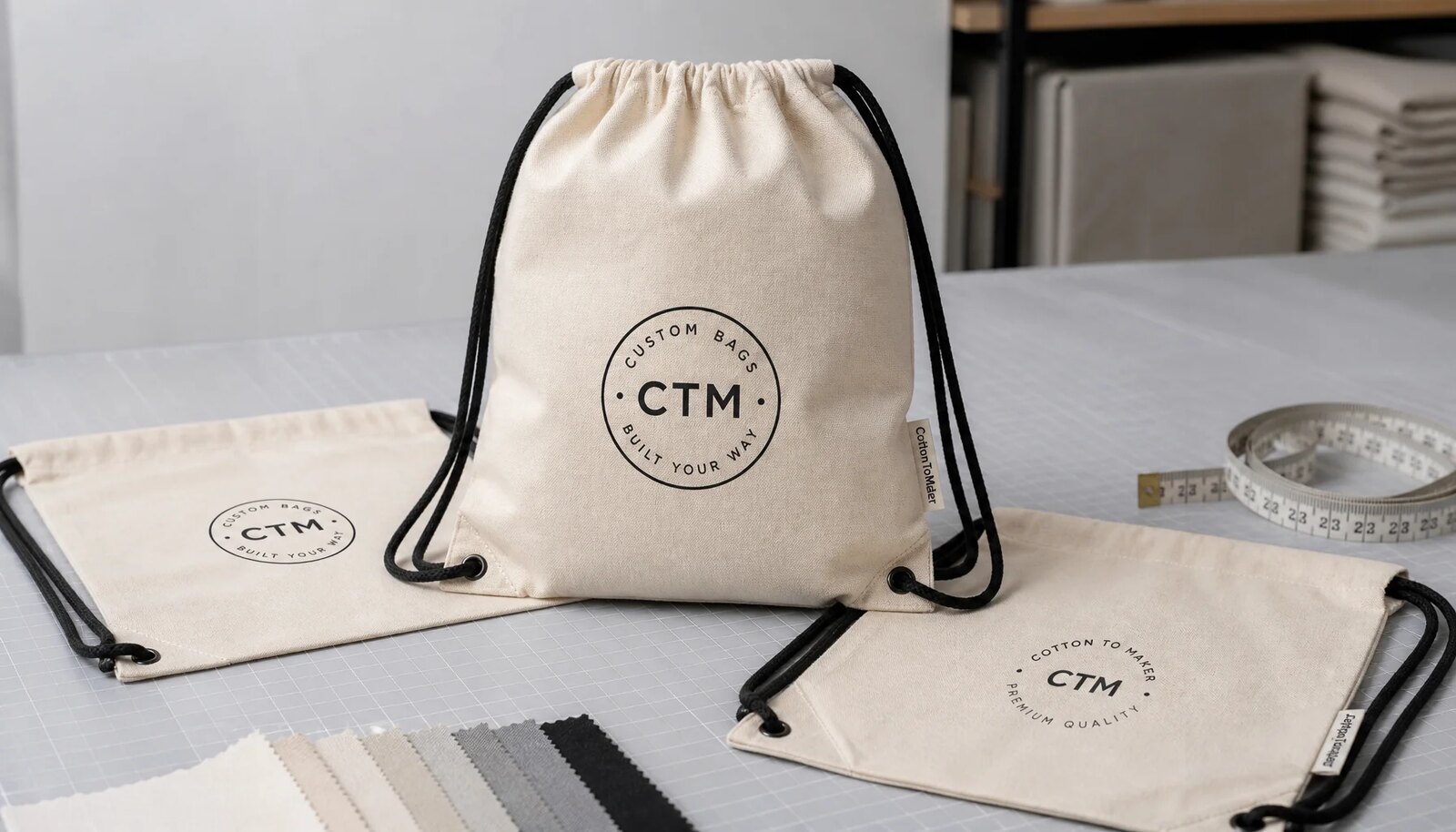
1. Start With the Real Craft Fair Use Case
Cotton drawstring backpacks for craft fairs are bought for different jobs. Some are low-cost giveaways at the entrance. Some are vendor welcome kits. Others become sponsor merchandise, workshop supply bags, retail resale items, or distributor inventory for several events. Those uses may look similar on a product photo, but they do not quote the same way. A giveaway program needs a stable unit price, simple counting, and quick cartons. A resale product needs better fabric, cleaner sewing, individual packing, labels, and tighter inspection. A sponsor program may need several logo versions, which can make artwork control more important than the bag itself.
The first procurement trap is asking only, “What is your MOQ?” before explaining what the bag must do. A supplier may offer a low MOQ for a standard natural cotton drawstring backpack with one black screen print. The answer changes if the same order includes dyed fabric, several cord colors, retail polybags, barcode labels, and separate cartons for different fair locations. The better question is not just how low the MOQ can go. It is which specification can reach the required date with acceptable quality and controlled cost.
Before pushing for a lower minimum, write down the commercial use, target quality level, fixed event date, artwork count, and packing route. Then decide which features are essential and which can move. If the bag only carries a brochure, badge, and light samples, 6 oz cotton may be enough. If shoppers will carry catalogs, craft tools, small purchases, or a water bottle, 8 oz often gives a better balance of handfeel and durability. If the bag is sold as merchandise, 10 oz can support a more premium story, but it may also raise unit cost, carton weight, and freight impact.
- Giveaway priority: stock fabric, standard size, one-color screen print, simple bulk packing, and reliable delivery.
- Vendor kit priority: adequate capacity, smooth cord pull, clean carton separation by booth group, and predictable counting.
- Sponsor merchandise priority: controlled artwork splits, accurate logo placement, Pantone reference, and carton marks by sponsor version.
- Retail resale priority: stronger fabric, individual packing, barcode or hangtag application, cleaner thread trimming, and tighter visual QC.
2. Turn Fabric Weight Into a Quoteable Spec
Fabric weight is one of the biggest drivers of price, MOQ, appearance, and freight. Cotton drawstring backpacks are often described in ounces, GSM, or both. As a practical reference, 5 oz cotton may sit around 140-170 GSM, 6 oz around 170-190 GSM, 8 oz around 220-240 GSM, and 10 oz around 280 GSM or higher. These ranges are not universal. Weave, finishing, shrinkage, and mill standards all matter. For a fair supplier comparison, the quote should state the actual GSM being offered and the tolerance the factory can hold.
For many craft fair programs, the realistic buying range is 6 oz to 8 oz. A 6 oz cotton backpack can work for cost-sensitive distribution when the bag is not expected to carry heavy items and the artwork is not a very large dark print. An 8 oz cotton backpack has more body, better opacity on natural fabric, and a more substantial feel for branded merchandise. Moving to 10 oz may fit premium booth resale or a higher-value sponsor gift, but it can reduce low-MOQ flexibility if the fabric is not already stocked by the supplier.
The fabric color route can change MOQ as much as the fabric weight. Natural unbleached cotton and stock black cotton are usually easier to source at lower MOQ than custom dyed cotton. A custom color may require lab dips, bulk dye approval, shade control, shrinkage checks, and a mill fabric minimum. If the craft fair date is close, a lower MOQ on custom dyed fabric may not be realistic. Using stock natural cotton and adjusting the print color is often safer.
- Use quote wording such as: “35 x 40 cm cotton drawstring backpack, 8 oz natural cotton, supplier to state actual GSM and GSM tolerance.”
- Avoid vague wording such as “high quality cotton,” because one supplier may quote 6 oz while another quotes 8 oz.
- For natural cotton, ask whether the fabric is unbleached, bleached, or treated, and confirm whether slubs are acceptable for your brand presentation.
- For dyed cotton, request lab dip approval, shade tolerance, and a clear rule for mixed shade panels or visible dye variation.
3. Know What MOQ Is Really Covering
MOQ is not only a sewing-line number. It is tied to fabric purchasing, dyeing batch size, cutting yield, print setup, drying space, cord availability, trim sourcing, packing labor, carton segregation, and inspection workload. A factory may be comfortable producing 300 natural cotton drawstring backpacks if the material is in stock and the artwork is a single one-color print. That same 300-piece order becomes much harder when it is split into six artwork versions, two fabric colors, individual polybags, and cartons for different destinations.
A strong MOQ negotiation keeps the base bag stable and treats decoration as the variable. Instead of asking for 100 pieces per design with several different specifications, ask whether the supplier can produce one total quantity with the same fabric, finished size, cord, reinforcement, and packing method, then split only the front print. This gives the factory cleaner cutting, simpler sewing, and fewer chances to mix the wrong cords, labels, or cartons. It also makes the quote more transparent because setup charges can be separated from the base bag cost.
Ask for price breaks that match real event demand. A first craft fair program may need 500 pieces. A seasonal rollout may need 1,000 to 5,000 pieces across multiple events. Price breaks at 300, 500, 1,000, 2,500, and 5,000 pieces help procurement compare the cost of launching small versus consolidating demand. If future demand is real, mention it. Do not promise unsupported repeat volume just to force a lower MOQ, because it can damage the supplier relationship and distort the quote.
- Lowest MOQ structure: one fabric color, one size, one cord color, one print artwork, and one packing method.
- Moderate MOQ structure: same base bag with two or three artwork versions using the same print color and print size.
- High MOQ pressure: custom dyed fabric, several cord colors, multiple print colors, retail packing, and low quantity per SKU.
- Quote requirement: separate base bag cost, screen charges, artwork change charges, packing charges, and carton data.
4. Specify Construction Before Price Hardening
Drawstring backpacks look simple, but small construction choices decide whether they survive a full day at a craft fair. The top channel, side seams, and bottom cord attachments carry most of the stress. If the top channel is uneven, the cords may pull poorly or jam. If the bottom corners are weak, the cord can tear out when the bag is worn on the back. If the seam allowance is too narrow or stitching is inconsistent, the bag may fail even when the fabric weight looks acceptable on paper.
Do not leave reinforcement open to interpretation. Common options include triangular fabric reinforcement at the lower corners, reinforced side-seam stitching, bartacks, or eyelet/grommet-based cord attachment. Metal eyelets can look neat, but they must be set cleanly and should not cut into the fabric. Triangular fabric reinforcement gives a more natural cotton look, but it needs secure stitching and enough fabric at the stress point. The factory standard may be fine; the buyer still needs to approve it through a physical sample.
Cord specification deserves more attention than it usually receives in RFQs. Cotton cord supports a natural, handmade, or eco-positioned product story, but it can fray if cut or knotted poorly. Polyester cord can provide more consistent color and abrasion resistance, especially in black or bright shades. Cord thickness, length, knot size, and end treatment all affect user experience. Short cords make the bag uncomfortable. Uneven cords make the product look careless before anyone even wears it.
- State the bottom-corner construction and require bulk production to match the approved sample.
- Confirm stitch type, backtack or bartack use, seam security, and the visible standard for thread trimming.
- Ask the supplier to confirm cord material, diameter or thickness reference, color, length, knotting, and end finishing.
- During sample approval, pull the cords repeatedly by hand and check that the top channel does not block, twist, or catch.
5. Match Print Method to Artwork and Risk
For craft fair cotton drawstring backpacks, screen printing is usually the most efficient decoration method for simple logos, sponsor marks, slogans, and one- or two-color artwork. The cost is driven by screen setup, number of colors, number of artwork versions, print size, ink coverage, and whether the print is on one side or both sides. For many 300-3,000 piece programs, screen print offers a practical balance of price, repeatability, and visual impact.
Heat transfer can be useful for small pilot runs, detailed graphics, gradients, or full-color artwork. It should still be tested carefully. A transfer that looks sharp on a flat sample may feel stiff on cotton, crack at fold lines, or show edge lifting after packing. Embroidery can work for heavier fabric and smaller logos, but it may distort lightweight cotton and is usually not efficient for large front graphics. The right print method depends on artwork complexity, expected quantity, and inspection risk, not only on the lowest starting MOQ.
Artwork files should arrive production-ready. Suppliers need vector artwork, print size in centimeters, print location, color references, and any limits on minimum line width or small text. Cotton texture can soften fine details. Large solid ink areas may change handfeel and need a print test. If several sponsor logos are used, combining them into one approved artwork file may reduce setup complexity compared with treating each logo as a separate print element.
- For screen print, request setup charge by screen, by color, and by artwork version.
- Define print placement with measurable references, such as distance from the top seam, side edge, or centered front panel.
- Ask for expected placement tolerance, commonly +/-0.5 cm to +/-1 cm depending on artwork and production method.
- Check print opacity, dry rub, tape pull, smudging, and cracking at the packing fold on the pre-production sample.
6. Negotiate Artwork Splits Without SKU Chaos
Craft fair buyers often need more than one logo version. Sponsors may need separate marks. Workshop tracks may need different graphics. A fair may have city editions, maker categories, or seasonal designs. This is where MOQ negotiation gets messy. A supplier may accept 1,000 pieces total but still require a minimum per artwork because each design needs setup, alignment, drying space, counting, packing separation, and carton marking.
The cleanest structure is one base bag with controlled decoration changes. A 1,000-piece order split 600/400 across two one-color black prints is far easier to quote and produce than a 1,000-piece order split across four fabric colors, three cord colors, and five print colors. If sponsors request different logo colors, ask whether one shared print color is acceptable. If not, request a clear surcharge for each additional print color and each artwork change. That keeps negotiation factual instead of emotional.
Packing instructions must follow the artwork plan. If cartons are not marked by artwork, the event team may lose time sorting bags during setup. If cartons contain mixed designs, the packing list should state the exact assortment by carton. For retail resale, each artwork may become a separate SKU with barcode labels and inventory control. In that case, MOQ per SKU matters more than the total order number.
- Ask suppliers to quote total MOQ and minimum quantity per artwork separately.
- Keep one print size and one print position across versions whenever possible.
- Use carton marks such as “Artwork A,” “Artwork B,” sponsor code, booth group, or destination code.
- If mixed cartons are required, define the assortment clearly and ask whether extra packing labor applies.
7. Compare Quotes by Landed Cost
A low ex-factory unit price can be misleading. It may exclude screen charges, sample fees, special packing, carton volume, inspection cost, domestic trucking, export handling, or freight. Cotton drawstring backpacks are lightweight compared with many products, but fabric weight and packing method still affect carton size and gross weight. A 10 oz backpack may look only slightly more expensive than 8 oz at unit level, yet it can change freight cost, storage space, and warehouse handling.
Use one quote template for every supplier. The quote should include currency, Incoterm, MOQ, price breaks, fabric GSM, setup charges, sample charge, sample lead time, bulk lead time, packing method, carton quantity, carton dimensions, gross weight, net weight, estimated CBM, payment terms, and quote validity. Without carton data, buyers cannot compare courier, air freight, LCL sea freight, palletization, or storage cost with confidence.
For craft fairs, delivery reliability has real value. The cheapest quote is not useful if it leaves no time for sample revision, inspection, customs clearance, event kit assembly, or final distribution. If the event date is fixed, quote comparison should include schedule risk. A slightly higher price from a supplier with stock fabric, clear carton data, and realistic lead time may be safer than a lower quote that depends on late dyeing or vague packing details.
- Request price breaks at 300, 500, 1,000, 2,500, and 5,000 pieces if demand may scale.
- Separate one-time charges from repeat-order unit costs so future craft fair programs are easier to budget.
- Ask for both bulk pack and individual polybag options if the final sales channel is not yet confirmed.
- Confirm whether pricing covers one complete shipment only or can support staggered shipment by event location.
8. Use the Sample to Lock the Standard
A digital mockup is useful for checking layout. It is not enough to approve production. The common risks are physical: fabric opacity, fabric handfeel, cord pull, seam security, print coverage, print position, and folded presentation. A pre-production sample should use the actual bulk fabric where possible, the approved cord, the final print method, the intended reinforcement, the final size, and the proposed packing method.
Sample approval should be documented with measurements and photos, not just a quick visual “OK.” Measure the finished size. Verify GSM if practical. Check cord length and pull. Inspect the bottom reinforcement. Rub the print. Fold the bag the way it will be packed and look for cracking, sticking, or ink transfer. If the sample uses substitute material because bulk fabric is not ready yet, the approval should clearly state what is approved and what still needs confirmation before bulk cutting.
Event-driven buyers sometimes approve too quickly because the calendar is tight. That can create a larger problem later if the print color is wrong, cords are uneven, or packing is not retail-ready. A sealed approved sample should be kept as the production reference. Photos should show print placement measurements, corner construction, top channel, cord knot, label position, and packing fold.
- Approve a physical pre-production sample before bulk cutting, especially for first orders or new artwork.
- Record finished size, print size, placement tolerance, fabric standard, cord length, and packing fold in the approval notes.
- If barcode, hangtag, label, or polybag text is required, include it in the sample or mark it as pending approval.
- Do not rely on photo approval alone when fabric shade, ink opacity, cord quality, or packed presentation is critical.
9. Build a QC Plan Buyers Can Enforce
Quality control for cotton drawstring backpacks should focus on repeatable, measurable checks. Buyer and supplier should agree on defect categories before production starts, because “good quality” is too vague to enforce. The inspection plan should cover fabric defects, shade variation, size tolerance, sewing quality, cord performance, print quality, packing accuracy, and carton marking. Larger orders may use AQL inspection, but even small craft fair orders need a written defect list.
State common tolerances in the purchase order. Finished size may be controlled at +/-1 cm. Fabric GSM may be controlled at +/-5% against the approved standard. Print placement may be controlled at +/-0.5 cm to +/-1 cm depending on artwork size and production method. These figures are practical references, not universal rules. Confirm what the factory can consistently achieve before approving the order.
Defect severity should be clear. Critical defects include wrong artwork, mold or mildew odor, unsafe sharp trim, blocked drawcords, broken seams, or completely wrong packing. Major defects include obvious print misplacement, open seams, severe stains, heavy ink smudges, wrong label, or serious shade mismatch. Minor defects may include small loose threads, slight cotton slubs, or minor measurement variation within tolerance. Natural cotton can have character; oil marks, poor sewing, and wrong logos should not be treated as character.
- Inline inspection point: check first finished pieces after printing and sewing start, before the full order is completed incorrectly.
- Final inspection point: verify product quality after packing is mostly complete, but before shipment is released.
- Functional check: pull cords repeatedly, inspect lower corner reinforcement, and confirm the bag opens and closes smoothly.
- Packing check: verify carton quantity, SKU separation, barcode position, folding direction, carton marks, and packing list accuracy.
10. Protect the Event Calendar
MOQ negotiation can save money, but a missed craft fair date can make the whole order useless. Backpacks may be needed before the event for sponsor kit assembly, booth allocation, vendor welcome packs, warehouse receiving, or distribution to different locations. A realistic timeline includes RFQ clarification, artwork preparation, sample making, sample shipping, sample review, revision if needed, material booking, printing, sewing, packing, inspection, export paperwork, international transport, customs clearance, domestic delivery, and event setup.
For normal production, a practical planning range is often 25-40 days after sample approval, depending on quantity, material availability, artwork complexity, and packing requirements. This does not include RFQ negotiation, sample shipping, customs clearance, or final-mile delivery. Custom dyed fabric adds time for lab dips and bulk dye approval. Retail packing adds time for label approval, barcode verification, and SKU-specific packing checks.
When the calendar is tight, simplify the specification. Use stock natural cotton, a standard size, stock cord, one-color screen print, one print location, and bulk carton packing. Avoid custom fabric colors, multiple cord colors, full-color transfers, complex assortments, and late artwork changes. The procurement goal is not the theoretical lowest MOQ. It is the lowest practical MOQ that can still be produced, inspected, shipped, and distributed before the fair.
- Fast schedule route: stock fabric, standard 35 x 40 cm size, one-color screen print, bulk pack, and one destination.
- Medium schedule risk: multiple artwork versions on the same base bag with carton separation by design.
- High schedule risk: custom dyeing, retail packing, several destinations, late barcode approval, or sponsor artwork changes after sample approval.
- Decision gate: approve the physical sample and packing instruction before bulk production starts, not after fabric is already cut.
Specification comparison for buyers
| Procurement decision | Practical specification to quote | When it fits craft fair buying | MOQ or QC risk to control |
|---|---|---|---|
| Fabric weight | 6 oz cotton for light event use; 8 oz cotton for most branded craft fair programs; 10 oz cotton for premium resale only | 6 oz helps protect budget for giveaways, 8 oz improves opacity and handfeel, and 10 oz works when the bag needs a retail-style feel | Ask for actual GSM and tolerance. Typical reference: 6 oz about 170-190 GSM, 8 oz about 220-240 GSM, 10 oz about 280 GSM or higher depending on mill standard |
| Finished size | Common adult size around 35 x 40 cm; confirm finished size after sewing, not cut panel size | Fits brochures, small purchases, craft kits, light samples, and sponsor inserts without looking oversized | Set finished-size tolerance, commonly +/-1 cm. A narrow opening or short cord length can make the bag function more like a pouch than a backpack |
| Fabric color route | Natural unbleached or stock black cotton for lower MOQ; custom dyed cotton only when the brand color is essential | Stock colors suit short craft fair calendars, pilot orders, and programs with fixed event dates | Custom dyeing can require lab dips, shade approval, shrinkage checks, and higher mill MOQ. Define shade tolerance before bulk dyeing |
| Cord specification | Cotton cord for a natural look; polyester cord for abrasion resistance and color consistency; quote cord diameter if known | Cotton cord matches handmade, eco-positioned, and maker-market programs; polyester can be more consistent for dark or bright colors | Confirm cord length, diameter, knotting, end treatment, and pull-through performance. Uneven cord lengths create visible complaints |
| Corner reinforcement | Triangular reinforced bottom corners or reinforced eyelet/grommet construction, depending on the design | Important when shoppers carry purchases, water bottles, catalogs, craft supplies, or vendor kits | The bottom cord attachment is a stress point. Inspect stitch density, backtack, cord security, and fabric tearing around the reinforcement |
| Print method | One-color or two-color screen print for MOQ efficiency; heat transfer for complex full-color artwork or small pilots; embroidery only on suitable heavier fabric | Screen print works well for 300-3,000 piece craft fair programs with simple logos, sponsor marks, or slogans | Quote screen charges by color and artwork. Confirm minimum line width, print placement tolerance, ink opacity, rub resistance, and whether large solid areas will crack when folded |
| Artwork split strategy | Negotiate total order quantity first, then allow controlled artwork splits on the same base bag | Useful for multiple sponsors, vendor groups, seasonal graphics, workshop tracks, or different fair locations | Too many small SKUs increase setup, packing segregation, carton marking errors, and unit cost. Keep fabric, size, cord, and packing identical where possible |
| Packing method | Bulk pack 50-100 pcs per export carton for giveaways; individual polybag, barcode, hangtag, or inner carton only for resale/distribution | Bulk packing is efficient for event setup; retail packing supports scanning, storage, shelf presentation, and distributor handling | Packing affects labor, carton volume, and inspection time. Require carton quantity, dimensions, gross weight, net weight, and carton marks in the quote |
| Sample approval | Physical pre-production sample using actual fabric, actual cord, approved print method, final size, and intended folding/packing | Necessary when event dates are fixed and there is little room for print, shade, size, or construction disputes | A digital mockup does not prove GSM, opacity, cord pull, seam strength, or print adhesion. Seal an approved sample and measure it |
Buyer checklist before sampling
- Define the commercial use before quoting: free giveaway, vendor welcome kit, sponsor merchandise, resale product, distributor inventory, or craft workshop supply bag.
- State the event date, required delivery date, and whether time is needed for kitting, booth distribution, or warehouse receiving before the fair opens.
- Specify finished size in centimeters and state that tolerance applies to finished goods after sewing, not only to cut panels.
- Specify cotton fabric by weight and construction where possible: for example, 8 oz natural cotton canvas or plain-weave cotton, actual GSM to be stated by supplier.
- Ask whether the quoted fabric is stock, greige, natural unbleached, bleached, stock black, or custom dyed, because each route changes MOQ and lead time.
- Confirm expected GSM tolerance, commonly +/-5%, and finished-size tolerance, commonly +/-1 cm, unless your buyer standard requires a tighter limit.
- Define cord material, cord color, cord diameter or thickness reference, cord length, knotting method, and whether cord ends are heat sealed, tipped, or simply knotted.
- Specify bottom-corner construction: reinforced fabric triangle, metal eyelet/grommet, bartack, or other approved method, and ask how the factory tests cord attachment.
- Group SKUs by common base bag specification. Keep the same fabric, size, cord, and packing if you need to negotiate lower MOQ across multiple artwork versions.
- Provide artwork as vector files with Pantone or closest standard color reference, print size, print location, and allowed placement tolerance.
Factory quote questions to send
- What is your practical MOQ for this cotton drawstring backpack in 6 oz, 8 oz, and 10 oz fabric, and what actual GSM do you quote for each option?
- Is the quoted fabric stock natural cotton, stock black cotton, bleached cotton, or custom dyed fabric? If custom dyed, what fabric MOQ and lab dip lead time apply?
- Can the MOQ be calculated by total order quantity if the same base bag is split into two or three one-color screen print artworks?
- What is the minimum quantity per artwork, per print color, and per bag color after the total MOQ is reached?
- What are the separate charges for screen setup, artwork change, print color change, sample making, sample shipping, and any packing materials?
- What finished-size tolerance, GSM tolerance, fabric shade tolerance, and print placement tolerance do you normally apply for cotton drawstring backpacks?
- Which cord materials, colors, and thicknesses are available from stock without increasing MOQ or lead time?
- How is the bottom cord attachment reinforced, and do you use bartack stitching, triangular reinforcement, eyelets, or another construction?
- Can you make a pre-production sample using actual bulk fabric, actual cord, final print method, final size, and final folding/packing?
- What is the sample lead time, bulk production lead time after sample approval, and latest approval date for our required ship date?
Quality-control points to confirm
- Finished size should be measured after sewing and drawcord insertion. A common tolerance for cotton drawstring backpacks is +/-1 cm unless the purchase order states otherwise.
- Fabric GSM should match the approved sample or specification within an agreed range, commonly +/-5%. If fabric is custom dyed, shade tolerance should be agreed against the approved lab dip or bulk standard.
- Natural cotton may contain minor slubs, but visible oil marks, dirt, mildew odor, large stains, mixed shade panels, or fabric holes should be classified as unacceptable defects.
- Drawcords should move smoothly through the top channel without blockage, twisting, skipped seams, sharp edges, or uneven pull length between left and right sides.
- Cord ends should be finished as specified. Cotton cord may be knotted; polyester cord may require heat sealing or a clean end treatment to reduce fraying.
- Bottom reinforcement should be checked under pull force by hand during inspection. The cord attachment should not tear the fabric, open the seam, or detach from the corner.
- Stitching should be straight and secure, with no open seams, broken stitches, skipped stitches, unsecured backtacks, or excessive loose threads on visible areas.
- Screen print should be checked for correct artwork, ink color, opacity, registration, smudging, pinholes, cracking at fold lines, and adhesion after a basic dry rub and tape pull check suitable for cotton fabric.
- Print placement should match the approved sample. For centered front logos, agree a placement tolerance, often +/-0.5 cm to +/-1 cm depending on artwork size and production method.
- Packing inspection should verify unit count, folding direction, polybag or no-polybag requirement, barcode position, hangtag, carton marks, carton assortment, and separation by artwork or destination.