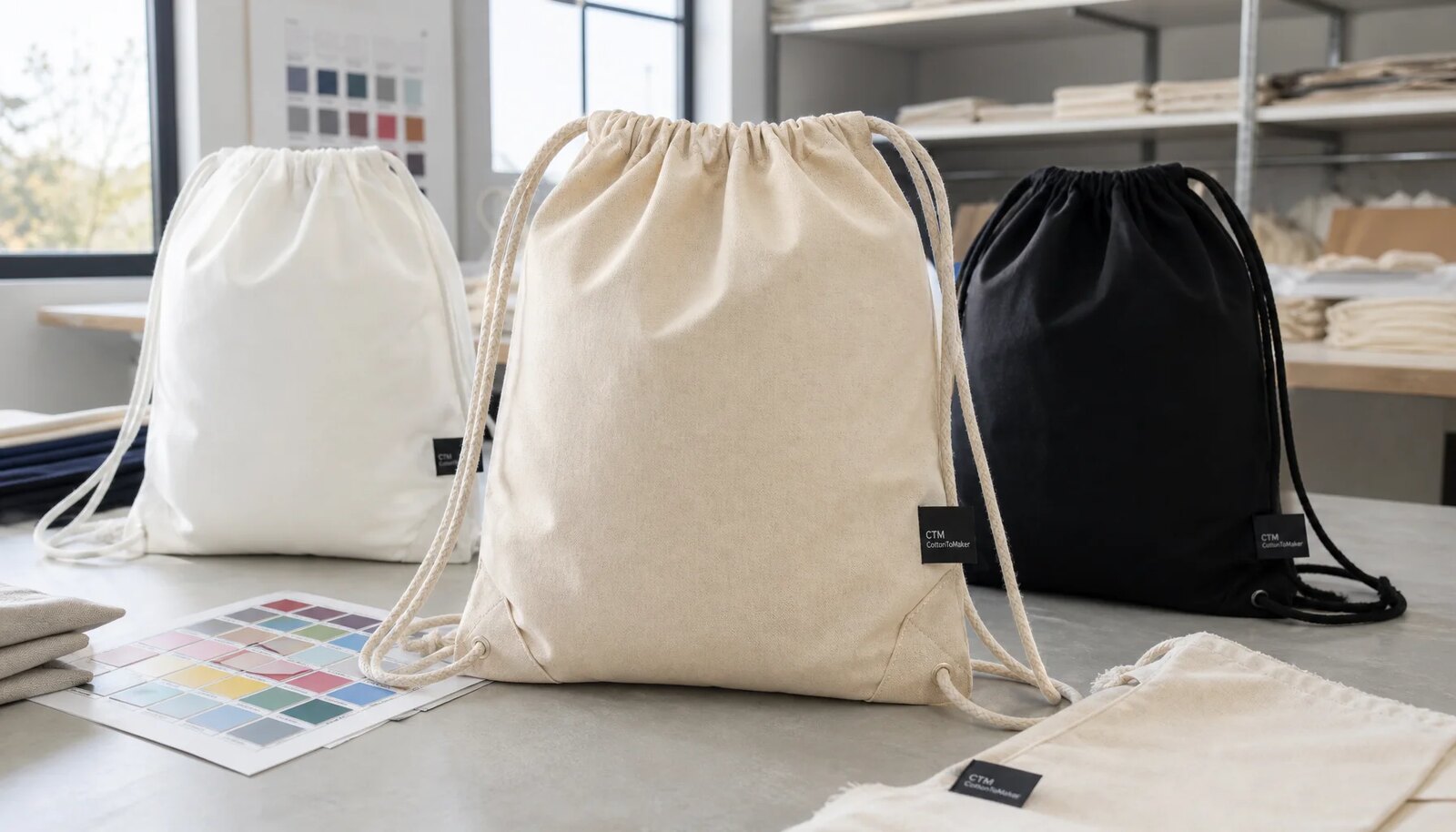
Start With The Bag's Real Job
The first decision is not logo size. It is not even GSM. Start with the job the bag has to do. A cotton drawstring backpack used for a short event handout can be light, simple, and bulk packed. A retail accessory sold beside apparel needs a cleaner hand feel, steadier sizing, controlled branding, and packing that looks deliberate. A staff kit, school program, campus item, or sample bag needs stronger cord exits because users may carry bottles, books, garments, catalogs, or equipment more than once.
Suppliers fill missing details with assumptions. One factory may quote a 145 gsm plain cotton bag with basic cord and no reinforcement. Another may quote 210 gsm light canvas with lower-corner patches, bar-tacks, a woven side label, individual packing, barcode labels, and export cartons. Both quotes may say cotton drawstring backpack. They are not the same product, and the price comparison will be noisy until the construction is pinned down.
Put the intended use in one clear sentence at the top of the RFQ. Name the channel, expected load, whether the bag may be washed, whether it is a low-cost insert or a visible branded product, and whether the order is a one-time campaign or a replenishment item. That one sentence helps the supplier recommend fabric weight, cord diameter, stitch density, reinforcement, decoration, and packing without guessing.
- Use light promotional construction only for flat, low-weight items and short-term distribution.
- Use retail construction when the bag will be sold, displayed, barcoded, or judged as part of an apparel collection.
- Use reinforced construction when the bag may carry books, bottles, samples, gym items, or staff equipment.
- Include expected load range if known, such as papers only, folded apparel, or mixed daily-use items.
- State the buying priority: lowest cost, natural appearance, durability, retail presentation, or launch-date protection.
Specify Finished GSM, Weave, And Finish Together
GSM is useful, but it cannot carry the whole specification. For cotton drawstring backpacks, 140-160 gsm is usually a light promotional range. It works for event distribution, gift-with-purchase programs, and low-load inserts. A 170-190 gsm fabric gives more body while keeping the bag foldable and cost-aware. A 200-240 gsm light canvas or heavier cotton cloth is often a better fit for retail, campus, staff, and repeated-use programs. Heavier options may feel stronger, but they also add sewing bulk, carton volume, and freight cost.
The word finished matters. Greige cloth, dyed cloth, washed cloth, and completed bag panels can measure differently. A supplier quoting 180 gsm greige cotton may deliver a finished bag that feels lighter after processing. Ask whether GSM is measured before or after bleaching, dyeing, washing, sanforizing, printing, steaming, or pressing. For procurement, use finished GSM with a tolerance instead of a vague target weight.
Weave changes both performance and appearance. Plain weave cotton can print cleanly and fold well, though it may feel less structured. Twill can feel smoother and denser, with a more apparel-like surface. Light canvas improves opacity and shape, but it increases needle load and packing bulk. A useful cotton drawstring backpacks for eco apparel brands material selection guide should therefore tie GSM, weave, fabric finish, shrinkage, and surface character together.
- Ask for finished GSM, not only greige fabric weight.
- Define weave as plain weave, twill, light canvas, or another agreed construction.
- State composition clearly, such as 100% cotton, recycled cotton blend, or cotton-poly blend if allowed.
- Confirm whether the cloth is natural, unbleached, bleached, dyed, washed, pre-shrunk, or sanforized.
- Request a physical swatch from the intended production fabric route, not a generic reference swatch.
Control Natural Cotton Character
Natural cotton is not one exact color. It may read warm cream, greyish off-white, or slightly yellow depending on fiber, yarn, finishing, and lighting. It can also show seed flecks, small neps, slubs, and yarn variation. Those features can suit an eco apparel brand, but only if the approved range is clear. Otherwise, what the brand calls authentic texture and what the warehouse calls dirty fabric may become the same argument at inspection.
Define the acceptable surface range before sampling goes too far. A buyer may accept light flecks and small slubs but reject oil marks, dark contamination, holes, heavy yarn faults, panel mismatch, or severe shade jumps. Put that language in the specification and support it with swatches or close-up photos where possible. The phrase natural cotton is too broad for a purchase order.
Shrinkage needs similar care. A drawstring backpack may not be washed often, but it can be steamed, pressed, handled in humid conditions, or washed by an end user. If the bag is sold as a reusable accessory, ask for expected shrinkage after the relevant process and set the finished-size tolerance after finishing. Higher-risk retail orders may need more formal testing. For simpler programs, practical shrinkage information and a stable golden sample may be enough.
Skew and twisting are not the same as shrinkage. A bag can hold roughly the right length and width while the side seam twists or the front panel looks off-grain. Ask how the factory relaxes fabric before cutting, aligns grain, and controls handling after washing or dyeing. If the route includes garment dye or wash, approve the washed result before moving into bulk at scale.
- Define acceptable fleck, slub, nep, and shade range with swatches or close-up photos.
- Reject holes, oil marks, dirt, severe yarn faults, panel mismatch, dampness, and strong odor as defects.
- Request shrinkage data if the bag may be washed or sold as a repeated-use accessory.
- Set finished-size tolerance after all finishing steps, not before washing, dyeing, or pressing.
- Approve natural and off-white shades under consistent lighting before bulk production.
Choose Color With MOQ And Reorders In Mind
Color is a production variable, not a late styling note. Natural and off-white cotton are often the simplest starting points because they fit eco apparel positioning and avoid much of the dye approval work. Black, navy, and custom-dyed colors can look more retail-ready, but they introduce shade control, lab dip timing, and replenishment questions. Procurement should bring color into the RFQ before the supplier builds the price.
Ask how the color will be produced. Fabric dyeing before cutting usually gives better consistency for cut-and-sew bags, but it requires lab dips and may trigger fabric minimums. Garment dyeing can create a softer, washed look, but it can also increase shrinkage, shade variation, cord compatibility issues, label discoloration, and print-planning risk. Stock dyed fabric can shorten lead time, yet repeat availability may be limited.
Document shade tolerance in a way the factory can use. For custom colors, approve lab dips with date, reference, and acceptable shade band. For natural cotton, approve a range instead of one tiny swatch. If the backpacks ship with apparel in related colors, keep tolerance tighter than for event giveaways. If dyeing is subcontracted, confirm who manages lab dips, bulk shade approval, and corrective action if the bulk lot is outside range.
- Use stock natural or off-white fabric when lower MOQ, speed, and simplicity matter most.
- Use custom dye only when volume and schedule can support lab dips and shade-band approval.
- Confirm whether cord, thread, woven label, print ink, and hangtag must match or contrast with the body fabric.
- Ask whether the same shade can be repeated for replenishment orders.
- Do not approve bulk cutting until the final color route is approved.
Treat Cord And Reinforcement As Performance Specs
The drawcord is not just trim. It is part of the load-bearing system. A cotton backpack can have a good body fabric and still fail if the cord is too thin, loose, fuzzy, or poorly anchored. Soft cotton rope supports a natural look, but pure cotton cord can stretch, flatten, fray, and shed fibers if the braid is weak. A tightly braided cotton-poly cord may move more smoothly and hold its diameter better. If the brand requires all-cotton components, ask to see the exact cord and discuss realistic performance.
Specify cord diameter in millimeters. Thin cord saves material and reduces packing bulk, but it may feel sharp on the shoulder and cut into the channel. Thick cord looks more substantial, but it needs a wider top channel and can increase carton volume. Cord length also matters. Too long, and the bag hangs low. Too short, and it may not close fully. Approve cord length on a worn sample, not only on a flat table photo.
Reinforcement is often a small cost with a large quality impact. Lower corners and cord exits carry repeated stress when the bag is pulled closed and worn. Use bar-tacks, back-tacks, reinforcement patches, or stronger seam construction where appropriate. Metal eyelets can be durable and clean-looking, but they are not automatically better. They add cost, inspection points, and possible sharp-edge or finish concerns. Fabric loops or reinforced stitched exits may fit a softer eco product better.
- Specify cord material, diameter, braid or twist type, color, end finish, knot style, and pull length.
- Set top channel width to suit the selected cord so opening and closing feel smooth.
- Use reinforced lower corners and cord exits for repeated-use, retail, campus, or staff programs.
- Require practical pull checks at cord exits and bottom corners during inspection.
- Review cord comfort and bag drop on a worn sample before approving bulk production.
Pick Decoration For The Actual Cotton Surface
Decoration should be chosen after the production fabric is known. Cotton texture affects ink absorption, edge sharpness, opacity, registration, embroidery stability, and hand feel. One-color screen print remains practical for many B2B cotton drawstring backpack programs because it is clear, repeatable, and cost-efficient. It works especially well for logos, line art, and simple brand marks on natural or light cotton.
Water-based print can give a softer hand, but it still needs a strike-off on the actual fabric and shade. Heavier ink systems may improve opacity on dark cotton, though they can feel raised or less aligned with a natural product story. Transfers can handle complex artwork, but they change the panel hand and may crack or peel if poorly matched to the fabric and fold method. Embroidery can look premium for small logos, but it adds needle stress, backing, cost, and possible puckering on lighter fabrics. A woven side label is often a strong option when the brand wants subtle identification without stiffening the main panel.
Separate artwork approval from production approval. A digital file can be correct while the finished decoration is not suitable for the cotton surface. Ask for print strike-offs, embroidery samples, or woven-label samples with exact placement. Define placement from the top edge, side seam, or center line, and set a tolerance such as +/- 5 mm when appropriate. For fine text, gradients, large solids, or multiple colors, ask the supplier to identify risks before the artwork is locked.
- Approve decoration on final production fabric, not on a generic print swatch.
- Define logo size, placement, color references, method, and acceptable placement tolerance.
- Use woven labels or small embroidery when large print coverage would compromise fabric hand.
- Check folding and rubbing so decoration does not crack, peel, transfer, or become sticky.
- Ask how decoration affects MOQ, setup charges, lead time, and rejection risk.
Compare Supplier Routes And Quote Details
A cut-and-sew factory, stock bag decorator, trading company, or merchandise supplier can all quote cotton drawstring backpacks. They do not provide the same level of control. A cut-and-sew factory is usually better for custom size, fabric weight, cord specification, reinforcement, and repeatable replenishment. A stock decorator may be faster for simple logo orders, but may not control fabric source, seam construction, or cord quality. A trading partner can coordinate several steps, provided process ownership is transparent.
Unit price often hides missing work. One quote may include only a blank bag and one-color print. Another may include finished 200 gsm cotton, bar-tacks, custom cord color, woven label, hangtag, individual bag, barcode, carton marks, and inspection support. The lowest number may simply be a narrower scope.
Use a structured quote sheet. Ask for fabric, cutting, sewing, cord, reinforcement, decoration, labels, packing, cartons, sampling, testing, and shipment terms as separate lines where possible. Confirm Incoterms or selling terms, such as EXW or FOB, because inland freight, export handling, and documentation affect landed cost. Also ask which processes are subcontracted. Subcontracting is common for dyeing, printing, embroidery, washing, or label making, but unmanaged subcontracting raises sample-to-bulk risk.
- Send the same tech pack, artwork, packing rules, and target quantities to every supplier.
- Ask who controls fabric sourcing, cutting, sewing, printing, labeling, packing, and inspection.
- Request line-item pricing for major cost drivers instead of one unexplained unit price.
- Compare finished GSM, finished size, reinforcement, decoration, and packing before comparing price.
- Ask for close-up sample photos of seams, cord exits, labels, and decoration before supplier approval.
Manage MOQ By Reducing Variables
MOQ is rarely one clean factory number. It is shaped by fabric roll minimums, dye lots, cord minimums, label weaving minimums, print setup, packing materials, carton marks, and SKU splits. A first order with one fabric, one body color, one cord color, one artwork, and bulk packing can usually be quoted more efficiently than a small order split across several colors, logo versions, barcodes, and retail packs.
Ask for MOQ by variable. A supplier may accept 1,000 pieces total but require 500 pieces per body color, 1,000 pieces per custom cord color, or a separate minimum for woven labels. Printed hangtags and barcode stickers may have their own minimums. If procurement does not uncover these numbers early, the merchandising plan can look approved internally and then stall during supplier confirmation.
Sampling should follow the same discipline. Start with fabric swatches and trim cards. Approve lab dips for custom color. Then move to print or embroidery strike-offs and a sewn sample. For retail programs, approve packing with the pre-production sample. The golden sample should include final fabric, cord, reinforcement, decoration, label, fold, packaging, and carton assumptions because each detail affects inspection and customer presentation.
- Ask for MOQ per body color, cord color, artwork, label, hangtag, barcode, and packing version.
- Hold one base construction steady when testing a new product launch.
- Use shared materials across colorways to improve pricing and production control.
- Do not approve bulk from a blank sample if final trims and decoration are still open.
- Keep one signed golden sample with the buyer and one with the factory.
Build Lead Time Around The Critical Path
A useful RFQ asks for more than unit price and total lead time. It asks which stage controls the schedule. Cotton drawstring backpack lead time may depend on fabric availability, lab dips, washing, shrinkage control, decoration setup, trim sourcing, cutting, sewing, final QC, packing, and export handoff. Stock natural fabric with one-color screen print can move faster than custom-dyed cotton with embroidery, woven labels, retail packing, and barcode checks.
Break the schedule into stages. Ask how many days are needed for swatches, lab dips, artwork strike-offs, first sample, pre-production sample, bulk fabric preparation, sewing, decoration, inspection, packing, and shipment booking. This gives procurement a working calendar and shows where approvals must happen quickly. It also prevents a familiar problem: the supplier quotes a short production window while excluding lab dip rounds, sample revisions, or material waiting time.
Landed cost is broader than ex-factory price. Heavier fabric may raise unit cost, carton weight, and freight volume. Individual packing may add labor and materials but reduce work at the fulfillment center. Better cord and reinforcement may cost more upfront while reducing complaints and replacement risk. Judge the quote by total program cost, receiving accuracy, and quality risk, not only by the first unit price.
- Ask for lead time by stage, not only one total production number.
- Include lab dips, strike-offs, sample approvals, packing approval, inspection, and export handoff in the calendar.
- Compare EXW, FOB, and landed assumptions before choosing a supplier.
- Treat rush production as high risk if materials, decoration, or packing are still unapproved.
- Simplify color, decoration, and SKU count when the launch date is fixed.
Define Packing And QC Before The PO
Packing is part of the product specification. Bulk-packed cotton drawstring backpacks may work for event handouts, internal kitting, or wholesale distribution where the receiving team separates units. Retail and DTC programs need more detail: folding method, individual bag or paper band, hangtag, barcode label, SKU sticker, inner carton count, master carton count, carton marks, and SKU separation rules. Fulfillment centers may also specify barcode placement, carton weight limits, pallet height, or advance shipment requirements.
Cotton can crease, absorb moisture, pick up odor, and show dirt more readily than many synthetic drawstring bags. Natural and off-white cotton make those issues more visible. Over-compression can crease print areas, distort woven labels, and weaken the first customer impression. If the shipment moves through humid conditions or long storage, ask about carton lining, inner wrapping, desiccants, and moisture checks.
Inspection should measure the spec, not just look at the bag. QC should confirm finished GSM, finished dimensions, cord diameter, cord length, logo placement, stitching, reinforcement, decoration, folding, packing, and carton marks against the signed golden sample. Bags should be measured laid flat without stretching, and results should be taken from multiple cartons. Add practical opening and closing checks so the channel does not twist and both cords pull evenly.
Stress points deserve special attention. Inspect lower corners, cord exits, side seams, top hem, pocket edges if used, label areas, and any bar-tack or reinforcement patch. Apply practical pull checks on sampled units. For decoration, check color, placement, edge clarity, adhesion, cracking, peeling, embroidery backing, loose threads, and needle damage. A good QC plan turns the RFQ into a measurable acceptance standard before the shipment leaves the factory.
- Specify bulk pack, individual bag, paper band, hangtag, barcode, or other retail format clearly.
- Define fold direction so prints, labels, and front panels are not damaged in cartons.
- Set inner carton count, master carton count, carton marks, gross weight limits, and SKU separation rules.
- Ask for carton dimensions and estimated gross weight before confirming the purchase order.
- Inspect packing accuracy with the same seriousness as stitching, fabric, cord, and decoration.
Specification comparison for buyers
| Spec decision | Recommended option | When it fits | Buyer risk to check |
|---|---|---|---|
| Commercial tier | Classify the bag as promo, merchandise, retail accessory, staff kit, school program, subscription insert, wholesale item, or DTC product before pricing. | This gives suppliers a durability and presentation target instead of letting each factory interpret the same bag size in its own way. | A quote may be built around a thin giveaway bag while the buyer expects a retail-ready accessory with repeated-use construction. |
| Finished fabric weight | Quote finished GSM: 140-160 gsm for light promo, 170-190 gsm for balanced merchandise, and 200-240 gsm for stronger retail or repeated-use bags. | This controls opacity, hand feel, shape retention, sewing difficulty, packing volume, and freight assumptions. | Greige GSM can be higher than finished bag GSM. Confirm where the weight is measured and after which finishing steps. |
| Weave and finish | Specify plain weave, twill, or light canvas, plus natural, bleached, dyed, washed, pre-shrunk, or sanforized finish. | This matters when print clarity, shrinkage, shade, texture, and brand hand feel need to match an apparel program. | Raw or loosely controlled cotton may shrink, skew, twist, shade-shift, or vary noticeably between lots. |
| Size tolerance | Set finished size tolerance, such as +/- 1 cm for common flat bag dimensions, plus tighter tolerances for logo placement and cord length. | Useful for retail, wholesale, barcode, kitting, and fulfillment programs where consistency affects receiving and customer perception. | Without stated tolerances, bulk units may vary enough to affect packing, wear length, display, or insert fit. |
| Drawcord spec | Specify cord material, diameter, braid or twist type, color, end finish, pull length, knot style, and shoulder drop. | Best for repeated-use bags where opening smoothness, comfort, and load performance influence complaints. | Loose cotton cord can fuzz, stretch, flatten, fray, or slip unevenly through the channel. |
| Cord exit and reinforcement | Use reinforced lower corners, bar-tacks or back-tacks, and a controlled top channel; add metal eyelets only when the construction needs them. | Needed for gym, campus, staff, sample-kit, and retail programs that may carry more than light papers or garments. | Cord exits and bottom corners are common failure points and may pass visual inspection unless pull checks are required. |
| Decoration method | Choose screen print, water-based print, transfer, embroidery, or woven label based on fabric surface, logo detail, hand feel, order size, and reject risk. | Works when the buyer balances brand appearance with repeatability, setup cost, and production yield. | Fine type, gradients, oversized ink coverage, or textured cotton can cause blurred edges, cracking, stiffness, or poor opacity. |
| Color strategy | Start with natural, off-white, black, or one custom color; add variants only after MOQ, shade tolerance, and lab-dip timing are clear. | Useful for eco apparel brands that need a controlled launch before expanding SKU count. | Custom dyeing can add lab dip rounds, shade-band approval, higher fabric minimums, and longer lead time. |
| Supplier route | Use cut-and-sew factories for custom builds, decorators for stock bags, and trading partners only when process ownership is transparent. | Best when procurement needs control over fabric, sewing, trims, print, labels, packing, and inspection. | If the quote owner does not control the production route, samples may not represent bulk manufacturing. |
Buyer checklist before sampling
- Define the buying channel: giveaway, retail accessory, staff kit, event merchandise, subscription insert, wholesale item, or DTC fulfillment item.
- State expected use and load: flat papers, folded apparel, books, bottles, samples, gym items, or mixed customer use.
- Confirm finished bag size, top channel depth, seam allowance expectation, cord length, shoulder drop, and whether a gusset, pocket, lining, or bottom reinforcement is required.
- Specify finished fabric GSM, weave, composition, fabric finish, color standard, shrinkage expectation, and whether the fabric is greige, washed, dyed, bleached, pre-shrunk, or sanforized.
- Define acceptable natural cotton character: seed flecks, slubs, neps, shade variation, off-white tone, and unacceptable defects such as oil marks, holes, heavy yarn faults, and dirt.
- Specify cord material, diameter in millimeters, braid or twist type, color, end finish, knot style, pull length, and whether the cord exits through fabric loops, sewn openings, grommets, or eyelets.
- Mark reinforcement points at cord exits, lower corners, top hem, pocket opening, side seams, label area, and any load-bearing seam.
- Provide artwork files with Pantone or thread references, decoration size, placement from seams, number of colors, method preference, and acceptable placement tolerance.
- Set MOQ by body color, cord color, print version, woven label version, hangtag, barcode, and packing format instead of asking for one blended MOQ.
- Define the sample path: fabric swatch, lab dip when needed, trim card, print strike-off, first sewn sample, pre-production sample, packing sample, and signed golden sample.
Factory quote questions to send
- What is the finished fabric composition, weave, and GSM, and is the GSM measured on greige cloth, finished cloth, cut panels, washed fabric, or completed bag samples?
- What finished size tolerance do you quote for length, width, top channel, cord length, and logo placement, and where are those measurements taken?
- What shrinkage tolerance applies to the selected cotton fabric, and how do you control skew, twisting, and size loss after washing, steaming, pressing, or packing?
- Which natural cotton defects are considered acceptable in your standard, and can you provide swatches showing the approved range of flecks, slubs, neps, and shade variation?
- Which cord options are available at the target MOQ, what are their diameters and compositions, and can you provide a trim card with cord, thread, eyelet, label, and hangtag options?
- How are the lower corners and cord exits constructed, and which points will be bar-tacked, back-tacked, double stitched, or reinforced with extra fabric?
- Which decoration method do you recommend for this artwork on the actual production fabric, and what changes if we adjust print size, ink type, number of colors, or fabric shade?
- What MOQ applies if we keep the same bag size but change body color, cord color, label, artwork, hangtag, barcode, packing method, or carton marking?
- What exactly is included in the unit price: finished fabric, cutting, sewing, cord, reinforcement, print, label, hangtag, individual packing, barcode, inner carton, master carton, carton marks, and inspection support?
- Which processes are in-house and which are subcontracted, including dyeing, washing, printing, embroidery, label making, packing, and final inspection?
Quality-control points to confirm
- Confirm finished GSM against the approved spec and define whether testing uses fabric cuttings, production roll samples, or completed bag panels.
- Inspect fabric for holes, oil marks, dirt, weaving defects, heavy slubs, shade jumps, skewing, panel mismatch, odor, dampness, and unacceptable surface variation.
- Measure finished length, width, top channel depth, cord length, cord diameter, logo placement, pocket placement if applicable, and folded dimensions against the signed golden sample.
- Check size tolerance consistently, for example by measuring bags laid flat without stretching and recording results from multiple cartons.
- Verify cord material, color, diameter, braid/twist consistency, end finish, knot security, and whether the cord slips evenly through both sides of the channel.
- Test opening and closing on sampled units so both cords pull smoothly, the top hem does not twist, and the bag closes evenly without fabric bunching.
- Review stitching at side seams, bottom corners, top hem, cord channel, pocket edges, label area, and stress points for skipped stitches, loose threads, puckering, broken thread, and uneven tension.
- Verify that all bar-tacks, back-tacks, reinforcement patches, grommets, eyelets, or fabric loops are present, correctly placed, and secure.
- Apply practical pull checks at cord exits and lower corners on sampled units to confirm that stitching and reinforcement hold under realistic handling.
- Inspect screen print, transfer, embroidery, or woven label for placement, color, edge clarity, adhesion, cracking, peeling, needle damage, skew, loose threads, and rough backing.