Start with the coffee roaster use case, not the word “canvas”
Many sourcing projects begin with a short request: cotton drawstring backpack with logo. It sounds clear, but it is not enough for reliable B2B quoting. The same phrase can describe a thin promotional sack, a medium-weight cotton backpack for café events, or a structured canvas merchandise item that sits beside mugs, beans, and brew tools in a roastery shop.
Start with the load. A café opening giveaway may carry a flyer, discount card, stickers, and a small sample sachet. A festival kit may carry a T-shirt, brochure, and one or two 250 g coffee bags. A retail brew-kit pack may include a 500 g coffee bag, paper filters, a tumbler, or a boxed dripper. Those products create very different stress on the fabric panel, bottom corners, cord exits, and top channel.
Then decide whether the backpack is a cost item or a sellable SKU. A free event giveaway can prioritize price, quick production, and carton efficiency. A bag sold in a roastery shop needs cleaner shade control, better folding, more reliable print registration, stronger stitching, and retail-ready labeling. If the bag is packed into an online coffee bundle, fulfillment cleanliness and packed size may matter as much as fabric hand feel.
One specification rarely fits every coffee program. A roaster may need a 200-240 GSM promotional cotton drawstring backpack for large events and a 300-340 GSM canvas version for retail merchandise. Splitting those needs prevents two common procurement mistakes: overbuilding low-value giveaways or underbuilding products customers are expected to keep.
- Define contents by approximate weight and shape before choosing GSM.
- Classify the order as giveaway, operational packaging, gift-with-purchase, employee kit, or sellable merchandise.
- For light paper inserts, 180-240 GSM may be commercially acceptable.
- For retail merch or coffee bundles, 270-340 GSM is usually the safer starting range.
- For heavier brew-kit contents, specify reinforced cord exits and a load test instead of relying on fabric weight alone.
Choose GSM with finished-weight terminology and tolerance control
GSM affects unit price, perceived value, print quality, sewing difficulty, and freight density. It is also easy to misunderstand. Some suppliers quote raw greige fabric. Others quote dyed roll fabric. Some use ounce descriptions such as 8 oz or 10 oz without stating the conversion basis. For procurement comparisons, ask for finished fabric GSM after dyeing and finishing, because that is closest to what the buyer receives in the packed bag.
A budget range of 180-240 GSM can work for large giveaways, conference inserts, launch promotions, or mailer-friendly campaigns with light contents. The tradeoff is visible: the bag may look limp, wrinkle more, show contents through the panel, and provide a less stable base for fine artwork. If your logo includes origin text, tasting-note typography, or line illustration, test it on the exact fabric before approving bulk.
For many coffee roaster programs, 270-340 GSM is a practical default. This range gives the panel enough body for a centered logo, feels more like merchandise, and supports moderate carrying weight without making cartons too bulky. It suits café retail programs, subscription gifts, holiday packs, and roaster-branded event kits.
A premium range of 340-380 GSM can be justified when hand feel and structure are part of the product value. Still, heavier is not automatically better. Thick fabric creates seam bulk, can slow sewing, may make the top channel stiff, and reduces pieces per carton. Above 380 GSM, approve samples carefully for cord movement, folded appearance, seam thickness, and total landed cost.
Set tolerance before production starts. A common commercial approach is ±5% on finished GSM or an agreed band such as 285-315 GSM for a nominal 300 GSM fabric. If GSM is central to the product’s value perception, ask for incoming fabric checks and finished-bag spot checks from different cartons.
- 180-220 GSM: lowest-cost promotional use with very light contents.
- 230-270 GSM: light gift-with-purchase or mid-tier event packs.
- 270-340 GSM: recommended default for most coffee roaster branded backpacks.
- 340-380 GSM: premium retail feel, higher carton weight, and higher freight cube.
- Set a written GSM tolerance and verify finished bags, not only fabric rolls.
Compare plain weave, canvas, twill, and recycled blends accurately
A quote that says “100% cotton” does not define the backpack. Cotton drawstring backpacks can be made from plain weave cotton, cotton canvas, twill, or cotton-rich recycled blends. Two fabrics with the same GSM may behave differently in printing, sewing, drape, and retail display. A 280 GSM loose plain weave may feel less stable than a 280 GSM canvas. A 320 GSM twill will not fold or print exactly like a 320 GSM canvas.
Plain weave cotton is usually the cost-control option. It works for high-volume promotional bags where the buyer wants a natural textile look but does not need a firm retail structure. The risk is a looser surface, which can show more pinholes, slubs, and uneven ink edges. If the coffee roaster’s branding uses small type or thin strokes, printed sample approval is important.
Canvas is the common choice when the bag should feel like merchandise. It has a firmer body, holds the front panel better, and usually gives a cleaner base for screen printing. For specialty coffee brands using minimalist logos, strong typography, or one-color graphics, cotton canvas often provides the most predictable visual result.
Twill can be attractive when a softer diagonal texture is desired, but it should not be accepted as a quiet substitution. Twill changes surface reflection, fold behavior, and sometimes the way ink sits on fabric. If a supplier proposes twill instead of canvas, ask for a printed sample and updated carton data.
Recycled cotton blends need extra sourcing discipline. They may support a material story, but buyers should not accept vague sustainability language. Recycled blends can show specking, shade variation, lint, and slightly softer print edges. Those traits may suit a rustic coffee aesthetic, but only if the marketing and compliance teams approve the real material standard and claim wording.
- Plain weave: lower cost, lighter structure, better for volume giveaways.
- Canvas: firmer hand, better front-panel stability, stronger retail presentation.
- Twill: distinctive diagonal texture; sample before approving substitution.
- Recycled blend: document composition and accept natural variation in advance.
- Never compare supplier prices without matching both GSM and fabric construction.
Control fabric color, natural shade, and dye risks
Coffee roaster merchandise often uses natural cotton, black, cream, charcoal, brown, olive, rust, and other muted tones. These colors pair well with coffee packaging, but each has production risks. Natural cotton can be efficient when stock fabric is available, yet its shade may shift from beige to cream to greyish ecru. Dark dyed cotton can look premium, but it needs better control of crocking, print opacity, and shade consistency.
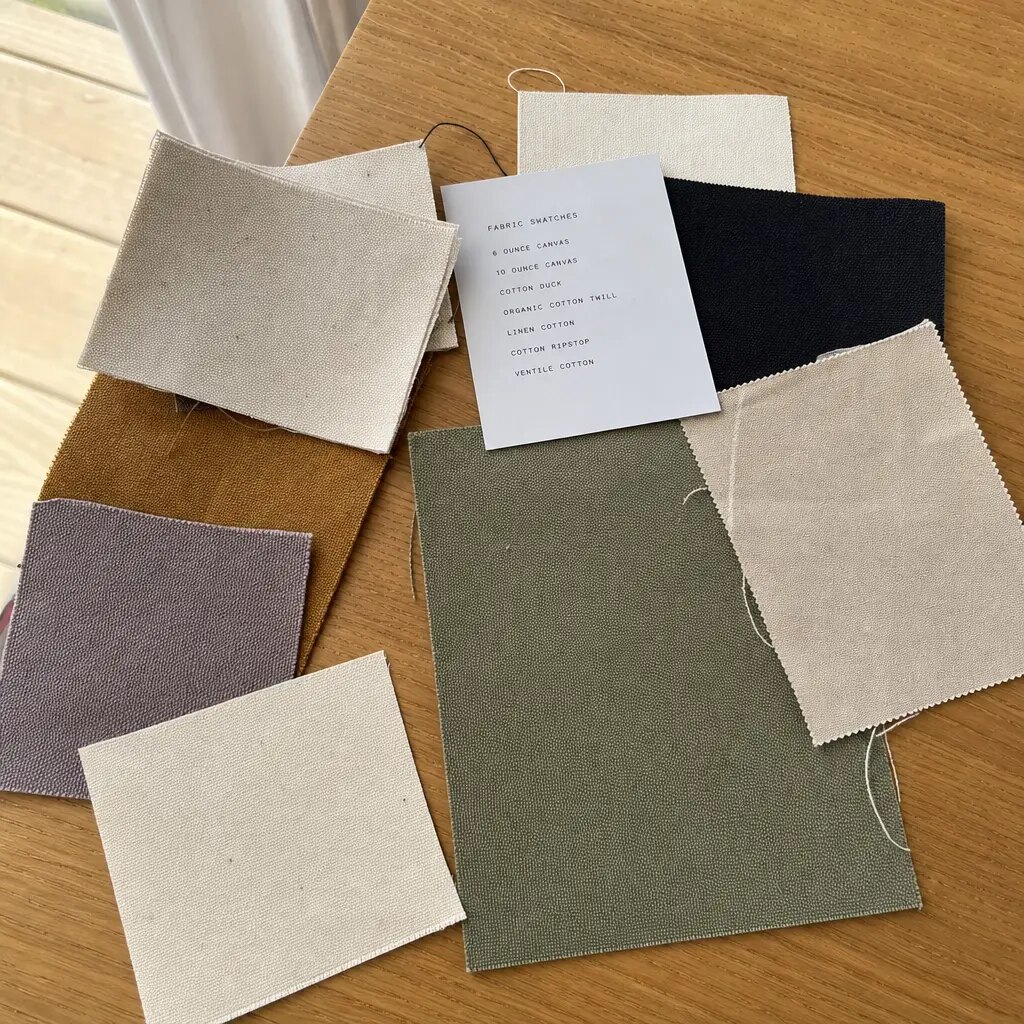
For natural cotton, photos are weak approval tools. Camera exposure and lighting can make the same fabric look warm cream in one image and cool grey in another. If the bag will be displayed beside printed coffee bags, kraft boxes, retail shelves, or café uniforms, approve a physical shade standard. Also record whether seed specks, slubs, or slight shade variation are part of the accepted look.
For dyed cotton, request lab dips or stock shade cards before bulk. Pantone references can help communicate direction, but fabric does not match coated paper exactly. A physical fabric swatch is a better production standard. Ask whether the supplier is quoting stock-dyed fabric or custom dyeing, because custom colors can change MOQ, price, and lead time.
Dark fabrics deserve a separate check. Black, charcoal, dark brown, and olive may transfer color if dyeing and finishing are not controlled. Request dry rub and, where needed, wet rub expectations. This is especially important when the backpack uses natural cords, light logos, or individual packaging. If formal colorfastness testing is required for your market, put the method in the RFQ rather than assuming the factory will choose one.
Print color and fabric color should be reviewed together. A white logo on black cotton often needs an underbase. A dark brown logo on natural canvas may look refined, but fine detail can disappear on a coarse surface. Small typography, QR codes, origin maps, and certification-style icons should be printed at actual size before approval.
- Approve natural cotton with a physical swatch, not a photo.
- Ask whether dyed fabric is stock color or custom lab dip.
- For dark colors, check dry rub and wet rub expectations before bulk.
- Include underbase cost when printing light logos on dark fabric.
- Test small text and fine-line artwork on the selected fabric surface.
Select the print method from artwork, quantity, and fabric surface
For cotton drawstring backpacks used by coffee roasters, screen printing is usually the baseline method. It works well for solid one-color or two-color logos, roastery names, simple illustrations, and typography. On natural canvas with black, brown, or dark green ink, screen printing can be economical and visually strong at medium and large quantities.
Screen print is not always the best answer. If the order includes many store names, seasonal versions, gradients, photo-style artwork, or short runs, heat transfer may reduce setup complexity. Transfers can be practical, but the film and application settings must be controlled. Poor transfers may crack, lift, feel plastic, or create a glossy patch that fights the natural cotton look.
Ink selection matters too. Water-based ink can give a softer hand on cotton, but opacity on dark fabrics may be lower and curing must be controlled. Plastisol, rubberized, or high-opacity systems may give stronger coverage, with a thicker feel. Ask suppliers to state the ink or print system they are quoting. “Logo printed” is not a specification.
For dark fabric, confirm whether the price includes a white underbase. Underbase affects screen count, setup cost, production time, opacity, and hand feel. A quote that excludes underbase may look cheaper but produce a dull, uneven, or low-contrast logo.
A digital mockup is useful for layout discussion, not production approval. The pre-production sample should show actual print size, actual fabric, actual ink or transfer, and actual placement. Check dry rub, light scratch, bending, tackiness, pinholes, opacity, and readability. If bags will be packed tightly, fold the printed sample and review whether blocking, sticking, or cord marks appear.
- Use screen print for solid logos, simple color counts, and larger orders.
- Use heat transfer for short runs, many artwork versions, gradients, or complex multicolor graphics.
- Confirm underbase requirements for black and dark dyed cotton.
- Set print placement tolerance, commonly ±5 mm to ±10 mm depending on artwork size.
- Approve a physical printed sample, not only a mockup.
Specify cords, top channel, seam allowance, and stress-point reinforcement
Cords and seams often create more customer complaints than the fabric panels. A drawstring backpack fails when the cord frays, the knot slips, the channel tears, or the side exit distorts under load. For coffee roaster programs carrying dense products such as coffee bags, tumblers, boxed filters, or brew accessories, these details deserve the same attention as GSM.
A common adult cotton drawstring backpack uses 5-8 mm cord. Thin cords reduce cost, but they can feel uncomfortable on the shoulder and may cut into the channel under load. Cotton rope gives a natural look that suits specialty coffee branding, although lower-grade cotton rope may shed fibers or fray. Polyester, cotton-poly, or polyester-core cords can improve strength and consistency, even if they look slightly less rustic.
Specify the top channel in construction terms. A single-fold channel is cheaper, but it may expose raw edges or tear sooner. A double-fold channel is usually better for repeated opening and closing. If the design avoids metal eyelets for a softer natural look, reinforced fabric exits become more important. Bartacks or box stitches at stress areas are worth requesting for retail and kit applications.
Seam allowance is a hidden price lever. A factory can reduce cost by cutting narrower allowances or minimizing reinforcement, but that increases seam grin and failure risk. Ask for inside-out construction photos during sampling and record approved seam allowance where possible. Inspect bottom corners with the bag filled, because rigid coffee products push into corners differently than soft apparel.
Define a practical load test for QC. A light event bag may only need to tolerate 2-3 kg. A retail merch or brew-kit bag should be reviewed around 4-5 kg static load, depending on intended contents. Agree the exact requirement with the supplier and test pre-production samples before bulk.
- Specify cord diameter, material, color, length, knot type, and end finish.
- For standard adult bags, 5-8 mm cord is a practical range.
- Use double-fold top channels for repeated use or heavier contents.
- Require reinforced side exits for coffee bundles and retail kits.
- Check filled-bag performance, not only flat appearance.
Build a quote matrix for MOQ, color splits, and artwork versions
MOQ is not only a sewing-line question. It depends on fabric stock, dye lot minimums, cutting efficiency, print setup, cord availability, packing method, and the factory’s willingness to manage variation. Natural stock cotton may support a lower MOQ. Custom dyed olive, rust, charcoal, or brown fabric may require a higher fabric mill minimum.
Coffee roasters often want multiple café colors, seasonal campaigns, or local store names. That can make commercial sense, but it complicates production. Four fabric colors with four print versions may create separate lab dips, screen setups, packing lines, carton marks, and QC references. Each split adds handling risk.
Instead of asking for one headline unit price, request a quote matrix. Ask for pricing at 1,000, 3,000, 5,000, and 10,000 pieces. Then ask how the price changes if the order is split across two fabric colors, three print artworks, or individual barcode packing. This shows the real cost of variation and helps procurement decide whether to launch with one hero specification first.
Confirm overrun and underrun terms before deposit. Textile bags may have production tolerance due to cutting loss, printing rejects, and QC sorting. Ask whether the supplier expects ±3%, ±5%, or another tolerance, and whether the buyer must pay for overruns. For retail SKUs with barcode counts, distributor allocations, or strict purchase order controls, this detail matters.
Lead time should be broken into stages: lab dip, sample, bulk fabric, cutting, printing, sewing, packing, inspection, and export. The critical path may be fabric dyeing, not sewing. Without this breakdown, buyers can approve artwork quickly and still miss a launch window because custom fabric or trims were not ready.
- Separate MOQ by fabric color, print artwork, size, and packing method.
- Ask for price breaks at several quantities, not one quantity only.
- Request separate costs for screens, lab dips, samples, and packing upgrades.
- Confirm overrun/underrun policy before purchase order approval.
- Use one base fabric and one artwork for first orders when schedule risk is high.
Write an RFQ that makes factory quotes comparable
A vague RFQ creates misleading price competition. If the request says “3,000 cotton drawstring backpacks with logo,” one supplier may quote 220 GSM plain weave, thin cords, single-fold channel, and bulk packing. Another may quote 320 GSM canvas, reinforced exits, 7 mm cords, and individual polybags. The cheaper offer may not be better; it may simply be a different product.
A factory-ready RFQ should include finished size, target finished GSM, fabric construction, fabric composition, color standard, cord specification, top channel construction, print method, print size, print color count, print position, packing, carton marks, SKU split, inspection requirement, incoterm, and target delivery date. If artwork is not final, provide estimated print dimensions and coverage so the supplier does not assume a small logo when the actual design is a large front-panel print.
Use the same incoterm when comparing prices. EXW, FOB, CIF, DDP, and delivered warehouse pricing are not interchangeable. For relatively low-value textile items, freight and packing can materially affect landed cost. Ask for estimated carton dimensions, pieces per carton, net weight, and gross weight at quotation stage.
Request assumptions in writing. If a supplier cannot match 300 GSM canvas and proposes 280 GSM plain weave, that may still be useful, but it must be identified as an alternate quote. Keep the base quote and alternate quote separate so internal approval does not compare mismatched products.
Procurement should also ask for QC cooperation up front. If you plan to use a third-party inspection, state the AQL level or inspection approach, measurement tolerances, defect definitions, and required documents. This avoids the common problem of negotiating inspection standards after goods are already packed.
- Attach artwork with size, colors, and placement dimensions.
- State finished GSM and fabric construction together.
- Ask suppliers to list every quote exclusion.
- Request carton data before PO, not after production.
- Require written confirmation for substitutions in fabric, cord, print, or packing.
Use sample approval to test production reality
Sampling should prove that the factory can make the bulk product, not just that the idea looks attractive. Sales samples may be made slowly from available fabric, substitute cords, or non-bulk print settings. For B2B approval, the important sample is the pre-production sample using intended bulk fabric, approved fabric color, actual cord, actual channel construction, actual print method, and actual packing style where possible.
Review the sample with measurements, not only with a quick visual check. Measure width and height flat after the bag has relaxed. Record print distance from the top edge and side seams. Check whether the logo is level and centered. Measure cord diameter and approximate length. Photograph construction details, including inside seams and side exits.
Then test the sample in realistic use. Fill it with the coffee contents planned for the program: for example, two 250 g coffee bags and a booklet, or one 500 g coffee bag plus a tumbler or filter box. Pull the cords repeatedly, wear it briefly, and check whether cords feel too thin, exits distort, seams grin, or bottom corners strain.
Print review should include handling checks. Rub the print with a dry cloth, bend the printed panel, and look for cracking, tackiness, ink lift, or pinholes. On dark fabric, confirm that the white or cream logo is opaque enough. On natural canvas, check whether small letters and line art remain readable against the texture.
Document approval clearly. A simple “approved” email is weak if a bulk dispute occurs. Mark up photos, record dimensions, record tolerances, and keep a sealed approved sample. If the sample needs changes, state whether a revised sample is mandatory before bulk. Skipping that step can save days and create much larger sorting costs later.
- Approve an actual pre-production sample, not only a sales sample.
- Measure print placement from seams and top edge.
- Test with realistic coffee contents and target load.
- Check cord movement after repeated opening and closing.
- Keep a signed, sealed, or clearly labeled master sample for inspection.
Control packing, freight density, moisture, and retail readiness
Packing is both a cost decision and a quality decision. Cotton drawstring backpacks have relatively low unit value, so carton cube, pieces per carton, packing labor, and freight terms can change total landed cost. Heavier canvas improves presentation, but it reduces the number of pieces per carton. Individual polybags improve cleanliness and SKU handling, but they add labor, material, and volume.
For many coffee roaster B2B programs, bulk flat packing in export cartons is enough. Depending on GSM, cord thickness, fold method, and carton size, carton quantities may commonly fall around 50-100 pieces. Do not assume that number, though. Confirm it by trial pack. Thick cords and heavy canvas can create uneven stacks if overcompressed.
Retail programs need more detail. If the bag is sold in a café or shipped through ecommerce fulfillment, it may require individual polybagging, paper banding, hangtag, barcode sticker, SKU label, or a specific display fold. Test barcode placement carefully. Stickers applied directly to textured cotton may not scan well and may leave residue.
Moisture and odor control also matter. Cotton can absorb moisture and warehouse odors. Sea freight, rainy-season loading, and long storage can increase risk. Ask suppliers how finished goods are dried, cooled after printing, protected before carton sealing, and stored before shipment. Avoid packing printed bags before ink is fully cured or cooled, because blocking and odor may appear after compression.
Treat carton marks as part of the specification. Mixed SKUs, multiple café locations, or different print versions require clear carton labels and accurate packing lists. Receiving teams should not have to open every carton to separate black canvas retail bags from natural event bags.
- Confirm pieces per carton, carton size, net weight, and gross weight before PO.
- Approve fold method when retail presentation matters.
- Avoid overcompression that causes print blocking or hard creases.
- Use individual polybags only when retail handling or fulfillment requires them.
- Require clear carton marks for SKU, color, artwork version, quantity, and PO number.
Specification comparison for buyers
| Spec decision | Recommended option | When it fits | Buyer risk to check |
|---|---|---|---|
| Finished fabric weight | 270-340 GSM finished fabric, approximately 8-10 oz cotton/canvas equivalent | Best B2B default for coffee roaster retail merch, café launch kits, subscription add-ons, festival packs, and gift-with-purchase programs carrying 250 g to 500 g coffee bags plus light accessories | Confirm the number is finished fabric GSM after dyeing/finishing, not raw greige fabric. Set bulk tolerance, commonly ±5% or an agreed GSM band, and verify on finished bags from multiple cartons |
| Budget fabric range | 180-240 GSM cotton plain weave | Light event giveaways, conference handouts, café opening inserts, or mailer-friendly campaigns with paper, stickers, vouchers, or small samples only | Can look limp, wrinkle heavily, show contents through the panel, distort fine print, or fail at cord exits if used for mugs, tumblers, boxed filters, or multiple coffee bags |
| Premium fabric range | 320-380 GSM cotton canvas or heavy cotton twill | Retail merchandise, holiday gift packs, premium coffee bundles, roastery shop products, and brand collaborations where hand feel and structure influence perceived value | Higher fabric cost, thicker seam bulk, slower sewing, fewer pieces per carton, and higher freight cube. Approve folded sample and packed carton data before bulk |
| Fabric construction | Plain weave for cost control; canvas for firmer body; twill only after sample approval | Plain weave works for high-volume promotions. Canvas suits minimalist coffee branding, stronger front-panel presentation, and sellable merchandise | A loose weave can create print pinholes, uneven edges, and seam grin. Ask for close-up fabric photos, weave description, and an actual printed pre-production sample |
| Cotton composition | 100% conventional cotton for predictable cost; certified/organic/recycled only when documentation supports the commercial claim | Use conventional cotton when delivery reliability, color consistency, and price stability matter most. Use recycled or organic cotton when the brand will make a verified material claim | Do not accept vague sustainability wording. Request composition declaration, certificate scope where relevant, transaction/lot documentation if required, and claim language approved by your compliance or marketing team |
| Finished bag size | Approximately 38 x 42 cm for standard adult drawstring backpack; size tolerance commonly ±1 cm unless tighter tolerance is agreed | Fits T-shirts, 250 g and 500 g coffee bags, paper filters, small brew accessories, event kits, and café merchandise bundles | A larger size quickly increases fabric consumption, carton cube, and cord length. Confirm whether dimensions are measured flat after sewing, before or after washing, and whether tolerance includes top channel variation |
| Print method | Screen print for solid one- or two-color logos; heat transfer for short runs, gradients, or multiple artwork versions | Screen print is usually most economical for roaster logos and typography at medium to large quantities. Transfer is useful for many café/location variants | Dark fabric may require white underbase, extra screen, longer curing, and thicker hand feel. Transfers need film quality, press temperature/time/pressure control, and wash/rub review |
| Cord specification | 5-8 mm cotton rope for natural look; cotton-poly or polyester-core cord for improved strength | Cotton rope suits specialty coffee aesthetics. Blended-core cord is better when the bag carries heavier kits or receives repeated opening and closing | Cheap cords fray, shed lint, bleed color at knots, vary in length, or slip through exits. Require pull test, knot security check, diameter tolerance, and colorfastness review |
| Top channel and exits | Double-fold top channel with reinforced side exits; bartack or box stitch for heavier use | Appropriate for retail use, trade-show kits, ecommerce gift packs, and repeated customer handling | Single-fold channels can expose raw edges and tear sooner. Inspect seam allowance, raw-edge control, stitch density, cord friction, and stress-point reinforcement |
Buyer checklist before sampling
- Define the commercial use before choosing material: retail merchandise, event giveaway, gift-with-purchase, subscription insert, employee kit, wholesale partner kit, or brew-accessory pack. The use case drives GSM, seam strength, print method, packing, and load target.
- State the complete finished specification in the RFQ: finished bag size, finished GSM, fabric construction, composition, fabric color standard, cord material, cord diameter, cord length, channel construction, print method, print size, print colors, print position, expected load, packing method, carton marks, and inspection requirement.
- Clarify fabric weight terminology. Ask whether quoted GSM is raw greige fabric, dyed/finished roll fabric, or finished bag fabric. For B2B comparison, use finished fabric GSM with an agreed tolerance, typically ±5% unless your brand requires a tighter band.
- For natural cotton, approve a physical shade standard instead of relying on words such as natural, cream, ecru, unbleached, beige, or raw cotton. Record whether seed specks, slubs, and shade variation are acceptable.
- For dyed cotton, request lab dip approval or a fabric shade card. Ask whether dyeing is reactive, pigment, stock-dyed, or piece-dyed, and require colorfastness expectations for rubbing/crocking, especially on black, charcoal, olive, brown, and rust fabrics.
- Request a pre-production sample made with the intended bulk fabric color, actual cord, actual channel construction, actual seam allowance, actual logo size, and actual print method. Do not approve bulk from a digital mockup or a stock natural cotton sample.
- Set measurable tolerances in writing before bulk production: finished size, print placement, print skew, shade range, GSM range, cord length, stitch density, carton quantity, and acceptable defect classification.
- Confirm all quote inclusions and exclusions: screen charges, artwork separation, lab dips, sampling, courier, hangtags, barcode stickers, individual polybags, master cartons, carton marks, export documentation support, and third-party inspection cooperation.
- Ask for a quantity and color-split matrix. Price one color/one artwork separately from multiple fabric colors, multiple logo versions, and mixed carton packing so procurement can see the real cost of variation.
- Review freight density early. Moving from 220 GSM plain weave to 340 GSM canvas can reduce pieces per carton and increase landed cost, even when the factory unit price still looks acceptable.
Factory quote questions to send
- What is the finished fabric weight in GSM after dyeing, washing, printing preparation, or finishing, and what bulk tolerance do you apply, for example ±5% or a specific GSM range?
- Is the fabric plain weave, canvas, twill, or another construction? Please state composition, yarn/weave description if available, and whether the bulk fabric will come from stock fabric or a planned production lot.
- Is the material conventional cotton, organic cotton, recycled cotton blend, or another composition? What documentation can you provide for any claim that will be used commercially?
- What are the finished bag dimensions included in your price, how are they measured, what seam allowance is used, and what finished size tolerance do you normally guarantee?
- What cord material, diameter, color, length, knot type, and end finish are included? What is your normal cord length tolerance and do you perform a pull or breakage check?
- How is the top channel constructed: single fold, double fold, overlocked plus fold, reinforced side exits, bartack, box stitch, or eyelet? Can you provide inside construction photos?
- Which print method are you quoting for the attached artwork? Please separate pricing for one-color screen print, two-color screen print, water-based ink, plastisol or rubber ink, heat transfer, and any underbase required for dark fabrics.
- For dark fabric colors, does your price include white underbase, extra screen charge, longer curing, and opacity control? How will the print hand feel differ from printing on natural cotton?
- Does the quote include artwork separation, screen setup, lab dips, pre-production sample, sample courier, hangtag, barcode label, inner packing, master carton, carton marks, and support for third-party inspection?
- What is your MOQ by fabric color, print artwork, size, and packing method? Can multiple colorways or artwork versions share one purchase order without changing unit price?
Quality-control points to confirm
- Verify finished fabric GSM against the approved standard. Cut or weigh samples from finished bags where practical, not only raw roll fabric. Check multiple cartons and apply the agreed tolerance, commonly ±5% unless otherwise specified.
- Confirm composition, weave appearance, hand feel, slub level, and shade against the approved pre-production sample. For natural cotton, judge shade against the signed physical standard, not supplier photos.
- Measure finished bag size flat after the bag has been unfolded and relaxed. Common commercial tolerance is ±1 cm on width and height, but tighter or looser tolerance must be agreed before production.
- Check print placement from fixed reference points such as top edge, side seam, and panel centerline. A practical tolerance is often ±5 mm to ±10 mm depending on artwork size, but the PO should state the agreed range.
- Inspect print levelness and skew. A clean coffee logo on a plain panel makes a 5 mm tilt visible, especially on minimalist typography or centered badge designs.
- Test print adhesion and curing with dry rub, light scratch, bending, and normal handling checks. Reject major tackiness, ink transfer, lifting, cracking, severe pinholes, or under-cured odor outside the approved standard.
- For dark dyed fabrics, check crocking risk by rubbing with a light dry cloth and, if required, request formal colorfastness testing from the supplier or third-party lab using an agreed method.
- Inspect cord diameter, pair length, knot security, smooth movement through the top channel, fiber shedding, fraying, color bleeding, and consistency between bags. Record acceptable cord length tolerance before bulk.
- Check top channel seams, side cord exits, bottom corners, side seams, and label attachments for skipped stitches, seam grin, raw edge exposure, broken needle marks, loose threads, tearing, or weak reinforcement.
- Review stitch density against the approved sample. Many cotton bag constructions use roughly 7-10 stitches per inch, but the actual approved density should be recorded and checked at stress points.