Start with the craft fair role, not the product name
Cotton drawstring backpacks for craft fairs can serve very different business purposes. A low-cost bag for booth flyers does not need the same fabric, cord, stitching, packing, or quality plan as a paid merchandise bag sold beside candles, ceramics, stationery, apparel, or art prints. If the RFQ only says “cotton drawstring backpack,” suppliers may quote very different bags under the same name.
A stronger brief defines the role first: giveaway, reusable attendee bag, sponsor kit, staff pack, artist merchandise, or retail resale item. Then convert that role into measurable specifications: GSM, weave, finished size, cord diameter, reinforcement, decoration, packing, carton data, samples, and inspection criteria.
This prevents false savings. A 150 GSM cotton bag with thin cord and no lower reinforcement should not be price-compared with a 240 GSM canvas bag with bar-tacked tabs, retail hangtag, and individual packing. Both may be valid, but they are not the same commercial product.
- Giveaway: prioritize cost, deadline, stock materials, and acceptable appearance for light contents.
- Reusable event bag: use mid-weight fabric, reinforced lower exits, smoother cord, and reliable print.
- Paid maker merchandise: specify heavier fabric, cleaner stitching, labels, and retail presentation.
- Sponsor kit: control artwork versions, carton sorting, and event-date delivery.
- Retail resale: define handfeel, shade, barcode needs, label placement, packing, and claim documentation.
Match GSM to load target and perceived value
Fabric weight is the central material decision because it affects strength, print result, perceived quality, carton weight, and landed cost. Ask for GSM or oz/yd2 and the weave. “100% cotton” is not enough: 150 GSM plain cotton, 200 GSM canvas, and 260 GSM twill are all cotton but behave differently.
Craft fair contents are unpredictable. One attendee may carry only postcards and a program; another may add a book, candle tin, water bottle, glass jar, or wrapped ceramic item. These loads concentrate stress at seams and lower cord exits. Treat load ranges as development targets unless the supplier performs and records an agreed test.
Heavier fabric is not automatically the best choice. Higher GSM raises unit price, carton weight, storage volume, and sometimes freight cost. It may also reduce foldability and comfort unless cord size and reinforcement are upgraded together.
- 120-140 GSM: very light promotional range for short-term paper-only use.
- 150-170 GSM: budget handout range; not ideal for paid merchandise.
- 180-220 GSM: practical reusable event range with better handfeel and print surface.
- 230-280 GSM: common retail-grade canvas or twill range for maker merchandise.
- 300 GSM and above: premium structured range; check sewing difficulty, freight, and comfort.
- For quote comparison, keep size, GSM, cord, reinforcement, decoration, and packing identical.
Select natural, bleached, dyed, canvas, or twill with standards
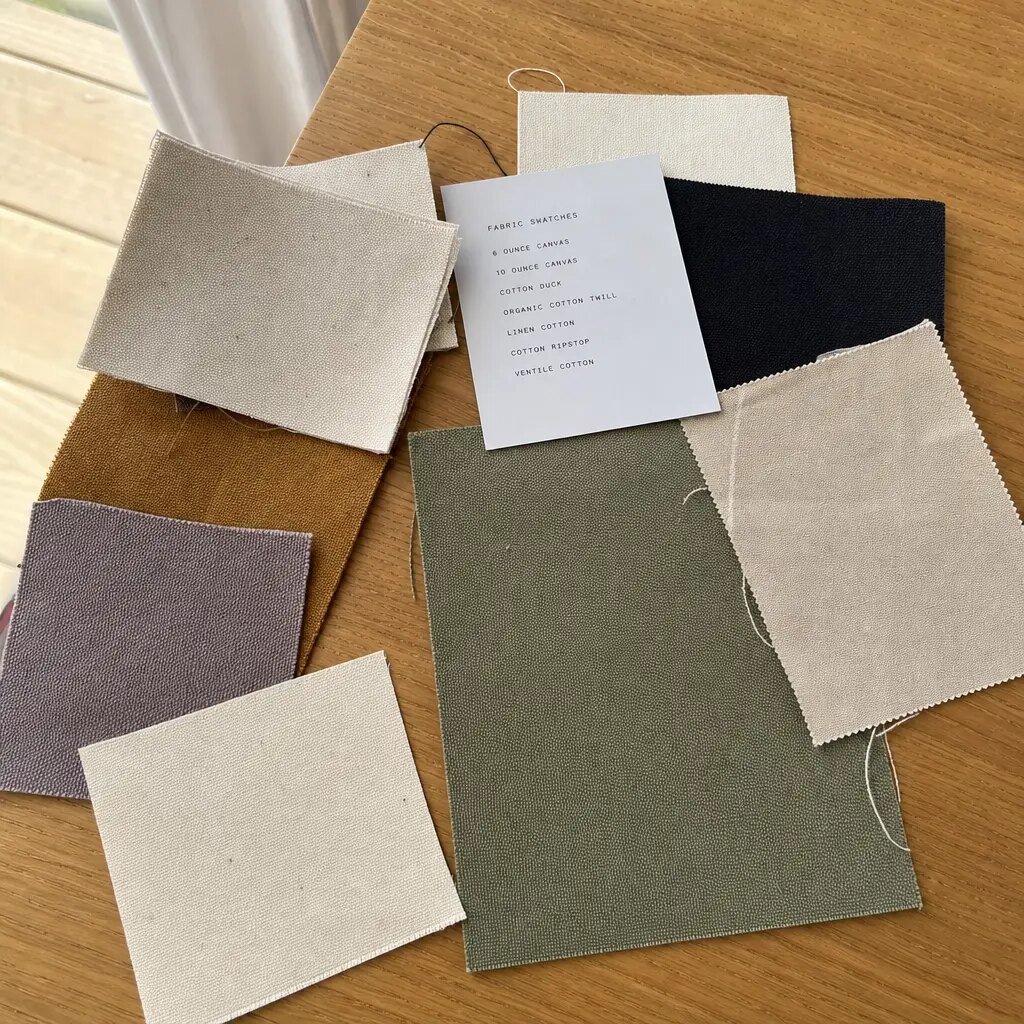
Natural unbleached cotton is popular for craft fairs because it fits handmade, rustic, and low-plastic positioning. It can include seed specks, slubs, and shade variation. Those features should be approved in writing so inspection teams know the difference between natural character and defects.
Bleached cotton gives a cleaner base for bright artwork, sponsor logos, barcodes, and retail tags. It also makes yellowing, oil marks, and storage stains more visible. Dyed cotton supports brand colors and seasonal assortments, but it adds shade control, possible colorfastness checks, and sometimes higher MOQ or longer lead time.
Weave matters. Canvas is a strong default for reusable drawstring backpacks because it is stable and print-friendly. Twill has diagonal ribs and a softer, more premium drape, but fine print details may soften. Plain weave is usually economical and lighter.
- Natural cotton: approve acceptable seed specks, slub, and shade range; reject stains and heavy contamination.
- Bleached cotton: use for clean contrast; inspect whiteness consistency before cutting.
- Stock dyed cotton: efficient for common colors; check shade consistency across cartons.
- Custom dyed cotton: require lab dip approval, shrinkage review, shade tolerance, and lead-time buffer.
- Canvas: best default for reusable and retail programs.
- Twill: premium handfeel; test logo clarity before bulk production.
- Organic or recycled cotton: verify documentation before making claims on tags, listings, or packaging.
Specify cords and top channel construction
The drawcord is both the closure and the shoulder strap. At a craft fair, users may open and close the bag repeatedly while walking between booths. A thin or rough cord can make a good fabric body feel cheap. An unfinished cotton cord can fray. A mismatched cord can drag inside the channel and stress the stitching.
Cotton rope pairs well with natural cotton and handmade positioning. Polyester or blended cord is often smoother, more consistent in color, and easier to finish. Flat woven cords can distribute pressure better than thin round cords, but they require a wider channel. Many casual cotton drawstring backpacks use round cord around 5-8 mm, depending on fabric weight and finished size.
The top channel must match the cord. If it is too narrow, users pull harder. If it is accidentally stitched through, the closure jams. Define channel width, cord route, cord length, color, and end treatment before sampling.
- Specify cord material: cotton rope, polyester cord, braided cord, flat woven cord, or approved alternative.
- Define diameter or width, such as about 5 mm, 6 mm, or 8 mm for round cord.
- Confirm cord color: natural, matching, contrasting, stock color, or Pantone direction.
- Require end treatment: knotting, tipping, tape wrapping, stitching, or heat sealing for synthetic cord.
- Measure finished cord length and left-right balance during QC.
- Open and close samples repeatedly to check channel smoothness.
Treat lower-corner reinforcement as a core requirement
Cotton drawstring backpacks usually fail in predictable areas: lower cord exits, top channel stitching, side seams, and bottom corners. The lower cord exit is critical because strap load transfers directly into the body fabric. A moderate load can create a sharp pull if the contents sit in one corner.
For paper-only giveaways, basic construction may be acceptable if the bag is not positioned as durable or retail-grade. For reusable event bags and paid merchandise, reinforcement should be standard. Common methods include self-fabric triangle patches, sewn tabs, bar tacks, metal eyelets, or combinations. Self-fabric patches spread load and keep a soft cotton look. Eyelets can look neat, but poorly set eyelets may cut the fabric.
Make reinforcement part of the base quote. Low-cost offers often omit patches, tabs, or bar tacks unless the RFQ states them clearly.
- Paper-only giveaway: basic cord exits may be acceptable with limited-use positioning.
- Reusable event bag: specify reinforced lower exits and secure top channel stitching.
- Retail merchandise: require reinforcement plus a documented pull or load check.
- Self-fabric patch: define shape, placement, stitch line, and alignment.
- Sewn tab: confirm tab material, insertion depth, and stitching security.
- Metal eyelet: check setting pressure, sharp edges, alignment, and tearing after pulling.
- Bar tack: use at stress points where construction allows; avoid density that cuts light cotton.
Test decoration on the actual cotton surface
Decoration should not be selected from a digital mockup alone. Natural cotton, heavy canvas, twill ribs, dark dyed fabric, and recycled blends all affect print clarity, opacity, and handfeel. Fine-line artwork may break up on slub cotton. A white logo on black canvas may need an underbase. Multi-sponsor artwork may be simpler as a transfer than as several screens.
Screen printing is usually efficient for one to three solid colors and bold artwork. Heat transfer is useful for full color, gradients, short runs, and many artwork versions, but check edge lift, cracking, pressure marks, and handfeel. DTG can produce detail, yet it depends on pretreatment, absorbency, and repeatability. Embroidery can look premium but is safer on heavier fabric and smaller designs to reduce puckering.
Craft fair programs often include city names, artist names, dates, or sponsor versions. A shared base bag can reduce material complexity, but each artwork version still needs proofing, setup, sorting, and inspection.
- Screen print: best for simple logos, sponsor marks, and bold typography in bulk runs.
- Heat transfer: useful for full color, gradients, small runs, and multiple versions.
- DTG: test on exact fabric for color strength, pretreatment marks, rub behavior, and repeatability.
- Embroidery: usually safer on 230 GSM and above; keep logo size modest.
- Woven label or side label: adds maker-brand presentation without a large printed panel.
- Dark fabric: confirm ink opacity, underbase, curing, and fine-detail legibility.
- Print placement: measure from fixed edges, such as centered and 12 cm below top edge.
Understand MOQ drivers before requesting prices
MOQ is driven by complexity. Stock natural cotton in a standard size with one screen print and bulk packing may have a low practical MOQ. Custom-dyed canvas with four artwork versions, woven labels, hangtags, barcode stickers, and retail packing will usually need higher setup, more handling, and more production control.
Craft fair buyers often want variety: different artist names, city editions, booth allocations, or sponsor combinations. Using one base bag helps, but each version can add screen charges, transfer setup, sorting labor, and inspection time. Multiple fabric or cord colors increase SKU complexity and error risk.
Sustainability and compliance requests can also affect sourcing. Organic cotton, recycled cotton, AZO-free dye, CPSIA, REACH, or colorfastness requirements may need supplier documentation, fabric traceability, or lab testing. If a claim appears on a hangtag, product listing, or package, collect evidence before purchase order approval.
- Lowest MOQ: stock fabric, standard size, standard cord, simple decoration, and bulk packing.
- Custom dye: may require lab dips, higher fabric MOQ, shade approval, and longer lead time.
- Multiple artwork versions: can share a base bag but add setup and sorting cost.
- Multiple colors: increase cutting waste, shade-control issues, and packing error risk.
- Retail packing: hangtags, barcodes, and individual bags add labor and planning time.
- Claims: verify organic, recycled, AZO-free, CPSIA, REACH, and colorfastness documentation where relevant.
Use samples to approve construction and tolerances
A sample should prove how the bag will be made, not only how it looks in a photo. A blank construction sample can confirm size, cord route, channel width, stitching, and reinforcement. A print strike-off shows ink opacity, detail, placement, and behavior on the actual fabric. The pre-production sample should use the real bulk fabric, drawcord, reinforcement, decoration, labels, and packing.
Sampling should include handling checks. Load the bag with expected contents or an agreed test weight. Pull the cords several times. Open and close the channel. Bend the printed panel. Rub decoration lightly with a white cloth. Inspect reinforcement after pulling. For dyed cotton, compare with the approved lab dip or swatch under consistent lighting.
Keep the approval record written and visual. Record dimensions, GSM, shade, print size, print position, cord length, channel width, reinforcement close-ups, label position, and packing format. If there are several artwork versions, approve each proof or strike-off and identify the shared base specification.
- Blank construction sample: approve body shape, cord, channel, stitching, and reinforcement.
- Lab dip: approve custom dyed fabric before bulk dyeing.
- Print strike-off: approve artwork on actual cotton where opacity or detail matters.
- Pre-production sample: approve the complete bag with actual materials and packing.
- Measurement record: check width, height, channel width, cord length, print size, and print position.
- Load check: test against the buyer-defined target; do not market performance unless tested and documented.
- Reference sample: keep a signed or sealed approval sample for production comparison.
Compare quotes by landed specification, not unit price
Cotton drawstring backpacks are easy to under-price by omission. A low quote may use thinner fabric, exclude lower reinforcement, include a smaller print area, omit labels, assume bulk packing, or provide no carton data. A higher quote may include canvas, thicker cord, bar tacks, retail tags, individual packing, and defined QC.
Ask suppliers to separate base bag cost, fabric upgrade, dyeing or lab dip cost, print cost, label cost, packing cost, sample fee, screen or setup charge, artwork-version charge, and documentation or testing cost. Request carton dimensions, pieces per carton, gross weight, net weight, and CBM because heavier GSM and individual packing can affect freight, storage, and event handling.
Tie price to responsibility. When the purchase order states GSM, size tolerance, shade approval, reinforcement method, print placement tolerance, packing, and inspection criteria, nonconforming goods are easier to manage before shipment.
- Align size, GSM, weave, cord, reinforcement, decoration, labels, and packing before comparing prices.
- Request carton dimensions, pieces per carton, gross weight, net weight, and estimated CBM.
- Separate screen charges, transfer charges, lab dips, sample courier, barcode labels, and retail packing.
- Ask whether inner bags, carton liners, desiccant, carton marks, and SKU separation are included.
- Calculate landed cost for heavier canvas, especially if air freight before an event is possible.
- Use one quote template so marketing, procurement, and operations compare the same product.
Plan packing, carton marks, and final inspection
Packing affects presentation, cost, inspection, and delivery accuracy. Cotton drawstring backpacks can be bulk packed flat, individually bagged, banded, tagged, or sorted by artwork version. Freshly printed or heat-transferred bags packed too tightly may show creases, pressure marks, ink offset, or transfer dents. Embroidered bags can show backing impressions if compressed.
Bulk packing is efficient for event handouts and wholesale cartons. Individual polybags protect units and simplify allocation, but they add plastic, labor, and carton volume. Paper belly bands, hangtags, barcode labels, and retail stickers can improve presentation, but they must be approved early to avoid reopening finished cartons.
Craft fair programs often have fixed event dates, so carton organization matters. If bags are divided by artist, booth, sponsor, city, or SKU, define inner quantity, carton quantity, carton label format, and mixed-carton rules. Final inspection should check packed goods, not only loose samples.
- Bulk flat packing: low cost, fast unpacking, and efficient carton use.
- Individual bag: useful for retail handling, barcode control, moisture protection, or allocation accuracy.
- Paper band or hangtag: approve material, position, barcode data, and claim language before packing starts.
- Compression control: avoid over-packing printed panels, transfers, or embroidery.
- Moisture control: consider carton liners, inner bags, or desiccant for humid storage or ocean freight.
- Carton marks: include SKU, artwork version, quantity, PO number, carton number, destination, and mixed-carton rules.
- Final inspection: verify sewing, decoration, packing count, carton marks, odor, moisture, and SKU separation.
Specification comparison for buyers
| Spec decision | Practical option | Best-fit use case | Typical commercial impact | Buyer risk to check |
|---|---|---|---|---|
| Budget giveaway fabric | 140-170 GSM plain-weave cotton, usually natural, bleached, or stock dyed | One-day booth handouts for flyers, stickers, coupons, and light flat samples | Lowest relative cost. Often practical from low MOQs when stock fabric and standard sizes are used. Shortest lead time, commonly 2-4 weeks after artwork approval for simple programs, depending on factory load. | Do not compare it with retail-grade canvas. It may be semi-transparent, crease easily, and fail faster if attendees carry bottles, books, jars, candles, or ceramics. |
| Reusable event fabric | 180-220 GSM cotton canvas or heavier plain cotton | Craft fair welcome bags, sponsor bags, school maker events, attendee kits, and general reusable use | Moderate cost, usually a sensible balance of unit price, handfeel, and carton weight. MOQs remain manageable if fabric is stocked. Lead time may stay close to standard production unless custom dyeing or many artwork versions are added. | Confirm lower-corner reinforcement, top channel width, seam strength, and buyer-defined load target before bulk approval. |
| Retail merchandise fabric | 230-280 GSM cotton canvas or cotton twill | Maker-brand merchandise, artist booth products, boutique resale, and gift shop programs | Higher unit cost and higher carton weight. MOQ can rise if fabric or color is not stocked. Supports cleaner retail presentation, woven labels, hangtags, and stronger perceived value. | Check whether the program needs a substantial retail bag rather than a foldable promo item. Test cord comfort, print clarity, and packing presentation. |
| Premium heavy fabric | 300 GSM and above cotton canvas or twill, used selectively | Structured premium drawstring packs and special retail merchandise where heavy handfeel supports the selling price | Highest cotton fabric cost band. Can slow sewing, increase freight, and reduce foldability. Works best when the whole construction is upgraded, not only the body fabric. | Heavy fabric is not automatically a stronger bag. Cords, seams, patches, bar tacks, and load testing must be aligned. |
| Natural versus bleached cotton | Natural unbleached for rustic positioning; bleached cotton for a cleaner print base | Natural suits handmade, eco-style, and minimal branding; bleached suits bright graphics and retail display | Natural stock fabric may reduce lead time. Bleached cotton can cost slightly more and needs stronger cleanliness control. Both support screen print and labels. | Natural cotton has seed specks, slubs, and shade variation. Bleached cotton should be checked for yellowing, oil marks, and staining. |
| Dyed cotton | Stock reactive-dyed colors where possible; custom dye only when color control is essential | Black, navy, forest green, red, seasonal editions, city editions, and sponsor-color programs | Stock colors usually keep MOQ and lead time lower. Custom dye may add lab dips, higher fabric MOQ, colorfastness checks, and 1-3 extra approval steps. | Check shade tolerance, shrinkage, colorfastness, and documentation for any color or sustainability claim. |
| Canvas versus twill | Canvas for structure and print stability; twill for softer drape and premium texture | Canvas fits most reusable craft fair bags; twill fits fashion-leaning maker merchandise | Canvas is broadly available and decoration-friendly. Twill may cost more or require a specific fabric source. Fine artwork should be strike-off tested. | Twill ribs can soften print edges. Stiffer canvas affects folding, carton volume, and shoulder comfort. |
| Drawcord material and size | Cotton rope for natural look; polyester or blended cord for smoother pull; often 5-8 mm round cord or comparable flat width | Cotton cord fits handmade positioning; polyester is practical for frequent opening and cleaner end finishing | Cord upgrades are usually lower-cost than fabric upgrades but strongly affect perceived quality. Flat or thicker cords require a wider top channel. | Cord below about 5 mm can feel sharp. Cotton cord may fray. Synthetic cord needs heat sealing, tipping, or another approved end treatment. |
| Lower cord exit reinforcement | Self-fabric triangle patches, reinforced tabs, bar tacks, eyelets, or a combined method | Any reusable bag, paid merchandise, or bag expected to carry books, jars, bottles, candles, ceramics, or kits | Small unit-cost increase with large quality impact. Must be included in the base quote because low-price offers may omit it. | This is a common failure point. Define method, placement, stitch quality, and pull-check requirement in the RFQ. |
Buyer checklist before sampling
- Define the bag role: free giveaway, reusable attendee bag, sponsor kit, staff kit, artist merchandise, or paid retail resale item.
- Set finished size and tolerance, for example 35 x 45 cm +/-1 cm, measured flat after sewing and before packing.
- Specify fabric content, weave, and weight: plain cotton, cotton canvas, cotton twill, organic cotton, recycled cotton blend, and target GSM or oz/yd2.
- Do not accept only “100% cotton” as the material specification. Require quoted GSM range and bulk GSM tolerance.
- Set a development load target: paper-only below 1 kg, light event use around 2 kg, or reusable craft fair purchases around 3-5 kg, with testing if the target will be marketed.
- Define seam construction, top channel width, bottom finishing, seam allowance, stitch quality, and whether raw internal edges are acceptable.
- Specify drawcord material, diameter or width, color, routing, finished length tolerance, and end treatment.
- Require reinforced lower cord exits for reusable or paid bags, using self-fabric patches, sewn tabs, bar tacks, metal eyelets, or an approved combination.
- Provide vector artwork and define print size, print position, Pantone references where needed, version list, and opacity expectations on dark fabric.
- Choose decoration after testing the real fabric surface: screen print, heat transfer, DTG, embroidery, woven label, printed label, hangtag, or mixed branding.
Factory quote questions to send
- What exact fabric are you quoting: fiber content, weave, GSM or oz/yd2, canvas or twill type, and whether it is stock fabric or made-to-order?
- What GSM tolerance applies to bulk fabric, and how will GSM be verified before cutting?
- Is the fabric natural unbleached, bleached, reactive dyed, pigment dyed, yarn dyed, organic, recycled blend, or another material? What documentation is available for any claim?
- For dyed fabric, will you provide lab dips, what light source will be used for approval, and what shade tolerance applies between approved dip and bulk fabric?
- What are the finished bag dimensions, cutting dimensions, shrinkage allowance, top channel width, seam allowance, and finished size tolerance after sewing?
- What development load target can the quoted construction be built against, and can you perform a pull or load check at lower cord exits before bulk release?
- What drawcord material, diameter or width, color, rope or weave style, end treatment, and finished cord length are included in the quoted price?
- Are self-fabric corner patches, reinforced tabs, metal eyelets, bar tacks, double stitching, or other stress-point reinforcements included, or are they optional upgrades?
- Which decoration method is included, what is the maximum print area, how many colors are included, and what charges apply for extra colors, screens, transfers, or artwork versions?
- Will you provide a digital proof, print strike-off, blank construction sample, and complete pre-production sample before mass production?
Quality-control points to confirm
- Use an inspection plan appropriate to order value and risk. For many commercial orders, buyers use ANSI/ASQ Z1.4 or ISO 2859-1 general inspection level II, with tightened checks for first orders, retail goods, or event-critical shipments.
- Set practical AQL targets in the PO when third-party inspection is used, such as 0 critical defects, 2.5 major defects, and 4.0 minor defects, unless the buyer’s own standard is stricter.
- Finished size should normally stay within +/-1 cm for common cotton drawstring backpack sizes unless the purchase order sets a tighter tolerance and the supplier confirms it is practical.
- Print placement should be measured from fixed edges. A typical commercial tolerance is about +/-0.5 cm to +/-1 cm depending on artwork size and bag construction.
- Fabric GSM should be verified by cutting and weighing a measured bulk fabric sample, not judged only by handfeel or supplier description.
- Fabric shade should be compared with the approved swatch, lab dip, or signed pre-production sample under consistent lighting, especially for natural, bleached, black, and custom-dyed cotton.
- Natural cotton should be inspected before cutting for acceptable versus unacceptable slub, seed specks, shade variation, oil marks, stains, weaving defects, foreign fibers, and visible contamination.
- Lower cord exits should withstand the agreed pull or load check without seam opening, fabric tearing, patch lifting, eyelet loosening, cord slippage, or cord cutting into the fabric.
- Drawcords should move smoothly through the top channel and remain even in length when closed. The channel should not be too narrow, twisted, or accidentally stitched through.
- Screen print should have clean edges, correct registration, acceptable opacity, no heavy bleeding, no pinholes beyond the approved standard, and no cracking after bending and light flexing.