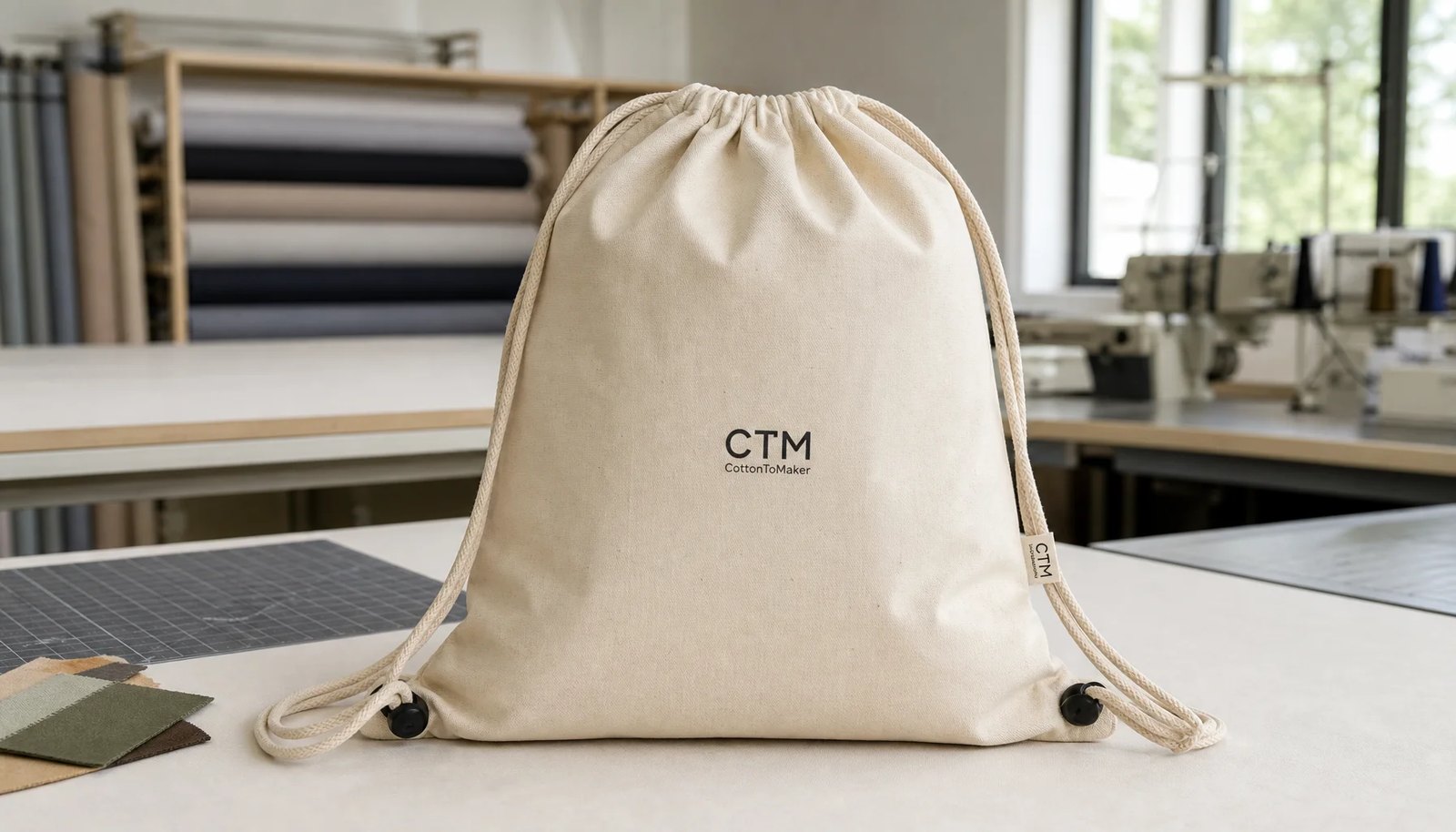
Why placement matters on a cotton drawstring backpack
A cotton drawstring backpack is not a flat panel, and it never stays flat for long. The top channel compresses the body, the cords cross the front panel, and the bag changes shape the moment someone fills it with brochures, samples, or a laptop sleeve. That is why logo placement matters more than the mockup suggests. A mark that looks centered on a proof can end up too close to the seam, interrupted by the cord path, or warped once the bag is cinched and carried across a busy show floor.
For trade show buyers, the real question is not whether the logo looks good in a PDF. It is whether the logo still reads clearly when the bag is folded, loaded, worn on one shoulder, and photographed from a distance. The cotton drawstring backpacks logo placement guide for trade show exhibitors should start with the finished bag and the actual use case, not with the artwork file. If that is not fixed early, the factory will make reasonable assumptions on your behalf, and those assumptions are expensive to correct later.
- Treat the worn bag as the real viewing condition, not the flat cut panel.
- Keep critical copy away from the top channel and the cord crossing area.
- Assume the bag will be folded, stuffed, and photographed after handout.
Fix the bag specification before you size the logo
Logo placement only works when the bag spec is already locked. Finished dimensions, fabric GSM, weave density, drawcord style, and even the cotton color all change the usable print area. A 33 x 40 cm bag gives you much less safe space than a 38 x 42 cm bag, and a thin 120-140 gsm body behaves very differently from a denser 180-220 gsm body. The buyer who sends artwork first usually gets a quote or sample based on whatever the supplier can source most easily, not necessarily the bag the brand actually wants.
As a practical rule, 180-220 gsm cotton is usually the more forgiving choice when the bag needs to look substantial, be reused, or carry sample weight without sagging badly. It gives the front panel more body, which helps the print stay flatter and makes the bag feel more intentional in hand. Lighter 120-140 gsm fabric still works for brochure-only handouts, but it is a less forgiving canvas. If the bag is supposed to carry a product kit, the spec should be built around structure first, unit cost second.
- Lock finished size before approving artwork scale.
- Choose a higher GSM when the bag must be reused after the event.
- Match the bag structure to the load, not just to the cheapest quote.
Choose the placement zone by how the bag will be used
Front-center placement is usually the safest starting point for trade show bags because it delivers the best brand recall with the least explanation. A practical setup is to keep the top edge of the logo box at least 20-25 mm below the finished top seam and leave at least 15 mm from the side seam, then adjust for the exact sewing pattern and cord tunnel. Those numbers are not universal standards, but they are a good procurement baseline. They give the supplier room for normal sewing variation without pushing the artwork into the parts of the bag that move the most.
Lower-front placement works when the brand wants a quieter look or when sponsor copy, event messaging, or a secondary graphic already occupies the upper field. Side labels, woven patches, and sewn tabs are useful when the front panel must stay visually clean, especially for premium programs or retail-style presentation. Bottom-panel branding is rarely the strongest option for trade show visibility because it disappears the moment the bag is set down. The safest rule is simple: the main logo should live where the panel stays flat and visible after the bag is loaded.
- Measure from the finished top seam, not from the cut fabric edge.
- Keep small text out of the top 30 mm unless the supplier proves the channel will not distort it.
- Use the front-center zone for primary visibility and reserve other placements for secondary branding.
Match the decoration method to the fabric and the artwork
Screen print is usually the most practical choice for a cotton drawstring backpack with a simple logo. It handles one or two spot colors well, scales efficiently at volume, and keeps a strong visual field on a broad front panel. That said, it is not forgiving of tiny detail. On textured cotton, fine lines can fill in, and small text can lose clarity quickly. Buyers should ask the factory what minimum line thickness and text height it can hold on the chosen fabric, then request a strike-off that proves the answer. A good starting point is to avoid very fine strokes and avoid tiny copy unless it has already been tested on the final cloth.
Embroidery can give a premium look, but it should be treated as a technical choice, not an upgrade by default. On lighter cotton, dense stitching can pucker the panel and distort the bag shape. A woven label or sewn patch can be a better premium answer when the brand wants permanence without loading the main panel with thread density. Heat transfer can be useful for more detailed artwork or variable copy, but it should never be approved from a screen alone. Ask for a production-grade sample that shows adhesion, flex behavior, and color stability on the actual bag fabric before bulk release.
- Use screen print for large, simple logos and cost-controlled programs.
- Use embroidery only when the fabric weight can support the stitch density.
- Use a woven label or patch when you want a premium mark without crowding the main panel.
Build the RFQ so suppliers quote the same product
A supplier cannot quote accurately from a logo file alone. The RFQ needs the finished bag size, fabric GSM, fabric color, decoration method, exact logo box size, and placement reference points. For the artwork itself, send vector files in AI, EPS, or PDF, with fonts outlined and Pantone references if color control matters. If the logo will ever be used in a one-color version, include that version up front. If the brand team needs a reversed or alternate version for a dark bag or a different event package, include that too so the supplier does not improvise.
The most useful RFQ also includes a marked-up placement drawing with dimensions from the top seam, side seam, and centerline in millimeters. If the front panel must stay within a safe area, say so explicitly. If the bag is natural cotton, not bleached white, call out the background tone because it changes contrast and the way the printed color reads in daylight. When the artwork is complex, ask the supplier to confirm the maximum printable area before sample production starts. That simple step prevents a lot of hand-wavy quoting later.
- Send a dimensioned placement sketch with seam references in millimeters.
- Include a one-color logo file and any alternate version needed for the event.
- Ask the supplier to confirm the print box size before sample production starts.
Use MOQ logic instead of accepting one blanket number
MOQ should be read as a function of setup, decoration complexity, and production line efficiency, not as a fixed truth about the bag style. A one-color screen print on a standard cotton bag is simpler to run than a two-position print, a patch plus print combination, or a multi-color design with tighter registration. If a quote gives one MOQ without separating those assumptions, it is not especially useful for procurement. Buyers need to know which part of the spec is driving the constraint.
The sourcing route matters just as much as the quantity. A direct factory with in-house decoration usually gives the cleanest control over placement, lead time, and repeat orders. A trading company can simplify communication when procurement wants one point of contact, but it often hides the actual production source and makes defect correction slower. A local decorator working on imported blanks can be the right answer for a rush event, yet the landed cost may rise once domestic handling, rework, and rush freight are included. The important question is not only what the MOQ is, but what exact spec that MOQ applies to.
- Ask for separate lines for blank bag, decoration, packaging, and freight.
- Compare MOQ by artwork version and placement, not just by bag shape.
- If you need more than one logo location, ask the factory to quote each placement separately.
Approve the sample with measurements, not just by eye
The sample stage should prove the placement, not merely the design. A proper approval sample uses the final fabric, final print method, and final folding or packing method. Mark the centerline, the distance from the top seam, and the clearance from the side seam on the sample before sign-off. If the logo box sits anywhere near the cord tunnel, ask the supplier to show the full print field on the actual sewn bag, not only on a flat proof. A PDF can help with content review, but it cannot prove where the print lands after sewing and finishing.
The sample should also reflect real use. Fill the bag with the same brochure stack, sample kit, or giveaway load that will be handed out at the show, then check whether the logo still reads clearly when the bag is cinched. Look for panel distortion, hidden text, folds that cut across the artwork, and any shift in balance once the cords are pulled tight. For higher-risk programs, the cleanest process is one strike-off or pre-production sample, one signed approval, and no bulk change unless the supplier issues a revised sample.
- Treat the approved physical sample as the master reference for bulk production.
- Measure the placement on the sewn bag and record the numbers on the approval sheet.
- Test the bag with the real contents it will carry at the show.
Set QC thresholds that catch the defects buyers actually see
The most expensive defect on a cotton drawstring backpack is often a small placement error, not a dramatic failure. A logo can be printed cleanly and still look wrong if it sits 8-10 mm too high, drifts toward the side seam, or gets clipped by the cord tunnel. That is why placement tolerance should be agreed before production begins. Many procurement teams start with plus or minus 5 mm for print position on a standard screen-printed bag and plus or minus 3 percent for artwork size, then tighten those tolerances only if the supplier can demonstrate the capability. If the factory cannot hold the numbers, the buyer should know that before the order is released.
Quality control should cover the functional details too. The drawcord should pull smoothly, the cord lock should hold under a realistic filled-bag load, and the seams should not open when the bag is lifted by the cords. Inspect for skipped stitches, loose thread ends, puckering around the print area, ink smear, incomplete curing, ghosting, and inconsistent fabric color across the lot. If your company uses an AQL standard, classify mixed artwork, seam failure, and unreadable logos as major defects and keep that rule consistent across incoming inspection and final release.
- Reject any logo that is clipped by a seam, tunnel, or cord lock area.
- Check print cure, color, and surface feel against the approved sample.
- Open random cartons to confirm SKU, quantity, artwork version, and fold direction.
Pack for the booth, not just for the warehouse
Packing affects how the logo looks the moment the cartons are opened at the venue. If the bag is folded too tightly, a crease can stay through the print for the entire event. If the unit is over-compressed in a small polybag, the surface can pick up pressure marks or lose its flatness. For trade show distribution, the packing spec should protect the logo face first and optimize carton density second. The right pack-out is the one that keeps the bag presentable when the booth team opens the carton and starts handing out stock.
Carton labels should make receiving simple. Include the style code, fabric color, artwork version, quantity, carton number, and gross or net weight if your logistics process uses them. If the order ships to multiple show sites, distribution centers, or regional teams, ask for clear pallet or carton marking so the right SKU can be pulled quickly. Do not leave fold direction open to interpretation if the logo face matters when the carton is opened. A cheap packing decision can create a surprisingly visible quality issue at the booth.
- Specify polybag count and carton count in the RFQ.
- Prevent over-folding that leaves permanent crease lines on the print face.
- Use carton labels that identify style, color, artwork version, and quantity.
Work backward from the show date and protect the schedule
The fastest way to miss a trade show date is to quote only factory production time and ignore the rest of the chain. A realistic schedule starts from the event date and works backward through artwork sign-off, strike-off or pre-production sample approval, bulk production, inspection, freight, customs, and inland delivery. If the buyer leaves out any one of those steps, the order may still be technically on time and practically late. That is especially true when the logo placement is tight, because a small correction can push the whole schedule.
For urgent events, stock blanks plus local decoration can reduce lead-time risk when there is no time for a full custom run. That route usually costs more per unit, but it may still be the right commercial answer if a missed handout matters more than unit price. For repeat programs, the better long-term move is to lock the bag spec, placement drawing, tolerance, and QC standard so the next order can follow the same approved setup without re-litigating the basics. In procurement terms, the best supplier is not the one with the shortest quoted lead time. It is the one that can repeat the same result without surprises.
- Work backward from the show date and include approval, production, inspection, and freight time.
- Use stock blanks and local decoration only when schedule risk is higher than cost risk.
- Keep the same approved spec and placement drawing for repeat orders.
Specification comparison for buyers
| Spec decision | Recommended option | When it fits | Buyer risk to check |
|---|---|---|---|
| 120-140 gsm natural cotton with one-color screen print | Lowest-cost giveaway spec with enough surface for a simple logo | Use for light brochures, low-weight handouts, and high-volume event distribution | Risk of thin hand feel, weaker structure, and show-through if ink coverage is heavy |
| 180-220 gsm cotton with one- or two-color screen print | Best all-around spec for reusable trade show bags | Use for staff kits, product sampling, and bags meant to be carried again after the show | Risk of higher unit cost and slightly longer sewing time |
| Front-center logo placement with 20-25 mm top clearance | Most visible option for brand recall | Use when the bag will be photographed, worn across the hall, or handed out at a booth | Risk of crowding the cord tunnel if the artwork is too tall or too close to the top seam |
| Lower-front placement with a smaller print box | More restrained branding with room for other copy | Use for premium minimalist programs, sponsor-heavy events, or co-branded kits | Risk of weak visibility from aisle distance |
| Woven side label or sewn patch | Permanent brand ID without loading the main panel | Use when the front panel must stay clean or when you want a retail-style finish | Risk of a smaller branding area and added sewing labor |
| Direct factory with in-house print or label application | Best control over artwork, tolerance, and repeat orders | Use for medium-to-high volume programs with a stable spec | Risk if decoration is still subcontracted but not clearly disclosed |
| Trading company bundling blank bag and decoration | Simpler communication and one-PO management | Use when procurement needs fewer vendors and less coordination | Risk of hidden margin, less visibility on the actual factory, and slower defect correction |
| Local decorator on imported blanks | Fast option for rush events or late logo changes | Use when the schedule matters more than landed cost | Risk of fabric mismatch, color drift between blank lots, and higher domestic handling cost |
Buyer checklist before sampling
- Lock the finished bag size, fabric GSM, and fabric color before approving logo dimensions.
- Send vector artwork in AI, EPS, or PDF, with fonts outlined and a one-color version included.
- Mark the logo position in millimeters from the top seam, side seam, and centerline on the RFQ drawing.
- State the exact use case: empty giveaway, brochure load, or product sample load.
- Specify the print method, number of colors, and whether the back panel, side seam, or side label is included.
- Request a pre-production sample or strike-off on the final fabric, not only a PDF proof.
- Agree the position tolerance in writing, such as plus or minus 5 mm on the finished bag.
- Define fold direction, polybag quantity, and master carton count so the logo face is not crushed in packing.
- Ask for separate pricing lines for blank bag, decoration, sample, packaging, and freight.
- Build schedule buffer for artwork corrections, sample approval, production, and transit time before the show date.
Factory quote questions to send
- What is the exact finished size, fabric GSM, weave, and color included in your quote?
- Is the decoration done in-house, or is any screen print, embroidery, patch, or label work subcontracted?
- How do you measure the placement on the finished bag, and what tolerance do you allow in production?
- What is the decorated area in millimeters, and what is the maximum print size you can hold on this bag?
- What is the MOQ per artwork, per color, per placement, and per fabric color?
- What sample will be produced before bulk, and is it made on the final fabric and final decoration method?
- Can you separate the quote into blank bag, decoration, packaging, inland transport, and export freight lines?
- What packing method are you quoting, including polybag count, carton count, and carton size?
- How many working days do you need after sample approval, and what events can extend the schedule?
- What QC standard will you use for placement, print quality, stitching, and carton packing?
Quality-control points to confirm
- Measure logo position on the finished bag from fixed seams and the centerline, not from the cut panel before sewing.
- Agree a placement tolerance before production starts; many buyers use plus or minus 5 mm for print position and plus or minus 3 percent for artwork size.
- Reject any bag where the artwork is clipped by a seam, cord tunnel, stitch line, or cord lock area.
- Check print for smear, incomplete coverage, pinholes, ghosting, or color drift against the approved sample.
- Verify that the print surface is fully cured and not tacky, flaky, or prone to rubbing off during handling.
- Inspect seams around the mouth, side panels, and cord channel for skipped stitches, loose thread ends, or puckering.
- Test the drawcord and cord lock for smooth pull and secure hold under a realistic filled-bag load.
- Compare the fabric color, hand feel, and panel flatness against the sealed pre-production sample.
- Open random cartons to confirm pack count, fold direction, artwork version, and SKU labels match the PO.
- Record lot numbers and defect photos before release so any corrective action can be traced back to the source lot.