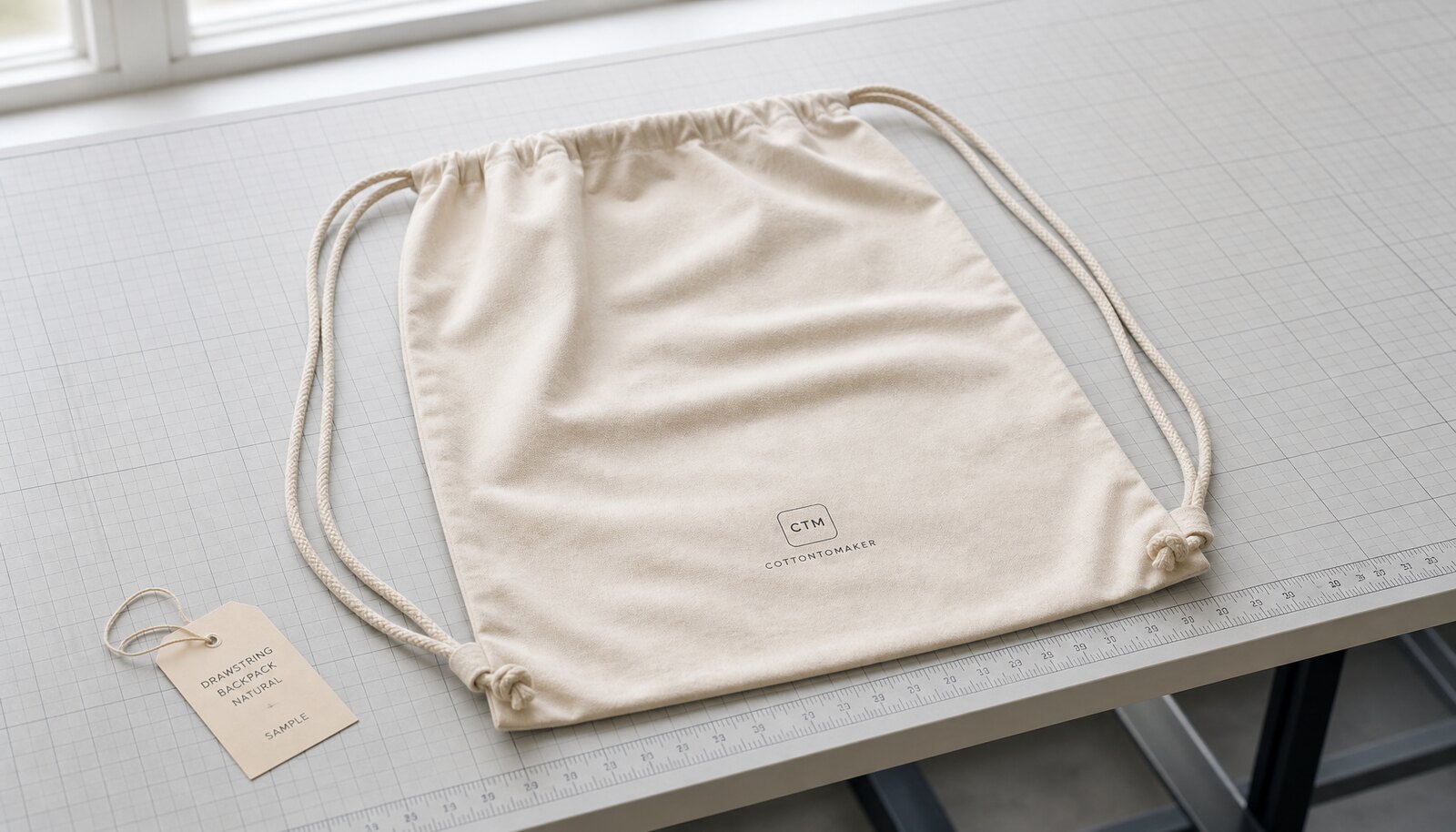
Why Gift-Shop Buyers Need a Different Spec
Cotton drawstring backpacks for gift shops are not just low-cost carry bags. They are retail objects that sit on pegs, in bins, or in shelf-ready cartons, which means the logo has to read clearly from a distance and still look intentional when a customer handles the bag. A placement that seems fine on a digital proof can fail once the top hem, cord tunnel, and fold line are part of the real product.
That is why procurement should anchor the decision to the finished bag, not to the flat artwork alone. Two suppliers can quote the same logo file and still deliver very different retail outcomes if one is measuring from the sewn hem and the other is placing the mark by eye. If the bag will be displayed folded, hanging, or boxed, say that upfront. Display format changes where the eye lands and where the print can safely sit.
- Measure on the finished bag, not just on the artwork file.
- Treat the cord tunnel and top hem as no-print reference zones unless the supplier has proven otherwise.
- State the display method: hanging, folded, or boxed.
Set the Body Spec Before You Touch the Artwork
The cotton body drives the feel, print quality, and shelf impression more than many buyers expect. For a gift-shop program, 140-160 GSM is usually a value-oriented band, 160-180 GSM is the most useful starting point for mainstream retail, and 180-220 GSM is better when the product needs a heavier hand feel or more stable presentation. These are sourcing ranges, not universal standards. Weave density, finishing, and shrink behavior can make a lighter bag print better than a heavier but looser cloth.
If the bag needs small type or thin lines, ask about the weave and the finish rather than chasing GSM alone. Tighter weave generally gives cleaner edges and less ink spread. Raw cotton can work if you want a natural look, but pre-shrunk or otherwise finished cloth is easier to control when fold consistency and print registration matter. Ask the supplier for any shrinkage or finishing data that affects the final size and the print zone.
- Ask for a GSM target with tolerance, not a vague fabric description.
- Confirm whether the cloth is raw, pre-shrunk, or otherwise finished.
- Request a swatch from the actual production lot or an equivalent lot.
Logo Placement That Survives Real Production
Front-panel placement is the safest default for cotton drawstring backpacks sold in gift shops. A practical starting point is to place the logo roughly 70-110 mm below the finished top hem, with enough clearance from the cord tunnel so the mark does not get visually swallowed by the top channel. That is a benchmark, not a fixed rule. Short souvenir bags, tall retail bags, and styles with different seam construction all need their own measured placement.
Size should be set with the bag, not with the brand deck. On a small souvenir bag, 80-100 mm wide may be enough; on a standard retail bag, 120-150 mm often looks more balanced; larger marks work only when the panel width and seam layout can support them. If the logo includes fine text, ask for an enlarged proof and a finished-bag sample, because cotton texture will punish thin lines and tiny counters that look crisp on screen.
- Approve a flat dieline with the logo centerline and top edge marked in millimeters.
- Keep the artwork clear of the side seam and cord tunnel with a documented margin.
- Test the fold before you approve the print position if the bag will ship flat-folded.
Choose the Decoration Method by SKU, Not by Habit
Screen print is usually the most practical option for a simple logo on cotton. It is efficient for repeat production, works well for one or two spot colors, and can give strong opacity on natural cloth. The control point is not the method name but the process behind it. Ask about ink type, mesh, cure method, and color consistency, and verify the result on the actual bag fabric rather than a generic proof.
Heat transfer is useful when the run is short or the artwork has more colors than a screen setup can handle efficiently. The tradeoff is usually in hand feel and long-term durability, so you should check for edge lift, cracking, and visible gloss differences if the bag will be handled often. Woven labels, patches, and embroidery create a more tactile retail finish, but they add sewing complexity, extra placement risk, and more inspection points. For gift-shop programs, the right choice is the one that matches both the logo and the expected shelf life of the product.
- Screen print: best for repeat orders and simple spot-color logos.
- Heat transfer: useful for short runs or multicolor art, but test durability carefully.
- Woven label or patch: better when tactile branding matters more than flat print cost.
- Embroidery: use only if you accept added bulk, slower sewing, and a different visual finish.
Make Supplier Quotes Comparable Before You Compare Price
A usable quote breaks out the real cost drivers. At minimum, ask for the blank bag, decoration setup, decoration run cost, packaging, cartons, and freight as separate lines or clearly separated notes. A single finished-unit number hides too much. One supplier may include setup and packing in the unit price, while another may leave them out and add them later. If you do not normalize those differences, the cheapest quote is often just the least complete one.
MOQ also needs to be defined with precision. On this product, MOQ can change with bag color, print color count, decoration method, and the packing format. If you are building several gift-shop SKUs from one base style, ask whether MOQ applies per artwork, per colorway, or across the combined order. When you evaluate price breaks, use the volumes you actually reorder, not just the supplier's preferred threshold.
- Request a split quote so the blank bag, setup, decoration, and packing are visible.
- Confirm whether MOQ is per SKU, per artwork, or per total order.
- Ask for price breaks at your likely reorder levels, not only the supplier's preferred volume.
Approve Samples as a Retail Object, Not Just a Sewing Sample
A blank body sample is useful, but it is not enough when logo placement matters. The approval sequence should usually move from blank body or size sample to a placement-marked sample or strike-off, then to a finished pre-production sample using the final decoration method, final fabric, and final packing method. If the factory cannot make the full pre-production sample immediately, they should at least send a marked placement drawing and a ruler photo of the printed panel so you can check measurements before production starts.
The sample should be judged the way the customer will see the product. Fold it the way the warehouse will fold it. Hang it the way the store will display it. If the logo disappears when the bag is packed flat, the placement may be too low or the mark may be too small. If the print crosses a fold line, the bag can look fine in a photo but fail on shelf. This is the point where many programs lose quality: they approve the artwork and never approve the bag as a physical retail item.
- Use a finished-bag sample, not only a blank bag or fabric swatch.
- Require a ruler photo of the actual printed panel before bulk production.
- Test the sample in the same fold and pack method you will use for shipment.
QC Should Catch Real Drift, Not Just Obvious Defects
The best QC rules are measurable and tied to the approved sample. For a standard gift-shop backpack, a practical starting point is to keep the logo centerline within about +/-5 mm of the approved drawing and the top edge of the print within about +/-3 mm, unless the artwork is oversized or the bag construction is unusual. Those are not universal standards, but they are tight enough to catch visible drift before it shows up on shelf. If the supplier asks for looser tolerances, they should explain why the construction or printing process needs them.
The most common failures are not dramatic. They are small visual defects that add up: print bleed, ghosting, uneven ink coverage, pinholes, skewed registration, seam puckering, twisted panels, frayed cords, and uneven channel stitching. If you use AQL, write it into the PO. If you do not, at least separate critical defects from major defects so there is no argument once the lot is finished. For first-run production, ask for a first-article photo or short video before the full lot is released.
- Measure multiple random units from each lot against the approved sample and drawing.
- Treat wrong placement, missing print, broken cord, and wrong carton count as critical defects.
- Keep the same tolerance language in the sample approval, PO, and inspection sheet.
- Check for print strike-through, seam puckering, panel twist, and carton crush, not just missing logos.
Compliance and Labeling Checks Are Part of Procurement
If these cotton drawstring backpacks are going into retail channels, do not leave compliance as a post-order admin task. The exact requirements depend on the destination market and how the bag is sold, but buyers commonly need to confirm fiber content, care instructions, and chemical test support for the body fabric and the print. If the bag is intended for a market with specific rules, ask the supplier which reports are current and which claims are actually covered by test evidence.
The important procurement habit is to separate what is required from what is convenient. A supplier may offer a test report for one fabric lot that does not cover the current production lot, or a general declaration that does not match the exact print method you are ordering. Ask whether the report applies to the fabric, the ink, or the finished bag. If the bag is sold in a market with labeling rules, make sure the label text, language, and placement are approved before bulk production starts.
- Confirm which compliance documents apply to the destination market before you place the order.
- Ask whether test reports cover the fabric, the print, or the finished bag.
- Check that care labels and fiber-content claims match the actual material mix.
Packing and Cartons Affect the Retail Finish
Packing is part of the product presentation. A tight fold across a printed area can leave a crease that never fully disappears, and overfilled cartons can compress the body enough to distort the logo before the shipment reaches the store. For gift-shop programs, the packing spec should protect the visual state of the bag, not just maximize carton count. That is especially important if the product is going to be unpacked and displayed immediately after receipt.
Specify the fold direction, inner pack count, carton count, and whether the logo faces inward or outward in the polybag. If the warehouse uses barcode stickers or size labels, tell the factory where those belong so they do not cover the print. Keep carton weights manageable enough for normal receiving and replenishment work. A cheap packing plan can create hidden labor and damaged presentation at the destination.
- Define whether the logo should face outward or inward inside the polybag.
- Keep carton fill low enough to avoid hard fold lines across the logo.
- Use carton marks that match your receiving system: SKU, size, color, and quantity.
Write the RFQ So Suppliers Quote the Same Product
A clean RFQ prevents a lot of bad comparison work. For cotton drawstring backpacks in gift shops, the request should name the finished size, target GSM, weave or finish expectations, logo size, logo position, print method, sample stage, packing format, and inspection expectation. If any of those are left open, suppliers will default to their own standard construction and you will spend the next round trying to normalize offers that were never equal in the first place.
The award should not go to the lowest headline price. Choose the supplier that can prove control over placement, fabric consistency, sample quality, packing, and compliance. If two quotes differ, ask whether they include setup, packaging, and freight, and confirm that the logo position and bag body are actually the same. That is where procurement stops being a price exercise and becomes specification control, which is what keeps a gift-shop program from drifting into inconsistent retail stock.
- Lock finished dimensions and placement measurements in the RFQ.
- State the print method, number of colors, and durability expectation.
- Define packing, carton marks, and the quality standard before pricing starts.
- Ask each supplier to confirm in writing that they are quoting the same spec, not their own default version.
Specification comparison for buyers
| Spec decision | Starting spec for quote comparison | Works best when | What to verify before you compare suppliers |
|---|---|---|---|
| Logo position | Front panel, with the logo typically 70-110 mm below the finished top hem and clear of the cord tunnel by at least 15-20 mm | The bag will hang on a peg, sit folded in a bin, or be packed for shelf display | Ask for a marked dieline or finished-bag drawing. The quote should reference the sewn bag, not just the artwork file |
| Logo size | 80-100 mm wide for small souvenir bags, 120-150 mm for standard retail bags, 160-180 mm only when the front panel is wide enough to avoid seam crowding | You need the mark visible from arm's length without compressing the cotton panel | Check small type, thin strokes, and negative space at the actual print size. Fine detail often looks better on screen than on cotton |
| Fabric weight | 140-160 GSM for value programs, 160-180 GSM for the most usable gift-shop range, 180-220 GSM for a heavier hand feel or more rigid presentation | The bag is sold as merchandise, not just handed out as a giveaway | Treat these as sourcing bands, not standards. Confirm the supplier's GSM tolerance, weave density, and whether the cloth is raw or pre-shrunk |
| Weave and finish | Tighter plain weave cotton, ideally with controlled shrinkage and a finish that helps print edges stay crisp | The logo has small text, thin lines, or needs a cleaner retail look | Request a swatch from the production lot or an equivalent lot and ask for any shrinkage or finishing data |
| Decoration method | Screen print for simple spot-color logos, heat transfer for short runs or multicolor art, woven label or patch for a tactile premium finish | Artwork, volume, and shelf-life expectations are known upfront | Verify rub resistance, cure quality, edge lift, and hand feel on a finished sample, not a digital proof |
| Compliance file | Fiber content, care label text, and chemical test support matched to your destination market | The bags will be imported into a regulated retail market | Ask which test reports are current, which apply to the body fabric versus the print, and whether any claims are lab-supported |
| Sample stage | Blank body sample, placement-marked sample, and finished pre-production sample with final print and packing method | The logo must land in a precise visual zone | Do not approve from a blank bag only. The finished sample should reflect the real fold, print, and pack method |
| MOQ driver | MOQ separated by body color, print color count, decoration method, and packing format | You need multiple gift-shop SKUs from one base style | Confirm whether MOQ applies per SKU, per artwork, or across combined colorways |
| Packing format | Flat-folded, size-sorted, carton weights kept manageable, with the logo protected from hard crease lines | The product will move through a warehouse before store display | Specify fold direction, inner pack count, polybag use, and whether the logo faces inward or outward |
Buyer checklist before sampling
- Confirm the logo position on the finished bag, not only on the artwork mockup, and record the distance from the top hem, side seam, and cord tunnel.
- Specify cotton weight as a target band with tolerance, then require the supplier to state the actual production range they will hold.
- Name the decoration method, color count, and durability expectation. A shelf-display souvenir has different needs from a bag that will be handled daily.
- Require a pre-production sample that uses the final bag body, final print method, and final fold or packing method.
- Ask for a fabric swatch, not just a photo, when the weave or finish affects print quality or shrink behavior.
- Write the packing standard into the PO: inner pack count, carton count, polybag use, fold direction, label placement, and carton mark format.
- Ask for a first-article photo or short video of the first printed panel so placement can be checked before the rest of the run is released.
- Define critical defects before production starts: wrong placement, missing print, broken cord, wrong carton count, or labels that cover the logo.
- Check whether your market needs fiber content, care instructions, and chemical test support, especially if the bags will be sold at retail rather than used as giveaways.
Factory quote questions to send
- Where exactly will the logo sit on the finished backpack, and can you show that location on a marked pattern or dieline with measurements?
- What cotton GSM range are you quoting, and what tolerance will you hold if the production lot runs lighter or heavier than target?
- Is the artwork screen printed, transferred, patched, woven, or embroidered, and what is the setup fee per color or per placement?
- Does your MOQ change by bag color, logo color count, decoration method, or packing format, and is the MOQ per SKU or across the full order?
- Can you provide a blank sample, a placement-marked sample, and a finished pre-production sample before bulk production starts?
- What does your standard packing include: inner count, polybag, carton size, carton marks, and logo orientation during packing?
- What production lead time do you quote after sample approval, and what steps are in-house versus subcontracted?
- If the artwork, placement, or packaging changes after approval, what happens to cost, timing, and sample re-approval?
- Which compliance documents can you provide for the destination market, and what is covered by existing test reports versus a new order?
Quality-control points to confirm
- Logo position matches the approved drawing and stays inside the agreed tolerance window; it does not drift into the seam, tunnel, or fold line.
- Print edges are clean, the color is even, and there is no obvious bleeding, ghosting, cracking, or pinholing across the cotton weave.
- The printed area is not distorted by a heavy fold or stitched seam that changes the retail appearance of the logo.
- Finished bag dimensions stay within the approved size range, and the bag body weight remains within the agreed GSM band for the lot.
- Drawcord length, knotting, and channel stitching are symmetric and secure, with no frayed ends, broken stitches, or uneven tension.
- Carton quantity, inner pack count, and size or color labels match the PO so receiving can process the shipment without relabeling.
- Color consistency between sample and bulk stays within the agreed tolerance for both fabric and logo ink.
- If you use first-article approval, check the first printed panel before the full lot is released.
- Inspect for failure modes that are common on cotton: print strike-through, seam puckering, panel twist, cord fray, and carton crush.