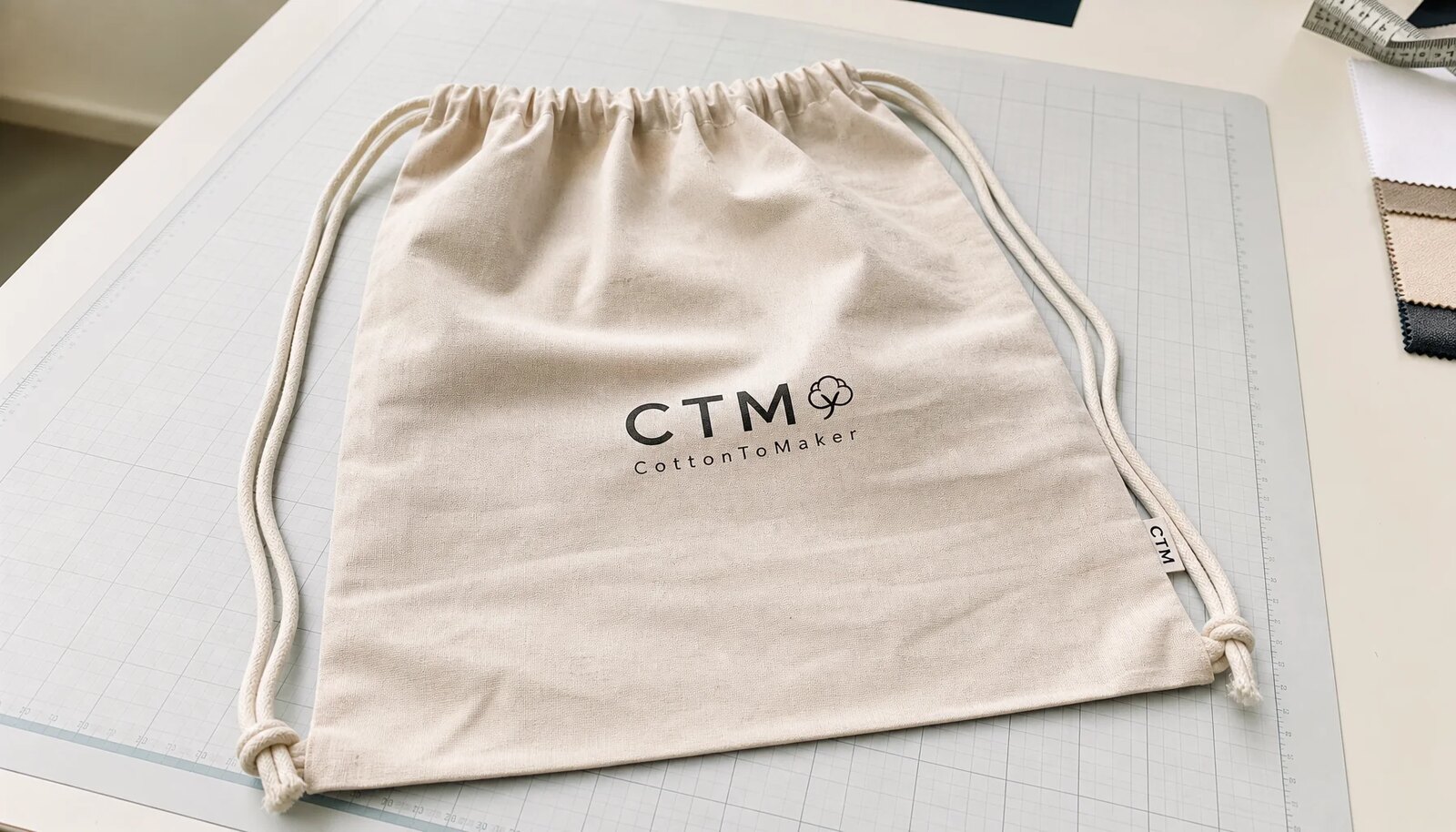
Start with the event job, not the artwork mockup
A strong cotton drawstring backpacks logo placement guide for event planners starts with the way the bag will be used. Procurement teams are not only buying a printable fabric panel. They are buying a branded item that may be handed out at registration, worn across a crowded venue, filled with brochures and samples, photographed at sponsor booths, packed into welcome kits, or shipped to multiple sites. A placement that looks clean in a flat digital proof can fail if the drawstring tunnel covers the logo, the carton fold creases through a transfer, or the sponsor mark becomes unreadable once the bag is cinched.
Before requesting pricing, define the main visibility requirement. If the bag is the primary sponsor giveaway, the front-center panel should usually carry the main logo because it is the surface most likely to face outward when worn or hung on a chair. If the bag is part of a premium hospitality kit, a lower-front logo, small patch, or woven label may feel more reusable. If several sponsors must appear, a primary front mark with a secondary back-panel line may work, but it should be priced and inspected as two decoration locations.
Turn that event use case into a measurable product spec. The RFQ should state finished bag size, fabric weight, cord construction, logo size, placement measurement, decoration method, packing method, and required delivery date. This keeps supplier quotes comparable and prevents the factory from making design decisions from a mockup alone. The safest procurement habit is simple: approve the look creatively, but buy the product by dimensions, tolerances, materials, and inspection criteria.
- Identify the primary viewing condition: worn, hanging, handed out flat, packed in a kit, or photographed at the venue.
- State whether the logo priority is sponsor visibility, retail-style subtlety, premium gifting, or multi-sponsor compliance.
- Convert the preferred layout into a written spec with finished-bag measurements and tolerances.
Map the usable print zones on the finished bag
Most cotton drawstring backpacks have four practical branding zones: front main panel, lower front panel, back panel, and side seam or label area. The front main panel is the default B2B choice because it is visible, easy to inspect, and usually large enough for a clear event logo. Lower-front placement can look more refined, especially with embroidery, a sewn patch, or a smaller screen print. Back-panel decoration is useful for sponsor lists, event dates, or secondary messages. Side labels add a retail-style detail but should not be treated as the only logo when sponsor visibility matters.
The top of the bag is the most common placement risk. The drawstring tunnel often consumes 25-45 mm of vertical space, depending on pattern and cord size, and the upper fabric bunches when the cords are pulled. If a logo sits too close to that area, the top of a wordmark may disappear when the bag is cinched. Side seams, bottom seams, and reinforced cord corners also reduce the usable field. A supplier may decorate flat panels before sewing, but the buyer should approve placement based on the finished sewn bag because that is what attendees receive.
A practical no-print zone should be shown on the placement drawing. For many standard event bags, start with at least 15 mm of clearance from tunnel edges and seams, then increase to 20-30 mm near cord exits, bottom corners, or areas that carry tension. These are not universal engineering rules because bag patterns vary, but they give buyers a concrete starting point for supplier discussion. The factory should confirm its recommended print window for the exact finished size and construction being quoted.
- Use front-center placement for maximum event visibility and simplest inspection.
- Use lower-front placement when the buyer wants a quieter merchandise-style look.
- Ask the supplier to mark the safe print window on the finished-bag drawing before sampling.
Size the logo with finished dimensions and tolerances
Logo size should be based on the finished bag, not the artwork file. A standard adult event drawstring backpack is often around 330-380 mm wide by 420-460 mm high, while smaller youth or lightweight giveaway versions may be narrower. On many standard sizes, a front logo around 180-260 mm wide can be readable without crowding the seams, but the correct size depends on the specific pattern, fabric weight, and decoration method. The buyer should not approve a supplier's generic print-area claim without checking how it fits the actual sewn bag.
The placement drawing should include the finished bag outline, drawstring tunnel, side seams, bottom seam, cord exits, and any corner reinforcement. It should specify logo width, logo height, the distance from the finished top seam to the top of the logo, and the horizontal alignment to the visible centerline. If the artwork file contains invisible padding, a tagline, or a registration mark, state whether centering is based on the full artboard or the visible logo shape. That detail prevents a common dispute where the supplier centers the digital boundary while the buyer expected the readable mark to look centered.
Set a placement tolerance that can be inspected in bulk. For standard event production, plus or minus 5 mm is often a practical target for logo position on a soft sewn textile. Premium programs or smaller runs may request plus or minus 3 mm, but only if the supplier confirms it can be held and the approved sample proves the method. Tolerance should apply to finished bags after sewing and decoration, not to cut panels before sewing. The PO should also define whether slightly tilted logos, off-center art, and inconsistent top distance are minor, major, or critical defects.
- Give logo width and height in millimeters, not only a percentage of the front panel.
- Measure placement from finished seams and visible centerline, not from a digital mockup.
- Use a written placement tolerance so QC can sort defects consistently.
Choose the decoration method before final art approval
Decoration method changes the usable placement zone, minimum line thickness, color behavior, hand feel, and inspection plan. Screen print is the standard workhorse for many cotton drawstring backpack event orders because it works well for simple one-color or limited-color logos and larger readable marks. Buyers should confirm ink opacity on the selected fabric, especially when printing light ink on dyed cotton or when printing over natural cotton texture. Fine text, thin rules, and small sponsor marks may need simplification before production.
Heat transfer can be useful for short runs, multicolor logos, gradients, or late sponsor artwork. It may reproduce detail that basic screen print cannot, but it brings different quality risks. Large transfers can feel stiff on soft cotton, show a glossy rectangle, lift at the edge, or crack if folded through the logo. Procurement should request fold, rub, and edge-adhesion checks on the same fabric and packing fold planned for bulk. A transfer that looks good on a flat sample may not be acceptable once the bag is folded tightly in a carton.
Embroidery should be used selectively. It can create a premium finish for small marks, but dense stitching on lightweight cotton can pucker the panel or distort lettering. Heavier cotton or canvas-style fabric around 8 oz / 270 gsm or above is usually a safer starting point, but the supplier still needs to test backing, stitch density, and hooping. Woven labels and patches are useful for a retail-style look, yet they require their own tooling, sewing tolerance, corner-security checks, and lead-time allowance.
- Use screen print for simple, visible event logos and efficient volume production.
- Use heat transfer when multicolor detail or short-run flexibility matters, then test fold and edge performance.
- Use embroidery, patches, or woven labels for smaller premium marks when fabric and lead time support them.
Specify fabric, sewing, and cords in the same RFQ
Logo placement cannot be separated from the bag construction. Two suppliers may both quote a cotton drawstring backpack, but one may be using lightweight 5 oz fabric and thin cords while another uses 8 oz canvas-style cotton with stronger reinforcement. A lighter 5-6 oz cotton bag can be suitable for budget giveaways and low fill weights. Heavier 8-10 oz cotton or canvas-style fabric often provides a flatter print surface and a more substantial hand feel, but it changes cost, carton weight, and sometimes lead time.
Ask suppliers to identify fabric weight in GSM or ounces and avoid vague terms such as thick, premium, or heavy without a number. Approximate conversions can help buyers compare quotes: 5 oz cotton is about 170 gsm, 6 oz is about 200 gsm, 8 oz is about 270 gsm, and 10 oz is about 340 gsm, though construction and finish still affect hand feel. If the event requires organic cotton, recycled cotton, unbleached cotton, custom dyeing, or azo-free dye compliance, state that in the RFQ and ask what documentation can be supplied.
Construction details affect both durability and logo position. The drawstring tunnel height, seam allowance, bottom seam, corner reinforcement, cord diameter, and cord exit points all define the safe decoration area. If the supplier prints before sewing, the artwork must allow for seam take-up and sewing variation. If the supplier decorates after sewing, the finished bag must fit the screen-print platen, heat press, embroidery hoop, or label-sewing operation. Either process can work, but procurement should know which route is being quoted because it changes both risk and QC checkpoints.
- Quote fabric weight by GSM or ounce and match it to expected event fill weight.
- Confirm tunnel height, seam construction, cord type, cord diameter, and reinforcement before approving placement.
- Ask whether decoration happens before or after sewing and how the supplier controls alignment.
Build an RFQ that makes every quote comparable
The lowest quote is often low because it excludes assumptions that another supplier included. A blank cotton bag is not the same commercial product as a decorated, inspected, destination-sorted event backpack with two logo versions and individual packing. Procurement should build an RFQ that forces every supplier to price the same finished size, fabric weight, color, cord, decoration method, logo size, placement, sample requirement, packing method, carton label format, delivery deadline, and overrun/underrun tolerance.
Break costs into visible lines where possible. Ask for blank bag cost, decoration cost, setup fees, sample fees, packing cost, carton cost, inspection cost, and freight terms. For screen print, ask whether screen fees are per color and per location. For embroidery, ask whether digitizing is included and whether stitch count affects unit cost. For transfers, patches, and woven labels, ask about setup, tooling, minimum order quantity, and repeat-order charges. If sponsor logos change by city or registration group, ask for pricing by logo version, not only by total order quantity.
Clarify accountability for decoration. Some factories sew and decorate in the same facility. Others use a subcontracted printer, embroidery shop, or label vendor. That can be acceptable, but the quote should state who owns final QC and who pays for sorting, rework, or replacement if logos are misaligned, off color, damaged, or mixed during packing. B2B buyers should resolve that before the PO is issued. After a defect appears, responsibility becomes harder and slower to negotiate.
- Require suppliers to quote against the same finished product, decoration, packing, and delivery assumptions.
- Separate setup, sample, decoration, packing, inspection, and freight costs so comparisons are honest.
- Confirm who is financially responsible for decoration defects and mixed-logo packing errors.
Use sampling to prove placement under real conditions
A digital proof is useful for spelling, sponsor hierarchy, color intent, and approximate layout. It does not prove that the logo works on the actual cotton drawstring backpack. A decorated pre-production sample should use the real fabric weight, production color, actual cord, correct tunnel construction, intended decoration method, and intended packing fold. If the first sample is made on a different blank or a different fabric color, treat it as a visual reference only, not as final production approval.
Review the sample in the same conditions the bag will face. Lay it flat and measure the logo position. Fill it with typical event contents such as a brochure stack, notebook, shirt, bottle, or samples. Cinch the cords and check whether the tunnel hides the upper logo. Hold or wear the bag and photograph it from a normal event-viewing distance. Fold it the way the factory will pack it and check whether the fold crosses the decoration. These checks take little time and often catch failures that a flat proof cannot show.
Sample approval should be documented as a production control record. Record the sample date, finished size, fabric weight, fabric color, cord type, logo size, placement measurements, color standard, decoration method, packing fold, and any approved corrections. If the sample requires a placement move, artwork simplification, color adjustment, or cord change, ask for a revised sample when the change affects the finished look or function. For lower-risk corrections, a marked correction proof may be acceptable, but it should be confirmed in writing by the supplier.
- Approve a decorated sample on the same construction planned for bulk production.
- Check the bag flat, filled, cinched, carried, photographed, and folded before release.
- Keep sample approval notes detailed enough for production QC to inspect against them.
Set QC limits that can be measured and sorted
Quality-control language should be practical enough for a factory inspector to use. Good print quality and centered logo are not enough. The PO or inspection brief should define placement tolerance, color reference, defect types, sample reference, carton count requirements, and separation rules for logo versions. If the approved logo top edge is 90 mm below the finished top seam, the inspection standard should say whether 85-95 mm is acceptable or whether a tighter range applies.
Decoration defects need to be listed by method. For screen print, check ink bleed, weak opacity, pinholes, skipped areas, lint in the ink, smudges, rough edges, registration shift, and inconsistent pressure. For heat transfer, check edge lift, cracking after a fold test, scorch marks, inconsistent gloss, adhesive outlines, and stiffness. For embroidery, check puckering, thread breaks, skipped stitches, backing trim, loose thread tails, hoop marks, and distorted small lettering. For labels and patches, check orientation, color, straight sewing, secured corners, and clean edges.
Do not inspect the logo separately from the bag. A correctly printed logo on a weakly sewn bag still fails the buyer's event requirement. Inspect fabric shade, stains, odor, loose threads, seam strength, tunnel stitching, cord pull, corner reinforcement, and bottom seam condition. Pull the cords open and closed several times to check symmetry and stress points. Sample across multiple cartons, and if production runs over multiple days or includes several logo versions, inspect each version and batch. Natural cotton can vary in shade and texture, so the approved sample should define what variation is acceptable.
- Inspect placement against finished-bag measurements and the approved sample.
- Classify defects by decoration method so the factory can sort consistently.
- Check sewing, cords, fabric condition, quantity, and carton labels along with the logo.
Plan packing around distribution and logo protection
Packing is part of logo quality. Cotton drawstring backpacks are often folded tightly to reduce carton volume, but a hard fold through a large print can create a visible crease, scuff heavy ink, or weaken a heat transfer. The RFQ should state fold direction, whether the decorated panel faces inward or outward, inner pack quantity, and whether bags must be bulk packed, individually packed, paper banded, or sorted by destination. A decorated sample should be reviewed in the same fold that will be used for bulk packing.
The best packing method depends on event workflow. Bulk packing reduces packaging waste and can speed onsite kit assembly when staff are filling every bag. Individual polybags may protect premium bags or keep white and natural cotton cleaner during handling, but they add cost, labor, and waste. Paper bands may help count and distribute bags while avoiding full polybag packing. Destination-sorted cartons are useful for roadshows, campus events, or regional conferences, but they require stricter carton labeling and quantity control.
Carton labels should match the receiving team's process. At minimum, ask for PO number, item or SKU, logo version, colorway, quantity, carton sequence, destination, and any kit code. If multiple sponsors, cities, or attendee groups are involved, avoid mixed cartons unless the packing list clearly identifies the mix and the receiving team expects it. A perfectly decorated bag that arrives at the wrong venue is still a failed procurement outcome, and the error may not be found until event setup.
- Specify fold direction and logo orientation before production packing starts.
- Choose bulk, polybag, paper band, or destination sorting based on the actual handout workflow.
- Require carton labels that identify PO, SKU, logo version, quantity, destination, and carton sequence.
Control schedule, landed cost, and reorder consistency
Lead time for decorated cotton drawstring backpacks includes more than sewing time. It includes artwork review, quote confirmation, material booking, sample production, sample shipping or photo approval, decoration setup, bulk production, inspection, packing, export handling, freight, customs if applicable, local receiving, and possible kitting. For event planners, the in-hand date matters more than the ship date. Work backward from the event setup date and leave time for receiving checks, shortage correction, or replacement cartons.
Compare landed cost rather than only unit price. Include the bag, decoration, setup charges, sample fees, inspection, cartons, packing materials, inland freight, international freight where applicable, duty, brokerage, local delivery, receiving labor, and any second-stage decoration or kitting. Buying blank bags and decorating locally can be the right choice when sponsor art is late or the schedule is compressed, but it can add freight legs, handling damage, spoilage allowance, and accountability gaps. The cheaper unit price may not be the cheaper delivered program.
For repeat events, keep the approved specification as a buying record. Save the finished-bag measurements, fabric weight, cotton requirement, color standard, cord construction, placement drawing, logo files, decoration method, approved sample photos, tolerance notes, carton details, inspection findings, and supplier quote assumptions. This record helps the next reorder move faster and makes supplier comparisons more precise. It also prevents small undocumented changes, such as a thinner cord or shifted logo position, from entering the next event order unnoticed.
- Build the schedule from required in-hand date, not from estimated factory ship date.
- Compare total landed program cost, including setup, inspection, freight, receiving, and kitting.
- Keep the approved spec and QC record for reorders, sponsor renewals, and supplier benchmarking.
Specification comparison for buyers
| Spec decision | Procurement-ready recommendation | Typical range or control point | Buyer risk to check |
|---|---|---|---|
| Front-center event logo | Center the primary mark on the finished front panel, below the drawstring tunnel and aligned to the visible panel centerline | Common visible logo area for standard event bags is often 180-260 mm wide by 120-200 mm high, depending on finished bag size and seam layout | A logo placed too high can be hidden by the tunnel when cinched; a logo placed too wide can distort near side seams when filled |
| Lower-front premium logo | Use a compact screen print, small embroidery, woven patch, or sewn label on the lower third of the front panel | Keep at least 20-30 mm from the bottom seam and avoid the corner reinforcement area if cords are anchored there | Lower marks can be missed in event photos; embroidery may pucker if cotton is lightweight or stitch density is too high |
| Back-panel secondary branding | Reserve the back panel for sponsor lines, program text, QR-related messaging, or event dates when front branding must stay clean | Treat it as a second decoration location with its own size, color, placement, and inspection standard | Two-sided decoration adds setup cost, proofing time, handling steps, and risk of mixed logo versions during packing |
| Side label or seam tag | Use a woven side label, hem label, or narrow seam tag as a retail-style detail, not as the only event logo | Typical label widths are often 20-35 mm folded, with placement measured from the side seam and top or lower seam | Visibility is low when the bag is worn; sewing must be straight and secure or the label makes the whole bag look careless |
| One-color screen print | Use for most event orders with simple logos, clear sponsor marks, and medium-to-large quantities | Ask for ink color standard, print stroke limit, opacity target, and registration tolerance if more than one color is used | Natural cotton texture can soften fine lines; weak opacity, pinholes, lint, and uneven pressure should be defined as defects |
| Heat transfer | Use for short runs, multicolor logos, gradients, or late sponsor artwork where screen setup is inefficient | Confirm transfer size, film type, hand feel, press temperature impact, edge adhesion, and fold/rub checks on the actual bag | Large transfers can feel stiff; edges may lift or crack if folded tightly through the logo in cartons |
| Embroidery | Use for small premium marks on heavier cotton or canvas-style bags with correct backing | For lightweight bags, keep stitch count conservative; heavier cotton around 8 oz / 270 gsm or above is usually a safer starting point | Dense stitching can pucker the panel, distort small lettering, leave hoop marks, or create visible backing issues |
| Patch or woven label | Use when the buyer wants a merchandise-style finish or logo detail that survives repeated use | Confirm patch size, thread colors, border type, stitch line, corner security, and exact sewing position | Patch tooling or label setup can extend lead time; crooked sewing is easy for recipients to notice |
| Factory-decorated order | Have one supplier control the sewn bag, decoration, final QC, and packing where schedule and accountability matter | Quote should state whether decoration is in-house or subcontracted and who pays for rework | If responsibility is split, defects can become a dispute between the bag factory, decorator, and buyer |
Buyer checklist before sampling
- Confirm finished bag dimensions in millimeters, not only cut-panel dimensions, and state whether measurements are before or after washing, dyeing, or finishing.
- Specify fabric weight in GSM or ounces, fabric color, weave or finish if known, and whether cotton must be conventional, organic, recycled, undyed, unbleached, or custom dyed.
- Define the drawstring tunnel height, side seam allowance, bottom seam allowance, corner reinforcement, cord exit point, cord type, and cord diameter before approving any logo placement.
- Send production artwork as AI, EPS, SVG, or press-ready PDF, plus Pantone or brand color references, black-and-white fallback art, and any required sponsor hierarchy rules.
- Provide a placement drawing measured from finished seams: top seam to logo top, bottom seam to logo bottom if relevant, side-to-side centerline, and logo width and height in millimeters.
- State no-print zones around the drawstring tunnel, cord exits, side seams, bottom seam, and reinforced corners; use measured margins rather than visual estimates.
- Define acceptable placement tolerance, such as plus or minus 3 mm for premium orders or plus or minus 5 mm for standard event bulk, subject to supplier capability and sample approval.
- Choose the decoration method before freezing artwork because screen print, heat transfer, embroidery, patch, and woven label each change line limits, color limits, and usable placement area.
- Ask for a decorated pre-production sample on the actual fabric, real cord, production seam construction, intended decoration method, and intended packing fold.
- Review the sample flat, filled with typical event contents, cinched, worn or held, photographed at event-viewing distance, and folded as it will ship.
Factory quote questions to send
- What finished bag size in millimeters, fabric weight in GSM or ounces, fabric color, weave or finish, cord type, cord diameter, and seam construction are included in the quoted unit price?
- Is the quote based on finished bag dimensions or cut-panel dimensions, and can you provide a measurement drawing showing the drawstring tunnel, side seam, bottom seam, and corner reinforcement?
- Is the price for blank bags, factory-decorated bags, or bags decorated by a subcontractor, and who is responsible if decoration defects require sorting, rework, or replacement?
- What decoration method is included, how many colors or thread colors are included, and are screen fees, plate fees, digitizing fees, transfer setup, patch tooling, or woven-label setup charged separately?
- What logo width, logo height, and placement are you quoting in millimeters, and what measurement point is used: finished top seam, visible panel centerline, digital artboard boundary, or cut-panel mark?
- What maximum recommended print area do you allow for this exact bag pattern after sewing, and what no-print margin do you recommend around the tunnel, side seams, bottom seam, and cord exits?
- Can you provide a decorated pre-production sample on the actual bulk fabric and cord construction, using the same ink, thread, transfer film, patch, or woven label intended for mass production?
- What placement tolerance can you hold in mass production on finished sewn bags, and how do you inspect centering after sewing rather than only on flat cut panels?
- What color-control method do you use for ink, thread, transfer, patch, or label colors, and how do you handle Pantone matching limits on natural or dyed cotton?
- What is the MOQ by decoration method, and does MOQ change if the order is split by multiple sponsor logos, colorways, destinations, carton labels, or packing groups?
Quality-control points to confirm
- Measure logo position on the finished sewn bag, not on the cut panel, because tunnel sewing, seam allowance, fabric relaxation, and folding can shift the visible centerline.
- Confirm the approved sample records logo width, logo height, distance from finished top seam, distance from centerline, color reference, decoration method, fabric weight, and cord construction.
- Hold logo placement to the PO tolerance agreed with the supplier; for many event orders, plus or minus 5 mm is a practical bulk target, while premium programs may request tighter control if sampling proves it is achievable.
- Keep decoration away from the drawstring tunnel, cord exits, side seams, bottom seam, and reinforced corners; a 15 mm minimum visible clearance is a common starting point, with 20-30 mm safer near high-stress areas.
- For screen print, reject ink bleed, poor opacity, skipped areas, pinholes, trapped lint, rough edges, registration shift, stains, smudges, visible halos, and inconsistent pressure across the lot.
- For heat transfers, check edge adhesion, cracking after folding, gloss consistency, scorch marks, adhesive outline, stiffness, and whether the carton fold runs through the transfer.
- For embroidery, inspect puckering, thread breaks, skipped stitches, loose thread tails, backing trim, hoop marks, distorted lettering, and whether small text remains legible.
- For woven labels and patches, verify straight sewing, secure corners, correct label orientation, consistent colors, clean edge finishing, and no loose threads along the seam.
- Test cord pull symmetry by opening and cinching the bag several times; cords should draw evenly, stay anchored, and not tear the tunnel or corner reinforcement under light hand tension.
- Check fabric shade consistency, odor, stains, slubs beyond approved sample level, loose threads, seam strength, and bottom-corner reinforcement along with logo quality.