Start with the coffee-roaster use case
A cotton drawstring backpack for a coffee roaster is rarely just a generic giveaway. It may sit on a cafe retail shelf beside whole-bean bags, hold sample packs for a wholesale account, carry brew cards at a trade show, or ship inside a subscription promotion. Logo placement should be chosen for that real buying channel, not copied from a blank-bag mockup.
For most roasters, the bag has to look clean next to packaging that already has a strong design system: kraft labels, valve bags, tins, tasting cards, cafe signage, or subscription boxes. A logo that is too high, too low, oversized, or squeezed near the cord casing can make the merch feel disconnected from the rest of the brand. The buyer's job is to turn a visual preference into a measurable production spec.
The simplest procurement rule is this: place the primary mark where it can be printed cleanly, inspected consistently, folded safely, and recognized when the bag is worn or displayed. That usually means the front panel, with enough clearance from the drawcord channel and seams. More unusual placements can work, but they need a stronger reason and tighter control.
- Identify the program before choosing placement: retail, wholesale, staff, event, subscription, or launch kit.
- Review the bag beside actual coffee packaging, not only on a supplier mockup.
- Make logo placement a measured spec in the PO, sample approval, and inspection record.
Compare logo placement options
Center front is the strongest default in a cotton drawstring backpacks logo placement guide for coffee roasters because it balances visibility, cost, and production control. A centered logo is easier to align on a flat front panel, easier to inspect in bulk, and readable when the bag hangs from a hook, sits on a table, or is worn over the shoulder.
Upper-front placement works best for a small icon, short wordmark, or understated cafe mark. It can look refined, but it has a narrow technical window. The top of the bag contains the cord channel, top stitch, and gathered cotton. If the print sits too close to that area, the logo can bow, wrinkle, or disappear into the fabric movement when the cords are pulled.
Lower-front placement can suit a limited-release roast graphic, small badge, or quiet premium mark. The main risk is packing. Drawstring backpacks are often folded for export cartons, retail backroom storage, or subscription fulfillment. If the fold line runs across the lower logo, the bag can arrive with a hard crease through the branding. Back-panel printing is useful for a URL, roast club line, event date, or wholesale message, but it should be treated as a second decoration location with its own cost and inspection standard.
- Use front center for the main logo on most roaster merch orders.
- Use upper front only when the logo is small and clear of the cord channel.
- Use lower front after approving the exact packing fold.
- Use back-panel printing for secondary content, not as a substitute for a weak front placement.
Set the safe print window
The overall bag size is not the printable area. A 34 x 42 cm cotton drawstring backpack does not give the buyer a full 34 x 42 cm logo field. The cord tunnel, seam allowance, side construction, gusset, bottom seam, and fabric movement all reduce the area where the print can sit cleanly. Procurement should request the safe print window in millimeters before final artwork is released.
A practical starting point for many medium cotton drawstring backpacks is to place the top of a center-front logo 35-50 mm below the cord channel, then adjust based on the actual construction. Side clearance should normally stay at least 30 mm from each sewn edge for a medium bag, and the logo should avoid any bottom fold zone shown in the packing sample. These are not decorative preferences; they are production controls that reduce rejects.
Coffee roaster logos often carry small details: city names, established dates, origin references, roast club copy, tiny cup icons, or website lines. If the safe print window forces those details below readable size, simplify the artwork. A clean wordmark with one strong icon usually performs better on cotton than a dense badge that was designed for a label or sticker.
- Ask for the safe print window in millimeters, not only the nominal bag dimensions.
- Record logo width, height, top clearance, side clearances, and bottom or fold clearance.
- Keep important text out of the cord, seam, gusset, and fold zones.
- Reduce artwork detail when the fabric or print area cannot hold it cleanly.
Choose fabric and construction for the load
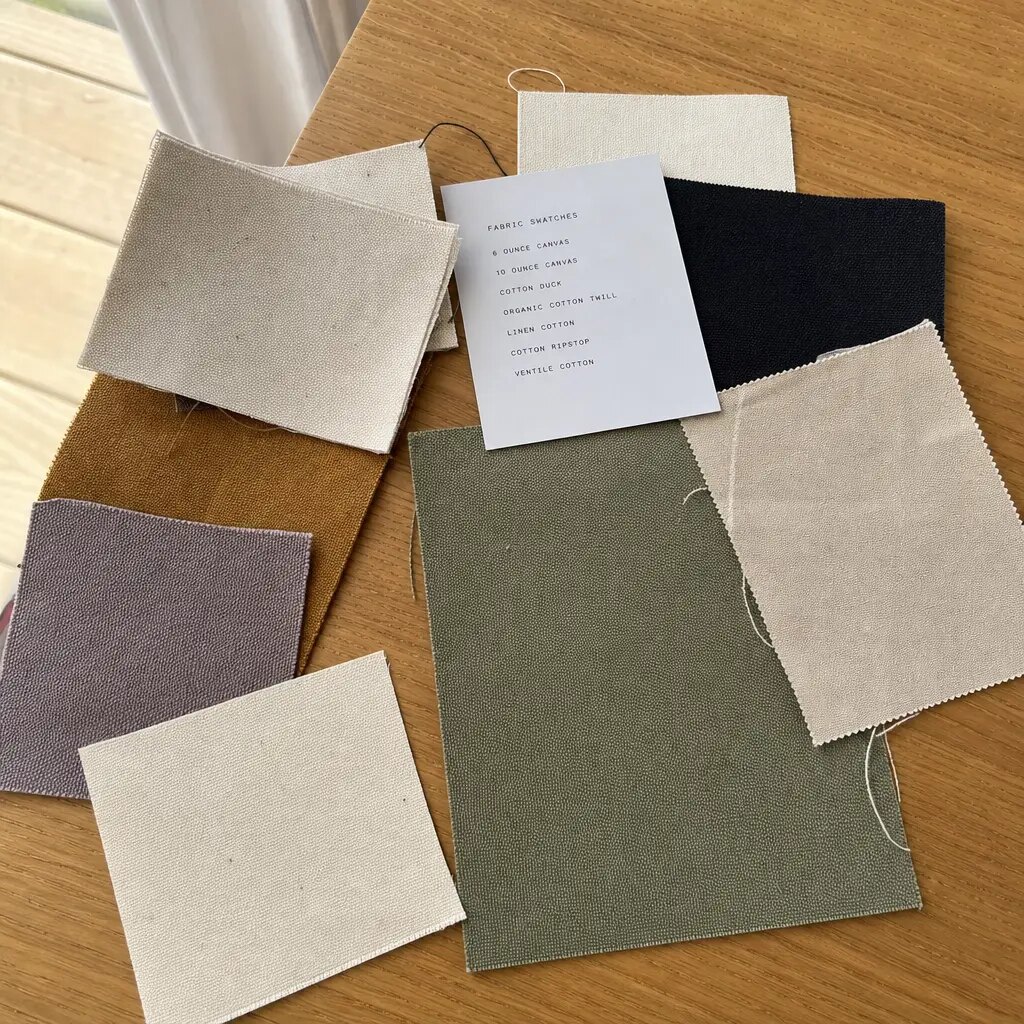
For coffee roaster programs, 180-200 GSM cotton canvas, cotton drill, or stable plain weave is often the most practical range. It feels more retail-ready than very light promotional cotton, supports cleaner printing, and still folds for cartons or mailers. Lighter cotton can work for one-day events or high-volume sampling, but it wrinkles more easily and can make the logo field look less controlled.
GSM is only part of the decision. A loose weave can soften the edges of small type. A textured canvas can make distressed artwork appear rougher than intended. A very stiff fabric may hold print well but pack poorly for subscription inserts. Buyers should review weave, surface texture, shade, and hand feel on the physical sample, especially if the backpack must sit beside premium coffee bags or gift boxes.
Construction matters because roaster bags carry real contents. A wholesale onboarding bag may hold sample packs, a brew guide, stickers, and a cafe card. A staff drop may include a notebook, pin, small tool, or apparel item. Check the drawcord casing, side seams, bottom seam, cord diameter, and knots before approving the print. A beautiful logo on a weak bag still creates a bad buying outcome.
- Use 180-200 GSM as a practical starting range for retail and wholesale roaster programs.
- Review weave and surface texture against the actual logo detail.
- Match seam strength and cord quality to the intended contents.
- Approve the finished bag construction, not just the printed panel.
Select the decoration method
One-color screen print is usually the best default for cotton drawstring backpacks ordered by coffee roasters. It is cost-effective at volume, reads clearly on cotton, and works well for wordmarks, simple icons, cafe badges, and clean seasonal marks. It also supports repeat orders when the supplier retains the screen, placement record, and approved sample.
Two-color screen print can work when the brand identity depends on an accent color, but it introduces registration control. The supplier must hold the relationship between colors closely enough that small letters and icon edges do not look shifted. For most roaster merch, a strong one-color print often looks more deliberate than a complex two-color mark fighting the fabric surface.
Transfers are useful for short runs, many colors, gradients, or pilot drops where the roaster is testing demand. They should be judged by hand feel, sheen, visible edge, adhesive residue, cracking after folding, and consistency across the run. Embroidery can look premium for small icons or staff bags, but large embroidery can pucker cotton drawstring panels. If embroidery is used, approve thread color, backing, stitch density, and distortion on the actual bag.
- Choose screen print for simple logos, repeat orders, and cost-controlled volume.
- Choose transfer for short runs or complex color only after checking feel and fold behavior.
- Choose embroidery for small premium marks on stable fabric.
- Set minimum stroke width and minimum text height before sampling.
Build a quote that prices the real bag
A strong RFQ should let suppliers quote the same product, not their own interpretation of it. Include bag dimensions, fabric GSM, weave, cotton shade, cord type, seam construction, logo size, placement, decoration method, color count, number of locations, target quantity, reorder expectations, packing method, carton marks, shipping terms, and in-hand date.
Logo placement affects price. A one-color center-front print is straightforward. A large print near the cord channel, a two-color registration job, front-and-back printing, woven labels, or artwork with tiny origin text can add setup cost and inspection time. If those details are missing at quote stage, the low price may change after artwork review.
Compare landed and operational cost, not just unit cost. Separate blank bag cost, decoration setup, sample charges, revision charges, packing materials, individual labeling, export cartons, inland handling, and freight assumptions. For seasonal roast launches or wholesale gift programs, ask whether the supplier can retain the production record for reorders so the next buy does not restart from zero.
- Send every supplier the same artwork, placement, fabric, packing, and delivery assumptions.
- Ask for MOQ plus two higher quantity breaks using the same spec.
- Separate setup, sample, packing, and carton costs from unit price.
- Document what is retained for reorders: screen, digital file, placement photo, and physical sample.
Evaluate supplier routes
Factory direct is often the best route when the buyer needs repeatability, clear technical discussion, and a retained production standard. This is useful for roasters that expect reorders, wholesale kit programs, or strict brand alignment across multiple cafe locations. The buyer can discuss fabric, safe print window, tolerances, and packing directly with the production source.
A merch agency, sourcing partner, or trading company can be helpful when the backpack is one item in a broader launch package. The key is transparency. The partner still needs to provide factory-level specs, decoration responsibility, inspection photos, and sample control. A polished quote without production detail is not enough for a branded cotton item that customers will handle.
Local decoration on imported blank bags can be practical for urgent events, staff gifts, or small market tests. The risk is that blank-bag lots may vary in size, weave, shade, and printability. Before decorating, inspect the blanks and measure the safe print window. Local speed does not remove the need for placement control.
- Use factory direct for repeatability and technical control.
- Use an agency or trader when coordinating several merch SKUs, but require factory-level evidence.
- Use local decoration for urgent or small runs after inspecting blank-bag consistency.
- Assign one party to own placement accuracy, color matching, rework, and release.
Approve the sample like a production standard
A digital mockup can show layout direction, but it cannot approve cotton behavior. The pre-production sample should use the final fabric, final GSM, final bag size, final cord, final sewing construction, final logo size, final placement, final decoration method, and final packing fold. If any item is substituted, the approval should state what remains open.
Handle the sample the way the customer or staff member will handle it. Fill it with two small coffee sample packs, a 250 g retail bag, brew cards, filters, or the actual planned kit contents. Pull the cords, hang it, fold it, reopen it, and place it beside current packaging. This review often catches issues that a flat photo misses: logo too low for shelf display, cord gathering too close to the mark, or fold pressure across the print.
Approval notes should be specific. Record the artwork revision, print method, logo width and height, top clearance from cord channel, side clearances, bottom or fold clearance, color target, fabric shade, packing method, and defect rules. Keep one physical sample and one annotated photo record tied to the PO. That sample becomes the standard for final inspection and future reorders.
- Approve a physical pre-production sample before bulk production.
- Test it with realistic roaster contents and actual packing flow.
- Record measured placement and color standards, not just visual approval.
- Keep the retained sample available for final inspection and reorder matching.
Set QC tolerances before bulk starts
Quality control should begin with the approved placement. For a one-color screen print, a practical commercial standard is logo position within +/-3 mm from the approved measurements. For transfers, embroidery, or multi-color work, use +/-4 mm unless the supplier has demonstrated a tighter capability. Multi-color screen registration should stay within +/-1.5 mm for normal viewing. These tolerances should be printed on the PO or inspection sheet, not left to a post-shipment debate.
Print defects should be defined in plain terms: no smearing, ghosting, double images, filled-in letter counters, broken fine strokes, scorch marks, press rectangles, adhesive residue, lint, oil, dust, or handling marks in the decoration zone. If the artwork includes small city text, a URL, or seasonal roast name, it must remain legible at arm's length when compared with the approved sample.
Inspect more than the logo. Check fabric shade, weave, hand feel, loose threads, skipped stitches, drawcord casing, seam strength, cord movement, knot security, folding, individual packing, carton counts, and carton marks. For larger runs, request inline photos and final random-carton photos before shipment. Inspection should pull from different cartons or production lots, not only the cleanest top samples.
- Use +/-3 mm placement tolerance for one-color screen print unless another written standard is agreed.
- Use +/-4 mm for transfer, embroidery, or more complex decoration.
- Reject print entering casing, seams, gussets, or restricted fold zones.
- Inspect sewing, cords, packing, and carton labels along with decoration quality.
Plan packing, MOQ, and reorders
Packing can protect or damage the logo. Bulk pack may be right for events where bags will be unpacked and handed out quickly. Individual packing, SKU labels, carton segregation, or paper bands may be needed for retail shelves, distributor receiving, cafe-location drops, and subscription fulfillment. The fold direction should be approved before production if the print sits anywhere near the lower half of the bag.
MOQ is shaped by fabric sourcing, cutting efficiency, print setup, label production, and packing work. The lowest MOQ may not be the best buying point because setup cost spreads across fewer units. Ask for the base MOQ, one mid-level break, and one larger reorder-friendly break using the same artwork and packing. This gives procurement a clearer view of the cost curve without encouraging overbuying.
Lead time should be counted from final sample approval and deposit, not from first inquiry. Work backward from the in-hand date and include artwork review, sample making, sample transit or review time, correction time, bulk production, packing, inspection, export handling, transport, and receiving. For reorders, reconfirm fabric shade, cord type, packing, and any artwork change. A new roast name, event date, or URL can require a new setup even when the bag shape stays the same.
- Approve the packing fold before bulk production.
- Choose bulk, individual, SKU-labeled, or carton-segregated packing based on receiving flow.
- Compare MOQ and higher breaks with the same spec assumptions.
- Count lead time from sample approval, not inquiry date.
- Reconfirm fabric, shade, cord, placement, and artwork before every reorder.
Specification comparison for buyers
| Decision area | Best-fit option | Use when | Procurement risk to control |
|---|---|---|---|
| Front center placement | Primary logo centered on the front panel, top edge 35-50 mm below the cord channel, with final clearance measured on the approved sample | Retail merch, wholesale welcome kits, staff issue bags, trade show gifts, cafe launch packs, and most roaster programs where the logo must read clearly | Cord-channel height, side seams, bottom fold, and fabric movement reduce the real print window; record exact top, side, and bottom clearances in millimeters |
| Upper front small mark | Small icon or short wordmark placed below the drawcord casing with generous top clearance | Minimalist cafe merch, premium small-batch releases, or bags that will hang on a peg or retail wall | Too-high artwork can distort when the cotton gathers; keep the logo outside the drawcord tunnel and top stitch zone |
| Lower front placement | Small-to-medium logo or release mark placed below center, away from the main cord-gather area | Retail-style designs, limited roast drops, quieter branding, or programs where the bag is displayed flat | Export folding and fulfillment folding can crease the logo; approve the exact fold pattern before production |
| Back-panel print | Secondary line, URL, wholesale program name, event name, or batch message printed on the back | When the front should stay clean and the second message has a real use for customers or staff | A second location adds setup, alignment, inspection, and rejection points; quote it separately from front-only printing |
| Woven side label | Small woven label captured in a side seam or near the lower side panel | Premium understated branding, repeat cafe retail goods, or programs where a printed logo is not desired | Label artwork, label MOQ, sewing position, and seam strength must be approved; it is not a quick substitute for print |
| 1-color screen print | Most reliable default for simple roaster logos on cotton | Wordmarks, badges, cafe icons, origin-free brand marks, and repeat orders at practical volume | Small letters, distressed marks, and fine lines can fill in on cotton; set minimum text height and stroke width before sampling |
| 2-color screen print | Controlled option for simple marks that need one accent color | Brands with a fixed two-color identity or event graphics with a limited palette | Registration tolerance between colors must be inspected; avoid tiny reversed text and very tight color traps |
| Heat transfer or digital transfer | Flexible option for short runs, complex color, gradients, or pilot merch | Seasonal tests, many-color artwork, low MOQ programs, or launch samples before a screen-print reorder | Check hand feel, sheen, transfer edge, wash/rub behavior, adhesive residue, and cracking after folding |
| Embroidery | Small premium mark on sufficiently stable cotton fabric | Cafe staff gifts, premium retail bags, or small icon branding where texture matters more than large visibility | Large embroidery can pucker drawstring bags; keep the stitch area small and approve backing, thread color, and fabric distortion |
Buyer checklist before sampling
- Define the commercial use first: retail shelf merch, wholesale onboarding kit, staff drop, event giveaway, subscription insert, or seasonal launch bundle.
- Specify bag dimensions, usable print window, fabric GSM, weave, cotton shade, drawcord type, seam construction, and whether the bag needs to hold coffee bags, sample packs, brew cards, filters, or staff items.
- Choose the placement route: front center for the main mark, upper front for a small icon, lower front only when folding is controlled, back panel for secondary information, or woven label for understated branding.
- Send final vector artwork with logo size, color references, minimum text that must remain legible, and any brand details that may be removed if the fabric cannot hold them cleanly.
- Require an annotated placement proof showing logo width, logo height, distance from the cord channel, left and right seam clearance, and bottom seam or fold clearance.
- Set production tolerances before sampling: logo position within +/-3 mm for single-location screen print, +/-4 mm for transfer or multi-color registration work, and no print entering seams, casing, or approved fold-restricted zones.
- Approve a physical pre-production sample on the final fabric, using the final decoration method, final print size, final placement, final cord, and final packing fold.
- Price the full order, not only the unit: blank bag, print setup by color and location, sample charges, artwork changes, packing, carton labeling, export cartons, inland freight, and retained-screen or reorder fees.
- Confirm supplier evidence before award: cotton bag print photos, workshop photos or partner-workshop details, inspection method, retained sample policy, and final inspection photo list.
- Lock packing instructions: bulk pack, individual polybag or paper band, SKU label, carton quantity, carton marks, fold direction, and whether the logo can be folded.
Factory quote questions to send
- What is the maximum safe print window in millimeters for this exact cotton drawstring backpack after allowing for the cord casing, top stitch, side seams, gusset, bottom seam, and planned fold?
- For our logo, what placement do you recommend for a coffee roaster merch bag: center front, upper front, lower front, back panel, or label? Please explain the production reason.
- Can you provide an annotated flat sample photo showing logo width, logo height, top clearance from the cord channel, side clearances, and bottom or fold clearance?
- What fabric GSM, weave, and cotton shade are included in the quote, and will the bulk fabric match the approved sample?
- What minimum stroke width and minimum text height can you hold cleanly on this cotton surface for screen print, transfer, and embroidery?
- Is the decoration handled in-house or by a partner workshop? Who is responsible for placement accuracy, color matching, rework decisions, and final inspection release?
- What are the setup charges per color and per location, and what changes if we add a back print, woven label, or second-color registration?
- What placement tolerance, color tolerance, registration tolerance, and seam-clearance standard will be used for bulk production?
- Will you retain the approved physical sample, screen or digital setup file, placement record, and packing photo for reorders?
- What inspection method do you use for this product, and can final inspection photos show placement measurements, print clarity, sewing, drawcord function, packing fold, carton labels, and random carton selection?
Quality-control points to confirm
- Primary logo position must match the approved sample within +/-3 mm for one-color screen print and within +/-4 mm for transfer, embroidery, or multi-color decoration unless the PO sets a tighter standard.
- No printed or embroidered artwork may enter the drawcord casing, top stitch line, side seam, gusset edge, bottom seam, or fold-restricted zone shown on the approved proof.
- Logo must be visually centered against the approved reference, with side-to-side balance checked from the sewn panel edges, not from loose fabric edges or an untrimmed blank.
- Multi-color screen print registration must stay within +/-1.5 mm for normal viewing, with no visible color shift that breaks letters, icons, or key brand shapes.
- Print color must match the approved sample under normal indoor light; obvious lot-to-lot shifts, uneven ink density, or mismatched accent colors are not acceptable for mixed-carton shipment.
- Small letters, city lines, URLs, roast names, and origin text must remain legible at arm's length if they were approved as readable elements on the production sample.
- No smearing, ghosting, double image, pinholes in solid logo areas, filled-in counters, broken strokes, scorch marks, press rectangles, adhesive residue, lint, oil, dust, or handling marks in the decoration zone.
- Fabric GSM, weave, shade, hand feel, and shrinkage behavior must remain consistent with the approved sample within the written material standard on the PO.
- Sewing must show no loose drawcord casing, skipped stitches, open seams, thread nests, needle cuts, twisted side seams, weak bottom seams, or excessive loose threads visible after trimming.
- Drawcords must pull smoothly, sit evenly, and remain secured after normal opening and closing; cord length should not vary enough to affect use or retail appearance.