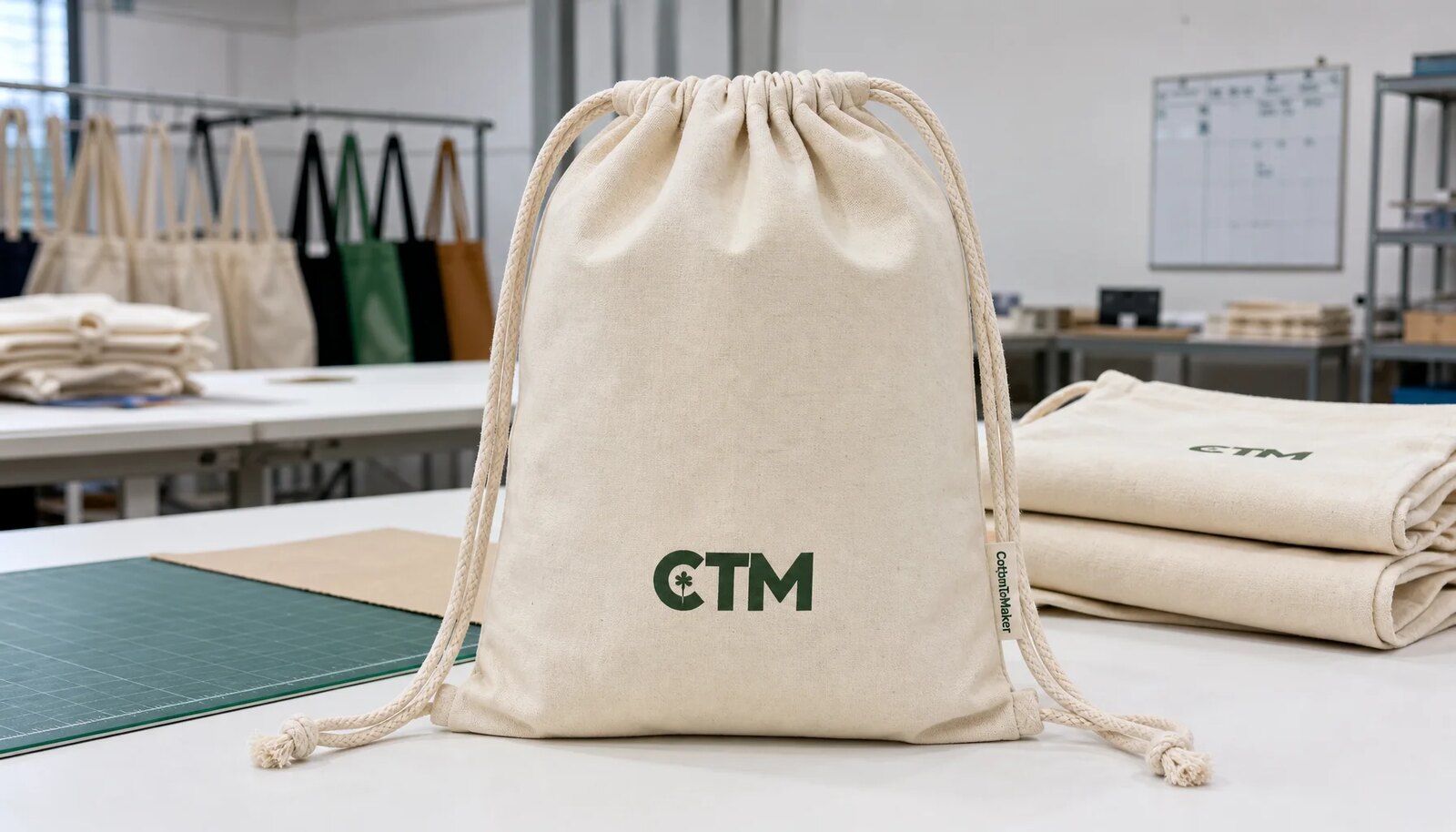
Start With the Craft Fair Use Case
A cotton drawstring backpack for a craft fair is not just a blank promotional sack with a logo dropped in the middle. It might be handed out at registration, sold by a maker brand, packed as a workshop kit, bundled with vendor coupons, or used as a lightweight shopping bag for small purchases. Each use changes the specification. A free sponsor bag can tolerate a simpler build than a paid resale item. A kit bag carrying boxed candles or folded apparel needs more structure than a bag holding maps and postcards.
Logo placement should be decided after that use case is clear. A mark that looks balanced in a PDF can sit too close to the drawcord channel once the top gathers. It can also disappear into a lower fold when the bag is stacked in cartons or worn on the back. For many adult cotton drawstring backpacks in the 350-400 mm width and 400-460 mm height range, the main front logo reads well when centered horizontally, with the top of the logo 90-120 mm below the finished top edge.
Procurement teams should treat viewing condition as a real sourcing input. Bags hanging from a booth hook are read differently from bags stacked flat on a table. A bag worn by visitors around the fair has motion, wrinkles, and contents pushing against the front panel. The RFQ should explain where the logo needs to be seen and how the bags will be distributed.
- Identify the primary use: giveaway, sponsor merchandise, retail product, workshop kit, VIP bag, or distributor stock.
- List expected contents so the supplier can match fabric weight, cord diameter, seam strength, and packing method.
- Confirm whether the bag will be reviewed mostly flat, hanging, closed, worn, or filled with event materials.
- For resale programs, leave more negative space so the cotton bag looks intentional rather than disposable.
- For sponsor programs, set logo hierarchy before sending artwork so every mark is not forced to the same size.
Write Placement Specs in Measurements
The safest placement instruction is not front center. It is a measured requirement that a printer, sewing line, and inspector can all follow. A strong specification might read: finished bag 380 x 420 mm, main logo 150 mm wide, centered on the front panel, top of logo 110 mm below the finished top edge, placement tolerance plus or minus 5 mm from the approved sample. That wording removes guesswork.
Finished-bag measurement matters because drawstring backpacks change shape after sewing. The top channel consumes vertical space. Side seams pull the panel inward. Bottom seams and corner cord attachments can create small distortions. If the supplier uses a cut-panel template only, the logo may look correct before sewing but drift visually after construction. Ask for the finished-front-panel safe area, not only the artwork template.
Printing sequence also affects placement. Printing before sewing gives a flatter surface and can be efficient for bulk production, but cutting and sewing must keep the visual center under control. Printing after sewing lets the printer work with the final bag shape, yet seams, cord bulk, and channel thickness can limit screen access. Neither route is automatically wrong. The important point is to choose the route early and price the tolerance honestly.
- Specify finished width, finished height, logo width, logo height, top-edge distance, centerline, and tolerance in millimeters.
- Keep the main logo below the drawcord channel and gathered area; on many adult bags, 90-120 mm from the top edge works well.
- Keep screen prints at least 35-50 mm from side seams when possible to reduce distortion and registration issues.
- Keep 50-70 mm or more above the bottom seam when the bag will carry rigid or bulky craft fair contents.
- Ask the factory to confirm whether the quoted tolerance applies to finished bags or only to printed panels.
Set a Practical Logo Size
Bigger is not always better on cotton. Large solid ink areas can make the front panel stiff, change the hand feel, crack along fold lines, or transfer when bags are compressed in cartons. On most adult cotton drawstring backpacks around 350-400 mm wide, a main logo width of 120-180 mm is a useful range for wordmarks, simple event marks, and one- to three-color sponsor logos.
Artwork shape changes the placement decision. A horizontal wordmark often sits comfortably just above the visual center of the usable front panel. A circular logo may look balanced flat but stretch or bulge when the bag is filled. A tall vertical mark can run into the top channel or lower reinforcement area. Multi-logo layouts need hierarchy, clear space, and minimum text size, not a grid of tiny unreadable sponsors.
A low-cost but effective check is to print the logo at actual size on paper, place it on a finished blank bag, and review it in real conditions. Look at it flat, hanging, closed, and lightly filled. If the order will hold boxed candles, ceramic ornaments, folded textiles, catalogs, notebooks, or craft kits, let those contents shape the final artwork size. Often, a slightly smaller logo with better spacing looks more premium and survives folding better.
- Use 120-180 mm as a practical starting width for the main logo on many adult-size cotton drawstring backpacks.
- Confirm minimum letter height based on booth viewing distance, not only the digital artboard.
- Avoid heavy logo coverage across expected fold lines, especially with transfers or large solid screen prints.
- Place circular and tall artwork away from the lower third if the bag will bulge with contents.
- For premium maker brands, consider a small front logo plus a woven side label instead of a large front print.
Choose Cotton Weight and Finish
Fabric weight influences almost every sourcing decision: opacity, print sharpness, seam strength, cord comfort, carton weight, and perceived value. Lightweight cotton around 140-160 GSM can be acceptable for short-term giveaways with light paper contents, but it may look transparent, wrinkle quickly, and show uneven ink absorption on larger prints. For reusable craft fair drawstring backpacks, many buyers move into 6-8 oz cotton canvas, roughly 200-270 GSM, because it gives more body without becoming difficult to pack.
Heavier cotton is not automatically the better buy. A 10 oz canvas can feel more substantial, but it adds freight weight, increases storage volume, and may require stronger cord and slower sewing. The right GSM depends on what the bag must carry and how the buyer wants it to feel. Event maps and postcards do not need the same construction as boxed craft kits or folded apparel sold at a maker booth.
Finish matters too. Natural cotton can suit craft fairs because the seed flecks and warmer tone feel handmade and less sterile, but those same flecks can interrupt fine artwork. Bleached cotton gives a cleaner print background and stronger contrast, yet it shows dirt more easily. Dyed cotton requires colorfastness checks and logo opacity testing, especially for white or light ink. Washed cotton may feel softer but can introduce more dimensional variation, so shrinkage behavior should be checked before bulk release.
- Use 140-160 GSM mainly for light promotional bags, small logos, and low load expectations.
- Use 200-270 GSM for reusable craft fair bags, sponsor kits, distributor stock, and small retail purchases.
- Use 280-340 GSM when premium hand feel matters, while checking freight impact and cord strength.
- Approve natural cotton with its actual shade range, flecks, and texture because mockups hide material variation.
- For dyed or washed cotton, require shade consistency, shrinkage, colorfastness, and logo contrast checks.
Match Decoration Method to Artwork Risk
Screen printing is usually the strongest default for cotton drawstring backpacks with one to three solid colors. It handles bulk orders well, supports clean placement, and can provide good opacity when the factory controls screens, ink, curing, and registration. Still, the RFQ should not just say screen print. Ask for ink type, color reference, line-detail capability, curing method, and the checks used before packing.
Heat transfer can be useful when the artwork has gradients, fine detail, many colors, or a small run size that makes screens inefficient. The tradeoff is feel and edge behavior. Transfers can be stiffer than ink, and edges may lift or crack after folding and carton compression. Test the actual transfer on the production cotton, fold the bag through or near the logo, compress it as it will ship, and inspect it again.
Embroidery creates a premium look on small marks but is risky for large front-panel branding on lighter cotton. Dense stitching can pucker the panel, add rough backing inside the bag, and change how the fabric hangs. When the front panel belongs to event artwork or sponsor artwork, a small woven side label may be the cleaner way to keep the buyer’s brand visible without crowding the main logo.
- Use screen print for solid spot-color logos, strong opacity, and predictable bulk repeatability.
- Use water-based ink when a softer hand is important and the cotton color provides enough contrast.
- Use high-opacity ink for light artwork on dyed or dark cotton, and confirm curing before packing.
- Use heat transfer only after checking edge adhesion, folding behavior, cracking, and hand feel.
- Use embroidery for small marks after reviewing puckering, backing, stitch density, and finished-bag drape.
Control Tolerance Before Production
Logo tolerance belongs in the commercial specification, not in a dispute after delivery. Cotton shifts during cutting, printing, sewing, pressing, and packing, so a zero-variance standard is not realistic for ordinary bulk production. For many standard screen-printed cotton drawstring backpacks, plus or minus 5 mm from the approved sample is a practical target for logo position. Tighter tolerances may be possible, but they usually require better jigs, slower handling, and more inspection time.
The measuring method should be written down. Inspectors can measure from the finished top edge to the top of the logo, then check the horizontal center against finished side seams or a defined centerline. Tilt should be measured with a ruler, square, or placement jig. A logo can be close to the correct top-edge distance and still look wrong if it is angled.
Defect classification keeps inspection fair. Wrong logo, wrong bag color, blocked drawcord channel, broken cord attachment, and unsafe contamination are critical issues because the bag may be unusable. A visibly tilted logo, severe ink cracking, open seam, large front-panel stain, or incorrect packing method is usually major. Small slubs or short thread ends may be minor when they sit outside the logo area and match the approved cotton standard.
- State logo placement tolerance in millimeters and connect it to the approved physical sample.
- Measure finished bags, not only printed fabric panels or artwork sheets.
- Classify visible tilt separately from top-edge distance because both affect shelf and booth appearance.
- Define critical, major, and minor defects before production starts.
- Agree on AQL level, inspection sample size, rework rules, and approval authority for borderline defects.
Build the RFQ Around Real Costs
MOQ for logoed cotton drawstring backpacks is shaped by more than factory preference. Stock natural cotton, stock cord, and one-color screen printing may be practical at 300-500 pieces depending on supplier conditions, season, and artwork. Custom dyed fabric, custom cord color, woven labels, multiple print positions, washing, retail packing, or destination sorting can push practical MOQ to 1,000 pieces or more because material minimums and setup labor must be spread across the order.
Unit price alone is a weak comparison. One quote may include screen charges, Pantone matching, strike-off, sample fee, reinforced cartons, individual packing, and barcode labels. Another may exclude all of them. Procurement should compare approved landed cost, not just the first bag price in an email. Ask for each cost driver as a line item so the team can see what is included and what is being substituted.
Small quantities can also change the production route. A supplier may use available blank bags, digital decoration, limited cotton colors, or looser placement control for a pilot run. That can be fine for a one-off event, but it should not be confused with a scalable bulk standard. If the craft fair program will repeat, ask whether future production can use the same fabric, cord, print method, and placement jig.
- Break out bag cost, print setup, screen charge by color, sample fee, label setup, extra logo position, packing, and sorting.
- Ask whether the MOQ assumes stock fabric and stock cord or requires custom material booking.
- Request carton dimensions, gross weight, net weight, and pieces per carton before comparing freight.
- Confirm when lead time starts: deposit, artwork approval, material confirmation, sample approval, or all of these.
- Ask suppliers to identify any sample-room substitutions that will differ from bulk production.
Use Samples as the Production Standard
The pre-production sample should become the physical contract for bulk production. A digital mockup can confirm layout intent, but it cannot show cotton texture, shade variation, ink spread, cord movement, sewing distortion, or the way a bag closes. A useful sample uses production fabric, production cord, actual ink or transfer, final seam construction, final logo placement, any side label, and the planned packing fold.
Sample approval should include measurements, not only a yes or no. Record finished width, finished height, logo width, logo height, distance from the finished top edge to the logo top, horizontal centerline result, tilt result, cord length, channel height, stitch density, label position, print color reference, and approved material variation. These notes give the inspection team a standard they can measure.
For repeat orders and multi-location programs, sample control is especially important. One sealed sample should stay with the factory. One should stay with the buyer, distributor, or inspection partner. Photos help with communication, but they should not replace the physical reference. On reorders, confirm whether fabric lot, cotton shade, print route, and cord material remain the same or whether a new approval sample is needed.
- Measure logo placement after sewing, not only after printing.
- Review the sample flat, hanging, closed, and lightly filled with representative craft fair contents.
- Rub the print with a dry white cloth and inspect for transfer, powdering, flaking, or peeling.
- Close and open the drawcord several times to confirm smooth movement through the channel.
- Approve the exact fold because a fold line through heavy ink can create creasing during transit.
Inspect Construction, Cord, and Function
A well-placed logo does not rescue a weak bag. The drawcord must close smoothly, the bottom corners must handle repeated pulling, and the seams must support the expected contents. Craft fair bags often carry more than paper. Visitors may add boxed candles, small jars, ceramic ornaments, folded apparel, craft kits, yarn, catalogs, water bottles, or sponsor samples. Those loads concentrate stress at the lower corners and side seams.
Cord specification should include material, diameter, length, color, and attachment method. A 5-7 mm cord is a common practical range for mid-weight cotton drawstring backpacks, although the best choice depends on fabric weight and load. A thin cord may reduce cost but can dig into shoulders, fray, slip through the corner seam, or look out of proportion on heavier canvas.
Inspectors should look beyond the front face. Side seams, top channel, bottom seam, and cord attachment points need checks for skipped stitches, open seams, loose threads, uneven stitch density, and fabric tearing. The channel must remain open after sewing and decoration. If the cord jams or a corner tears during the event, the bag has failed even if the logo is beautiful.
- Specify cord diameter, material, color, length, and whether ends are knotted, tipped, or left plain.
- Pull-test bottom cord attachments several times using a method agreed with the supplier.
- Check that the top channel is not blocked by stitching, ink, loose thread, or label placement.
- Inspect seam strength around lower corners because that is where load stress concentrates.
- Reject open seams, skipped load-bearing stitches, broken bartacks, and cord slippage as functional defects.
Plan Packing for Event Distribution
Craft fair orders often pass through several hands before the event. They may ship to a brand warehouse, distributor, event organizer, regional sales team, or direct booth location. Packing must protect the print and make sorting simple. Flat packing is efficient, but the fold should avoid heavy ink areas when possible. If the fold must cross the logo, test that fold on the approved sample and inspect it after compression.
Bulk packing may use inner polybags of 25 or 50 pieces and export cartons of 100-200 pieces, but the right count depends on bag size, fabric GSM, cord bulk, decoration method, and retail packaging. Heavier cotton, large transfers, hangtags, belly bands, individual polybags, and barcode labels can reduce carton quantity and increase freight volume. Ask for carton dimensions, gross weight, net weight, and pieces per carton before freight booking.
Carton marking is part of QC, not an afterthought. If an order includes multiple artwork versions, bag colors, sponsor sets, booth destinations, or event kits, each carton should show SKU, artwork version, color, quantity, purchase order, destination, and carton number. Poor marking leads to warehouse opening, resorting, dirt exposure, creasing, and the wrong logo arriving at the wrong event.
- Confirm inner pack quantity, carton quantity, carton dimensions, gross weight, and net weight before final pricing.
- Avoid overpacked cartons that press inked panels together for long periods and increase transfer risk.
- Use moisture protection for sea shipments, humid seasons, or long warehouse storage.
- Test hangtags, stickers, barcode labels, and belly bands for staining, adhesive marks, and fiber pull.
- Require carton marks by SKU, artwork version, color, destination, event kit, or booth reference when applicable.
Specification comparison for buyers
| Spec decision | Recommended option | When it fits | Buyer risk to check |
|---|---|---|---|
| Primary front logo position | Center on the finished front panel; for a common adult bag around 380 x 420 mm, set the top of the logo 90-120 mm below the finished top edge | Craft fair giveaways, sponsor bags, booth welcome kits, maker-market merchandise, and retail add-on packaging where the logo must read while hanging or carried | If the logo starts too high, the drawcord channel and gathered cotton distort it; if too low, it may fold against the lower back, carton fold, or bottom cord reinforcement |
| Main logo size | 120-180 mm wide for most 350-400 mm wide adult cotton drawstring backpacks; keep height proportional and leave visible negative space | Readable wordmarks, simple event marks, sponsor logos, and one- to three-color screen prints | Oversized ink areas can feel stiff, crack along fold lines, transfer in cartons, or make a craft bag look like disposable promo packaging |
| Finished-bag safe area | Approve a measured safe zone after sewing that excludes the top channel, side seams, bottom seam, and bottom corner cord reinforcement | Orders printed after sewing, artwork near construction points, or programs with strict sponsor placement rules | Cut-panel print dimensions do not equal finished-bag dimensions; sewing, shrinkage, and cord-channel construction can move the visual center |
| Placement tolerance | Common commercial target: plus or minus 5 mm from approved sample for standard screen-printed cotton bags; quote tighter tolerances separately | Bulk orders where the logo is centered and inspected with a ruler or placement jig | Unstated tolerances cause disputes; plus or minus 2-3 mm may be unrealistic without special jigs, slower handling, or higher cost |
| Fabric weight | 6-8 oz cotton canvas, roughly 200-270 GSM, with approved opacity, hand feel, and shrinkage behavior | Reusable bags carrying brochures, craft kits, yarn, candles in boxes, folded apparel, catalogs, samples, or small purchases | 140-160 GSM cotton can be transparent and wrinkle-prone; 10 oz cotton raises freight weight and may need heavier cord and reinforced sewing |
| Print method | Screen print for one to three solid spot colors; heat transfer for gradients or detailed short runs; embroidery only for small premium marks | Screen print is usually the most controllable bulk method for logoed cotton drawstring backpacks | Transfers require edge-lift and folding tests; embroidery can pucker light cotton; screen print requires curing, rub checks, and registration control |
| Ink and color control | Use Pantone reference or approved physical swatch, then confirm dry rub, scratch, cure, and fabric-color contrast on the production material | Brand owners, distributors, sponsor programs, multi-location events, and repeat seasonal buys | Phone photos are not color standards; under-cured ink can powder, flake, crack, or transfer during carton storage |
| Cord and corner reinforcement | 5-7 mm cotton or cotton-like cord with reinforced bottom corner stitching, bartacks, or triangular reinforcement where appropriate | Mid-weight craft fair bags used for light retail goods, catalogs, samples, and booth kits | Thin cord can cut into shoulders, slip at the corner seam, fray, or fail pull tests when bags are overfilled |
| Brand label option | Use a small woven side label sewn into the side seam when the front panel is reserved for event or sponsor artwork | Private-label programs, maker brands, distributor identity, and resale bags that need subtle ownership | The label must not block the cord path, weaken the side seam, irritate users, or disturb the final folding method |
Buyer checklist before sampling
- Define the finished bag size in millimeters, not only the nominal size; include finished width, finished height, channel height, cord length, and whether the bag has a gusset or flat bottom.
- Specify fabric weight in both GSM and ounce where possible, such as 200-270 GSM or 6-8 oz cotton canvas, and confirm whether the cotton is natural, bleached, dyed, washed, recycled-content, or blended.
- List the expected contents: brochures, booth maps, craft kits, yarn, candles in boxes, folded apparel, notebooks, catalogs, sponsor samples, or small retail purchases. Use this to set fabric, cord, and seam requirements.
- State the commercial use: free giveaway, sponsor merchandise, paid retail product, VIP welcome kit, workshop kit, or distributor stock. The use changes logo size, packing, and defect tolerance.
- Confirm the finished front-panel safe area after allowing for the top drawcord channel, side seams, bottom seam, corner reinforcement, expected fold line, and any side label.
- Specify logo width, height, top-edge distance, horizontal centerline, orientation, and placement tolerance in millimeters instead of using wording such as front center or normal position.
- Ask whether printing will occur before sewing or after sewing, and require the supplier to explain how that process affects placement tolerance, centerline, print flatness, and safe print area.
- Choose the decoration method according to artwork risk: screen print for solid spot colors, heat transfer for gradients or small detailed runs, embroidery for small marks, and woven label for subtle brand ownership.
- Provide vector artwork, Pantone references, minimum line thickness expectations, knockout details, logo hierarchy for sponsor layouts, and instructions for avoiding fold lines through heavy ink coverage.
- Request a pre-production sample using production fabric, production cord, actual ink or transfer, final logo placement, final seam construction, label position if any, and the planned packing fold.
Factory quote questions to send
- What finished bag size are you quoting in millimeters, and what tolerances apply to finished width, finished height, drawcord length, channel height, and usable front-panel area?
- What cotton fabric weight are you quoting in GSM and ounce, and is the material natural greige, bleached, dyed, washed, recycled-content, organic-certified, blended, or otherwise treated?
- Is the quoted fabric stock material, or does it require fabric booking, dye lot approval, washing, shrinkage control, or a minimum fabric quantity?
- What is the safe logo area on the finished front panel after excluding the drawcord channel, side seams, bottom seam, corner cord attachment, and planned fold line?
- Will the logo be printed before sewing or after sewing, and what placement tolerance can you hold on finished bags using that process?
- For a standard adult bag, can you hold plus or minus 5 mm from the approved sample for logo position and no obvious tilt when measured against the finished top edge and centerline?
- Which print method are you quoting, and what ink type, transfer type, curing process, mesh count or transfer specification, and color matching method are included?
- What minimum line thickness, minimum text height, and minimum gap between design elements do you recommend for this cotton texture and print method?
- How will you check ink curing, dry rub resistance, scratch resistance, and ink-to-ink transfer risk before packing?
- What cord material and diameter are included, and how is the bottom corner attachment reinforced against pulling, seam tearing, or cord slippage?
Quality-control points to confirm
- Logo placement should be measured from the finished top edge to the top of the logo and from the finished side seams or centerline to the logo center. A common commercial tolerance is plus or minus 5 mm unless a tighter standard is agreed and priced.
- Logo tilt should be checked with a ruler, square, or placement jig. Visual checking alone is not enough because a small diagonal shift becomes obvious when several bags hang together at a booth.
- The top drawcord channel must remain open after printing and sewing. Check that ink buildup, seam catching, loose threads, or misaligned stitching do not block closing and opening.
- Printed logos should pass a dry white-cloth rub check and light scratch check without obvious ink transfer, powdering, flaking, peeling, or surface cracking.
- Ink color should be compared under consistent light against the approved physical sample or Pantone reference. Phone photos and uncontrolled factory lighting should not be the only color approval method.
- For heat transfers, inspect edge adhesion, surface cracking, and stiffness after the bag is folded through or near the logo area and held under normal carton compression.
- For embroidery, inspect puckering, thread breaks, backing irritation, distorted fabric, and whether dense stitching affects the way the bag folds or hangs.
- Bottom corner cord attachments should withstand repeated pull testing without cord slippage, bartack breakage, seam tearing, grommet distortion if used, or visible fabric damage.
- Finished dimensions should be measured flat, with separate tolerances for width, height, channel height, cord length, reinforcement area, gusset if any, and label position if used.
- Fabric panels should be checked for large stains, oil marks, water marks, shade panels, broken yarns, severe slubs, holes, contamination, and visible defects in or near the main logo area.