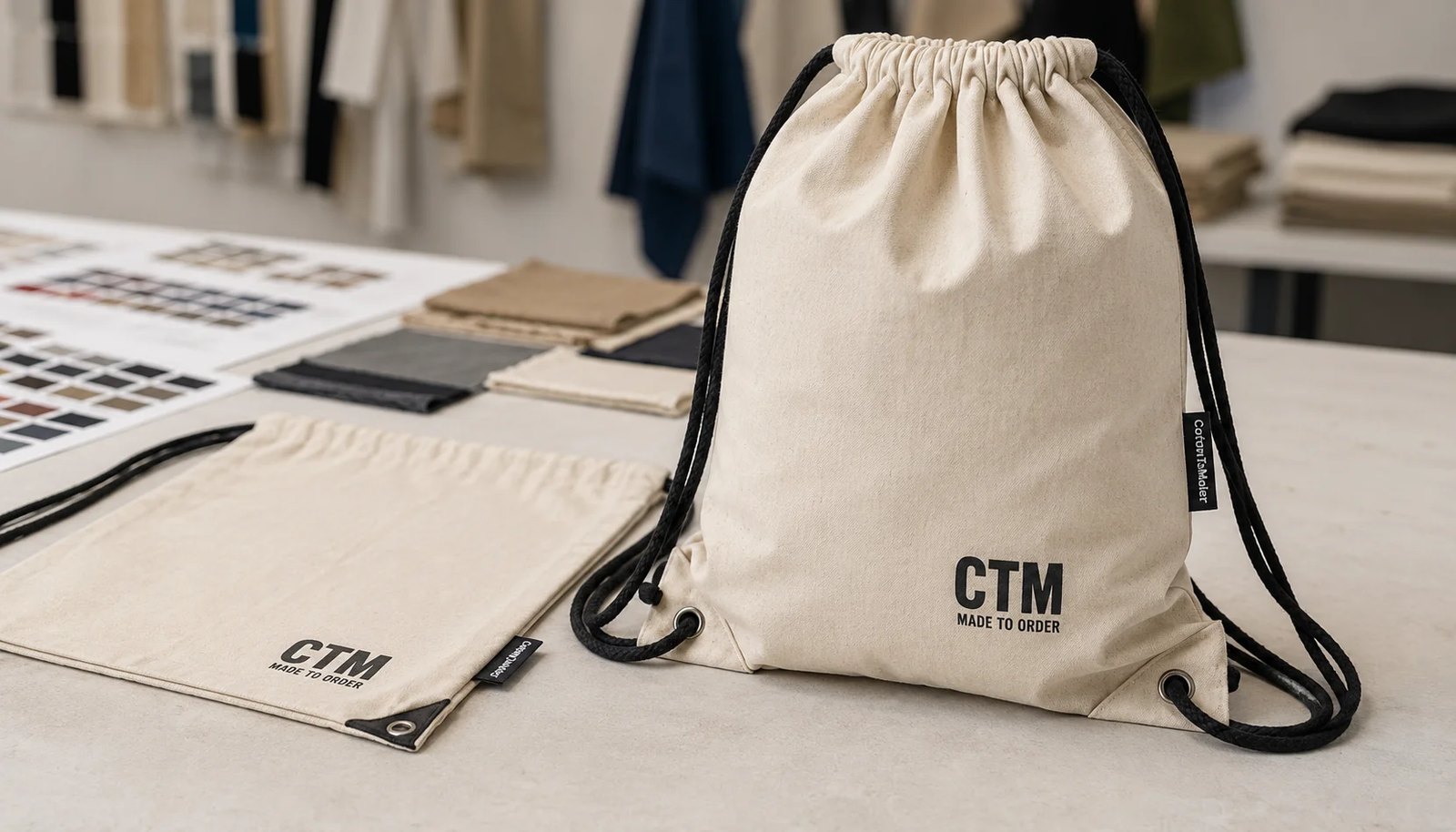
Start MOQ Negotiation From the Real Use
For liquor retailers, cotton drawstring backpacks are usually not a basic giveaway bag. They may be used for tasting kits, loyalty club rewards, seasonal promotions, private label merchandise, distributor sales visits, or store opening campaigns. Each use changes the acceptable fabric weight, reinforcement, print method, packing style, and MOQ logic. A buyer who only sends a logo and asks for the lowest MOQ will normally receive an over-simplified quote that is difficult to compare with other suppliers.
The first negotiation point is not price. It is whether the factory understands what the backpack must carry and how it will be distributed. If the bag will hold a single lightweight promotional item, a lighter cotton option may be enough. If retail staff will pack gift items, glassware, tasting sheets, apparel, or accessories, the construction must be stronger. MOQ discussions become easier when the use is clear because the factory can show which specs can be simplified without causing complaints.
- For event giveaways, prioritize unit cost, fast packing, and clear logo visibility.
- For retail gift kits, prioritize fabric body, reinforcement, carton strength, and clean presentation.
- For loyalty programs, prioritize repeatable color, print durability, and consistent finish across reorders.
- For resale merchandise, treat the bag like a product: stronger fabric, tighter QC, better labeling, and fewer visible thread defects.
- For distributor campaigns, define whether cartons ship to one warehouse or many stores because packing affects labor and cost.
Choose Fabric GSM Before Discussing Quantity
Cotton drawstring backpacks can be made from several cotton weights, but not every weight is commercially sensible for liquor retail. A 5 oz cotton fabric may meet a low-cost promotion budget, but it can look thin when printed and may not protect the buyer's brand image if used with heavier contents. An 8 oz cotton canvas, often around 270 GSM depending on construction, is a common practical starting point. It gives better body, holds screen print well, and still folds efficiently for export packing.
Heavier 10 oz or 12 oz canvas can be useful for resale or premium club merchandise, but it changes the negotiation. Heavy fabric can require different sewing handling, may reduce pieces per carton, and may not be available from stock in every color. If the buyer wants a very low MOQ with heavy dyed canvas, the factory may either quote a high unit price or push for a larger quantity because dyeing and fabric purchasing minimums become the real constraint.
- 5 oz cotton: suitable for lightweight giveaways, but weaker handfeel and less structure.
- 8 oz cotton canvas: practical middle option for branded liquor retail promotions and gift programs.
- 10 oz cotton canvas: better for premium programs, stronger feel, higher material and freight impact.
- 12 oz canvas: strong but less MOQ-friendly unless the buyer accepts higher cost and longer lead time.
- Natural cotton usually supports lower MOQ better than custom dyed cotton because fabric availability is simpler.
Understand What Really Drives MOQ
MOQ is not a single factory rule. It is built from smaller minimums: fabric roll quantity, dye lot size, cord purchasing, screen setup, cutting efficiency, sewing line setup, packing labor, and carton handling. A factory may accept 500 pieces for a natural cotton backpack with one-color screen print, while the same bag in custom dyed cotton with matching cords and four-color artwork may require a much higher quantity. The product looks similar in a catalog, but the production planning is different.
The strongest MOQ negotiation lever is spec discipline. Keep the first order to one size, one fabric color, one cord type, one print method, and one packing method. If the buyer needs multiple store brands or seasonal artwork versions, separate the conversation into total quantity and per-design minimum. Some factories can combine sewing quantity but must still charge print setup by artwork. That distinction matters because a quote that says MOQ 1,000 pcs may mean 1,000 per design, not 1,000 total.
- Fabric MOQ is affected by stock availability, fabric width, dyeing, shrinkage allowance, and cutting yield.
- Print MOQ is affected by screen setup, number of ink colors, curing time, and artwork changeovers.
- Cord MOQ is affected by material, diameter, color matching, and whether it is stock or custom dyed.
- Packing MOQ is affected by individual polybags, barcode labels, store assortments, and carton mark versions.
- Inspection cost per unit becomes higher at very small quantities, even if the factory accepts the order.
Use Spec Tradeoffs Instead of Pushing Only Price
A low unit price can be achieved in several ways, but not all are acceptable. A factory may reduce fabric GSM, use thinner cords, remove reinforcement, simplify stitching, or switch from screen print to a cheaper transfer. These changes may be fine for a short event giveaway, but they can create problems for a liquor retailer if the bag is expected to carry valuable branded items or represent a premium store program. Good negotiation identifies which changes are harmless and which damage the product.
A practical RFQ can request two quote versions. Version A should be the preferred retail spec. Version B should be an MOQ-friendly value engineering option. For example, the buyer may keep the 8 oz natural cotton fabric and front screen print but accept stock black cords instead of custom dyed cords. That saves complexity without weakening the main product. In contrast, reducing the reinforcement at cord anchor points may save little and create a higher failure risk.
- Usually acceptable: stock natural fabric instead of custom dyed fabric for trial orders.
- Usually acceptable: one-color screen print instead of multi-color artwork when brand rules allow it.
- Usually acceptable: flat bulk packing instead of individual polybags when goods go to a warehouse.
- Risky: reducing fabric too much when the bag must carry bottles, glassware, or heavy retail kits.
- Risky: deleting bar tacks or corner reinforcement when the backpack will be loaded by store staff.
- Risky: approving artwork only from a digital layout without seeing print coverage on cotton texture.
Match Print Method to Liquor Retail Artwork
Most liquor retailers and distributors use logos, event marks, club program names, or seasonal graphics. For solid logos and limited colors, screen printing is usually the most stable choice on cotton drawstring backpacks. It gives controlled cost, durable color, and efficient production when the artwork is clean. The buyer should provide vector files, Pantone references, print size, placement from bag edges, and the approved logo clearance rules. Without this, factories may quote based on assumptions that later change the price.
Heat transfer can be useful when artwork contains gradients, small color blends, photographic elements, or complex campaign graphics. However, transfers can feel different on cotton and may not match the relaxed textile look that many liquor retailers want. Embroidery is possible but is less common for large front graphics because it adds cost, can distort lighter fabric, and may need backing. The print decision should be made with the fabric GSM, logo size, and use case together, not as a separate decoration line.
- Screen print works best for one to three solid colors and medium to large logo areas.
- Discharge or water-based ink may feel softer, but fabric color and curing control matter.
- Plastisol-style prints can give strong opacity but may feel heavier on large logo blocks.
- Heat transfer is useful for complex graphics, but the buyer should review edge finish and handfeel.
- Embroidery fits small premium marks or side labels better than large flat front artwork.
- Metallic ink, very fine type, and low-contrast colors need a strike-off before bulk approval.
Build the RFQ Around Quote Data
A useful quote for cotton drawstring backpacks should be more than a unit price. The buyer needs enough data to compare suppliers on the same basis. Two quotes that both say 8 oz cotton may still differ in finished size, shrinkage control, cord diameter, reinforcement, print coverage, carton quantity, and inspection readiness. If the quote does not show these details, the buyer may choose a cheaper supplier and later discover that the product was not equivalent.
For MOQ negotiation, require the supplier to show what changes at different quantity breaks. A professional factory can normally explain why 500, 1,000, 2,500, and 5,000 pieces price differently. The cost drop may come from fabric purchasing, print setup amortization, carton efficiency, or sewing line planning. If the supplier cannot explain the price break, the buyer has less evidence for internal approval and less control when the purchase order is issued.
- Quote quantity breaks: request at least three quantities, such as 500, 1,000, and 2,500 pieces.
- Material line: include fabric weight, color, width if relevant, and whether stock or custom sourced.
- Logo line: include print method, number of colors, print size, and number of positions.
- Construction line: include cord type, reinforcement, stitching, and tolerance.
- Packing line: include pieces per inner bundle, pieces per carton, carton size, gross weight, and marks.
- Commercial line: include sample cost, mold or screen charges if any, payment terms, lead time, and quote validity.
Approve Samples With Production Criteria
Sample approval should not be treated as a visual formality. For this product, a proper pre-production sample should use the confirmed fabric weight, final cord type, final stitching method, and final print process. A sample made from substitute fabric is useful only for shape discussion. It cannot approve handfeel, print absorption, shrinkage behavior, or load performance. For liquor retail programs, the sample should be packed with realistic contents before approval.
The buyer should record acceptance criteria in writing after sample review. This helps avoid arguments during inspection. For example, finished size tolerance can be plus or minus 1 cm, print placement tolerance can be plus or minus 5 mm to 8 mm depending on design, and fabric GSM tolerance should be agreed against the approved swatch. The goal is not to create unnecessary paperwork. The goal is to make sure the factory, importer, and retail buyer are judging the same product.
- Review fabric handfeel and opacity under normal store lighting, not only under bright sample room lights.
- Pull the cords repeatedly to see whether the channel runs smoothly and corners hold shape.
- Load the sample with the intended contents and hang it for a short period to observe stress points.
- Rub the print after curing to check whether ink transfers or cracks on the cotton surface.
- Measure logo position from fixed bag edges so approval can be repeated during inspection.
- Photograph the approved sample with a ruler and close-ups of cord anchors, stitching, and print texture.
Control Packing Before It Becomes a Cost Surprise
Packing is often where a low MOQ order becomes less economical. Flat bulk packing is usually the most efficient for cotton drawstring backpacks. The factory can stack bags, bundle them by a fixed quantity, and pack them into export cartons with clear carton marks. This is suitable when the importer or distributor will allocate stock later. It also reduces plastic use and saves packing time.
Individual polybags, barcode stickers, size labels, store assortment packs, and display-ready cartons all change labor and material cost. They can be necessary for retail distribution, but they should not be added after price negotiation. For liquor retailers with multiple store locations, carton marking should identify PO number, item code, color, quantity, carton number, gross weight, and destination if required. Good carton instructions prevent warehouse delays and short-ship disputes.
- Bulk flat pack: lowest packing complexity and usually best for warehouse distribution.
- Individual polybag: useful for cleanliness and unit handling, but adds plastic, labor, and carton volume.
- Barcode label: required for some retail systems; artwork and data must be approved before packing.
- Store assortment carton: helpful for chain retail rollouts, but requires precise allocation files.
- Master carton strength: important if cartons are palletized, rehandled, or shipped to multiple warehouses.
- Carton quantity: should balance freight efficiency with weight that warehouse staff can handle safely.
Plan Lead Time Around Approval Gates
Lead time for cotton drawstring backpacks depends on material availability, sample approval speed, print complexity, and packing requirements. A simple natural cotton bag with one-color screen print can move faster than a custom dyed fabric order with multiple print colors and store-level packing. The buyer should separate sample time, bulk material time, production time, inspection time, and shipping handover time. A single total lead time hides the steps that usually cause delay.
Approval delays are common in liquor retail because artwork may need brand, legal, distributor, or campaign approval. If those teams review only after the factory makes a strike-off, the schedule can slip. A better workflow is to approve artwork size, Pantone colors, and logo position before sampling, then approve the physical strike-off for color and print quality. The purchase order should state whether bulk fabric cutting can start before final print approval or only after the pre-production sample is signed.
- Material preparation can be short for stock natural cotton and longer for custom dyed fabric.
- Screen setup and strike-off approval should be scheduled before bulk printing.
- Bulk sewing should not start until construction details and reinforcement are approved.
- Inspection booking should happen before the goods are fully packed if the buyer wants easier defect review.
- Retail launch dates should include buffer for customs clearance, inland trucking, and warehouse allocation.
- Reorders are faster only if fabric, cord, print ink, and packing specs remain unchanged.
Compare Landed Cost, Not Only Factory Price
For importers and distributors, the lowest FOB unit price is not always the lowest landed cost. Heavier fabric, individual polybags, lower carton efficiency, and oversized bag dimensions increase freight and handling. A supplier offering a slightly lower unit price with poor carton utilization may cost more after ocean freight, customs, inland delivery, and warehouse labor. This is especially important for cotton backpacks because they are soft goods, but carton volume can still rise quickly with heavy canvas or bulky cords.
A landed-cost comparison should include unit price, sample and setup charges, inspection cost, export carton quantity, carton cubic meters, gross weight, duty category assumptions, freight method, and warehouse handling. The RFQ should request estimated carton dimensions before the order is placed. Even if those dimensions are not final until packing, early estimates allow procurement teams to compare sourcing options more accurately and avoid a surprise when the forwarder calculates volume.
- FOB unit price: compare only after confirming the same fabric, size, print, and packing.
- Setup charges: include screens, strike-offs, custom labels, barcode setup, and special packing labor.
- Freight volume: calculate from estimated carton dimensions and pieces per carton.
- Duty and tax: validate with the importer of record because classification depends on market and product details.
- Warehouse labor: include relabeling or repacking if cartons are not prepared for the final distribution route.
- Defect allowance: a very cheap order with weak QC can cost more if retail stores reject units.
Specification comparison for buyers
| Spec decision | Recommended option | When it fits | Buyer risk to check |
|---|---|---|---|
| Fabric weight | 8 oz cotton canvas around 270 GSM | Balanced choice for liquor gift programs, tasting kits, and reusable retail giveaways where the bag must feel stronger than a pouch but still fold for carton packing | Very light 5 oz cotton can look cheap and may show bottle corners; heavy 12 oz canvas raises MOQ, freight volume, and sewing time |
| Bag size | Approx. 38 x 45 cm with usable depth from soft fabric | Fits branded apparel, tasting notes, two small gift items, or retail loyalty merchandise; safer than undersized promo bags | If intended to carry bottles, define bottle count, diameter, and weight; cotton drawstring backpacks are not automatically wine carriers |
| Cord type | Cotton rope or braided cotton cord, 6-8 mm | Good retail feel, better alignment with natural cotton positioning, and easier color matching for understated liquor brands | Thin PP cords lower cost but can cut into fabric eyelets and weaken the premium impression |
| Bottom reinforcement | Self-fabric corner patches with bar tacks | Useful when distributors load kits in-store or retail staff handle full cartons repeatedly before events | Without reinforcement, cord pull points may tear during load testing even if the fabric itself passes |
| Logo method | Screen print for 1-3 solid colors; heat transfer only for gradients or photographic artwork | Screen print gives reliable cost control and good coverage on cotton, especially for simple liquor retailer marks or event graphics | Fine type, metallic effects, and large ink coverage can crack or feel stiff if the artwork is not tested on the selected GSM |
| MOQ negotiation lever | Keep one fabric, one size, one cord, and one print position for the first order | Best way to reduce factory setup friction while negotiating a practical trial quantity | Changing fabric color, size, cord color, or logo placement creates separate material planning and may split the MOQ |
| Packing format | Flat pack 50 pcs per inner bundle, export carton with carton marks | Works for distributors shipping to multiple retail stores and keeps carton counting simple | Individual polybags add labor, plastic cost, and packing volume; require them only if stores need unit-level cleanliness or barcode control |
| Sample approval | Pre-production sample made in bulk fabric with final cord, stitch, and logo process | Protects the buyer before deposit is converted into bulk cutting and printing | A digital mockup or sample in substitute fabric is not enough for color, shrinkage, print handfeel, or load testing |
Buyer checklist before sampling
- Define the commercial use: giveaway, bottle gift set, loyalty reward, tasting event kit, distributor sales tool, or resale item.
- State the target load in kilograms and the actual contents, especially if bottles, cans, glassware, catalogs, or apparel will be carried.
- Specify fabric by weight and construction, such as 8 oz cotton canvas around 270 GSM, not only the word cotton.
- Confirm whether the fabric is natural, bleached, dyed, organic, recycled cotton, or custom PMS dyed.
- Provide finished bag dimensions with tolerance, not flat artwork dimensions only.
- Lock the cord material, cord diameter, cord color, and reinforcement method before requesting the final MOQ.
- Send vector artwork with Pantone references, print size in centimeters, print location, and any brand clearance requirements.
- Separate must-have specs from negotiable specs so the factory can propose an MOQ-saving version.
- Request one quote for the preferred spec and one quote for a simplified MOQ-friendly spec.
- Require a pre-production sample in the approved bulk materials before mass production.
Factory quote questions to send
- What is the MOQ for this exact cotton drawstring backpack spec, and which element is driving it: fabric, dyeing, cord, printing, cutting, or packing?
- Can you quote both 5 oz, 8 oz, and 10 oz cotton options with the same finished size and print position?
- Is the MOQ per fabric color, per artwork, per print color, per carton mark, or total order quantity?
- What ready greige or natural cotton fabric widths are available for this bag size, and how does cutting yield affect MOQ?
- Can bulk fabric be used from stock, or does the fabric need weaving, dyeing, or finishing for this order?
- What is the minimum print run for screen printing, and how many screens are needed for our artwork?
- What is the recommended cord diameter and reinforcement method for our target load?
- What sample types are included before bulk production: material swatch, print strike-off, fit sample, and pre-production sample?
- What are the normal tolerances for finished size, fabric GSM, print position, cord length, and carton weight?
- How many pieces fit per export carton with flat packing, and what are the estimated carton dimensions and gross weight?
Quality-control points to confirm
- Fabric GSM should be checked against the approved swatch, with practical tolerance agreed before production.
- Finished dimensions should stay within the purchase order tolerance, commonly plus or minus 1 cm for this product type.
- Cord channel stitching must be even, with no skipped stitches or loose thread loops that catch during opening.
- Bottom cord anchor points should have reinforcement patches or bar tacks if the bag is expected to carry retail kit weight.
- Print position should match the approved sample, especially when the logo is centered under the drawstring channel.
- Ink coverage should be even on cotton texture, with no pinholes that make brand marks look worn before use.
- Print adhesion should pass reasonable rub testing after curing, especially for dark ink on natural cotton.
- Drawstrings should pull smoothly from both sides without twisting inside the top channel.
- Carton quantity, inner bundle quantity, carton marks, and destination labels should match the packing instruction.
- Random load testing should use realistic contents, not only hand pulling an empty bag.