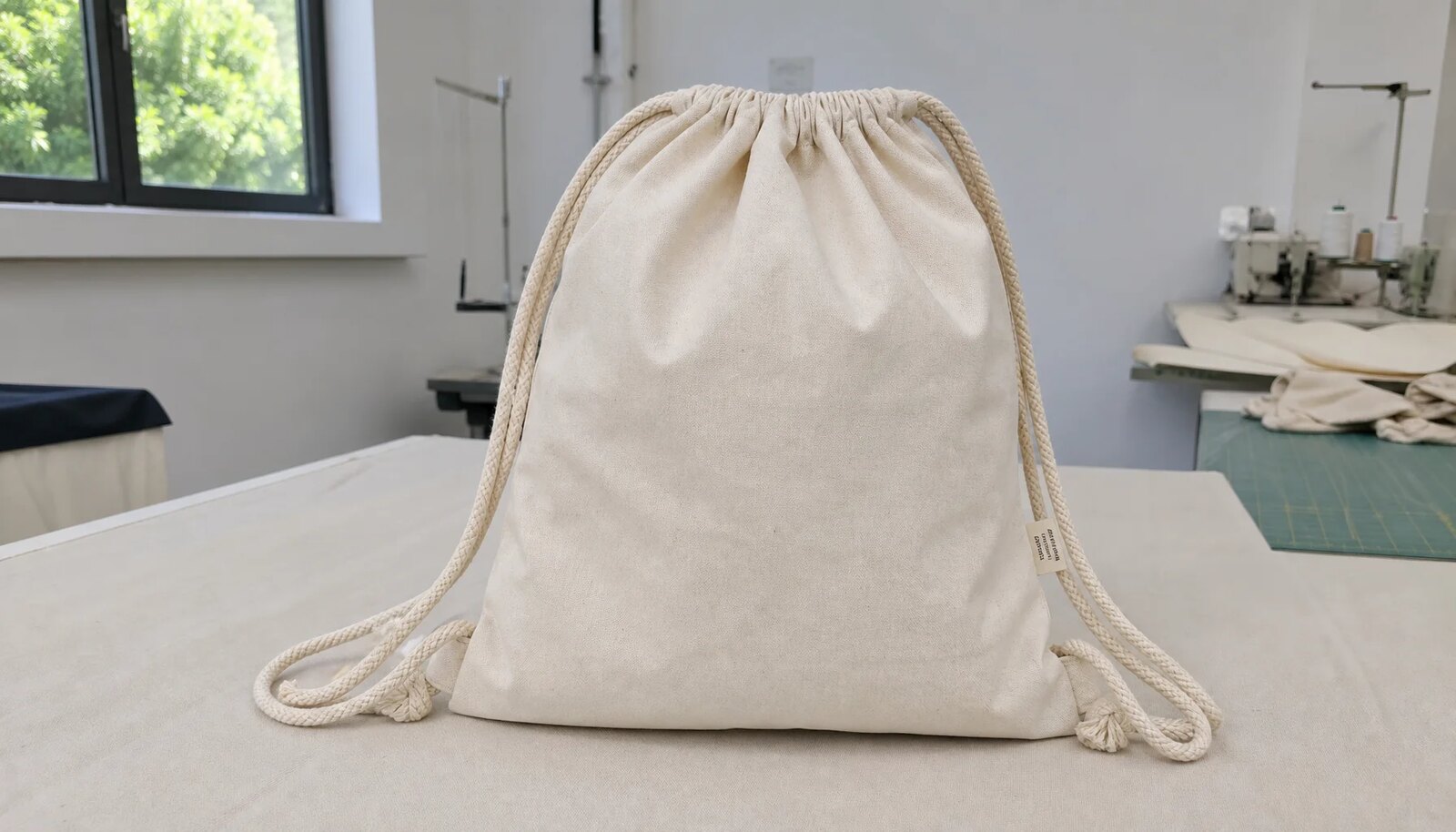
Start With the Selling Job, Not the Bag
For cotton drawstring backpacks for farmers market vendors, the bag usually serves one of three business jobs: a resale item on a market table, a giveaway that carries produce or event materials, or a branded utility item tied to a seasonal promotion. Lead time planning changes with each use case. A retail-facing item needs cleaner stitching, more consistent folding, and better carton presentation because buyers will inspect it at the booth or on a shelf. A giveaway can tolerate a simpler build if the value is in the brand impression rather than the product margin. If the use case is unclear, suppliers fill in the gaps with their own assumptions, and the result is a quote that does not match the actual program.
Write the selling job in one sentence before you send an RFQ. Example: natural cotton drawstring backpack for farmers market vendor resale, one-color logo, bulk packed, delivery before spring market season. That sentence tells the supplier what must stay standard and what must be controlled. It also reduces late-stage churn. In this category, schedules usually slip because the buyer changes the merchandising plan after sample approval, not because the sewing line is inherently slow. The stronger your use-case definition, the easier it is to lock the build, price the order, and protect the ship date.
- State the end use: resale, giveaway, or vendor kit.
- State the sales channel: market booth, distributor stock, or retail shelf.
- State the date that cannot move, not just the preferred date.
- State whether the bag must hold produce, brochures, merch, or daily carry items.
Translate the Use Case Into a Build Spec
A usable spec starts with the right balance of fabric weight, bag size, and closure details. For most market programs, 160-180 GSM natural cotton is the practical default because it feels substantial without driving unnecessary cost. Around 140 GSM can work for a light promo item, but it may feel thin once a customer loads it with produce, a water bottle, or event handouts. At 200 GSM and above, the bag feels more premium and holds up better under heavier use, but sewing slows down, folding gets bulkier, and freight cost rises because cartons carry fewer units per cubic meter. The right choice depends on whether the bag is meant to be a quick giveaway or a repeat-use retail item.
Size should be chosen around what the end user actually carries, not just what looks balanced on paper. A market-friendly backpack usually needs enough depth to hold folded fabric, a small purchase, or a pair of bottles without straining the corner seams. Keep the cord length practical and specify whether you want a simple cotton cord, braided cord, or a cord with a stopper. If you need print space, leave a clean front panel and keep the artwork away from seams, eyelets, and the cord channel. Buyers often focus on logo size and forget that a logo can be rejected if it sits too close to stitching or lands on a crease line after folding.
- Use 160-180 GSM as the default commercial option.
- Reserve 200-220 GSM for premium positioning or heavier contents.
- Keep the main print zone clear of seams, eyelets, and cord exits.
- Specify cord length, stopper style, and any label placement in the first RFQ.
Choose the Branding Method Based on Time and Risk
Branding is one of the fastest ways to increase lead time if the artwork is not planned correctly. One-color screen print is usually the cleanest route for cotton drawstring backpacks because it is fast, understandable, and cost-efficient for simple logos. It also keeps the quote easier to compare. If the art uses gradients, fine linework, or tight registration, ask the factory whether the design needs simplification before the screens are made. A design that prints well on a mockup may still fail once it reaches cotton texture and real production tolerances.
Woven labels, side labels, and hangtags can improve the retail feel, but each element adds a decision point and often a second operation. That matters when the program is tied to a fixed market season. If the first order is meant to test demand, keep the branding stack modest: one print, one label, and one packaging format. If the bag is intended for resale through a retailer or distributor, the look may justify a cleaner label application and more controlled presentation. The point is not to minimize branding. The point is to match the branding method to the calendar and the channel.
- Screen print is usually the fastest and most economical method for flat logos.
- Use woven labels when brand presentation matters enough to justify extra lead time.
- Keep artwork simple if the ship date is tight.
- Ask the supplier to confirm whether a second print color creates a separate setup fee.
Read the Quote Like a Production Buyer
A useful quote shows what is driving both price and schedule. If the supplier only gives a unit price, you cannot tell whether the lead time is tied to fabric booking, print setup, sewing capacity, or packing labor. Ask for the fabric GSM, color basis, print method, label type, packing format, and incoterm. Those items are enough to compare quotes on equal terms. A lower price that hides custom dyeing, separate screens, or special carton packing can become the more expensive option once the order reaches your warehouse.
The biggest hidden gaps in this category usually sit in setup and packing. Screen setup, artwork cleanup, woven label weaving, polybag insertion, carton marking, and export packing are all real production steps, but not every supplier includes them in the base price. Request them separately if they are not obvious. That makes it easier to compare true ex-factory cost against the program you actually need. For procurement buyers, the quote is only useful if it distinguishes fixed costs, variable costs, and changes that create a second approval cycle.
- Separate fabric, print, label, packing, and freight in the quote.
- Ask whether the quote assumes stock fabric or newly booked fabric.
- Confirm whether the unit price includes inner packing and carton marks.
- Treat any quote without an incoterm as incomplete.
- Ask which items trigger a second setup charge if the artwork changes.
Use MOQ as a Planning Tool, Not a Surprise
MOQ on cotton drawstring backpacks is usually a function of fabric booking, print setup, sewing efficiency, and carton planning. If you want a lower MOQ, keep the program simple. Natural cotton, one logo position, one or two print colors, standard cord, and a standard label are the easiest levers. If you add custom dyed fabric, multiple artwork positions, special packaging, and more than one size, the MOQ rises because the supplier has to spread setup cost across a larger run. That is a production reality, not a negotiation failure.
The best way to manage MOQ is to decide which custom details are worth the extra cost and which can wait for a future run. A farmers market vendor resale program often benefits from a stable base spec that repeats each season. That lets the buyer lock the body construction and vary only the artwork or label on subsequent orders. If the first order must stay small, standardize the fabric, cord, and packing before you push on the sewing price. Factories usually recover margin from complexity, not from the basic bag shell.
- Lower MOQ by keeping fabric color natural and artwork simple.
- Avoid splitting the order into too many colorways or sizes.
- Use standard cord and label options first, then add custom details later.
- Treat custom dyeing as a schedule risk, not only a design choice.
- Ask the supplier whether the MOQ is driven by fabric, print, or packing efficiency.
Approve Samples Like the Order Is Already in Production
A strong sample process starts with a pre-production sample that is measured, handled, and photographed against the approved specification. Do not approve a sample because the logo looks acceptable in a photo. Measure the bag width and height, inspect the stitch lines, pull the cords, and check whether the print sits where the art file shows it should sit. If there is a woven label or side label, confirm that it does not interfere with the cord channel, the fold line, or the product's flat presentation. Many first runs fail because the sample looked fine on the table, but the production cartons were never locked to the same standard.
If the backpack is meant for market use, it should also survive basic handling tests. Load it by hand with a reasonable weight, shake it, and inspect whether the base opens, whether the cord slides evenly, and whether the print cracks under stress. Natural cotton variation should also be settled at this stage because buyers often underestimate how much the shade can vary from one batch to the next. Keep one sealed golden sample and use it to resolve disputes later. Without that reference, minor variation turns into a shipping argument during inspection.
- Measure the sample, do not just approve the appearance.
- Confirm logo placement, cord symmetry, and seam behavior under load.
- Keep one sealed golden sample with the PO record.
- Reject photo approval as the only approval method.
- Check that labels and folds do not interfere with the cord channel or closing action.
Plan Packing for Wholesale, Not for a Product Photo
Packing is often the difference between a clean receiving experience and a damaged carton claim. For wholesale programs, bulk folding is usually better than retail-style presentation because it reduces labor and keeps the quote honest. But bulk packing still needs structure. Each unit should be folded the same way, counted correctly, and protected from moisture and dust. If the order will sit in transit for weeks, the carton plan matters. A carton that is too large allows the bags to shift and crease. A carton that is too small forces over-compression and makes unpacking messy for the buyer.
If the program needs retail readiness, say that clearly. That means individual polybags, barcodes, hangtags, and carton marks that match the receiving system. Do not assume the factory will choose the right pack style for your channel. If you sell through distributors, your warehouse team will care more about consistent counts and legible marks than about decorative presentation. Keep carton weights manageable so receiving teams can handle them without damage. The best packing spec is the one your warehouse can actually receive, store, and forward without rework.
- Specify fold method, inner pack count, and carton count.
- Limit carton weight to a practical handling range for your warehouse.
- Add moisture protection if the route or season creates humidity risk.
- Use retail packaging only when it improves sell-through or compliance.
- Confirm carton size before production so the packed count does not distort the unit price.
Build the Calendar Backward From the Ship Date
The cleanest way to plan lead time is to work backward from the date the goods must be in hand, not from the date the PO is issued. A straightforward cotton drawstring backpack run with stock fabric and one-color print can move through sample approval, production, and packing faster than a custom program, but only if decisions stay locked. A more customized order with dyed fabric, woven labels, and tighter packaging standards needs more calendar room because each step adds a decision point. As a planning baseline, allow about one to two weeks for sample development, roughly three to five weeks for a simple production run, and additional time if freight and customs are part of the scope.
The schedule usually slips for reasons the buyer can control. Artwork changes after sample approval are the most common. Close behind are late color approvals, carton label revisions, and unclear packing instructions. Seasonal congestion matters too, especially for spring and summer market cycles. Build in a buffer for one round of correction, because a perfect first sample is less common than buyers hope. If the shipment is tied to a fixed event date, freeze the spec earlier than feels comfortable. That is usually cheaper than paying for air freight to rescue a late shipment.
- Work backward from the in-hand date, not the PO date.
- Allow extra time if the order includes custom dyeing or woven labels.
- Freeze artwork, carton marks, and packing details before bulk starts.
- Keep a schedule buffer for inspection and freight delays.
- Assume one correction cycle unless the supplier has already shown the same build before.
Write the RFQ So the Factory Can Price Cleanly
A clean RFQ for cotton drawstring backpacks should be short, specific, and comparable. State the exact size, fabric GSM, color basis, logo file, print position, number of colors, label type, packing style, quantity by SKU, destination, and target ship window. If you need a sample before bulk, say whether the sample is for fit, print, or both. If compliance or testing matters to your channel, include it in the first message. A supplier can only price what it understands, and vague RFQs lead to quotes that look competitive but do not cover the real work.
Once the quotes arrive, compare them line by line instead of choosing the lowest unit price. Separate sample cost, tooling, packaging, freight, and any excluded charges. Then compare the factory lead time against your schedule risk. A slightly higher quote from a supplier that can hold the ship date is usually better than a lower quote that needs extra approvals or adds a second setup fee later. The goal is not to buy the cheapest bag. The goal is to land the right bag on time, with no hidden changes in construction or packing.
- Send one spec sheet to every supplier.
- Force each supplier to quote the same fabric, print, and packing basis.
- Compare sample fee, tooling, unit price, and excluded charges separately.
- Choose the quote that matches both cost and calendar.
- Ask for a measurement sheet and one packed-carton photo before you release the bulk order.
Use a Pre-Shipment Checklist Before You Release Payment
A production buyer should not wait until goods are on the dock to find basic errors. Before final payment or shipment release, check the production sample against the PO, confirm the carton count, and review the packed-unit photos or inspection notes against the golden sample. If the order is large enough to justify it, use a pre-shipment inspection that checks dimensions, stitching, print placement, cord function, and carton marking. A photo set alone is not enough to prove repeatability across the run.
The release checklist should be simple enough to repeat every time, but strict enough to catch the mistakes that usually cost time in receiving. Confirm the carton label matches the SKU, the inner pack count matches the packing list, and the finish level matches the approved sample. If the factory reports any deviation, decide whether it is acceptable before the shipment leaves. It is much cheaper to hold a pallet for correction than to receive 1,000 bags that do not meet the buyer standard.
- Match the production lot against the sealed golden sample.
- Confirm carton count, SKU count, and pack count before release.
- Review inspection notes for size drift, stitch defects, and print errors.
- Hold any shipment that has unclear carton marks or mixed SKUs.
- Use a documented go/no-go decision before final payment.
Specification comparison for buyers
| Spec decision | Recommended option | When it fits | Buyer risk to check |
|---|---|---|---|
| Sourcing route | Direct factory with one complete spec sheet and art pack | Repeat programs, custom print, and buyers who need tighter control over sewing and packing details | Vague RFQs lead to non-comparable quotes and late rework after sample approval |
| Sourcing route | Trading company or sourcing office with consolidated coordination | When you need multiple product types in one shipment or do not have internal capacity to manage factory follow-up | Extra margin layer, slower technical answers, and less visibility into the actual production line |
| Fabric weight | 160-180 GSM natural cotton for most market programs | Standard resale, vendor giveaways that still need to feel durable, and light daily carry | Too light can feel flimsy; too heavy increases sewing time, carton bulk, and landed cost |
| Fabric weight | 200-220 GSM for premium retail or heavier-load programs | When the bag must feel substantial, carry produce or merch, and support a higher selling price | Heavier cloth reduces carton quantity, raises freight cost, and slows sewing |
| Branding method | One-color or two-color screen print on the main panel | Simple logos, good unit economics, and moderate lead times | Fine lines, gradients, and tight registration may need art simplification before screens are made |
| Branding method | Woven side label plus a small print mark | Retail-oriented programs that need a cleaner look and stronger brand recall | A second sewing operation and longer label lead time |
| Packing route | Bulk folded with moisture protection and master cartons | Wholesale shipments, palletized freight, and B2B resale programs | Creasing, odor, and carton crush if carton size and pack count are not specified |
| MOQ strategy | Keep body color natural and standardize cord and label options | When you need lower MOQ without paying for custom dyed fabric | Mixing too many SKUs splits the run and lifts unit cost |
| Inspection route | Pre-shipment inspection against a sealed golden sample | First run, new supplier, or larger orders where rework would be expensive | Approving only product photos can miss seam, size, and stitch defects |
Buyer checklist before sampling
- Final bag size with tolerance, including flat width, height, and any gusset or bottom depth if used
- Fabric weight in GSM, fiber content, whether the cloth is pre-shrunk, and whether the shade must match a reference sample
- Print file type, logo size, print position, number of colors, and whether the artwork is intended for screen print or another method
- Cord specification, stopper type, eyelet detail if used, and whether cord color must match the fabric or a Pantone target
- Packing format, inner polybag requirement, carton pack count, carton marks, and whether retail labels or barcodes are needed
- Target order quantity by color and by SKU, plus the acceptable MOQ for future repeats
- Target ship window, destination port or warehouse, and whether the quote must include freight, duty, or only ex-factory terms
- Quality standard for approval, including measurement tolerance, print placement tolerance, and acceptable defect rate
- Sampling requirement, including whether you need a pre-production sample, size counter sample, or sealed golden sample
- Acceptance rule for natural cotton variation, including the maximum shade variance you will tolerate across the run
Factory quote questions to send
- What exact fabric weight, weave, and finishing are you quoting, and is the cloth sourced from stock or booked specifically for this order?
- Which print method are you pricing, how many setup charges are included, and what artwork changes would create a second setup fee?
- Is the quoted MOQ based on fabric purchase, sewing line capacity, print screen setup, or carton packing efficiency?
- What is included in the sample fee, and will the fee be credited back after bulk order confirmation?
- How many days do you need for pre-production sample, bulk production, inspection, and packing after artwork approval?
- What carton count, carton size, and net or gross weight are you using for the quote?
- Which costs are excluded from the unit price, such as inner packing, hangtags, labels, testing, or freight?
- Can you share one recent production photo, one measurement sheet, and one example of the final packed carton marking?
- Is the quoted lead time based on confirmed material stock, or does it assume new purchase and color matching?
- What is your tolerance policy if the first production lot shows size drift, skewed print placement, or cord length variation?
Quality-control points to confirm
- Bag dimensions match the approved spec within the agreed tolerance, with no visible size drift across the carton
- Stitching is straight, seam allowance is consistent, and the bottom corners do not open when the bag is loaded by hand
- Cord length is even on both sides, stoppers hold position, and the cord does not fray excessively at the cut ends
- Print position is centered or placed exactly as approved, with no ghosting, banding, or visible color breakdown
- Fabric weight and handfeel match the sealed sample closely enough that the buyer would not treat it as a different product
- Labels, hangtags, and carton marks match the PO and do not create mixed-SKU confusion during receiving
- Packing is consistent, folded the same way in every unit, and cartons are dry, clean, and free from odor or crush damage
- A random carton pull test confirms that sample quality is repeatable across the production lot
- Cord tunnel stitching is secure, with no skipped stitches or tearing at the exit points
- If the order uses natural cotton, shade variation stays within the approved visual range and does not create carton-to-carton mismatch