Why lead time slips on a bag that looks simple
Cotton drawstring backpacks look simple on a product page, but the schedule rarely behaves like a simple item. A blank bag still depends on fabric booking, cord sourcing, cutting, printing, sewing, packing, and export readiness. If one of those steps changes after quote acceptance, the factory may need to rebook material or reshuffle capacity, and the ship date moves with it.
For eco apparel brands, the timing risk is higher because the product is often tied to a material story as well as a price target. Natural cotton, heavier canvas, retail labels, and sustainable packaging all add decisions that need approval. The order may still be small in unit count, yet it behaves like a configured product rather than a commodity blank.
A useful planning rule is to split the lead time into stages instead of treating it as one promise. For a straightforward cotton drawstring backpack with stable artwork and standard packing, sample development may take about 7-14 working days, and bulk production may take 20-35 working days after pre-production approval. Add buffer for dyed fabric, special labels, destination-market testing, or retail-ready packing. The buyer who asks for a stage-by-stage calendar usually gets a more reliable answer than the buyer who only asks for the shipping date.
- Treat the backpack as a built-up product, not a blank commodity.
- Ask for milestone dates for samples, material booking, production, packing, and shipment.
- Assume revisions cost time unless the spec is frozen before quote acceptance.
Start with end use, carry need, and channel rules
The first procurement mistake is to source the bag before defining how it will be used. A trade-show giveaway, a retail merch drop, a sample kit insert, and an e-commerce enclosure all demand different priorities. Giveaways usually optimize for price, simple artwork, and rapid packing. Retail programs usually need cleaner stitching, more stable dimensions, better finishing, and labels that can move through receiving without manual fixes.
The RFQ should state what the bag must carry, not just how it should look. If the backpack needs to hold a folded garment, shoes, books, a catalog, or a sample kit, say so. If the brand expects repeated use, that should push the spec toward stronger fabric, better seam reinforcement, and a decoration method that can survive handling. When the use case is vague, the supplier fills in the blanks with its own assumptions, which makes quote comparison unreliable.
The visual target matters too. Natural cotton, washed cotton, and dyed cotton do not present the same way, even when the shape is identical. Natural fabric can show fiber variation and a more organic look. Dyed fabric may require shade control and lot consistency. If the goal is a premium retail feel, say so explicitly. That allows the supplier to recommend a sensible build instead of defaulting to the cheapest acceptable version.
- State the channel: promo, retail, e-commerce, or internal brand merch.
- Define what the bag must carry so the supplier can recommend the right construction.
- Write down the visual goal: natural, organic, clean retail, or premium merch.
- Add a finished-size tolerance so the quote is tied to measurable output.
Fabric, weave, and construction choices that affect the schedule
For many standard programs, 140-170 GSM cotton is a practical starting point. In ounce language, that is usually around 4.5-5 oz fabric. It keeps weight and cost under control while still allowing basic print quality and a usable hand feel. Once the spec moves into 200-280 GSM canvas, the bag feels more substantial and usually reads as more retail-ready, but cutting and sewing take longer and freight weight increases.
The weave and finish also change how the bag performs in production. Cotton twill, plain weave, and canvas do not behave the same way at the seam, around the cord channel, or under heat during decoration. Heavier weaves give the product more body, but they can slow sewing and require stronger thread control. If the bag is meant to carry more weight, ask whether the factory will reinforce the bottom corners, use double stitching at the top hem, or add bar-tacks where stress concentrates.
Shrinkage is a common source of disagreement. Unfinished cotton can move after washing, steaming, or pressing, and lot variation is normal if the fabric is not controlled well. If finished dimensions matter for a garment insert, catalog mailer, or kit sleeve, ask whether the fabric is pre-shrunk or whether the factory has already built shrink allowance into the tolerance. That detail should be written into the spec before sampling starts, not discovered after bulk cutting.
- Use 140-170 GSM for promo programs where cost and speed matter.
- Use 200-280 GSM canvas when the bag needs more body or a stronger retail feel.
- Ask whether the fabric is pre-shrunk, washed, or expected to change after finishing.
- Confirm reinforcement at the bottom corners, top hem, and cord channel if the bag will carry more weight.
Decoration decisions change both lead time and perceived quality
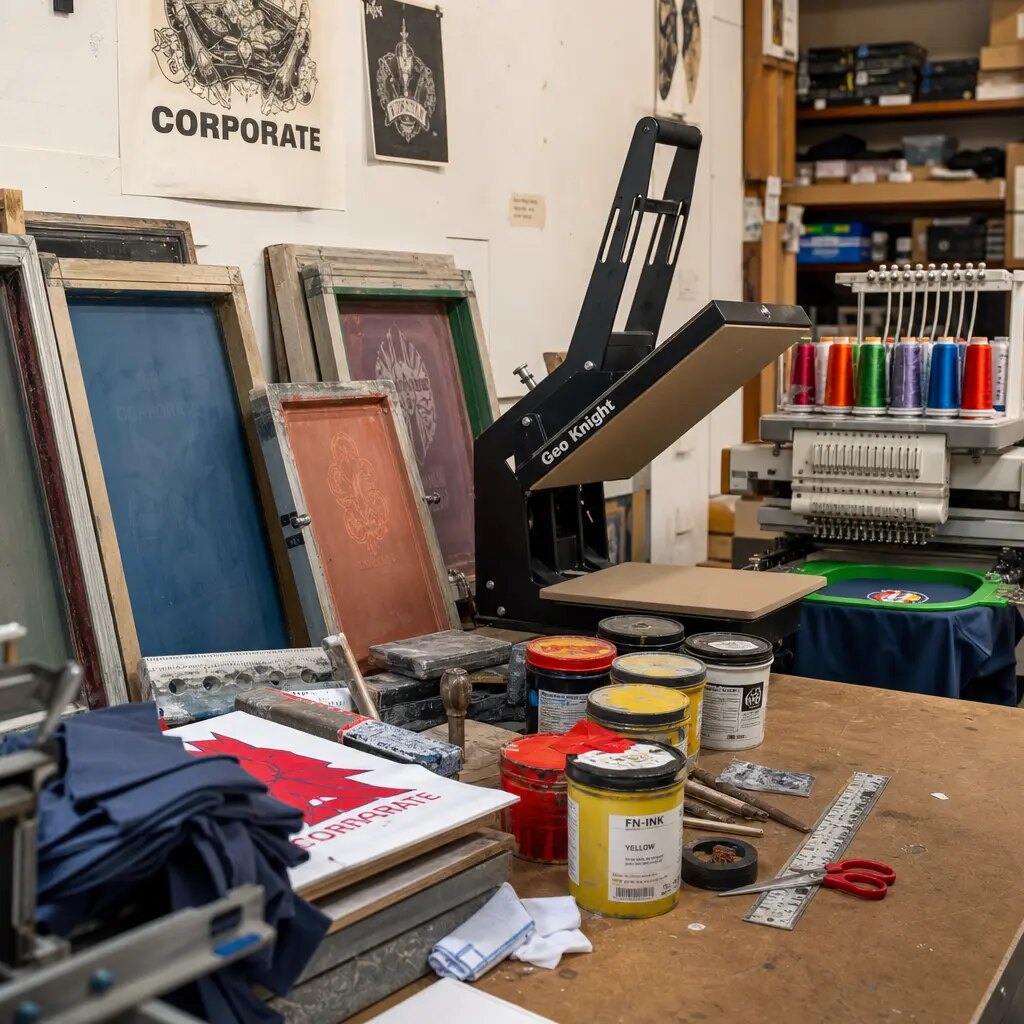
Decoration is where many lead times become unstable. Screen printing is usually the most efficient option for stable artwork and repeat volume. It works well for one or two colors, especially when the logo is simple and the run is large enough to absorb setup work. The tradeoff is that the supplier needs screens, color alignment, and a clear print area, so any artwork change after approval can create extra cost and delay.
Heat transfer or digital transfer can make sense for lower MOQs, multi-color graphics, or artwork that does not justify a full screen setup. The risk is performance and feel. If the transfer is too thick, poorly cured, or applied too close to a seam, it can crack, lift, or feel plasticky. For eco apparel brands, that can dilute the natural look the customer expects. The method should therefore be judged on both durability and brand fit, not only on price.
Branding extras should be planned with the same discipline. Woven side labels, care labels, hangtags, and barcode stickers all add approval steps. They also add placement checks and, sometimes, market-specific compliance review. A practical rule is to approve the decoration on a sewn sample, not only on a flat art proof. The sewn sample shows how the print sits against the seam, how the labels look on the finished bag, and whether the bag still feels balanced after branding is added.
- Use screen print for stable logos and larger runs.
- Use transfer methods only when the run size or artwork detail justifies the tradeoff.
- Keep print away from seams and cord exits by a written margin, often 10-15 mm at minimum.
- Approve branding on a sewn sample, not only on a digital mockup.
How to compare supplier quotes without being misled by a low unit price
A useful quote comparison starts with one shared build spec. Every supplier should quote the same fabric weight, the same cord type, the same decoration method, the same label set, and the same packing format. Without that discipline, one quote may look cheaper only because it omitted a label, assumed bulk packing, or priced a lighter fabric than the buyer actually needs.
Process ownership matters as much as line-item pricing. A factory that handles cutting, printing, sewing, and packing in-house usually has more control over handoffs and schedule risk. If the work is split across outside vendors, the price may still be competitive, but every transfer adds another place where delay or QC drift can occur. Procurement buyers should ask directly which steps are in-house and which are outsourced.
The quote should also show what happens when the plan changes. Ask for the sample fee, screen setup fee, extra color charge, label charge, barcode charge, carton artwork charge, and the cost of a packing revision. If the supplier cannot itemize the cost structure, the buyer cannot tell whether the low unit price is real or only a starting point that will increase later. A clear quote is usually a sign that the production plan is equally clear.
- Compare only like-for-like quotes with the same GSM, print method, labels, and packing.
- Ask which steps are in-house and which are outsourced.
- Request separate pricing for samples, extra colors, labels, and packing changes.
- Check whether the quote is EXW, FOB, or another term so freight responsibility is clear.
Build a milestone schedule before bulk production starts
Lead time should be managed as a sequence of milestones, not one promise on a spreadsheet. The main stages are RFQ review, sample development, artwork approval, material booking, pre-production sample sign-off, bulk cutting, printing, sewing, final inspection, packing, and shipment booking. This structure makes it easier to see where time is being spent and where the actual risk sits.
For a standard order, a practical timeline might look like this: quote and spec alignment in a few days, sample production in 7-14 working days, bulk material booking after approval, bulk production in 20-35 working days, and packing plus export preparation in the final days before handoff. If the order uses dyed fabric, special labels, or outside testing, the schedule should include more buffer. A 5-10 working day contingency is often easier to absorb before production starts than after the line has already been committed.
Capacity is part of the schedule. Even a clean spec can miss the target if the factory has not reserved a production slot. Buyers should ask whether the supplier can hold capacity while samples are approved and whether the slot depends on artwork sign-off by a specific date. That one question often prevents a seasonal order from being pushed behind other work already on the line.
- Freeze artwork and construction before the factory books bulk material.
- Get sample approval dates in writing before the line is committed.
- Reserve a production slot instead of relying on an open-ended promise.
- Build buffer time for packing, carton labeling, and freight booking.
Approve the sample as a production benchmark, not a display piece
The pre-production sample should prove the whole bag, not only the logo. Buyers should check finished size, seam shape, cord movement, label position, top hem structure, and how the bag folds for packing. A sample that looks fine in a photo can still fail in use if the cord channel is too tight, the print sits too close to a seam, or the body collapses more than expected.
A sealed reference sample is the safest control point. Both buyer and supplier should keep one signed sample as the benchmark for fabric shade, logo placement, construction, and hand feel. If the supplier revises the sample, the buyer should sign off again before bulk cutting begins. Otherwise, the lot can drift away from the approved version and the problem only appears during final inspection, when the corrective options are already limited.
Remote approval needs more than a photo set. Ask for measured dimensions, close-ups of seams and labels, a side-by-side comparison against the previous sample, and a written note explaining what changed. If the order will be reordered later, store the approved sample reference with the quote record and artwork file. That makes the next reorder faster and reduces the chance that a new team member approves the wrong version.
- Approve a full pre-production sample, not only a logo proof.
- Measure the finished bag, cord length, and label placement against the spec.
- Keep one sealed reference sample signed by both sides.
- Do not release bulk cutting until the final sample is approved.
Packing, cartonization, and warehouse rules should be planned early
Packing is not a back-end detail. It affects labor time, carton strength, freight cost, and how quickly the buyer's warehouse can receive the shipment. For promo orders, bulk packing in cartons may be enough. For retail or e-commerce, the buyer often needs individual polybags, barcode stickers, carton marks, and consistent pack counts so the product can move into inventory without manual rework.
Eco apparel brands should decide whether they want standard polybags, paper-based packaging, or no individual bag at all. If sustainable packaging is part of the brand promise, the supplier should quote it clearly because it can change both cost and packing speed. The point is not to assume the greenest option is always the fastest; the right choice depends on receiving rules, product protection, and the shipping lane.
Carton details matter more than many buyers expect. Agree the inner pack count, master carton count, gross carton weight, and carton dimensions before packing starts. Many warehouses prefer cartons that stay within manual handling limits, often around 15-18 kg gross weight, though each distribution center may set its own rule. Clear shipping marks, SKU labels, and carton numbering reduce confusion at receiving and lower the chance of chargebacks or relabeling costs.
- Define inner pack count and master carton count up front.
- Set a maximum gross carton weight that your receiving team can handle safely.
- Confirm barcode, SKU, and carton mark rules before packing starts.
- Ask whether packaging choice changes the packing speed or the ship date.
QC and compliance should be specific, measurable, and tied to the destination market
Quality control for cotton drawstring backpacks should focus on function as much as appearance. The bag must open and close smoothly, the drawcord should move evenly, the seams should hold under normal use, and the print should stay intact after light handling. A sample can look fine on a table and still fail in bulk if seam allowance, thread tension, or cord channel width is inconsistent from piece to piece.
The buyer should write acceptance criteria into the RFQ instead of using phrases like good quality or production standard. State the size tolerance, the print tolerance, the label position tolerance, and the number of pieces to be inspected at each stage. If the order is headed to retail, add barcode and carton checks as well so the warehouse does not reject the shipment for preventable packaging errors.
Compliance should follow the channel and the destination market. If the order needs fiber content labeling, care instructions, restricted-substance testing, or country-specific paperwork, that should be called out before quoting. Otherwise, testing can become the hidden step that pushes the order past the planned ship date. For repeat programs, it helps to keep the test plan, artwork, packing format, and approved sample under the same SKU record so future reorders do not start from scratch.
- Check seam integrity at the bottom corners, cord exit points, and top hem.
- Rub-test the print lightly and inspect for cracking, smearing, or edge lift.
- Verify carton count, pack configuration, and label legibility before release.
- Tie any required testing or documentation to the destination market in the RFQ.
What to send suppliers so quotes are actually comparable
The strongest RFQ is specific without being bloated. It should tell the supplier what to make, how to decorate it, how to pack it, and when the goods need to ship. For cotton drawstring backpacks, that means a tech pack or sketch, finished dimensions, fabric weight, cord type, logo file, print area, label requirements, pack format, target ship window, and the destination market. If those inputs are missing, the supplier fills the gaps with assumptions and the quotes become difficult to compare.
It also helps to state the commercial context. A giveaway order, a retail replenishment order, and a branded insert for apparel shipments use different cost logic and sometimes different quality priorities. When the end use is clear, the supplier can recommend a more practical construction and packing method instead of defaulting to the cheapest possible build. That usually saves time later because the sample is closer to the final requirement on the first pass.
The final procurement rule is simple: choose the supplier that gives the clearest schedule, the cleanest line-item quote, and the most repeatable sample. If a supplier cannot explain where time is being spent, or if the quote hides major details, the risk usually shows up later in production. A good cotton drawstring backpack order is not just low cost; it is a controlled program with predictable approvals, measurable quality, and a shipment that arrives in the form your warehouse expects.
- Include a tech pack or sketch with finished dimensions and construction notes.
- State fabric GSM, cord type, logo method, and label requirements.
- Specify packing format, carton count, target ship window, and destination market.
- Ask for a quote breakdown by material, labor, decoration, packing, testing, and export terms.
Specification comparison for buyers
| Spec decision | Recommended option | When it fits | Buyer risk to check |
|---|---|---|---|
| Base fabric | 4.5-5 oz / 140-170 GSM cotton twill or plain weave | Best for giveaways, event merch, and light retail programs where cost and speed matter | Too light can distort at the seams, show print-through, or feel limp after packing |
| Premium fabric | 6-8 oz / 200-280 GSM cotton canvas | Best for retail-ready, reusable, or higher perceived-value programs | Heavier fabric adds sew time, freight weight, and stress on the cord channel if construction is weak |
| Finished size tolerance | Agree a practical tolerance, often +/- 0.5 cm on smaller dimensions and +/- 1 cm on larger panels | Useful when the bag must fit a garment, catalog, or kit sleeve | If tolerance is not written down, the bulk run can drift enough to affect packing or fill rate |
| Drawcord spec | 4-5 mm braided cotton or cotton/poly blend cord with matched left and right finished length | Fits standard promo and retail bags with reliable closure feel | Cut ends, fray control, and unequal cord lengths can create final inspection rejects |
| Decoration method | 1-2 color screen print for volume, digital transfer or heat transfer for short runs or multi-color art | Screen print is efficient for stable logos; transfer methods fit lower MOQ or detailed art | Each method has different setup, cure, and durability risks; do not compare them as if they were equal |
| Branding extras | Woven side label plus care/content label when the channel requires retail presentation | Useful for retail, resale, or distributor programs | Artwork approval, label placement, and language can add days if they are not locked before sample approval |
| Packing format | Bulk pack for promo, individual polybag plus barcode sticker for retail and e-commerce | Choose based on warehouse receiving and channel requirements | Incorrect pack count, barcode placement, or carton marks can delay inbound processing |
| MOQ logic | Base MOQ by fabric color, decoration version, and size, not only total quantity | Best for programs with multiple SKUs or artwork variations | A low headline MOQ may hide extra fees for separate colors, separate screens, or split packing |
| Production model | Direct factory with in-house cutting, printing, sewing, and packing | Best when lead time is tight and process control matters | If key steps are outsourced, handoffs can add delays and make QC accountability harder |
Buyer checklist before sampling
- Define the finished size, seam allowance, fabric GSM, cord diameter, and whether the bag needs a gusset, reinforced corners, or a structured top hem.
- State the end use clearly: giveaway, retail, e-commerce insert, sample kit, or distributor pack. The intended use should determine fabric weight and packing format.
- Ask the supplier to quote the same build across all offers: fabric, decoration, labels, packing, testing, and export terms.
- Specify the artwork file type, print method, number of colors, print placement, and the acceptable registration tolerance before sampling starts.
- Set a size tolerance in writing, especially if the bag must fit a catalog, garment, or product bundle.
- Request a pre-production sample and a sealed golden sample before bulk cutting. Do not release production on a flat artwork proof alone.
- Separate MOQ by total units, fabric color, print version, and size so suppliers do not compare different production assumptions.
- Confirm the packing format: bulk pack or individual polybag, barcode sticker, carton count, master carton size, and maximum carton weight.
- Ask for a milestone schedule with dates for material booking, sample approval, bulk production, packing, and shipment.
- Clarify any destination-market testing, fiber content labeling, care labeling, or restricted-substance requirements at the RFQ stage.
Factory quote questions to send
- What is the lead time broken into material booking, sample approval, bulk production, packing, and ex-factory readiness?
- Is the MOQ based on total quantity, fabric color, size, print version, or all of those together?
- What exact fabric weight is included in the quote, in GSM and oz, and what tolerance do you allow from roll to roll?
- Which print method is included, how many screens or setup steps are priced, and what is the surcharge for extra colors or a second print position?
- Does the quote include woven labels, care labels, hangtags, barcode stickers, and carton marks, or are any of those extra?
- What is included in the sample fee, and will the fee be credited back after bulk approval?
- Are cutting, printing, sewing, packing, and inspection all done in-house, or are any steps outsourced?
- What inspection standard do you use for seam quality, print defects, drawcord function, and carton count accuracy?
- What are the overage and shortage tolerances at final packing, and how are partial cartons handled?
- Can you provide a line-item quote that separates fabric, labor, decoration, packing, testing, export documents, and freight terms such as EXW or FOB?
Quality-control points to confirm
- Fabric weight should match the agreed GSM or oz spec within the supplier's stated tolerance, and the fabric should not feel noticeably thinner at stress points.
- Finished bag dimensions should stay within the agreed tolerance, including body width, body height, gusset depth if used, and drawcord length.
- Seam allowance should be consistent, usually around 0.7-1.0 cm if that is the approved build, with no skipped stitches, loose thread ends, or seam puckering.
- Top hem, cord channel, and bottom seam should be reinforced enough for the intended load and should not distort when the bag is filled.
- Drawcords should slide smoothly, be the same finished length on both sides, and show controlled fray at the cut end.
- Print placement should match the approved sample, with acceptable color density, opacity, and registration. For simple logos, agree the tolerance in millimeters, often 1-2 mm.
- Print should pass the agreed rub or adhesion check without cracking, smearing, or edge lift during light handling and packing.
- Labels, care content, and barcode stickers should be in the correct position, legible, and fixed securely after packing and carton movement.
- Carton count should match the packing list, carton markings should be consistent, and gross carton weight should remain within warehouse handling limits.
- No visible oil marks, holes, broken threads, fabric slubs in critical areas, or untrimmed loose ends should remain after final trim and inspection.