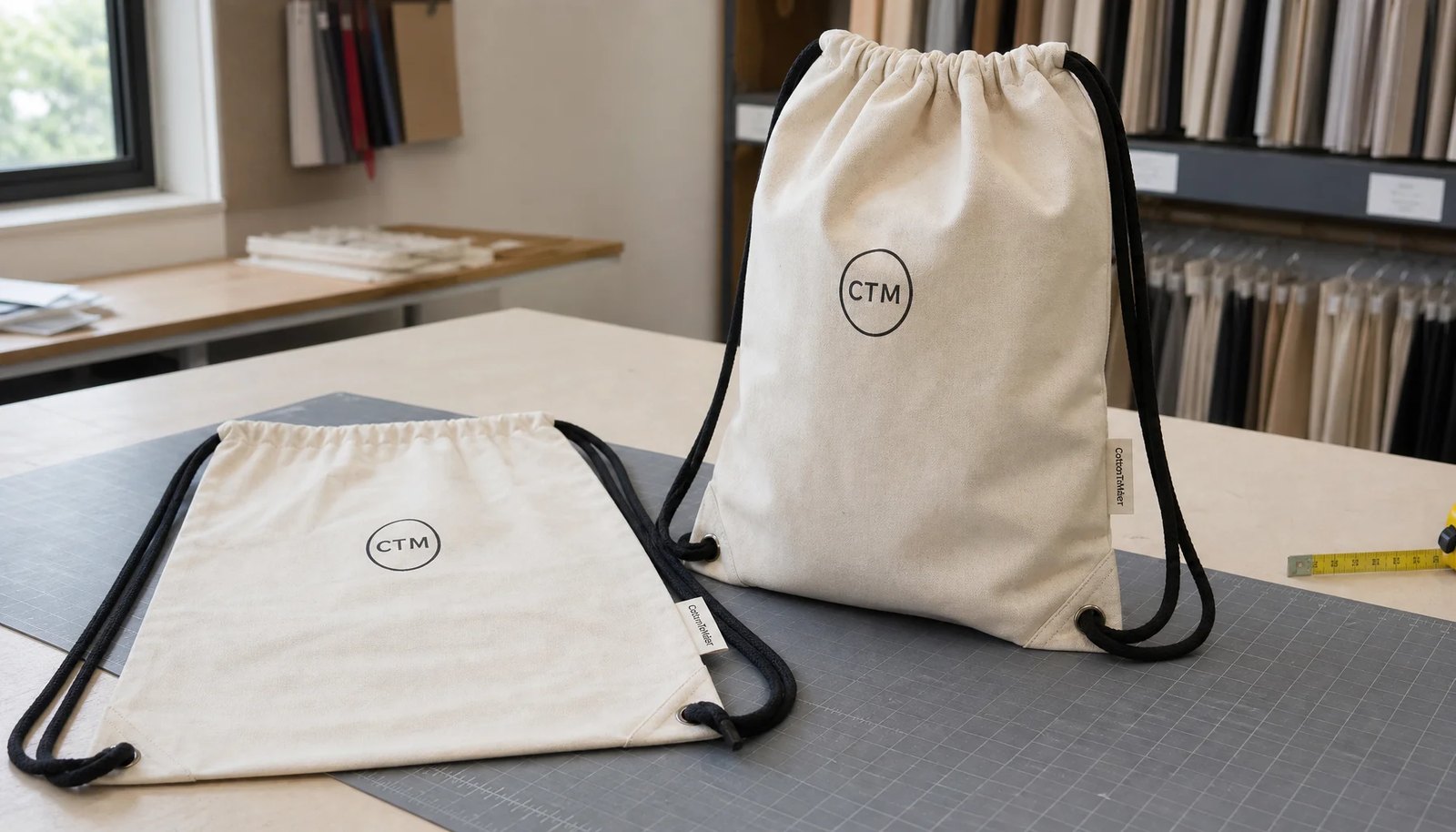
Why Lead Time Planning Fails on Bookstore Backpack Orders
Wholesale cotton drawstring backpacks for university bookstores look simple on a quote sheet, but the schedule is usually made of several dependent steps: fabric preparation, cutting, printing, sewing, trimming, inspection, packing, and export release. When a buyer only asks for one delivery date, suppliers may quote the best-case ex-factory time and leave out artwork approval, sample courier time, deposit clearance, and carton marking confirmation.
The real buying problem is not whether a factory can sew a drawstring backpack. Many can. The problem is whether the supplier can hold fabric consistency, print accuracy, reinforcement strength, and packing instructions while still meeting a campus launch date. A bookstore order tied to orientation week, alumni weekend, or semester opening cannot be rescued easily if the approval sample is late or the print shop is overloaded.
- Treat lead time as a production map, not a single promise.
- Separate sample lead time, bulk production time, inspection time, and shipping time.
- Use the final approved sample date as the schedule trigger.
- Avoid approving production from a PDF mockup only.
- Confirm whether the quoted date is ex-factory, FOB port, or delivered.
Start With the Use Case Before Selecting Fabric
A university bookstore may use the same product name for very different products. An orientation giveaway bag may carry a folder and water bottle for one week. A retail backpack sold at checkout may need to hold books, a hoodie, and daily campus items. A sponsor kit may need a large printable front panel but only moderate load strength. These differences change the correct fabric weight, drawcord, seam construction, and packing method.
For cotton drawstring backpacks, buyers commonly compare 6 oz, 8 oz, 10 oz, and 12 oz cotton canvas. A 6 oz bag may be acceptable for low-cost events, but it can feel thin for retail resale. An 8 oz fabric is often the practical middle point for bookstore programs because it balances print surface, softness, freight weight, and durability. A 10 oz or 12 oz fabric gives a stronger retail feel but raises fabric cost, sewing difficulty, carton weight, and sometimes lead time if the color is not in stock.
- 6 oz cotton: best for light event giveaways where lowest unit cost matters.
- 8 oz cotton canvas: balanced option for standard campus logo backpacks.
- 10 oz cotton canvas: better for paid retail items and heavier daily use.
- 12 oz canvas: strong hand-feel, but may need heavier needle setup and longer sewing time.
- Natural cotton: fast and cost-effective, but stains and shade variation are more visible.
Build a Specification That a Factory Can Price Correctly
A useful RFQ for cotton drawstring backpacks should describe the finished product, not only the logo. The factory needs finished dimensions, fabric type, fabric weight, color, drawcord material, cord diameter, corner reinforcement, seam style, print method, print size, packing, carton limits, and delivery term. Without these details, quotes will look cheaper than they really are because each supplier is filling the gaps differently.
Finished size is especially important. A common campus size might be around 35 x 42 cm, but buyers should specify whether this is the final sewn size or cutting size before seam allowance and shrinkage. Cotton can shrink during washing, dyeing, or finishing. If the bookstore requires a bag to hold letter-size documents or a specific welcome folder, the sample should be loaded with the actual contents before approval.
- State finished size with tolerance, such as 35 x 42 cm plus or minus 1 cm.
- Specify fabric as cotton canvas, plain weave cotton, recycled cotton blend, or dyed canvas.
- Define drawcord type: cotton cord, polyester cord, flat tape, or braided rope.
- Include reinforcement: metal eyelet, stitched fabric tab, bartack, or double-layer bottom corner.
- List print area and placement from the top edge or centerline, not only visual position.
Print Method Choices Affect Both Cost and Calendar
Most bookstore logo backpacks use screen printing because it is durable, economical at volume, and well suited for solid university marks. The quote should state the number of print colors, print size, ink type, and whether the printing is done before or after sewing. Printing flat panels before sewing usually improves registration and production speed, but it requires final artwork approval before cutting and assembly move forward.
Heat transfer can be useful for small multi-color designs, sponsor graphics, or short runs with several logo versions. It is not automatically cheaper when the order becomes large, and poor transfer film can crack or feel plastic on cotton. Embroidery gives a premium look but should normally be used on heavier cotton canvas and smaller logo areas because dense stitching can pucker lighter fabric and slow production.
- Use screen print for one to four solid colors and repeated bookstore logos.
- Use heat transfer when logo versions are many and each quantity is low.
- Use embroidery for premium small logos on 10 oz or heavier canvas.
- Require Pantone references for brand colors and a print strike-off for approval.
- Define acceptable print hand-feel if the bag will be sold as retail merchandise.
MOQ Logic: Separate Fabric, Color, and Artwork Minimums
MOQ is not one number. For cotton drawstring backpacks, MOQ can come from fabric purchasing, dyeing, cutting efficiency, print setup, sewing line allocation, or packing materials. A supplier may accept 300 pieces in natural cotton with one black screen print, while the same factory may require 1,000 pieces per color for custom dyed fabric or 500 pieces per logo to justify screen setup and production handling.
Bookstore buyers often create schedule problems by splitting a total order into too many small variations. For example, 2,000 pieces across four body colors and five department logos becomes many mini production lots. Each lot needs artwork handling, print setup, drying space, sewing control, and packing separation. If the launch date is fixed, it may be safer to reduce colorways, use one shared body color, or print department names through a secondary label or hangtag.
- Request MOQ per fabric color and per logo version separately.
- Ask for price breaks at realistic levels such as 500, 1,000, 2,000, and 5,000 pieces.
- Group department orders under one fabric color to protect lead time.
- Use hangtags or carton labels when internal department separation is needed.
- Avoid custom dyed fabric for urgent orders unless the supplier already has lab dip approval.
Sample Approval Should Remove Production Ambiguity
A good sampling route has at least two controls: a blank size and construction sample, then a printed pre-production sample. The blank sample verifies fabric hand-feel, finished size, drawcord comfort, reinforcement, seam allowance, and loading performance. The printed sample verifies logo scale, placement, color, ink coverage, curing, and the visual match against bookstore expectations.
The approved sample should become the production reference. One sample should remain with the factory production team, and one should stay with the buyer or buying office. If the buyer later changes logo size, body color, drawcord material, or packing, the lead time should be recalculated. Factories cannot keep the original schedule when approvals move backward after material has already been ordered.
- Approve fabric hand-feel under normal store lighting, not only from photos.
- Load the sample with the expected contents and test the cord pressure on shoulders.
- Measure print position from fixed garment points, such as top edge and side seam.
- Sign off on one exact sample version before bulk cutting.
- Record any approved deviation in writing with photos and measurements.
Practical Lead Time Map for a Custom Cotton Backpack
For normal wholesale cotton drawstring backpack programs, buyers should plan backward from the required in-store date. A realistic custom order may need several working days for artwork checking, 5-10 days for sampling, additional time for courier review, 7-20 days for fabric preparation depending on stock or dyeing, 15-30 days for bulk production, and several days for inspection and export packing. Ocean freight, customs, and inland delivery sit outside the factory production lead time.
The safest RFQ states the required delivery milestone and asks the supplier to break the calendar into approval stages. If the supplier only replies with a total lead time, the buyer should request the assumptions behind it. The biggest hidden delays are late deposit, unclear artwork, custom fabric color, changed packing instructions, low-volume split lots, and peak season capacity before school terms or holidays.
- Artwork review: usually 1-3 working days when vector files are complete.
- Blank sample: commonly 3-7 working days if fabric is available.
- Printed pre-production sample: commonly 5-10 working days after artwork approval.
- Bulk production: often 20-35 working days after sample and deposit confirmation.
- Inspection and final packing: reserve 2-5 working days before shipment release.
Packing Decisions Can Change Cost, Waste, and Receiving Speed
Packing is not a small afterthought for bookstore programs. A retail resale item may need individual polybag, hangtag, barcode sticker, size label, and clean folding. An orientation event order may only need bulk packing by 25 or 50 pieces per inner bundle so campus staff can distribute quickly. A distributor order may require mixed cartons, customer item numbers, purchase order labels, and destination-specific marks.
Cotton bags are vulnerable to dust, moisture, and compression marks, especially natural or light-colored fabric. Individual packing keeps products cleaner but increases labor, material cost, and unpacking waste. Bulk packing is faster and cheaper but requires clean cartons, moisture control, and careful handling. The RFQ should define carton quantity, maximum gross weight, carton dimensions if warehouse racking is strict, and whether recycled polybags or plastic-free packing are required.
- Use individual polybags for retail shelves, web fulfillment, or barcode scanning.
- Use bulk packing for event distribution when speed and lower waste matter.
- Keep carton weight manageable, often below 15-18 kg for easier bookstore receiving.
- Require carton marks with SKU, color, quantity, PO number, and destination.
- Confirm whether hangtags and barcodes are supplied by the buyer or printed by the factory.
Quote Data Needed for Real Landed-Cost Comparison
Two backpack quotes can show the same unit price and still produce different landed costs. Fabric weight changes carton weight and CBM. Individual packing changes labor and carton volume. Screen setup, sample courier, barcode labeling, inspection, inland trucking, and export documents may be included by one supplier and excluded by another. Procurement teams should normalize quotes before presenting savings to a bookstore or brand owner.
A useful comparison should include unit price, Incoterm, sample fee, setup charge, MOQ, payment term, production lead time after approval, carton quantity, carton dimensions, gross weight, CBM, packing details, and validity date. If the buyer is importing, duty classification and country of origin documentation should also be reviewed with the freight forwarder. The cheapest ex-factory price may lose advantage once packing volume and rework risk are included.
- Compare all quotes under the same Incoterm, such as EXW, FOB, or DDP.
- Request carton CBM and gross weight before estimating freight.
- Separate one-time screen charges from repeat order unit price.
- Include inspection cost and sample courier cost in the landed-cost file.
- Check whether supplier pricing is valid through the required production month.
QC Thresholds That Prevent Store-Level Complaints
Quality control for cotton drawstring backpacks should focus on defects customers will notice immediately: crooked logo, dirty fabric, weak corner stitching, rough cord ends, loose threads, and inconsistent size. For university bookstore merchandise, logo placement is often more sensitive than small fabric slubs because buyers expect the school mark to look centered, clean, and officially licensed.
Before production, define critical, major, and minor defects. Critical defects may include wrong logo, unsafe metal parts, mold, severe stains, or mixed customer artwork. Major defects may include broken stitching, weak eyelets, misaligned print, wrong body color, or missing barcode. Minor defects may include small thread ends or slight natural cotton variation within the approved sample standard. These definitions help the inspector make consistent decisions instead of arguing carton by carton.
- Set print centering tolerance before mass production begins.
- Test cord pull strength on loaded bags, not empty display samples.
- Reject oil stains, mold odor, and dirty light-colored panels as major defects.
- Confirm carton count and SKU separation during final random inspection.
- Keep approved fabric and print sample available during inspection.
Specification comparison for buyers
| Spec decision | Recommended option | When it fits | Buyer risk to check |
|---|---|---|---|
| Fabric weight | 8 oz cotton canvas or 10 oz for heavier bookstore kits | 8 oz works for orientation giveaways and light retail use; 10 oz fits books, water bottles, and paid merchandise | Low GSM may look cheap and print well but tear at cord exit points under load |
| Drawcord construction | 6-8 mm cotton or polyester cord with reinforced eyelets or bar-tacked lower corners | Cotton cord gives a natural retail look; polyester cord handles abrasion and color consistency better | Thin cord reduces cost but cuts into fabric and causes customer complaints when bags carry textbooks |
| Print method | Screen print for solid logos; heat transfer only for small multi-color runs; embroidery only on heavier fabric | Screen print is best for bookstore logos, mascot graphics, and event sponsors at normal bulk volumes | Complex artwork quoted as digital transfer can crack if the supplier uses poor film or low curing temperature |
| Order quantity logic | Start RFQ at 500-1,000 pieces per color/spec, then price breaks at 2,000 and 5,000 pieces | Useful when campuses split quantities by department, orientation, alumni, and retail shelves | Combining too many colorways may push each color below efficient cutting and printing volume |
| Sampling route | Blank size sample first, then printed pre-production sample before bulk fabric cutting | Best when fit, fabric hand-feel, drawcord comfort, and logo placement all affect approval | Approving only a digital mockup leaves no evidence for shrinkage, print hand, or actual packing size |
| Packing format | Individual polybag only for retail resale; bulk pack by 25 or 50 for campus events | Retail stores need barcodes and clean presentation; orientation teams usually need fast carton distribution | Overpacking adds cost and waste; underpacking creates dirty natural cotton bags before store receipt |
| Lead time buffer | Plan 45-70 days ex-factory after sample approval for custom cotton drawstring backpacks | Fits dyed fabric, custom print, carton labeling, inspection, and export booking without emergency air freight | Counting from PO date instead of sample approval date hides artwork, deposit, and material delays |
| Supplier route | Factory-direct for custom construction; trading partner for mixed small bookstore items | Factory-direct works when the backpack is a core SKU; traders help when bundling many low-MOQ accessories | A quote that does not identify fabric source, print method, and inspection point is difficult to compare |
Buyer checklist before sampling
- Define the campus use case: retail resale, orientation giveaway, alumni event, club merchandise, or sponsor kit.
- Specify finished size, usable capacity, fabric GSM or oz, drawcord diameter, and reinforcement method.
- Send vector artwork with Pantone references, print size, print position, and whether the logo must pass wash or rub tests.
- Separate quantities by body color, logo version, packing format, and delivery destination before requesting price breaks.
- Require a physical size sample and a printed pre-production sample before bulk cutting or printing.
- Set carton weight limits, barcode requirements, inner pack quantities, and master carton marking in the RFQ.
- Build the schedule from artwork approval and deposit receipt, not from the first email inquiry.
- Reserve inspection time before final balance payment and export booking.
- Compare quotes using the same Incoterm, carton dimensions, gross weight, sample fees, and mold or screen charges.
- Keep one approved sample at the supplier and one with the buyer as the production control reference.
Factory quote questions to send
- What fabric composition, GSM or oz, yarn count, and shrinkage tolerance are included in your quote?
- Is the backpack made from greige cotton, stock dyed fabric, or custom dyed fabric, and how many days does fabric preparation require?
- What is the actual MOQ per fabric color and per logo version, and what price breaks apply at 1,000, 2,000, and 5,000 pieces?
- Which print method is quoted, how many colors are included, and what curing or colorfastness checks are performed?
- Can you provide a blank sample and printed pre-production sample, and how many working days does each step require?
- What reinforcements are included at the drawcord exit, bottom corners, and side seams?
- What packing is included: bulk pack, individual polybag, barcode sticker, hangtag, recycled polybag, or FSC carton?
- What are the estimated carton dimensions, pieces per carton, gross weight, and CBM for the quoted quantity?
- At what production stage can inspection be arranged, and what AQL or defect classification do you normally support?
- What schedule assumptions can delay the quoted lead time, including artwork changes, deposit timing, fabric dyeing, holiday capacity, and vessel booking?
Quality-control points to confirm
- Finished size tolerance should normally be controlled within plus or minus 1 cm unless the design requires tighter retail display consistency.
- Fabric weight should be verified against the approved sample, with no substitution from 8 oz to lighter plain cotton without written approval.
- Drawcord pull strength should be tested on loaded samples, especially at eyelets, grommets, bartacks, and bottom corner channels.
- Print position tolerance should be defined before production, typically within plus or minus 5 mm for a centered bookstore logo.
- Screen print adhesion should pass a tape pull or rub check after full curing, not immediately after wet printing.
- Needle holes, loose threads, skipped stitches, oil stains, fabric slubs, and dirty natural cotton panels should be classified before inspection.
- Carton drop and compression risk should be reviewed when bags are individually packed for retail shelves.
- Random cartons should be opened to verify quantity, barcode, hangtag, inner pack, and destination labeling.