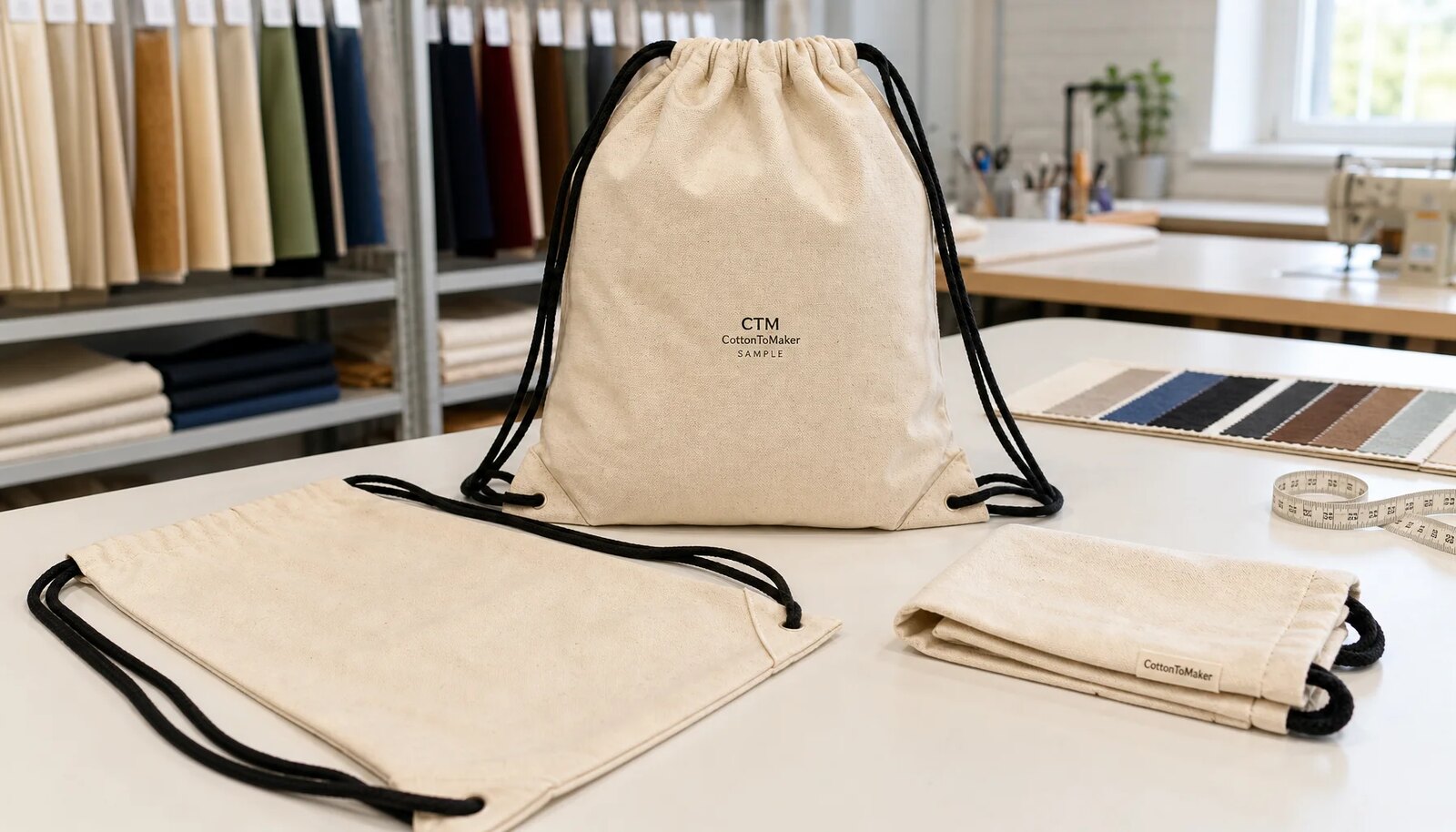
Start With the Real Deadline
Cotton drawstring backpacks are simple to sew, but craft fair orders still miss deadlines when buyers plan from the wrong date. The risk is not only production. It is the full chain: defining the product, approving artwork, sampling, buying fabric, printing, sewing, packing, inspecting, shipping, receiving, and then allocating the correct version to the correct fair, booth kit, shop, or warehouse location.
A supplier may write “25 days production” on a quote. That can be accurate and still not enough. It may mean 25 days after final artwork, approved sample, deposit, bulk material readiness, confirmed packing, and factory line allocation. It may not include fabric swatches, sponsor logo review, sample courier time, buyer sign-off, inspection scheduling, export booking, customs clearance, domestic delivery, or co-packing. Those steps belong in the buyer’s calendar, not in a vague note beside the unit price.
Work backward from the first date the bags must be usable. For B2B procurement, that date is often earlier than the public craft fair opening. It may be the warehouse receiving appointment, the date retail photos are needed, the distributor dispatch date, or the kitting date for exhibitor welcome packs. If the backpacks will be sold, add SKU setup, barcode testing, hangtag approval, price label checks, photography, and inventory transfer. If sponsors are involved, allow time for logo approval. Sponsor artwork can move slower than a sewing line.
- Use warehouse receiving, kitting, retail photography, or distributor dispatch as the working deadline.
- Count factory lead time from final artwork, approved sample, final PO, deposit, and complete packing data.
- Separate sampling, bulk production, inspection, freight, customs, domestic delivery, and kitting in the schedule.
- Add buffer for dyed fabric, multiple artworks, retail barcodes, sponsor approvals, holidays, and split shipments.
- Assign clear internal owners for artwork, product construction, and packing or logistics data.
Translate the Use Case Into Specs
A cotton drawstring backpack can serve very different commercial purposes. It might be a free booth giveaway, a customer shopping bag, a paid retail item, a sponsor merchandise piece, or part of an exhibitor welcome kit. Each use calls for a different level of fabric body, stitching, print control, and packing presentation. A low-cost brochure carrier does not need the same specification as a retail bag displayed beside handmade ceramics or local-brand apparel.
Before requesting pricing, describe what the bag must do. What will it carry? How will it be presented? Will customers wear it for several hours, or will it simply hold event leaflets? Will it go into a warehouse kit, a retail fixture, or direct-to-event cartons? These choices guide the fabric weight, finished size, cord material, lower tab strength, print method, label rules, inner packing, and carton marking.
The more specific the RFQ, the easier it is to compare suppliers. “Natural cotton drawstring backpack, 34 x 42 cm finished size, 8 oz or about 270 gsm cotton canvas, 5 mm cotton cord, reinforced lower tabs, one-color front screen print, bulk pack 100 pcs per carton” gives a factory a clear costing basis. “Cotton backpack with logo” leaves too much room for cheaper fabric, smaller tabs, rougher stitching, weak cord, or unclear packing. The first RFQ produces comparable quotes. The second produces guesses.
- Define the business use: giveaway, retail product, sponsor bag, exhibitor kit, staff bag, or customer shopping backpack.
- List expected contents: brochures, apparel, candles, ceramics, books, craft kits, yarn, or mixed purchases.
- Lock visible details: fabric color, natural speck tolerance, print size, logo position, label placement, and trimming standard.
- Lock functional details: finished size, cord length, channel width, lower tab reinforcement, seam allowance, and pull test.
- Tell suppliers the route: warehouse kitting, direct-to-event delivery, retail distribution, marketplace fulfillment, or split drops.
Specify Fabric Weight and Color
Fabric weight changes the feel, durability, print result, carton weight, and landed cost. Very light cotton may be acceptable for budget giveaways, but it can feel disposable next to handmade, local-maker, museum shop, gallery, or eco-positioned products. Heavy canvas feels more substantial, yet it also raises fabric consumption, folded thickness, sewing difficulty, carton volume, and freight weight. For many craft fair cotton drawstring backpacks, 8 oz cotton canvas, commonly around 270 gsm, is a practical middle ground. For heavier retail contents, 10 oz, commonly around 340 gsm, may be better, but only if the cord, seams, and lower tabs are strengthened too.
Avoid vague fabric language. “Thick,” “medium,” and “premium” do not help a factory buy the correct material or help a buyer compare quotes. Ask suppliers to state both oz and gsm, then clarify whether the number refers to greige fabric, finished fabric, dyed fabric, or washed fabric. If finished size matters, ask whether the material is pre-shrunk or whether the stated measurement tolerance already allows for normal cotton movement.
Natural cotton also needs visual rules. Small seed specks, light slubs, and mild shade variation may fit an artisan product story. Holes, oil marks, mildew odor, heavy stains, severe dye patches, and broken yarns should not be accepted as “natural character.” Dyed cotton gives stronger brand color control, but it adds lab dips, shade tolerance, dye lot management, possible crocking checks, higher MOQ, and extra time. For tight craft fair calendars, natural or stock fabric is usually easier to schedule than dyed-to-order fabric.
- 4-5 oz cotton: only for very light promotional use where low cost matters more than retail value.
- 6 oz cotton: acceptable for brochure bags, simple event giveaways, and budget-sensitive programs.
- 8 oz cotton canvas: practical for most reusable craft fair bags, sponsor programs, and retail-adjacent merchandise.
- 10 oz cotton canvas: better for heavier contents when lower tabs, cord, thread, and seams are upgraded.
- 12 oz canvas: reserve for structured premium products where higher cost, sewing time, and freight weight are accepted.
- Dyed fabric: plan lab dip approval, shade tolerance, dye lot control, colorfastness checks, and extra lead time.
Define Construction Before Price
Drawstring backpacks look basic, so construction details are often skipped. That is where quote comparisons become unreliable. Two suppliers can quote the same 34 x 42 cm, 8 oz cotton drawstring backpack and still deliver very different products. One may use a stronger cotton cord, a clean channel, larger lower tabs, denser stitching, and better seam allowance. Another may use narrow seams, small tabs, low stitch density, and cord that frays quickly. The lower price may simply be a weaker bag.
The lower corner tab deserves special attention. When the backpack is worn, the drawstring becomes the shoulder strap and the load concentrates at the bottom cord exits. If the tab is too small, the seam allowance is narrow, or the stitch density is low, the bag can fail even when the cotton panel feels strong. Ask the supplier to identify the tab construction: self-fabric triangle, inserted fabric tab, webbing tab, bartack reinforcement, or dense lockstitch. Close-up sample photos help, but physical testing is better.
The top channel matters too. A narrow channel creates friction and makes the bag harder to close. An uneven channel can twist the cord and make the top edge look cheap. Cord length should be checked on a worn sample, not only in a flat photo. If the design uses flat cotton tape instead of round cord, the channel width and turning method may need adjustment. Approve these details before bulk cutting, not after cartons are packed.
- Finished size: about 34 x 42 cm for adult use unless the kit contents require another size.
- Measurement tolerance: commonly +/-1 cm for width and height, with print placement tolerance agreed separately.
- Top channel: straight, wide enough for the selected cord, and free from blocked sections or internal stitch errors.
- Cord: 5-6 mm cotton cord for natural positioning, or flat cotton tape for a softer retail look.
- Lower tabs: self-fabric or reinforced tabs with adequate seam allowance and bartack or dense lockstitch where specified.
- Seams: clean lockstitch, consistent seam allowance, no skipped stitches, no open seams, and trimmed loose threads.
Choose Printing by Artwork Risk
Most craft fair backpack artwork is built from event logos, maker-market graphics, sponsor marks, shop names, or simple illustrations. For one to three solid colors, screen printing is usually the most practical bulk method. It is repeatable, economical at quantity, and well suited to simple branding. The quote should still state the ink type, print size, print position, curing method, color tolerance, maximum print area, and whether dark fabric needs an underbase.
Artwork risk increases quickly. Fine lines can fill in on cotton texture. Small text can lose clarity. Distressed effects may not repeat cleanly from bag to bag. Large solid ink blocks can feel stiff or show cracking if the ink, mesh, curing, and folding are not controlled. Dark fabric may require an underbase, which adds setup cost and changes hand feel. Water-based ink can suit a natural craft-market look, but opacity and curing need attention. Plastisol or rubber ink may improve coverage, although the print surface can feel heavier.
Transfers are useful when the artwork has gradients, full color, or many versions. They also change the product character. A film surface may feel less natural than direct screen print, and poor adhesion can lead to edge lifting, cracking, bubbling, or visible film marks. Embroidery can work for a small premium logo on heavier canvas, but it is rarely efficient for large front-panel event graphics. Lock the print method before the pre-production sample. Changing from screen print to transfer, or from transfer to embroidery, can reset cost, timing, and approval work.
- Screen print: best for solid logos, simple sponsor marks, and repeatable bulk production.
- Water-based ink: softer hand feel, but opacity and curing must be checked, especially on colored fabric.
- Plastisol or rubber ink: stronger opacity on many fabrics, but may create a heavier print surface.
- Heat transfer: suitable for full-color or gradient artwork; test edge adhesion, cracking, and hand feel.
- Embroidery: best for small premium logos on heavier canvas, not large event graphics.
- Artwork files: provide vector art, Pantone references, print size, placement diagram, color count, and sponsor rules.
Plan MOQ by Version
MOQ is not just a total piece count. For cotton drawstring backpacks, minimums are shaped by fabric buying, dyeing batches, cutting efficiency, print setup, sewing line planning, packing materials, carton labels, and shipment separation. A 2,000-piece order in one natural fabric with one print and bulk packing is much easier than 2,000 pieces split across four colors, six sponsor logos, two barcode formats, and three delivery destinations.
Craft fair programs often create version pressure. Regional events may need local artwork. Sponsor panels may change from fair to fair. Retail stock may need barcode labels while giveaway stock does not. These differences are not only administrative. Each artwork may require a separate proof, screen, setup, drying space, production segregation, and QC record. Each packing version may require different inner counts, hangtags, barcode labels, carton marks, or warehouse sorting instructions.
A practical negotiation path is to standardize the backpack first. Keep one size, one fabric weight, one fabric color, one cord, and one sewing construction, then negotiate print splits. If the blank bag is identical, the factory can cut and sew more efficiently, and multiple artwork versions become easier to manage. Ask for a quote table that separates unit price, screen or setup cost, sample cost, and lead time impact for each version. That makes it easier to decide which logo variations are worth the added work.
- Lowest MOQ usually comes from natural cotton, one size, one cord color, one artwork, and bulk packing.
- Dyed fabric increases MOQ because shade approval, dye lots, and batch efficiency must be controlled.
- Multiple artworks increase screen charges, proofing time, production separation, and inspection workload.
- Retail labels add barcode, hangtag, polybag, carton separation, and warehouse receiving requirements.
- Split shipments add sorting, documentation, inland freight, and booking complexity.
- Best lever: standardize construction and fabric, then negotiate artwork splits with visible setup charges.
Build the Approval Gate Schedule
A strong lead time plan is not one production number. It is a sequence of approval gates: RFQ confirmation, artwork proof, fabric approval, pre-production sample, bulk material readiness, cutting, printing, sewing, inline checks, final inspection, packing release, and shipment handover. Skipping a gate may feel faster, but it can create rework, rejected goods, emergency freight, or missed kit assembly later.
For a first custom cotton drawstring backpack order, many buyers should plan 10-12 weeks before the warehouse need-by date. Normal custom production may be 45-60 days from final artwork, approved pre-production sample, deposit, final version split, and packing confirmation, but that does not include every buyer-side delay or every logistics route. Repeat orders with unchanged fabric, artwork, construction, and packing can be shorter. First orders with dyed fabric, multiple logos, retail packing, or split destinations should be planned more conservatively.
Build two schedules. The supplier schedule starts when the factory has what it needs to produce: final artwork, approved pre-production sample, deposit, confirmed version split, and complete packing rules. The buyer schedule includes internal approval, sponsor sign-off, finance, warehouse booking, barcode creation, product photography, and event-kit assembly. Both need buffer. A perfect factory timeline cannot fix a late sponsor logo or a missing barcode file.
- RFQ clarification: 2-5 working days when specs, quantities, artwork, and delivery terms are complete.
- Artwork proof and fabric swatch: 3-7 working days depending on color, print detail, and workload.
- Pre-production sample: often 7-14 working days after materials and artwork are ready.
- Buyer sample review: allow 2-5 working days for measuring, testing, internal sign-off, and revision decisions.
- Bulk production: commonly 20-35 days after approved sample and deposit for standard custom quantities.
- Final inspection and shipment handover: allow 3-7 days before freight movement.
- Freight and customs: plan separately by courier, air, sea, rail, truck, or local stocked supply.
Approve Samples With Real Tests
A sample is not a keepsake. It is a risk-control tool. When the cotton drawstring backpack sample arrives, measure the finished width and height, check the top channel, pull the cords, inspect the lower tabs, review seam cleanliness, rub the print, fold the bag as it will be packed, and load it with realistic contents. Supplier photos are useful for confirming general appearance, but they cannot prove fabric hand feel, print curing, cord comfort, tab strength, or carton practicality.
The approved pre-production sample should represent the bulk order as closely as possible. If the sample uses substitute fabric, substitute cord, temporary print, or different packing, treat it as a concept sample only. Before production release, request a sample made with bulk fabric, final cord, final print method, approved thread and reinforcement, and the final folding direction. For craft fair programs, late corrections can affect booth launches, sponsor commitments, retail listings, and seasonal selling windows.
Write sample comments in measurable language. Instead of “make it stronger,” specify larger lower tabs, bartack reinforcement, wider seam allowance, or higher stitch density. Instead of “logo is too low,” state the approved distance from the top edge or the center position. Keep dated photos, measurement notes, artwork references, swatch approvals, and packing approvals with the PO. Those records are far more useful than informal chat comments if inspection finds a problem.
- Measure finished width, height, channel width, cord length, tab size, and print placement against the spec sheet.
- Load the backpack with realistic contents and repeatedly pull both cords to check tabs and seams.
- Rub the print after curing and after folding to check adhesion, smearing, blocking, or color transfer.
- Confirm natural cotton specks, slubs, and shade variation with the brand team before bulk approval.
- Review fold direction and packing because a flat sample may develop print marks or hard creases in cartons.
- Photograph the approved sample with ruler, color reference, tab close-up, print close-up, and packing method.
Control Packing and Carton Data
Packing often receives attention late, but it can decide whether the order arrives ready to use. Bulk packing lowers unit cost, reduces plastic, and speeds unpacking, but the buyer must control print curing, fold direction, inner pack quantity, carton separation, and handling. Individual polybags protect each backpack and support retail cleanliness or barcode scanning, but they add labor, material, carton volume, plastic, and event-site waste.
If the backpacks go to a central warehouse for booth kit assembly, flat bulk packs of 50 or 100 pieces may be efficient. If they ship to shops, retail booths, or fulfillment locations, individual barcoded polybags, hangtags, or belly bands may be needed. If the order ships to several fair locations, carton labels and SKU separation matter more than a small unit-price saving. Carton marks should include PO number, item code, quantity, fabric color, artwork version, destination, carton sequence, net weight, and gross weight.
Request carton data before the PO is finalized. Drawstring backpacks can become freight-sensitive if folded loosely or packed with trapped air. Over-compression creates other problems: hard fold marks, print blocking, distorted cords, and difficult counting. Ask for master carton dimensions, units per carton, inner pack quantity, gross weight, net weight, carton count, and estimated total CBM. If cartons will be handled manually at warehouses or fairgrounds, keep gross weight practical for staff.
- Bulk pack: lower cost and less plastic, suitable for warehouse counting, booth kits, and event distribution.
- Individual polybag: better for retail cleanliness and barcode scanning, but increases labor, plastic, and CBM.
- Hangtag or belly band: useful for retail presentation; approve placement, barcode readability, and packing speed.
- Carton marks: include PO number, item code, quantity, artwork version, destination, and carton sequence.
- SKU separation: do not mix sponsor logos, colorways, barcode versions, or destinations inside unlabeled cartons.
- Carton data: require dimensions, gross weight, net weight, carton count, units per carton, and total CBM.
Compare Quotes by Landed Risk
A cotton drawstring backpack quote should give enough detail for landed-cost comparison. Unit price is only one line. Buyers also need sample charges, screen or setup charges, revised sample charges, packing surcharges, label costs, carton dimensions, gross weight, CBM, inland freight, export terms, payment terms, production lead time, inspection support, and shipment readiness assumptions. Without those details, the cheapest quote can become expensive after extra screens, revised samples, retail packing, higher freight, or emergency air shipment.
Quote discipline protects margin and delivery reliability for importers, distributors, promotional product buyers, retailers, and event organizers. Ask for quantity tiers that match likely demand, such as 500, 1,000, 2,500, and 5,000 pieces. If multiple logos are involved, ask for version split pricing rather than a single blended number. Also ask what changes the lead time: dyed fabric, custom cord color, large print coverage, multiple screens, barcodes, individual packing, or split delivery.
Make logistics assumptions comparable. EXW can look cheaper than FOB because it excludes inland transport and export handling. DDP can look convenient, but review the duties, taxes, delivery location, and documentation included. A quote without carton dimensions and CBM cannot be compared accurately for courier, air, sea, warehouse storage, or pallet planning. For fixed craft fair dates, also compare schedule confidence, sample accuracy, QC cooperation, packing control, and communication clarity.
- Request price tiers that match real buying volumes, not only the largest possible order.
- Separate setup charges by artwork so sponsor, regional, and retail versions are visible.
- Ask for sample cost, revised sample cost, courier cost, screen charge, packing charge, and label cost.
- Require carton size, gross weight, net weight, carton count, and total CBM for each main quantity tier.
- Clarify Incoterms, inland freight, export documents, payment terms, and shipment booking responsibility.
- Compare risk: approval clarity, sample accuracy, QC cooperation, packing control, and lead time transparency.
Specification comparison for buyers
| Spec decision | Recommended option | When it fits | Buyer risk to check |
|---|---|---|---|
| Fabric weight | 8 oz cotton canvas, usually about 270 gsm, for most craft fair programs; 10 oz, about 340 gsm, for heavier retail use | 8 oz fits reusable shopper bags, sponsor merchandise, booth giveaways, bookstore or gallery programs, and light retail; 10 oz is better for candles, books, ceramics, yarn kits, or bundled purchases | Quote must state oz and gsm, whether weight is greige or finished, fabric construction if available, shrinkage allowance, shade tolerance, and acceptable natural cotton specks or slubs |
| Finished size | Approx. 34 x 42 cm adult size with +/-1 cm finished measurement tolerance unless a tighter tolerance is agreed | Fits brochures, folded apparel, postcards, craft kits, light gifts, and customer purchases without looking oversized on a booth wall | Oversized panels increase fabric use, carton volume, and freight; undersized bags reduce perceived value and may not fit kit contents |
| Drawstring material | 5-6 mm cotton cord or flat cotton tape; confirm cord length on worn sample, not only flat layout | Best for handmade, eco, museum shop, gallery, artisan market, local-maker, and bookstore programs where PP cord may feel inconsistent with the product story | Check cord color tolerance, end fraying, channel friction, shoulder comfort, knot security, and bottom tab pull strength |
| Lower corner reinforcement | Self-fabric triangle tab or inserted reinforced tab with bartack or dense lockstitch reinforcement | Important for any reusable backpack because shoulder load concentrates at the bottom cord exits | Low-cost quotes may use small tabs, narrow seam allowance, low stitch density, or weak thread that fails under loaded pull testing |
| Print method | Screen print for 1-3 solid colors; transfer print for full-color, gradient, or very detailed artwork; embroidery only for small premium marks | Screen print suits craft fair logos, sponsor marks, booth names, event artwork, and simple illustrations | Confirm ink type, underbase requirement, print area, position tolerance, curing, rubbing resistance, folding/blocking risk, and artwork minimum line thickness |
| MOQ structure | Negotiate MOQ by fabric color, artwork, bag size, cord color, packing version, and shipment drop, not only by total pieces | Useful when one fair program has local logos, sponsor panels, retail and event versions, barcode variants, or regional delivery drops | Supplier may accept total MOQ but add screen charges, sample time, sorting labor, packing charges, or longer lead time for each version |
| Sample approval route | Approve fabric swatch, artwork proof, pre-production sample, and packed carton or packing mock-up before bulk production | Best for importers, distributors, brand teams, event organizers, and retailers needing evidence before PO release | Skipping packed sample can hide hard fold marks, print blocking, wrong barcode placement, mixed SKU counts, excessive carton weight, or poor carton marks |
| Packing format | Flat bulk pack 50 or 100 pcs per inner polybag; individual polybag only when retail cleanliness, barcode scanning, or fulfillment requires it | Works for warehouse receiving, booth kit assembly, distributor dispatch, and event distribution where fast counting matters | Individual packing adds labor, plastic, and CBM; bulk packing can cause print rubbing if ink is under-cured or folding direction is uncontrolled |
| Lead time basis | Plan 45-60 days from final artwork, approved pre-production sample, deposit, final version split, and packing confirmation for normal custom production | Suitable for spring, summer, and holiday craft fair calendars where booth kits, sponsor dates, and retail launch windows cannot move | Do not count factory lead time from first inquiry; count from the last approval that allows the factory to buy material, cut, print, sew, pack, inspect, and book shipment |
Buyer checklist before sampling
- Confirm business use: free giveaway, paid retail item, exhibitor welcome kit, sponsor merchandise, customer shopping backpack, staff bag, or warehouse kitting component.
- Set the true need-by date as warehouse receiving, kitting, retail photography, or distributor dispatch date, not the public craft fair opening date.
- Specify fabric by oz and gsm, color, dye status, shrinkage tolerance, finishing status, and acceptable natural cotton flecks, slubs, shade variation, or seed specks.
- Lock finished size, panel shape, top channel width, seam allowance, cord type, cord diameter or tape width, cord length, lower tab construction, stitch density, and measurement tolerance.
- Send production-ready vector artwork with Pantone or brand color references, print size, placement diagram, color count, underbase requirement, and legal or sponsor logo rules.
- Separate total quantity from SKU logic: fabric colors, print artworks, regional versions, retail labels, packing versions, barcode versions, carton marks, and delivery drops.
- Ask each supplier to quote sample charge, screen/setup charge, revised sample cost, unit price by tier, packing surcharge, label cost, inland freight, carton dimensions, CBM, Incoterms, and lead time basis.
- Require a pre-production sample made with bulk fabric, bulk cord, final print method, final stitch construction, approved lower tab, and final folding or packing direction before production release.
- Build the schedule from sample approval, deposit, and complete packing data; add buffer for artwork revision, lab dips, holidays, inspection, shipment booking, customs, domestic transfer, and kitting.
- Approve packing rules in writing: units per inner pack, individual polybag or bulk pack, fold direction, protective interleaving if needed, carton marks, barcode labels, master carton weight, pallet needs, and SKU separation.
Factory quote questions to send
- What exact cotton fabric weight are you quoting in oz and gsm, and is that greige, after finishing, after dyeing, or after washing?
- Is the quoted fabric natural, greige, bleached, stock dyed, or dyed to order, and what lead time and MOQ apply to each option?
- What finished size tolerance, print placement tolerance, fabric shade tolerance, and acceptable natural cotton defect limits are included in your quote?
- What is the MOQ by fabric color, print artwork, bag size, cord color, label type, packing version, and shipment destination?
- Which print method is included in the unit price, and what are the maximum print area, color count, ink type, curing method, underbase requirement, and position tolerance?
- Do you recommend water-based screen print, plastisol/rubber ink, heat transfer, digital transfer, or embroidery for this artwork and fabric weight, and what are the risks?
- Are screen setup charges, digital proofing, sample charges, revised sample charges, courier cost, barcode label cost, hangtag cost, carton marking cost, and export carton cost included or separate?
- Can the pre-production sample be made with bulk fabric, bulk cord, final ink or transfer, final stitch type, final lower-tab reinforcement, and final packing method?
- What stitch type, seam allowance, thread, and reinforcement do you use at the bottom cord tabs, and what practical loaded pull test can you perform before shipment?
- What are the packed carton dimensions, gross weight, net weight, units per inner pack, units per master carton, carton count, and estimated total CBM for the quoted quantity?
Quality-control points to confirm
- Fabric weight should match the approved swatch within the agreed tolerance, commonly agreed in gsm rather than visual feel only, with no holes, oil marks, mildew smell, stains, severe slubs, broken yarns, or uneven dye patches beyond the approved natural cotton character.
- Finished size should stay within the agreed tolerance, commonly +/-1 cm for width and height on this type of soft sewn bag, with panels cut square enough that the backpack hangs straight and does not twist when lightly loaded.
- Top channel width should match the selected cord or tape, close evenly, and remain free from internal stitching errors, blocked sections, fabric bunching, or rough seams that make the drawstring hard to pull.
- Drawstrings should pull smoothly through the channel without snagging, uneven shoulder length, sharp knots, broken yarns, rough cut ends, loose splices, or excessive friction after repeated opening and closing.
- Lower corner tabs should be properly inserted or attached, reinforced with bartack or dense lockstitch where specified, have adequate seam allowance, and show no tearing after repeated shoulder-pull testing with a practical load.
- Screen print should match approved artwork, print size, position, and color target as closely as the fabric allows, with no pinholes, smearing, heavy ink buildup, under-cured ink, blocking, poor registration, or transfer after folding.
- Heat transfer, if used, should be checked for edge lifting, cracking, bubbling, misalignment, film marks, excessive stiffness, and adhesion after bending, rubbing, and folding.
- Seams should be clean and secure, with no skipped stitches, loose threads, open seams, needle cuts, raw exposed edges, seam puckering that distorts the shape, or fraying that affects retail handling.
- Packing counts should match PO requirements by inner pack and master carton, with barcode labels, carton marks, SKU separation, destination labels, and carton sequence checked before shipment release.
- Cartons should be export-appropriate, practical in gross weight for manual handling, and packed without over-compression that damages print surfaces, deforms cords, creates hard fold marks, or causes mixed-version sorting errors.