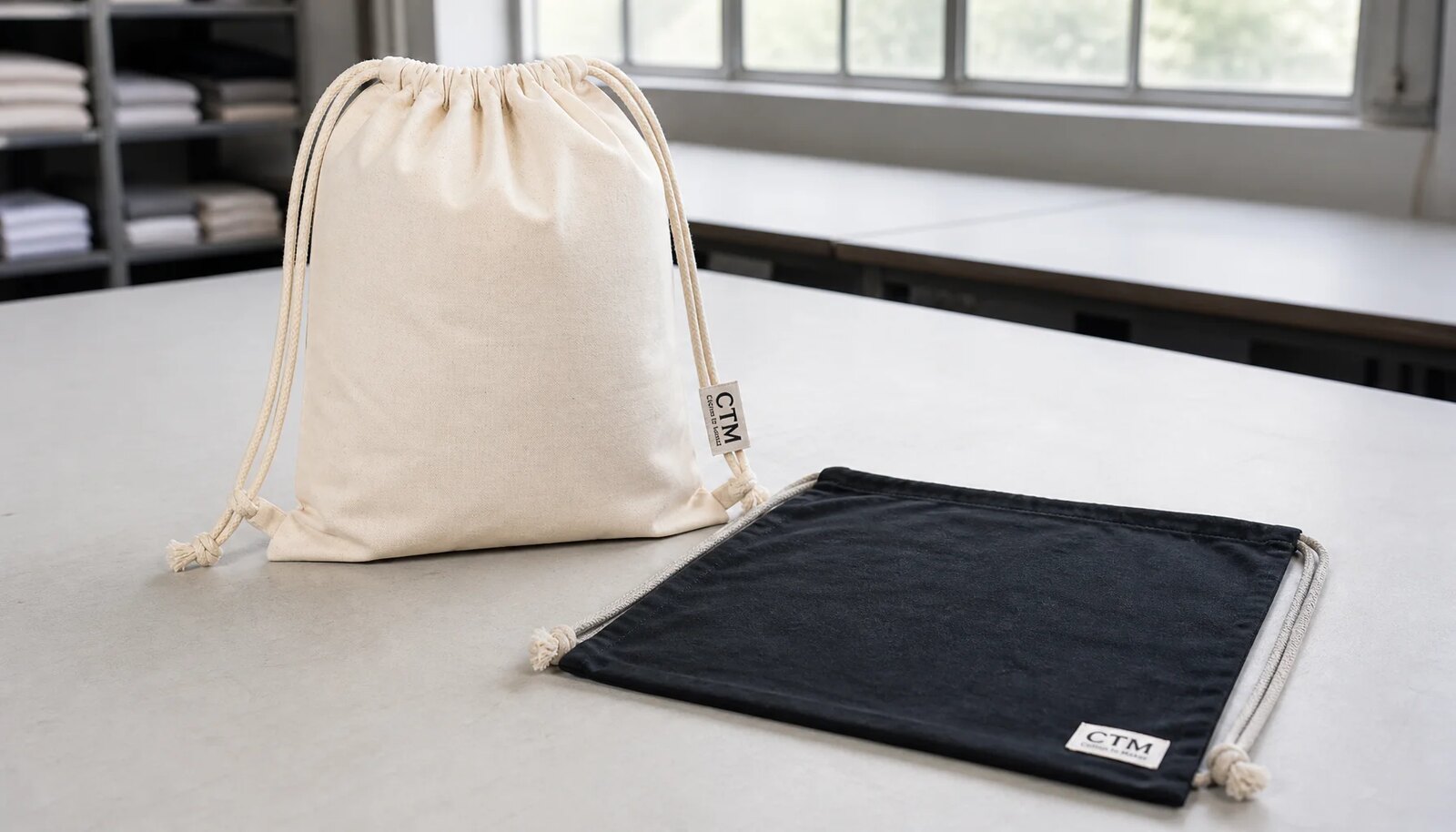
Start with the retail job
Hotel retail buyers should begin with the selling context, not the generic bag category. A cotton drawstring backpack used in a resort market, spa boutique, lobby shop, or beach kiosk has to support a visible shelf price, hold up to normal guest handling, and arrive in a format the property can receive quickly. A low factory price is not helpful if the product feels too thin, scans poorly, or needs repacking at the hotel.
Clarify whether the backpack is an entry souvenir, a beach accessory, a spa retail add-on, a branded gift program, or a multi-property replenishment SKU. That single decision changes the right fabric weight, body shape, cord quality, decoration method, packing, barcode placement, and carton count. It also helps the buyer avoid paying for details the guest will not value.
The practical output is a quote-ready spec. Instead of asking suppliers for a cotton logo backpack, ask for a defined finished size, GSM, weave, construction, decoration, cord, packing method, carton data, incoterm, and quantity tiers. This keeps the discussion commercial and measurable.
- Define the selling environment before the RFQ: shelf, hanging peg, bin, counter display, amenity kit, or back-of-house resale.
- Separate entry and premium SKUs so fabric and decoration choices match the intended retail price.
- Ask the retail team how units will be replenished by property, because carton count and inner packs affect receiving labor.
- Treat the approved sample as the production standard, not just a visual reference.
Convert the concept into a controlled spec
Most quote variance comes from missing details. A drawstring backpack can be flat or gusseted, natural or dyed, plain weave or twill, bulk packed or retail packed, screen printed or labeled. If the RFQ leaves those choices open, each supplier will quote a different product while using the same product name.
A controlled spec should list finished dimensions, fabric GSM, weave, fabric color, body construction, cord type, cord length, cord channel height, reinforcement points, decoration method, artwork size, artwork placement, label or hangtag details, packing method, and carton requirements. If barcode scanning is required, include the barcode size, location, and scan expectation on the packed unit.
Keep quote lines simple. One size, one fabric weight, one color, one artwork version, and one packing method per line makes pricing easier to compare. If the buyer wants a 160 gsm pilot and a 220 gsm premium version, they should be quoted as separate alternatives rather than blended into one vague request.
- State whether size is measured before or after pressing and packing.
- Name the weave as well as the GSM, because similar weights can feel different in plain cotton, twill, and canvas.
- Define print or label position using centimeters from seams or edges.
- Include retail packing and carton marking in the first RFQ instead of adding them after supplier selection.
- Require suppliers to identify any assumptions they made when quoting.
Match fabric and construction to shelf price
Fabric weight is one of the clearest cost and perception levers. A 140-160 gsm plain cotton bag can work for a cost-sensitive pilot, small souvenir, or light amenity resale item. It will usually feel softer and less structured, may wrinkle more, and can show seam lines or contents more clearly. That may be acceptable when the shelf price is modest.
For a stronger hotel retail presentation, 180-220 gsm cotton twill or canvas is often a better starting point. The hand feel is more substantial, the bag can hold shape better on display, and screen print generally has a cleaner base. The tradeoff is higher material cost and potential increases in carton weight or freight cube, so the upgrade should be modeled in landed cost.
Construction should follow the use case. A flat body is efficient, compact, and familiar. A gusseted body adds capacity and perceived value, but only if gusset depth is specified and inspected. Reinforced lower corners, a clean cord channel, and consistent cord length usually matter more to guest satisfaction than unnecessary decorative complexity.
- Use lighter cotton for entry retail, trial quantities, or simple souvenir pricing.
- Use heavier twill or canvas for premium resort, spa, or beach retail programs.
- Choose gusseted construction when capacity and shelf shape justify the extra cost.
- Check natural cotton for slubs and dyed cotton for shade variation, lint visibility, and seam puckering.
- Ask for an actual-material sample before approving bulk production.
Choose decoration with yield in mind
Decoration should sell the hotel brand and remain repeatable in production. A one-color screen print is often efficient for bold logos, resort names, and simple artwork. Woven labels, patches, or embroidery can create a more understated retail look and may handle fine details better than print on textured or dark fabric.
Artwork complexity affects both unit cost and defect risk. Thin lines, small type, tight registration, gradients, and multiple print colors can increase setup, slow inspection, and reduce yield. If a cost target is tight, the buyer should first simplify artwork, reduce color count, or move small details to a woven label before cutting fabric quality.
Placement also has a retail function. A large front logo works when the bag hangs flat. A side label may read better when units are folded or stacked. If the bag is sold in a polybag, approve the fold direction so the branding and barcode remain visible without repacking.
- Request a print strike-off or decorated sample on the actual fabric color.
- Define artwork size and placement from fixed seams or edges.
- Confirm color count, screen charges, label tooling, patch backing, and attachment method.
- Inspect decoration after folding because retail packing can hide or distort the branding.
- Use store-like lighting when checking contrast on natural, black, navy, or tonal designs.
Write the RFQ as a pricing control
A useful RFQ does more than collect unit prices. It controls the quote inputs so procurement can compare suppliers without guessing what is included. The RFQ should combine product specification, quantity tiers, packing requirements, commercial terms, sample requirements, approval steps, and inspection expectations.
For hotel retail cotton drawstring backpacks, request realistic pricing tiers such as 1,000, 3,000, and 5,000 pieces if those quantities match the buying plan. Ask suppliers to show MOQ separately by fabric color, artwork version, decoration process, and packing format. A supplier may accept 1,000 pieces total but require higher minimums per dyed color or woven label run.
Require price separation where possible. Base bag, decoration, packing, setup, sampling, export cartons, and freight basis should be visible. A single blended price is convenient, but it makes value engineering harder. If the buyer needs to reduce cost, they should know whether savings come from fabric weight, artwork simplification, fewer packing steps, larger quantity, or freight optimization.
- Use the same incoterm, delivery point, currency, and payment terms across all quotes.
- Ask what is included and excluded instead of assuming setup, packing, and carton labels are included.
- Request carton dimensions, gross weight, and units per carton with the first commercial quote.
- State overrun or underrun tolerance and whether split shipment is required.
- Ask suppliers to confirm quote validity and reorder pricing assumptions.
Use a concrete tiered pricing model
A bulk pricing plan should convert supplier quotes into landed cost per sellable unit. The model does not need to be complicated, but it should separate recurring unit costs from one-time setup charges. This prevents a pilot price from being mistaken for reorder economics and helps the hotel decide whether a larger run is worth the inventory commitment.
A simple model can include base bag cost, decoration cost, retail packing cost, allocated setup cost, inspection allowance, and freight or destination estimate. For example, if a 1,000-piece order has a base bag at 1.85, decoration at 0.28, packing at 0.16, setup charges of 300 allocated across the order, and estimated freight and handling of 0.35 per unit, the planning landed cost is 2.94 per sellable unit before duties or local taxes. At 3,000 pieces, the same 300 setup charge allocates to 0.10 per unit instead of 0.30, and the base unit price may also improve if the supplier reaches a production break.
The buyer should not chase the lowest tier automatically. A 5,000-piece price may look attractive but can create aged inventory if sell-through is uncertain. A 1,000-piece pilot may cost more per unit but reduce markdown risk. The best tier is the one that supports the target retail margin and realistic replenishment cadence.
- Sample model: landed unit cost = base bag + decoration + packing + allocated setup + inspection allowance + freight and handling estimate.
- Compare pilot and reorder economics separately because setup allocation changes sharply by quantity.
- Add missing packing or barcode costs to any quote that excludes them before ranking suppliers.
- Use carton cube and gross weight to test whether a heavier fabric erases a unit-price advantage.
- Work backward from target retail price and margin to set the maximum acceptable landed cost.
Compare suppliers beyond unit price
The supplier comparison should balance price, MOQ, lead time, process ownership, and defect responsibility. A direct factory can be strong for repeat hotel retail programs because sewing, decoration, packing, and export cartons may be managed under one production plan. That usually gives clearer accountability, but the buyer still needs to confirm which steps are actually in-house.
Blank-bag sourcing with local decoration can be useful for urgent pilots or regional programs. The tradeoff is handoff risk. If the blank bag is off-size and the local decorator prints it anyway, responsibility becomes harder to assign. Additional freight, unpacking, printing, rebagging, and local handling may also narrow the expected savings.
Trading companies and sourcing agents can add value when they coordinate multiple suppliers, consolidate shipments, or support mixed SKUs. The buyer should still require transparency. The key question is not whether the partner is a factory or intermediary; it is who controls each step and who pays for correction when something fails.
- Score suppliers on accountability, MOQ fit, lead-time realism, QC support, packing accuracy, and landed cost.
- Ask who owns rework if sewing passes but decoration or barcode labeling fails.
- Confirm whether labels, patches, printing, embroidery, cartons, and barcode work are outsourced.
- Avoid comparing quotes until excluded charges and freight assumptions are normalized.
- Favor suppliers that can explain inspection standards and production checkpoints clearly.
Inspect with defined sampling and defect classes
Quality control should be written before production starts. The approved sample sets the visual standard, but the inspection plan defines how bulk goods will be judged. For consumer soft goods, buyers commonly reference acceptance sampling frameworks such as ANSI/ASQ Z1.4 or ISO 2859-1, then set their own AQL levels and defect classes based on product risk and retail expectations.
Defect classes make inspection less subjective. Critical defects may include unsafe components, strong chemical odor, wrong artwork, unreadable barcode for a POS-required item, or contamination that makes the product unsellable. Major defects may include open seams, severe print defects, wrong fabric, incorrect size outside buyer tolerance, missing label, missing cord, or mixed colors. Minor defects may include small loose threads, slight wrinkles, or small cosmetic issues within the buyer's agreed limit.
Inspection should not happen only at final packing. Check fabric before cutting, verify decoration setup before full print run, review sewing during production, and perform final random inspection after packing. Final inspection should open cartons from different parts of the batch to catch count errors, mixed colors, packing drift, and carton label mistakes.
- Define sampling plan, AQL, and defect classes in the PO or inspection instruction.
- Use buyer-approved tolerances rather than assuming one universal standard for every hotel program.
- Check fabric, cutting, decoration, sewing, packing, barcode scan, and carton labels at separate checkpoints.
- Reject or rework critical retail failures before shipment, not at property receiving.
- Keep inspection photos and reports tied to the PO for reorder comparison.
Control packing, logistics, and timing
Packing is part of the product for hotel retail. A bag that arrives clean, folded consistently, correctly labeled, and easy to scan saves receiving time and protects shelf presentation. A bag that arrives crushed, mixed by color, short-counted, or packed with hidden labels can create labor costs that were never visible in the factory quote.
Decide whether the unit needs bulk pack, individual polybag, insert card, hangtag, barcode sticker, size sticker, or retail-ready presentation. For multi-property replenishment, carton labels should show SKU, color, quantity, PO number, destination property, and any required routing information. Carton count should match receiving behavior when possible; if properties replenish in 50-unit batches, inner packs or cartons of 50 can reduce handling.
Timing should be stage-based. Ask for dates for artwork approval, sample making, sample review, material booking, cutting, decoration, sewing, packing, inspection, carton close, dispatch, and expected arrival. Buyer-side delays such as late barcode data, late carton marks, or artwork revisions should be treated as schedule risks, not factory problems.
- Approve pack-out photos showing fold direction, barcode position, inner packs, and carton marks.
- Scan barcodes from the final packed unit before shipment when POS scanning is required.
- Align carton counts with property receiving and replenishment quantities.
- Build inspection and carton close time into the schedule instead of treating production finish as ship-ready.
- Ask whether fabric, cord, label, and carton specs can remain stable for repeat orders.
Specification comparison for buyers
| Buying route or spec choice | Typical commercial tradeoff | Best fit | Procurement risk to verify |
|---|---|---|---|
| Direct factory manages sewing, decoration, and packing | Usually clearer accountability and fewer handoffs; MOQ may be higher than local finishing routes | Repeat hotel retail SKUs, multi-property programs, seasonal replenishment | Confirm which steps are in-house and which are subcontracted before relying on one-source accountability |
| Blank bags plus local decoration | Lower pilot friction and faster local artwork changes; extra freight touches and repacking can raise landed cost | Urgent tests, regional launches, last-minute event retail | Define who owns defects if blank bags pass but decoration, barcode, or repacking fails |
| Trading company or sourcing agent | Can consolidate suppliers and support smaller programs; transparency varies by partner | Buyers needing multiple soft goods, mixed SKUs, or coordination support | Ask for factory identity, production flow, inspection responsibility, and margin-included pricing basis |
| 140-160 gsm plain cotton | Lower material cost and lighter cartons; softer, thinner retail hand feel | Entry souvenir, amenity resale, price-sensitive pilot | Check opacity, wrinkling, seam visibility, and whether the shelf price still feels justified |
| 180-220 gsm twill or canvas | Higher material and freight exposure; stronger hand feel and better print base | Premium resort shops, spa retail, beach accessories, branded gift programs | Model carton weight and cube so the fabric upgrade does not surprise the landed cost |
| Flat body construction | Efficient sewing and packing; limited capacity and less structured presentation | Simple logo bags, compact displays, lower retail price points | Confirm lower-corner reinforcement and cord channel strength for normal guest use |
| Gusseted body construction | More sewing time and bulk; better usable volume and more substantial shape | Beach, pool, resort market, and spa retail programs | Specify gusset depth separately and inspect it as a controlled dimension |
| Bulk pack | Lowest packing labor and material cost; less retail-ready at property level | Back-of-house use, desk resale, or programs with local repacking | Check cleanliness, count accuracy, fold consistency, and receiving labor impact |
| Individual retail pack | Higher unit cost; faster receiving, cleaner shelf handling, easier barcode control | Gift shops, lobby retail, multi-property replenishment | Verify barcode scan, insert placement, polybag size, warning text if applicable, and carton labels |
Buyer checklist before sampling
- Define the retail use case first: lobby shop, spa boutique, resort market, beach accessory, event retail, amenity resale, or multi-property replenishment SKU.
- Issue one RFQ line per size, fabric weight, colorway, artwork version, construction type, and packing method so supplier quotes stay comparable.
- Lock finished dimensions, fabric GSM, weave, fabric color, cord material, cord length, body construction, reinforcement points, decoration method, and packing format before requesting final pricing.
- State whether dimensions are measured before or after pressing and packing, and define buyer-approved tolerances for size, gusset, print placement, cord length, label position, and color variance.
- Request pricing at realistic quantities such as 1,000, 3,000, and 5,000 pieces, with MOQ listed separately by fabric color, artwork, and decoration method.
- Ask suppliers to separate base bag cost, decoration cost, packing cost, setup charges, sample charges, export carton cost, and freight basis rather than giving only one blended unit price.
- Require carton dimensions, gross weight, net weight, units per carton, inner pack method, carton marks, barcode label format, and destination or incoterm on every quote.
- Approve a pre-production sample using actual fabric, actual cord, final decoration, label or patch, fold direction, retail packing, barcode location, and carton label format where relevant.
- Build an inspection plan that names sampling level, acceptable quality limits, critical defects, major defects, minor defects, and checkpoints before cutting, during production, and before shipment.
- Keep a signed master sample or controlled approval photo set for repeat orders so fabric hand feel, cord type, print size, label placement, and packing do not drift quietly.
Factory quote questions to send
- What exact fabric GSM, weave, color process, and finish are included, and is the material plain cotton, twill, canvas, or another construction?
- Is the cotton pre-shrunk, washed, untreated, dyed to order, or stock fabric, and what shrinkage or color variation should we expect between sample and bulk?
- What finished size is quoted, how is it measured, and what buyer-defined tolerance can you hold for height, width, gusset depth, cord channel, and cord length?
- What cord type, diameter or width, material, length, knot method, and end finish are included in the price?
- Is the quoted body flat or gusseted, and are lower corners, cord channel seams, and stress points reinforced?
- Which decoration method is quoted, how many colors or label positions are included, and what artwork setup, screen, strike-off, label tooling, or embroidery digitizing charges apply?
- What MOQ applies per fabric color, per artwork version, per decoration method, and per packing format, and what unit prices apply at 1,000, 3,000, and 5,000 pieces?
- Does the quote include the pre-production sample, sample freight, artwork proof, barcode setup, hangtag, insert card, polybag, carton marks, and export carton labeling?
- What are the carton dimensions, gross weight, net weight, units per carton, expected carton count, and loading assumptions for the quoted quantity?
- Which inspection approach do you support, such as ANSI/ASQ Z1.4 or ISO 2859-1 sampling, and what defect classes do you propose for stains, odor, wrong artwork, missed stitches, poor print, missing labels, and short counts?
Quality-control points to confirm
- Check fabric GSM, weave, color, and hand feel against the approved sample before cutting begins, not only after finished goods are packed.
- Use buyer-defined dimensional tolerances on the inspection sheet; for example, a buyer may choose plus or minus 1 cm on key body dimensions if that fits the SKU and display requirement.
- Measure gusset depth as its own controlled dimension when the design is gusseted, because uneven gussets change usable capacity and shelf shape.
- Use buyer-defined cord tolerance; for example, plus or minus 2 cm may be acceptable for some programs, but tighter or looser limits should be set by the buyer before production.
- Pull the drawcord through the channel to confirm smooth movement, balanced shoulder lengths, no tearing, no severe twisting, and no seam strain at the channel exit.
- Use buyer-defined print placement tolerance; for example, plus or minus 5 mm may be appropriate for centered logos, but the approved tolerance should be recorded in the PO or QC checklist.
- Classify wrong artwork, missing label, unreadable barcode, severe stain, strong odor, unsafe component, or unusable drawcord as critical or major defects depending on the buyer's retail requirements.
- Inspect print quality for smearing, ghosting, pinholes, registration shift, ink buildup, color mismatch, weak contrast, and poor edge definition at normal viewing distance.
- Inspect sewing for skipped stitches, popped stitches, seam creep, loose backstitching, open seams, uneven cord channels, weak lower corners, and excessive loose threads.
- Check cord ends, knots, patches, labels, hangtags, insert cards, polybags, barcode stickers, carton labels, carton counts, and mixed-color risk during final random inspection.