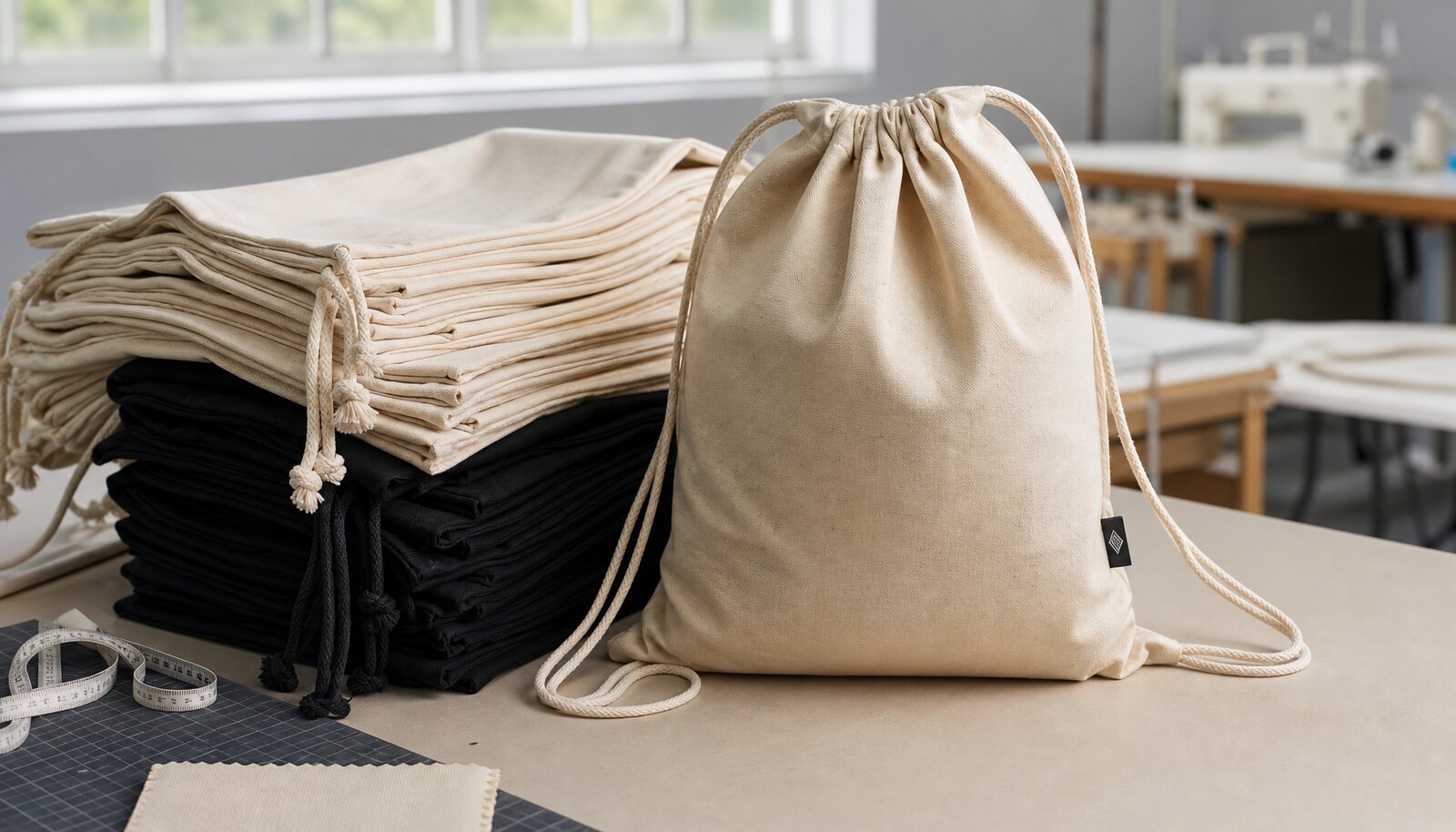
Why MOQ negotiation matters more here than on a generic promo bag
Cotton drawstring backpacks for gift shops sit between souvenir item, carry bag, and impulse purchase. That mix changes the buying math. A supplier may offer a low entry quantity, but if that minimum is tied to one color, one print position, one fabric lot, and one packing format, it may still be too rigid for a store program that needs flexibility.
For procurement teams, the real question is not simply whether the MOQ is low. It is whether the minimum supports a sellable SKU that can be priced, displayed, shipped, and reordered without rework. A bag that looks acceptable in a sample room can become expensive once you add seasonality, barcode labeling, carton limitations, and the cost of carrying slow stock after the tourist season ends.
That is why the negotiation should start with the retail use case. A museum store, a coastal gift shop, and a chain of airport kiosks may all buy the same bag category, but they do not need the same spec. The order structure should reflect demand risk, not just product preference.
- Use MOQ to control risk, not just to win a lower quote.
- Match the spec to the retail channel before comparing suppliers.
- Treat each extra variable as a cost driver until the supplier proves otherwise.
Start with the shelf price, then work backward to the bag spec
Gift shop sourcing goes wrong when buyers begin with a generic product description and try to force the price down later. Reverse the process. Decide first what the bag can realistically sell for on shelf, then calculate the landed cost you can afford after freight, duties, packaging, and any store-level handling.
That calculation usually gives you a more honest spec. A lighter 120-140 GSM cotton bag may work for a lower-ticket souvenir program, especially if the bag is sold as a practical add-on rather than a premium carry item. If the bag is meant to stand alone as a gift shop product, 160-180 GSM often gives a better retail impression without pushing it into a heavier, more expensive category.
The weight decision affects more than appearance. It changes how the bag folds, how the print sits on the fabric, how much it costs to ship, and whether the bag still feels like an impulse buy. A heavier fabric can justify a higher retail price, but only if the customer sees that value on the shelf.
- If the bag is an add-on or packaging insert, lean lighter and keep the spec simple.
- If the bag is a standalone retail item, choose a fabric weight that holds shape and prints cleanly.
- Do not specify fabric by appearance alone; ask for GSM and finishing details.
What actually drives MOQ on these bags
Factories usually do not count MOQ only by units. They also count setup burden. That means fabric lot, dye batch, artwork version, print colors, and packing method can all move the minimum. A single-color logo on stock natural cotton is easy to schedule. A custom-dyed body, two print positions, and individual retail bagging is not.
The most effective MOQ negotiation strategy is to freeze the base bag and vary only the branding. That lets the supplier reuse the same sewing pattern, cord type, and fabric source. If you want to test demand, ask for a stock-base option first. Stock base often gives you the lowest practical MOQ because the supplier is not buying or dyeing new fabric just for your first run.
Where buyers get trapped is in the phrase 'custom.' Custom can mean a different print, or it can mean a different body fabric, cord color, label, and fold method. Those are not equivalent. When you ask for a quote, force the supplier to identify which element is really driving the minimum and which element is just preference.
- Lower MOQ usually comes from stock fabric, one logo color, and flat packing.
- MOQ rises quickly when you add custom dye, multiple artwork versions, or special retail packaging.
- If the supplier will not separate setup cost from product cost, the quote is hard to benchmark.
Use the sourcing route that matches the order stage
The right sourcing route depends on whether this is a test run, a seasonal drop, or a repeat purchase. A first-time order should usually favor the simplest route that still supports your retail presentation. That means stock cotton, one decoration method, and one packing format. For repeat business, you can consider a more customized bag once you know the sell-through rate and reorder pattern.
Buyers often make the mistake of asking for a fully custom program too early. Custom fabric, custom size, and custom color all look attractive in the sample stage. They become less attractive when the first order has to move quickly or when the store needs a clean reorder without re-approving every detail. In procurement terms, customization is only worth it when the volume is stable enough to absorb the extra setup burden.
A useful rule: if the order is below the point where you are confident of repeat demand, do not pay for specs that are hard to reuse. Save custom dye, custom weave, or embroidered branding for a SKU that already has a proven sales record.
- Test order: stock base, simple branding, bulk packing.
- Repeat order: fixed spec, documented tolerances, predictable carton config.
- Custom route: only when the higher setup cost is offset by stable demand or higher shelf price.
Comparison table: which route becomes uneconomical first
The table below is the practical version of the sourcing decision. It shows not just what option to choose, but where each option stops making sense. That matters because the cheapest quote on paper is often the most expensive option once setup, packing, and freight are folded in.
Use it to compare suppliers on the same operating logic. If one supplier is quoting a stock base and another is quietly quoting a made-to-order fabric, the two numbers are not comparable even when the product photo looks similar.
- Ask for one quote format across all suppliers so the comparison is fair.
- Keep sample approvals linked to the same spec version used for the quote.
- Reject vague wording such as 'premium cotton' unless the supplier also provides GSM and finish.
Fabric and construction benchmarks buyers can actually use
On this product, fabric weight is only one part of quality. Stitch density, seam finish, and cord tunnel construction matter just as much because the bag is constantly pulled open and closed. A light but well-constructed bag can outperform a heavier one with weak seam reinforcement.
For gift shop use, the most visible quality signal is not just the fabric itself but how the bag behaves when empty. If the bag collapses like a thin pouch, the customer reads it as a lower-value item. If it hangs neatly, keeps its shape, and sits flat when folded, it looks retail-ready. That is why many buyers prefer a modestly heavier fabric with a clean finish over the lightest possible build.
You do not need to over-spec it. You do need to define the part of the bag that will fail first. Usually that is the top hem, the cord tunnel, or the bottom corner where the seam takes repeated stress. If those zones are reinforced properly, the product can usually survive normal gift shop handling without moving into an unnecessarily heavy construction.
- Ask for the exact GSM and whether it is prewashed, bleached, dyed, or left natural.
- Inspect bar-tacks or reinforcement at stress points before approving bulk.
- Confirm whether the bag uses eyelets, stitched tunnels, or a hybrid closure, because the construction changes cost and durability.
Print method should match both artwork and reorder logic
For most cotton drawstring backpacks in gift shops, single-color screen print is the cleanest balance of cost and repeatability. It gives a crisp retail look and keeps the quote easy to read. If your art has fine lines, gradients, or several colors, a transfer or digital method may preserve detail better, but it changes the economics and may reduce your flexibility on MOQ.
Woven labels and side labels are worth considering when the brand should feel subtle rather than promotional. They are especially useful when the bag itself is simple and the value comes from the retail program around it, not a large graphic. That said, a label is not a free substitute for print. It changes the look, and the buyer should approve that look as a retail choice, not just a cost-saving move.
The practical rule is simple: if the artwork is likely to change frequently, keep the decoration method flexible and low setup. If the artwork is stable and the same program will be reordered, a more finished branded look may justify a slightly higher setup cost because it reduces future changeover friction.
- Screen print is usually best for one-color logos and stable repeat programs.
- Transfer or digital methods make sense when artwork detail matters more than setup simplicity.
- Label-based branding works well when the goal is a clean, understated retail presentation.
What a sample must prove before you move to bulk
A blank sample is not enough when the final product depends on artwork placement, color contrast, or the way the bag folds for sale. For this category, the most useful approval is a decorated pre-production sample that reflects the actual fabric, cord, print method, and packing format. Otherwise, you can approve a good bag and still receive a different retail experience in bulk.
Use the sample to test both appearance and behavior. Measure the body, check the cord pull, fold the bag into its final carton position, and inspect how the print sits on the fabric after it has been handled. If the sample is meant to be a final approval unit, it should also show the exact label position, barcode format, and any insert or hangtag that the store will see.
A sensible threshold for sample-to-bulk control is simple: if the bulk spec deviates from the approved sample in a way a shopper would notice, the supplier should re-submit. That is especially true when the fabric shade, print size, or cord style changes. Minor variance is normal; unannounced substitution is not.
- Do not approve bulk from a blank proto if the decoration is part of the sellable value.
- Compare the decorated sample against the quote line by line before giving production release.
- Set a clear rule for what counts as a material change, such as fabric weight, print method, or packing method.
How to read a quote without missing the hidden cost
A unit price is only useful if you know what is inside it. Many bag quotes hide the real cost in setup, decoration, or packing assumptions. One supplier may appear cheaper until you discover that screen setup, barcode labels, or polybags are extra. Another may quote a slightly higher unit price but include the packing and carton data you actually need for distribution.
A clean quote should separate the base bag, branding, packing, and carton information. That makes supplier comparison possible and reduces the risk of later scope creep. If the supplier can only give a lump sum, ask for the underlying assumptions in writing. You do not need a perfect cost model. You do need a quote that can survive procurement review.
Watch especially for cost shifts caused by print coverage, number of colors, and decoration position. Those are the most common variables that make two apparently identical bags quote very differently. If the supplier cannot explain the delta in plain terms, the quote is not mature enough for approval.
- Require a line for base bag cost and separate lines for decoration and packing.
- Ask whether any quote includes screen setup, sampling labor, or repeat order savings.
- Do not compare suppliers until each quote uses the same packing and carton assumptions.
QC criteria that are strict enough to catch real problems
Procurement depth matters most at inspection. A gift shop bag does not need industrial-grade testing, but it does need a clear acceptance plan. Start with measurable checks. If the bag is 160 GSM and the supplier delivers something visibly lighter, that is a process failure, not a minor variation. If the print is shifted, the cord cuts into the tunnel, or the seams open under ordinary use, reject the lot or require rework.
For first production, inspect both aesthetics and function. The print should be aligned within the agreed tolerance, with no obvious pinholes or color breakup. Stitching should be even, with no skipped seams, loose thread tails, or weak top hem reinforcement. The cord should move smoothly without snagging. A reasonable internal test is to open and close the bag repeatedly on the sample and then inspect for fraying or tunnel damage.
If you want to formalize acceptance, use an AQL-based inspection plan and spell out major versus minor defects. That is more effective than asking for 'good quality' because it lets the factory understand what failure looks like before shipment. It also gives procurement a defensible basis for rejection if the lot does not match the approved sample.
- Set a fabric-weight tolerance before production, not after the shipment arrives.
- Use a first-article check for print placement, seam quality, and cord function.
- Define major defects, such as seam opening or wrong decoration, separately from minor cosmetic issues like loose thread ends.
Specification comparison for buyers
| Decision area | Practical recommendation | Typical buyer use | When it becomes uneconomical | Main quote drivers |
|---|---|---|---|---|
| Fabric weight | 120-140 GSM for low-ticket souvenir use; 160-180 GSM when the bag needs to stand up better on shelf and feel closer to a retail item | Museum shops, tourist gift shops, event stores, and bundled gift inserts | Below 120 GSM the bag can feel flimsy; above 180 GSM the bag can look and cost like a small canvas pack, which is often too heavy for souvenir pricing | Yarn count, weave density, dyeing, finishing, and whether the fabric is stock natural or custom dyed |
| Print method | Single-color screen print for simple logos; woven label or side label for restrained branding; heat transfer or digital only when artwork detail justifies it | Short seasonal runs, simple destination graphics, and branded gift shop programs | Multi-color art on a very low quantity order usually turns expensive fast because each extra color adds setup and risk | Number of colors, print area, placement, screen setup, and whether the supplier charges per artwork version |
| MOQ route | Use a stock-base bag first, then change only the logo, label, or hangtag; reserve custom fabric or custom size for repeat programs | First-time tests, pilot launches, and buyers comparing several gift shop locations | Custom color or custom fabric rarely makes sense for a test run because the setup cost gets spread over too few units | Fabric lot, dye batch, pattern cutting, and the supplier's counting rule for MOQ per color or per design |
| Cord and closure | Standard polyester or cotton-poly cord usually gives the best price-stability balance; add reinforcement at the tunnel if the bag will be handled repeatedly | Retail bags that will be opened and closed often, not just used once as packaging | Premium cord is hard to justify on a low-margin souvenir if the body fabric and print are already the main value drivers | Cord diameter, cord finish, reinforcement stitching, and whether eyelets or stitched tunnels are included |
| Packing format | Flat bulk packing is the default for warehouse efficiency; add individual polybags only when shelf presentation, barcode application, or dust protection requires it | Distributor replenishment, backroom storage, and mixed store orders | Individual bagging, inserts, and hangtags can outweigh the product margin on small orders | Labor for folding, bagging, barcode placement, carton density, and carton dimension changes |
| Sampling route | Approve a decorated pre-production sample, not just a blank proto, when print placement or retail presentation matters | Any order where artwork, label placement, or shade has to match a known retail standard | Blank-only approval is weak when the final product depends on print opacity, registration, or how the bag folds in carton | Sample labor, print setup, revised artwork, fabric source, and whether the sample reflects final packing |
| Order stage | Use a low-risk test order to validate sell-through; only move to a locked repeat spec after you know the target price and sell-in timing | New SKU tests, seasonal drops, and museum or attraction stores with uncertain demand | The cheapest first order can be expensive if it creates rework, relabeling, or unsold inventory after the season ends | Target retail price, reorder likelihood, freight method, and whether the same spec can be repeated without new setup |
| Quote structure | Ask for an itemized quote with base bag, decoration, packing, and carton data separated | Buyers comparing two or more suppliers on a fair basis | A single all-in quote becomes hard to benchmark when the supplier changes setup, packing, or carton assumptions later | Fabric spec, decoration cost, packaging, carton quantity, carton size, and gross weight |
Buyer checklist before sampling
- Start with the target shelf price and margin, then work backward to the maximum landed cost you can tolerate.
- State the fabric weight, color basis, cord type, print method, and packing format in the RFQ so the factory cannot fill gaps with assumptions.
- Ask the supplier to define MOQ by total quantity, per color, per artwork, and per fabric lot if any of those differ.
- Request a decorated pre-production sample when artwork placement, logo size, or color contrast matters to the retail decision.
- Compare sample dimensions, cord length, and print placement against the approved spec, not against memory or a photo.
- Confirm carton quantity, carton size, and gross weight before approving freight or warehouse planning.
- Review the stitched tunnel, top hem, bottom corners, and label attachment under load, because those are the common failure points.
- Set acceptance rules for shade variation, print registration, loose threads, and size tolerance before bulk starts.
- Ask whether any price breaks depend on using the supplier's stock base, and whether changing one variable resets the MOQ.
- Keep one clean spec sheet per SKU version so repeat orders do not inherit unapproved changes from email threads.
Factory quote questions to send
- Is your MOQ counted by total pieces, per color, per artwork, or per fabric lot?
- Which GSM options can you price on the same bag, and how much does the quote change if we move from 120 GSM to 160 GSM?
- What is included in the unit price: fabric, cutting, sewing, cord, decoration, packaging, and carton labeling?
- Can you quote the same design with screen print, heat transfer, and woven label so we can compare both MOQ and landed cost?
- What is the sample lead time for a decorated pre-production sample, and does the sample use the same fabric and cord as bulk?
- What tolerances do you accept for body dimensions, print placement, and color shade in bulk production?
- How many units per carton do you recommend, and what carton size and gross weight should we use for freight calculation?
- What is your process if the sample and the bulk production do not match on fabric feel, print opacity, or label position?
- Do you charge extra for screen setup, artwork revision, pantone matching, barcode stickers, hangtags, or individual polybags?
- What payment terms are tied to sample approval, production release, and final inspection?
Quality-control points to confirm
- Fabric weight: confirm the approved GSM is held within a practical tolerance, typically around +/-5%, and reject unexplained substitutions that change hand feel or drape.
- Dimensions: measure bag body width, height, and cord length against the approved sample; set a clear tolerance band, such as +/-5 mm on print placement and +/-10 mm on body dimensions, before production starts.
- Stitching: inspect seam density, bar-tacks, tunnel stitching, and corner reinforcement for skipped stitches, loose thread, puckering, or seam opening under gentle load.
- Tunnel and cord performance: run the cord repeatedly through the tunnel and check for snagging, fraying, or cutting into the fabric after several open-close cycles.
- Print quality: verify registration, opacity, edge sharpness, and color consistency, then run a dry rub test and a light wet rub test on the first article to check transfer.
- Sample-to-bulk match: compare the decorated pre-production sample to bulk approval for fabric shade, label position, cord finish, and print size; do not accept silent substitutions.
- Packing accuracy: count units per inner pack and carton, confirm the agreed fold method, and check that labels, inserts, or polybags are present where specified.
- Carton condition: reject crushed, wet, or overfilled cartons and verify that carton markings match the order, SKU, and packing list.
- Commercial acceptance: consider using an AQL-based inspection plan, such as a stricter standard for major defects and a looser one for minor cosmetic issues, instead of a vague 'good quality' rule.