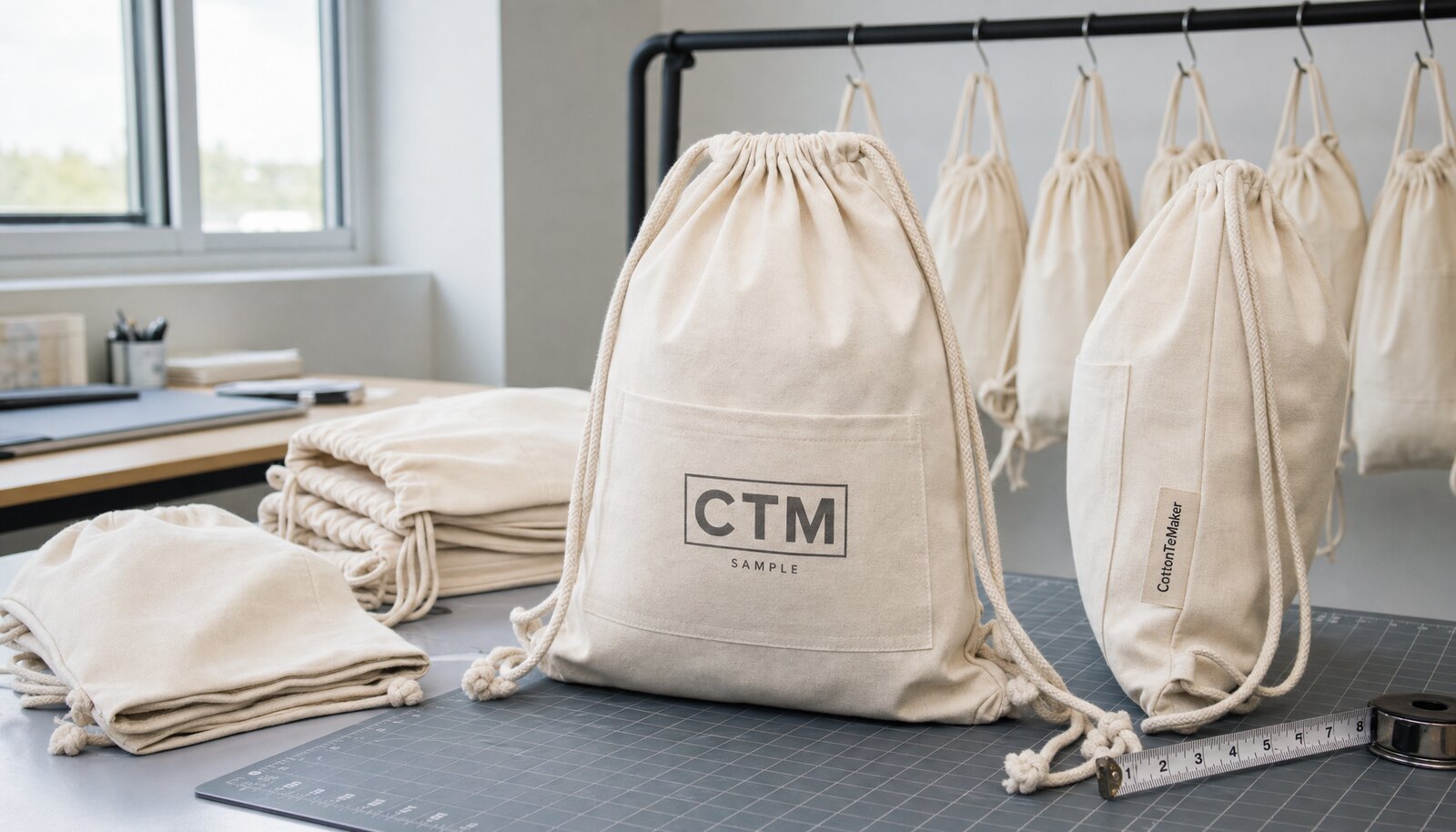
Why retail buyers get cotton drawstring backpack quotes wrong
Most quote disputes start because the bag is treated like a simple commodity. In practice, cotton drawstring backpacks for retail change price fast when fabric weight, print method, cord grade, and packaging are not written down clearly. A supplier can quote a light 4 oz bag with one-color screen print, while the buyer expects a heavier 8 oz bag with retail-ready inserts and a woven label. Those are not comparable offers.
For procurement teams, the goal is not the lowest line price. It is the most usable landed cost for the intended shelf price, channel, and return rate. If the bag is meant for a gift aisle or impulse retail rack, the hand feel, print clarity, and packed appearance matter as much as the unit cost.
- Write the RFQ around finished use, not just dimensions.
- Separate base bag cost, decoration cost, and packing cost.
- Ask suppliers to quote the same approval sample, not their stock version.
- Treat freight weight and carton count as part of the buying decision.
Choose the retail spec first: fabric, size, and finish
For most retail programs, 4 oz to 6 oz natural cotton is the most economical starting point. It keeps the bag light for hanging displays and lower freight cost, and it is usually enough for lightweight gift items, event retail, and general accessory use. Move to 8 oz cotton when the brand wants a more premium feel, better structure, and less fabric show-through under print.
Size should follow the product mix, not a vague “standard” bag. A compact bag for cosmetics or small accessories may sit around 25 x 30 cm, while a broader retail carry bag may need 35 x 45 cm or more. If the bag is too small, the cord channel compresses awkwardly and the pouch looks thin on shelf; if it is too large, it adds fabric cost and can be overbuilt for the category.
- Natural unbleached cotton is usually the safest retail base for broad appeal.
- Dyed cotton should only be used when the color is part of the SKU plan and tested for shade consistency.
- Ask for a measured finished size after sewing, not only cut size.
- If the bag carries heavier items, specify reinforced corners or a double-stitched base.
Print and branding choices that survive retail handling
The most quote-friendly decoration is one-color screen print with a simple logo or short message. It scales well, is easy to approve, and usually gives the cleanest margin for retail. Once art becomes multi-color, gradient, or fine-detail, the supplier may switch to heat transfer, digital transfer, or a more complex print process that changes the cost structure and the failure risk.
If the brand wants a quieter look, a woven side label or sewn-on patch is often more durable than a large print area. That works especially well for premium basics or evergreen SKUs. The tradeoff is that labels add sewing labor and require tighter placement control. For retail buyers, the key is to decide whether the bag needs visual impact from across a display or a more restrained brand cue up close.
- 1-color screen print is usually the cleanest option for simple logos.
- Heat transfer suits short runs or detailed artwork, but it must be tested for cracking and edge lift.
- Woven labels work well when the bag itself should stay neutral.
- State exact logo size and print placement on the RFQ drawing.
Supplier route comparison: factory direct, trading company, or mixed sourcing
The right sourcing route depends on how stable the retail program is. Direct factory sourcing usually gives better control over fabric weight, stitch details, and repeat consistency. It is the better route when the brand expects reorders, private label packaging, or a need to lock the same SKU for multiple seasons. The buyer can also push harder on sample accuracy and process control.
Trading companies can be useful when you need mixed product consolidation, multiple trims, or a single point of paperwork for a complex procurement flow. But they can also add a hidden margin layer and slow down technical clarifications. For cotton drawstring backpacks for retail, the supplier path should be chosen based on the needed level of control, not only the first price presented.
- Direct factories are stronger for repeatable retail SKUs and technical control.
- Trading companies may help when the order is small, mixed, or bundled with other categories.
- Ask who actually cuts fabric, prints, sews, and packs the order.
- Request the same sample route you expect for bulk production.
How MOQ logic actually affects your quote
MOQ is not one number across all versions of the same backpack. A supplier may be willing to make 500 pieces of one natural cotton bag with one print color, but the minimum can jump once you split the order into multiple colors, multiple logos, or retail-specific packaging. Each variant can trigger separate fabric handling, screen setup, or carton labeling costs.
For retail buyers, the cleanest way to keep MOQ under control is to simplify the SKU matrix. One body color, one print location, and one decoration method will usually produce the most predictable quote. If the brand needs multiple colorways, compare the cost of one base color plus varied labels against multiple dyed bag runs. That comparison often shows that label variation is cheaper than fabric variation.
- Single-color natural cotton is usually the lowest MOQ path.
- Each additional print color can add setup cost and minimum quantity pressure.
- Custom-dyed fabric often raises MOQ more than custom labeling does.
- Clarify whether MOQ applies per design, per size, or per carton pack format.
Sample approval: what the pre-production sample must prove
A retail sample should prove more than the logo placement. It needs to show the exact fabric weight, cord feel, opening structure, stitching quality, and final pack method. If the supplier sends a lighter stock sample, the buyer may approve the wrong hand feel and then face objections when bulk bags arrive. The approved sample should be treated as the production reference.
The most useful sample review is tactile and dimensional. Measure the finished width and height, pull the cord several times, inspect the channel stitching, and look for distortion around printed areas. If the print sits too close to the seam or the bag mouth folds the artwork, the bulk result may look cheap on shelf even if the print itself is technically correct.
- Approve one golden sample with the exact fabric, cord, label, and packaging.
- Measure finished size, not cut panel size.
- Inspect seam straightness, corner reinforcement, and print distortion after pulling the cord.
- Keep a signed sample reference for production and final inspection.
Cost drivers that change landed price more than the base bag price
The unit price on the quote is only part of the story. Freight charge often shifts materially when carton sizes are inefficient or when the bag is packed with bulky retail inserts. A slightly better carton plan can reduce volumetric weight enough to offset a small manufacturing premium. That matters for importers and distributors who compare landed cost by SKU, not just factory cost.
Decoration and packing are the other common cost traps. A one-color print may be inexpensive, but if it requires multiple screens, careful alignment, or repeat setup for small batches, the real cost goes up. Likewise, individual polybags, barcode stickers, hang tags, and retail display prep can add meaningful labor even if each item seems minor on its own.
- Review freight weight, not only carton quantity.
- Separate base bag, print, label, and packing as line items.
- Compare natural cotton versus dyed cotton by total landed cost.
- Ask the factory to quote both bulk-packed and retail-packed versions if needed.
Packing details that protect margin and reduce receiving problems
Bulk-packing is usually the most efficient route for wholesale and distribution orders. Bags should be folded consistently, stacked to avoid cord tangling, and packed in a way that prevents dust marks or creasing around the print. If the retail channel needs shelf-ready units, then individual polybags, size stickers, and barcode application must be built into the quote from day one.
Carton labeling should match the PO and the warehouse receiving rules. A simple mismatch between SKU code, color name, and carton count can slow inbound checks and create avoidable chargebacks. For retailers, the packing spec is not an afterthought; it is part of the product.
- Define inner pack count and master carton count in the RFQ.
- Specify whether cords should be tied, tucked, or banded for transit.
- Require clean carton labels with SKU, color, quantity, and gross/net weight.
- If retail-ready, state barcode placement and scan test expectation.
Lead time planning and schedule risks
A normal schedule for standard cotton drawstring backpacks is often 5 to 10 days for sampling and 25 to 40 days for bulk after sample approval. That range assumes standard fabric availability and clear artwork. It stretches when a buyer changes print positions late, requests custom dyeing, or adds retail packaging that requires separate material sourcing.
The biggest schedule risk is not sewing time; it is approval delay. If the buyer waits to finalize logo size, color, or carton pack-out, the factory may hold fabric and labor slots while the project sits frozen. Procurement teams should plan around the longest approval path, especially when the bags are tied to seasonal retail launches or distributor resets.
- Add time for artwork correction, not just production.
- Custom dyed fabric and special labels can extend the schedule.
- Release the sample stage early enough to protect ship windows.
- Keep one contact owner for approvals to avoid version drift.
QC thresholds that keep a retail bag from turning into a claims issue
Retail buyers should define acceptance criteria before bulk production. The most useful thresholds are straightforward: fabric weight should stay close to approved spec, seams should be even, prints should stay aligned, and cords should move smoothly through the channel without binding. The more the bag is sold as a value item, the more visible small defects become on shelf.
A practical inspection plan looks at both appearance and function. Inspect the front of the bag for print clarity, the back for seam finish, the top opening for symmetry, and the corners for thread buildup. Then pull the cord repeatedly and check whether the channel tears or the bag distorts. These are the failures that show up quickly in retail returns.
- Set a fabric weight tolerance band and keep it documented.
- Reject open seams, skipped stitches, and loose thread nests in load-bearing areas.
- Check print registration against the approved sample, not against memory.
- Inspect a carton sample for packing consistency before final release.
Specification comparison for buyers
| Spec decision | Recommended option | When it fits | Buyer risk to check |
|---|---|---|---|
| Fabric weight | 4 oz to 6 oz cotton for low-cost retail; 8 oz cotton when the bag must feel more substantial | Promotional retail, seasonal gift sets, entry-level souvenir programs, and stores that need a lightweight carry item | Too-light fabric can wrinkle, show print show-through, and fail abrasion expectations; too-heavy fabric raises freight and unit cost |
| Cotton finish | Natural unbleached cotton for cost and broad retail appeal; dyed cotton only if the color is part of the SKU plan | Private label basics, eco-positioned assortments, and broad color programs | Natural cotton can vary in tone by batch; dyed fabric can have shade variation and wash bleed if testing is skipped |
| Print method | 1-color screen print for large simple logos; heat transfer for small runs or more detailed art; woven label for premium understated branding | Retail programs where logo clarity matters more than full-wrap graphics | Complex artwork can drive setup cost, registration issues, and slower approvals; some methods crack or fade after handling |
| Closure construction | Cotton cord with stitched channel or reinforced eyelets at top seam | Most retail use, especially when bags are packed flat and sold as impulse accessories | Weak top seam causes tearing at the draw channel; low-grade cord frays and shortens bag life |
| Supplier route | Direct factory for repeat SKUs; trading company only when you need mixed-category consolidation or one-stop paperwork | Brands and distributors with steady reorders or clear artwork | Trading layers can hide factory limits, delay sampling, and reduce control over fabric and print quality |
| MOQ logic | 500 to 1,000 pcs per color/artwork for simple retail orders; higher if custom fabric dye or special trims are involved | Private label trials, regional rollouts, and seasonal retail drops | MOQ may jump if the supplier treats each color, size, and print position as a separate production line item |
| Packing method | Bulk packed in polybags and cartons for wholesale; individual retail inserts only if the channel requires hanging or barcode-ready presentation | Wholesale distribution, store replenishment, and e-commerce fulfillment | Retail-ready packing adds labor and material cost; loose packing can cause dust marks, cord tangling, and barcode damage |
| Lead time structure | Sample in 5 to 10 days, bulk in 25 to 40 days after approval for standard cotton construction | Orders with clear specs and available fabric stock | Lead times stretch when artwork is unclear, fabric must be dyed, or packaging needs custom printing |
| Compliance evidence | Factory audit docs, fabric composition declaration, colorfastness test summary, and carton packing details | Retailers that need vendor onboarding or import documentation | Missing paperwork can block receiving, delay customs, or force rework at destination warehouse |
Buyer checklist before sampling
- Confirm final bag size, gusset, handle drop, and usable loading weight.
- Specify fabric type, GSM/oz weight, color tolerance, and shrinkage expectations.
- Send vector artwork and define logo size, print position, and Pantone references.
- Ask for sample photos plus one physical pre-production sample before bulk approval.
- Agree carton packing, barcode or hangtag needs, and shipment marks before production.
- Record inspection checkpoints for stitching, print adhesion, stains, and quantity count.
Factory quote questions to send
- What fabric weight, yarn count, and weave density are you pricing for the quoted cotton drawstring backpack?
- Is the quoted price based on one print location, one print color, and one side label, or does it include all decorations?
- What is your MOQ per color and per artwork version, and what changes the MOQ upward?
- Can you produce a pre-production sample using the same fabric, cord, stitch count, and packing as bulk order?
- What are the included carton pack-out details, carton dimensions, and master carton quantity?
- What is the bulk production lead time after sample approval, and what items typically cause delays?
- Which QC checks do you perform before shipment for seam strength, print registration, and cord insertion?
Quality-control points to confirm
- Fabric weight tolerance should stay within a practical band of about +/- 5% of the approved GSM or oz weight.
- Stitch density at load-bearing seams should be even, with no skipped stitches, loose thread nests, or seam puckering.
- Drawcord channels must pull smoothly without snagging; cord ends should be sealed or finished to avoid early fray.
- Print position should stay centered within the approved tolerance, with no ghosting, color bleed, or visible misregistration.
- Bag opening and finished dimensions should match the approved sample closely enough to fit the target retail use and shelf display.
- Cartons should arrive dry, clean, and labeled correctly, with pack counts matching the purchase order and inner pack plan.