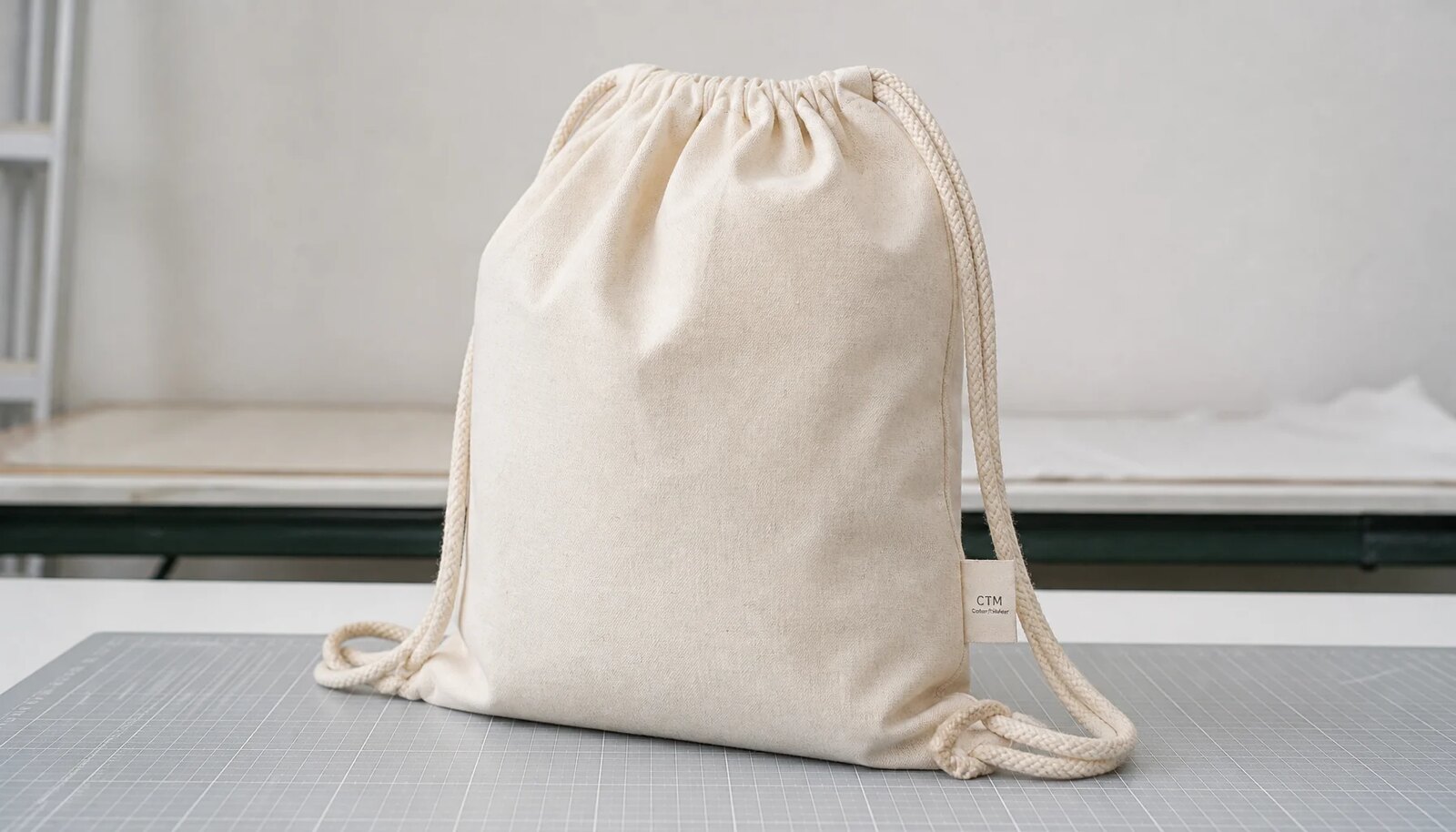
Start With the Hotel Retail Use Case
A strong RFQ starts with the job the bag must do, not with the generic phrase “cotton drawstring backpack.” A resort gift-shop item, spa retail item, conference counter product, and multi-property souvenir program may all use similar construction, but they do not require the same fabric, branding, packing, or replenishment plan.
Give suppliers a short use-case statement. For example: “Retail cotton drawstring backpack for coastal resort gift shop, natural cotton body, one-color front logo, individual barcode packing, expected to carry towel, sunscreen, bottle, and small purchases.” This tells the factory how to think about GSM, seam strength, cord comfort, decoration, and shelf presentation.
If the bag is expected to carry weight, describe it as a practical design target unless you are commissioning formal testing. Many buyers use a starting point such as 1-2 kg for light amenity use or 2-4 kg for sturdier retail use, then ask the supplier how the construction supports that target.
- State the channel: resort shop, boutique retail wall, spa shop, conference counter, amenity desk, or group merchandise program.
- State whether the bag is a standalone SKU, bundled item, guest amenity, or event product.
- Describe the brand style: bold souvenir logo, tonal boutique mark, woven side label, patch, or minimal inside label.
- Share target launch date, destination market, and forecast reorder pattern if known.
Make the Product Measurable
Comparable quotes require measurable construction. At minimum, the RFQ should define finished size, fabric, top hem, drawcord channel, side seams, bottom corners, cord type, reinforcement, decoration, labels, and packing. Otherwise, one supplier may quote a light promotional bag while another quotes a sturdier retail item.
Use finished measurements after sewing and finishing, not cut panel dimensions. A practical day-bag range is often around 34 x 42 cm to 38 x 45 cm, but the right size depends on what guests will carry and how the bag should look on the shelf. If the hotel wants the bag to hold a folded towel, bottle, or purchases, test those items in the sample.
Put tolerances in writing before sampling. A common starting point for many retail drawstring backpacks is +/-1 cm on finished width and height, but this should be confirmed with the supplier and adjusted for the design. If thick rope or flat tape is used, also define drawcord channel width and tolerance.
- Specify finished size in centimeters and measurement method: flat, empty, after sewing and finishing.
- Define top hem depth and drawcord channel construction.
- State side seam and bottom construction: overlock, folded seam, lockstitch, double stitching, or other method.
- Identify stress-point reinforcement at cord exits, lower corners, and side seams.
- Ask for close-up sample photos of inside seams, cord exits, top channel, label placement, and bottom corners.
Choose GSM, Weave, Finish, and Shade Control
Fabric weight affects hand feel, shelf structure, cost, decoration behavior, and carton volume. Practical starting points are 180-220 gsm for light amenity or event use, 260-280 gsm for many retail-facing hotel programs, and 320-340 gsm for a heavier premium feel. These are not universal rules; the final choice should be confirmed through supplier samples and the hotel’s retail price position.
Weave matters as much as GSM. Plain weave, drill, twill, and canvas can all be cotton, but they print, drape, and sew differently. A tighter, smoother fabric usually supports cleaner print edges and better dimensional control. A looser natural cotton may look relaxed but can show more texture, slub variation, and print breakup.
Shade control should be addressed early. Natural cotton may vary from cream to beige by lot. Stock dyed black, navy, or seasonal colors can shift between sample and bulk. Custom dye adds lab dip approval, higher MOQ, and more lead time. Ask whether the fabric is natural, bleached, stock dyed, custom dyed, washed, pre-shrunk, steamed, or pressed after sewing.
- Quote one main fabric spec, then list alternates separately instead of mixing them in one price.
- Write target GSM and agreed tolerance into the PO when GSM is material to the buying decision.
- Keep an approved swatch or fabric test record with the master sample.
- For custom color, approve lab dip before a full pre-production sample.
- Ask how repeat-order shade continuity will be managed across hotel properties.
Specify Drawcords and Stress Points
The drawcord closes the bag and acts as the shoulder strap, so it is a functional trim rather than a minor detail. If it is underspecified, suppliers may quote very different materials and comfort levels. A thin cord can save cost but feel poor when loaded. A thick cotton rope can look natural but may fray if the ends are not finished well.
Common options include 5-7 mm cotton rope, braided polyester cord, blended cord, or 10-15 mm flat woven tape. Cotton rope supports a natural retail look. Polyester often pulls smoothly and resists fraying. Flat tape may improve shoulder comfort but requires a channel designed for its width.
The cord exit is one of the highest-stress areas. Confirm whether the cord exits through a side seam, stitched opening, reinforced tab, or eyelet. Eyelets can look clean, but they must not cut the fabric or create sharp edges. Reinforcement should appear in the master sample and inspection checklist.
- Specify cord material, diameter or width, shade, finished length, and shoulder-loop balance.
- Specify end finish: knot, sewn end, heat cut, aglet, metal tip, stopper, or no hardware.
- State whether plastic or metal hardware is allowed for the hotel brand and destination market.
- Require reinforcement at cord exits and lower stress points.
- Include a practical pull check or supplier’s internal standard in the QC plan.
Match Decoration to Artwork and Retail Position
Decoration determines whether the bag feels like hotel merchandise or a generic promotional item. Screen print, transfer, embroidery, woven label, patch, hangtag, and tonal branding can all work, but each has different cost, MOQ, lead-time, and quality risks.
Screen printing is often efficient for one or two spot colors, especially for repeat orders. Specify artwork size, color references, placement, and tolerance. For tight hotel marks, buyers may request +/-5 mm placement; for larger casual graphics, +/-10 mm may be acceptable if approved. The tolerance should match the artwork and supplier capability.
Transfers can help with many colors, gradients, seasonal graphics, or smaller quantities, but they should be approved physically on the actual cotton fabric. Check hand feel, edge halo, flexing, lifting, cracking, and rub transfer. Embroidery and woven labels can increase perceived value, but embroidery may pucker lighter cotton and labels may carry separate MOQ and setup fees.
- Record artwork file name, version, date, approved size, and color references.
- For screen print, check opacity, registration, edge sharpness, cure, and placement.
- For transfers, approve a physical sample and test flex, rub, and edge adhesion.
- For embroidery, confirm stitch count, backing, thread shade, and puckering risk.
- For woven labels, specify size, fold style, color count, placement, and sewing method.
Select the Supplier Route With Process Visibility
The lowest quote is not always the lowest-risk route. Procurement needs to know who controls fabric buying, cutting, sewing, decoration, labeling, packing, inspection, and export. A direct bag factory can be effective for repeat retail programs, especially when cutting, sewing, and decoration are controlled at the same site.
A trading company may be useful for mixed hotel merchandise programs, communication support, trim sourcing, or consolidated packing. The key risk is sample-to-bulk continuity. Ask for the named factory, production address, sample source, and inspection location. If the site changes after approval, require written approval or a new pre-production sample.
Stock blank plus local decoration can support urgent tests and lower volumes, but control over size, GSM, shade, label placement, and reorder continuity is weaker. If a stock blank is only a market test before custom production, state that clearly so it is not treated as the final production reference.
- Ask which steps are in-house and which are subcontracted.
- Identify who owns corrective action if defects are found after decoration or packing.
- Require written notice if factory, printer, embroiderer, or packing site changes.
- For stock blanks, confirm future availability, shade continuity, barcode limits, and label restrictions.
- For multi-property programs, confirm whether cartons can be packed by property, SKU, or PO.
Use a Quote Grid That Exposes Cost Drivers
A useful RFQ response format prevents suppliers from hiding differences inside one all-in number. Ask each supplier to price the same main specification and list exceptions line by line. If they recommend a cheaper alternate, it should appear as an alternate, not as if it meets the original spec.
Request tiered prices because hotel retail demand often changes after launch. A property may test 500 pieces, reorder 1,000, and later roll out 3,000-5,000 pieces. The same spec should be quoted at each tier using the same incoterm, currency, packing, and payment assumption.
Break out recurring unit cost from one-time charges. Screens, embroidery digitizing, transfer setup, woven label setup, hangtag artwork, barcode file handling, samples, testing, and custom cartons should not be buried. Also request carton dimensions, pieces per carton, net weight, gross weight, and quote validity so landed cost can be modeled.
- Copyable response fields: quantity tier, unit price, incoterm, currency, MOQ, lead time, sample cost, setup fees, packing, carton data, payment terms, and validity.
- Request prices at 500, 1,000, 3,000, and 5,000 pieces or your actual forecast tiers.
- Ask for MOQ by fabric color, print version, label version, hangtag version, barcode version, and packing version.
- Require exceptions for GSM, size, cord, decoration, packing, lead time, and inspection.
- Ask whether repeat-order pricing changes if artwork, fabric, and packing remain unchanged.
Control Samples Before Bulk Production
Sample approval should prove construction, decoration, and retail presentation, not only appearance in photos. Handle the sample, fill it with realistic contents, pull the cords, inspect the inside seams, rub the print, scan the barcode, and fold it into the proposed unit pack.
Use clear sample stages. A fabric swatch confirms material and shade. A lab dip confirms custom color. A print strike-off confirms ink, transfer, or embroidery on the chosen fabric. A prototype checks construction. A pre-production sample should represent bulk production, including final fabric, decoration, labels, hangtags, barcode, and packing.
The approved pre-production sample should become the retained master sample. Label it with supplier, factory, date, fabric spec, GSM, artwork version, print method, cord spec, packing method, and any approved deviations. If anything changes after approval, update the record.
- Measure finished width and height and record results.
- Compare fabric hand feel, shade, and GSM reference with the approved swatch.
- Check cord movement, loop balance, knot security, and stress-point reinforcement.
- Inspect print opacity, placement, edge quality, adhesion, and rub transfer.
- Scan barcode and confirm SKU data, country-of-origin wording, hangtag copy, and spelling.
- Photograph front, back, inside, cord exit, side seam, print close-up, label, packed unit, and carton mark.
Define Packing, Inspection, and Shipment Evidence
Packing is part of the retail product. A good cotton drawstring backpack can still fail at receiving if the barcode is unreadable, the fold crushes the logo, carton counts vary, or cartons are not marked by property. Define unit pack, fold method, barcode position, hangtag, insert, country-of-origin label, carton count, carton dimensions, and carton marks in the RFQ.
Inspection should be agreed before production. Many buyers use AQL-based final inspection, but the exact level, sample size, defect classifications, and acceptance rules must be written. The inspection should include carton sampling, finished measurement checks, seam and cord checks, print rub/crock checks, barcode scanning, packed-unit review, and comparison to the retained master sample.
Ask for shipment evidence before release. Useful records include packed-unit photos, master carton photos, carton mark photos, barcode scan confirmation, final inspection report, defect photos, rework evidence if needed, carton dimensions, gross weight, and packing list. This is especially important for multi-property rollouts where receiving teams may not know the product history.
- Define unit pack: bulk, polybag, paper band, kraft sleeve, hangtag only, or retail-ready barcode pack.
- Approve fold method so the logo, label, and barcode are not placed on damaging creases.
- Confirm suffocation warning, country-of-origin marking, SKU data, and warehouse compliance wording where required.
- Set carton quantity, maximum carton weight, carton dimensions, PO, SKU, color, destination, and carton numbering.
- Use retained master sample control for final inspection and reorders.
- Require scan checks for barcodes and visual checks for carton marks before shipment.
Specification comparison for buyers
| RFQ line item | What to request | MOQ impact | Cost or lead-time impact | Sample or inspection evidence |
|---|---|---|---|---|
| Fabric | Main quote for one named fabric, such as 270 gsm cotton drill, plus any alternates clearly separated | Custom dye, uncommon weave, or heavy canvas may raise MOQ by color | Higher GSM increases material cost, carton cube, and sometimes sewing time | Approved swatch, GSM tolerance in PO, shade range, and bulk fabric check |
| Finished size | Finished measurement after sewing, for example 36 x 43 cm, with agreed tolerance | Unusual sizes may reduce cutting efficiency or require new patterns | Larger panels increase fabric use and carton volume | Measured pre-production sample and inline/final size checks |
| Drawcord | Material, diameter or width, color, length, end finish, and reinforcement at exits | Custom cord color or hardware may have separate trim MOQ | Thicker rope, flat tape, aglets, or stoppers increase unit cost | Cord pull check, loop balance check, and close-up master sample photos |
| Decoration | Method, artwork size, color references, placement, tolerance, and setup fees | Multiple property logos may create MOQ per print version | Screen setup, embroidery digitizing, or transfers affect cost and schedule | Print strike-off, physical decorated sample, rub/crock check, placement check |
| Labels and retail trim | Woven label, care label, hangtag, barcode label, insert, and country-of-origin marking | Labels and hangtags often have separate MOQs or setup charges | Custom trims add approval steps and can delay samples | Approved label artwork, scan test, spelling check, and trim placement check |
| Packing | Fold method, unit pack, barcode position, carton count, carton marks, and carton dimensions | Different packing by property or SKU can split production lots | Individual packing adds labor, material, carton cube, and receiving control | Packed-unit approval, carton drop/handling review if required, and carton mark photos |
| Commercial terms | Tiered pricing at 500, 1,000, 3,000, and 5,000 pieces using same spec and incoterm | Price may change sharply at fabric, print, or trim MOQ breaks | Lead time depends on fabric sourcing, decoration, packing, and approvals | Quote grid with validity, payment terms, sample cost, setup fees, and production days |
| Inspection plan | AQL level, defect classification, carton sampling, retained master sample, and rework rules | Stricter inspection can affect factory process control and timing | Third-party inspection, testing, or reinspection adds cost | AQL report, defect photos, barcode scan record, pull test notes, and retained sample control |
Buyer checklist before sampling
- Define the hotel retail use: gift-shop SKU, resort amenity, spa item, conference retail item, or multi-property merchandise program.
- State expected contents and practical load target, such as light 1-2 kg use or sturdier 2-4 kg use, without presenting it as a certified claim unless tested.
- Specify finished size after sewing and finishing, not cut panel size.
- Use practical starting tolerances only after supplier confirmation, such as +/-1 cm for finished width and height.
- Name fabric type, weave, color, target GSM, and GSM tolerance, commonly discussed around +/-5% when supported by supplier control.
- Define drawcord material, diameter or width, shade, length, end treatment, and reinforcement at cord exits.
- Lock decoration method, artwork file version, print size, color references, placement, and placement tolerance before sampling.
- Separate MOQ by bag color, print version, label version, hangtag version, barcode version, and packing version.
- Request tiered prices at realistic quantities using the same spec, incoterm, currency, and packing.
- Break out setup fees: screens, transfers, embroidery digitizing, label setup, barcode handling, hangtag setup, sample fee, and custom carton charges.
Factory quote questions to send
- What exact cotton fabric, weave, finish, target GSM, and GSM tolerance are included in your quote?
- Is the fabric natural, bleached, stock dyed, custom dyed, washed, pre-shrunk, steamed, or pressed after sewing?
- Can you provide a swatch, lab dip, or cut-panel sample before the pre-production sample if shade or hand feel is important?
- What finished size and tolerance are you quoting for width, height, and drawcord channel width?
- What seam construction is included: overlock, lockstitch, folded seam, double stitching, bar tack, reinforced tab, or eyelet?
- What drawcord material, diameter or width, color, length, end finishing, knot, stopper, or tip is included in the unit price?
- What internal pull or load checks do you perform on cord exits, shoulder loops, side seams, and bottom corners?
- Is decoration handled in-house? If not, who controls the printer, embroiderer, label maker, or packing site?
- Which decoration method do you recommend for this artwork and fabric, and why?
- What print placement tolerance can you hold in bulk, such as +/-5 mm or +/-10 mm from the approved sample position?
Quality-control points to confirm
- Use a written inspection plan before production, commonly general inspection level II with an agreed AQL unless the buyer specifies another standard.
- Classify defects before inspection: critical defects may include unsafe hardware, wrong barcode, or prohibited labeling; major defects may include open seams, wrong size outside tolerance, failed cord exits, poor print adhesion, or wrong artwork; minor defects may include small loose threads or slight cosmetic variation within limits.
- Select cartons across the shipment, not only from the top of one pallet; record carton numbers, SKU, color, and quantity sampled.
- Measure finished width and height flat after sewing and finishing against the PO tolerance, using the retained master sample as the visual reference.
- Check fabric GSM against the approved swatch or test report when GSM is a buying requirement; confirm the tolerance was agreed before inspection.
- Compare fabric shade, texture, slubs, specks, and hand feel under consistent lighting, especially for natural cotton where lot variation should be pre-approved.
- Inspect for holes, oil marks, stains, weaving faults, dye streaks, heavy slubs outside the approved character, and panel-to-panel shade mismatch.
- Check seams for skipped stitches, broken thread, loose thread, raw edges, open seams, puckering, crooked stitching, and weak top hems.
- Perform a practical pull check on drawcord exits and shoulder loops using the agreed buyer or supplier method; record force, duration, or repeated pulls if a formal method is set.
- Fill a sample bag with the agreed practical load and check side seams, lower corners, cord movement, and shoulder-loop balance after handling.