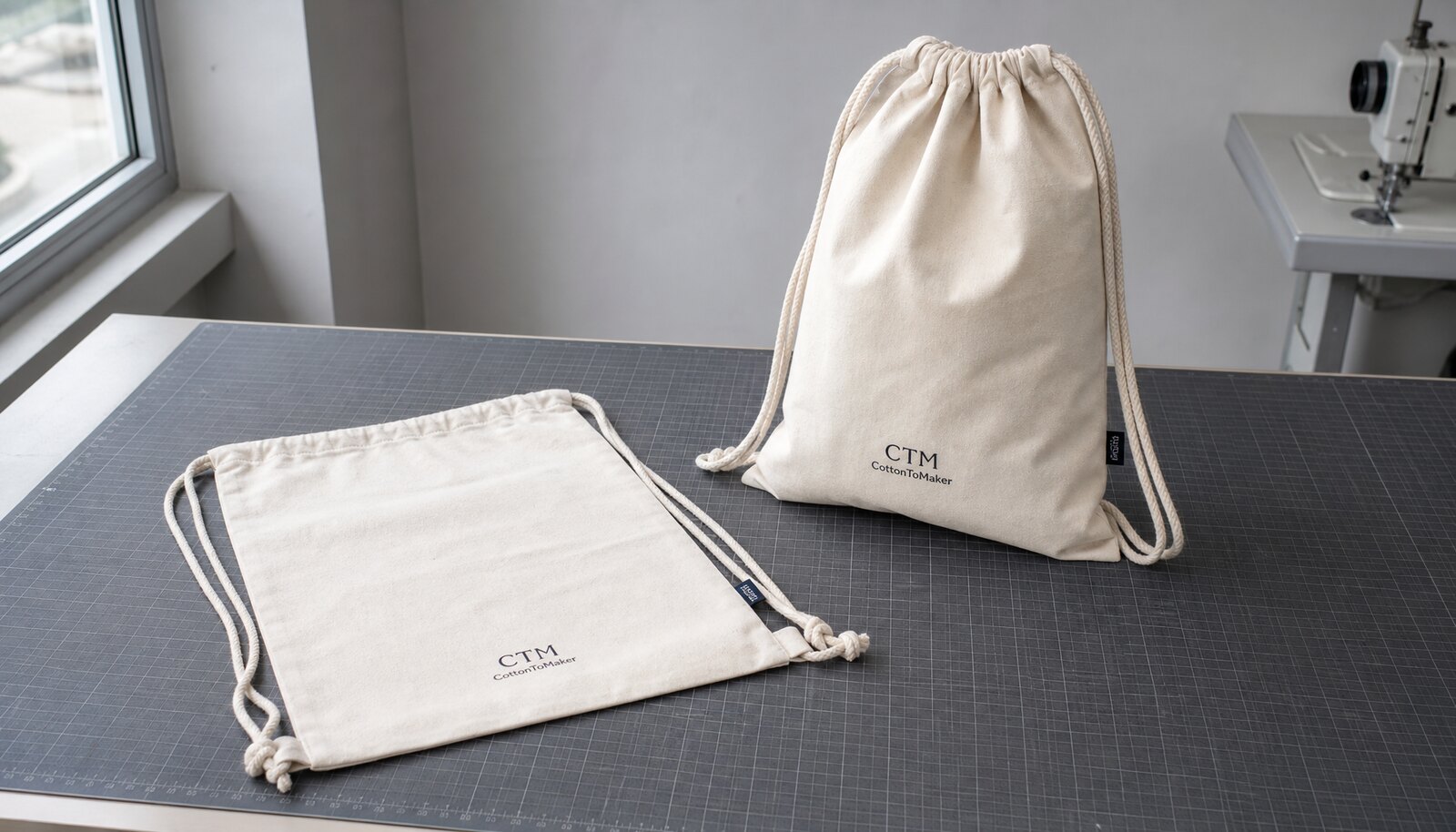
Why gift-shop buyers get weak quotes on cotton drawstring backpacks
Gift-shop procurement teams often receive quotes that look comparable at first glance, yet each supplier is pricing a different backpack. One quote may assume 120 GSM fabric, a loose weave, and a basic one-color print. Another may assume 160 GSM canvas, reinforced tunnel stitching, and a woven side label. The unit price spread looks dramatic, but the real issue is that the bags are not the same product.
That is why cotton drawstring backpacks for gift shops need a tighter RFQ than a standard promotional-bag order. The bag has to look clean on a hook or shelf, open and close smoothly for shoppers, and survive repeated handling without the cords cutting into the fabric or the print looking worn before it reaches the sales floor. If the RFQ does not define those expectations, the factory will fill in the blanks with its own assumptions.
A stronger procurement brief does not just ask for a cotton drawstring backpack. It tells the supplier what kind of cotton, what construction quality, what print finish, what packing format, and what delivery date the buyer is actually trying to buy. That gives procurement a comparable set of quotes and reduces the chance of revising the order after sampling.
- Different assumptions about GSM, stitch count, label build, and packing can make quotes look cheaper or more expensive than they really are.
- Gift-shop bags need a cleaner retail presentation than plain event giveaways.
- The procurement goal is to force every supplier to price the same product, not their preferred version of it.
Build the buying spec before asking for a price
For most retail gift-shop programs, a practical fabric range is 140–160 GSM cotton twill or medium canvas. That range usually balances shelf presence, print clarity, and cost. Below it, the bag can feel thin, show seam shadows, and wrinkle more aggressively. Above it, the bag may become too stiff, more expensive to sew, and less attractive for lightweight souvenir sets unless a premium look is part of the brand plan.
The RFQ should also state the finished size in measurable terms. Use width, height, and any gusset or bottom depth, and include the tolerance. If the bag is intended to hold boxed gifts, brochures, mugs, or folded apparel, the supplier should be quoting a bag that can cope with real in-store use, not just an empty sample on a table. A note like “standard backpack size” does not give a factory enough information to build a repeatable product.
Cotton behavior matters too. Raw cotton can shrink, distort, or relax after sewing depending on how it was stored and processed. If the buyer needs consistent retail presentation, ask for a controlled shrinkage spec or a pre-shrunk fabric route. That matters when the bag sits with printed logos, labels, and hanging displays that must line up after production.
- State fabric type by name: cotton twill, cotton canvas, or cotton blend; do not rely on the word “cotton” alone.
- Specify a GSM target with a tolerance band, especially if hand feel and print opacity matter.
- Define finished size and whether it is measured flat, stuffed, or from seam to seam.
- Clarify if shrinkage control is required before bulk is approved.
The RFQ template buyers can copy and send
A useful RFQ reads like a purchase instruction, not a product wish list. Use the template below as the base brief for cotton drawstring backpacks for gift shops. Keep the wording short, measurable, and easy for the supplier to quote.
Fill in every bracket before sending the RFQ. If a field is truly optional, mark it as optional so the supplier does not guess. The best RFQs make the minimum acceptable spec clear, then list any acceptable alternates separately.
Use the same template version for every supplier so price differences reflect actual manufacturing assumptions instead of incomplete instructions.
- Keep the template short enough that sales teams can answer it without rewriting it.
- Attach artwork, size sketch, and carton label artwork as separate files.
- State any optional upgrades so the base quote stays clean.
Worked example: a completed RFQ spec for a gift shop order
The sample spec below shows how a buyer can turn the template into a ready-to-quote brief. It is intentionally practical, not premium or low-end by default. The goal is to create a repeatable retail bag with enough structure for award decisions.
Example specifications are most useful when they include the pieces that usually get skipped in a first email: exact dimensions, fabric build, logo method, and packing. They also show the supplier what “acceptable” looks like before the first sample is sewn.
Use this example as a starting point, then adjust it to the bag size, brand style, and destination market you need.
- This style of spec is detailed enough for a factory to quote without guessing.
- If the buyer needs premium retail packaging, add hangtags or tissue as separate lines.
- If the buyer wants lower cost, reduce the print area or simplify the label build before reducing fabric quality.
How price is built: the drivers buyers should compare before award
Unit price on cotton drawstring backpacks is usually driven by a small number of variables. Fabric weight is one of the biggest, followed by print complexity, cord type, label construction, packing method, and order quantity. A 140 GSM bag with no label and simple folding can price very differently from a 160 GSM bag with a woven label and retail inner pack, even if both look like “the same backpack” in an email thread.
MOQ matters because setup and cutting efficiency are spread across the run. Screen printing generally carries a setup charge, and embroidery or woven labels may add tooling or minimums. If the buyer wants the same artwork across multiple colors or store programs, ask whether MOQ applies by color, by artwork version, or by package version. That avoids accidental under-ordering and re-quote surprises later.
Lead time is usually tied to whether the factory has stock fabric and stock cords or must source them fresh. Fast quotes can hide long material lead times, especially when the fabric is a specific shade or pre-shrunk route. Packaging also affects cost: a flat-fold bag in a simple carton is easier to ship than a retail inner pack with barcode labels and polybag inserts.
For landed-cost comparison, quote the same Incoterm across suppliers. FOB is usually easier for comparing factory prices, while CIF or DDP can be useful when the buyer wants a landed view. Just do not compare an FOB quote against a delivered quote without normalizing freight, insurance, and import charges first.
- Ask for a line-item breakdown or at least identify what is included in the unit price.
- Check whether MOQ is by total order, color, artwork version, or packing version.
- Separate one-time setup charges from repeat unit cost.
- Use the same Incoterm across suppliers before making a decision.
Supplier comparison framework for award decisions
A good comparison framework shows which supplier is the best commercial fit, not just the cheapest. Start by forcing every quote onto the same spec version, then score what actually matters for a gift-shop program: compliance with spec, sampling speed, production capability, packaging accuracy, commercial terms, and communication quality. If a supplier cannot quote cleanly, that is a signal about future execution as well.
One practical way to compare suppliers is to score them in five buckets: price realism, spec match, QC confidence, lead-time credibility, and supply-chain transparency. Price realism is not the lowest price; it is the price that clearly reflects the spec you asked for. Spec match is whether the quote includes the right fabric, print, label, and packing. QC confidence comes from the factory’s measurable acceptance standard, not a vague promise of “good quality.”
Lead-time credibility should be judged against the quoted production plan. A supplier that gives a firm sample date, material booking plan, and ex-factory target is usually easier to manage than one that only says “ASAP.” Supply-chain transparency matters because procurement needs to know whether the work is done in-house or split across multiple subcontractors. The more handoffs, the more the buyer should inspect the process.
- Award the order on the same assumptions, not on the friendliest email thread.
- If a supplier is cheaper, find out what they removed before accepting the price.
- Use a simple scorecard and keep it with the RFQ file for future reorders.
Sampling, approvals, and the point where production becomes locked
A photo or render is useful for alignment, but bulk approval should be based on a real-material pre-production sample. The sample should use final fabric, final cord, final print method, final label, and final seam construction. If the sample is built from substitute materials, the buyer is approving the wrong product.
During sample review, measure the bag, open and close it repeatedly, inspect the tunnel ends, and check the print placement against the artwork sheet. If the bag will be displayed on hooks or in bins, test whether it still looks neat after being folded the way store staff will receive it. That matters because many retail complaints are not about the logo; they are about the bag looking sloppy in display.
Once the sample is approved, lock the reference. Keep a sealed golden sample or a documented photo pack with size measurements, fabric notes, print placement, and acceptable tolerance. Any later change to fabric weight, cord length, print area, or packing should be treated as a revision, not as an assumed improvement.
- Require a real-material pre-production sample before bulk cut approval.
- Record size, cord length, print position, and label placement on the sample sheet.
- Keep a sealed golden sample or a digitally controlled reference set.
- Treat any later change as a written spec revision.
QC and acceptance standard: use measurable thresholds, not general promises
For gift-shop bags, inspection should focus on the defects that customers will see and the failures that shorten retail life. A useful standard combines AQL with clear defect definitions and simple measurable checks. AQL alone is not enough if the buyer never defines what counts as critical, major, or minor.
Set measurement tolerance first. A practical starting point for many retail programs is ±10 mm on finished width and height, with tighter control if the bag must fit a display fixture or a gift box. For print, specify acceptable shift from the approved placement and define obvious visual failures such as bleeding, smudging, missing ink, or color mismatch under normal light. For stitching, set an expectation that there are no skipped stitches, loose ends longer than the trim standard, or open seams at the tunnel or side gusset.
For destination-market compliance, add the specific labels or tests that matter. EU and UK buyers commonly need fiber content and care labeling to be correct, and some programs also require REACH-related chemical awareness or supplier test evidence depending on the material and ink system. US buyers often focus on fiber content accuracy, country-of-origin marking, and any retailer-specific chemical restrictions. The RFQ should not list every regulation in the world; it should name the rules relevant to the target market and the buyer’s own retailer requirements.
A simple acceptance line in the RFQ helps avoid disputes later: “Goods must match approved sample, remain within stated measurement tolerance, have no open seams, no broken bar-tacks, no obvious print defects, and no carton damage on receipt.” That is easier to enforce than a broad statement such as “quality must be good.”
- Use both AQL and defect definitions.
- Set a measurement tolerance for bag size and print placement.
- Require no open seams, no broken bar-tacks, and no obvious print defects.
- Name only the destination-market compliance items that actually apply.
Packing, freight, Incoterms, and sample-charge guidance
Packing changes cost, handling time, and damage risk. For cotton drawstring backpacks for gift shops, inner packing by color or SKU is usually worth the small added cost because it helps warehouse teams receive and allocate quickly. If the order is for multiple store locations, clear carton marks and barcode labels reduce sort time and reduce the chance of mixed SKU cartons.
Use the RFQ to make freight assumptions explicit. Ask for an FOB quote at the departure port and, if useful, a landed estimate under CIF or DDP for budget planning. If the supplier only quotes ex-factory, procurement still needs the freight assumptions to compare total cost. That is especially important when the bag price is low but packing volume is high.
Sample charges should be stated up front. A practical RFQ asks whether a pre-production sample is chargeable, whether the charge is refundable against bulk order, and who pays courier cost. Some factories will offer one sample free and charge only express freight; others will bill a sample fee for a fully made prototype. Buyers should compare sample policies because they affect both the timeline and the hidden sourcing cost.
For lead time, a realistic range for a stocked-fabric, simple-printed program is often about 30–45 days after sample approval and deposit, while custom fabric, multiple artwork changes, or more complex packing can extend that to roughly 45–60 days or more. If the order is seasonal, build in a buffer and ask the supplier to identify the longest-lead component. That is usually fabric booking, label production, or artwork sign-off, not sewing itself.
- State whether you want FOB, CIF, or DDP so quotes are comparable.
- Ask for sample charge, courier cost, and whether sample fees are refundable.
- Confirm whether inner packs are required by color or SKU.
- Treat any lead-time quote as conditional on sample approval and material availability.
Compliance and market-specific checks buyers should not skip
Compliance for cotton drawstring backpacks is usually not complicated, but it is easy to miss the basics when the order is small. At minimum, the bag should carry accurate fiber content information where required, country-of-origin marking where required, and a label build that matches the destination market’s retail expectations. If the bag is sold as a textile accessory in a regulated market, the buyer should confirm whether the label content must be in a specific language.
For the EU and UK, buyers commonly check fiber-content labeling and any retailer-required chemical compliance documents tied to textile accessories, inks, or trims. For the US, check country-of-origin marking, fiber content accuracy, and any retailer-specific restricted-substance rules. If the bag will be sold through a national chain, the chain may have its own packaging and testing rules on top of statutory requirements. Those should be written into the RFQ so the factory quotes the full burden, not just the stitching.
The cleanest approach is to put compliance into the supplier brief as a simple line item: “Comply with destination-market labeling and retailer chemical requirements applicable to textile bags.” That keeps the RFQ useful without overloading it with irrelevant legal text. Then ask for any test reports or declarations the factory already has on file for the same fabric, print, or label system.
- Identify the destination market before award.
- Ask whether labels must be in a specific language.
- Request test reports or declarations where they already exist.
- Include retailer-specific requirements when the buyer has them.
Specification comparison for buyers
| Comparison point | Recommended spec range | Better for | Buyer checks before award |
|---|---|---|---|
| Fabric weight | 140–160 GSM cotton twill or medium canvas | Gift shops that want sturdier shelf presentation and a cleaner print surface | Ask for mill spec, GSM tolerance, and shrinkage control after washing or humidity exposure |
| Seam construction | 10–12 mm seam allowance at main seams; stress points bar-tacked | Programs that will see repeated handling, re-packing, or hanging display use | Request stitch-per-inch target, bar-tack length, and whether tunnel ends are double-stitched |
| Cord build | 5–7 mm cotton rope or cotton-poly cord; 55–70 cm finished length per side depending on bag height | Retail bags that need easy opening and a fuller visual look on shelf | Confirm cord diameter, cord end finish, eyelet reinforcement, and whether both cords are equal length after assembly |
| Print method | 1–2 color screen print for stable logos; heat transfer only for small pilot runs or complex art | Gift-shop programs with repeatable artwork and forecasted replenishment | Require print area in mm, registration tolerance, ink opacity standard, and wash/rub resistance expectations |
| Labeling | Woven side label or printed care label; optional hangtag if retail presentation matters | Branded retail lines and souvenir assortments | Specify label size, position, stitch type, and whether care content must meet the destination market |
| Packing | Inner pack by color/SKU; cartons with fixed count and declared dimensions | Importers and distributors receiving into stores or DCs | Ask for carton size, gross weight, carton mark format, and whether polybags or tissue are included |
| Sampling | Real-material pre-production sample plus sealed golden sample | Orders where artwork placement and finish matter to retail sell-through | Confirm sample lead time, sample cost, and who signs the final reference sample |
| Supply route | Direct factory for repeat programs; trading/consolidation only when volume is small or specs are still changing | Buyers balancing control, speed, and program maturity | Ask who owns cutting, sewing, printing, and final packing; request factory identity and audit evidence |
| Inspection standard | Inline + final inspection with AQL target stated in the RFQ | Buyers who need predictable defect levels on inbound goods | Require defect examples, acceptance criteria, and whether third-party inspection is allowed |
Buyer checklist before sampling
- Finished size in mm or cm, measured flat, with tolerance and gusset detail if used
- Fabric type, GSM, weave type, and whether the cloth is pre-shrunk or raw
- Seam allowance target, stitch density, and bar-tack reinforcement at drawstring stress points
- Cord material, diameter, finished length, knot or heat-seal finish, and eyelet reinforcement
- Print method, number of colors, Pantone or CMYK target, print area, and placement distance from top and side seams
- Label requirements: woven label, care label, side flag, barcode sticker, hangtag, or none
- Packing spec: units per inner pack, inner pack style, carton count, carton dimensions, gross weight target, and carton markings
- Approved sample sequence: artwork proof, pre-production sample, sealed golden sample, and first-article approval if needed
- Destination-market compliance needs, including fiber content labeling or chemical limits where relevant
- Required in-stock date, ex-factory date, and any seasonal launch or store reset deadline
Factory quote questions to send
- What exact fabric construction are you quoting, including weave, GSM, and tolerance range, and can you name the mill or fabric source?
- What seam allowance, stitch density, and bar-tack specification will you use on the main body and drawstring tunnel?
- What cord diameter and finished length are included in the quote, and are the cord ends knotted, heat sealed, or stitched?
- Is the print method screen print, heat transfer, embroidery, woven patch, or sewn label, and what is the setup charge for each option?
- What is the minimum order quantity by color, by artwork version, and by packaging version, not just total units?
- Can you provide a real-material pre-production sample before bulk production, and what is the sample cost and lead time?
- What carton dimensions, gross weight, and units per carton are assumed in the quote?
- Which production steps are in-house and which are outsourced, including fabric weaving or sourcing, cutting, printing, sewing, labeling, and packing?
- What QC standard do you use for measurement tolerance, seam strength, print registration, and carton condition, and what AQL is applied at final inspection?
- What documents can you provide for sourcing diligence: factory profile, business license, audit report, social compliance summary, material certificates, or test reports?
Quality-control points to confirm
- Fabric weight is verified against the approved spec and should not feel visibly thinner or looser than the golden sample
- Finished dimensions should stay within the agreed tolerance; measure at least width and height on a flat bag and note any twist or asymmetry
- Seam allowance should match the approved target, with no exposed raw edges at stress zones and no broken or skipped stitches
- Bar-tacks or reinforced stitches at drawstring openings should be even, secure, and free of thread ends longer than the agreed trim standard
- Cord diameter and length should match the approved sample closely enough that both sides hang evenly and the bag closes smoothly
- Print should be centered within the approved tolerance, with no ghosting, pinholes, bleeding, cracking, or color shift under normal light
- Rub resistance and handling check: light dry rubbing should not create obvious ink transfer or flaking on the print area
- Eyelets or tunnel openings should not distort, tear, or pucker when the cords are pulled several times to simulate retail handling
- Labels should be correctly placed, legible, and stitched cleanly; care or fiber content labels should match the destination-market requirements
- Carton counts should match the packing list, with no mixed SKU cartons unless explicitly approved