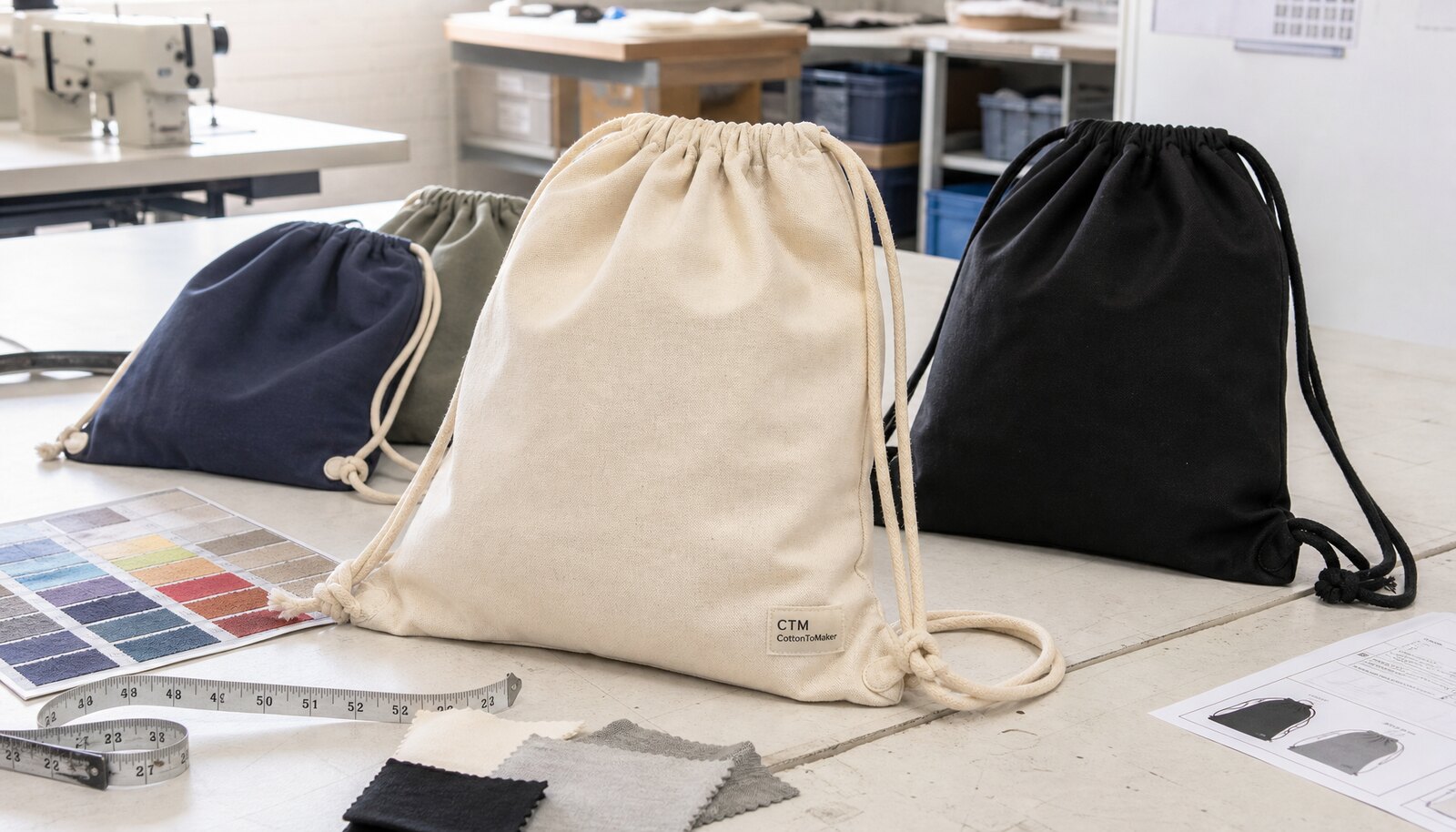
1. Start with the retail job the bag has to do
For gift shops, cotton drawstring backpacks are not just commodity carriers. They are display items, souvenir packaging, and often low-ticket brand extensions at the same time. The material choice should therefore be linked to how the bag will sit on a shelf, what it needs to carry, and how much of the retail price is being justified by its appearance in a customer’s hand. If the bag looks weak when empty, it will usually read as underpriced even when the artwork is attractive.
The fastest way to avoid buying the wrong bag is to segment the request by use case before asking for prices. A museum store usually needs a cleaner surface, calmer branding, and a more refined hand-feel. A children’s shop may accept simpler cloth if the bag is lightweight and the graphics are bright and durable. A destination retail store in a heritage site or park often wants natural cotton that reads as a keepsake rather than a promo item. If those are combined into one vague brief, suppliers will quote to the lowest common denominator and you lose leverage over the specs that matter.
A practical procurement brief should answer three questions up front: what is the selling price band, what is the likely fill weight, and what kind of customer will touch the bag before buying it? A lower-price bag can tolerate lighter fabric and simpler finishing. A bag positioned above the impulse range needs stronger body, cleaner seams, and a decoration method that still looks like retail merchandise rather than a giveaway. In practice, the retail story drives the material more than the logo does.
There is also a channel difference that buyers sometimes miss. A store that hangs bags on hooks needs a face that looks neat from a distance, while a table-display program needs a bag that holds shape even when partially folded. The same backpack can work in both channels, but not with the same fabric weight, fold style, and pack format. Build the brief around the display environment, not only the product itself.
- Segment the program by store type before sourcing: museum, souvenir, children’s, lifestyle, or branded merch.
- Define the customer’s hand interaction: hanging display only, counter pickup, or repeated customer use.
- Match the bag to the target shelf price, not to the supplier’s standard template.
2. Use fabric weight as the first commercial filter
When buyers search for cotton drawstring backpacks for gift shops material selection guide, the most common error is treating cotton as one generic material. In reality, GSM is the decision that changes both the quote and the shelf effect. A 140–160 GSM cotton is usually a sensible entry point when you need a competitive landed cost and the bag will carry only light souvenirs or folded brochures. It keeps the product accessible, but it may not hold a crisp shape if the bag is oversized or printed with a heavy graphic.
Move to 180–200 GSM if the bag needs to feel like merchandise rather than packaging. This range tends to be the safest all-round choice for most gift-shop buyers because it gives enough body for a visible shelf silhouette without pushing sewing difficulty too high. The bag hangs more cleanly, folds more predictably, and is less likely to look limp after being handled by shoppers or staff. For replenishment programs, it also gives the buyer a little more tolerance if there is small lot-to-lot variation.
At 200–220 GSM, the bag starts to behave like a premium retail accessory. It usually looks better in destination shops, branded gift programs, and higher price bands where the customer expects a denser cloth and cleaner drape. The tradeoff is not just cost. Heavier fabric can require tighter control over seam allowances, needle selection, and drawcord tunnel construction. If the supplier is under-equipped, the bag may still pass a visual approval but fail at repeat use or create needle-hole stress around the seams.
The useful procurement rule is to choose the lightest fabric that still supports the selling story. If the bag carries only flat souvenirs, do not pay for extra body you do not need. If it is sold as a keepsake or branded retail item, a heavier cloth can be cheaper in commercial terms because it reduces the risk of a product that feels weak when it lands in the store. Buyers should also ask whether the GSM is measured on raw fabric or after finishing, because the same number can hide a meaningful difference in real-world hand-feel and size stability.
One caveat: shrinkage claims are often presented too casually. Cotton will usually change after washing, finishing, or steam treatment, but the amount depends on yarn type, weave, finishing route, and even how the bags are packed and stored before sale. Rather than rely on supplier shorthand, ask for a tested range and the conditions under which it was measured.
- 140–160 GSM: cost-conscious, light hand-feel, best for lower-load or higher-volume gift programs.
- 180–200 GSM: balanced retail choice with better body and better perceived value.
- 200–220 GSM: premium-feel option with stronger shelf presence and usually higher sewing sensitivity.
- Confirm whether the quoted GSM is on finished fabric or raw fabric; the same number can hide a meaningful difference.
3. Match cotton type, weave, and shade control to print clarity
Cotton type matters because the same weight can behave differently on the sewing line and at the print station. Combed cotton usually gives a cleaner surface and more consistent hand-feel, which helps if the bag carries a centered logo, a small emblem, or fine-line text. Standard yarn or greige cotton can still work well, but the surface may be less uniform. That is acceptable for many gift-shop programs if the product story is natural and price-sensitive. It becomes a problem when the visual target is premium and the artwork has tight edges or small typography.
The weave should be specified with enough detail to control print and seam behavior. A tight plain weave is usually the best choice because it gives a more predictable print panel and reduces the risk of pinholes or distortion around the cord channel. A looser weave can create a softer, more rustic aesthetic, but the buyer should expect more visible variation on the surface, a higher chance of edge fray, and less definition in logos. That is not automatically wrong; it just needs to fit the store concept and the retail price.
Natural color also deserves more discipline than many briefs give it. Teams often write “natural cotton” and stop there, but the acceptable shade band should be written down. A slightly warm or slightly grey natural tone may be fine if the whole order is from the same lot. Trouble starts when the supplier mixes lots and the front-facing retail wall shows visible tone variation. If you want repeat replenishment, ask for a retained control swatch and a lot-matching rule, not just a color name.
For buyers seeking a quiet premium look, the best result is often a clean, medium-weight combed cotton in a tight plain weave with a restrained print or woven label. That combination usually looks more expensive than a lower-cost bag with a bigger logo and a weaker cloth. If the bag is part of a heritage or museum assortment, a more subdued cloth can also leave room for the retail site’s own branding to sit alongside the product rather than compete with it.
- Specify combed vs standard yarn cotton, not just “100% cotton.”
- Use tight plain weave when print clarity and seam stability matter.
- Agree a natural-shade control swatch if the product will be replenished over multiple lots.
4. Build the spec around size, load, and display format
The bag’s actual use case should shape the size and the fabric decision together. A small 25 x 30 cm backpack works well for compact souvenirs, cards, and lightweight gift items, especially when shelf space is limited and the bag must look neat when hanging. The commercial risk is that the bag can look too small for a premium price point if the store expects a more substantial souvenir feel. Buyers should not choose this size just because it is cheap to make.
A 30 x 40 cm bag is the most flexible option for most gift shops. It tends to sit in the sweet spot between cost, display presence, and practical utility. For many programs, this is the best base size because it suits a broad range of souvenirs and allows decent branding without making the product look like a school supply. It also makes quote comparison easier because many factories can produce this size without major tooling or process changes.
A 35 x 45 cm bag is more appropriate when the customer expects a larger accessory or when the retailer wants the product to stand out on a wall display. It can look more premium, but only if the fabric weight and print size are scaled correctly. A heavy graphic on an oversized but thin bag often looks worse than a small emblem on a dense cloth. The buyer needs to think in terms of proportion: size, fabric body, print area, and shelf position should all support one another.
If you know the maximum loading expectation, put it in the brief. A light souvenir bag does not need the same seam reserve as a bag intended to carry books, catalogs, or a folded sweatshirt. This matters because suppliers will often quote the same construction across many orders unless the buyer explicitly asks for reinforcement where it is needed. For retailers with mixed assortments, it can be smart to keep one base size but specify two fabric options: a lighter version for impulse items and a heavier one for premium corners or flagship stores.
- Small format: 25 x 30 cm for impulse items and compact souvenirs.
- General retail format: 30 x 40 cm for the widest commercial use.
- Large format: 35 x 45 cm when shelf presence and perceived value matter more.
- State the intended load so seam and tunnel construction can be matched to use.
5. Compare supplier quotes on the same basis, not the lowest headline price
For procurement teams, quote normalization is one of the most important parts of buying cotton drawstring backpacks for gift shops. A low unit price is not meaningful if the supplier is quoting a lighter fabric, omitting packing, or assuming a print method that will not match the approved sample. The quote should be read as a complete system: fabric, cord, stitching, print, labels, packing, and freight impact all belong in the comparison.
Ask each supplier to quote the same reference spec. That means the same finished size, same GSM, same color basis, same print colors, same label position, same cord type, and same pack count. If one factory quotes a stock natural cloth while another is quoting dyed fabric or a brushed finish, the unit prices cannot be compared directly. The same applies to packing. A bulk-packed carton and an individually bagged retail pack can have very different freight implications even if the ex-works price looks close.
A useful buyer rule is to compare three numbers, not one: first-order price, repeat-order price, and landed-cost impact. First-order price captures setup and artwork charges. Repeat-order price shows whether the supplier can support replenishment without large penalties. Landed-cost impact includes carton volume, pack count, and any extra handling. This is where a seemingly cheap quote can become the more expensive choice, especially if the carton count is inefficient or the pack format adds unnecessary cubic volume.
It also helps to ask for a stepped quote. For example, request pricing at 1,000, 3,000, and 5,000 pieces, with the same spec. That makes it easier to see whether the supplier is pricing the job honestly or simply loading the first tier with setup overhead. If the supplier refuses to separate setup from unit cost, you lose visibility into real repeat economics. Buyers should also ask whether artwork changes, label changes, or carton-print revisions trigger a new setup charge, because those fees can matter more than a small unit difference on a replenishment order.
- Normalize every quote to the same size, GSM, print colors, cord type, and pack format.
- Separate first-order setup cost from repeat-order unit cost.
- Compare carton volume and handling as part of landed cost, not as an afterthought.
- Ask for tiered pricing so you can see where the real break points are.
6. Choose branding and decoration that fit the store, not just the artwork
Print can make the bag look retail-ready, but it can also push it toward a promotional feel if the execution is too heavy. Screen printing is still the most practical route for many gift-shop programs because it handles simple logos, short text, and repeat orders with good consistency. If the artwork is stable and the volume is meaningful, screen print often gives the best balance of cost and durability. The key is curing and ink load: too much ink can leave a stiff patch that cracks at fold lines, while too little ink looks washed out on natural cotton.
Heat transfer or DTF has a place when the order is small, the design is complex, or the artwork changes often. The buyer should not assume it is lower risk simply because the setup is easier. On cotton, the hand-feel can become more layered and the edge can lift or crease if the bag is folded tightly in packing. A transfer may be acceptable for a short-run gift program, but it should always be tested in the actual carton fold, not just on a flat sample board. That matters more for retail than for a one-off sample.
Woven labels and side labels are useful when the customer wants a calmer, more premium product. They preserve the textile feel of the bag and reduce the risk of a large print dominating a small format. For some gift shops, a small side label or hem label is enough branding. That is often the better choice if the product is meant to sit alongside ceramics, stationery, or artisan goods rather than mass promotional items.
One practical rule: the more delicate the retail environment, the less aggressive the branding should be. A museum or design shop usually benefits from understatement. A family attraction or children’s retail outlet can support bolder graphics, but the print still needs to be durable enough to survive folding, handling, and the occasional wash. Buyers should ask for a strike-off on the actual cloth, not just a digital proof, because cotton texture can change the final look of thin lines and small text.
- Use screen print for stable repeat runs and simple artwork.
- Use transfers only when complexity or low volume justifies the hand-feel tradeoff.
- Use woven or side labels when the brand wants a quieter premium presentation.
- Always approve a strike-off on the actual cotton, not just a digital proof.
7. Construction details that separate a retail bag from a giveaway bag
The structure of the bag is as important as the cloth. A good-looking cotton drawstring backpack can still fail commercially if the construction is loose or inconsistent. The drawcord tunnel is the first place to inspect because it takes repeated friction. If the tunnel is too narrow for the cord diameter, the bag will feel sticky or uneven when opened. If it is too wide, the cord may sit sloppy and the top edge can lose shape. This matters in gift shops because the customer often judges the bag by how smoothly it opens in the aisle or at the counter.
Stitch quality matters most where the bag carries load. Side seams, bottom seams, and tunnel seams should be even and secure, with no skipped stitches or loose ends hanging out of load-bearing areas. For procurement, it is useful to ask the factory what stitch density they use on visible seams. A practical target for many cotton retail bags is around 7 to 9 stitches per inch on body seams, with slightly higher density on reinforced areas if the fabric and thread allow it. The exact number may change with cloth weight, but the buyer should not accept vague answers like “standard stitching.”
Needle-hole risk becomes more visible as fabric weight and print thickness increase. When the cloth is dense or the print layer is heavy, oversized needle holes can create puckering or weak points around the seam. That is why buyers should ask not only about seam appearance, but also about the needle size and thread spec used for the approved sample. If the factory changes either one during production, the seam can behave differently even if the bag looks the same at first glance. Some suppliers will call this a normal process variation, but for a retail bag it should still be controlled.
Bartacks or equivalent reinforcement should be mandatory at the top corners of the tunnel and other stress transitions. This is one of the easiest places for a buyer to define a pass/fail rule: no missing reinforcement, no loose thread bundles, and no visible tearing around the stress points. For a gift-shop program, you are not trying to over-engineer the product, but you do need enough structure that the bag does not feel fragile in the customer’s hand. If the bag is intended to be worn like a backpack, ask for a real load-use test instead of assuming the sample will hold up because it looks neat on a table.
- Ask for a stitch-density target, not just “good stitching.”
- Check the tunnel width against the actual cord diameter.
- Require bartacks or equivalent reinforcement at stress points.
- Watch for needle-hole puckering around seams and heavy print zones.
8. Sample approval: make the sample prove the production process
Sample approval is where many sourcing programs go wrong. A neat hand sample can look excellent while the bulk order turns out softer, thinner, or less consistent because the factory changed fabric or simplified the decoration route. For that reason, buyers should ask for a pre-production sample made with the same cloth, cord, print method, finish, and label construction that will be used in bulk. If the sample does not match production inputs, it is only a presentation sample.
The sample should be handled like a working product, not just photographed. Open and close the drawcord several times. Load it with a realistic item weight based on the store type. Fold it the way the retailer will fold or hang it. Then inspect whether the top line still sits straight, whether the cord cinches evenly, and whether the print wrinkles or cracks at the first fold. Those checks are more useful than simply looking at a polished image. If the bag is meant for a children’s shop, a light but frequent-use test matters; if it is meant for a museum store, the front-face appearance and print finish may matter more than heavy carry use.
It also helps to ask for sample photos from three stages: flat, open, and packed. Flat photos show print and alignment; open photos show shape and stitching; packed photos show whether carton folding will damage the product. If the supplier can only provide one flattering angle, the sample approval process is too shallow. A good factory should be able to show how the bag behaves as a finished retail unit, not just as a single piece on a table.
Keep one signed physical reference sample on file. That reference is important when you later need to resolve size disputes, print placement questions, cord differences, or packing complaints. It gives both sides a common point of comparison when the bulk shipment arrives. For replenishment programs, it is also worth keeping the approval photos with the PO so the next reorder is judged against the same visual standard.
- Use a pre-production sample that matches the exact bulk materials and processes.
- Test open/close action, folding behavior, and realistic loading.
- Request flat, open, and packed photos before sign-off.
- Retain one signed reference sample for production comparison.
9. QC thresholds and inspection rules procurement teams can actually use
Quality control should focus on the defects that matter commercially: weak seams, poor print, inconsistent size, cord function issues, and packing damage. You do not need an overcomplicated checklist, but you do need measurable thresholds. Start with size tolerance, shrinkage, stitch density, and pack count. Then add visual rules for print, stitching, stains, and cord function. If these are not written before production, the factory will use its own standard and you may end up debating what “acceptable” means after the goods ship.
A practical procurement standard for cotton retail bags includes a few concrete points. First, size should be measured after finishing, not before cutting, and the tolerance band should be written into the PO. Second, shrinkage should be controlled with an explicit limit; for many cotton bag programs, a band around 3% to 5% after the agreed finishing method is a sensible commercial ceiling, though premium programs may want tighter control. Third, the seam standard should be visible in stitch density. Buyers often ask for something in the range of 7 to 9 stitches per inch on body seams, and they should reject skipped stitches, loose thread knots, or open seam ends.
Print inspection should go beyond color visibility. Check alignment, coverage, edge sharpness, and durability after fold. A useful rule is to reject any print that cracks noticeably after a controlled fold test or leaves ink marks on adjacent fabric when rubbed. On a natural cotton bag, a little texture variation is normal; broken graphics and obvious smears are not. If the print sits too close to a seam or tunnel, be careful about needle-hole stress and edge lift after packing. For a store-facing product, a slightly soft print is usually preferable to a hard, plastic-looking print that fails at the fold line.
Inspection planning should use a sampling method instead of visual spot-checking only. Many buyers use an AQL approach for shipment inspection, often around 2.5 for major defects and 4.0 for minor defects, but the exact plan should be agreed with the supplier and aligned to lot size. The point is to make the pass/fail rule objective. If you are buying for several stores or a distributor network, that objectivity matters because one bad lot can create multiple small claims downstream.
For acceptance, define the non-negotiables in advance. A slightly soft hand-feel might be acceptable if the bag is otherwise in spec. A visibly lighter fabric, broken bartacks, off-center print, repeated cord jamming, or carton count errors should not be accepted. Procurement saves more money by rejecting the wrong defect than by chasing the lowest unit price.
- Set size, shrinkage, stitch, print, and pack requirements before production starts.
- Use a practical AQL sampling plan for shipment inspection.
- Reject obvious seam weakness, print cracking, cord jamming, and carton count errors.
- Keep the pass/fail rule objective so claims do not become subjective debates.
10. Packing, cartons, and shelf readiness: protect the first impression
Packing is not just logistics; it is part of the retail experience. Cotton wrinkles easily, so the way a bag is folded and carton-packed affects how it looks when opened. Bulk packing is usually the best choice for importers and distributors because it lowers freight volume and reduces unnecessary plastic. But the fold must be controlled so the print face is not creased too sharply and the tunnel area does not deform. If the bags arrive looking tired, the store staff will often blame the product even when the problem started in packing.
Individual polybags are useful when the store expects shelf-ready presentation, barcode protection, or a cleaner premium finish. They can also help with multi-store distribution where staff need a simple scan-and-place process. The tradeoff is more material, more labor, and more carton volume. Buyers should only pay that premium when the retail channel actually needs it. If the shop will repack the bag anyway, the individual bag may just add cost. For some buyers, a simple belly band or folded paper insert is enough to signal retail presentation without full polybagging, but that should still be discussed before production starts.
Carton planning should be based on folded dimensions and load stability. Ask the supplier for the carton size, inner pack count, and gross weight, and then check whether the folded product still looks neat after compression. If a carton is too tight, the fabric can come out with hard crease lines and the logo face may look tired before it ever reaches the shelf. If the carton is too loose, the goods can shift and create uneven packing damage. The best carton is the one that protects the bag without over-compressing it.
Barcode placement should also be discussed early. Some retail programs want a barcode on the polybag, some on the hangtag, and some on the outer carton only. If this detail is left until the end, the supplier may choose the easiest method for them rather than the easiest method for your warehouse or store team. For larger retail accounts, it is worth confirming whether the barcode needs to scan through the pack or whether it will be applied after unpacking.
- Use bulk packing for distributors and importers unless shelf-ready units are required.
- Use individual polybags only when the retail channel benefits from them.
- Check folded dimensions against carton size to avoid crease damage.
- Confirm barcode location, carton marks, and inner pack count before production.
Specification comparison for buyers
| Spec decision | Recommended option | When it fits | Procurement tradeoff / quality implication | Quote check to ask |
|---|---|---|---|---|
| Fabric weight | 140–160 GSM cotton | Entry-price gift shops, light souvenirs, children’s events, low load expectation | Lower cost and lighter freight, but weaker body, more visible wrinkles, and a higher chance of seam stress if the bag is overfilled | Is the GSM measured on finished fabric or raw cloth? Ask for the tolerance band and the test method. |
| Fabric weight | 180–200 GSM cotton | Most gift-shop retail programs that want a more substantial hand-feel | Balanced cost and shelf presence; usually the safest all-round choice for retail display and repeated handling | What shrinkage is assumed after finishing, and is the cloth pre-shrunk or finished to size? |
| Fabric weight | 200–220 GSM cotton | Premium museum shops, branded merch, higher price points, heavier perceived value | Stronger body and better shelf drape, but higher fabric cost and more sewing resistance at tunnels and seams | Does the factory need a different needle size, thread spec, or seam allowance for this cloth weight? |
| Cotton type | Combed cotton | When print clarity, cleaner surface, and a smoother retail feel matter | Slightly higher fabric cost, but better ink definition and fewer surface irregularities | Is the quote based on combed yarn fabric or standard yarn fabric? |
| Cotton type | Natural/greige cotton | Eco-led, artisanal, souvenir, and heritage retail positioning | Simple to source and usually quick to quote, but natural shade variation must be managed lot to lot | What is the acceptable shade range between lots, and can you hold a retained control swatch? |
| Weave | Tight plain weave | General retail and logo-heavy products | Most predictable for sewing and print, with less distortion and fewer pinholes | Can you share a close-up weave photo or construction detail, not just a product image? |
| Weave | Looser plain weave or lightly textured cloth | Only when a softer, more rustic look is intentional | Can suit artisanal positioning, but print sharpness and seam integrity are harder to control | How does the factory prevent pinholes, fraying, or tunnel stretch on this weave? |
| Cord type | Braided cotton cord | Most retail programs that want a natural textile look | Good hand-feel and presentation, but the cord can vary in thickness and friction if the supplier switches sources | What is the cord diameter, construction, and color fastness, and is it sourced from an approved supplier? |
| Cord type | Poly-cotton or polyester-cotton cord | Higher cycle count, heavier handling, or stronger glide needed | Usually smoother draw action and more consistent strength, but the look is less purely natural | Will cord material change the bag’s recycled or natural-positioning claim? |
Buyer checklist before sampling
- Define the selling channel first: museum store, souvenir shop, children’s retail, lifestyle store, or branded promo resale.
- Set the target retail price band before choosing GSM; the fabric should support the price, not just the artwork.
- Specify finished size, seam allowance, cord diameter, cord material, logo size, logo placement, and pack format in one brief.
- Ask for a production-matching pre-production sample using the same fabric, cord, print method, finish, and label construction.
- Normalize all supplier quotes to the same GSM, size, print colors, cord type, lining status, pack count, and carton spec before comparing.
- Require written tolerances for width, height, shrinkage, shade variation, and stitch density.
- Confirm carton count, barcode placement, hangtag needs, and ship marks before production release.
- Keep one signed reference sample and one photo record of the approved fold, print, cord action, and label placement.
Factory quote questions to send
- What is the exact fabric construction, including GSM tolerance, weave, yarn type, and whether the fabric is pre-shrunk or finished to size?
- What is the expected shrinkage after washing or steam finishing, and what tolerance do you allow on the finished size?
- Which print method is included in the quoted unit price, and what are the setup charges, color change fees, and repeat-order fees?
- What is your MOQ per size, per color, and per artwork, and what triggers a price break?
- Will you source the cord, labels, barcode stickers, and cartons in-house or from approved subcontractors?
- What is your stitch standard on load-bearing seams, and what needle size or thread spec do you use for this cloth weight?
- How will the bags be packed, what is the inner pack count, and what is the final carton size and gross weight?
- What pre-production sample will you send, and what inspection or test record can you provide at shipment?
Quality-control points to confirm
- Define the severity levels before inspection starts: critical defects that affect safety or function, major defects that affect retail acceptability, and minor defects that are cosmetic but not commercially material.
- Fabric GSM should match the approved range; set a practical acceptance band in the PO and reject obvious underweight cloth even if the supplier says it is within tolerance.
- Set a shrinkage limit in the PO. For many cotton retail bags, buyers use a practical ceiling around 3% to 5% after the agreed finishing method, but that should be tightened if the bag is premium or size-sensitive.
- Specify stitch density in measurable terms. A common procurement target is about 7 to 9 stitches per inch on visible body seams and slightly higher on reinforced tunnel areas if the fabric allows it.
- Require reinforcement at the top of the tunnel and any stress transition point; reject missing bartacks, loose thread bundles, or skipped stitches on load-bearing seams.
- Define print acceptance by both visual and physical behavior: no misregistration beyond the agreed tolerance, no pinholes, no obvious smearing, and no cracking after a controlled fold test.
- Add a rub and fold check for print adhesion. For a simple retail standard, inspect after 20 to 30 firm folds and one dry rub pass to see whether ink lifts, flakes, or transfers.
- Check cord friction by pulling the bag open and closed several times; the cord should slide without jamming, and both ends should cinch evenly.
- Set size tolerances before bulk starts. Reject bags that are visibly out of square, materially smaller than the approved sample, or inconsistent enough to affect shelf presentation.
- Inspect with a clear AQL plan rather than a casual glance. Many buyers use an AQL approach around 2.5 for major defects and 4.0 for minor defects, with the exact sampling table agreed in advance and aligned to lot size.