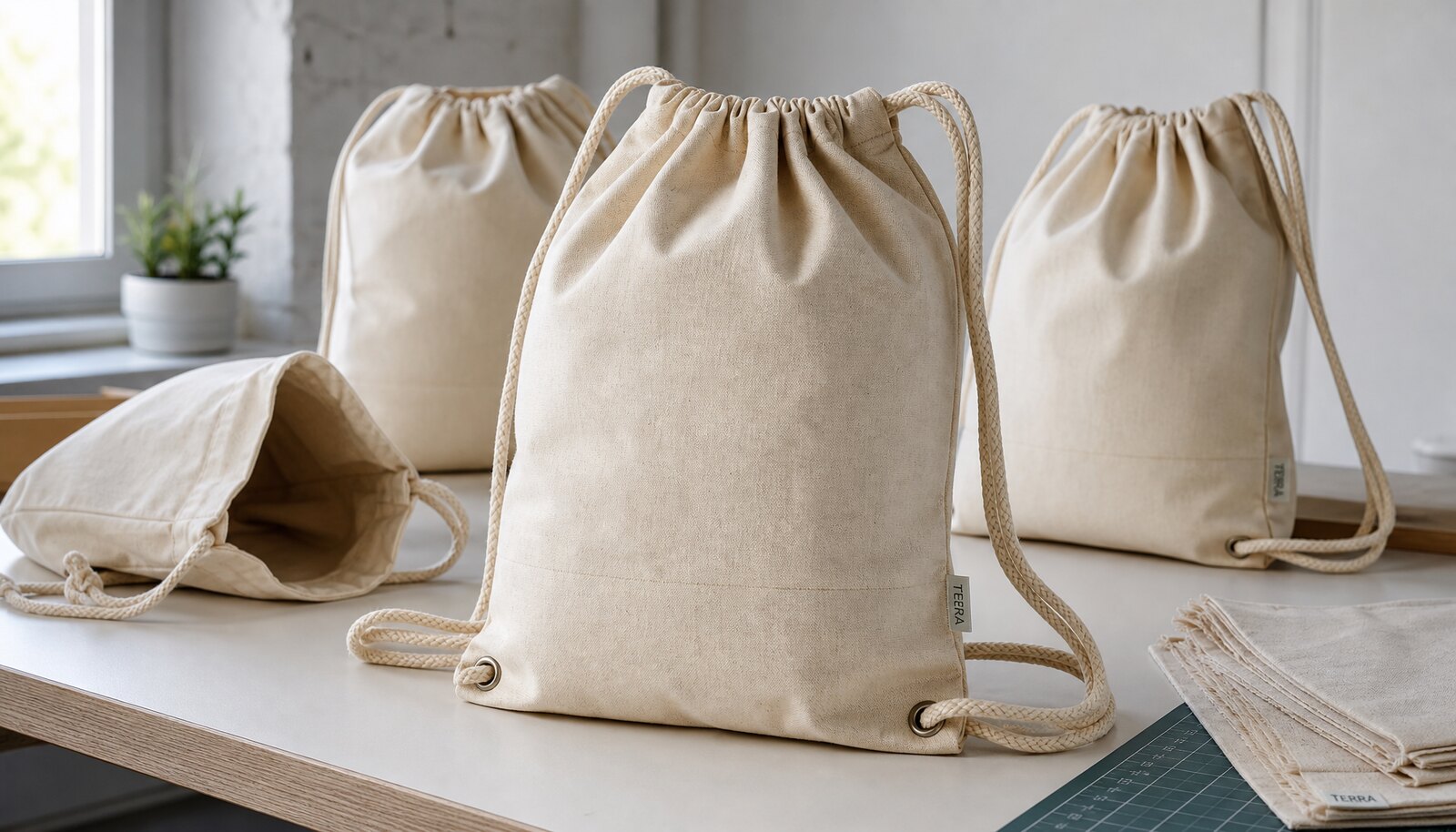
Why cotton drawstring backpacks for gift shops need a real lead-time plan
Cotton drawstring backpacks can look like a simple retail item, but lead-time risk usually comes from the parts buyers do not treat as schedule drivers. Fabric availability, decoration method, packing format, and approval discipline can move a quote from manageable to late very quickly. For gift shops, that matters because the bag is often tied to a tourism season, holiday assortment, museum store refresh, event opening, or gift-with-purchase program. If the shipment lands after the traffic window, the bag may still be usable, but the commercial value drops sharply.
A useful lead-time plan starts with the shelf date and works backward. The buyer needs room for RFQ, sample review, corrections, purchase order release, fabric booking, production, inspection, freight booking, and customs or DC receiving. A quote that looks fast on paper may only be fast if stock fabric is available, the artwork is already print-ready, and the factory has open capacity. If any of those inputs change after quoting, the schedule changes too.
That is why procurement teams should treat this item as a controlled program, not a one-line commodity. The goal is not just to buy a bag. The goal is to buy a repeatable retail item with enough schedule certainty to protect store availability and enough spec discipline to make the next reorder easier than the first one.
The more seasonal or event-driven the gift-shop channel, the more important it is to separate what can be standardized from what must be customized. Stock fabric, one-color artwork, and standard packing are the easiest path. Custom color, multi-color printing, retail labeling, and store-specific packing all add time. None of those choices are wrong; they just need to be visible before the buyer compares factories.
For a buyer managing a summer tourism rush or year-end gifting window, the practical question is not “Can the factory make it?” It is “Can the factory make it inside the window with enough margin for samples, freight, and receiving?” That is the planning standard worth using.
Mini checklist:
- Start from the in-store date and work backward.
- Separate must-have custom details from optional retail extras.
- Ask the supplier to quote the same spec, not a similar bag.
Choose the bag spec before you ask for price
Spec drift is one of the biggest reasons quote comparisons fail. Two factories may both quote cotton drawstring backpacks, but one is pricing a lightweight souvenir bag while the other is pricing a heavier canvas-style version with stronger hems and more labor. For gift shops, that difference can be meaningful. A low-ticket souvenir bag often works well in a lighter build, while a premium retail bag needs more body, cleaner stitching, and better presentation on the shelf.
A practical starting point is to define the bag by use case. If the bag will carry brochures, small gifts, or lightweight souvenirs, a lighter cotton body can keep the unit cost competitive. If the bag is sold as a premium accessory, used as part of a higher-value gift set, or expected to survive repeated customer use, a heavier fabric and reinforced stress points make more sense. The buyer should not select fabric weight by habit; it should follow the commercial role of the product.
In addition to fabric, buyers need to lock the finished dimensions, cord type, top hem depth, and reinforcement method. A bag that is 1 cm off on width may not sound serious, but on a retail shelf that can change the perceived quality. Likewise, a cord that looks fine in a photo may feel cheap if the diameter is too small or if the channel is cut too tight. The best RFQs read like an engineering brief: clear size, clear material, clear finish, clear tolerances.
A useful benchmark is to ask the factory to state the actual fabric weight in GSM, not just “cotton” or “canvas.” For simple gift-shop SKUs, many buyers work in a range rather than a single number, but the quote should still show the target and acceptable tolerance. If a factory will not identify the fabric range, compare another supplier. Without a measurable fabric spec, price comparisons are weak and QC becomes reactive.
If the supplier gives only a rough size range or a vague material description, the buyer is not yet comparing real offers. Ask the factory to quote against one dimension sheet and one approved reference photo. That is the easiest way to reduce the gap between the buyer’s mental image and the factory’s production reality.
Mini checklist:
- Define the bag’s retail role: souvenir, premium add-on, or reusable gift item.
- Lock finished width, height, hem depth, cord diameter, and target fabric GSM.
- Ask for a spec sheet with measurable tolerances, not a general description.
Use a commercial comparison table, not a simple price list
Many buyers compare cotton drawstring backpack quotes as if all suppliers are quoting the same package. They usually are not. The same-looking bag can have different lead-time implications, different MOQ triggers, different carton costs, and different quality risks depending on who makes it and how the order is structured. A side-by-side commercial comparison helps buyers see the hidden tradeoffs before they choose the lowest unit price.
The table below is useful because it ties each sourcing route to lead-time impact, MOQ impact, and cost implications. That is the real procurement question for gift shops. A lower ex-factory price can still be the wrong choice if it needs custom dyeing, extra sampling, or subcontracted packing. Likewise, a slightly higher price may be the better deal if the factory can prove faster turnaround and better control over the full production chain.
When evaluating options, ask the supplier to quote the same spec in the same format: fabric weight, print method, packing type, carton count, and ship-date basis. If one supplier adds labels and another leaves them out, the quotes cannot be compared cleanly. If one source is stock fabric and the other is custom dyed, the lead time and MOQ are also different even if the bags look similar in the sample photo.
Decision threshold matters here. If the gift-shop launch date is less than one production cycle away, choose the route with the fewest unknowns, not the lowest headline unit price. If the buyer has a stable reorder schedule and can hold a little inventory, a direct factory with in-house decoration may produce the best total value. If the order is small and the deadline is tight, domestic assembly may be worth the premium.
Mini checklist:
- Compare lead-time impact, MOQ impact, and landed-cost impact together.
- Ask what is in-house and what is subcontracted.
- Reject quote comparisons that do not use the same bag spec and packing format.
Compare supplier routes and verify who actually controls production
A direct factory, a trading company, and a domestic assembler can all sell cotton drawstring backpacks for gift shops, but the schedule risk profile is not the same. A direct factory usually gives the most visibility into cutting, sewing, printing, and packing because the buyer can ask one producer to own the entire flow. A trading company can be helpful when the buyer needs sourcing support or several product options, but the actual production may be spread across multiple facilities. A domestic assembler can be excellent for rush replenishment, but the buyer may pay more for that speed.
The key sourcing question is not “Who quoted the lowest price?” It is “Who controls the critical steps?” The buyer should ask whether the supplier controls fabric booking, print production, sewing, labeling, and carton packing in-house. If the answer is no, the supplier should be able to explain which parts are outsourced, how those vendors are selected, and how the schedule is protected. If that answer is vague, the lead time is a forecast, not a commitment.
Factory qualification should include more than a website and a sample. Buyers should ask for production photos, machine list, staff count by process, and examples of similar bags produced on the same line. It is especially important to verify whether the factory really handles decoration in-house. Some suppliers quote print as if it were part of the same operation, but later move it to another workshop. That handoff can add delay, make color control weaker, and complicate accountability if the print is off-spec.
A useful qualification question is: “If I approve the sample today, what are the next five steps before ex-factory, and who owns each one?” A supplier that can answer this cleanly is much easier to plan with than a vendor who only gives a general lead-time range. Another strong validation question is: “Show me the most recent order that used the same fabric, same print method, and same packing style.” If the supplier cannot speak to an actually similar order, the buyer should be cautious about promised speed.
Subcontracting risk deserves special attention. If sewing is in-house but printing is outsourced, the schedule depends on a second workshop’s queue and quality standard. If packing is subcontracted, carton accuracy can become someone else’s problem until the shipment is already complete. Buyers do not need perfection; they do need transparency.
Mini checklist:
- Ask for proof of in-house cutting, sewing, printing, and packing capability.
- Request process photos or a short factory capability summary for each critical step.
- Confirm whether outsourced processes change the promised lead time or QC responsibility.
Build an RFQ that yields comparable quotes
An RFQ for cotton drawstring backpacks should function like a short production brief, not a vague inquiry. The buyer should include the finished size, fabric spec, color target, cord type, artwork file, print placement, number of colors, quantity by color, packing instructions, and destination. If any of those items are missing, the factory will make an assumption. The buyer may then receive five quotes that look comparable but are built on five different products.
For gift-shop buyers, the commercial context matters too. State whether the order is for one store, a chain, a museum shop, a tourist location, or a distribution center. That helps the factory judge packing format, carton count, and replenishment expectations. If the order is seasonal, say the in-store date and the acceptable ship window. If the order is a reorder, include the prior PO or approved sample number so the factory can quote against a known standard rather than a fresh interpretation.
The strongest RFQs also define what the quote must include and what it must exclude. For example: print included, labels included, cartons included, but freight excluded. Or carton marks included, barcode labels included, but retail hangtags excluded. The point is not to add paperwork. The point is to remove hidden assumptions that later become price disputes.
A good quote packet also asks the supplier to state the MOQ by color and by artwork version. This matters because a one-color print on natural cotton may have a very different MOQ from a custom-dyed colorway with two print variants. Buyers should also ask whether mixed colors can share one production run. That answer often determines whether the order is viable for a small gift-shop program or only for a larger chain rollout.
Ask the supplier to return the quote in a line-item format when possible: fabric, cutting and sewing, decoration, labels, packing, sample fee, and carton spec. Line-item quoting makes it easier to spot where a supplier is hiding cost or assuming a different finish level. It also makes reorders faster because you can compare the same program over time.
Mini checklist:
- Send one clear spec sheet and one artwork file only.
- State what the quote must include and what it must exclude.
- Ask for MOQ by color, by artwork version, and by packing type.
Sample approval is the real gate before bulk production
For cotton drawstring backpacks, sampling is not just a visual check. It is where the buyer locks the product reference that the factory must follow in bulk. A photo approval alone is too weak because it cannot control size, handfeel, seam quality, print placement, or cord behavior. The best practice is to approve a measured gold sample and keep it on file with the signed spec sheet and artwork.
Sampling should also be used to expose hidden assumptions in the quote. If the buyer asked for a natural cotton bag and the sample arrives warmer, cooler, or more slubbed than expected, the buyer can correct the direction before mass production starts. If the logo is slightly too close to the edge or the cord channel is narrower than expected, those issues should be revised before bulk cutting begins. Once fabric is cut, small mistakes become expensive to fix.
This is also the time to confirm whether any embellishment affects the schedule. A one-color screen print may approve quickly; embroidery, multi-color print, or special label placement may need an extra proof cycle. Buyers should ask the factory to mark the sample with the approved dimensions, the print location, and any tolerance notes. That gives receiving teams a concrete reference if there is a dispute later.
The most useful sample approval outcome is not “looks good.” It is “measured, signed, and reproducible.” That means the sample meets the buyer’s size requirement, the artwork placement is acceptable, the cord length is balanced, and the factory has the same reference in its production file.
For gift-shop buyers, the sample should also answer practical retail questions: Does the bag open and close smoothly? Does it stand up well when folded for shelf display? Does the print still look clean on the actual fabric shade? If the sample does not answer those questions, it is not ready for bulk approval.
Mini checklist:
- Approve a measured gold sample, not just a photo.
- Record size, cord length, placement, and fabric shade on the approval sheet.
- Do not release bulk production until the sample, artwork, and packing spec all match.
Decide print method with both schedule and retail presentation in mind
Print method is one of the biggest drivers of cost and lead time on cotton drawstring backpacks for gift shops. Single-color screen print is often the cleanest option for repeat retail programs because it is efficient, durable, and relatively easy to control. If the artwork is simple and the order is moderate to large, screen print usually gives the best balance of cost and consistency.
When artwork becomes more complex, the process changes. Multi-color screen print needs more setup and more control on registration. Digital print and heat transfer can support smaller runs or more detailed artwork, but they also bring different approval needs and may be less forgiving if the file is not production-ready. Embroidery can look premium, but it adds stitch density, backing, and machine time. For some gift shops that is exactly the right choice; for others it is over-specification.
Procurement buyers should ask the factory to quote more than one decoration route when the final direction is still open. For example, compare one-color screen print versus embroidery on the same bag. That comparison reveals the true difference in price, setup time, and approval complexity. It also helps buyers avoid choosing a decoration method that looks nice in a mockup but slows the order enough to miss the season.
Artwork preparation matters as much as the method. Buyers should provide a clean vector file when possible, specify Pantone targets if color accuracy matters, and define the exact print size and position on the panel. Without those details, factories may adjust the art to make it printable, which can change the visual result. A print method decision should therefore be tied to the actual sales use, not just the design preference.
For retail buyers, one more practical question matters: how will the print look after handling? A logo that appears sharp on a sample image can look weak if the ink sits too thin on the fabric or if the print area is too close to seams and folds. Ask the supplier to show a real pre-production sample from the same method rather than only a mockup.
Mini checklist:
- Use one-color screen print as the baseline comparison unless the artwork demands more.
- Ask how print method changes setup time, MOQ, and rework risk.
- Provide production-ready artwork with placement, size, and color targets.
Packing, labeling, and carton rules can add or save days
Packing is often where a gift-shop order gets slower than expected. If the buyer only needs bulk cartons for a warehouse or DC, the factory can usually move faster. If the bags must be individually polybagged, folded a certain way, labeled with barcodes, and packed by store or SKU, the labor content rises and so does the chance of error. Buyers should specify the packing standard before quoting, not after production has started.
A good packing brief includes the inner pack quantity, carton count, carton dimensions, gross weight target, label position, and any retailer-specific barcode rules. These details are not administrative extras; they affect labor, freight density, and receiving accuracy. For example, a bag that ships in tidy bulk cartons may be cheaper to move and easier to receive, but a store-ready pack can reduce downstream handling if the buyer’s DC is built for it. The right answer depends on where the labor cost should sit.
Another common issue is mixed-SKU cartons. They may help with assortment display, but they can complicate receiving and inventory control if the retailer wants simple carton identity. Buyers should ask whether the factory can keep cartons clean by color or SKU, and whether the carton marks match the PO. If the packing format is not controlled, a shipment can arrive technically on time but still create work for the warehouse.
The factory should also be able to confirm packing verification before shipment. That means carton count checks, label checks, and ideally a photo record of finished cartons before sealing. For cotton drawstring backpacks, this step often catches the kind of mistakes that are invisible in the product itself but painful in the receiving dock.
If the gift shop program has different receiving rules by store or region, say so early. Packing changes made after production starts are one of the most common causes of late handoff and rework. The more standardized the pack, the more predictable the schedule.
Mini checklist:
- Decide bulk pack versus retail-ready pack before RFQ.
- Confirm carton count, carton size, gross weight, and label rules.
- Ask for a pre-shipment packing verification photo or checklist.
Plan lead time backward from the shelf date, not from the PO date
The safest way to plan cotton drawstring backpacks for gift shops is to work backward from the store date. Start with the date the goods must be on shelf or available in the DC, then subtract freight time, customs or receiving time, production time, and sample approval time. That leaves the true window available for sourcing and production. If the item is seasonal, the buyer should add buffer time for artwork changes, holidays, and factory loading during peak seasons.
A common planning mistake is to use the supplier’s shortest quoted lead time as the working schedule. That number is often only valid when stock fabric is available, the sample has already been approved, artwork is final, and packing is simple. Buyers need a planning lead time, not an optimistic one. If the factory says 20 days ex-factory under ideal conditions, the procurement team may still need a longer internal plan to protect the retail calendar.
A practical way to protect the schedule is to define three dates: sample approval date, production start date, and arrival date. Then build a margin between them. If the order is a seasonal launch, keep extra room for one round of sample correction and one freight contingency. The cost of carrying a small buffer is usually lower than the cost of missing a gift-shop selling window.
The buyer should also understand what can extend the schedule. Fabric booking delays, print revisions, sample rework, carton label changes, and production slot congestion are all common causes. A good lead-time plan lists these risks and assigns a buffer to each one. That may sound conservative, but in gift-shop retail the penalty for a late bag is often worse than the cost of carrying a modest time buffer.
For reorders, the schedule can be faster if the approved spec pack is clean and the factory already knows the product. That is why it is worth saving the exact approved sample data, artwork file, carton spec, and QC notes. A reorder should not start from scratch. It should start from the last approved reference and only change what really needs to change.
Mini checklist:
- Work backward from shelf date or DC receipt date.
- Build buffer for sampling, material booking, and freight delay.
- Save the approved spec pack so reorders can move faster.
Set QC controls that are specific enough to reject bad lots
Generic QC language is not enough for retail programs. Gift-shop buyers need acceptance criteria that are specific enough for the factory to follow and the inspector to enforce. For cotton drawstring backpacks, the buyer should define what good looks like for size, seams, cord behavior, print placement, labels, carton count, and overall appearance. If the goods are sold to consumers, the first carton must look clean because the product will be judged on shelf presentation as much as on function.
A practical quality plan usually combines inline checkpoints with final inspection. Inline checks help catch mistakes while the order is still being made. Final inspection confirms whether the carton lot meets the agreed standard before shipment. The buyer can ask for AQL-based inspection or an equivalent internal standard, but the key is consistency. The factory should know the critical defects that are unacceptable: broken cords, major print shift, torn seams, dirty marks, wrong color, wrong label, or missing SKU identification.
Factory-specific controls matter here. Ask whether the line checks seam strength at the top hem and cord channel, whether pull tests are performed on attachment points, and whether carton drop or pack verification is used before shipping. These are not exotic requirements; they are basic controls for a bag that will be handled repeatedly by shoppers and retail staff. If the supplier cannot explain how the product is checked at each stage, the buyer should assume the QC is reactive rather than controlled.
The inspection plan should also include what gets measured, what gets photographed, and what triggers a hold. For example: size out of tolerance, more than the allowed number of major defects under AQL, incorrect carton count, or barcode mismatch. A good QC plan protects sell-through because it keeps obvious defects out of the store and reduces the chance of receiving disputes at the DC.
Inspection sequence matters. The usual best practice is: pre-production sample approval, inline inspection after cutting or early sewing, mid-line check after printing or labeling, then final inspection before packing release. That sequence catches process drift earlier than a single end-of-line look. If the factory only offers one final check, the buyer should treat it as weaker control.
Mini checklist:
- Use an AQL-based or equivalent final inspection standard.
- Check seam strength, cord pull, and print placement, not just appearance.
- Verify carton count, packing accuracy, and label correctness before release.
Specification comparison for buyers
| Buying route | Lead-time profile | MOQ profile | Cost implications | Best fit for gift shops |
|---|---|---|---|---|
| Direct factory with in-house cut/sew/print/pack | Usually the most controllable path once materials are booked. Typical production windows for a simple stock-fabric, one-color print order are often around 20-35 days after sample approval; add time if fabric must be dyed or artwork is revised. | Often flexible on repeat programs, but color-specific MOQ still applies if fabric is custom dyed. Mixed-color orders may be possible when the factory can split cutting and packing efficiently. | Usually strongest ex-factory pricing on larger runs. Setup, screen, or dye costs may be lower when the line already handles the same bag structure. | Best for seasonal programs, reorders, and buyers who need schedule control. |
| Trading company / sourcing agent | Quote turnaround can be quick, but actual production may take longer because the order may pass through multiple parties. The buyer should expect more risk around handoffs and proofing unless the agent controls the factory tightly. | Can help smaller buyers combine requests across factories, but the real production MOQ still depends on the maker of record. | Unit price may appear competitive, but extra coordination, sample cycles, and margin layers can raise landed cost. | Useful when you need one contact for multiple SKUs or help comparing factories. |
| Local decorator / domestic assembler | Fastest for emergency replenishment or short-run event needs, especially if blank stock is available. Commonly the shortest path when freight lead time is the real problem. | Often lower or more flexible MOQ for the decoration portion, but blank inventory and color choice can still limit volume. | Higher unit cost is common. The tradeoff is speed, lower freight risk, and simpler communication. | Best for rush top-ups, local events, or bridge orders when overseas lead time is too long. |
| Stock-fabric program with standard colors | Usually the fastest factory route when cotton body fabric is already in stock and only printing and packing remain. Production often becomes a print-and-pack schedule rather than a full material-buy program. | Lower MOQ is often possible because the factory does not need to book a custom dye lot. | Lower sample and setup burden; pricing can be attractive if the artwork is simple and repeatable. | Good for gift shops that need a dependable evergreen SKU. |
| Custom-dyed fabric program | Adds mill booking or dyeing time and can extend the critical path before production starts. This is one of the most common schedule slip points. | MOQ usually rises because the dye lot and fabric booking must be covered. | Higher cost and more schedule risk, but better if brand color control is essential. | Best when the bag is part of a branded retail set or premium assortment. |
| Simple one-color screen print | Usually the fastest decoration route and easiest to schedule for repeat orders. On stable repeat programs, this is often the lowest-risk decoration choice. | Typically supports lower MOQ than multi-color decoration or complex finishing. | Lowest decoration cost on many programs; setup is straightforward. | Best for souvenir shops, tourist retail, and logo-driven gift programs. |
| Multi-color, gradient, or detailed artwork | Proofing and registration checks can add several days and may create extra sample rounds if the art is not print-ready. | May increase MOQ if the setup effort is high or color separation work is complex. | Higher print cost and higher rejection risk if artwork is not production-ready. | Works when visual impact matters more than speed and the sell price supports it. |
| Retail-ready packing with barcodes and shelf labels | Adds labor and usually extends packing time, especially for mixed-SKU orders or store-specific packouts. | MOQs may be affected if the factory must pack by store, SKU, or barcode sequence. | Raises labor cost and carton complexity, but can save warehouse labor later. | Appropriate for buyers shipping to stores or DCs with strict receiving rules. |
Buyer checklist before sampling
- Lock bag size, fabric weight, color, cord type, and print method before requesting quotes.
- Send one artwork file with print size, placement, color count, and Pantone references if color matching matters.
- State MOQ by color, by artwork version, and whether mixed colors can share one production run.
- Define packing method, carton count, barcode rules, retail labels, and whether polybags are required.
- Request a measured pre-production sample or gold sample before bulk approval.
- Ask for the actual lead time from sample approval, not from inquiry date or quote date.
- Confirm whether fabric is stock, custom dyed, or mill-booked after order confirmation.
- Ask for an inline QC plan, final inspection criteria, and photo evidence before shipment.
- Build a backup plan for peak season, including partial shipment or alternate freight if the line slips.
- Save the approved spec pack so reorders can be quoted against the same reference.
Factory quote questions to send
- What is the exact lead time from approved sample to ex-factory, and what events can extend it?
- Is the price based on stock fabric, custom-dyed fabric, or fabric that must be sourced after PO?
- What fabric weight, weave, and finish are included, and what tolerance do you allow on GSM or thickness?
- Which print method is included, how many colors are covered, and what setup or screen charges apply?
- What is the MOQ per color and per artwork version, and can mixed colors share one production run?
- Are cord, hem reinforcement, side labels, wash labels, and packing included in the unit price or charged separately?
- Can you confirm whether printing, sewing, labeling, and packing are done in-house? If not, which steps are subcontracted?
- What sample cost applies, what revisions are included, and is the sample fee refundable after order confirmation?
- What carton size, carton count, gross weight, and pallet pattern should I expect for shipping planning?
- Can you share your inline QC checkpoints, final inspection standard, and the AQL level you use for this order?
Quality-control points to confirm
- Use a defined inspection standard at final check, such as AQL 2.5 for major defects and AQL 4.0 for minor defects, or the buyer’s stated equivalent.
- Measure finished size, cord length, and hem depth against the approved sample or spec sheet, with clear pass/fail limits.
- Check seam strength at stress points: top hem, cord channel, side seams, and any bartacks that carry load.
- Perform pull tests on cord attachment and closure points to confirm the bag opens and closes smoothly without tearing.
- Inspect print registration, ink coverage, and placement against the signed-off artwork; reject obvious shift, blur, or color contamination.
- Verify fabric consistency lot by lot: shade, weave tightness, visible slubs, and any thin spots that affect retail appearance.
- Use inline checkpoints during cutting, sewing, and printing so problems are caught before all cartons are packed.
- Check carton drop and pack integrity: carton counts, inner pack count, tape seal quality, carton marks, and shipping labels.
- Confirm that labels, barcodes, and country-of-origin marks match the approved artwork and retailer instructions.
- Review a carton sample from the top, middle, and bottom of the pallet or stack to catch variation that a single carton can miss.