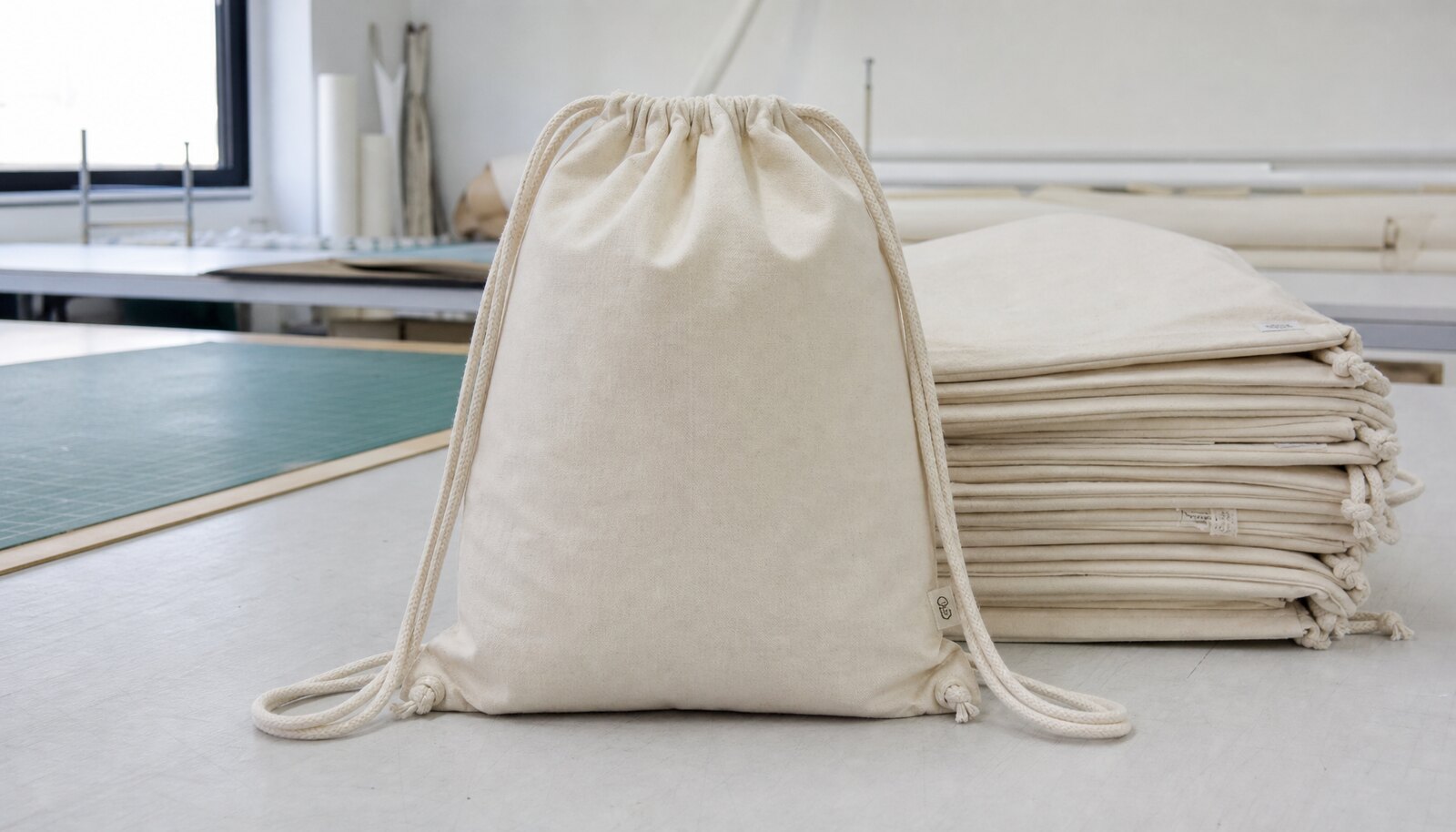
1. What the buyer is really solving in a gift shop program
Cotton drawstring backpacks for gift shops are rarely bought as a simple commodity item. They sit at the intersection of merchandising, souvenir presentation, and practical packing. In a shop setting, the bag has to look neat on arrival, stay consistent across the order, and survive the opening, counting, and shelf-replenishment process without creating extra labor for the retailer. That means the sourcing decision is not just about the bag body. It is about the build spec, the print method, the carton plan, and how the carton will behave when the warehouse opens it for receiving.
A buyer who only asks for a price on a "cotton drawstring backpack" often gets a quote that is too vague to compare. One supplier may quote the right size but pack too aggressively. Another may quote a low base unit price but leave out labels, polybags, or carton marks. In practice, the cheapest quote is often the one with the largest gap between the sample and the bulk shipment. That is why procurement teams need a carton packing plan at the RFQ stage, not after the order is already moving.
For gift shops, this is especially important because the receiving team usually wants predictable cartons. They may receive by case count, scan by barcode, or place goods directly into a backroom inventory system. If the cartons arrive with unclear marks, inconsistent quantities, or compressed bags that no longer fold neatly, the store team spends time fixing a packaging problem that should have been solved in production. The buyer’s job is to prevent that work from leaking downstream.
The best way to think about this item is as a small retail program, not a loose bag purchase. Once you define the intended display use, the packing style, and the receiving route, the factory can quote more accurately and the QC plan becomes much easier to enforce.
- Define the use case first: shelf sale, souvenir add-on, promo giveaway, or bundled resale pack.
- Treat carton packing as part of the product spec, not as a freight afterthought.
- Use the RFQ to expose whether the supplier understands retail receiving and carton discipline.
2. Choose fabric weight and construction with packing in mind
For most gift shop programs, the practical cotton range is usually around 140 to 220 GSM, but that number only matters when it is tied to the intended use. Around 140 to 160 GSM is common when you want a lighter souvenir bag that keeps the unit price down and still looks acceptable on a display hook. Around 180 to 220 GSM is more suitable when the bag needs a firmer hand feel, better shape, and stronger visual presence on the shelf. Heavier fabric can also make the print sit more cleanly, but it increases bulk and carton volume.
Construction choices matter almost as much as the fabric. A flat drawstring backpack is easier to fold, stack, and carton-load than a gusseted version, which is why it often works best for standard gift shop orders. A gusseted bottom or side gusset can improve usability and perceived value, but it also changes the way the bag sits in the case, the amount of compression the print panel can tolerate, and the carton count you can safely achieve. If the buyer never states whether a gusset is allowed, the factory may pick the simplest option for production efficiency rather than the best option for retail handling.
The cord and channel detail should not be treated as decoration. A cord that is too thin can feel weak and may look underbuilt when the bag is handled in-store. A channel that is not stitched evenly can twist after folding, which is a packaging issue as much as a sewing issue. For gift shops, many buyers prefer a natural cotton body with a simple front print and a small woven label on the side seam because it keeps the product clean, giftable, and easy to carton-pack without adding too much thickness.
If the bag is going to be folded repeatedly for warehouse receiving or retail topping-up, ask the factory to show how the finished bag folds and how long it stays flat. Some cotton fabrics look fine out of the sample press but spring open after a few minutes, which makes carton packing less efficient and can distort the print panel.
- 140 to 160 GSM: lighter souvenir or promo use where unit cost matters.
- 180 to 220 GSM: stronger retail feel, better shape, and more stable print presentation.
- Flat construction is easier to carton-pack; gusseted profiles need more careful fold testing.
- Ask whether the fabric is pre-shrunk or washed, because shrinkage changes finished size and carton fit.
3. Print method, decoration level, and how the bag will survive folding
The print method should be selected based on how the bag will be packed, handled, and displayed after it leaves the factory. Screen printing remains the default choice for many gift shop programs because it handles simple logos well, gives repeatable color, and usually keeps unit costs manageable at volume. It is also easier to control when the buyer wants a straightforward front-panel imprint that looks clean in retail photography and on the shelf.
Heat transfer is worth considering when the artwork is more detailed or the order is short-run, but it must be checked against folding behavior. A transfer that looks sharp on a flat sample can show edges, wrinkle lines, or fold memory after the bag is compressed in a carton. If the retailer cares about a soft hand feel, the buyer should ask the factory how the transfer performs after a carton test, not only after a single press sample.
Embroidery looks premium and may be suitable for a higher-end gift shop assortment, but it increases stitch density, adds thickness, and can pull on lighter fabric. That makes it a better fit for a heavier body fabric and a more generous carton plan. If the order is price-sensitive, a small woven label or side label often gives enough brand presence without the added bulk of stitched decoration. In many cases, the best answer is not one decoration method but a restrained combination: a simple front logo, a clean side label, and no extra sewn-on elements that make carton packing harder.
A good RFQ should ask the supplier to quote the same bag with one print method only, rather than allowing multiple methods to be mixed casually in one line item. Otherwise the factory may offer a low price on the easiest decoration and later charge extra for changes once the artwork is final.
- Screen print is usually the safest default for simple logos and repeat orders.
- Heat transfer needs a carton test because folding can affect appearance.
- Embroidery should be checked for fabric pull, added thickness, and higher carton bulk.
- Keep decoration restrained if the order must pack tightly and still look retail-ready.
4. MOQ, pricing structure, and what really drives the quote
MOQ is usually the result of cutting efficiency, print setup, label application, and packing labor rather than a random factory rule. If the buyer wants a simple natural bag with one logo and one carton format, the factory can often quote more efficiently than for a multi-color design or a mixed-color assortment. A higher MOQ is common when the order requires a dedicated fabric lot, more than one artwork screen, or separate carton sorting by color or style.
The important point for procurement is that MOQ should be stated separately for the bag body, the decoration, and the packing format. A quote that gives only one MOQ number does not tell you whether the supplier is pricing a simple bulk pack, a retail-ready bundle, or an assortment carton. In gift shop orders, the packing method can change labor more than the bag itself. Two suppliers may both say 5,000 pieces, but one includes inner bags and case marks while the other quotes only loose bulk loading. Those are not the same offer.
The unit price can also hide trade-offs. A very low price may assume loose folding, no barcode labels, no polybags, and a simple carton count. That can be fine for some buyers, but it is a poor comparison if your receiving warehouse expects labeled case packs. Likewise, a quote that looks higher may actually be the better commercial option if it includes the packing steps you would otherwise pay for later. For cotton drawstring backpacks for gift shops, the true comparison is landed, saleable inventory — not just the bag shell price.
A buyer should ask the supplier to break out any added cost for color changes, label application, individual bag packaging, or special carton loading. Once these pieces are visible, the procurement team can compare quotes on equal terms and avoid paying for a cheap base price that becomes expensive at the packing stage.
- Ask for MOQ by design, by color, and by packing format.
- Separate bag cost from print, label, packing, and carton cost whenever possible.
- Be cautious with very low quotes that assume loose packing or no retail preparation.
- Mixed assortments usually increase labor and require stricter carton controls.
5. A practical comparison of sourcing routes and carton-control risk
The best sourcing route depends on how tightly you need to control the carton plan. A direct factory is usually the strongest choice when you need custom size control, repeatable print placement, and a reliable packing method from one order to the next. That gives you the best chance of locking the fold, inner pack count, and master carton size before production begins. It is especially useful if you expect reorders and want the next shipment to match the first one.
A trading company can be useful if your program includes multiple bag styles or you need one contact person for a broader assortment. The trade-off is that the quotation may sit one step away from the actual production line. That does not make it a bad option, but it does mean you must ask clearer questions about who is responsible for print errors, carton loading mistakes, and repacking costs if the goods do not match the approved sample.
Stock service suppliers are the fastest route, but they are the least predictable for carton uniformity. Ready-stock cotton drawstring backpacks can vary by dye lot, cord length, thread finish, and carton count. That may be acceptable for a one-off promotional need, but it is usually not ideal for a gift shop buyer who wants consistent retail presentation. If stock is the only feasible route, the buyer should still ask for current lot photos and a sample pulled from the same inventory that will ship.
Blank bag plus local printing is another route worth considering when you need local artwork changes or faster market-specific branding. It can work well for short runs, but it creates a second supply chain and can complicate carton ownership. The receiving team must know whether the carton contains fully finished goods or blanks that still need decoration. If that distinction is unclear, the landed cost and the QC scope both become harder to manage.
- Direct factory: best for custom packing control and repeat orders.
- Trading company: workable, but packing responsibility must be explicit.
- Stock supplier: fastest, but batch-to-batch variation is common.
- Blank bag plus local print: useful for short runs, but carton ownership becomes split.
6. Build the carton packing plan before the supplier quotes the order
For gift shop orders, the carton plan should be written as clearly as the bag spec. Start with one core question: how should the factory fold the bag so it arrives neat, counts easily, and does not trap the drawcord? Flat folding is usually the most practical method. It keeps the bag stackable, protects freight density, and makes it easier for receiving teams to verify counts without reworking every item. If the bag is printed on one side, the fold should protect that print panel from crease damage and avoid forcing the cord into a tight bend.
The second question is carton count. A better carton count is not always the highest carton count. If a carton is too full, the bags can spring open, wrinkle, or deform under their own pressure. If the carton is too loose, the bags shift during transit and can arrive with crushed corners or uneven stacks. The right target depends on the bag size, fabric weight, fold method, and whether the buyer wants polybags or inserts. For many standard programs, it is cleaner to start with a moderate inner pack and then test whether the carton can hold the goods without damaging the logo area.
One color per carton is usually the cleanest solution for warehouse receiving. It reduces count mistakes, makes barcode scanning easier, and simplifies visual checks. Assorted color cartons should only be used if the retailer explicitly wants them. If assortments are requested, the factory should print or apply a carton label that clearly shows the color mix and quantities inside each carton. Otherwise the receiving team may have to open cartons unnecessarily to confirm the contents.
The carton spec should also cover outer carton construction. Ask for the board grade, the number of corrugation layers if relevant, the tape method, and whether the cartons need edge protection or pallet wrap. A carton that is good enough for transport may still be poor for retail DC handling if the board is too weak or the dimensions make stacking unstable. Put simply: the carton is part of the delivery promise, not just a shipping box.
- Use flat folding unless the retailer asks for a different presentation.
- Test carton count against wrinkle risk, not just freight density.
- Prefer one color per carton unless an assortment is written into the PO.
- Specify carton board strength, tape method, and stacking assumptions when freight matters.
7. Concrete carton examples and what they mean for warehouse receiving
It helps to think in real carton scenarios instead of generic packing advice. A common structure for a small-to-medium gift shop order is a moderate inner pack, one style or one color per carton, and a master carton that stays within a handling weight the warehouse can move without needing a two-person lift. That kind of plan is slower to squeeze into the freight rate, but it is faster and safer to receive. The warehouse team can count, label, and store the goods without opening and re-packing every case.
A second scenario is a higher-density export pack, where the factory increases the case count after proving that the bag folds flat and the drawcord stays controlled. This can reduce freight volume, but the buyer should only approve it after seeing a packed sample carton. If the carton is too compressed, the bags may emerge with stubborn folds across the logo panel. That does not always make the bag unusable, but it can downgrade the retail appearance enough to matter for a gift shop display.
A third scenario is a retail-ready pack with hangtags, barcode labels, and maybe an insert card. This works well when the goods go directly to a store or a retail DC, but the factory has to slow the line and check every extra component. The carton labels must match the SKU system exactly. If one label is missing or one barcode is misapplied, the receiving team may reject the carton or quarantine it for rework. In that case, the buyer should ask for a line clearance check before packing starts and a carton sample with all inserts applied.
Warehouse receiving details matter just as much as the factory plan. If the buyer expects carton counts to be scanned into a system, the carton mark must be legible from multiple sides. If the retailer receives by pallet, pallet height and wrapping style should be agreed before shipment. If the warehouse needs inner packs for backroom replenishment, the supplier should not pack everything as one loose stack inside the master case. These are small decisions on paper, but they determine whether the order lands cleanly.
- Moderate inner packs usually reduce damage and make receiving easier.
- Higher-density cartons should be approved only after a packed sample test.
- Retail-ready inserts need a stronger line-clearance and label-control process.
- Receiving method should drive carton mark layout and pallet assumptions.
8. Sample approval, QC thresholds, and what to reject before bulk production
The pre-production sample should be a true production reference, not a display piece. It needs the final fabric, final print method, final cord, approved label, and the exact fold the factory plans to use in bulk. If the sample is only a blank bag or only a print proof, the buyer still does not know whether the finished bag will pack cleanly. This is where many orders go wrong: the sample looks fine on the table, but the carton pack fails because the bag opens too much, the cord twists, or the print panel creases under compression.
A useful sample review should include a simple pass/fail sheet. Check the finished size against the approved spec. Measure the cord length and make sure both sides are even. Inspect stitching at the top corners, where failure is most likely if the bag is being pulled open repeatedly. Review print placement and color density under both direct light and normal indoor light, because some prints appear acceptable only in one environment. If the order has a side label or hangtag, verify the attachment location and the orientation of the label before approving bulk production.
For carton testing, open and refold at least a few pieces the way the warehouse will handle them. Then close the carton and check whether the stack springs open or collapses too tightly. If the bags bunch up, the carton count may need to be reduced or the fold method adjusted. If the carton is too loose, ask the factory to add an inner bundle or revise the fold. Do not approve a high-density carton simply because the count looks efficient on paper. If the bag loses its shape or the print face is damaged, the retail value of the shipment drops.
A buyer should also ask for a clear defect threshold. For example: no broken seams, no missing stitches at critical seams, no misaligned print that is visible at arm’s length, no unlabeled cartons, and no carton count variance without written approval. The point is not to create an impossible standard; it is to make sure the supplier knows what failure looks like before production starts. The factory should not be guessing what matters to your warehouse or gift shop customer.
- Approve the sample only if it matches the final fabric, print, cord, label, and fold.
- Test carton fit by repacking a few units the way the warehouse will actually handle them.
- Use pass/fail rules for stitch quality, size, print placement, and carton count.
- Reject blank or partial samples when carton performance is part of the order requirement.
9. Lead time, freight planning, and the hidden schedule risks buyers miss
A realistic lead time has three stages: sample approval, bulk production, and final packing or loading. For a straightforward cotton drawstring backpack program, the factory may need about 20 to 35 days after sample approval and deposit, but that is only useful as a rough planning range. The actual schedule depends on fabric availability, print complexity, carton requirements, and whether labels or inserts are finalized early enough for packing. If the buyer changes artwork late, the factory may finish sewing but still be unable to complete carton loading on time.
Freight planning should begin with the carton spec. Carton dimensions determine CBM, and carton weight determines how easy the shipment is to handle on arrival. A high-density packing plan can reduce volume, but only if the carton still opens cleanly and the bags remain presentable. If the goods are going into a gift shop warehouse, you should also confirm whether the receiving team prefers loose cartons, palletized cartons, or pallet plus stretch wrap. That choice affects not just freight cost but unloading speed and damage risk.
The carton mark and packing list must match exactly. If the packing list says one quantity per carton but the cartons are labeled differently, the receiving team may need to count manually, which is a waste of time and can lead to disputes. If a retailer uses barcode or scan-based receiving, ask the factory to provide a carton label proof before shipment. A good supplier will also be able to give you an estimated carton count per pallet and a rough stacking plan so the logistics team can book space accurately.
Late-stage schedule risk usually comes from three places: final artwork not approved, packing instructions not finalized, and carton supply not ready. Buyers often focus on sewing lead time and ignore these three blockers. In reality, the shipment is not complete until the goods are packed, labeled, and documented in a way the warehouse can accept without rework.
- Treat sample approval, bulk production, and packing as separate schedule steps.
- Get carton dimensions early so CBM and handling plans are accurate.
- Confirm pallet or loose-load receiving before booking freight.
- Late artwork and late labels are common causes of packing delays.
10. How to compare quotes and close the order with fewer surprises
The most useful quote is the one that shows the full build and packing scope clearly enough that two suppliers can be compared line by line. That means the RFQ should show bag size, cotton GSM, construction type, print method, carton quantity, inner pack quantity, label requirements, and whether the cartons need to be palletized. If one quote is cheaper but excludes packing labor or carton materials, the headline price is misleading. Procurement should compare the same shipment outcome, not just the same bag shell.
When reviewing the quote, look for missing information before you look at the unit price. If the supplier cannot tell you the carton size, the inner pack quantity, or whether the carton count is fixed, the offer is not ready for a controlled gift shop program. If the supplier is clear on those items, ask for a sample pack or carton photo. That tells you whether the packing instruction is real or just a promise in the quotation.
Before you place the order, ask the factory to confirm the final version of the packing method in writing. That can be a short line in the PO or a packing annex that lists fold method, inner pack count, carton count, carton marks, and pallet details if needed. This is especially important for cotton drawstring backpacks for gift shops, where the look of the goods matters as much as the bag itself. Once the factory has a signed packing instruction, it is far easier to hold them to the agreed standard at shipment.
The practical goal is simple: get cartons that arrive in a condition the retailer or warehouse can receive immediately, without repair work, re-counting, or re-folding. That is the point where the sourcing process becomes commercially useful instead of merely inexpensive.
- Compare total scope, not just base bag price.
- Require the carton spec and packing method to be written into the PO or packing annex.
- Ask for a packed sample photo or carton photo before mass production starts.
- Choose the quote that minimizes receiving work, not the one that only looks cheapest at first glance.
Specification comparison for buyers
| Spec decision | Recommended option | When it fits | Buyer risk to check |
|---|---|---|---|
| Direct factory sourcing | Use a factory that cuts, sews, prints, inspects, and cartons the bags in-house | Best for repeat gift shop programs where print placement, carton count, and packing method must stay consistent | Verify the factory actually controls final carton loading and does not hand off print or packing to a subcontractor |
| Trading company sourcing | Use a trading company only if it can show the real factory, real packing line, and real QC ownership | Useful when you are combining backpacks, tote bags, pouches, and seasonal items under one PO | Confirm who owns defects, repacking, label errors, and late carton changes |
| Stock service supplier | Buy ready-stock bags when you need quick replenishment with minimal customization | Fits urgent retail top-ups, events, or low-risk programs where exact carton uniformity matters less | Check dye lot variation, cord length differences, and whether current stock matches the sample you approved |
| Custom factory program | Specify fabric, size, print, label, inner pack, and master carton instructions before the quote is finalized | Best for branded gift shop programs that will reorder and need predictable receiving | If the tech pack is weak, the factory will choose its own folding, bag insert, and carton fill method |
| Blank bag plus local printing | Import blank bags and print locally if you need fast artwork changes or market-specific branding | Works when the retailer wants a short run or local event branding and can manage two suppliers | You may save on unit bag cost but lose control of fabric consistency, print registration, and carton standards |
| Retail-ready kitted packing | Pack with hangtag, barcode label, insert card, and case mark in one controlled flow | Suitable when the buyer wants shelf-ready goods or e-commerce fulfillment from the same carton spec | Each added insert increases labor and mispack risk, so the receiving check must be tighter |
| High-density carton loading | Increase carton count only after the bag is flat-folded, the cord is controlled, and the print panel is protected | Useful when freight cost pressure is high and the warehouse can receive by carton count | Too much compression can crease the logo area, deform the opening, and slow store-level unpacking |
| Mixed-color case pack | Keep one color per carton unless the retailer explicitly wants assortments | Best for cleaner warehouse receiving, faster count checks, and fewer barcode mistakes | Assortments create picking and repacking errors unless carton labels, inner pack lists, and SKU mapping are strict |
| Pre-production sample with carton trial | Approve a sample that includes the final packing method, not just the bag construction | Essential when the buyer cares about shelf appearance, carton fit, or retail handling | A blank sample can still fail after print, folding, or carton loading, so insist on a packed reference |
Buyer checklist before sampling
- Confirm the finished bag size, fabric GSM, cord diameter, and whether the backpack uses a single drawcord channel, double drawcord construction, or a gusseted bottom.
- State the intended use up front: gift shop shelf sale, souvenir add-on, promo giveaway, seasonal bundle, or resale pack, because that changes print, label, and carton requirements.
- Lock the artwork method in writing, including print type, number of colors, placement, artwork file format, and the exact pantone or visual reference to be matched.
- Set a carton packing target by size and shipment mode: inner pack quantity, master carton quantity, maximum carton gross weight, and whether the order must be palletized.
- Require a pre-production sample made from final fabric with final print, cord, label, and the actual folding method that will be used in bulk production.
- Set acceptance tolerances for finished size, print shift, stitch quality, cord length balance, and carton count so the factory knows what is rejectable before production starts.
- Ask for carton dimensions, estimated CBM, carton weight, and pallet loading assumptions before approving the quote, not after production has started.
- Request a packing list format that matches the retailer’s receiving process, including SKU, color, quantity, carton number, and any batch or lot code required.
- Confirm the lead time split between sample approval, bulk production, final inspection, and carton loading rather than accepting one vague delivery promise.
- Ask for production photos or a short carton-loading video when the order is large, the supplier is new, or the packing plan includes mixed colors or retail inserts.
Factory quote questions to send
- What exact fabric is quoted: cotton type, GSM, weave, shrinkage allowance, and whether the fabric is pre-shrunk, washed, or greige-processed?
- Which print method is included, how many colors are covered, and what are the setup charges, screen charges, or plate charges for each design?
- What is the MOQ by color, by design, and by packing style, and does the MOQ change if the order uses single-color print, multi-color print, or mixed carton assortment?
- How many pieces per inner polybag or bundle, how many inner packs per master carton, and what is the target carton gross weight?
- What carton size are you quoting, and how does that carton change if the bags are flat-folded, retail-folded, or packed with inserts?
- What is included in the sample charge, what part is refundable, and how many days do you need from artwork approval to sample shipment?
- Which QC documents can you provide before shipment: inspection report, carton dimension sheet, packing list, carton label proof, and random carton photos?
- What is the production lead time after sample approval and deposit, and what parts of the schedule are most likely to slip if the artwork, labels, or carton spec change late?
- Can you quote the same bag with and without polybags, barcode stickers, hangtags, or palletizing so we can compare landed cost cleanly?
- Who signs off on the final packing method, and can you confirm that the same method will be used in bulk production without substitution?
Quality-control points to confirm
- Fabric GSM matches the approved spec within the agreed tolerance, with no obvious thinning, weak spots, or uneven weave that changes print appearance.
- Finished dimensions are within tolerance for width, height, and gusset or base depth where applicable, with both sides measured on the same folding standard.
- Cord length is even on both sides, knots are secure, the cord moves smoothly through the channel, and there is no fraying at the eyelet or stitch entry point.
- Stitching is straight and consistent, with no skipped stitches, loose thread clusters, broken seam ends, or weak top-corner reinforcement.
- Print placement is centered or positioned to the approved artwork template, with no major shift, heavy ghosting, ink cracking, or color bleeding after folding.
- Side labels, woven labels, care labels, or hangtags are attached in the approved location and match the approved artwork and SKU information.
- Carton count matches the packing list, carton marks are legible on multiple sides, and every carton contains the same quantity unless an assortment pack was approved in writing.
- Carton compression does not crease the logo panel, flatten the drawstring channel, or distort the bag opening beyond the accepted handling standard.
- For gift shop programs, one inspection should include repacking a few units to make sure the bag refolds cleanly and does not spring open inside the carton.
- If pallets are used, carton stacking height, wrap quality, and edge protection should be checked so the bottom cartons do not collapse during transit.