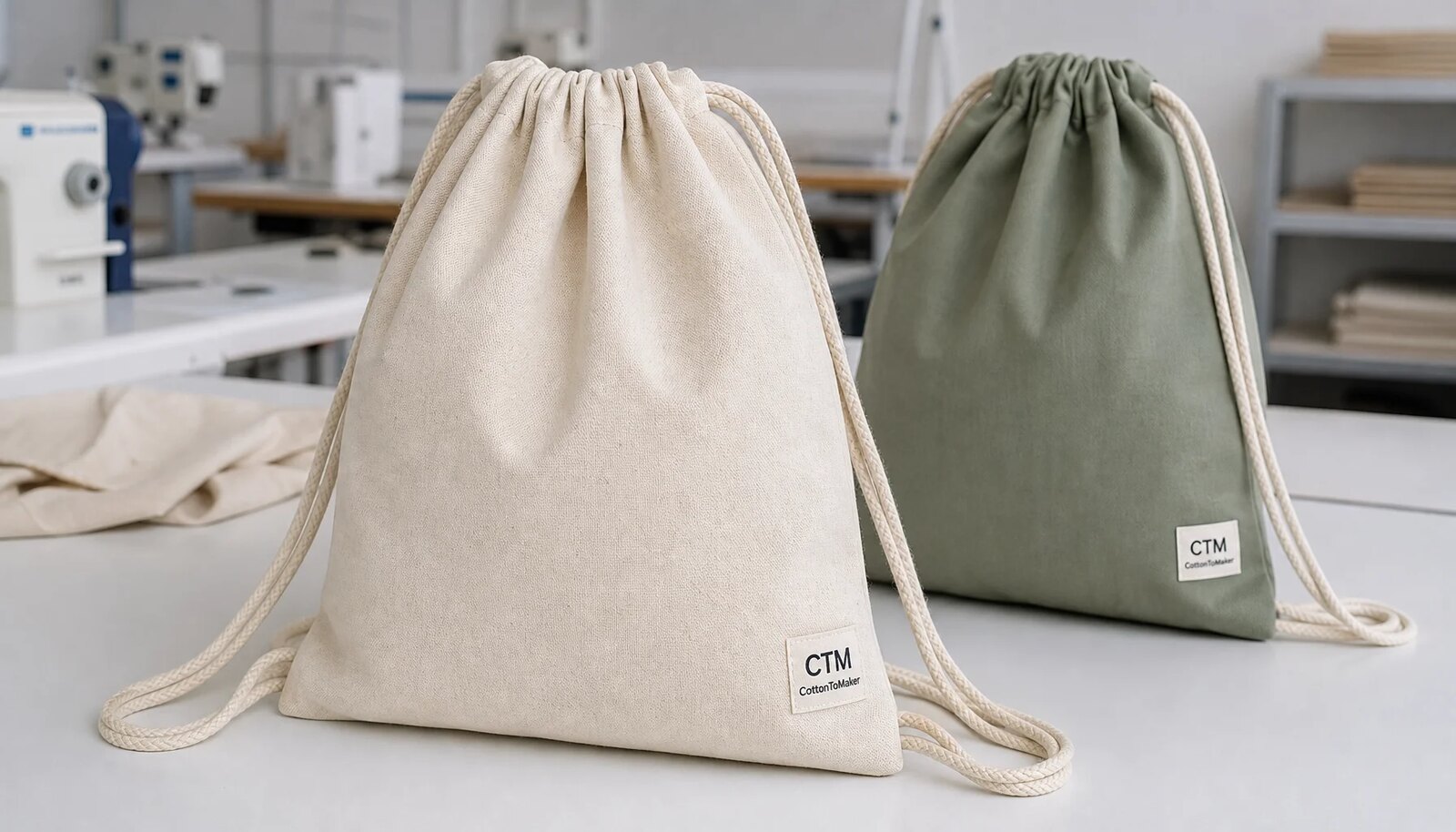
Define The Buying Job Before The Bag
Cotton drawstring backpacks for farmers market vendors are often sourced as simple promotional bags, but the B2B buying decision is more precise than that. The same basic shape can become a vendor welcome kit, a staff utility bag, a paid merchandise item, a CSA box insert, a sponsor giveaway, or a low-cost add-on sold beside jam, honey, bread, coffee, flowers, produce, candles, or soap. Each role changes the acceptable fabric weight, seam strength, decoration method, packing format, and price ceiling.
Procurement should start by documenting how the bag will be used during a normal market day. A vendor may carry a card reader, receipt roll, cash pouch, gloves, apron, price signs, tasting spoons, seed packets, rubber bands, produce stickers, a water bottle, or a small tool kit. A market organizer may distribute bags to farms before opening day. A brand sponsor may care most about logo visibility. A farm shop may sell the bag as merchandise and expect cleaner stitching and presentation. These are not cosmetic differences; they change the specification.
The first sourcing risk is approving a unit price before the internal team agrees on the commercial job of the bag. Marketing may request a larger logo, operations may need cartons labeled by market location, and finance may compare only EXW unit cost. A stronger cotton drawstring backpacks for farmers market vendors bulk pricing plan connects those needs before the RFQ goes out. It gives suppliers a performance target and gives buyers a fair basis for comparing quotes.
- Classify the bag as giveaway, staff utility, retail merchandise, subscription insert, event sponsor kit, or seasonal market program.
- Set a working load category: paper-only, light samples, daily vendor tools, or heavier packaged goods.
- Decide which priority leads the spec: lowest landed cost, stronger reuse, retail presentation, or sponsor visibility.
- Write the use case into the RFQ so suppliers quote the same performance expectation.
Set Size, Capacity, And Tolerances
Finished size looks straightforward, but drawstring backpacks lose usable space at the top once the cord channel is folded and closed. Common cotton drawstring backpack sizes often fall around 33 x 43 cm, 35 x 45 cm, or 38 x 45 cm, but procurement should not rely on catalog size alone. Ask suppliers to quote finished width, finished height, usable height below the cord channel, cord-channel width, and the approximate print-safe area. A bag that looks large flat can still feel cramped if the opening is narrow or the draw closure sits too low.
Tolerances should be written before sampling. For cut-and-sew cotton bags, a practical finished-size tolerance is often around +/- 1 cm to +/- 1.5 cm, depending on fabric, washing, and production method. Print placement may need a tighter tolerance, such as +/- 5 mm to +/- 10 mm, if the logo must align with a label, pocket, or centered artwork. Cord length should also have a tolerance because uneven cords affect fit and appearance. If the bag must fit inside a produce box or retail shipper, dimension tolerance becomes a logistics issue, not just a design issue.
Capacity should be tested with real contents. A vendor bag for flyers and coupons does not need the same strength as a bag that may hold glass jars, bottled drinks, or tools. If the expected load is moderate, define a sample load test around 3 kg. If the bag is intended for heavier staff use, test at 5 kg and inspect cord exits and bottom seams afterward. These numbers are not a substitute for formal lab testing, but they create a practical approval standard that suppliers and buyers can both understand.
- Specify finished dimensions plus usable height after the drawstring channel is closed.
- Use practical tolerances such as +/- 1 cm to +/- 1.5 cm for size and +/- 5 mm to +/- 10 mm for print placement when alignment matters.
- Confirm cord length, cord symmetry, and shoulder fit on an actual loaded sample.
- Test sample capacity with likely market contents before approving bulk production.
Choose Cotton Fabric With Real Specs
Fabric weight is one of the largest cost and performance drivers in a cotton drawstring backpacks for farmers market vendors bulk pricing plan. A lighter 140 to 180 gsm plain cotton can work for flyers, coupons, printed schedules, sponsor inserts, or short event giveaways. It packs efficiently and can keep the unit price low, but it may be more transparent, wrinkle more easily, and feel less substantial in the hand. It also needs careful seam and print review because lightweight cotton can distort under tension.
For most vendor programs, 200 to 220 gsm cotton canvas or twill is a practical middle range. It gives the bag more structure, improves perceived value, and usually provides a better screen-print surface without making freight volume too heavy. If the bag will be sold as merchandise or used repeatedly by staff, 240 gsm and above may be justified. At that point, buyers should also model carton CBM because heavier fabric changes carton count, freight cost, storage space, and manual handling.
The quote should name the fabric more clearly than simply cotton. Plain weave, canvas, and twill behave differently at similar gsm. Natural cotton may include seed flecks and slight shade variation; that can support a market-friendly look if approved in advance. Dyed cotton needs shade tolerance and colorfastness expectations. Washed cotton can feel softer but may have more shrinkage and lot-to-lot variation. Ask whether the fabric is stock, greige fabric dyed for the order, washed after sewing, or pre-finished before cutting. Those details affect lead time, color control, and repeat-order reliability.
- Use 140 to 180 gsm for light promotional programs with modest load expectations.
- Use 200 to 220 gsm for balanced vendor programs where body, print appearance, and reuse matter.
- Use 240 gsm or heavier for retail merchandise, staff utility, or heavier packed goods.
- Require fabric weight tolerance, commonly +/- 5% to +/- 8%, and ask how the supplier verifies gsm.
- Document weave, finish, color standard, shrinkage expectation, and natural cotton fleck acceptance.
Engineer The Stress Points
Construction is where many low quotes lose value. On a drawstring backpack, the stress is concentrated at the top hem, cord channel, cord exits, bottom corners, and side seams. A bag can look acceptable in a flat product photo and still fail when a vendor pulls the cords tight, carries bottled products, or tosses the bag into a stall bin at the end of the day. Procurement should ask the supplier to describe the internal seam construction, not only the outside appearance.
For moderate to heavy use, ask for a double-fold top hem, adequate seam allowance, reinforced cord exits, and bar-tacks where stress concentrates. Metal eyelets can look neat, but they are not automatically stronger; if the fabric is lightweight or the panel is not reinforced, an eyelet can pull through under load. A sewn reinforced opening or bar-tacked cord exit may be more practical for many cotton market bags. Bottom seam type also matters. A simple overlock seam may be acceptable for lightweight giveaways, while a bound, folded, or reinforced bottom construction is more appropriate for heavier contents.
Cord specification should be treated as a functional part, not an afterthought. A 5 to 8 mm cord is common for this product category, but the best choice depends on fabric weight, load, and hand feel. Cotton cord supports a natural product story, while polyester cord may offer stronger color consistency and abrasion resistance. Thin cord reduces cost and bulk but can cut into the shoulder when loaded. Define cord material, diameter, color, length, knot method, and whether the cord ends must be heat sealed, tipped, or simply knotted.
- Ask for photos of the inside top hem, side seams, bottom seam, and cord exits during sample review.
- Specify bar-tacks or reinforcement if the bag will carry more than light printed material.
- Do not assume metal eyelets improve durability unless the fabric around them is reinforced.
- Define cord diameter, material, length, color, knot style, and pull smoothness in the spec sheet.
- Review stitch consistency, skipped stitches, loose threads, and backstitching before bulk approval.
Select Decoration By Volume And Wear
Decoration should be chosen for artwork, quantity, fabric texture, handling, and reorder control. Screen printing is usually the default choice for bulk cotton drawstring backpacks with one to three logo colors. It can produce a clean logo at scale, and setup cost becomes more efficient as volume increases. Water-based ink can give a softer hand on natural cotton, while plastisol or similar systems may improve opacity on darker fabric. The right ink system depends on brand color, bag color, hand-feel expectations, and cure control.
Heat transfer can help with short runs, multi-color art, or multiple market-location versions, but it should be tested carefully on textured cotton. Transfers may show edge film, bond unevenly on coarse fabric, or behave poorly when folded through the graphic. Embroidery can feel premium on heavier canvas, but large filled embroidery areas may pucker the fabric and increase cost. Woven side labels, small patches, or branded tabs often give a cleaner retail signal without putting a large decoration process across the main panel.
For farmers market programs, legibility matters after folding, transport, sun exposure, and friction against crates or tables. Fine type, QR codes, sponsor marks, and thin outlines should be checked at actual print size. A digital mockup is not enough. Ask the supplier to define print placement tolerance, curing process, and what rub or fold checks they perform. Keep the final artwork, print size, color references, ink notes, and placement measurements with the approved sample so reorders do not depend on memory.
- Use screen print for stable bulk programs with simple logos and one to three colors.
- Use heat transfer only after adhesion, fold, and edge appearance are tested on the actual cotton surface.
- Use embroidery mainly on heavier fabric and avoid large filled areas unless puckering is acceptable.
- Use woven labels or patches when retail presentation matters and large print coverage is not necessary.
- Require an actual-size proof for small type, QR codes, sponsor blocks, or detailed artwork.
Build A Transparent Bulk Pricing Plan
A useful bulk pricing plan is more than a unit-price table. It should show how cost changes when quantity, gsm, construction, decoration, packing, and shipping assumptions change. For cotton drawstring backpacks, the main cost drivers are fabric weight, cutting yield, sewing time, cord type, reinforcement, print method, number of print colors, setup charges, labels, retail packaging, carton volume, and freight basis. When those elements are blended into one number, procurement cannot see whether a quote is efficient or incomplete.
Request price breaks at meaningful volumes, such as 1,000, 3,000, 5,000, and 10,000 pieces, or at the supplier's actual efficient break points. The purpose is not to force arbitrary discounting. It is to see where screen setup, material purchasing, cutting efficiency, and line setup become more economical. A 5,000-piece order split across five colors and four logos is not the same as one 5,000-piece production run. Each fabric color and artwork version may carry separate setup, shade control, print alignment, and packing complexity.
Buyers should compare base specification first, then price optional changes as adders. For example, quote a 200 gsm natural cotton bag with one-color front screen print, reinforced cord exits, standard folding, and master carton packing. Then ask for separate adders for 240 gsm fabric, second print location, woven side label, individual polybag, hangtag, barcode sticker, destination carton labels, and DDP freight. This structure makes internal decisions easier because each department can see the cost of its request.
- Separate unit price, setup charges, sample charges, artwork charges, packaging charges, inspection, and freight.
- Ask suppliers to quote by quantity, color, artwork version, and packing format instead of one blended total.
- Compare EXW, FOB, CIF, and DDP only after converting them to the same landed-cost basis.
- Model carton CBM and gross weight before choosing a heavier gsm or individual retail packing.
- Keep optional upgrades as line-item adders so approvals are based on visible tradeoffs.
Send An RFQ Suppliers Can Price Accurately
A strong RFQ should read like a production brief. Include finished size, fabric weight, weave, finish, bag color, cord material, cord diameter, cord color, reinforcement details, logo method, logo size, print placement, quantity by version, packing format, destination, Incoterm, sample requirement, and inspection standard. If the bag must fit into a produce box, ship to multiple regional markets, or carry a defined load, include that detail. Suppliers cannot price accurately from a request that says only custom cotton drawstring bag with logo.
The RFQ should also define what the buyer expects in return. Ask for price by tier, setup charges, sample cost, sample lead time, production lead time, carton dimensions, gross weight, net weight, estimated CBM, payment terms, quote validity, and all assumptions behind the price. This prevents a common comparison problem: one supplier includes reinforced exits and carton labels, another excludes them, and a third assumes a lighter fabric. The cheapest quote may simply be quoting a different product.
Allow the supplier to recommend one value-engineered alternative, but require it to be listed separately from the requested spec. A factory may suggest a standard natural cotton shade, a smaller print area, a stock cord color, or a different pack count that lowers cost or reduces risk. That experience is useful, but procurement still needs an apples-to-apples baseline for decision making. Keep the core spec fixed, then compare alternatives in a second column.
- Attach vector artwork, logo size, placement mockup, color references, and any brand guidelines.
- State the exact Incoterm and delivery destination for quote comparison.
- Require carton dimensions, pack count, gross weight, net weight, and estimated CBM with each quote.
- Ask for the requested spec and one cost-saving alternative as separate lines.
- Set a quote validity period and approval deadline because cotton, labor, and freight costs can move.
Approve Samples With Measured Criteria
Sampling prevents expensive mistakes only when the sample represents production reality. A reference sample can show general workmanship, and a handmade development sample can confirm shape, size, and decoration direction. It should not be treated as bulk approval if it uses substitute fabric, a different cord, a hand-applied logo, or non-production packing. For a custom farmers market vendor program, the safest approval point is a pre-production sample made with the actual fabric, actual cord, final reinforcement, final decoration process, and proposed folding method.
Sample review should be measured against the spec sheet. Check finished width, finished height, usable top opening, cord length, cord movement, seam allowance, stitch consistency, label placement, print size, print placement, print opacity, print hand feel, and overall symmetry. Then load the bag with realistic contents. A bag that looks good empty may reveal weak cord exits, tight closure, uncomfortable cord, or bottom seam strain when loaded with jars, bottled drinks, packaged products, or vendor tools.
Color and hand feel should be approved under practical lighting. Natural cotton can look different under daylight, warehouse light, and retail lighting. If the logo color matters, clarify whether the supplier is matching Pantone, a physical swatch, or a digital file. If the fabric is natural cotton, approve the acceptable level of seed flecks and shade variation. Store the approved sample in a labeled bag with the date, supplier, fabric spec, print method, and approval notes. That golden sample is the reference for inspection, reorders, and claims.
- Label sample type clearly: reference, development, pre-production, or production-line sample.
- Reject final approval if the sample uses substitute fabric, substitute cord, or non-production printing.
- Measure the sample before discussing subjective appearance.
- Run a practical load test and inspect stress points after the test.
- Keep the approved sample, artwork proof, color references, and packing photos together.
Inspect Quality At The Failure Points
Quality control should focus first on functional failure points and then on appearance. The key areas are the cord channel, cord exits, top hem, side seams, bottom seam, bottom corners, print surface, labels, and carton accuracy. A generic soft-goods inspection may miss the specific risks of drawstring backpacks, so the checklist should match the actual use case. If the order is for staff utility, load and cord checks matter more. If the order is for retail sale, stitching cleanliness, shade consistency, and packaging presentation rise in importance.
Define measurable inspection standards before production. For dimensions, use the approved tolerance from the spec. For fabric, confirm gsm by the agreed method and compare shade across several cartons. For sewing, inspect skipped stitches, thread breaks, loose ends, puckering, weak backstitching, and seam breakout risk. For cord function, open and close the bag repeatedly and check symmetry, knot security, and shoulder comfort under load. For print, inspect registration, edge sharpness, opacity, placement, cure, dry rub, fold cracking, and any ink transfer to the opposite panel.
Cotton has natural variation, but the acceptance standard should be explicit. Minor seed flecks on natural cotton may be approved if they fit the intended look. Oil stains, mildew odor, dye streaks, dirty handling marks, mixed shade lots, major slubs through the logo, and damaged cartons should not be accepted as normal. Packing accuracy also deserves inspection because receiving mistakes create real downstream cost. Verify inner pack count, master carton count, barcode placement, country-of-origin marking, carton label, shipping mark, and packing list accuracy before release.
- Pull samples from multiple cartons, not only the first carton opened.
- Check dimensions, gsm, shade, stitching, cord function, load performance, and print quality against the approved sample.
- Use dry rub and fold checks for printed panels before shipment release.
- Separate acceptable natural cotton character from stains, odor, shade mix, or workmanship defects.
- Photograph defects and record carton numbers so claims can be traced.
Pack For Receiving, Retail, And Freight
Packing can quietly change landed cost and distribution efficiency. Bulk folded packing is often best for market organizers, co-ops, event distributors, and multi-location teams. Inner bundles of 25, 50, or 100 pieces can make counting and redistribution faster, depending on how the receiving team works. Bulk packing also reduces material cost and can improve carton efficiency. However, fold method matters. A hard fold through a large printed logo can make the bag look worn before it reaches the vendor.
Retail packing should be used only when the sales channel needs it. Individual polybags, hangtags, insert cards, barcode stickers, and branded sleeves add labor, materials, carton volume, and sometimes sustainability concerns. They may be worthwhile for farm shops, grocery counters, coffee shops, gift sets, or merchandise tables. They are usually unnecessary for internal vendor distribution. The right choice is the one that matches how the bag will be received, counted, displayed, sold, or handed out.
Freight planning belongs in the sourcing stage, not after production. Ask for carton dimensions, gross weight, net weight, pack count, estimated CBM, and pallet pattern if applicable. Cotton bags become bulky as gsm and cord diameter increase, and individual packing can reduce carton density. If the shipment will be split by market location, supplier, sponsor, or artwork version, carton labels should be printed accordingly. Clear carton instructions reduce warehouse rework, mis-picks, and emergency relabeling costs after arrival.
- Use bulk folded packing when speed, count accuracy, and freight efficiency are the priority.
- Use individual retail packing when barcode, cleanliness, display, or customer presentation is required.
- Approve the fold method with a packed sample or packing photo.
- Require carton dimensions, gross weight, net weight, pack count, and CBM before selecting the supplier.
- Label cartons by color, artwork, destination, market date, or program when the shipment will be redistributed.
Specification comparison for buyers
| Spec decision | Recommended option | When it fits | Buyer risk to check |
|---|---|---|---|
| Finished size | Common range: 33 x 43 cm to 38 x 45 cm, with usable height checked after the cord channel is closed | Vendor welcome kits, market staff bags, produce-box add-ons, and simple retail merchandise | Confirm finished-size tolerance, usually +/- 1 cm to +/- 1.5 cm, and check whether the top hem reduces usable capacity |
| Fabric weight | 200 to 220 gsm cotton canvas or twill for most vendor programs | The bag needs a substantial hand feel, repeat use, and efficient bulk packing | Verify gsm tolerance, commonly +/- 5% to +/- 8%, plus shrinkage expectation and whether fabric is stock, dyed, washed, or finished |
| Light promotional build | 140 to 180 gsm plain cotton with one-color print and standard seams | Flyers, coupons, light samples, sponsor giveaways, or short event campaigns | Test opacity, seam strength, fabric skew, and print coverage on natural cotton before approving price |
| Heavy-use construction | 240 gsm and above with reinforced cord exits, bar-tacks, and a stronger bottom seam | The bag may carry jars, bottled drinks, tools, bundled flowers, small packaged foods, or staff supplies | Check that reinforcement, seam allowance, and heavier cord are included at each quoted price tier |
| Cord specification | 5 to 8 mm cotton or polyester cord, with length and knot style defined | A balanced vendor bag that must close smoothly and sit comfortably on the shoulder | Thin cord can reduce cost but cut into the shoulder; confirm cord pull strength, colorfastness, and length tolerance |
| Decoration method | Screen print for one to three logo colors and stable repeat programs | Larger bulk quantities, sponsor logos, market names, farm brands, and seasonal artwork | Ask for ink system, curing method, screen/setup charge, placement tolerance, dry rub result, and screen reuse policy |
| Premium branding detail | Woven side label, small patch, or controlled embroidery on heavier cotton | Paid merchandise, specialty food bundles, coffee, bakery, flower, soap, or CSA-style programs | Check label MOQ, label placement tolerance, embroidery puckering risk, and whether label cost is separate |
| Supplier route | Direct cut-and-sew supplier with decoration coordination and final inspection ownership | You have a fixed spec, repeat quantity, and need consistent cotton weight, stitching, and packing | Verify what is in-house versus subcontracted for dyeing, sewing, printing, labeling, and carton packing |
| Fast pilot route | Stock blanks decorated locally or by a stock-program supplier | Urgent market dates, small tests, sponsor approval, or pre-season sampling | Confirm blank source, shade continuity, reorder availability, and whether pilot construction can match custom bulk production |
Buyer checklist before sampling
- Define the commercial role of the bag: free giveaway, paid retail item, vendor staff utility, loyalty gift, CSA box insert, sponsor kit, or produce-box add-on.
- Set target finished dimensions, usable capacity after closure, and a realistic working load before asking for price.
- Specify cotton fabric weight in gsm, weave type, finish, color, acceptable gsm tolerance, shrinkage expectation, and shade tolerance.
- Decide whether the bag needs reinforced cord exits, bar-tacks, metal eyelets, double-fold top hem, French seams, overlock seams, bottom seam binding, or a bottom reinforcement patch.
- Confirm cord material, cord diameter, cord color, cord length, knot style, pull smoothness, and whether cord length tolerance is acceptable for shoulder carry.
- Choose decoration method, logo size, number of colors, print location, ink type, hand-feel expectation, print placement tolerance, and brand color matching method.
- Break quantity down by bag color, artwork version, market location, carton label, and delivery destination instead of quoting one blended total.
- Ask for price tiers at practical bulk breaks and require setup, sample, label, packing, inspection, and freight charges as separate lines.
- Request a pre-production sample made with actual production fabric, cord, reinforcement, decoration, and packing method before approving bulk cutting.
- Create a QC checklist for dimensions, gsm, stitching, cord function, load performance, print durability, odor, shade, carton count, labeling, and country-of-origin marking.
Factory quote questions to send
- What exact cotton fabric weight, weave, yarn type if known, finish, and gsm tolerance are included in this quote?
- Is the quoted fabric stock fabric, greige fabric to be dyed, custom-dyed fabric, washed fabric, or finished fabric, and what shade tolerance should we expect between lots and reorders?
- What finished dimensions are you quoting, and what are your normal tolerances for width, height, usable height below the cord channel, cord length, and print placement?
- Which construction details are included: double-fold top hem, reinforced cord exit, bar-tacks, bottom seam type, side seam type, seam allowance, inside edge finishing, and bottom patch?
- Which production steps are done in-house and which are subcontracted, including fabric sourcing, dyeing, cutting, sewing, printing, embroidery, labeling, inspection, and carton packing?
- What are your MOQ and price breaks at 1,000, 3,000, 5,000, and 10,000 pieces, or at your actual efficient production break points?
- What is included in the unit price, and what extra charges apply for screens, plates, artwork cleanup, embroidery digitizing, woven labels, hangtags, barcodes, polybags, master cartons, or special folding?
- Which print method are you proposing, what ink system will be used, what curing process is used, and what dry rub, wet rub, fold, wash, or adhesion checks do you normally perform before packing?
- Can you provide carton dimensions, gross weight, net weight, inner pack count, master carton count, estimated CBM, and pallet recommendation for each packing option?
- What type of sample will be provided: reference sample, handmade development sample, pre-production sample using actual materials, or production-line sample from bulk goods?
Quality-control points to confirm
- Check the approved spec sheet against the factory work order before bulk cutting starts, including gsm, weave, color, dimensions, cord, reinforcement, print, labels, and packing.
- Measure finished bag width, height, usable height below the cord channel, top opening, cord length, and print placement on samples from multiple cartons.
- Verify fabric weight with an agreed gsm test method or retained cut swatches, and compare shade across cartons under consistent light.
- Inspect the top hem, cord tunnel, cord exits, bar-tacks, side seams, bottom seams, seam allowance, inside finishing, and bottom corners for skipped stitches, loose threads, puckering, weak backstitching, and breakout risk.
- Run a practical load test using the intended market contents or an agreed test weight, such as 3 kg for moderate use or 5 kg for heavier staff-use validation, then check seam strain and cord comfort.
- Open and close the drawstring repeatedly, for example 20 to 30 cycles during sample review, to confirm smooth movement, symmetry, knot security, and whether the bag hangs level when loaded.
- Review print registration, edge sharpness, ink opacity, ink hand feel, placement, cure, dry rub result, fold behavior, and whether ink cracks or transfers after packing.
- Check for oil spots, needle marks, dirt, odor, mildew smell, dye streaks, mixed shade lots, major fabric slubs on the print face, and visible seed flecks beyond the approved natural cotton standard.
- Confirm individual pack, inner pack, master carton count, carton marking, barcode placement, country-of-origin marking, shipping marks, and packing list accuracy.
- Hold a signed golden sample, approved artwork proof, inspection photos, and packing photos for repeat orders so future production is judged against the same reference.