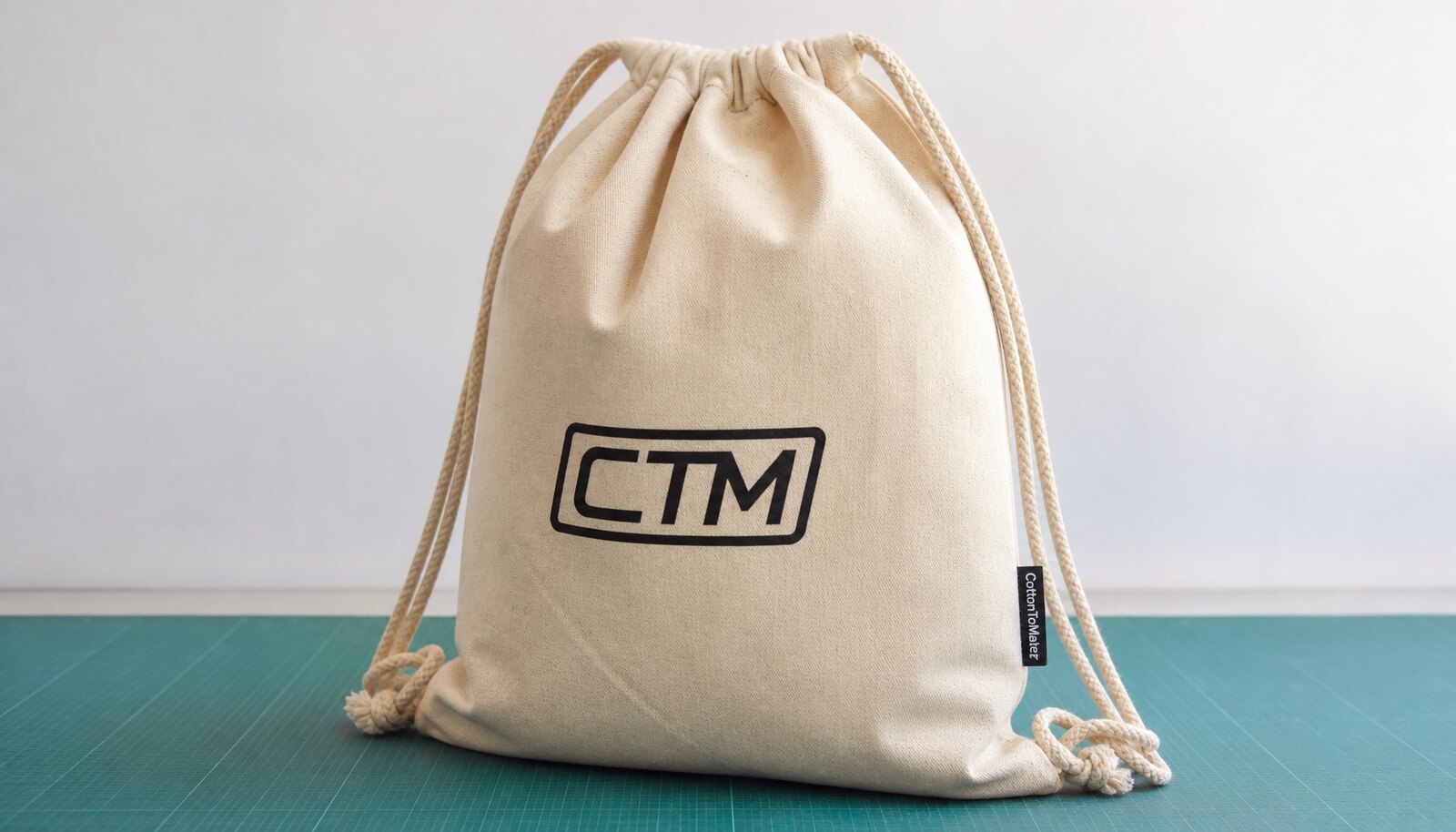
Why event buyers choose cotton drawstring backpacks
Cotton drawstring backpacks solve a specific event problem: they are light enough to distribute fast, useful enough to keep, and printable enough to carry a brand mark without needing a full packaging program. That mix makes them more attractive than paper bags for many event teams and more credible than very thin synthetic giveaways when the bag itself will be seen in public after the event.
The buying question is not whether the bag looks acceptable in a mockup. It is whether it works in the actual event flow. Registration staff need bags that can be stuffed quickly. Sponsors need a surface that prints cleanly and reads at a distance. Attendees may need to carry the bag across a venue, through a transit commute, or home with a catalog, bottle, or sample kit inside. Those details change the spec more than the marketing description does.
A useful RFQ starts with the event use case, not the bag category. A conference pack, campus orientation kit, retail gift-with-purchase, and booth giveaway all imply different load, print, and packing needs. Once that use case is clear, the supplier can quote something comparable instead of a generic cotton bag with no commercial context.
Set the load first, then choose fabric weight and weave
For cotton drawstring backpacks for events, fabric weight is usually the first spec that affects both appearance and performance. In practical buying terms, 140-160 GSM works for lighter giveaways and short carry distances, while 160-180 GSM is the more balanced range for standard event kits. Above 180 GSM, the bag usually starts to behave more like a reusable utility item or premium merch piece than a simple handout.
GSM is only part of the picture. A loose weave at the same weight can look thinner, print less cleanly, and distort sooner at the cord channel and seam corners. Ask for the weave description, yarn count if available, and whether the cloth is bleached, natural, dyed, or pre-washed. The finish matters because cotton can change hand feel, shrinkage behavior, and print consistency depending on how it was prepared.
This is where many quotes drift into abstraction. The buyer does not need the supplier to prove fabric theory. The buyer needs a bag that fits the kit and survives the carry profile. If the bag will hold a bottle, notebook, and charger, request a sample with those exact items inside. If the bag is only holding folded collateral, you can prioritize lower weight and lower cost.
Use the decoration method that matches the artwork and reorder risk
Screen print is still the default for most event programs because it is repeatable, fast to set up, and generally the easiest to control across a larger run. It works best when the logo uses solid shapes, a limited number of colors, and enough clear space around the mark. On textured cotton, fine type and thin linework can lose edge sharpness, so simple art usually produces a cleaner result than an elaborate layout.
Heat transfer is useful when the artwork needs gradients, multiple colors, or a very small production run. The tradeoff is that transfer quality depends heavily on process control and film durability. It can also feel less integrated into the cloth. Embroidery gives a premium look, but it adds cost, can slow production, and may distort lighter fabric if the stitch density is too high.
For reorders, the best decoration method is the one the factory can repeat without drift. If the event will recur, the supplier should be able to reproduce the print placement, ink reference, and label position from a retained production file. That matters more than trying to maximize visual complexity on the first order.
Size, cord, and seam design decide whether the bag feels cheap
Many event bags fail on geometry, not on the headline spec. If the bag is too narrow, the contents wrinkle and the opening becomes awkward to use. If it is too tall, the bag looks empty and wastes cloth. The useful way to approve size is to test the actual event contents, then check how the draw closes and how the bag hangs when loaded.
Cord design deserves more attention than it usually gets in an RFQ. Ask whether the cord is cotton, polyester, or a blend, what the diameter is, and how the ends are finished. A thin cord may look neat in photos but can feel harsh on the shoulder and wear faster in the tunnel. Cord entry points should be reinforced so the stitching does not fail where the load concentrates.
The main stress points are predictable: top corners, cord exit points, and the base seam. A supplier should be able to explain the reinforcement method, whether that is extra stitching, a wider seam allowance, or bar tacks at the load points. If the bag will be handled quickly at registration or reused after the event, those reinforcements are not optional details.
Compare supplier routes by control, not by headline price
Direct factories make sense when the order depends on tight control over cloth, sewing, print placement, and packing. They are usually the cleanest route for event programs with fixed dates because the buyer has fewer handoffs to manage and fewer places where the spec can drift. The tradeoff is that a factory may require stricter MOQ, longer fabric sourcing time, or less flexibility if the order changes late.
Trading companies and sourcing agents are useful when the buyer wants one point of contact across multiple items or does not want to manage several factories. That convenience only helps if the intermediary can name the actual production site, the print partner, and the packing location. If they cannot, control becomes opaque and the reorder risk goes up.
Region matters, but only when tied to the actual supply chain. China is often strongest for capacity, faster quoting, and broad process options. India can be attractive when the buyer wants cotton-heavy sourcing or a more natural-fiber story. Turkey or nearby nearshore supply can reduce transit time for European deliveries and can be useful when replenishment speed matters more than the lowest ex-works price. Local converters are often the best choice for urgent domestic events when freight, customs, and deadline risk outweigh lower unit cost.
Read MOQ and price the way a factory does
MOQ in this category is rarely one number. It often varies by fabric color, print color count, cord color, and packing format. A quote that looks small on unit price can still carry separate screen charges, sample charges, dye lot minimums, or special packing surcharges. The buyer should ask which line item actually drives the minimum and whether a reorder can reuse the same setup.
The cleanest pricing structure is one that separates fixed and variable cost. Fixed cost includes sampling, setup, screens, and any custom dyeing or label tooling. Variable cost includes cloth, labor, printing, packing, and shipping. If those pieces are blended too tightly, it becomes hard to compare suppliers or understand why a reorder changed. That is where procurement teams often lose leverage without realizing it.
For recurring event programs, a standard base bag usually works better than constant redesign. Keep the bag body consistent and vary only the insert, tag, or collateral if the campaign changes. That reduces setup waste and lowers the chance that a future order slips because the supplier has to rebuild the process from scratch.
Treat sourcing region and compliance as linked decisions
Regional sourcing is not only about transit time. It also affects fabric access, labor cost, documentation, and how easy it is to support destination-market requirements. A supplier with strong cotton access may still be a poor fit if they cannot provide the paperwork the destination team needs. A low-cost factory may still be expensive in practice if customs and testing are left to the buyer at the last minute.
If the bags are going into the EU or UK, ask how the supplier handles fiber declarations, packaging marks, and any chemical or material documentation tied to the print, dye, or label stack. For the US, confirm whether the bag is a general promotional textile item or part of a broader retail program with different requirements. If the bag includes heavy print, coatings, or specialty labels, ask whether a test is needed on the actual production stack-up rather than on a generic fabric swatch.
The right commercial question is simple: what can the supplier prove, and what cannot they prove? If the supplier works regularly in your destination market, they should be able to state the normal documentation route. If they cannot, tighten the spec or move to a supplier that can support the paperwork without improvisation.
Approve the sample like a production buyer
The pre-production sample should be made from the final fabric and final print route. A blank cloth swatch or a digital mockup does not show how the ink behaves on textured cotton, how the seams sit under tension, or how the bag folds for packing. If the supplier wants to substitute material for the sample, treat that as a separate approval, not the final sign-off.
Sample review should be measurable. Record finished size, cord length, print location, and the approved color reference. If the bag includes a woven label, check edge finish and stitch consistency. If the fabric is natural or undyed cotton, expect normal shade variation but define the acceptable range against the approved sample. The point is not perfection; it is keeping the production lot inside a visible and documented reference.
Keep a retained sample on both sides. Procurement should hold one approved sample, and the factory should keep one too. That gives both parties a common reference if the production run starts to drift or if a reorder is placed months later with the same art but a different team handling it.
Set QC thresholds that match event risk
QC for cotton drawstring backpacks should focus on the failures that create real operational pain: weak seams, poor print consistency, wrong packing, and mixed carton contents. Cosmetic issues matter, but an event bag that looks fine and fails at the cord tunnel is a harder problem than a slightly uneven print edge. Define the failure types that will actually create complaints or rework.
For seam strength, many buyers set a minimum in the 20-30 N range for light event bags and increase the requirement when the bag will carry heavier kits or be reused. If your program expects hard use, define a higher threshold and ask how the supplier measured it. For colorfastness, request dry rub and wet rub results on the actual production fabric, and add wash testing if the bag may be laundered or reused repeatedly. For shrinkage, a common buyer limit is under 5 percent in both dimensions unless the spec intentionally allows more movement.
The inspection plan should include the first articles and the final cartons. Early checks catch placement and process drift. Final inspection should verify the lot, not just a pilot sample, and should sample enough cartons to catch mix-ups by size, color, or print version. The receiving team should also know how to handle mismatched carton marks or barcode labels before the shipment arrives.
Packing and lead time can make a good bag arrive unusable
Packing should match the downstream process. If the bags go to a warehouse for kitting, bulk carton pack is usually the most efficient. If they go straight to retail handoff, sponsor welcome packs, or mailers, you may need a fold method that protects the front panel and a label format that fits receiving. The wrong pack format does not change the product, but it can create a large labor problem at destination.
Cotton bags are sensitive to dust, creasing, and moisture pickup if the packing environment is sloppy. Clean polybags, dry cartons, and clear carton marks matter more than many buyers expect. Loose packing can crease the print. Overly tight packing can leave pressure marks or distort the shape. The goal is to make the first opening at destination look like an approved sample, not like a repacked carton from a warehouse floor.
Lead time should be broken into sample, production, and transit. The longest-risk step is often not the sewing line; it is fabric sourcing, print setup, customs clearance, or freight booking. Ask the supplier to name the step that is most likely to slip. That answer is usually more useful than a single promise date.
Specification comparison for buyers
| Spec decision | Recommended option | When it fits | Buyer risk to check |
|---|---|---|---|
| Sourcing route | Direct factory with sewing and decoration in one controlled line | You need control over cloth, print placement, and ship date | Confirm whether cutting, sewing, printing, and packing are all in-house or split across subcontractors |
| Regional fit | China for broad capacity and faster quoting, India for cotton-heavy sourcing and natural-fiber positioning, Turkey or nearby nearshore supply for shorter transit into Europe, local converters for urgent domestic programs | Your priority is transit time, customs simplicity, or replenishment speed rather than only ex-works price | Ask where the fabric is woven, where printing happens, and whether the schedule includes customs buffer time |
| Fabric weight | 140-160 GSM for light giveaway use; 160-180 GSM for standard event kits; above 180 GSM for heavier loads or premium positioning | Conference packs, retail promos, sponsor activations, and reusable attendee bags | Thin fabric can show print-through, distort at seams, and feel low-value under bright lighting |
| Decoration method | 1-color screen print for volume, woven label for a cleaner premium look, heat transfer only when artwork requires it | Simple logos, repeat reorders, and clear contrast on natural cotton | Small text, fine lines, and gradients can lose clarity on textured fabric |
| MOQ strategy | Tie MOQ to fabric color, print color count, and packing format instead of a single headline number | Multi-SKU campaigns or phased event calendars | A low MOQ may hide screen, setup, dye lot, or packing charges |
| Packing route | Bulk polybag plus carton pack unless the receiving process requires retail-style folding and barcode labeling | Warehouse distribution, conference kits, or direct-to-event shipping | Loose packing creates dirt, wrinkles, and mix-ups; overpacking adds cost and handling time |
| QC approach | Pre-production sample, first-article approval, inline check, and final AQL inspection with written tolerances | Any order with logo placement, color matching, or a fixed event deadline | Skipping early approval usually leads to reprint, repack, or missed ship date |
Buyer checklist before sampling
- Define the event use case, expected carry weight, and whether the bag is a giveaway, merch item, or retail SKU.
- Lock the fabric weight, weave, finished size, and cord length before asking for price.
- Specify print method, logo size, print colors, and whether the same art must repeat across reorders.
- Ask for a pre-production sample on the final fabric, not only a blank swatch or digital proof.
- Confirm carton pack count, polybag requirement, barcode label needs, and whether inserts or hang tags are included.
- Request lead time separated into sample, production, and transit, with the longest-risk step identified.
- Compare quotes on the same basis: fabric, print, packing, inspection level, and freight assumption.
- Approve written tolerances for size, color shift, stitching, seam strength, and print alignment before mass production starts.
- Ask which part of the order is subcontracted, if any, and who signs off the final inspection before shipment.
- For destination markets with compliance requirements, ask for the exact test reports or declarations available for the planned fabric and decoration route.
Factory quote questions to send
- What exact fabric weight, weave, yarn count, and finished bag size are you quoting, and are those the same for all units in the order?
- What is the print method, how many colors are included, and what setup charges apply for a second logo location or revision?
- What is the MOQ by fabric color and by print color, and which line item drives the MOQ if we split sizes or SKUs?
- Can you produce a pre-production sample on the final fabric with final print placement before we release the PO?
- What are your standard tolerances for dimensions, seam allowance, stitching, cord length, and shade variation?
- Can you share your target seam pull strength, colorfastness standard, and shrinkage allowance for this fabric?
- How are the bags packed, how many per inner carton, and can you support retail fold, barcode label, or master carton markings?
- What is the production lead time after sample approval, and what part of the schedule is most likely to slip?
- Which parts of the order are subcontracted, if any, and who performs final inspection before shipment?
- If we source through your factory in a specific region, what is the normal transit lane and customs lead time to our destination?
Quality-control points to confirm
- Fabric weight matches the approved spec and does not feel noticeably thinner in the body panel, base, or cord tunnel area.
- Finished size stays within the agreed tolerance, especially height and width after stitching and trimming.
- Seam pull strength meets the agreed threshold for the end use; for light event bags, many buyers set a minimum around 20-30 N, then raise it for heavier kits or reusable programs.
- Cord pulls smoothly, stops evenly on both sides, and does not twist, fray, or slip under a normal carry load.
- Print is centered or placed as approved, with no blur, pinholes, visible underbase mismatch, or color shift beyond tolerance.
- Colorfastness is checked on the actual production fabric; buyers often request dry rub and wet rub results, and add a wash test if the bag may be reused.
- Shrinkage is measured after laundering or steam exposure where relevant; a common buyer limit is under 5 percent in length and width unless the spec allows more movement.
- Stitching is even at stress points, with no skipped stitches, loose threads, broken seams, or weak top corners.
- The sample fold, carton count, and label format match the packing instruction, including any barcode or retail tag.
- Cartons are clean, dry, and correctly labeled, with no mix of sizes, colors, or print versions in one case pack.