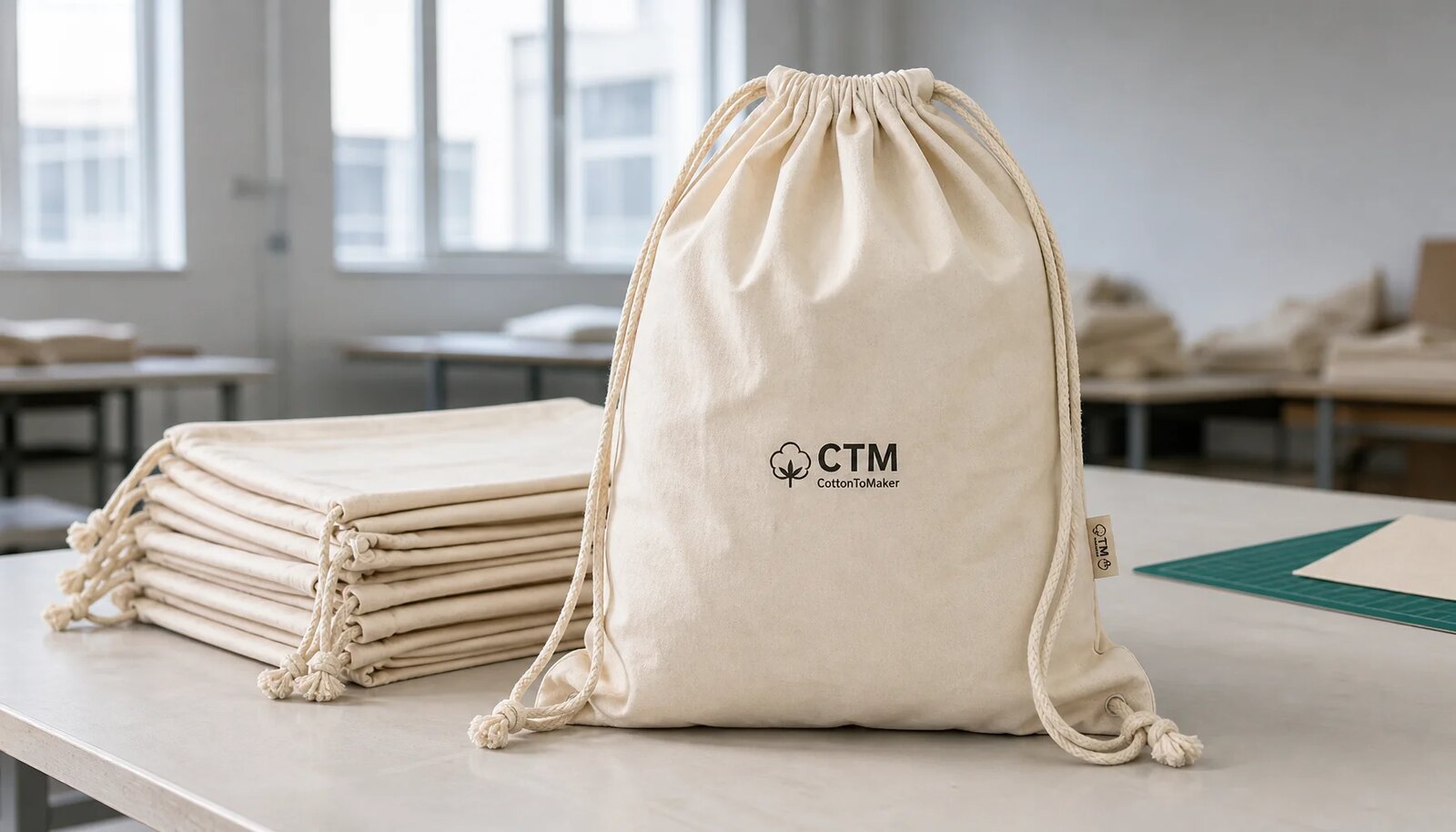
Start With the Event Job, Not the Bag Name
A cotton drawstring backpack sounds simple until it has to carry the whole event experience. It may hold agendas, badge packets, notebooks, sponsor literature, product samples, apparel, staff supplies, or prepacked welcome kits. If the RFQ only says "cotton drawstring backpack," the supplier has to fill in too many blanks: fabric weight, finished size, cord type, reinforcement, print method, packing style, and carton labeling. Those assumptions are often the reason two quotes look far apart even though the product name is the same.
Start with the job the bag must do. A low-cost registration giveaway can be built differently from a VIP launch kit with a hoodie, stainless bottle, and boxed charger. A staff bag may need smoother cord action because it will be opened all day. A sponsor bundle may need a flatter print panel and more controlled carton marks so activation teams can sort by brand or location without opening every box.
Before asking for prices, write one practical use sentence. For example: "Natural cotton drawstring backpack for a three-day conference welcome kit, carrying one A4 notebook, badge packet, 500 ml bottle, sponsor brochure pack, and folded T-shirt, bulk packed for registration desk assembly." That sentence gives the factory a real target. It also helps internal stakeholders understand why a cheaper, thinner, smaller bag may not be the same purchase.
- List intended contents by dimensions and approximate weight, not only by item name.
- State whether the bag is a giveaway, working carry bag, VIP gift, sponsor package, staff kit, resale item, or room-drop item.
- Define how bags will be distributed: loose at registration, prepacked as kits, shipped to a 3PL, delivered to a venue, or split by region.
- Include event date, required in-hands date, receiving address, appointment rules, and venue delivery restrictions.
- Decide whether packaging reduction, reusable quality, organic cotton, recycled content, or certification documents are true requirements.
Turn Contents Into Size and Load Specs
Finished size should follow the contents, not the other way around. Many event buyers default to a familiar size such as about 35 x 40 cm or 38 x 45 cm. Those sizes can work well, but the real test is what happens when the bag is filled and cinched. A notebook may sit nicely on the flat panel, then push against the seams once a bottle, T-shirt, and brochure stack are added. If the opening is too narrow, staff lose time during kit assembly. If the bag is too tall for the contents, the logo can fold, slump, or disappear under the drawcord channel.
Ask suppliers to quote finished dimensions, not just cut dimensions. Cotton can shrink, relax, or distort during sewing, pressing, or packing. A practical tolerance for simple sewn cotton bags is often discussed around plus or minus 1 cm, depending on fabric, size, and construction. Logo placement usually needs tighter control, commonly plus or minus 5 mm to 10 mm from the approved position for event work. Do not leave those numbers implied; put them in the purchase order or quality sheet.
Load expectations also need plain language. If the bag will carry 1 kg, 2 kg, or more, write that into the RFQ. If the kit includes angular boxes, bottles, books, or electronics packaging, request reinforced bottom corners and a pack-out test. A drawstring backpack is not a technical outdoor pack, and it should not be oversold as one. The point is to make sure the construction matches real event handling: being filled quickly, carried across a venue, dropped under chairs, and pulled open repeatedly.
- Measure the widest, tallest, and thickest items before choosing the bag size.
- Request a physical pack-out test for A4 or letter-size documents, bottles, apparel, and boxed inserts.
- Specify finished width and height with written tolerance, not approximate catalog dimensions alone.
- State expected load weight and whether the bag must support short handout use, daily attendee use, or repeated staff use.
- Check that the logo remains visible when the bag is filled and closed.
- Confirm the top opening is wide enough for fast kit assembly without forcing contents.
Choose Cotton Weight With Tradeoffs in View
Fabric weight affects price, feel, print result, sewing behavior, carton weight, and freight. For short-use handouts, 5 to 6 oz cotton, roughly 170 to 200 gsm, can be a reasonable range. It works best for lighter contents such as brochures, badge inserts, pens, thin notebooks, campus handouts, or sponsor flyers. The risks are also clear: less opacity, more print show-through, weaker perceived value, and higher strain at seams if the bag is packed too heavily.
A 7 to 8 oz cotton, often around 220 to 270 gsm depending on fabric construction and supplier conversion, is a useful middle ground for many conferences and trade shows. It usually gives a firmer hand feel and better print stability while keeping carton weight manageable. When the buyer wants a reusable attendee bag but does not need heavy canvas, this is often the first range worth sampling.
For premium launches, staff programs, retail-style merchandise, or heavier welcome kits, 10 to 12 oz cotton canvas, roughly 300 to 400 gsm, may be appropriate. The stronger feel can support a more substantial brand presentation. Still, heavier is not automatically better. It adds material cost, folding bulk, sewing time, and freight weight. It may require a wider cord tunnel, stronger reinforcement, and more attention to print curing because thick folded bags can trap pressure and heat inside cartons. When the use case is still being debated, ask for two fabric options and compare them as complete packages: sample performance, carton data, print appearance, and landed cost.
- Ask for both ounce weight and GSM because conversion can vary by fabric type and supplier convention.
- Confirm weave and finish, such as plain weave cotton, cotton canvas, natural, bleached, dyed, washed, or unwashed.
- Request swatches or sample bags in the exact quoted weight instead of approving from a catalog image.
- Ask how natural cotton shade variation will be handled across production lots.
- Confirm whether dimensions are measured after sewing, pressing, washing, or another finishing step.
- For heavy or angular contents, specify reinforcement instead of relying only on a higher GSM.
Specify Sewing, Cord, Corners, and Hardware
Most failures happen at the working points: cord channel, side seams, bottom corners, knot area, grommet hole, or label seam. That makes construction detail a procurement issue. A complete specification should name the seam type, stitch density, seam allowance, cord material, cord diameter, channel width, corner reinforcement, bartack use, hardware, and label placement. Without those details, one supplier may quote a simple sewn bag while another quotes a stronger build under the same product name.
Cord choice changes both feel and function. Cotton cord supports a natural product story and usually looks cohesive with undyed cotton. Polyester cord may slide more smoothly and handle moisture better. Many event drawstring bags use cords around 5 mm to 8 mm, but the right diameter depends on fabric weight and tunnel width. A thick cord in a narrow channel will bind. A thin cord can feel sharp under load and may not sit well at the corners. Ask the supplier to test the cord after the bag is packed, not only when it is empty.
Hardware should earn its place. Metal eyelets or grommets can look clean and guide the cord on heavier bags, but they add inspection risk. Poorly set grommets can pull out, cut the cord, rust, scratch contents, or tear the fabric. A reinforced sewn corner is often simpler and easier to control for event orders. If grommets are part of the design, define plating, edge smoothness, setting strength, and inspection criteria before production begins.
- Specify side-seam construction, such as overlocked, folded, double-stitched, or another agreed method.
- Request stitch density guidance and check that it is consistent at stress points.
- Define bottom-corner reinforcement, including bartacks, extra fabric patches, or reinforced folded seams if needed.
- Match cord diameter to channel width so the bag closes smoothly without twisting or bunching.
- If using grommets, inspect for sharp edges, rust, plating marks, loose setting, and fabric tearing.
- Check that woven labels, side tabs, or care labels do not interfere with seams or packing folds.
Match Branding Method to Cotton and Artwork
Branding should be chosen from the artwork, fabric surface, quantity, deadline, and expected use. Screen printing is usually the practical wholesale default for bold marks, event names, sponsor logos, and one to three spot colors. It can give good coverage at medium and large quantities, but screens, setup, strike-offs, and each color should be priced clearly. Natural cotton is not a coated white surface, so PMS colors can look warmer, softer, or less saturated than a digital proof suggests.
Digital transfer or heat transfer may fit gradients, full-color sponsor art, smaller runs, or several event versions. The tradeoff is surface feel and durability risk. Transfers should be checked for edge lift, cracking, flexibility, and whether the finish looks right on cotton. Embroidery can work for a small premium logo on heavier canvas, but it can pucker light fabric and is rarely ideal for large front artwork. Woven side labels or small tabs can add detail without crowding the main print panel.
Approval has to go beyond a mockup. A digital proof confirms position and rough scale, but it cannot show ink absorption, print opacity, registration, curing, hand feel, or interaction with cotton shade. For meaningful control, request a print strike-off or preproduction sample on the real production fabric using final logo size and final print method. State print position as a distance from top edge and center line, then add a written placement tolerance. If there are many sponsor logos, confirm the minimum readable size before compressing them into a crowded block.
- Send vector artwork where possible, and specify final print width, height, color count, and placement from reference edges.
- Ask whether PMS matching is exact, close visual match, or best effort on natural cotton.
- Approve print opacity, edge sharpness, color registration, curing, rub resistance, and hand feel on the actual fabric.
- For large prints, check whether the artwork creases badly when the bag is folded for packing.
- For transfers, test edge adhesion, cracking, stretch, and surface feel before bulk release.
- For embroidery, review puckering, backing, thread trimming, and the inside finish of the bag.
Build an RFQ That Makes Quotes Comparable
The lowest unit price is not useful if each supplier quoted a different product. One factory may include 8 oz cotton, reinforced corners, screen print, export cartons, and sample approval. Another may assume 6 oz cotton, stock size, bulk packing, no inspection support, and ex-works pickup. Both can call the item a cotton drawstring backpack. Procurement needs one specification sheet and the discipline to make every supplier quote against it.
MOQ is usually tied to real production drivers. Fabric purchasing, custom dyeing, cutting efficiency, screen setup, cord color, woven labels, hangtags, and packing labor can all push the minimum upward. A stock natural cotton bag with one-color print may support a much lower practical quantity than a custom-dyed bag with two print locations, special cord, individual packing, and carton-level sorting. Ask which specification is driving the MOQ, then decide whether that feature is worth the minimum.
Hidden cost is where many event budgets get messy. Request separate lines for screens, digital setup, PMS matching, strike-offs, sample cost, sample freight, labels, hangtags, polybags, cartons, inspection, export documentation, inland delivery, and freight. Ask for tiered pricing at the target quantity and logical breakpoints such as 1,000, 2,500, 5,000, or 10,000 pieces when relevant. Sometimes the next quantity tier lowers the effective unit cost. Sometimes it only creates surplus inventory. The numbers should make that visible.
- Use one RFQ sheet for all suppliers and prohibit unapproved substitutions in fabric, size, cord, or packing.
- Request tiered pricing, setup charges, sample charges, and freight assumptions as separate lines.
- Confirm MOQ by fabric color, print color count, logo position, cord color, label type, and packing method.
- Ask whether quoted pricing includes inspection support, export cartons, carton marks, and documentation.
- State overrun and underrun tolerance, often negotiated in a small range such as plus or minus 3% to 5% for custom goods.
- Clarify whether short shipments are refunded, replaced, credited, or accepted only with buyer approval.
Control Sampling Before Bulk Production
A sample is useful only if it proves the production method. A digital mockup can confirm graphic direction, but it cannot prove fabric thickness, seam tension, cord glide, print opacity, or folded packing behavior. For custom cotton drawstring backpacks, a sensible sequence is digital artwork proof, fabric swatch, print strike-off if needed, preproduction sample, then production release. Skipping straight from mockup to bulk production saves a little time at the front and can spend far more time at receiving.
The preproduction sample should use the final fabric weight, final cord, final construction, final logo size, final print method, final label placement, and intended fold. If a sample uses substitute fabric or stock cord, the supplier should state exactly what will change in bulk. Otherwise the approval does not prove much. Procurement should measure the sample, photograph critical details, perform a pack-out test, and keep it as the golden sample for production, inspection, and receiving.
Sample comments need one owner and clear wording. Notes like "make it nicer" or conflicting stakeholder edits create confusion. Strong comments are measurable: move logo 15 mm higher, increase cord length by 5 cm, improve print opacity, reduce seam puckering, correct carton label, or approve with no change. Once the sample is approved, changes to artwork, fabric, cord, label, or packing should trigger written confirmation and, when needed, a revised strike-off or sample.
- Approve one golden sample and require the supplier to keep a matching production reference sample.
- Record finished dimensions, logo placement, fabric weight, cord type, stitch details, label placement, and packing method.
- Test the sample with actual or realistic event contents, then open and close the cords several times.
- Reject unclear substitutions unless the supplier documents what will change in bulk and obtains approval.
- Keep dated photos of the front, back, print close-up, cord channel, bottom corners, inside seams, labels, and packed fold.
- Freeze artwork and construction after approval so production is not chasing moving requirements.
Set Tolerances and Defect Rules Before Inspection
Quality standards should be specific enough to prevent disputes without turning a straightforward event bag into an overbuilt technical product. The PO should define the main tolerances: finished width and height, logo placement, acceptable shade variation, print quality, workmanship standard, packing count, and defect handling. Cotton bag dimensions may be discussed around plus or minus 1 cm, while logo placement may need tighter control. The right numbers depend on the actual fabric and construction, so agree them with the supplier before cutting starts.
Not all defects have the same impact. Wrong artwork, a broken seam, sharp grommet, strong odor, severe stain, materially wrong size, or incorrect carton count can disrupt the event. A small loose thread inside the bag may be minor if it can be trimmed and does not affect presentation. For event procurement, the most damaging defects are the ones that slow receiving, create visible brand inconsistency, or fail during use. Define rejection, rework, replacement, discount, and segregation rules before the goods ship.
For larger orders or fixed event dates, a recognized sampling approach such as ANSI/ASQ Z1.4 or ISO 2859-1 with agreed AQL levels can make inspection cleaner. Many promotional orders use simpler inspection language, but even then the check should be structured. Pull units from multiple cartons, measure against the golden sample, photograph defects, record quantities, and verify carton labels. The top carton is not the production run.
- Write size, logo placement, shade, print, seam, odor, hardware, and packing tolerances into the PO or quality agreement.
- Define critical defects such as wrong artwork, unsafe hardware, severe stains, strong odor, broken seams, or materially wrong size.
- Define major defects such as visibly shifted print, poor opacity, skipped stitches at stress points, damaged cartons, or wrong packing count.
- Define minor defects such as isolated loose threads or small internal cosmetic issues that do not affect use or presentation.
- Agree whether rework, replacement, discount, or segregation applies when defects are found.
- Require defect photos with scale or measurement where possible, especially for size and print-placement issues.
Plan Packing, Cartons, and Receiving
Packing is part of the event operation. Bags may go to a kit assembler, hotel loading dock, convention center, brand office, campus warehouse, or third-party logistics provider. Bulk packing is efficient for registration teams and reduces packaging waste. Individual polybags, paper bands, hangtags, or SKU labels may be useful for VIP gifts, retail-style packs, sponsor kits, or direct-to-attendee distribution. Choose the method based on how the bags will be counted, sorted, stored, and handed out.
Carton details should be confirmed before production finishes. Tight cartons can create hard creases, pressure marks, or print transfer if curing and packing are not controlled. Loose cartons let bags shift and arrive messy. Very heavy cartons slow event staff and may violate receiving preferences. Ask for units per carton, carton dimensions, gross weight, net weight, carton marks, barcode labels, pallet rules, and maximum carton weight. For manual handling at venues, manageable cartons are usually better than boxes packed to the absolute maximum.
Sustainability preferences need operational detail too. A buyer may ask for no individual polybags, recyclable cartons, paper bands, or reduced packaging. Those instructions should be explicit because the factory will otherwise use its normal protective method. Packaging reduction still has to protect printed cotton from moisture, abrasion, dust, and carton damage. If shipments split by city, sponsor, department, or event date, require a carton-numbering system and packing list that receiving teams can understand without opening every box.
- Confirm units per inner pack, units per master carton, carton dimensions, gross weight, and net weight before packing.
- Specify fold method and whether cords are tucked, tied, banded, or left loose.
- State whether individual polybags, paper bands, hangtags, care labels, barcode stickers, or retail inserts are required.
- Align carton marks with event name, PO number, SKU, color, artwork version, quantity, destination, and carton sequence.
- Set maximum carton weight when venue staff or temporary teams will move cartons manually.
- Request photos of folded bags, inner packing, carton labels, packed cartons, and pallet configuration before shipment.
- For split deliveries, require location-specific packing lists and carton numbering by destination.
Treat Lead Time as a Chain of Decisions
Lead time is not one block of time. It is a chain: artwork freeze, fabric booking, dyeing if needed, cutting, print setup, printing, curing, sewing, trimming, inspection, packing, export booking, transit, customs, inland delivery, receiving, and event distribution. When a supplier says production takes 25 days, ask what starts the clock. It may begin after deposit, artwork approval, sample approval, or fabric arrival. Those details matter because event dates rarely move.
Custom choices add approval points. Custom-dyed cotton, special cord colors, woven labels, multiple print positions, individual packing, split shipments, and special carton labels can all extend the schedule. Holidays, peak factory periods, freight booking limits, customs delays, and warehouse appointment rules can affect delivery even when production is on time. Ask for milestone dates instead of one final promise.
The easiest time to protect the schedule is before the PO is released. Freeze artwork, logo size, fabric color, cord color, label placement, packing method, and delivery destination early. Late artwork changes may require new screens or strike-offs. Late packing changes can alter carton counts and freight quotes. Late split-shipment requests can change documents, labels, and receiving instructions. Build internal approval days into the timeline because buyer-side delays can be just as costly as supplier delays.
- Ask when the lead time begins and which approvals must be complete before production starts.
- Separate sample lead time, bulk production lead time, inspection time, freight booking, transit, customs, and final delivery.
- Request milestone dates for fabric ready, print start, sewing start, inline check, final inspection, packing, and ship date.
- Identify the last safe date for sea freight and the cost impact if the order must move by air or courier.
- Add buffer for holidays, customs exams, warehouse intake, kit assembly, and venue delivery appointments.
- Decide who can approve urgent changes when the normal event team is unavailable.
Specification comparison for buyers
| Spec decision | Recommended option | When it fits | Buyer risk to check |
|---|---|---|---|
| Supplier route | Direct factory for custom OEM or repeat event programs | Best when you need fixed GSM, custom size, controlled sewing, repeat artwork, labels, and consistent packing across multiple orders | Confirm the quote includes fabric, cutting, sewing, logo application, packing, export carton, inspection access, sample approval, and the quoted incoterm |
| Supplier route | Trading company or sourcing office | Useful when the event kit includes several merchandise categories and your team wants one coordinator | Ask which factory will sew the bags, who owns the approved sample, how defects are reported, and whether substitutions require written approval |
| Supplier route | Domestic decorator using stocked blanks | Fits urgent programs, smaller runs, local fulfillment, or late artwork changes | Verify the blank bag specification by GSM, size, cord, shade, and construction because stock substitutions can change print result and load performance |
| Fabric weight | 5 to 6 oz cotton, about 170 to 200 gsm | Light brochures, badge packets, thin notebooks, campus handouts, sponsor drops, or short-use giveaway programs | Check opacity, seam strain with contents, shrinkage, print show-through, and whether the panel feels too thin for the brand |
| Fabric weight | 7 to 8 oz cotton, about 220 to 270 gsm | Common middle specification for conference kits, trade shows, corporate events, and reusable attendee bags | Confirm finished-size tolerance, print opacity, stitch density, corner reinforcement, and carton weight on the actual production fabric |
| Fabric weight | 10 to 12 oz cotton canvas, about 300 to 400 gsm | Premium launches, VIP packs, staff bags, heavier welcome kits, or retail-style presentation | Check sewing lead time, freight cost, cord-channel strength, print curing, folding thickness, and whether maximum carton weight stays acceptable |
| Finished size | Typical event range: about 35 x 40 cm to 38 x 45 cm | Fits many A4 or letter-size inserts, notebooks, flat brochures, T-shirts, and medium welcome kits | Do a physical pack-out test; contents that fit flat may strain corners or block drawcord closure once stacked |
| Construction | Sewn cord tunnel with reinforced bottom corners | Reliable default for many cotton drawstring backpacks because it avoids hardware issues and keeps cost controlled | Specify cord diameter, channel width, stitch density, knot method, and corner reinforcement; inspect cord glide and seam pull |
| Construction | Metal eyelets or grommets at lower corners | Can improve appearance and cord routing on heavier canvas or premium programs | Check plating, rust risk, sharp edges, pull-out strength, fabric tearing around the hole, and inspection criteria for hardware defects |
Buyer checklist before sampling
- Write the event use case in the RFQ: registration giveaway, conference kit, sponsor bundle, VIP gift, staff pack, campus orientation bag, room drop, resale item, or multi-location program.
- List intended contents with approximate dimensions and weight, such as A4 notebook, 500 ml bottle, folded T-shirt, boxed charger, brochure stack, badge packet, or product samples.
- Lock finished bag width and height, fabric GSM or ounce weight, weave, cord material, cord diameter, reinforcement method, logo size, print position, and packing format before comparing prices.
- Use the same quantity, artwork color count, packing method, delivery destination, incoterm, inspection requirement, and delivery deadline for every supplier quote.
- Ask for a preproduction sample made with the real fabric, real cord, final construction, final logo size, final print method, and intended fold or packing method.
- State commercial rules for MOQ, setup charges, sample charges, artwork charges, overrun and underrun tolerance, short-shipment handling, and reorder pricing.
- Include measurable quality expectations: finished-size tolerance, logo-placement tolerance, seam and cord function, print durability checks, odor limits, shade consistency, and workmanship standards.
- Confirm carton quantity, carton dimensions, gross weight, net weight, carton marks, SKU labels, barcode placement, pallet rules, and maximum carton weight before production starts.
- Build approval time into the schedule for artwork freeze, swatches, strike-off, preproduction sample, bulk inspection, freight booking, customs clearance, receiving, and event distribution.
- Keep one approved golden sample and require production, inspection, and receiving teams to compare bulk goods against it before accepting deviations.
Factory quote questions to send
- What exact cotton fabric are you quoting: ounce weight, GSM, weave, yarn appearance, natural or dyed finish, and expected shade variation between lots?
- What finished bag size can you hold, and what tolerance do you apply for width, height, cord-channel width, and logo placement?
- What construction is included in the unit price: seam type, stitch density, seam allowance, reinforced bottom corners, bartacks, grommets, cord diameter, and knot method?
- What is your MOQ by fabric color, custom dye, print method, number of print colors, logo position, cord color, woven label, hangtag, and packing method?
- Which costs are separate from the unit price, including screens, digital setup, PMS matching, strike-offs, sample freight, labels, polybags, hangtags, cartons, inspection, documents, and inland delivery?
- What approval sequence do you recommend: digital proof, fabric swatch, print strike-off, preproduction sample, production photo review, inline check, and final inspection?
- Can you quote tiered pricing at the target quantity and at logical breakpoints such as 1,000, 2,500, 5,000, or 10,000 pieces where applicable?
- What overrun or underrun tolerance do you apply, such as plus or minus 3% to 5%, and how are shortages, extras, or unusable defects invoiced or replaced?
- What carton quantity, carton dimensions, gross weight, net weight, and pallet configuration are you quoting for courier, air, sea freight, or domestic truck delivery?
- Which inspection standard do you use for sizing, seams, cord action, print placement, stains, odor, loose threads, hardware, count accuracy, and packing condition?
Quality-control points to confirm
- Measure finished width, height, drawcord-channel width, and print placement against the approved sample and written tolerances in the PO.
- Verify fabric weight by supplier certificate or agreed method, and compare shade, hand feel, visible slubs, stains, panel matching, and odor against the golden sample.
- Inspect seam quality at side seams, bottom corners, cord channel, top opening, reinforcement points, bartacks, and any label attachment.
- Pull-test the cord path by opening and closing the bag repeatedly; check cord glide, knot security, symmetry, grommet setting, sharp edges, and whether the bag closes evenly when loaded.
- Check print placement, sharpness, opacity, color consistency, registration, edge cleanliness, curing, tackiness, rub resistance, and any transfer lifting or cracking.
- Perform a practical load test with intended event contents or a realistic weight equivalent, especially if the kit includes bottles, books, apparel, or boxed products.
- Inspect for loose threads, skipped stitches, raw edges, puckering, stains, oil marks, needle holes, shade variation, broken hardware, and uneven folding.
- Confirm inner-pack count, master-carton count, carton labels, SKU stickers, barcode placement, destination labels, and any retail or 3PL packaging requirements.
- Pull random units from multiple cartons instead of only checking the top carton, and compare all findings with the approved golden sample before shipment release.
- Keep inspection photos, measurement records, defect notes, and carton-label images so receiving teams can resolve disputes quickly if cartons arrive damaged or inconsistent.