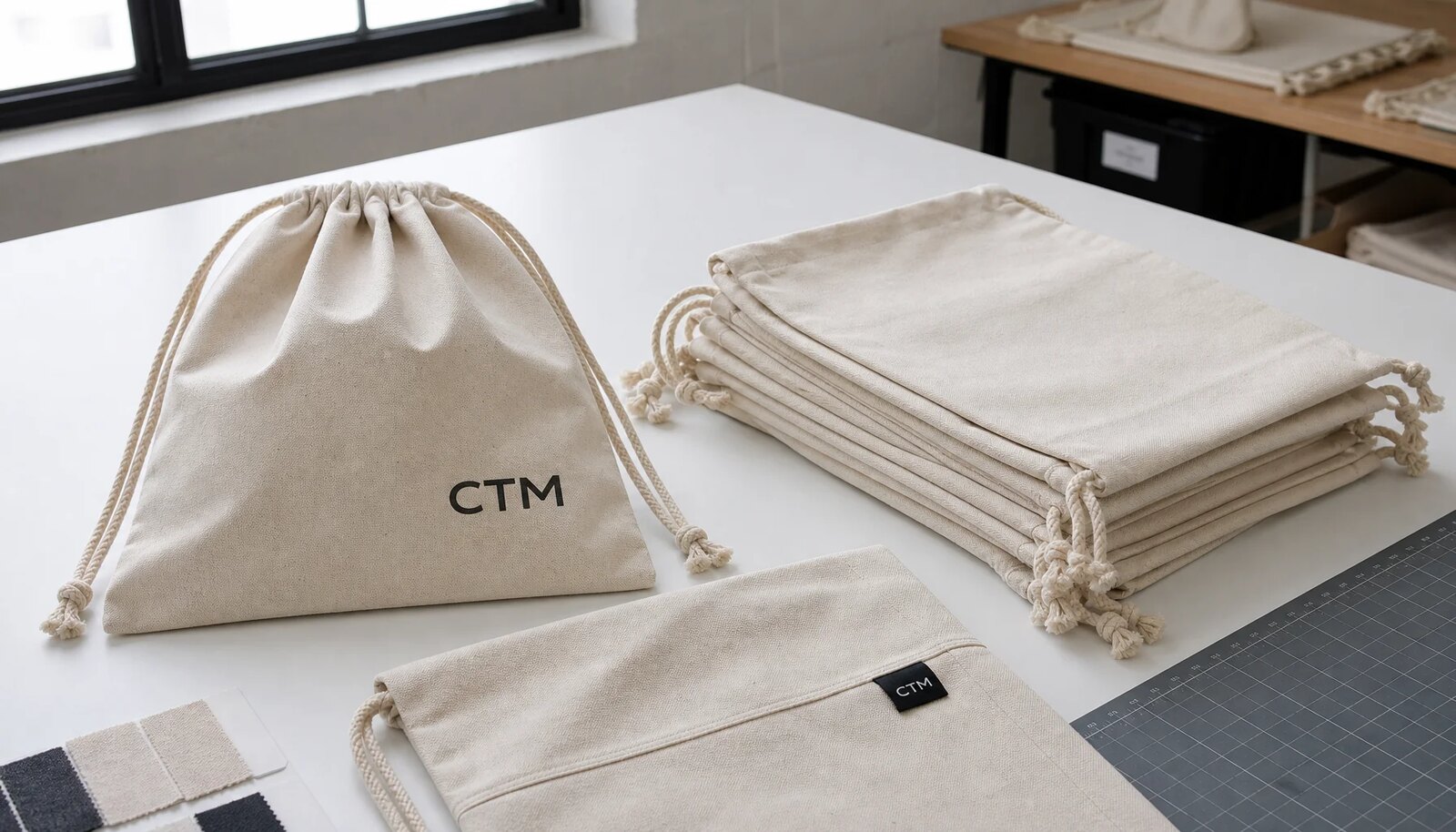
Start With the Event Job, Not the MOQ
MOQ negotiation gets easier when the supplier can see the job the bag has to do. A cotton drawstring backpack for a one-day registration desk is a different purchase from a premium conference kit, a campus recruiting giveaway, a staff pack, or a sponsor bundle with boxed samples inside. The first question is not how low the minimum can go. It is what the bag must hold, how it will be distributed, how long attendees are likely to carry it, and what the brand cannot afford to get wrong.
Turn that use case into measurable specifications before requesting a quote. Finished size, fabric weight, fabric color, cord type, logo method, logo dimensions, reinforcement, packing format, delivery destination, and in-hand date all affect the minimum. When these details are missing, suppliers protect themselves with higher MOQs, loose assumptions, or a cheap default construction that may not suit the event.
The phrase cotton drawstring backpacks for event planners MOQ negotiation guide sounds like a price discussion, but the real topic is control. A lower minimum helps only if the bags arrive on time, fit the event materials, look acceptable under venue lighting, and survive attendee handling. If MOQ is reduced by switching to thinner cotton, weaker cord exits, smaller print coverage, or rushed packing, the buyer has moved risk from the purchase order to the registration table.
Classify the order before the RFQ. A simple giveaway can often use natural 120-140 gsm cotton, a one-color print, stock cord, and bulk cartons. A conference kit may justify 140-160 gsm cotton, stronger reinforcement, cleaner stitching, and tighter packing checks. A sponsor-heavy program with several artwork versions may feel like one event to the planner, but it can look like several small production runs to the factory.
- Define function, contents, branding, packing, and delivery before negotiating MOQ.
- Separate attendee-facing requirements from internal preferences.
- Treat each fabric color, artwork version, and shipment wave as a possible MOQ driver.
- Protect construction and delivery reliability before chasing the smallest minimum.
Identify the Real MOQ Driver
MOQ is rarely a single number pulled from a price list. It usually reflects the smallest practical quantity for material booking, cutting, print setup, sewing line setup, packing labor, and inspection. Cotton drawstring backpacks look simple, but every variation creates another production event. A different fabric color may require a separate dye lot or stock allocation. A second logo version may need another screen, strike-off, carton label, and sorting step. A custom cord color can carry an accessory MOQ that is higher than the bag quantity itself.
Fabric is often the first constraint. Natural cotton and supplier stock colors can support lower quantities because the fabric may already be available or easy to purchase through regular channels. Custom-dyed cotton is different. It may require lab dips, dye-house minimums, shade approval, longer lead time, and extra colorfastness checks. If the buyer wants both a custom body color and a custom cord color, the order may hit two separate minimums before cutting begins.
Print and branding are another common floor. A one-color screen print on one side is efficient because setup is predictable and inspection is straightforward. Multi-color screen printing adds registration risk, drying or curing time, and more rejection points. Heat transfers can solve fine detail, but they bring temperature, pressure, adhesion, rub, and hand-feel checks. Woven labels and patches add their own development minimums and sewing operations.
Packing can raise MOQ quietly. Bulk cartons of identical bags are efficient. Sorting by sponsor, staff group, venue, or delivery wave is slower and easier to mispack. An order for 2,000 bags across five artwork versions and four destinations may be less efficient than an order for 1,200 identical bags shipped to one warehouse. The factory is not only pricing units. It is pricing interruptions, leftovers, relabeling, and error risk.
- Ask which driver sets the MOQ: fabric, dyeing, printing, accessories, sewing setup, packing, or shipment sorting.
- Use stock fabric and stock cord when low MOQ matters more than exact color matching.
- Limit artwork versions and delivery waves where the event plan allows it.
- Do not assume a higher total quantity is automatically simpler for the factory.
Write Specs a Factory Can Price Cleanly
A strong RFQ should read like a compact technical brief, not a mood board. Start with finished dimensions. Common event sizes include 34 x 42 cm and 35 x 45 cm, but the right choice depends on the contents. If the bag must hold an A4 folder, notebook, badge envelope, water bottle, brochure stack, or boxed sponsor item, test those items before the quote goes out. The usable opening after the hem channel matters as much as the flat measurement.
Fabric weight should be stated as finished gsm with a tolerance. Many event bags use 120-140 gsm finished cotton for light giveaways and 140-160 gsm finished cotton for more substantial kits. Ask whether the supplier is quoting finished gsm, loom-state gsm, or a nominal commercial range. If the quote only says 6 oz cotton or standard cotton, request clarification. Regional naming and supplier shorthand can hide meaningful differences in fabric weight and feel.
Construction details belong in the spec because they determine whether the bag behaves well in real use. Define hem channel depth, side seam and bottom seam type, seam allowance, overlock or lockstitch requirement, cord exit treatment, and bar-tacks if required. The cord needs its own line: cotton or polyester, braided or flat, approximate diameter, finished length, color, knotting, and end finish. If supplier-standard cord is acceptable, state the minimum acceptable diameter and color family.
Branding requirements should include artwork file format, print dimensions, print location, number of colors, Pantone references if needed, and whether artwork is final. Placement should be measured from a clear reference point such as top edge, side seam, or center line. A logo that looks centered on a flat proof may shift visually when the bag is loaded or closed, so approve from physical sample photos and measurements, not only a digital mockup.
- Quote finished dimensions and usable opening, not only a vague size name.
- Specify finished gsm and tolerance in writing.
- Define cord, seam, hem channel, and reinforcement details because they affect event durability.
- Attach final artwork and state whether print color, size, and placement are fixed.
Make Quotes Comparable
For B2B procurement, the quote should show assumptions, inclusions, exclusions, and deviations. A unit price alone is not enough. Ask each supplier to quote against the same specification and call out any change they have made to reach the price. The quote should include bag size, fabric weight, body color, cord spec, branding method, print dimensions, number of print colors, packing format, carton details, Incoterm, lead time, sample cost, setup cost, and payment terms.
Separate setup charges from unit price. Screen charges, plate making, print strike-offs, Pantone matching, woven label development, patch sewing, sample fees, carton labels, individual polybags, and inland freight may be included by one supplier and excluded by another. These line items are not automatically unreasonable. The problem is when they appear late. For smaller event orders, a setup fee spread across 300 or 500 pieces can change the effective unit cost more than a small difference in base price.
Ask for tiered pricing tied to real decisions. If the event needs 800 bags, request 800, 1,000, and 1,500 pieces using the identical specification. Include a planned overage tier if late registrations, staff packs, or sponsor extras are likely. This helps you see whether MOQ is driven by a fixed setup cost, a fabric roll minimum, or labor efficiency. Avoid requesting unrealistic tiers only to get a unit price that will never be approved.
The quote should also state overrun and underrun tolerance. Textile cutting and quality rejection can create small quantity variation, but events often need a firm count. If exact quantities are required, order a planned overage and define whether excess units are acceptable. A plus or minus 3% tolerance may be workable for merchandise inventory. It can be risky for a conference with fixed attendee numbers and no time to reorder.
- Require each quote to show spec assumptions and deviations.
- Break out setup, sampling, packing, and freight-related charges.
- Request practical quantity tiers using the same build.
- Confirm whether the order allows overrun, underrun, or exact shipment only.
Negotiate MOQ With Smarter Tradeoffs
The best MOQ concessions usually come from reducing variation, not weakening the bag. Keep one body size, one fabric weight, one fabric color, one cord spec, one print side, one artwork version, and one packing method wherever possible. If multiple sponsors are involved, consider one shared bag design and put sponsor variation on printed inserts, event programs, hangtags, paper sleeves, or carton allocations. That keeps the production run cleaner while still supporting sponsor visibility.
Be careful with changes that remove the features preventing visible failure. Do not strip out cord exit reinforcement, accept very loose stitching, or move to a fabric that is too thin for the planned load. Attendees may not know the gsm number, but they can feel a bag that looks flimsy or fails in use. Event staff will notice cords pulling out, seams opening, and prints smearing during registration. Better levers include stock body color, stock cord, smaller print area, one-color artwork, bulk packing, and one consolidated delivery.
Ask the supplier to explain the MOQ floor in plain terms. If fabric minimum is the blocker, natural cotton or stock fabric may solve it. If print setup is the blocker, simplified artwork or fewer versions may help. If packing labor is the issue, bulk cartons or fewer destination splits may lower the minimum. If sewing line efficiency is the constraint, a master PO with scheduled delivery releases may work better than several small orders placed separately.
Commercial discipline can also help. Offer final artwork at PO, faster deposit, one decision-maker for sample approvals, stable carton requirements, and acceptance of standard export packing if those terms genuinely fit the event. Suppliers are more flexible when buyer-side uncertainty is low. Asking for a lower MOQ while colors are undecided, logos are pending, and destination splits are still moving gives the factory good reason to hold the minimum.
- Simplify variations before changing fabric strength or sewing quality.
- Ask the supplier which specific change would lower MOQ.
- Use one master order when several small event waves share the same bag.
- Trade clear approvals and stable specs for better commercial flexibility.
Match Branding to Quantity and Detail
Branding choice affects MOQ, cost, lead time, and defect risk. One-color screen print is often the most efficient option for cotton drawstring backpacks used at events. It works well for simple logos, short text, and bold artwork. It is also easy to inspect because buyers can define print dimensions, placement, color, and edge quality. The main checks are ink opacity, cure, smearing, cracking, and placement consistency on textured cotton.
Multi-color screen print should be used when the artwork justifies the added setup. Each color can require its own screen and registration control. Small sponsor logos, fine text, and tight spacing may not reproduce cleanly on cotton weave, especially on lower gsm fabric. Before locking the design, ask whether the artwork can be simplified, printed as one color, moved to an insert, or handled with a transfer method.
Heat transfer can help with fine detail, gradients, or full-color marks, but it is not automatically better. Transfers can feel heavier on cotton, may show a film edge, and require correct temperature, pressure, and dwell time. Ask for a transfer sample on the actual fabric. Check adhesion, hand feel, edge lifting, rub behavior, and appearance after folding. For event bags that will not be laundered, rub resistance, blocking, and carton-compression appearance may matter more than wash testing.
Woven labels, patches, and hangtags can create a more premium presentation and sometimes reduce print risk. They are useful when the logo is small, complex, or intended to feel subtle. The tradeoff is label MOQ, label artwork approval, sewing placement tolerance, and another production dependency. If the bag MOQ is low but the woven label MOQ is high, the branding route becomes the real minimum. Ask before the design is approved.
- Use one-color screen print for simple, efficient event branding.
- Require strike-offs for strict color, fine detail, or large print areas.
- Check transfer hand feel, adhesion, rub behavior, and carton compression risk.
- Confirm label, patch, or hangtag MOQs before choosing premium branding.
Control Sampling Before Bulk
Sampling should answer one question at a time. An existing sample shows general workmanship and fabric feel. A material swatch confirms fabric and shade direction. A lab dip confirms custom dye color. A print strike-off confirms artwork size, ink color, opacity, and edge behavior on the actual cotton. A proto sample confirms size and construction. A pre-production sample should represent final fabric, cord, construction, branding, and packing. That final sample should become the main reference for bulk production.
Measure the sample against the RFQ rather than judging it by appearance alone. Record finished width, finished height, usable opening, cord length, channel depth, seam consistency, and logo placement from defined reference points. Load the actual event contents into the bag. A cotton drawstring backpack can look fine when empty but show stress at the cord exits or bottom seam when packed with a notebook, bottle, and sponsor sample.
For print approval, compare the physical output to the artwork file and Pantone target where relevant. Natural cotton absorbs ink and can make colors look softer than a digital proof. The weave can reduce sharpness at small text or thin lines. Define whether slight texture show-through is acceptable. For large prints, check that ink is cured before folding and does not block, transfer, or crack when compressed in a carton.
Keep a sealed sample or a documented approval file with photos, measurements, and written comments. The buyer, supplier, and inspector should work from the same reference. If the event team changes artwork, print size, body color, packing, or quantity after approval, ask whether a new strike-off or sample is required. A small design change can still mean a new screen, revised label, or adjusted production setup.
- Use the right sample type for the decision being made.
- Approve bulk only against final-material and final-process samples.
- Test real event contents before signing off.
- Document measurements, photos, approved tolerances, and change history in one reference file.
Set QC Criteria Before the PO
Quality control should be written before production starts. Define critical, major, and minor defects in terms the supplier and inspector can apply. Critical issues include wrong logo, wrong artwork version, unsafe contamination, mold odor, or a construction failure that makes the bag unusable. Major defects include open seams, missing cord, severe stains, broken stitches, wrong size outside tolerance, print smearing, badly misregistered artwork, or carton sorting errors. Minor defects may include small loose threads, slight natural cotton slubs, or small placement variation within agreed tolerance.
Agree on measurable tolerances. Finished dimensions for soft sewn products need some tolerance because cotton cutting and sewing are not machined processes, but the tolerance must not prevent the intended insert from fitting. Print placement should be stated in millimeters from the top edge, side seam, or center line. If the supplier proposes a standard tolerance, record it in the PO or approval sheet. Vague approval language creates disputes once bulk is packed.
Fabric QC should respect cotton's natural character without accepting poor handling. Natural cotton may show slubs, seed flecks, and mild shade variation. That is different from oil marks, dirt, holes, heavy broken yarns, mildew odor, or severe shade changes within the same bag. For dyed cotton, inspect shade consistency across cartons and run basic dry-rub checks if bags may touch light-colored event materials. For white or light natural bags, cleanliness during sewing and packing matters.
Inspection should cover product and packing together. Pull units from multiple cartons, not only from the top of one carton. Compare pieces to the approved sample, measure dimensions, test drawcord movement, inspect seams, check reinforcement, verify logo placement, and review print cure. Then verify carton marks, quantity per carton, inner bundle count, destination labels, artwork version labels, and packing list accuracy. For events, a carton with the wrong sponsor version can be as disruptive as a defective bag.
- Define critical, major, and minor defects before issuing the PO.
- Write finished-size and print-placement tolerances in measurable terms.
- Inspect fabric, sewing, cord function, logo quality, and packing accuracy.
- Sample across cartons, colors, artwork versions, and destination splits.
Use Packing as a Control Point
Packing affects cost, freight, cleanliness, and venue execution. Bulk flat packing in export cartons is usually the most efficient option for standard event distribution. Cartons of 25 or 50 bags are often practical for registration teams because they are easy to count and stage. Ask for carton dimensions, gross weight, net weight, carton count, carton material, and units per carton before final freight decisions. A low ex-factory price can lose value if carton cube is inefficient.
Individual polybags, paper sleeves, belly bands, or presentation inserts can make sense for VIP kits or pre-packed welcome boxes, but they add real work. They increase material cost, packing labor, inspection steps, disposal burden, and carton volume. For many events, clean bulk packing with consistent inner bundles is a better compromise. If bags are printed with large logos, confirm folding direction and whether print surfaces touch each other. Ink that is not fully cured can transfer under shipment pressure.
Carton marking should be treated as a controlled spec, especially for multi-venue events. Marks should identify SKU, artwork version, fabric color, quantity, destination, carton number, and event wave if relevant. If cartons are palletized, confirm pallet height, stretch wrap, mixed-carton rules, and whether destination cartons can be separated without relabeling. Packing mistakes are often discovered late, when event staff have little time to sort or correct them.
Logistics can be part of MOQ negotiation. A supplier may accept a smaller order when the buyer agrees to one destination, one ship date, and bulk packing. Split shipments may be necessary, but provide allocations early so the factory can pack correctly. If the order repeats annually, consider one efficient batch with scheduled releases, provided storage conditions, inventory ownership, and event timing are clear.
- Confirm carton count, dimensions, weight, units per carton, and carton marks before shipment.
- Choose individual packing only when it improves the actual distribution process.
- Define folding method when print protection matters.
- Provide destination and version allocations before packing starts.
Build the Timeline Backward
Event planners should schedule cotton drawstring backpack sourcing backward from the required in-hand date. That date is not the factory ship date. It should include customs clearance if applicable, local delivery, warehouse receiving, carton count check, kitting, transfer to venue, and contingency time. The supplier's production lead time normally starts after deposit, final artwork, and sample approval. If any of those items are open, the production clock has not truly started.
Break the schedule into RFQ, quote review, sample development, sample approval, material booking, bulk production, inspection, packing, shipment, customs, and local delivery. Stock-fabric bags with one-color print can move faster than custom-dyed, multi-version, or label-heavy orders, but approvals still control the timeline. Ask which changes reset lead time: artwork revision, Pantone change, fabric color change, packing change, quantity increase, or destination split.
Freight mode belongs in landed cost, not in a late emergency discussion. Sea freight may be economical for larger orders with enough time. Air freight or courier may be needed for urgent samples, late approvals, or small replenishment quantities. A low unit price can become expensive if the schedule forces air freight. Compare unit cost, setup charges, carton cube, freight, duty, and local handling before selecting the supplier.
Name the person who can approve samples and deviations. Sponsor-heavy events often lose time because logos are still being collected after sourcing begins. If sponsor artwork is uncertain, quote the base bag separately and hold versioned artwork as a controlled add-on. The more final the inputs are at RFQ stage, the more credible the MOQ negotiation becomes.
- Set the required in-hand date and build the schedule backward.
- Clarify which approval starts bulk production.
- Ask what changes reset the factory lead time.
- Compare landed cost under realistic freight modes before awarding the order.
Specification comparison for buyers
| Spec decision | Recommended option | When it fits | Buyer risk to check |
|---|---|---|---|
| Finished size | 34 x 42 cm or 35 x 45 cm | Registration bags for badges, A4 sheets, folded brochures, maps, notebooks, and light sponsor inserts | Confirm finished-size tolerance, usable opening width, and whether the intended contents still fit after hemming and drawcord closure |
| Fabric weight | 120-140 gsm finished cotton | Cost-controlled giveaways carrying brochures, badge envelopes, flyers, maps, or light flat inserts | Below the agreed gsm range, cotton can look transparent, wrinkle heavily, distort print edges, and weaken the cord channel |
| Fabric weight | 140-160 gsm finished cotton | Conference kits, recruiting events, sponsor bags, and repeat-use attendee bags | Higher fabric weight raises unit cost, carton gross weight, and freight cost; compare landed cost and carton cube before approving |
| Fabric color | Natural cotton, white, black, or supplier stock color | Lower-MOQ programs where speed, price stability, and simpler sourcing matter | Natural cotton shade varies by lot; define acceptable shade range, seed mark level, slub level, and visible stain limits |
| Fabric color | Custom-dyed cotton | Brand-critical programs where bag color must follow a campaign palette or venue theme | Ask for dye MOQ, lab dip approval time, shade tolerance, colorfastness checks, and whether the drawcord must match |
| Cord | Standard cotton or polyester braided cord, stock color | Most event bags where function and delivery reliability matter more than exact accessory matching | Confirm cord diameter, finished length, pull strength, knot security, and whether cord ends fray after repeated handling |
| Print method | One-color screen print on one side | Most procurement-led event orders with simple logos and medium quantities | Confirm screen charge, ink type, cure process, print placement tolerance, and whether a strike-off is included |
| Print method | Multi-color screen print or transfer | Sponsor-heavy artwork, gradients, fine detail, or brand marks that cannot be simplified | More setup, registration risk, possible heavier hand feel, and higher rejection risk on textured cotton |
| Branding detail | Sewn woven label, patch, or hangtag | Premium events, subtle co-branding, or artwork that does not print cleanly on cotton | Check label MOQ, sewing tolerance, needle damage, label lead time, and whether label approval delays bulk production |
Buyer checklist before sampling
- Actual event use case: registration giveaway, sponsor kit, VIP pack, recruiting bag, merchandise bundle, staff distribution, or pre-packed welcome kit
- Finished bag width and height, plus the exact insert, brochure, notebook, folder, bottle, box, or sample item the bag must hold
- Usable opening width after the hem channel and drawcord closure, not only the flat bag dimensions
- Target finished fabric weight in gsm and acceptable tolerance, such as +/-5% or a supplier-stated commercial tolerance
- Fabric color standard: natural cotton shade range, stock color reference, Pantone target, lab dip requirement, or approved swatch
- Whether gsm is quoted as finished gsm, loom-state gsm, or supplier nominal gsm, and how it will be verified in bulk
- Cord type, cord material, diameter, finished length, color, knotting, end finish, and whether supplier-standard cord is acceptable
- Construction details: hem channel depth, side seam, bottom seam, seam allowance, overlock or lockstitch, cord exit treatment, and reinforcement
- Bar-tack or reinforcement requirements at cord exits and any load expectation for conference kits, sponsor inserts, or merchandise packs
- Logo method: screen print, heat transfer, woven label, sewn patch, hangtag, paper sleeve, or combined branding method
Factory quote questions to send
- What is the MOQ per finished bag size, per fabric color, per artwork version, per print method, and per shipment wave?
- Which part sets the MOQ floor: fabric purchase, dyeing, cutting, print setup, accessory sourcing, sewing line setup, packing, or shipment sorting?
- Is the quoted fabric weight finished gsm, loom gsm, or nominal supplier range, and what tolerance will you guarantee in production?
- Is the fabric in stock, cut from existing greige goods, newly woven, or custom dyed for this order?
- For natural cotton, what shade variation, slub level, seed mark level, and visible stain limit do you consider acceptable?
- What cord material, diameter, finished length, color, pull strength, knotting, and end treatment are included in the unit price?
- What seam type, hem channel construction, seam allowance, reinforcement, and bar-tack standard are included?
- Are screen setup, plate making, print strike-off, Pantone matching, label development, patch sewing, sampling, carton marking, and destination labels included or separate?
- What is the print placement tolerance, finished-size tolerance, color tolerance, shade tolerance, and quantity overrun or underrun tolerance?
- Will the pre-production sample use bulk fabric, bulk cord, final construction, final print process, final label, and final packing?
Quality-control points to confirm
- Finished width, height, usable opening, and drawcord closure are within agreed tolerance and fit the intended event contents without forcing
- Fabric weight checks align with the agreed finished-gsm range and the approved sample hand feel
- Fabric shade, weave, slub level, and visible cotton marks match the approved standard, with no heavy lot-to-lot shade shift across cartons
- No unacceptable stains, oil marks, holes, mildew odor, broken yarns, cutting damage, or dirty handling marks on attendee-facing panels
- Side seams, bottom seams, hem channel, and seam allowances are secure, straight, and free of skipped stitches, open seams, puckering, or raw exposed edges
- Cord material, diameter, finished length, color, knotting, and end finish match the approval sample; cords pull smoothly and close evenly from both sides
- Cord exits include agreed bar-tacks or reinforcement, with no tearing, fraying, or weak stitch points after manual pull testing
- Print size, color, opacity, registration, edge sharpness, cure, and placement match approved strike-off within written tolerance
- No print smearing, blocking, cracking, excessive hand feel, ink transfer, obvious pinholes, or contamination in the logo area
- Woven labels, patches, hangtags, paper sleeves, or carton version labels are the correct version, correctly positioned, and securely attached or applied