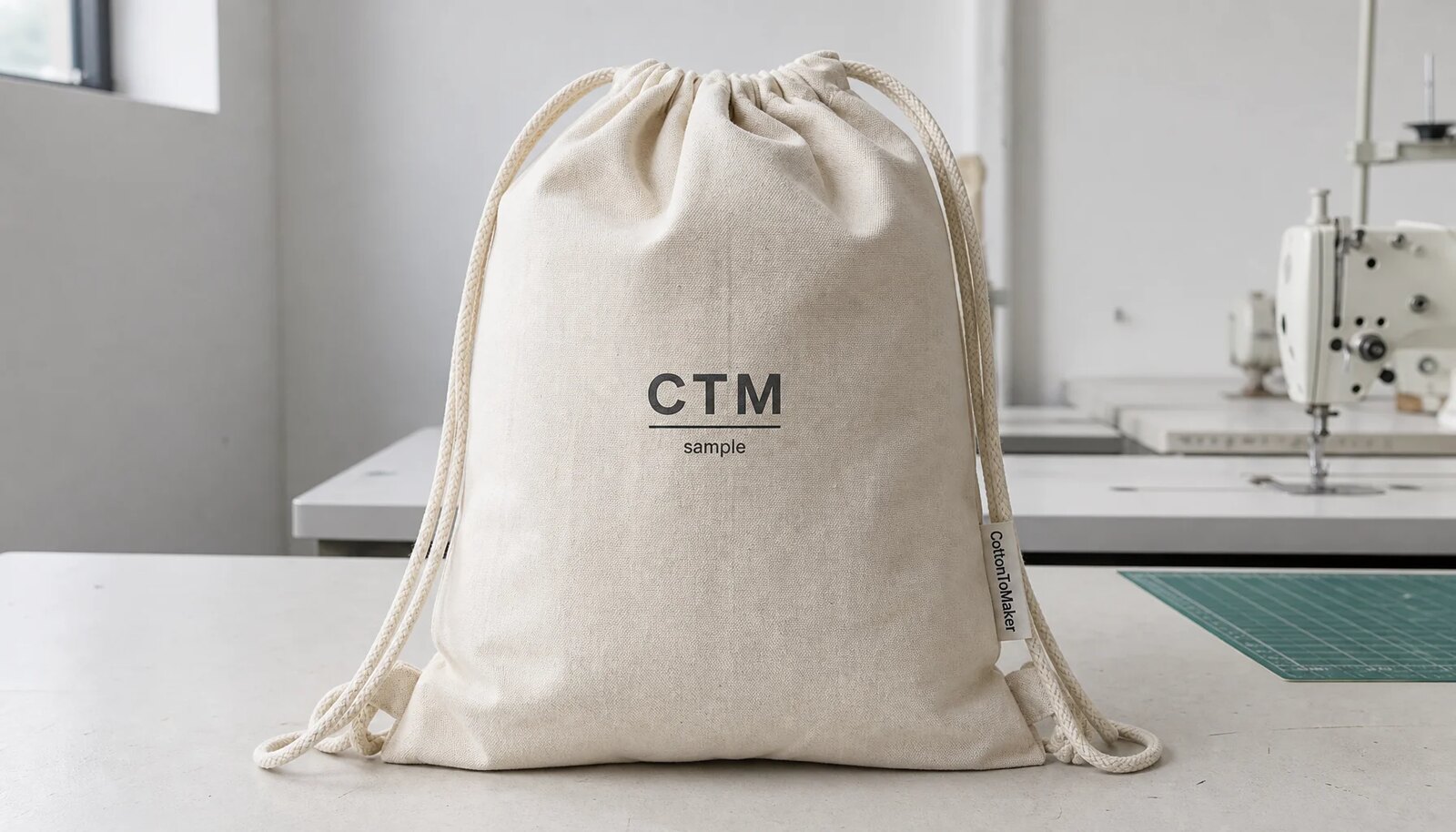
Start with the finished bag, not the flat artwork
Most logo placement failures happen before production begins. A buyer approves a centered mark on a flat PDF or mockup, but the factory later adds side seams, turns the top cord tunnel, threads the drawstrings, presses the bag, and folds it for packing. The result is a logo that suddenly looks too high, too close to the edge, or partly hidden once the backpack is cinched. On cotton drawstring backpacks for event planners, this matters because distribution is usually fast and public. Bags are handed out at registration tables, dropped into hotel rooms, stacked at sponsor booths, or photographed at entrances. If the logo reads poorly at that moment, the order has already missed its purpose.
Procurement teams should therefore approve placement on the finished product geometry, not on a blank rectangle. Ask the supplier for a dimensioned bag sketch that shows finished width and height, side seam allowances, top tunnel depth, bottom fold, and any construction detail that reduces the visible front panel. Also confirm whether the print is applied before sewing or after sewing. A design centered on the cut panel may shift slightly once the bag is sewn and pressed, especially on lighter cotton. If a supplier cannot provide a technical sketch, then the pre-production sample becomes the approval master and every placement measurement should be recorded directly from that physical sample.
- Request a finished-size tech sketch, not only a flat artwork mockup.
- Treat the front panel as a reduced usable area once seams and tunnel depth are included.
- Review placement on the bag flat, cinched, and lightly filled before approval.
Calculate the usable print area with margins, not guesswork
Event buyers often start with a common bag size such as 35 x 45 cm or 38 x 42 cm and assume the entire face is printable. In practice, the print zone is smaller. Each side seam consumes part of the visual width, the top tunnel may remove 25 to 40 mm from the upper area, and the bottom fold can round upward when the bag carries weight. If the bag is packed tightly, the center of the panel may also take a soft crease that changes how a large solid print reads on arrival. Tall logos, stacked sponsor blocks, URLs, QR codes, and fine text are the first elements to suffer when buyers ignore these reductions.
The most reliable approach is to define logo position from fixed reference points. State the artwork width and height in millimeters, then record the top offset from the bottom of the finished cord tunnel or from another clearly defined line, plus the left offset from the finished side seam. That gives every factory the same measurement logic and makes quality control objective. Inspectors can use a ruler rather than arguing about whether the print looks centered by eye. If the graphic includes legal text, a website, or small sponsor names, leave more clearance than you would for a single bold icon. Compression and wrinkling near the top of the bag usually reduce small-text legibility first.
- As a practical starting rule, keep the main logo about 20 to 30 mm below the cord tunnel on standard event bags.
- Leave roughly 15 to 20 mm clearance from each side seam so the print does not fall into the turned edge.
- Keep fine text and QR codes away from the bottom quarter of the bag, where folding and body pressure are strongest.
- Approve the same placement dimensions on both the artwork sheet and the physical sample.
Choose fabric weight and weave before you choose decoration
Fabric weight determines how stable the front panel will be when it is printed, sewn, packed, and worn. A 120 to 160 GSM plain-weave cotton bag can work well for economical giveaways, but it does not behave like a 180 to 220 GSM twill or a heavier canvas-style drawstring backpack. Lighter fabrics wrinkle more easily, allow more show-through from heavy ink coverage, and offer less support for dense embroidery or large patches. Midweight constructions usually give event planners the best balance between cost, print clarity, and perceived value. Heavier cotton or canvas becomes more useful when the bag is meant to feel like a premium gift or a repeat-use retail item instead of a one-day carrier.
Weave also changes decoration performance. Plain weave may show more texture through the print, twill often presents a steadier surface, and heavier canvas can handle embroidery or sewn patches with less distortion. Ask for the actual construction details rather than accepting the word cotton as a complete specification. Buyers should confirm GSM tolerance, weave type, dyed or natural base, and whether darker colors require an underbase for print opacity. If the bag body color changes, the same logo may need a different ink build, which affects both unit cost and lead time. That is why artwork scale and decoration method should follow fabric choice, not the other way around.
- Use 120 to 160 GSM cotton for budget-sensitive giveaway orders with simple, low-risk prints.
- Use roughly 180 to 220 GSM when you want a cleaner front panel and more stable bulk production.
- Move to 220 GSM and above or canvas-style fabric when embroidery or sewn patches are part of the spec.
- Request the actual weave and color construction, because fabric texture changes print edge clarity and distortion risk.
Match logo placement to how the bag will be used at the event
Placement should reflect the bag's job at the event, not just the brand guide. A registration giveaway needs fast recognition from a distance, so a centered front logo usually performs best. A VIP welcome bag may justify a more restrained side label or a smaller front mark if the presentation needs to feel more polished than promotional. A volunteer or staff bag may need larger text and stronger contrast because it doubles as wayfinding inside the venue. Sponsor-funded bags add another layer: the event brand often needs the front panel, while sponsor logos belong on the back or in a secondary area that does not turn the product into a cluttered bulletin board.
Think about how attendees will actually carry the bag. When the bag is full and cinched, the upper area compresses first, which is why tall logos placed too high tend to wrinkle or disappear. When the bag hangs against the body, very low artwork can be obscured by the wearer's arm or hip. If photography matters, keep the primary mark where it reads in quick crowd shots. If reuse matters, keep the layout simple enough that the bag still feels acceptable outside the original event context. Buyers often get better long-term value from one strong front mark and one subtle secondary brand element than from trying to fit every stakeholder onto the front panel.
- Center front is the safest default for high-volume event distribution.
- Lower-front placement works better for tall logos and bags that will be cinched tightly.
- Back-panel branding suits sponsor marks, dates, or secondary campaign information.
- Side labels or small hem labels work well when the bag needs a retail-like or repeat-use presentation.
- Do not let stakeholder additions force critical text into the tunnel area or near the seams.
Decoration method changes both placement risk and unit economics
Screen print remains the most practical default for cotton drawstring backpacks because it balances visibility, durability, and bulk pricing. It is especially efficient for one-color or two-color front logos at medium to high quantities. The method is familiar to most factories, easy to inspect, and usually the least risky choice for event deadlines. Once the artwork becomes multicolor, tightly registered, or very large, setup and reject risk both rise. Dark dyed bags may also require an underbase or higher-opacity ink build, which improves visibility but changes hand feel and can extend curing time. Buyers should ask whether the logo is printed before sewing or after sewing, because that affects both usable area and alignment control.
Other decoration methods solve different commercial problems. Heat transfer or digital transfer works when quantities are smaller, sponsor versions change, or the design includes names, gradients, or image elements that do not suit standard screen printing. The tradeoff is greater sensitivity to folding and pressure in packed cartons. Embroidery communicates a more premium finish, but it should be reserved for heavier cotton or canvas and simpler shapes, otherwise the panel can pucker. Woven labels and sewn patches create permanent branding without covering a large print area, but they introduce extra labor, separate MOQs, and another placement tolerance to manage. Procurement should choose the method that the fabric, artwork, and delivery window can realistically support.
- Choose screen print for the cleanest cost control on straightforward event logos.
- Use transfer methods when artwork complexity or personalization is more important than the softest hand feel.
- Use embroidery only when the fabric can support stitch density without distorting the panel.
- Use woven labels for subtle permanent branding and sewn patches for textured, higher-value presentation.
- Confirm whether decoration happens before or after sewing, because that changes placement logic and QC checkpoints.
Write RFQs so every supplier is quoting the same backpack
A weak RFQ is the main reason buyers receive prices that cannot be compared. One supplier quotes a smaller logo, another assumes a lighter fabric, a third includes a single-side print but omits the side label, and the lowest number looks attractive only because the specification is incomplete. To keep quotes comparable, the RFQ should freeze the bag's finished dimensions, cotton GSM, weave type, body color, cord material and thickness, decoration method, logo size in millimeters, print colors, exact placement, and packing requirement. If the event uses multiple sponsor versions or split shipments, include those variables at the start. Otherwise the hidden cost appears after the PO is placed.
Ask for pricing in quantity tiers and request visible line items where possible: sample cost, screen or setup charge, label sewing charge, patch charge, polybag cost, carton marking, and freight basis. Buyers should also define the commercial terms that matter to procurement, such as ex-works, FOB, or delivered pricing, plus the date from which lead time is counted. If two factories price different assumptions on setup, inspection, or packing, they are not quoting the same product. A disciplined RFQ does more than reduce price confusion. It exposes which supplier has actually read the job and which supplier is only trying to win on a headline unit cost.
- Include a bag drawing or annotated artwork sheet with placement dimensions in millimeters.
- Specify body color, cotton weight, cord specification, and any label or patch construction in the same document.
- Ask for quantity breaks, setup costs, sample charges, and packing terms instead of a single blended unit price.
- State whether pricing should be ex-works, FOB, or delivered so landed-cost comparison is real.
- Require written confirmation of overrun, underrun, and defect-replacement policy before comparing offers.
Use a staged sample approval process instead of one generic sign-off
A digital proof is useful, but it only proves layout, spelling, and approximate visual balance. It does not prove how the print sits on the real bag, how the cotton weave affects edge clarity, or whether the mark disappears when the drawstrings are tightened. A better process separates approvals into stages. First, approve the artwork file for content and dimensions. Second, approve a strike-off or decoration sample for print color, opacity, edge definition, thread appearance, or label construction. Third, approve a full pre-production sample on the actual bag fabric and construction. Each step answers a different question, and skipping steps is how buyers end up approving a design without approving the product.
This staged approach is especially important when multiple stakeholders are involved, such as sponsors, marketing teams, or event agencies. Once the pre-production sample is approved, freeze the approved reference points: bag size, fabric, logo size, logo position, color standard, and packing direction. If the artwork changes after that point, treat it as a revision with a new approval record instead of a casual email note. That gives procurement clear change control and protects the factory from conflicting instructions. For fixed event dates, a clean approval chain can matter as much as price because it prevents production from stalling while different teams debate details that should have been locked earlier.
- Use the digital proof to confirm content and dimensions, not final production behavior.
- Use a strike-off or decoration sample to confirm color, opacity, thread look, or label construction.
- Use the full pre-production sample to confirm actual placement on the sewn bag when flat and cinched.
- Freeze all approved details after pre-production sign-off and treat later artwork changes as formal revisions.
Inspect quality by defect type, not by general impression
Event buyers need inspection standards that are concrete enough to catch costly errors before shipping. The most useful approach is to define defects by severity. Critical defects usually include the wrong logo, the wrong sponsor version, severe spelling errors, or any issue that makes the bag unusable. Major defects often include print placement outside the approved tolerance, unreadable text, poor print opacity, crooked labels, cords that do not run smoothly, or seam failures. Minor defects might include small loose threads or slight shade variation within an agreed range. Whether you use an internal standard or a formal AQL plan, the key is to classify defects before inspection starts so everyone evaluates the same way.
Inspection should also happen at more than one stage. Incoming checks can confirm fabric shade, GSM, weave consistency, and cord components before decoration begins. Inline checks can catch registration drift, misplaced prints, uneven embroidery tension, or label orientation problems early enough to correct them without reworking completed cartons. Final inspection then confirms that the last carton is as good as the first. For decorated cotton drawstring backpacks, a bag that looks acceptable in a quick photo can still fail in real use if the logo crosses the tunnel line, cracks after folding, or becomes unreadable when the bag is cinched. Functional checks matter as much as visual ones.
- Define critical, major, and minor defects before production so acceptance is not subjective.
- Check incoming fabric and cords before decoration starts, especially if multiple lots or dyed colors are involved.
- Inspect the first production pieces and mid-run output, not only the final packed cartons.
- Run a simple use check: open the bag, cinch it, reopen it, and confirm the logo still reads clearly.
- Compare the first carton and the last carton against the same approved sample and measurement sheet.
Packing and distribution planning protect the decorated panel
Packing is often treated as an afterthought, but it can undo a good branding decision. A front print that looks clean at the end of production can arrive with a hard crease through the center if the folding direction is wrong. Transfers are particularly sensitive if they are packed before fully stabilizing, and thick patches can press marks into the opposite panel when cartons are overfilled. Buyers should specify whether the logo must face outward or inward in the fold, whether individual polybags are required, and whether an interleaf or looser fold is needed for more delicate decoration. Sustainable packaging goals also matter here, because unnecessary polybags add cost and handling without always improving protection.
Distribution planning becomes even more important when bags are split by venue, sponsor version, colorway, or attendee type. Carton markings should help the event operations team move product without opening every box. A clear carton label can include PO number, bag color, logo version, quantity, destination room or venue code, and carton count. If the order is shipping to multiple sites, build the distribution map into the packing instruction before mass production. That reduces recounting, relabeling, and last-minute mistakes at the warehouse. For event planners, efficient packing is not just a logistics detail. It is part of brand protection because the first person who sees the bag at the venue is often not the buyer who approved it.
- Do not place the primary logo directly on the main fold line unless the decoration method has been approved for it.
- Avoid overfilled cartons that compress patches, labels, or fresh prints against the opposite panel.
- Use carton marks that identify colorway, logo version, quantity, and venue destination at a glance.
- Write split-pack instructions before production if different sponsors or attendee groups need separate cartons.
Lead time, landed cost, and contingency planning decide whether the order is truly safe
Lead time should be counted from the point at which production can actually move, which is usually artwork approval and pre-production sample sign-off, not just PO date. The critical path may include fabric sourcing or dyeing, screen or transfer setup, sample sewing, sample approval, bulk production, inspection, and freight. A simple one-color screen print on natural cotton can move quickly, but every added variable changes the schedule: dark dyed fabric, multiple sponsor versions, labels, embroidery, or split deliveries all add coordination steps. Buyers should ask suppliers to state both production days and ex-factory date, then add realistic buffer time for inspection and transport. Event dates are usually fixed, so schedule risk deserves the same attention as unit cost.
Landed cost follows the same logic. The lowest blank bag price often becomes the most expensive total program once setup, decoration labor, sampling, packing changes, rework risk, and expedited freight are included. Procurement teams should compare total delivered cost against failure risk. For many event programs, the strongest default specification is a midweight cotton bag with a single front screen print and disciplined packing instructions. If the date is immovable and approvals are uncertain, a simpler decorated factory run or even a blank-bag contingency may be commercially safer than a premium decoration plan that leaves no recovery time. The right sourcing decision is the one that delivers readable branding on schedule, not the one that only looks cheapest on the first quote line.
- Count lead time from artwork and sample approval, because that is when production constraints become real.
- Add schedule buffer when fabric color, label sewing, and print setup all change on the same order.
- Compare landed cost, not only blank bag cost, by including setup, sampling, packing, inspection, and freight assumptions.
- Use the simplest decoration method that still meets the event objective when the deadline cannot move.
- Keep a documented backup plan for late sponsor approvals, short shipments, or last-minute regional splits.
Specification comparison for buyers
| Spec decision | Recommended option | When it fits | Buyer risk to check |
|---|---|---|---|
| Main front logo | Center-front screen print with measured clearance below the cord tunnel | High-volume registration bags, sponsor giveaways, hotel welcome packs | Usable print area must be based on the finished sewn bag, not the flat cut panel |
| Tall or stacked artwork | Lower-front print with extra top clearance | Bags that will be cinched tightly or carried full | If placed too low, the mark can disappear against the wearer's body when the bag is worn |
| Secondary sponsor branding | One-color back-panel logo, URL, or event date | Multi-sponsor events that need a cleaner front panel | Back visibility is lower, so avoid paying for complex artwork that will not be seen well |
| Subtle permanent branding | Woven side label sewn into the side seam | Premium events, resale programs, or repeat-use bags | Label MOQ, fold type, and seam orientation must be approved before bulk production |
| Premium front branding | Embroidery on 220 GSM or heavier cotton or canvas | VIP gifts, staff kits, or merchandise with longer intended use | Light fabric can pucker, and high stitch counts can distort the front panel |
| Short-run personalization | Heat transfer or digital transfer | Names, team designations, room groups, or multicolor art at lower quantities | Packed folds can crack or lift transfer film if the application and curing are weak |
| Textured heritage look | Sewn patch on a heavier base fabric | Museum shops, lifestyle events, and branded merchandise programs | Patch thickness increases labor cost and can leave marks on the opposite panel in packed cartons |
| Dark dyed bag body | Screen print with underbase or other high-opacity ink build | Black, navy, forest, and other dark cotton colors | Underbase changes hand feel, can affect color matching, and may require longer curing time |
| Late artwork approval contingency | Blank bag sourcing plus local decoration | Fixed event dates with uncertain final sponsor sign-off | Brand consistency can drift between local decorators unless color standards are locked first |
Buyer checklist before sampling
- Freeze the finished bag size, fabric GSM, weave, color, and cord specification before approving logo scale.
- Request a dimensioned bag drawing that shows the finished front panel, cord tunnel depth, side seams, and bottom fold.
- Define the main logo size in millimeters and record placement from fixed reference points, not by visual centering alone.
- Mark no-print zones around the tunnel, side seams, eyelets, bottom fold, and any area that will crease heavily in use.
- State whether decoration is front only, back only, or both sides, and whether the bag will be printed before sewing or after sewing.
- Specify the decoration method, color standard, and any underbase, label fold, patch edge, or embroidery backing requirement.
- Ask for a digital proof, a strike-off or decoration sample, and a full pre-production sample on the actual bag construction.
- Write the acceptable placement tolerance and color tolerance into the PO or artwork approval record.
- Confirm folding direction, polybag requirement, carton count, carton marks, and whether the logo can sit on the main crease line.
- Ask for lead time from artwork approval and from pre-production sample approval, not from PO issue date alone.
Factory quote questions to send
- What is the finished bag size, actual fabric GSM tolerance, weave type, color, and cotton composition?
- What is the usable print area on the finished sewn front panel after side seams, cord tunnel, and bottom fold are accounted for?
- Will the logo be applied before sewing or after sewing, and how does that affect placement tolerance?
- What exact logo size in millimeters and what exact top and side offsets are included in your price?
- Which decoration method will you use, and what ink system, transfer construction, thread, label fold, or patch backing is included?
- What MOQ applies by decoration method, by colorway, and by logo version if sponsor art changes?
- Can you provide a digital proof, a strike-off, and a full pre-production sample on the same fabric and bag pattern before mass production?
- What placement tolerance, color tolerance, and defect standard can you hold consistently in bulk production?
- How will the bags be folded, rested after printing if needed, packed per inner and outer carton, and marked for distribution by venue or SKU?
- What are the production lead time, ex-factory date, overrun or underrun policy, and rework or replacement process if the logo placement is outside approval?
Quality-control points to confirm
- Finished bag size, fabric GSM, weave appearance, and cord specification match the approved sample and purchase order.
- Front logo position is within the written placement tolerance, commonly about plus or minus 5 mm for standard event bags unless another tolerance was agreed.
- Artwork sits clear of the cord tunnel, side seams, eyelets, bottom fold, and visible stitch lines on every inspected piece.
- Printed color matches the approved standard under normal daylight, and dark bags show adequate opacity where an underbase was specified.
- Screen prints have even coverage with clean edges and no pinholes, ghosting, misregistration, smearing, or excessive ink bleed into the cotton weave.
- Transfers show no lifting corners, bubbling, silvering, adhesive marks, or obvious cracking after a basic fold-and-open check.
- Embroidery and patches do not pucker the panel, distort the bag shape, or create uncomfortable bulk under normal carrying pressure.
- Side labels are straight, consistently oriented, captured cleanly in the seam, and do not interfere with cord movement.
- Cords slide evenly, knots are secure, seams are intact, and there are no broken stitches, skipped stitching, loose threads, or glue marks.
- Packed bags follow the agreed fold direction, the decorated panel is protected from hard crease lines, and the first and last cartons match the approved sample.