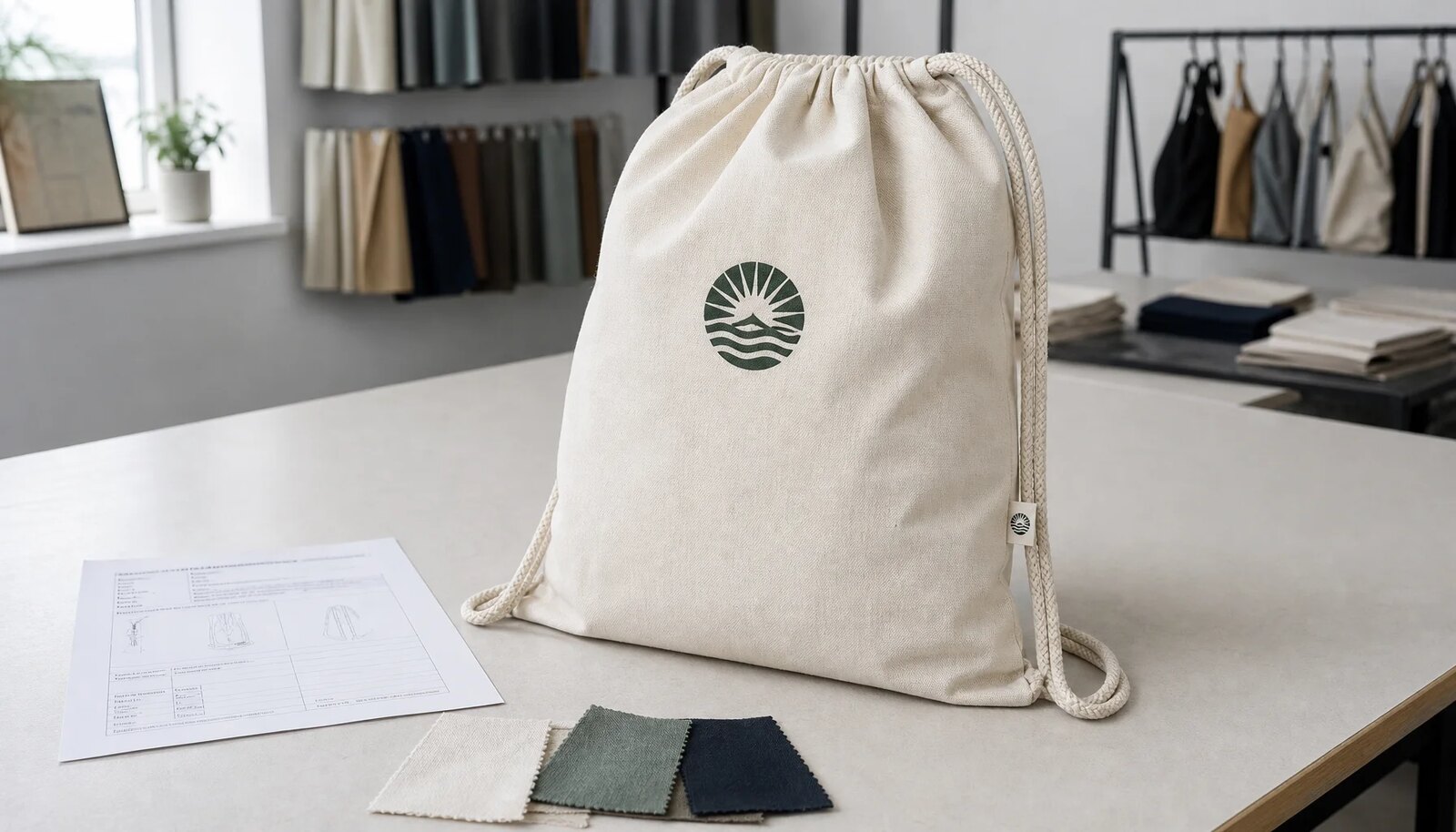
Start with the date bags must be usable
For event planners, the useful deadline is not the factory completion date. It is the moment the team can open cartons, count the bags, confirm the logo, move them into registration areas or kits, and hand them to attendees without a scramble. Cotton drawstring backpacks are simple products, but event orders often slip because the schedule is built around production days only. Artwork approval, packing, inspection, freight, venue receiving rules, and internal distribution all need room on the calendar.
Put the required in-hand date in the specification before you ask for final pricing. A quote that says 15 production days is only useful if it explains what starts the clock. Some suppliers count from deposit. Others count from approved artwork, approved lab dip, approved strike-off, fabric arrival, or pre-production sample approval. Those are very different schedules, especially when the buyer still has brand, legal, sponsor, or venue approvals pending.
Work backward in calendar days, not only factory working days. Add time for sample review, supplier revisions, production, inspection, packing, pickup, customs where relevant, final delivery, receiving, and a small contingency buffer. A bag that arrives the morning after check-in opens has missed the business purpose, even if the stitching is beautiful. Treat timing as a procurement requirement, not a side note.
- Set the required in-hand date before requesting a final supplier schedule.
- Ask what milestone starts the quoted lead time and which steps are excluded.
- Separate approval time, production time, inspection time, freight time, and receiving time.
- Build the schedule in calendar days, with local holidays and venue receiving windows included.
Choose the sourcing route first
The right lead-time plan depends on how the bags will be sourced. Cotton drawstring backpacks for event planners usually fall into three routes: verified stock blanks, stock blanks with decoration, or a fully custom factory run. They may look similar on a quote sheet, but they carry different risks.
Verified stock blanks are the quickest option when branding is not required or when the team can accept existing size, fabric weight, color, cord, and construction. This route can work for urgent internal meetings, volunteer kits, or programs where the bag is mainly a utility item. The risk is inventory accuracy. A catalog listing is not live stock. Ask for available-to-ship quantity by SKU, body color, warehouse, and reservation status.
Stock blanks with local decoration are useful when the blank bag is acceptable and the logo is straightforward. The schedule still needs artwork proofing, print setup, curing or drying, QC, and repacking. A fully custom run is the better choice when you need a specific GSM, dyed body color, cord type, sewn label, reinforced corner, private packing, or multi-destination allocation. Custom gives control, but it adds fabric sourcing, lab dips, sampling, cutting, sewing, inspection, and freight booking. Compare quotes only after you know which route each supplier is pricing.
- Use stock blanks only after live inventory is confirmed by SKU, color, warehouse, and quantity.
- Use stock-plus-decoration when artwork is final and the blank bag is already acceptable.
- Use custom production when fabric, construction, branding, or pack-out rules must be controlled.
- Do not compare a stock quote and a custom quote as if they carry the same schedule risk.
Specify fabric without vague labels
Fabric weight should be one of the first decisions in the RFQ. For light event giveaways, 120-140 GSM plain-weave cotton may be suitable for brochures, lanyards, pens, small notebooks, or light samples. For premium conferences, campus welcome packs, retail-style kits, or heavier contents, 180-220 GSM cotton or 8-10 oz canvas is usually more appropriate. Heavier fabric can improve handfeel and opacity, but it may also increase sewing time, carton volume, and freight cost.
Avoid relying on words such as standard, premium, canvas, or heavy duty unless the supplier also gives measurable details. GSM means grams per square meter. Canvas may be described in ounce weight, and suppliers can use different conventions depending on market, fabric state, or local naming. Ask for GSM, weave, finish, handfeel, and a physical swatch or retained standard.
Color has its own timeline. Natural cotton is often faster than dyed cotton, but it still needs an agreed shade range, seed-fleck tolerance, odor expectation, and slub standard. Bleached cotton can look cleaner but may show stains or print issues more clearly. Piece-dyed cotton supports brand programs, yet it adds lab dip approval, bulk shade tolerance, dye-lot consistency, and crocking checks. If the event calendar is tight, do not leave body color unresolved after supplier selection.
- Define GSM, weave, finish, and color process in the RFQ.
- Ask whether the quoted fabric is in stock, greige, dyed, washed, or specially sourced.
- Approve a swatch, lab dip, or retained production standard when shade or handfeel matters.
- State acceptable natural cotton variation before production, not after inspection.
Lock construction before price comparison
A drawstring backpack looks basic until the spec is left open. The top channel, side seams, bottom corners, cord path, knots, and reinforcements all affect durability and production time. A lightweight giveaway may use a simple folded channel and overlocked seams. A heavier conference kit may need stronger lower corners, bar tacks, double-needle stitching, eyelets, or a thicker cord.
For B2B procurement, a generic request for a cotton drawstring bag invites supplier assumptions. State the body width and height, measurement points, drawcord channel width, seam type, cord material, cord diameter, cord length, knot style, reinforcement method, and any woven label or patch placement. A practical tolerance for basic cut-and-sew soft goods is often plus/minus 1 cm on body dimensions, but confirm that with the supplier and define whether it applies before or after pressing, washing, or packing compression.
Cord details are easy to overlook. A 4-5 mm polyester cord may be readily available, while cotton cord, thicker cord, custom dyed cord, branded stoppers, or metal tips can require separate sourcing. If the bag will carry heavier contents, ask about stress points. If attendees will wear it for a full day, check comfort, cord length, and whether knots or stoppers stay secure under normal tension.
- State body size, channel width, seam type, reinforcement, cord material, and cord diameter.
- Define size, print-placement, and label-placement tolerances before quotation.
- Ask whether bar tacks, eyelets, reinforced corners, and special cords are included in the unit price.
- Review the bag flat, filled, and cinched because soft goods change shape in use.
Build an RFQ suppliers can price cleanly
A strong RFQ saves time because it removes guesswork. For cotton drawstring backpacks, include the product specification, artwork files, quantity breakdown, packing rules, destination, Incoterm, sample requirement, and required in-hand date. If those details are missing, suppliers will fill the gaps differently, and procurement will be comparing assumptions instead of comparable offers.
Break quantity down by body color, cord color, artwork version, print placement, label version, packing version, and destination. A 10,000-piece order may be straightforward if it is one natural cotton body, one logo, and bulk packing. The same total quantity becomes more complex when split across five body colors, four sponsor logos, two cord colors, and several venue allocations. Version count affects MOQ, setup time, production flow, packing accuracy, and inspection scope.
Ask for line-item pricing where practical. Separate blank bag cost, decoration, setup or screen charges, sample cost, label cost, special packing, carton cost, barcode labels, inland transport, export documents, freight estimate, and excluded charges. This prevents a low unit price from expanding later. For events, the real comparison is landed cost plus readiness by the required date.
- Send the same spec, artwork, Incoterm, packing rules, and deadline to every supplier.
- Ask for pricing by version, not only one blended total.
- Require a clear list of included and excluded charges.
- Request carton dimensions, pieces per carton, gross weight, and estimated carton count with the quote.
Plan approvals like the critical path
Approval delays are one of the most common reasons branded bag orders miss their ideal window. The supplier may be waiting while the buyer confirms logo color, print size, sponsor order, cord color, carton labels, or packing allocation. Assign one accountable approver for product details, one for artwork, and one for logistics decisions. When everyone can comment but nobody owns the release, the calendar disappears quickly.
For stock orders, a blank sample can confirm fabric feel, size, cord function, and basic construction. For printed stock, a digital proof is useful, but it does not show ink opacity, edge sharpness, curing, or how the print sits on textured cotton. A strike-off or printed sample is stronger when brand appearance matters. For custom production, the pre-production sample should represent final fabric, size, cord, seam construction, label, print, and packing as closely as practical.
Treat sample review as a measurement exercise, not only a visual check. Record body width, body height, cord length, channel width, print location, label placement, and any reinforcement dimensions. Photograph the sample flat, filled lightly, and cinched. Consolidate feedback into one marked file or email. After approval, keep a golden sample with the factory and, when possible, with the buyer or inspection team.
- List every approval needed: fabric, lab dip, proof, strike-off, sample, label, carton mark, and packing plan.
- Set internal approval deadlines earlier than the supplier's last possible date.
- Measure samples instead of approving only by photo.
- Freeze the approved sample and spec before bulk production starts.
Control decoration before bulk work starts
Decoration is the part attendees notice first, and it can take longer than expected. A one-color screen print is often efficient for simple logos, strong contrast, and medium to large quantities. It still needs final vector artwork, screen setup, placement approval, curing, and QC. Heat transfer can handle complex artwork or shorter runs, but it should be checked for edge feel, adhesion, cracking risk, and appearance on cotton texture.
The artwork package should include editable vector files, final print dimensions, color references, placement instructions, and restrictions around seams or drawcord channels. A logo placed too high may distort when the bag is cinched. A logo placed too low may fold during packing or sit near a stress point. State placement tolerance in measurable terms, such as plus/minus 5 mm or plus/minus 10 mm depending on print size and production method.
Color matching needs realistic expectations. Pantone references help, but ink on natural cotton will not always match a coated-paper brand guide. Fabric shade, ink opacity, weave texture, and curing all affect the result. If brand color is critical, request a strike-off and approve it under consistent lighting. If speed matters more, use high-contrast artwork with fewer colors and avoid gradients, tiny legal text, thin lines, and halftones.
- Provide editable vector artwork, print size, placement, and color references with the RFQ.
- Keep artwork away from drawcord channels, seams, folded edges, and reinforced corners.
- Ask for a strike-off when color, opacity, or fine detail is important.
- Define decoration defects such as wrong color, poor registration, low opacity, cracking, or off-placement.
Make packing part of the product
Packing is not administrative housekeeping for event orders. It affects freight cost, receiving accuracy, storage condition, and labor on site. Bulk packing may be best when bags ship to a distribution center or will be kitted locally. Bundle packing helps staff count quickly. Individual polybags can keep natural cotton cleaner during storage, but they add cost, time, plastic use, and carton volume. Event-zone packing can save work when cartons go directly to booths, registration desks, field teams, or campus locations.
Define pieces per carton, carton dimensions, carton marks, barcode labels, destination codes, mixed-carton rules, pallet requirements, and packing list format before packing begins. If a venue needs 200 bags per booth or a campus program needs 50 bags per location, tell the supplier early. Repacking finished cartons is slower and more error-prone than packing correctly the first time.
Cotton compresses, but freight is often driven by volume as much as weight. Heavier fabric, thick cords, reinforced corners, loose folding, or individual polybags can increase carton size. Ask for estimated carton dimensions and gross weight before relying on a freight estimate. If the bags will be stored before the event, include moisture, odor, carton strength, and pallet condition in the release checklist.
- Choose bulk pack, bundle pack, individual polybag, or event-zone pack before final quotation.
- Confirm pieces per carton, carton dimensions, carton count, gross weight, and carton marks.
- Use destination codes and barcode labels when orders are split across venues or teams.
- Open sample cartons during inspection to verify counts and mixed-SKU rules.
Build freight buffers before you need them
Lead-time planning should include freight assumptions early. Cotton drawstring backpacks can be bulky, especially in heavier GSM fabrics or individual packing. Domestic courier, LTL, air freight, ocean freight, and split shipment strategies all carry different costs and risks. A freight estimate based only on gross weight is weak. Procurement needs carton dimensions, carton count, gross weight, ship-from point, ship-to point, Incoterm, and delivery appointment requirements.
For international custom orders, clarify whether the quote is EXW, FOB, CIF, DDP, or another Incoterm. The Incoterm decides who is responsible for inland trucking, export clearance, main freight, insurance, import clearance, duties, taxes, and final delivery. A low FOB unit price may still be the right choice, but it should be compared against landed cost and deadline risk, not treated as equivalent to a domestic delivered quote.
A split shipment can protect the event when order size and budget allow it. The buyer may send the quantity needed for event launch by faster freight and move the balance by a slower route. This only works with clear carton marking, separate packing lists, and strict control so urgent cartons are not mixed with later-delivery goods. Plan priority cartons before packing, not after the warehouse asks which boxes matter most.
- Ask for carton dimensions and gross weight before treating a freight quote as usable.
- Compare suppliers using the same Incoterm and destination assumptions.
- Plan receiving time for customs, warehouse appointments, venue rules, and internal distribution.
- Use priority carton marking if part of the order must arrive earlier than the balance.
Use QC to protect the event
Quality control should focus on failures that disrupt the event: wrong color, wrong size, missing cords, weak seams, unreadable logos, stains, odor, incorrect counts, wrong carton labels, and mixed destinations. Natural cotton may have slight texture variation or seed flecks, so define acceptable cosmetic variation in advance. A natural slub within the approved range is not the same as a hole, oil mark, broken seam, or severe print defect.
A practical inspection plan connects the signed spec sheet, approved artwork, and golden sample. Inspectors should measure body dimensions, check GSM against the agreed method or retained standard, review stitching at stress points, pull cords under normal tension, inspect print placement and adhesion, and open cartons across the lot to verify counts. For soft goods, measurement must be consistent. State whether the bag is measured flat, unfilled, and uncinched, and whether tolerance applies before or after pressing or packing compression.
Use a written defect classification. Major defects may include broken seams, holes, missing cords, severe stains, wrong body color, wrong artwork, wrong print color, unreadable logo, incorrect size beyond tolerance, or cartons packed with the wrong SKU. Minor defects may include loose threads, light removable marks, small shade variation within the approved range, or slight print imperfections that do not affect brand readability. If using AQL, state the sampling standard and levels before inspection, such as ANSI/ASQ Z1.4 with AQL 2.5 major and 4.0 minor, or use the buyer's established house standard.
- Inspect against the spec sheet, approved artwork, and golden sample.
- Measure size, cord length, channel width, print placement, and label placement consistently.
- Check both product quality and packing accuracy before shipment release.
- Require photo evidence of measurements, print checks, open cartons, carton marks, and pallets for remote release.
Specification comparison for buyers
| Planning decision | Recommended option | When it fits | Buyer risk to check |
|---|---|---|---|
| Sourcing route | Verified stock blank from a regional supplier | Event date is under 3 weeks away, branding is not required, or the team can accept standard size, color, cord, and construction | Ask for live inventory by SKU, color, warehouse, and available-to-ship quantity; catalog availability is not proof of stock |
| Sourcing route | Stock blank with local decoration | You need branded cotton drawstring backpacks, the blank bag is acceptable, and final artwork can be approved quickly | Print proofing, screen setup, curing time, QC, and repacking can remove much of the stock advantage |
| Sourcing route | Custom factory run from cotton yardage | You need custom GSM, dyed shade, size, cord, label, reinforcement, packing, or multi-destination allocation | Fabric purchasing, lab dips, sampling, cutting, sewing, inspection, export booking, and customs require a longer calendar |
| Fabric weight | 120-140 GSM plain-weave cotton | Light event giveaways holding brochures, lanyards, pens, small samples, or registration materials | Check opacity, handfeel, seam strength, shrinkage allowance if washed, and whether natural slubs are acceptable |
| Fabric weight | 180-220 GSM cotton or 8-10 oz canvas | Premium conferences, client gifts, retail-style kits, campus welcome packs, or heavier contents | Higher weight can increase sewing time, needle settings, carton volume, freight cost, and screen-print ink coverage requirements |
| Size tolerance | Plus/minus 1 cm for basic cut-and-sew dimensions | Typical soft-goods tolerance for body width and height when the bag is not fitted to a rigid insert | Confirm whether tolerance applies before or after pressing, washing, or packing compression |
| Decoration | 1-color screen print | Simple logo, strong contrast, medium or large quantity, and a tight but controlled schedule | Fine text, thin lines, halftones, and gradients may need artwork changes; curing and rub resistance should be checked |
| Decoration | Heat transfer | Complex artwork, multiple colors, smaller runs, or artwork that is expensive to screen print | Test adhesion, edge feel, wash/rub resistance, cracking risk, and appearance on textured cotton |
| Decoration | Woven label or sewn patch | Cleaner brand detail, retail-style presentation, or a smaller mark away from the front panel | Label MOQ, label approval, placement tolerance, and sewing sequence add time |
Buyer checklist before sampling
- Confirm final bag dimensions, measurement points, and tolerance, such as plus/minus 1 cm for body width and height unless a tighter tolerance is required
- State cotton GSM, fabric construction, finish, and color route: natural, bleached, piece dyed, garment washed, or matched to a color standard
- Define acceptable shade tolerance, natural cotton slub range, odor standard, and whether visible seed flecks are acceptable
- Specify cord material, cord diameter, cord color, length, knot style, stopper requirement, and whether polyester cord is acceptable when cotton cord is unavailable
- Confirm construction details: folded drawcord channel, reinforced corners, metal eyelets, bar tacks, overlock seams, French seams, double-needle stitching, or boxed lower corners
- State stitch density expectation, such as 8-10 stitches per inch where appropriate, and require secure back-tacking or bar tacks at stress points
- Provide editable vector artwork and identify Pantone, CMYK, or approved brand color references for every printed color
- Specify print method, print size, print area, placement tolerance, ink type if required, and whether artwork must avoid seams, cord channels, or folded edges
- Break out quantity by body color, cord color, artwork version, packing version, destination, and required arrival date
- Ask for MOQ by body color, fabric lot, cord color, artwork, label, patch, and packing version, not only total order MOQ
Factory quote questions to send
- Is the quoted price for existing stock blanks, printed stock blanks, or a fully custom cut-and-sew production run?
- What exact cotton GSM, fabric construction, finish, and color process are included in the quote?
- What size tolerance, GSM tolerance, shade tolerance, and print-placement tolerance are you quoting against?
- Is the fabric physically in stock, or does it need to be purchased, dyed, washed, tested, or cut from greige goods?
- What is the MOQ per body color, cord color, artwork, print placement, sewn label, patch, and packing version?
- Which steps are handled in-house and which are outsourced, especially fabric sourcing, dyeing, printing, sewing, label production, inspection, packing, and freight booking?
- How many business days are needed for a blank sample, artwork proof, strike-off, lab dip, printed sample, and pre-production sample?
- What production lead time is counted from approved artwork, approved sample, approved lab dip, fabric arrival, deposit date, or production slot confirmation?
- What is the current production capacity for this bag style, and how does the schedule change if approval is delayed by 2-3 business days?
- What carton count, pieces per carton, carton dimensions, gross weight, and packing method were used to calculate freight?
Quality-control points to confirm
- Measure body width, body height, cord length, channel width, print position, label position, and reinforcement dimensions against the signed spec sheet before bulk packing
- Verify fabric GSM using the agreed test method or retained standard, and flag obvious substitution, excessive thinning, shade inconsistency, or unacceptable slub variation
- Check stitch density, seam straightness, skipped stitches, loose threads, puckering, and bar-tack strength at drawcord channels, side seams, bottom corners, and reinforced areas
- Inspect cord material, cord diameter, cord color, knot security, stopper function if used, and whether the bag opens and closes smoothly under normal tension
- Inspect print placement, opacity, registration, edge sharpness, color match, adhesion, curing, rub resistance, and readability against the approved strike-off or golden sample
- Check that artwork is not distorted by the drawcord channel, seam allowance, folding method, panel puckering, or carton compression
- Inspect for broken stitches, holes, tears, oil marks, dye stains, fabric contamination, mold, odor, and excessive loose threads
- Use an agreed inspection standard such as ANSI/ASQ Z1.4 sampling with AQL 2.5 major / 4.0 minor, or the buyer's house standard, with a written major/minor defect list
- Open cartons across the lot to verify pieces per carton, SKU mix, color mix, artwork version, carton marks, barcode labels, destination labels, and packing list totals
- Check moisture level, odor, carton strength, pallet condition, edge protection, and transit readiness if bags will be stored before the event