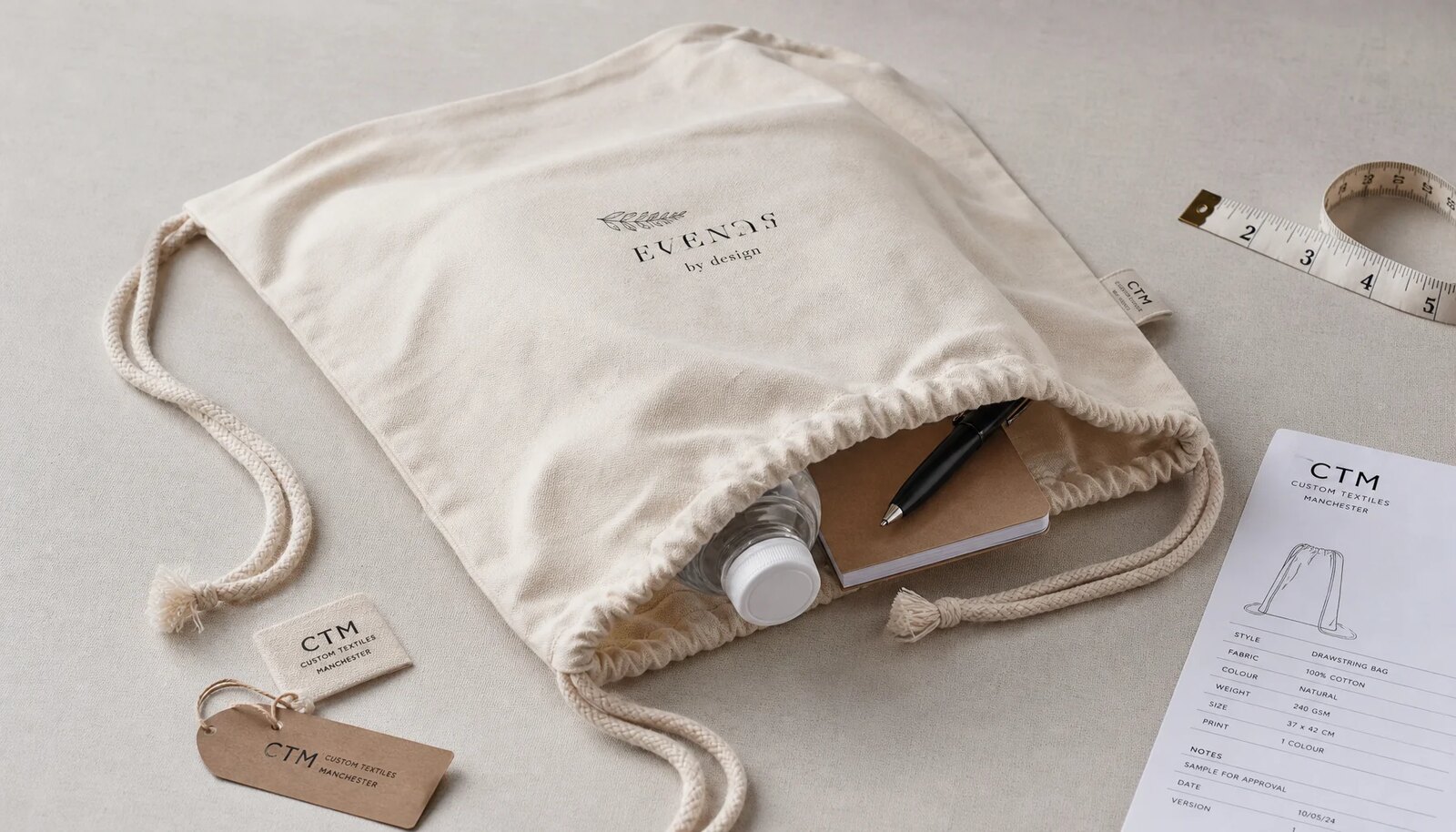
Start With the Event Load, Not the Artwork
Cotton drawstring backpacks look simple, which is exactly why weak specifications slip through. A buyer may see a clean product photo, approve a logo proof, and write a short line such as natural cotton bag with logo. That is enough to start a conversation, but it is not enough to protect an event order. The bag may be filled by a kitting team, stacked in cartons, handed out quickly at registration, carried through a venue, repacked in a hotel room, and reused after the event. Each step adds stress before the brand team ever sees the backpack in use.
The first procurement question should be practical: what will the bag carry, and how will people handle it? A bag holding a folded T-shirt, badge, and agenda is not the same product as a bag holding a stainless bottle, notebook, charger, catalog, and boxed sample. Hard objects press into lower corners. Paper stacks pull against side seams. Repeated opening and closing tests the top channel. Carton compression can damage a print before the first attendee touches the bag.
For B2B buyers, the target is not maximum strength at any cost. The target is a construction that fits the load, budget, schedule, and brand presentation. When every supplier quotes against the same contents, target loaded weight, finished size, fabric range, cord specification, seam detail, print method, and packing rule, price comparison becomes much cleaner. Without that detail, a low price may simply mean a lighter bag, a weaker cord, looser inspection, or a packing method that creates receiving work later.
- Write the use case as one-day giveaway, multi-day attendee kit, staff pack, VIP gift, retail item, reusable sponsor bag, or campus welcome bag.
- List real contents and flag hard-edge items such as bottles, catalogs, chargers, notebooks, boxed samples, and thick paper stacks.
- State the target loaded weight, for example 1.5 kg, 2.0 kg, or the buyer's measured kit weight, instead of saying standard event items.
- Separate functional pass/fail requirements from cosmetic preferences so factories understand what cannot be compromised.
- Ask suppliers to flag any requested detail that materially changes cost, MOQ, lead time, or inspection risk.
Turn Fabric Weight Into a Buyable Specification
Fabric weight is one of the fastest ways to compare cotton drawstring backpacks, but it needs to be stated in measurable terms. Many event bags fall in the 6 oz to 8 oz cotton range, roughly 200 to 270 GSM. That is a practical sourcing range, not a universal rule. Lighter cotton can work for soft, low-weight handouts. Heavier cotton can improve hand feel and resistance to stress, but it also increases unit cost, carton volume, and freight weight.
GSM does not tell the whole story. A plain canvas may feel firmer and more textured. Twill may feel smoother and drape differently. Natural cotton can support an understated, reusable look, but shade variation becomes more visible unless the buyer sets an acceptable range. Dyed cotton opens brand color options, yet it adds colorfastness and shade-lot controls. Washed or softened cotton may feel better in the hand, but it can affect shrinkage, lint, measurements, and final appearance.
A stronger RFQ asks for at least two controlled fabric options using the same size and construction. For example, ask suppliers to quote 200 to 220 GSM and 240 to 270 GSM with the same cord, channel, lower-corner reinforcement, and print method. This shows the real cost of upgrading the bag instead of letting one supplier quote a light promotional version while another quotes a more durable reusable version.
- Use approximately 200 to 220 GSM for light contents such as brochures, badges, folded tees, flat inserts, and small soft gifts.
- Consider approximately 240 to 270 GSM when the bag carries notebooks, bottles, catalogs, boxed samples, or items meant for repeated use.
- Request a written tolerance, such as a defined GSM range or +/-5%, and confirm whether it applies before or after washing or finishing.
- Specify natural, bleached, dyed, washed, or pre-shrunk cotton and ask what that choice changes for price, lead time, shade control, and shrinkage.
- Check odor, lint, shade consistency, color transfer, and shrinkage whenever bags touch apparel, premium gifts, light paper, or packaged food-adjacent items.
Lock Size, Fit, and Tolerances Before Sampling
Finished size is not only a catalog dimension. It determines whether the event kit fits, whether the drawcord closes without strain, and whether the logo lands in the right visual zone once the bag is loaded. Common event drawstring backpack sizes include about 14 x 17 in and 15 x 18 in, but buyers should confirm the required fit using the actual items instead of copying a familiar size from a prior order.
Tolerances matter because cotton fabric can move during cutting, sewing, washing, and finishing. A small variance may be acceptable for a general giveaway bag. The same variance can become a problem when a notebook barely fits, a boxed sample changes the bag shape, or the logo shifts into a fold line. Procurement teams should define finished width, height, channel width, cord length, and print placement tolerance before bulk production starts. For many soft goods, a written tolerance such as +/-0.5 in or an agreed metric equivalent is more useful than no tolerance at all.
Fit testing should happen on the pre-production sample with the real contents. Load the sample, close it, carry it, and look at what changes. Do the lower corners distort? Does the top channel bunch? Does the logo disappear into wrinkles? A flat sample can look perfectly acceptable while the loaded product shows that the size, fabric, or artwork placement is wrong for the event.
- Measure the largest item in the kit and confirm the bag closes without forcing the cord.
- Define whether quoted size means flat finished size, before-wash size, or post-finishing size.
- Set width, height, channel width, cord length, and print placement tolerances in the purchase specification.
- Check print position on both flat and loaded samples, especially for large sponsor logos or centered event artwork.
- Confirm whether fabric shrinkage, washing, or pressing can change final dimensions after sample approval.
Specify Stress Points in Factory Language
Most cotton drawstring backpack failures begin in predictable places: lower corners, side seams, bottom seam turns, cord exit points, and top channel ends. These areas take the load when the bag is lifted, pulled open, closed quickly, or carried for a long walk through a venue. A bag can use decent fabric and still fail if the sewing is loose, the channel is too tight, or the cord pulls against an unfinished edge.
The quote should describe construction in production language. Buyers do not need to design the factory's sewing line, but they should ask for seam type, stitch density, thread, bartack locations, and reinforcement method. A quote that says reinforced stitching is too vague for an event-critical order. A better quote says where reinforcement appears, how the lower corners are finished, how the top channel is folded, and what level of thread trimming is expected.
The top channel deserves its own review. It should be wide enough for the selected cord, folded cleanly, and stitched consistently. If the channel is too narrow, the cord drags and users pull harder. If the channel end is weak, it can tear during repeated draw cycles. If the cord path is uneven, one side may close faster than the other, making the backpack feel awkward even when it does not technically fail.
- Ask for stitch density in stitches per inch or centimeter, or request the factory's standard and approve it on the physical sample.
- Require secure finishing at side seams, bottom seams, channel ends, cord exits, and lower corners.
- Use bartacks or reinforced stitching at cord stress points and lower corners when bags carry heavier kits.
- Inspect inside seams for fraying, skipped stitches, loose thread tails, and rough edges that can shed lint into cartons.
- Confirm whether contrast stitching is decorative only or part of the functional reinforcement.
Build the Durability Test Around Real Handling
A useful cotton drawstring backpacks for event planners durability testing checklist does not need to be a laboratory program. It needs to reproduce what will actually happen before and during the event. Load the sample with the planned contents, open and close the cord, carry it by both cords, lift it briefly by one cord, set it on a clean hard surface, fold it as the factory will pack it, and inspect the same stress points after each step.
Write pass/fail rules before the buyer evaluates the sample. Otherwise, every result becomes a discussion about whether a flaw is normal. Decide whether any seam opening is a fail, how much cord fray is acceptable, whether a hairline print crack is allowed, and what level of odor or lint is unacceptable. A one-day handout may tolerate small cosmetic variation. A sponsor bag positioned as a premium reusable gift should be judged more tightly.
Test every supplier sample the same way, with the same contents and the same handling steps. That is what turns durability from a general impression into a procurement comparison. For higher-value orders, add a simple cord pull check, a color transfer check on light fabric or paper, and a carton compression review using the quoted fold and inner count.
- Loaded hold: pack the planned contents and carry or hang the bag for a defined period while checking side seams, bottom seam, and lower corners.
- Draw cycle: open and close the cord 25 to 50 times and inspect channel distortion, cord fray, knot security, and draw smoothness.
- Handling drop: drop the loaded bag from a realistic hand height onto a clean hard surface and inspect corners, seams, and contents impact points.
- One-cord stress check: lift briefly by one cord to see whether the channel twists, tears, or pulls unevenly.
- Print rub and fold check: fold the bag as quoted, rub the printed area with cotton or white paper, and check cracking, peeling, smearing, and transfer.
- Carton compression review: pack several samples in the proposed fold and count, leave compressed, then check creases, print blocking, and scuffing.
Choose Cord Material for Comfort and Risk
The drawcord is both the closure and the carrying strap, so it deserves more attention than it usually receives. Thin cord lowers cost, but it can cut into shoulders, stretch under load, or pull unevenly through the channel. Thick cord may feel better, but it requires a wider channel and can raise material cost. For event bags, braided cotton, polyester, or cotton-poly cord is common, with diameter selected according to bag size, load, and desired hand feel.
Cord behavior changes after use. A sample may close smoothly the first time and twist after 30 openings. Knots may look secure until the bag is loaded. Cotton cord can support a natural look, but it may absorb moisture and fray more visibly. Polyester can be more dimensionally stable, though it may look less natural depending on the bag style. The buyer should specify material, diameter, color, end treatment, knot size, and pull-through control.
Cord color is another detail worth controlling. Natural cords can vary by lot, and dyed cords can miss the bag shade or sponsor palette. If the cord is part of the brand look, include it in the approved sample standard and carton inspection. If several bag colors or print versions are packed in the same shipment, cord substitution becomes a realistic final-inspection risk.
- Specify cord material as cotton, polyester, or cotton-poly instead of generic drawstring.
- Define cord diameter, commonly in a practical range such as 5 to 8 mm depending on load and comfort target.
- Check that the channel width matches the selected cord and still draws smoothly after repeated cycles.
- Require secure knots, clean sealed ends where used, and no loose unraveling at cord ends.
- Inspect cord color, length, knot consistency, and pull-through risk across multiple cartons, not only the top sample.
Treat Branding as a Durability Surface
The logo is not just decoration. It is a surface that gets folded, stacked, rubbed, compressed, and handled by warehouse teams and attendees. A print can look sharp on a flat approval sample but crack at fold lines, transfer inside cartons, or scuff during kit assembly. Procurement buyers should evaluate print durability with the same discipline used for seams and cords.
Screen printing is often practical for one- or two-color event logos at volume when the ink is compatible with the cotton texture and properly cured. Woven labels or sewn patches can work well for premium programs or bags expected to be reused because the branding is not spread as a large ink layer across a foldable surface. Heat transfer can be useful for detailed artwork or smaller runs, but it should be tested on the final fabric for edge lift, cracking, and adhesion after folding.
Artwork approval should include placement tolerance, color standard, print size, curing expectations, and fold interaction. A logo placed too high can distort near the cord channel. A logo placed across the common fold line may crease. A dense ink deposit can block against another bag if packed before curing is complete. A physical strike-off or printed pre-production sample gives far better evidence than a digital proof alone.
- Use screen print for simple event marks, sponsor logos, and high-volume runs where color count is limited.
- Use woven labels, sewn patches, or small printed labels for premium appearance or longer reuse.
- Test heat transfer for cracking, peeling, edge lift, and adhesion on the final cotton fabric.
- Define print placement tolerance and measure it from fixed bag edges, not from a moving wrinkle or fold.
- Check curing, rub resistance, fold behavior, color transfer, and blocking before approving carton packing.
Make Supplier Quotes Truly Comparable
Cotton drawstring backpack quotes can look similar while describing very different products. One supplier may price 200 GSM natural cotton with basic seams and bulk packing. Another may price 260 GSM cotton, thicker cord, bartacks, a woven label, and controlled inner bundles. The procurement team can make comparison easier by issuing a structured RFQ and asking for clear alternates instead of accepting broad descriptions.
Supplier route also affects accountability. A direct factory may control cutting, sewing, printing, and packing under one production plan. A trading company or coordinator may still be useful, especially for multi-category event sourcing, but the buyer needs to know which steps are subcontracted and who owns defects. If the print shop causes blocking, if the cord supplier delivers the wrong shade, or if the packing workshop mixes destinations, responsibility should be clear before the purchase order is placed.
A complete quote should separate unit price from fixed and variable adders. Sample fees, screen charges, label tooling, heavier fabric, thicker cord, bartacks, individual polybags, barcode labels, special carton marks, and split shipments should be visible. This prevents a low unit price from hiding costs that reappear after sample approval.
- Send the same fabric, size, cord, seam, print, packing, and inspection requirements to every supplier.
- Ask for controlled alternates instead of vague cheaper options, such as two GSM ranges or two branding methods.
- Identify which processes are in-house and which are subcontracted.
- Separate fixed setup charges from unit cost, sample cost, packing adders, and freight assumptions.
- Compare landed cost per usable bag, including freight, duty, customs clearance, inland delivery, storage, and kit assembly labor where relevant.
Set QC Limits Before Production Starts
Inspection is most useful when the pass/fail standard is written before production. Phrases such as good quality or export standard do not give the inspector enough to work with. The buyer should define the approved sample reference, measurement tolerances, defect categories, carton-count expectations, and any special event requirements. This turns final inspection into a decision process instead of a last-minute negotiation.
For larger B2B orders, an AQL-style final inspection may be appropriate, with the inspection level and acceptance limits selected according to order size and risk. Even when the buyer does not use a formal AQL plan, defects should be grouped by severity. Critical defects include broken needle contamination, mildew, unsafe foreign material, wrong product, or wrong logo. Major defects include open seams, missing cords, incorrect size, severe stains, print cracking, poor draw action, and wrong carton count. Minor defects may include small trim threads or slight cosmetic variation within the approved standard.
Inline checks are valuable because systematic sewing or printing defects can spread quickly. If the channel is too narrow, the lower-corner reinforcement is missing, or the print is under-cured, a final inspection may find the issue after thousands of pieces are already finished. Ask for first-production photos, inline inspection notes, or a retained production sample before the full run is completed, especially when the event date cannot move.
- Define critical defects such as broken needles, mildew odor, wrong logo, wrong material, unsafe debris, and severe contamination.
- Define major defects such as open seams, missing cords, wrong size, print cracking, severe stains, color transfer, poor draw action, and wrong packing count.
- Define minor defects such as small loose threads, minor print specks, or slight shade variation within the agreed standard.
- Use the approved pre-production sample as the physical reference for fabric, cord, print, label, construction, and fold.
- Require inline review when the order is urgent, large, technically new, or tied to an immovable event date.
Control Packing, Cartons, and Receiving Labor
Packing is part of product quality because it shapes what arrives at the warehouse or venue. A well-made cotton drawstring backpack can still become a problem if the logo is folded through a heavy crease, prints block together, cartons are overweight, counts vary, or colorways are mixed. Event teams often have little time between receiving and distribution, so carton discipline protects labor as well as presentation.
The packing specification should define fold method, inner bundle count, outer carton count, carton dimensions, carton gross weight, carton marks, and whether bags are bulk packed or individually polybagged. Bulk folded packing is usually efficient for large handouts, provided the fold protects the branding and allows fast counting. Individual polybags may be useful for VIP gifts, retail resale, barcode scanning, multi-location shipments, or repeated handling before distribution.
Carton labeling should match the receiving plan. Multi-location programs need PO number, SKU, bag color, print version, quantity, destination code, carton number, and gross weight. If cartons are staged by venue, sponsor, campus, or registration zone, that information should appear before shipment. Clear carton marks may look like a small detail on the quote, but they can prevent costly sorting work under event pressure.
- Approve the fold direction so the logo, label, cord channel, and corners are not permanently creased or damaged.
- Set inner bundle counts that match receiving or kit assembly needs, such as 25, 50, or 100 pieces per bundle.
- Require carton labels with PO number, SKU, color, print version, quantity, carton number, gross weight, and destination code where needed.
- Confirm carton dimensions and gross weight before shipment so freight estimates and manual handling are realistic.
- Use individual polybags only when cleanliness, presentation, barcode scanning, or multi-touch distribution justifies the cost and waste tradeoff.
Specification comparison for buyers
| Procurement decision | Recommended specification | Best-fit event use | Quote or QC risk to control |
|---|---|---|---|
| Supplier route | Factory or accountable supplier that can document fabric sourcing, cutting, sewing, printing, cord insertion, inspection, and packing responsibilities | Fixed-date conferences, sponsor programs, campus events, staff kits, multi-location campaigns, and repeat orders where bulk goods must match the approved sample | Ask which steps are subcontracted and require written ownership for print defects, cord variation, packing errors, mixed cartons, and rework |
| Fabric weight | 6 oz to 8 oz cotton twill or canvas, approximately 200 to 270 GSM, with a written production tolerance such as +/-5% or an agreed GSM range | Most attendee kits, registration bags, trade show giveaways, staff packs, reusable sponsor bags, and lightweight merchandise programs | A vague term like cotton canvas can hide a lighter fabric; verify bulk fabric against the approved sample and stated tolerance |
| Finished size | Common event sizes around 14 x 17 in or 15 x 18 in, with tolerance defined for width, height, channel width, cord length, and print placement | Programs packing notebooks, catalogs, folded apparel, badges, bottles, chargers, or boxed samples | Finished size can shift after cutting, sewing, washing, or shrinkage; require measured approval and carton-level checks |
| Fabric finish | Natural, bleached, dyed, washed, or pre-shrunk cotton with defined odor, lint, shade, shrinkage, and colorfastness expectations | Important when bags touch light apparel, paper inserts, premium gifts, retail-ready kits, or food-safe outer packaging | Uncontrolled finishing can cause musty odor, dusting, shade-lot variation, shrinkage, or color transfer inside cartons |
| Cord specification | Braided cotton, polyester, or cotton-poly cord, commonly 5 to 8 mm depending on load and comfort target, with secure knots or clean sealed ends where suitable | Bags opened repeatedly at registration desks or carried across multi-day venues with heavier contents | Thin or inconsistent cord can fray, stretch, twist, slip through the channel, or cut into the shoulder under load |
| Top channel | Double-folded channel sized to the cord, with clean edge finishing and reinforcement at cord exits or channel ends | Needed when users repeatedly open and close the bag or when the bag carries hard items | A narrow channel creates cord drag; weak ends tear when users pull quickly or lift by one cord |
| Seam construction | Lockstitch and/or overlock finishing with defined stitch density, secure backtacks, reinforced lower corners, and trimmed thread tails | Any event bag expected to carry more than soft paper handouts | Skipped stitches, needle cuts, loose tails, and weak corner turns become failures during kit packing and venue handling |
| Branding method | Screen print for simple volume logos; woven label, sewn patch, or printed label for premium or longer-use programs; heat transfer only after adhesion testing | Sponsor logos, conference branding, retail-style gifts, staff bags, campus welcome kits, and VIP programs | Print approval must include curing, rub, fold, blocking, registration, placement tolerance, and color transfer checks |
| Sampling route | Pre-production sample made from final fabric, cord, seam construction, print method, artwork placement, fold, and carton packing plan | Event-critical orders where rework after delivery is impractical | Blank samples and digital proofs do not prove print opacity, cord action, loaded behavior, odor, or carton appearance |
Buyer checklist before sampling
- State the event use case in the RFQ: attendee kit, sponsor giveaway, registration bag, staff pack, VIP gift, retail item, campus welcome bag, or multi-location program.
- List the actual contents and target loaded weight, including bottles, notebooks, catalogs, badges, chargers, apparel, boxed samples, inserts, and paper weight.
- Specify fabric by GSM or ounce weight, weave, color, finish, shrinkage expectation, odor requirement, lint control, and accepted GSM tolerance.
- Define finished size tolerance for width, height, channel width, cord length, and print placement before sample approval.
- Request the seam type, stitch density, thread type, lower-corner reinforcement, bartack locations, channel finishing, and loose-thread acceptance limit.
- Confirm cord material, diameter, color tolerance, knot or end treatment, draw action, and minimum pull or handling expectation.
- Choose branding by artwork complexity, fabric texture, fold location, rub exposure, carton pressure, budget, and expected reuse.
- Require a pre-production sample made with final fabric, cord, stitching, print or label, fold method, and carton packing plan.
- Run buyer-side durability checks using the real event contents before approving the bulk sample.
- Set written pass/fail rules for seam opening, skipped stitches, cord failure, print cracking, print transfer, odor, stains, shade variance, size variance, and carton count errors.
Factory quote questions to send
- What exact fabric weight, weave, yarn description, finish, and GSM or ounce tolerance are included in this quote?
- Can you quote two controlled fabric options, such as 200 to 220 GSM and 240 to 270 GSM, using the same size, cord, seam construction, and print method?
- What is the finished bag size, and what tolerance do you apply to width, height, channel width, cord length, and print placement?
- Are fabric inspection, cutting, sewing, printing, cord insertion, trimming, final inspection, and packing handled in-house, and which steps are subcontracted?
- What seam type, stitch density, thread, reinforcement method, and bartack positions are included in the quoted construction?
- What cord material, diameter, color tolerance, end treatment, knot security, and pull or draw-cycle expectation are you quoting?
- Which print method are you pricing, what artwork limits apply, what setup charges apply, and what curing or adhesion checks are used?
- Will the pre-production sample use final bulk fabric, final cord, final ink or label, final stitch construction, approved fold, and the planned carton method?
- What inspection checkpoints do you use for fabric GSM, shade, odor, sewing, print, cords, carton count, needle control, and packing cleanliness?
- What MOQ applies by fabric color, cord color, print version, label version, and packing version, and what are the price breaks at each tier?
Quality-control points to confirm
- Fabric GSM or ounce weight, weave, shade, finish, odor, lint level, and hand feel match the approved sample and written tolerance.
- Finished dimensions stay within the agreed tolerance for width, height, channel width, cord length, and print placement.
- Side seams, bottom seams, lower corners, channel ends, and cord exit points show no open seams, skipped stitches, broken threads, needle cuts, or unsecured thread tails.
- Bartacks or reinforcement stitches are present where specified and are consistent in position, length, density, and thread security.
- Cord slides smoothly through the channel, does not fray or twist excessively, and does not pull through under normal loading and draw cycles.
- Cord ends are secure, knots are consistent, sealed ends are clean where used, and cord color matches the approved sample across inspected cartons.
- Print coverage is even, edges are clean, registration is aligned, color is within the approved standard, and there is no blocking, cracking, peeling, staining, or unacceptable transfer.
- Labels, patches, or sewn branding are positioned correctly, attached securely, and free of loose edges or skipped stitches.
- Bags are clean, dry, and free of oil marks, mildew odor, loose lint, broken needles, mixed components, sharp debris, and foreign material.
- Packing count matches the PO by inner bundle and outer carton, with no mixed colors, print versions, destinations, or unapproved substitutions.