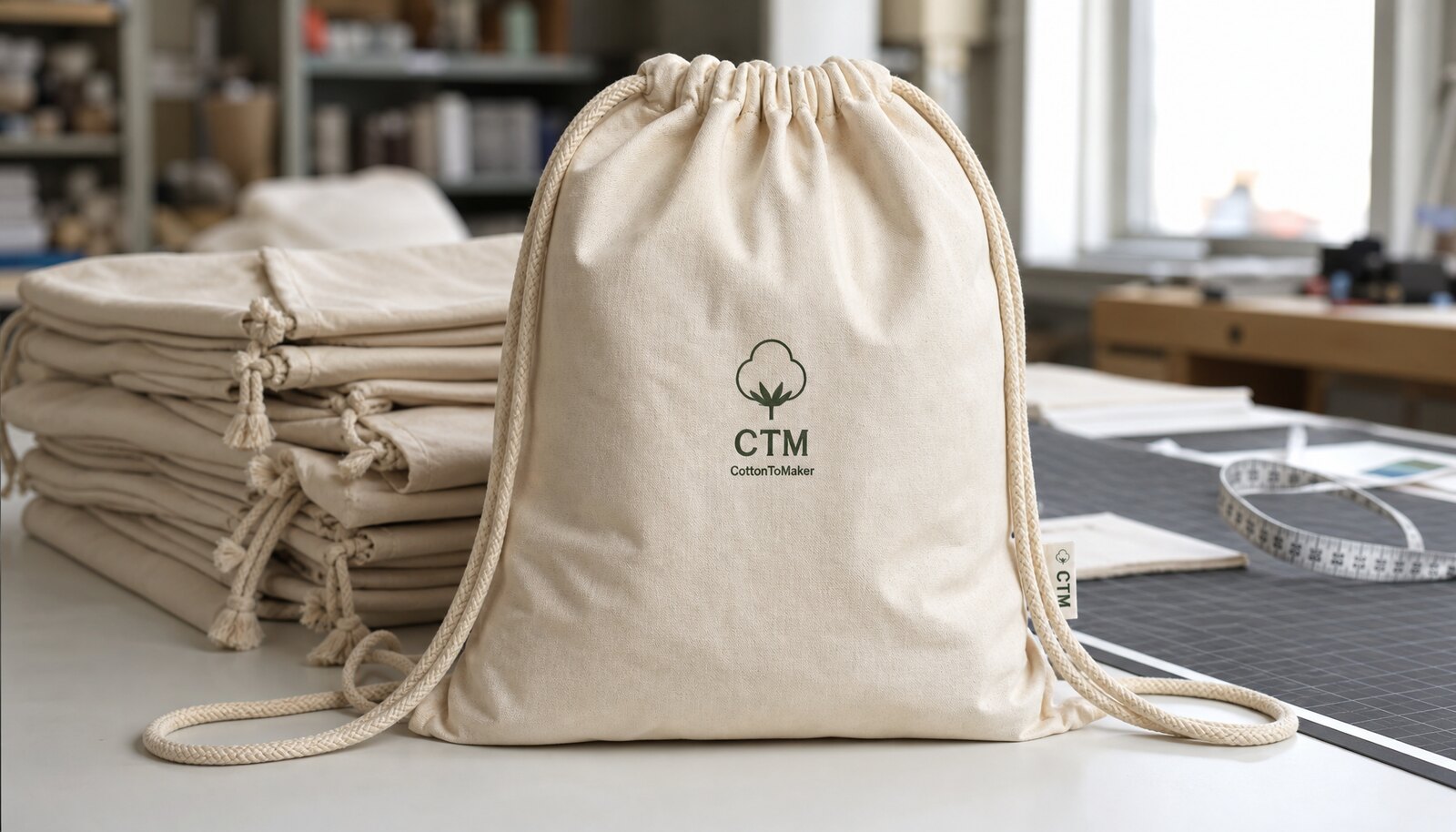
Start with the gifting job, not the product name
A cotton drawstring backpack sounds simple until three suppliers quote three different bags. One assumes a lightweight event giveaway. Another prices a heavier cotton canvas item for employee onboarding. A third includes individual packing, a transfer print, and stronger cartons. All three may be acting in good faith, but procurement cannot compare them until the business use is clear.
Begin the RFQ with the role the bag must play. A trade show handout that carries a brochure, badge, and pen can be lighter and more price-driven. An employee welcome kit holding a hoodie, notebook, charger, and bottle needs better seams, more reliable cords, and cleaner presentation. A client gift may call for restrained branding, tighter logo placement, smoother folding, and packaging that looks intentional when opened.
This is why a cotton drawstring backpacks for corporate gifting supplier compliance checklist should start before fabric selection. The end use affects construction, compliance evidence, QC level, packing, freight, and landed cost. The goal is not to make a basic textile product complicated. It is to stop vague buying language from becoming avoidable sorting, complaints, or missed campaign dates.
- State the program type: event giveaway, employee onboarding kit, client gift, mailer insert, retail-support item, or internal merchandise.
- List the intended contents and approximate loaded weight instead of asking the supplier to guess the load.
- Separate functional requirements from brand requirements: carrying strength, hand feel, logo visibility, fold quality, presentation, and receiving format.
- Tell suppliers how the bags will move after receipt: event table distribution, warehouse storage, local kitting, direct-to-recipient shipment, or local decoration.
- Use the same use-case language with every supplier so each quote solves the same procurement problem.
Turn the brief into a measurable spec
The biggest price differences usually sit in fabric, decoration, reinforcement, finishing, and packing. If those details are loose, the lowest quote may simply be the quote with the most missing assumptions. Finished GSM is a good example. Light promotional cotton may sit around 120-140 GSM. Many corporate gifting programs find 160-180 GSM a practical middle range because it gives more body without moving into heavy canvas cost and carton weight. For a premium or repeated-use bag, 220 GSM and above, or canvas described by ounce weight, may be appropriate. These are sourcing ranges, not universal rules.
Avoid phrases such as good cotton, thick canvas, eco fabric, or natural material as final specifications. Ask for composition, weave, finished GSM or ounce weight, color process, and whether the fabric is natural, bleached, dyed, printed, recycled-content, or blended. Clarify whether GSM refers to finished fabric or greige fabric. That distinction can change the delivered hand feel and the fairness of the price comparison.
Construction also needs numbers. Record finished flat size, top-channel depth, cord material and diameter, seam allowance, stitch type, bottom-corner reinforcement, and whether the inside seams are overlocked or otherwise finished. Cord diameter may be around 4-6 mm for many cotton drawstring backpacks, but the final choice should be confirmed by sample and loaded use. If eyelets are included, add checks for rust, sharp edges, cracking, placement, and pull-out strength.
- Specify finished dimensions measured flat and empty, with written tolerance such as plus/minus 5 mm or another agreed value.
- Define fabric by composition, weave, finished GSM or ounce weight, color, treatment, and any recycled or blended content.
- Confirm cord material, diameter, color, knot or tip finish, and whether cords must match body fabric or brand color.
- State top-channel construction, seam allowance, stitch type, bottom reinforcement, and whether bar-tacks or eyelets are included.
- Convert premium feel into visible choices: heavier fabric, cleaner stitching, tighter print tolerance, upgraded label treatment, or individual packing.
Use tolerances before there is a dispute
A specification without tolerances leaves room for argument. Cotton fabric varies, panels shift slightly during cutting, and print placement can move during production. Procurement should agree the allowed range before sampling and repeat it in the order confirmation. For a basic cotton drawstring backpack, common negotiated starting points include plus/minus 5 mm on finished width and height, plus/minus 3 mm to 5 mm on simple logo placement, plus/minus 5% on fabric weight, and plus/minus 20 mm on cord length. Adjust these figures for the design, equipment, and brand standard.
Defect categories should be practical. Critical defects can include wrong logo, wrong destination labeling, unsafe sharp metal, mold, contamination, or a construction failure that makes the bag unusable. Major defects may include open seams, poor print curing, serious logo misplacement, broken drawcords, visible front-panel stains, or incorrect packing. Minor defects might include a removable loose thread or a small natural cotton slub away from the logo area, if the buyer has accepted natural fabric variation.
If a third-party inspection is planned, name the sampling approach early. Many importers use ANSI/ASQ Z1.4 or ISO 2859-1 with General Inspection Level II and buyer-defined AQLs, such as 0.0 for critical defects, 2.5 for major defects, and 4.0 for minor defects. These are common commercial settings, not legal requirements. What matters is that the buyer, supplier, and inspector are using the same yardstick before cartons are sealed.
- Write numeric tolerances for dimensions, logo position, logo size, cord length, fabric weight, carton count, and packing count.
- Define critical, major, and minor defects with examples tied to the actual gifting program.
- Use zero tolerance for wrong logo, wrong artwork version, wrong barcode, wrong destination mark, mold, contamination, or unsafe sharp components.
- State whether natural cotton slubs, seed flecks, and shade variation are acceptable, and where they become major defects.
- Confirm inspection level, AQL, sampling method, and reinspection responsibility before deposit or PO release.
Ask for evidence that matches the order
Compliance paperwork can look impressive while proving very little about the actual shipment. A supplier may send a company profile, an old audit summary, a broad restricted-substance report, and a declaration template. Those files do not automatically show that the cotton fabric, ink, cord, label, eyelet, and packing for this order meet the destination market or the buyer’s internal policy.
Separate factory evidence from product evidence. Factory-level files may include business registration, production address, social compliance status if required, and confirmation of whether sewing, printing, embroidery, or packing is subcontracted. Product-level evidence may include fabric composition, restricted-substance testing where required, colorfastness, print or transfer information, labeling review, and destination-specific declarations. Requirements can differ across the United States, European Union, United Kingdom, Canada, and other markets. A brand owner’s policy may also be stricter than local regulation.
The weak point is often traceability. A test report for a different tote bag, a blank fabric swatch, or a previous ink system may not support the backpack now being made. Ask the supplier to map each document to the component it covers: body fabric, drawcord, print ink, transfer film, metal eyelet, woven label, hangtag, polybag, carton, or finished bag. If the supplier cannot explain the link, the file may be sales paperwork rather than production control.
- Ask for issue dates, tested product descriptions, test standards, lab names, and photos or references matching the quoted bag or component.
- Confirm whether each report covers the finished bag, fabric only, ink only, cord only, metal trims only, labels only, or factory system.
- State destination market and buyer policy in the RFQ so suppliers know whether new testing may be needed.
- Require the actual production factory name and production address, especially when buying through a trader or sourcing agent.
- Record compliance obligations in the PO or order confirmation so they are not treated as optional after pricing.
Choose decoration for the fabric, not the mockup
A digital mockup can make almost any logo look clean. Production is less forgiving. Screen printing is often the most efficient choice for one- or two-color corporate logos because setup is straightforward, repeat cost is predictable, and opacity can be approved with a strike-off. Heat transfer can handle more colors, gradients, and fine detail, but buyers should check film hand feel, edge adhesion, gloss level, cracking risk, and how the film sits on cotton texture.
Embroidery, patches, woven labels, and side tags can make the item feel more considered, especially for client gifts or employee kits. They also add setup time and inspection points. Embroidery may pucker lighter fabric if stitch density and backing are not controlled. Patches and woven labels must be positioned consistently and attached securely. A small side label can look understated, but only if the seam construction supports it.
Logo placement should be measured from fixed points, not guessed by eye. Ask the supplier to show logo size and location on the actual finished bag size, including the top channel, cord exits, side seams, fold lines, and any label. If the brand color is strict, provide Pantone references or approved color values. Natural cotton is not a bright white print surface, and dark cotton may require an underbase for opacity. A signed strike-off or pre-production sample is the cleanest approval tool.
- Use screen printing for simple logos, repeat orders, and strong unit-cost control.
- Use heat transfer only after approving film hand feel, edge adhesion, opacity, cracking resistance, and finish on the actual fabric.
- Use embroidery, patches, woven labels, or side tags when the brand benefit justifies extra cost, time, and inspection.
- Approve logo size and placement on an actual sample or full-scale template, not only a digital mockup.
- Define print position tolerance, logo size tolerance, color reference, curing or adhesion check, and acceptable fabric texture under the print.
Make the sample do real work
A sample is more than a photograph for approval. It is the first production control. Stock samples are useful for judging general workmanship, but they should not be treated as final approval for a custom corporate gifting order. The pre-production sample should use intended bulk fabric, final drawcord, final decoration method, final labels if any, and the proposed folding and packing. If any component is provisional, the approval should say so plainly.
The sample record should capture facts: finished width and height, top-channel depth, cord length, fabric weight, print size, print location from edges, print color, label position, fold method, and packing format. If the buyer signs off only on a photo, later disagreements become subjective. If both buyer and factory keep a tagged physical sample with the same approval sheet, the production team has a standard that can be checked on the line.
Use the sample the way the recipient will use it. Pull the cords repeatedly, load the intended contents, check the bottom corners, fold the bag into the planned kit format, and see whether the logo creases or scuffs. If the bags will sit in a warehouse or travel by ocean freight, ask about moisture protection and carton strength. Small sample-stage checks are much cheaper than opening cartons after arrival and discovering the problem is already multiplied.
- Require a pre-production sample made from actual bulk materials and the final decoration method before mass production.
- Tag the approved sample with date, version, material, color, logo method, packing method, and buyer approval status.
- Record measurements and tolerances for size, logo position, cord length, channel depth, and visible stitch quality.
- Test the sample with intended contents instead of judging it only while empty and flat.
- Hold bulk production if fabric, cord, artwork, color, compliance evidence, or packing is still undecided.
Write QC points the line can actually check
Quality control improves when the factory can inspect the same details the buyer will inspect. Words such as nice, strong, premium, and acceptable are not enough for a production line. For cotton drawstring backpacks, the inspection sheet should cover incoming fabric, cutting accuracy, stitching, reinforcement, drawcord function, decoration quality, label placement, packing accuracy, and carton condition. Each category needs pass and fail examples.
Stitching deserves close attention because many defects are visible and functional. Inspect side seams, bottom corners, top channels, cord exit points, bar-tacks, eyelets, and label attachment. Missing stitches, open seams, skipped overlock, needle cuts, and weak bottom corners should be categorized by severity. A removable loose thread may be minor. A weak corner on a bag intended to carry onboarding materials is major because it affects use and brand perception.
Decoration needs early control. Check print opacity, color, edge sharpness, placement, curing, transfer adhesion, and embroidery puckering before final packing. A shifted logo found during first-piece review can be corrected. The same defect found after cartons are sealed becomes a sorting project, discount discussion, remake, or missed delivery. For branded orders, ask for first-piece photos or in-line records before the full run continues.
- Inspect incoming fabric for shade, weight, width, stains, holes, shade bands, and visible weave defects before cutting.
- Check first-piece dimensions, cord function, logo position, and seam construction against the signed sample before full-line production.
- Classify defects as critical, major, or minor so sorting, remake, or acceptance decisions are not negotiated at the last minute.
- Inspect stress points: bottom corners, cord channels, eyelets, bar-tacks, seam ends, and label attachment.
- Require production photos or first-piece records for branded orders before the supplier finishes the entire run.
Control packing before it becomes a cost surprise
Packing is often discussed late, but it affects unit cost, lead time, warehouse labor, freight, and perceived quality. Bulk packing is efficient when the buyer will distribute bags from an event table or repack locally. Individual polybagging may help with clean presentation, barcode control, direct-to-recipient handling, or retail-style receiving, but it adds labor, material, carton volume, and waste. Paper bands, glassine bags, recycled-content polybags, insert cards, hangtags, and barcodes should be quoted as separate lines.
Fold method matters more than many RFQs admit. A sharp fold across the logo can leave a crease through the print. Tight cartons can flatten cords, deform eyelets, or scuff transfers. If the backpack is part of a corporate gift set, the supplier needs to know whether the bag is the outer gift container or one component inside a box. That choice affects fold direction, cord placement, front-panel protection, and carton count.
Carton planning is also part of commercial control. Master carton quantity, dimensions, gross weight, shipping marks, and mixed-carton rules influence freight cost and receiving accuracy. A low unit price with oversized cartons or inconsistent pack counts may become expensive once landed cost and warehouse handling are calculated. Keep carton gross weight manageable for manual handling unless the receiving operation has approved a different requirement.
- Specify bulk pack, individual bag, paper band, insert card, hangtag, barcode, inner carton, or retail-ready packing as separate quote lines.
- Approve fold direction and confirm that the logo area will not be crushed, scuffed, or sharply creased.
- Lock carton quantity, carton dimensions, gross-weight target, and mixed-carton rules before packing begins.
- Provide shipping marks, SKU labels, barcode data, destination addresses, and receiving requirements early.
- Ask whether moisture protection, inner liners, desiccants, or stronger export cartons are needed for the route and storage period.
Plan around approvals, not sewing days
The sewing time for a basic drawstring backpack may be short. The order timeline is rarely only sewing. Fabric booking, dyeing or fabric purchase, artwork review, screen or transfer preparation, sample revisions, compliance testing, packaging artwork, payment processing, inspection scheduling, and freight can all sit on the critical path. When a supplier says production takes two weeks, ask whether that means line time after every approval is complete.
Artwork and sample approval are common bottlenecks. If the buyer has several internal reviewers, the supplier cannot hold fabric, screens, or packing capacity indefinitely without risk. The RFQ should ask what information is required before each step starts. Vector artwork may be needed before the strike-off. Final carton marks may be needed before packing. Destination documents may be needed before shipping. A usable schedule assigns responsibility to both supplier and buyer.
Peak corporate gifting seasons add pressure. Conferences, product launches, onboarding cycles, and year-end campaigns can overlap with factory holidays or already-booked production lines. A credible supplier should identify the slowest dependency and provide the latest approval date that still protects delivery. Be cautious with unusually fast promises when the order includes custom fabric, new testing, multiple logos, individual packing, or kitting.
- Break the schedule into artwork review, sample production, sample transit, sample approval, material booking, bulk production, inspection, packing, and freight.
- Ask which milestone controls the delivery date and what happens if buyer approval is late.
- Reserve buffer for print correction, fabric shade adjustment, carton label changes, compliance review, and reinspection if needed.
- Confirm whether the quoted lead time changes during peak gifting seasons, factory holidays, or high-capacity periods.
- Put the agreed timeline, approval owners, and latest release dates into the purchase order or order confirmation.
Compare suppliers by usable landed cost
Unit price is only one line in the sourcing decision. A quote can look attractive because it excludes setup charges, samples, testing, labels, individual packing, stronger cartons, inspection, export handling, or freight. A fair comparison normalizes the deliverable: same finished size, same finished GSM, same cord, same decoration, same packing, same compliance scope, same inspection scope, same incoterm, and same destination.
Incoterms need careful reading. EXW, FOB, CIF, DAP, DDP, and local delivery include different responsibilities and cost points. A low EXW price may still require inland freight, export clearance, origin charges, international freight, insurance, customs clearance, duties, taxes, and final delivery. A higher DDP quote may reduce coordination if the supplier is capable and transparent. The useful number is landed cost per acceptable, usable bag delivered where the campaign needs it.
Risk has a cost too. A supplier with clearer documentation, stronger sample control, practical QC records, and stable repeat pricing may be better value than the lowest first-order number. Quantity variance also matters. If a campaign needs exactly 5,000 gifts and only 4,850 acceptable pieces arrive, the shortage can create expensive local fixes. Ask how overruns, underruns, defects, remakes, reinspections, and cancellation are handled before awarding the order.
- Normalize every quote to the same specification, decoration method, packing format, compliance scope, inspection scope, and trade term.
- Separate product cost, setup cost, sample fee, testing cost, packing cost, inspection cost, inland freight, export charges, international freight, duty, and local delivery.
- Compare first-order economics and repeat-order economics because tooling, samples, and screen charges may change.
- Ask for overrun, underrun, defect, remake, reinspection, and cancellation policies in writing.
- Score suppliers on documentation quality, responsiveness, production control, and risk reduction, not only unit price.
Specification comparison for buyers
| Supplier option | What to verify | Commercial advantage | Buyer risk to control |
|---|---|---|---|
| Direct sewing factory | cord material proof, reinforcement close-ups, load-test photos, approved sample tag, and bulk-line first-piece record | Better sample-to-bulk control and faster production feedback | May be weaker on export paperwork or branded packing unless checked early |
| Trading company | Factory name, production photos, trim-source proof, and who owns QC decisions | Can coordinate small mixed orders and extra services | Markup can hide real factory capability and slow defect decisions |
| Specialized bag workshop | cord diameter, eyelet or reinforced channel, bottom corner reinforcement, seam allowance, bar-tack position, and load target | More practical for detailed construction, trims, and repeat programs | Capacity may be limited during peak seasons |
| Low-price general supplier | 6-10 oz cotton canvas, 210D polyester, rPET, or blended cotton with shrinkage and colorfastness expectations set before sampling | Useful for simple promotional runs with loose specs | Material downgrades, weak packing, and vague inspection scope can erase savings |
| Retail-ready supplier | fold direction, cord protection, bundle count, carton compression, moisture bag, and retail label position | Can handle labels, SKU separation, carton marks, and receiving rules | Higher unit cost must be compared against reduced warehouse work |
| Compliance-focused supplier | Fabric records, labeling review, test plan, and production traceability | Safer for retail programs and repeat brand orders | Documentation claims need evidence, not only sales language |
| Local sample room plus bulk factory | Signed sample, bulk factory handoff, first-piece photos, and deviation owner | Good for complex branding before large production | Sample room quality may not match bulk line unless handoff is controlled |
Buyer checklist before sampling
- Define the gifting use case before quoting: trade show giveaway, employee onboarding kit, client gift, retail-support item, mailer insert, direct-to-recipient package, or internal merchandise program.
- State intended contents and approximate loaded weight, such as brochure only, apparel plus notebook, or bottle plus welcome kit, so fabric and reinforcement are not guessed.
- Lock finished dimensions, fabric composition, finished GSM or ounce weight, weave, cord material, cord diameter, logo method, logo placement, and packing format before requesting final pricing.
- Clarify whether size is measured flat and empty, whether tolerance is plus/minus 5 mm or another agreed value, and whether the opening width must fit a specific item.
- State destination market, buyer compliance policy, labeling rules, restricted-substance expectations, and whether product-specific testing is required before shipment.
- Ask whether the quoted material is finished cotton GSM, raw greige fabric weight, canvas ounce weight, blended cotton, recycled content, polyester, rPET, or another substitute.
- Require a pre-production sample made with intended bulk fabric, final cord, final decoration method, final label if any, and proposed folding and packing.
- Provide artwork in vector format and confirm Pantone or brand color references, logo dimensions, location from bag edges, and placement tolerance, commonly plus/minus 3 mm to 5 mm for simple prints if the supplier agrees.
- Define acceptance tolerances for finished dimensions, logo placement, print color, cord length, stitch defects, fabric slubs, shade variation, carton count, and packing count.
- Request quote breakdowns for sample fee, screen or tooling charge, decoration, labels, individual packing, cartons, testing, inspection, inland freight, export handling, and freight basis.
Factory quote questions to send
- What exact fabric construction will you use for bulk production, including composition, weave, finished GSM or ounce weight, color process, shrinkage expectation after washing if relevant, and whether the material is natural, bleached, dyed, printed, recycled-content, or blended?
- Is the GSM stated as finished fabric weight, greige fabric weight, or an estimated category? What tolerance will you accept on bulk fabric weight, for example plus/minus 5% if agreed?
- What finished size are you quoting, how is it measured, and what width and height tolerance will be written into the order confirmation?
- What cord material, diameter, color, knot finish, top-channel construction, seam allowance, bottom-corner construction, and reinforcement method are included in the quoted unit price?
- If eyelets are used, what material and finish are they, how are sharp edges controlled, and will the eyelet area be reinforced or tested for pull-out?
- Will the logo be screen printed, heat transferred, embroidered, woven-label applied, patch-applied, or another method, and what setup charge, MOQ, curing requirement, color limitation, or artwork requirement applies?
- For printing, what position tolerance, logo size tolerance, print color tolerance, opacity standard, and curing or adhesion check will you use before packing?
- Can you provide a pre-production sample made from the actual bulk fabric, final trim, final decoration, final labels, and proposed packing before mass production starts?
- Which compliance documents can you supply for this destination market, what product or material do they reference, what laboratory or issuing body provided them, and what is the issue date of each report?
- Do your documents cover the finished bag, fabric only, print ink only, cord only, label only, or factory management system? Please map each report to the component it supports.
Quality-control points to confirm
- Finished width, height, corner shape, opening width, top-channel depth, and drawcord length match the approved specification within written tolerances, such as plus/minus 5 mm for basic dimensions and plus/minus 20 mm for cord length if agreed.
- Fabric composition, finished GSM, weave texture, color, shrinkage behavior if relevant, and hand feel match the approved pre-production sample and any declared GSM range or tolerance.
- Front and back panels are cut straight, aligned properly, and free from unacceptable holes, stains, oil marks, shade bands, heavy slubs, weaving defects, or visible panel skew.
- Side seams, bottom seams, top hem, channel openings, and stress points are straight, secure, and consistent with the approved seam allowance and stitch density.
- Reinforcement at bottom corners, cord exit points, bar-tacks, eyelets, or channel ends is positioned consistently and does not tear during agreed pull checks or sample load checks.
- Drawcords pull evenly through both channels, do not snag on rough seams or eyelets, and return the bag opening to a closed position without excessive twisting or fraying.
- Knots, cord ends, heat seals, metal tips, or aglets if used are secure, consistent in appearance, and do not expose sharp edges.
- Print color, opacity, edge sharpness, curing, adhesion, placement, size, and hand feel match the signed sample under consistent daylight or lightbox inspection.
- Heat transfers show no lifting edges, scorched marks, adhesive residue, cracking, bubbling, or unacceptable gloss difference compared with the approved sample.
- Embroidery, patches, woven labels, or side tags are centered or positioned as specified, securely attached, free of puckering, and do not distort lightweight cotton panels.