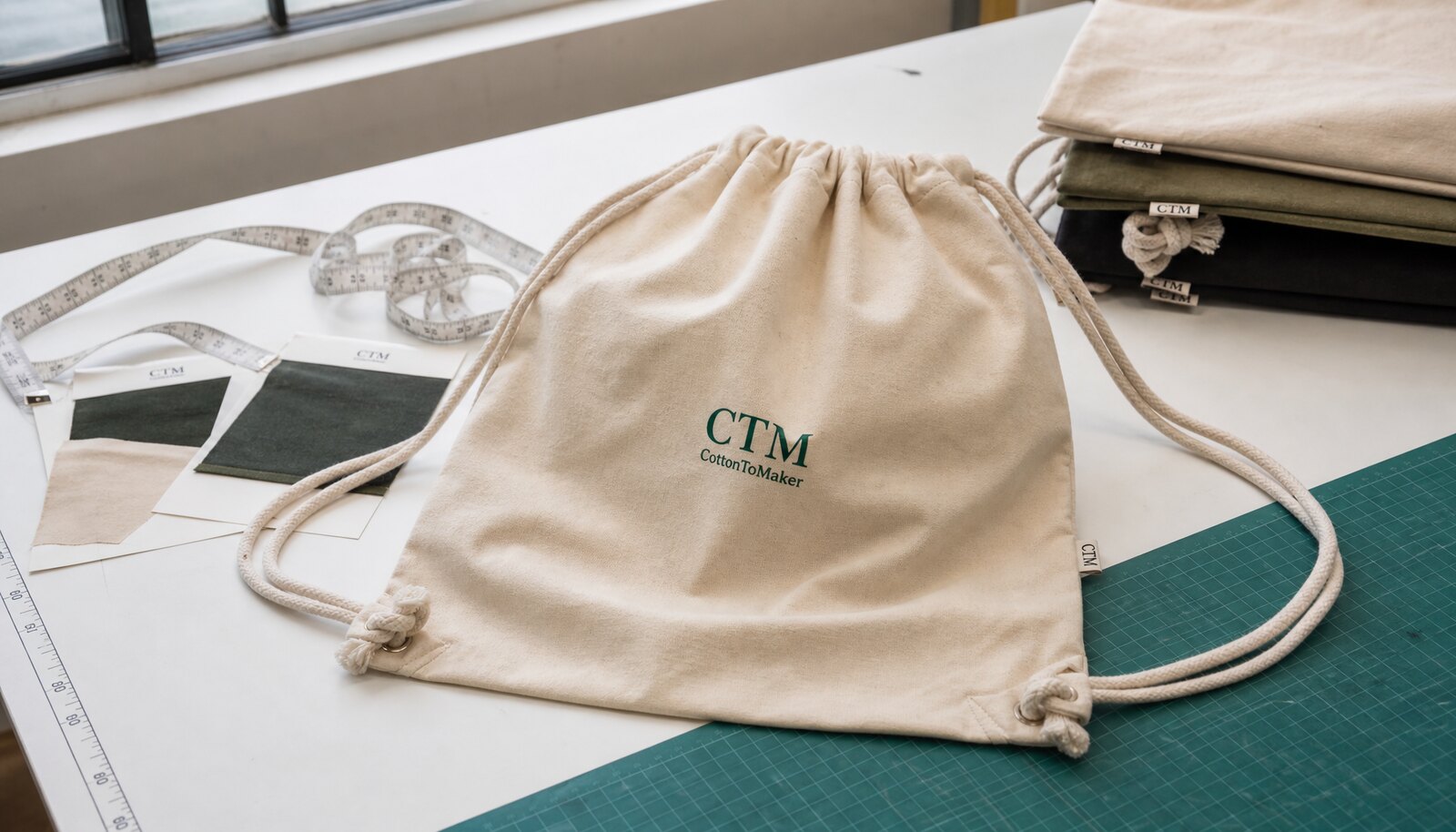
Why print proofing matters for winery bags
Boutique wineries use drawstring backpacks in a way that is more visible than a plain promotional pouch. They end up in tasting rooms, club shipments, event gift sets, and retail counters, so the bag is part packaging and part brand surface. If the logo is too small, the ink sits crooked, or the cotton looks cheap, the bag reads like an afterthought instead of a controlled product line.
Print proofing is the point where you stop guessing. The approved proof should settle the fabric, the size, the print method, the placement, and the packaging into one production standard. For a cotton drawstring backpack, a digital mockup is not enough. The real decision is whether the sample in your hand matches what you intend to receive in bulk, especially when the bag is meant to represent a premium wine brand.
- Treat the sample as the production standard, not a presentation piece.
- Tie the proof to the final PO, SKU, and carton spec.
- Use the same approval standard for the logo, bag shape, and pack format.
Choose the bag spec before touching artwork
For most boutique winery programs, 150 to 180 GSM natural cotton is the practical starting point. At that weight, the bag has enough body to print cleanly, survive repeat handling, and avoid the flimsy feel common in very light promotional stock. A 140 GSM bag can work for one-off event giveaways, but it will show wrinkles and light-through more easily. Once you move above 200 GSM, the bag feels more substantial, but it also becomes bulkier in carton packing and usually costs more to ship.
Size and structure matter as much as GSM. A common range is roughly 34 by 42 cm or 36 by 45 cm for a drawstring backpack, but the right size depends on whether the bag is only for handouts or also needs to hold a tasting kit, bottle, or booklet. Cotton cord gives a softer premium feel, while polyester cord slides more easily and can be slightly more durable in repeated use. Reinforced cord holes, a neat top hem, and clean bottom stitching matter more than decorative extras when the bag will be inspected by customers.
- Use 150 to 180 GSM cotton for most retail or club-gift programs.
- Ask for the exact finished size, not only the cut size.
- Confirm cord material, cord length, and reinforcement at the hole or channel.
Pick the print method by art and volume
Screen printing is the default choice when the logo is simple, the color count is low, and the order volume is healthy enough to absorb setup. It gives the most predictable look on cotton and usually holds up better than decoration methods that sit on top of the fabric. If the design is one or two spot colors with clear edges, screen print normally gives the cleanest result for a winery brand mark.
Heat transfer or DTF is useful when the artwork has gradients, fine type, or more colors than a screen setup can handle efficiently. It is also practical for smaller runs where a screen fee would distort the unit economics. The tradeoff is feel and age. A transfer can look too thick or too glossy on a soft cotton bag, so you need a real strike-off on the final fabric. For premium brands, a woven side label or small stitched label can support the print without overloading the front panel.
- Use screen print for simple winery logos and repeatable bulk runs.
- Use transfer methods only when the art requires it or the MOQ is small.
- Approve on real cotton, because fabric texture changes the visible color and edge quality.
Read MOQ and quote structure like a buyer
MOQ is not one number. It changes with fabric color, print color count, cord color, and packing format. A factory may be comfortable quoting 500 pieces for natural cotton with one-color print, but the same order can move higher if you want custom dyed fabric, a matching cord, a hang tag, or individual polybags. In practice, the quote is telling you how many process changes the factory has to absorb before it can run efficiently.
A usable RFQ makes suppliers quote the same basket of assumptions. Ask for unit price, setup fee, sample charge, packing charge, and freight basis separately so you can compare apples to apples. If one supplier looks cheap only because the screen fee is hidden in the unit price or the sample charge is missing, you will not see that until late. For procurement, the cleanest quote is the one that exposes every step of the cost stack.
- Request price breaks at 500, 1,000, 3,000, and 5,000 units if your volume may scale.
- Separate bag cost, print setup, sample cost, and freight in every quote.
- Confirm whether the factory keeps screens or charges setup again on reorders.
Compare supplier routes, not just factories
For a bag that will carry a winery logo, the sourcing route matters as much as the factory name. A direct factory with sewing and printing in the same operation usually gives the most control over proofing because the same team can align the sample, the print placement, and the bulk run. That reduces handoff risk and makes it easier to correct an issue before production scales.
A stock blank plus local decoration can work when speed matters more than exact specification, but the buyer has less control over weave, thickness, and drawcord quality. A trading company can simplify communication if you are sourcing multiple items at once, yet it adds another layer between the proof and the line that actually runs the order. For boutique wineries, the best route is usually the one that preserves the approved sample most faithfully, not the one that sounds easiest on paper.
- Use direct factory sourcing when the bag itself is part of the brand experience.
- Use stock blanks only when the spec can be loosened without hurting presentation.
- Avoid split responsibility unless one party owns the final signed sample.
Use the sample to lock the production standard
The sample trail should include more than one image file. A serious approval flow uses a print strike-off, a pre-production sample on the final fabric, and if possible a sewn sample from the exact line that will produce the bulk order. That gives you three ways to catch a problem: artwork accuracy, material behavior, and assembly quality. Pictures can miss all three, especially on natural cotton where weave and color vary slightly by batch.
Once the sample arrives, compare it against the PO, the artwork file, and the agreed packaging note. Record the date, the color reference, and any approved deviation. If you accept a slightly darker natural cotton or a small placement change, note it before bulk starts. That prevents a long argument later when the first cartons are opened and someone is relying on memory instead of a signed record.
- Inspect front, back, inside, and label areas under neutral light.
- Measure finished size, cord length, and print position on the actual sample.
- Keep one signed reference sample with the order file for final inspection.
Set QC thresholds before production starts
QC thresholds should be defined before cutting begins. A small placement variation can be acceptable on a soft cotton bag, but the tolerance needs to be stated in advance. If the logo is off-center by a visible amount, if the ink smears, or if the cord holes are weak, those are not minor issues. The same applies to line weight in the logo. Fine text that looks clear on a screen may disappear once printed on slubby cotton, so minimum line thickness should be part of the spec.
The inspection structure should separate critical, major, and minor defects. A wrong logo, wrong color, or missing label is critical because it changes the identity of the bag. A weak seam, crooked print, or broken cord is major because it affects use and shelf presentation. Minor issues such as a stray thread or a slight wrinkle may be acceptable in bulk, but only if they do not hurt the product's retail appearance. This classification saves time because everyone knows what triggers rework and what does not.
- Critical defects stop shipment: wrong art, wrong size, missing label.
- Major defects require corrective action: off-center print, weak seam, broken cord.
- Minor defects should be capped: loose thread, light wrinkle, small natural-cotton variation.
Packing and shelf readiness affect the quote
Packing is not just a logistics detail. For winery use, the bag may go straight from carton to tasting room shelf, club pack, or e-commerce prep bench. Bulk nested packing keeps freight efficient and reduces unit packing cost, but individual polybags with insert cards help if the bag is displayed as retail merchandise. You need to decide whether the product is being sold, handed out, or stored, because each use case wants a different finishing method.
Carton marks should be readable and useful to receiving teams. Ask for SKU, color, quantity, PO number, and carton count on at least two sides of the master carton. Also confirm how the factory folds the bag and tucks the cords. A loose pack can waste space and raise freight, while an over-compressed pack can leave hard crease lines that make the bag look lower grade than it really is.
- Specify bulk nested, individual polybag, or banded packing at RFQ stage.
- Require master carton dimensions before you book freight.
- State the fold direction if the bag will be displayed immediately after receipt.
Lead time, landed cost, and the RFQ data you actually need
A realistic timeline has four gates: artwork proof, sample approval, bulk production, and packing and dispatch. If any one of those is vague, the schedule slips. The best way to avoid that risk is to make the factory quote the process by stage instead of promising a single delivery window with no detail. For custom cotton drawstring backpacks, the proof phase is usually where buyers lose the most time because the logo or placement is still changing.
Landed cost should include the parts buyers often forget to compare: sample shipping, setup fees, print plates or screens, packaging materials, carton prep, inland moves, and the export or import handling that sits outside the factory quote. Two suppliers can show similar ex-factory numbers and still land very differently. The RFQ is strong when every supplier is forced to quote the same finished spec, with the same packaging assumptions and the same approval sequence.
- Ask for a lead time breakdown by proof, sample, production, and packing.
- Compare landed cost, not only ex-factory price.
- Keep the RFQ narrow so suppliers quote the same spec instead of guessing.
Specification comparison for buyers
| Spec decision | Recommended option | When it fits | Buyer risk to check |
|---|---|---|---|
| Source route | Direct factory with in-house sewing and printing | Best when you need one party to control fabric, print placement, and final pack-out | Make sure the factory really owns the print process and is not outsourcing the decoration step |
| Source route | Blank stock bag plus local decorator | Useful when speed matters more than exact fabric control or when the order is very small | Risk of mismatched fabric feel, different cord quality, and no control over bag dimensions |
| Fabric weight | 150 to 180 GSM natural cotton | Works for most boutique winery giveaways, tasting room retail, and club gifts | Check shrinkage, opacity, and whether the weave is tight enough for clean logo edges |
| Print method | One-color screen print on the front panel | Best for clean winery marks, simple logos, and repeat orders with stable artwork | Watch for poor registration, ink bleed on slubby cotton, and weak curing |
| Print method | Heat transfer or DTF for small runs with complex art | Fits low MOQ orders, multi-color logos, or artwork with fine detail | Confirm hand feel, wash durability, and whether the finish looks too plastic for a premium brand |
| Logo placement | Centered front panel with a defined print window | Works when the bag is used as a visible brand item, not just a utility pouch | Measure placement tolerance and make sure the logo is visible when the bag is partially closed |
| Packing route | Bulk nested packing for wholesale | Good for warehouse receiving, carton efficiency, and lower unit packing cost | Confirm fold direction and cord tuck so the bags do not arrive creased or distorted |
| Sample route | Physical pre-production sample plus print strike-off | Best for procurement teams that need a hard approval standard before bulk starts | Do not approve from screen images alone; compare fabric shade, size, and print position on the real bag |
Buyer checklist before sampling
- Lock the final bag size, fabric weight, cord type, and print area before requesting quotes.
- Approve one physical sample on the final fabric, not just an artwork PDF or mockup.
- Confirm the print method, color count, and whether setup fees apply per artwork version.
- Define acceptable placement tolerance for the logo and the cord hole position.
- Specify whether the bags ship bulk nested, individually polybagged, or with insert cards.
- Request carton dimensions, carton count, and net and gross weight before freight booking.
- Ask for lead time by stage: proof, sample, bulk production, packing, and dispatch.
- Keep one signed reference sample with the PO and packing spec for final inspection.
Factory quote questions to send
- What fabric weight, weave, and shrinkage range will you use for the quoted bag?
- Is the print done in-house, and what is the setup fee for each color or artwork version?
- Can you share a real pre-production sample or strike-off on the final cotton fabric?
- What is the minimum order quantity at the quoted spec, and which changes would raise it?
- How will the bags be packed: bulk nested, individually polybagged, or with insert cards?
- What is the expected lead time after artwork approval and sample sign-off?
- What carton size and carton count do you plan for this order?
- What defect tolerance do you use for print placement, stitching, and cord assembly?
Quality-control points to confirm
- Logo color matches the approved reference within the agreed visual tolerance under normal indoor light.
- Print placement stays within the agreed position window and is centered consistently across the run.
- Fabric weight and hand feel match the approved sample, with no obvious yarn gaps or weak weave areas.
- Seams at the side, bottom, and cord channel are secure, even, and free from skipped stitches.
- Cord length, knotting, and draw function are consistent from bag to bag without fraying or binding.
- No major ink bleed, smudging, cracking, or uneven curing appears on the finished surface.
- Packing count per carton matches the purchase order, and carton marks are readable on two sides.
- Any woven label, side label, or care label sits flat, with no twisted or misaligned attachment.