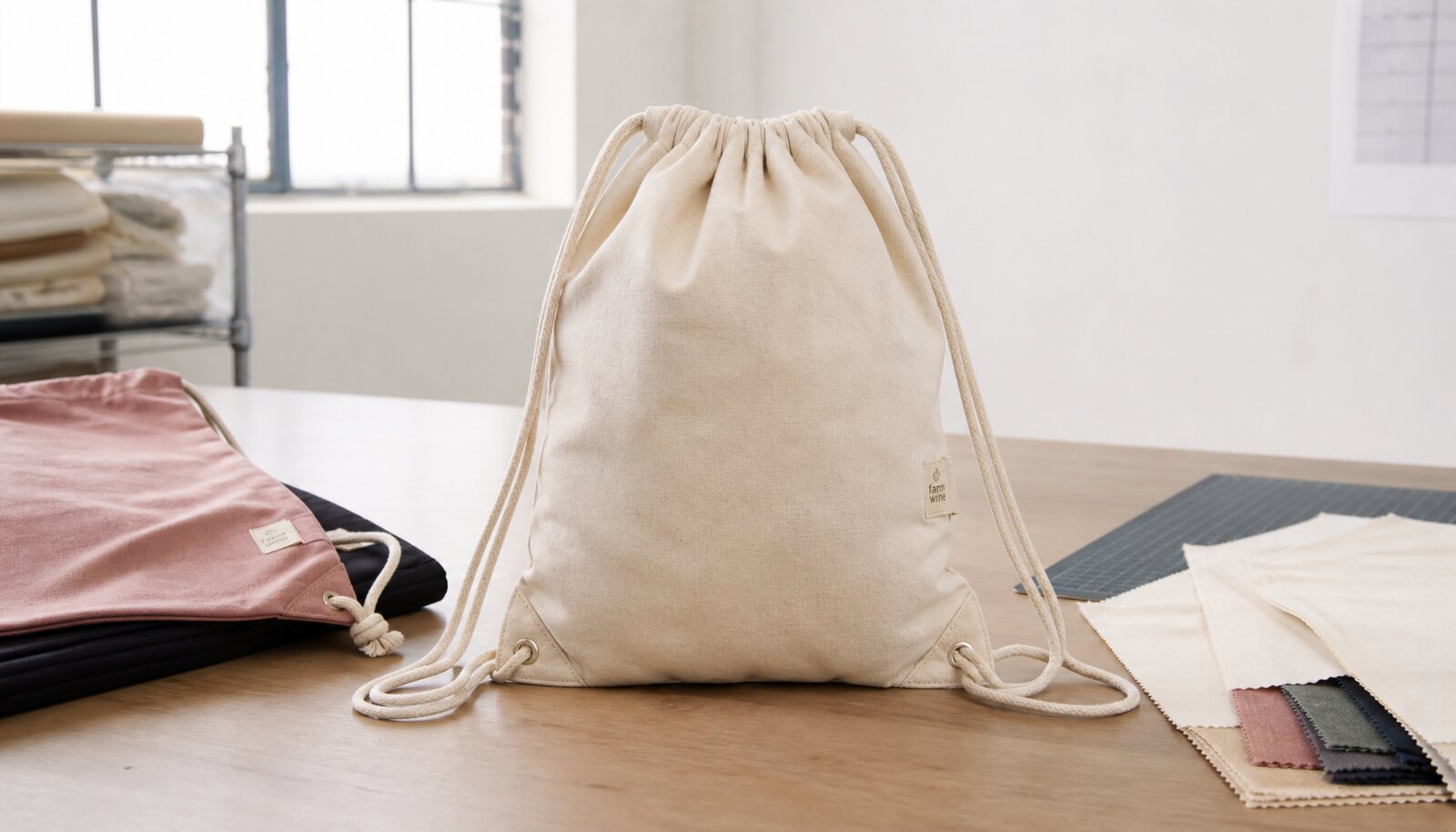
Why Boutique Wineries Use Cotton Drawstring Backpacks Instead Of Generic Gift Bags
For boutique wineries, a cotton drawstring backpack does more than carry product. It can become part of the visitor experience, a branded gift at a club event, a retail item in the tasting room, or a simple way to bundle small purchases without looking disposable. The format is practical because it is easy to open, easy to carry, and easy to print with a winery logo or seasonal message. It also gives a brand a larger surface than a paper bag while still staying lightweight enough for gifting and mail-friendly programs.
That said, the buying decision is not really about whether the bag is cotton. The real decision is whether the bag can be produced consistently, decorated clearly, packed in a way that protects the print, and landed at a total cost that fits the winery’s margin. A retail-minded buyer will care as much about the feel of the cloth and the neatness of the seam as about the unit price. In a boutique setting, those details affect whether the bag feels like a merch item or just an afterthought.
For procurement teams, the most useful framing is to treat the bag as a repeatable branded component. That means defining it like one: same size, same fabric, same cord, same artwork, same packing method, and the same acceptance criteria for every reorder. If those choices are left loose, quotes will appear attractive but the actual product can vary enough to undermine the brand experience.
A good default is to think in three use levels. First is the lightweight promotional bag for event handouts. Second is the gift or club bag that should feel polished when a customer receives it. Third is the retail merch bag that must survive repeated handling and still look good on shelf. The more the bag has to perform like merchandise rather than packaging, the more you need to control fabric weight, construction, and finishing details.
If you are sourcing cotton drawstring backpacks for boutique wineries bulk pricing plan purposes, the first question should never be ‘what is the cheapest quote?’ It should be ‘what is the exact product we can reorder without having to re-approve the entire program every season?’ That question leads to better supplier conversations and fewer surprises later.
- Use the bag as part of the winery’s brand presentation, not just as filler packaging.
- Separate event-only programs from retail or club programs because the quality target is different.
- Treat repeatability and print consistency as procurement requirements, not nice-to-have features.
Set The Spec First: Size, Fabric, Cord, And Finish
Before asking for price, define the product so the factory is quoting the same bag you intend to buy. A bag that is described only as ‘cotton drawstring backpack’ leaves too much room for interpretation. One supplier may quote a lighter weave, another may use a different finished size, and another may include a label while the next one does not. Those differences make the numbers look competitive when they are really pricing different products.
Start with finished size. State width and height as the buyer wants the bag to measure when finished and packed in a normal way. Then choose the fabric weight. For many winery programs, a mid-weight cotton is the most practical starting point because it gives enough body for a neat print and enough softness to feel approachable. Heavier cloth brings a more premium hand feel and better shape retention, but it raises sewing effort, freight weight, and sometimes MOQ because the factory needs a different material setup.
The finish matters more than many buyers expect. Unbleached cotton gives a natural, artisanal look that fits rustic or heritage branding. Bleached or brighter cotton can improve contrast for logos with fine details or lighter brand colors. If the bag will be sold rather than simply given away, ask whether the cotton is pre-shrunk or whether the factory expects normal shrinkage after washing or handling. Even if the bag is not meant for repeated laundering, shrink behavior can affect how the seams sit and how the print reads over time.
Cord design deserves the same attention. Ask what cord material is used, what diameter it is, how the ends are finished, and whether the cord path through the tunnel is reinforced. A thin cord may look neat but can feel cheap in hand and may cut into the bag under load. A thicker cord can improve comfort and presentation but may increase both material cost and assembly time. If the bag will carry more than light merch, the cord and tunnel should be designed together instead of treated as separate options.
The best RFQ format is one that forces the supplier to commit to the exact construction. Specify finished size, fabric weight or approved range, color, cord style, logo position, and any secondary elements such as woven labels or sewn patches. The more exact the spec, the easier it becomes to compare real quotes rather than apples-to-oranges numbers.
- Lock finished size before pricing; do not let suppliers choose their own interpretation.
- Choose fabric finish based on the brand story and artwork, not only on price.
- Match cord thickness and reinforcement to the actual load the bag needs to carry.
How Bulk Pricing Is Built: What The Factory Is Really Charging For
A useful bulk pricing plan starts by understanding what is inside the unit price. The cost is not just cotton fabric. It is fabric consumption, cutting waste, stitching labor, cord insertion, decoration setup, print run time, label attachment, folding, carton packing, and sometimes warehouse handling before export. When buyers only compare a single unit number, they can miss how one supplier is bundling packing and another is quoting it as an extra charge.
For procurement use, a better question is: what is the base bag, what is the decoration, and what is the packaging? If the supplier cannot split those components, the quote is hard to benchmark. This matters especially for boutique wineries because branding choices can change cost more than the cloth itself. One simple print may be inexpensive, but a woven label, a hang tag, and individual retail folding can move the price enough to affect your margin on a gift or merch line.
The most useful way to think about pricing is in tiers rather than a single figure. At low volumes, setup costs dominate. At mid volumes, the price starts to respond to fabric consumption and labor efficiency. At higher repeat volumes, the factory can amortize print screens and optimize cutting, which is where unit economics improve. The exact breakpoints vary by supplier, but the logic is consistent: the smaller the run and the more complex the branding, the higher the cost per bag.
For a winery buyer, example quote bands are more useful than a vague promise of ‘factory direct pricing.’ In low-complexity programs, a simple blank or lightly printed cotton drawstring backpack may fall into a modest wholesale band, while a heavier fabric, multiple decoration steps, and retail packing will push the program into a meaningfully higher band. Instead of trying to guess the market number, ask each supplier to quote at three volumes, such as a pilot quantity, a standard seasonal quantity, and a repeat re-order quantity. That shows where the price actually drops.
A practical landed-cost scenario should include the factory price, packing, inland freight to port or warehouse, ocean or air freight, duty if applicable, and receiving costs at the destination. For example, a quote that looks attractive ex-works can become less competitive once the cartons are over-weight, the pack-out is inefficient, or the shipping charge rises because the bags are bulkier than expected. The procurement lesson is simple: a low sticker price is not a low program cost unless the packaging and freight assumptions are also under control.
When you request pricing, make the supplier answer in a way finance can use. Ask for price by volume tier, by decoration level, and by pack format. If you are comparing multiple vendors, normalize the quotes to the same carton count, same artwork complexity, and same delivery point. That is how you build a bulk pricing plan that can survive budget review.
A strong sourcing file usually shows three price views: blank bag, decorated bag, and fully packed bag. That gives the buyer a clean read on where the money is going and where savings are possible if the winery decides to simplify the program later.
- Use pricing tiers, not a single quote, so you can see how volume changes the economics.
- Separate base bag cost from decoration and packing cost.
- Compare landed cost at the same delivery point rather than comparing ex-works numbers alone.
Which Sourcing Route Fits Your Winery Program Best
There is no single best supplier route for cotton drawstring backpacks. The right path depends on whether the winery needs speed, consistency, technical control, or a low-friction buying process. Direct factory sourcing is strongest when the bag will be reordered and when you want control over the construction details. The factory can usually answer stitching, fabric, and pack-out questions more clearly because it is closer to the work. That matters if the bag is part of a repeat brand program and not just a one-time event item.
Trading companies and sourcing agents can be helpful when the buyer needs coordination rather than engineering detail. If you are ordering mixed sizes, multiple print versions, or several packaging styles at once, an experienced intermediary may simplify the workflow. The tradeoff is that you need to be very clear about who is actually making the product and who is responsible if the sample differs from the bulk run. A quote that looks tidy on paper can hide margin layers or reduced visibility into the factory’s real capabilities.
Domestic decorators using imported blanks are often chosen for urgent programs. If the winery needs a quick launch for a harvest event or a local promotion, this route can reduce development time because the blank bag already exists. The downside is that the blank is now part of your specification, even if you did not directly control it. If the importer changes the blank source or the bag lot changes, your decorated product can shift in hand feel, seam quality, or fit.
The right decision usually depends on three questions: Do you need the exact same bag again? Do you need the lowest total landed cost? Do you need the fastest turnaround? The answer to all three is rarely the same supplier route. For a boutique winery, repeatability and brand presentation are often more valuable than the absolute cheapest first run, especially if the bag is tied to a retail shelf or club experience.
When comparing routes, ask for evidence, not just claims. Request factory photos, sample photos, packing photos, and a written explanation of where each process step happens. Then compare the vendors on the same criteria: who owns the fabric, who does the printing, who packs, who inspects, and who arranges freight. That structure exposes the real cost and reduces the chance of a quote that only looks simple because responsibilities are hidden.
If your team expects ongoing reorder behavior, direct factory control is usually the safer long-term option. If the program is experimental, a managed intermediary may be good enough. If the need is urgent and the order is small, blanks plus local decoration may be the most practical answer. The key is to choose the route based on the program life cycle, not on the first number that arrives in your inbox.
- Direct factory sourcing is strongest for repeatability and QC control.
- Trading or agent models are useful when coordination matters more than technical depth.
- Domestic decoration on stock blanks is best for speed, but the blank bag must be locked by sample.
Pricing Bands And Tiers Buyers Should Ask For In The RFQ
One reason bulk pricing feels vague is that many RFQs ask for ‘best price’ without telling the supplier how to tier the offer. For procurement teams, a better approach is to request pricing at three volume levels and across several spec options. That gives you a map of where costs are actually moving, instead of one number that cannot support a budget decision.
Ask for at least three quote levels. The first is a pilot or small seasonal quantity. The second is a standard batch that reflects your normal event or retail need. The third is a repeat or annual buy that assumes the same spec and the same packaging. If the supplier can only quote one number, you cannot tell whether their pricing is steady or whether the quote is padded to cover uncertainty. A genuine bulk plan should reward standardization.
The table below is meant to help buyers normalize responses, not to lock them into one universal market price. Actual numbers vary by country, freight mode, fabric source, decoration method, and carton configuration. Still, the tiers are useful because they reflect how suppliers usually think: setup-heavy at low volume, more balanced in the middle, and more efficient once the run is stable and repeatable.
| Quote tier | What to ask for | Why it matters | | --- | --- | --- | | Pilot tier | Sample-like production, limited colorways, and minimal risk commitments | Reveals setup charges and helps test whether the artwork or fabric needs adjustment | | Standard seasonal tier | The most likely order size for one winery campaign or merch cycle | Helps you understand the normal operating price you would budget against | | Repeat reorder tier | Same spec, same artwork, same packing, same delivery point | Shows what the supplier can offer once the process is already approved | For a more complete pricing request, ask the supplier to quote the same bag under three decoration conditions: blank, one-color print, and print plus label. If you need retail-ready packing, add that as a fourth condition. This is where many buyers discover the real economics. The bag body may be relatively inexpensive, but the finished branded item is priced by labor and handling more than by cotton alone.
Example landed-cost thinking is also helpful. Suppose the winery orders a standard batch, and the factory quote looks reasonable until the team adds individual folding, label attachment, carton marking, inland freight, and export freight. Those additions may not sound large separately, but together they can shift the economics enough to change whether the program works as retail merchandise or must stay a promotional giveaway. That is why the price plan should be built from line items rather than from the headline quote.
A buyer-friendly RFQ usually asks the supplier to provide a cost matrix, not a single number. The matrix should show how price changes when fabric is heavier, decoration is added, or packaging becomes retail-ready. That makes internal approval much easier because finance can see the cost of each option and marketing can choose the presentation level that best fits the campaign.
- Request three volume tiers so you can see setup cost versus true bulk cost.
- Ask for blank, printed, and retail-packed pricing to isolate the cost drivers.
- Use a quote matrix to compare factories on the same basis.
Decoration Choices That Hold Up In Real Winery Use
Branding is where cotton drawstring backpacks for boutique wineries either look polished or start to feel generic. The most reliable default is a simple screen print because it gives crisp branding on natural cotton at a sensible cost. For logos with straightforward shapes, one or two colors usually work well. Once the artwork gets too detailed, the bag surface can lose fine lines or shift slightly during production, especially if the cotton weave is open or the print area is small.
The buyer should think about how the bag will be seen after it leaves the factory. In a tasting room, the customer may hold it, fold it, stuff it into a car, and open it again later. If the print is fragile or too close to the edge, it can wear faster than expected. That is why many buyers add a secondary brand element such as a sewn side label, a woven patch, or a discreet hang tag. The added touch can make the bag feel more intentional without requiring a complex print setup.
If the winery wants a premium look, the best improvement is often not more decoration but better placement. A centered logo with generous clear space can look more upscale than a crowded design with multiple colors. Keep text away from seams and cord tunnels, and leave enough margin for folding. Ask the supplier to show the artwork on a production-oriented template, not just a polished mockup, because the sewing lines and fold positions affect where the logo actually lands.
Another useful question is how the decoration interacts with the cotton finish. Natural unbleached cotton usually softens the contrast, which can be attractive for rustic branding but less effective for very light inks or small lettering. Bleached cotton improves readability but may not match a heritage or organic presentation. If the winery has a specific brand mood, the decoration method should support that mood instead of just lowering cost.
For short runs or more complex graphics, some buyers consider heat transfer or similar methods. Those can be workable, but only if abrasion and handling are tested. A decorative method that looks good on day one can become a problem if it cracks, lifts, or rubs after a few handlings. That is why the right decoration choice is not just about appearance on a proof; it is about durability after normal use in a winery setting.
The smartest approach is to choose one primary branding method and one fallback. For example, if the main front print must be simple and economical, a woven side label can carry the premium signal. If the front print has to do everything, make the artwork strong enough to survive the cotton texture and the folding process. The goal is not to add decoration for its own sake; it is to make the bag feel intentional and durable within the budget the winery actually has.
- Use screen print for clear, repeatable logos.
- Add a woven label or patch when the bag needs a premium retail feel.
- Keep artwork clear of seams, folds, and the cord tunnel.
Sample Approval: Turn It Into A Measurement And Fit Check, Not A Guess
Sample approval should do more than confirm that the bag looks close to the artwork file. It should prove that the factory can make the same bag consistently. For a meaningful review, ask for a blank sample first if the spec is new, then a pre-production sample with the final print, label, cord, and packing method. That sequence matters because it separates construction issues from decoration issues. If you approve only a decorated sample, you may miss problems in the base bag that show up during the bulk run.
The review process should be documented against a simple checklist. Measure width, height, and symmetry. Check whether the cord lengths are equal. Examine stitch quality at the bottom seam, top tunnel, and stress points. Open and close the bag several times. Load it with the actual contents the winery expects to use and see whether the bag still closes cleanly. If the bag is meant to sit in a retail display, fold it the same way the factory plans to pack it and make sure the presentation still looks neat.
The sample should also be checked in ordinary light, not only under bright showroom lighting or in a polished photo. Natural cotton can hide subtle print issues, and soft daylight can reveal whether the ink is too thin, the logo is too close to the edge, or the contrast is weaker than expected. If a woven label is used, inspect the stitching and the edge finish. If the cord feels rough, twisted, or inconsistent, that is a warning that the bulk lot may not feel premium either.
A practical approval file should include the approved sample, a signed reference sheet, and the final art file with the exact placement dimensions. If any detail changes after approval, such as a label shift or a different packing method, treat the altered version as a new sample and re-confirm it. That extra discipline is worth it because small changes are easy to overlook and hard to correct once a full production lot has been made.
For wineries that plan future reorders, the sample should be archived with photos of the front, back, inside, and folded state. That way the next season’s order is compared against a physical standard instead of a memory. Many procurement problems begin when a team says ‘make it like last time’ but cannot point to the last approved version. A tight sample record solves that.
If the program is especially visible or tied to a launch event, a small pilot lot before full bulk can be worthwhile. It gives you a real-world test of print durability, folding behavior, and carton packing without committing the entire budget before the first review is complete.
- Use a blank sample plus a pre-production sample when the spec is new.
- Measure the bag, inspect the stitches, and test the cord under load.
- Archive the approved sample and reference sheet for reorders.
Packing And Carton Design Can Move The Landed Cost More Than You Expect
Packing is often treated as a logistics detail, but for branded cotton bags it can materially change both cost and damage risk. Bulk carton packing is the least expensive approach and usually makes sense when the winery or distributor will repack later. It keeps labor low and simplifies the factory process. However, bulk packing can also allow the print to rub against other bags if folding is sloppy or cartons are overfilled.
Retail-ready packing increases labor but can protect the presentation. If the bags are going straight to a tasting room shelf, club fulfillment line, or customer-facing gift station, a neat fold and protective inner wrap may be worth paying for. The buyer should decide whether the bag is being shipped as packaging or sold as merchandise. Those two uses do not justify the same pack-out.
Ask the supplier how the bag is folded, whether each unit is separated with tissue or a thin polybag, and whether the print surface touches another print during packing. Even a good screen print can be damaged if the cartons are packed too tightly. For export, carton sizing matters as well. A box that looks efficient on the factory floor may generate a higher freight cost if it is awkward to palletize or if the gross weight creates handling issues.
Request carton data with the quote rather than after the order is placed. The data should include carton dimensions, units per carton, gross weight, outer label content, and whether the cartons are suitable for stacking. If the winery uses a 3PL or a distribution center, get the carton mark format right the first time so the receiving team does not need to relabel or rework shipments. Mis-marked cartons are a common source of avoidable delay.
Moisture protection is another overlooked issue. Cotton can absorb humidity, and cartons moving through ocean freight or warehouse staging may see conditions that affect the feel of the bag. If the destination is humid or the transit route is long, ask whether the factory uses an inner liner, desiccant, or other protection. That may not be needed for every order, but it should be considered for larger or more sensitive shipments.
The main rule is simple: do not let the factory choose the packing method for convenience if you have a customer-facing use case. Specify the fold, the packing count, the carton mark, and any retail labeling up front. That gives you a true comparison across suppliers and reduces the chance that the cheapest quote becomes the costliest order after rework or damage.
- Bulk pack is the lowest-cost option when repacking will happen later.
- Retail-ready pack is worth it when presentation and damage prevention matter.
- Ask for carton dimensions, carton count, gross weight, and mark format in the quote.
A Better QC Gate For Reorders: What To Inspect Before Shipment And On Receipt
Quality control should be built as a gate, not a last-minute reaction. If the winery expects reorders, the QC criteria should be established in the first purchase order and repeated every time. That way the supplier knows exactly what counts as acceptable, and the buyer knows exactly what to inspect before payment or final release. For a cotton drawstring backpack, the most important control points are measurable and visible: size, seams, print position, cord symmetry, and carton count.
At the supplier stage, inspect the pre-production sample against the reference sheet and make sure the production line can reproduce it. During bulk production, ask for in-process photos of stitching, printing, and packing if you are sourcing remotely. Before shipment, inspect a representative sample from the lot using a simple defect list. You do not need a complex quality manual to catch the common failures; you need consistency and enough specificity to stop disputes.
The most common defect patterns are predictable. Fabric can vary too much from panel to panel. Stitching can wander near the tunnel or bottom seam. The print can sit too high, too low, or too close to a fold. Cords can come out uneven or twist at the ends. Cartons can be overfilled or labeled incorrectly. If the supplier knows these are the watchpoints, the factory is more likely to self-correct before the shipment is packed.
A useful procurement practice is to divide defects into three classes. Major defects are the ones that affect function or brand acceptance, such as open seams, broken cords, or unreadable logos. Minor defects are cosmetic issues that do not affect use but still need a limit, such as small thread trims or slight print variation. Critical defects are the ones that can stop shipment entirely, such as wrong size, wrong artwork, or wrong packing format. This classification helps the supplier respond quickly and keeps the discussion focused.
At receiving, do not rely only on the supplier’s inspection report. Open cartons from more than one location in the shipment and compare the bags to the approved sample and purchase order. A shipment can look perfect on top and still hide variation in the middle. For a winery program with a launch date, receiving surprises are especially costly because the merch may already be committed to a club mailing, tasting-room event, or retail setup.
If you want the reorder to behave like the first order, keep the reference standard alive. Save one approved sample, one final spec sheet, one final artwork file, and one packing diagram. That package is more valuable than a loose email chain because it gives every future buyer the same reference point.
- Classify defects as major, minor, or critical before production starts.
- Inspect sample, bulk, and receiving stages instead of relying on one final check.
- Keep the approved sample and spec sheet on file for every reorder.
How To Build A Bulk Pricing Plan That Survives Budget Review
A good bulk pricing plan is not just a supplier quote. It is a cost model that shows what the winery will pay from factory door to usable inventory. To build that plan, separate the program into its components: base bag, decoration, inner packing, carton packing, inland freight, international freight, duty if applicable, and receiving or fulfillment fees. If any of those are missing, the quote is not ready for procurement approval.
The easiest way to make the plan useful is to build it as a range. Low case, expected case, and high case. The low case assumes the simplest decoration and the least expensive approved packing. The expected case reflects the program the winery is most likely to buy. The high case includes heavier fabric, extra branding, or retail-ready handling. That gives marketing and finance a way to see what optional features really cost before the order is placed.
It also helps to compare landed cost per usable unit rather than factory cost per piece. If a bag is cheap but arrives damaged, overpacked, or incorrectly labeled, it is not truly cheap. If a slightly higher-cost bag arrives ready to use and matches the approved sample exactly, the procurement result may be better even if the unit price is higher. This is especially true for boutique wineries, where brand presentation can matter more than shaving a few cents off the bag price.
For ongoing programs, ask the supplier how the price changes at the reorder stage. Some factories can maintain the same material and print setup for a follow-up order and may offer a better rate. Others may reprice because the fabric lot changed or because the original setup has to be rebuilt. If you expect future seasons, negotiate the right to hold the specification and artwork on file so the re-run behaves like a repeat, not a new development project.
A final pricing plan should also show the decision tradeoffs. For example, if the winery moves from bulk carton to retail-ready fold, what is the increase? If the logo expands from one color to two, what is the cost delta? If the fabric weight moves up, what happens to freight and handling? Those comparisons turn the quote into a planning tool, not just a purchase request.
When the bag is part of a seasonal campaign, the real procurement win is consistency: same look, same feel, same pack, same arrival window. Build the cost model around that goal, and the pricing conversation becomes much clearer for both the winery and the supplier.
- Model low, expected, and high case landed cost before approval.
- Compare usable-inventory cost, not just factory unit price.
- Ask how reorder pricing changes if the spec stays exactly the same.
Specification comparison for buyers
| Buying route | Typical fit for winery programs | Pricing behavior | Main buyer watchout |
|---|---|---|---|
| Direct factory with sewing, printing, and packing under one roof | Best for repeat winery programs, private-label merch, club gifts, and any order where you want one accountable source | Usually the most competitive on repeat volume because labor, print, and packing are bundled without extra markups from intermediaries | Confirm you are speaking with the production factory, not a sales office or broker; ask for factory photos, machine photos, and sample-room evidence |
| Trading company or sourcing agent managing multiple factories | Useful when you need mixed bag colors, mixed pack-outs, or help coordinating freight and multiple SKUs | Often appears fast on quotes, but the final number can include margin stacking across fabric, decoration, and logistics | Request line-item pricing and ask who owns QC responsibility if fabric, print, and carton packing happen in different places |
| Domestic decorator using imported blank cotton bags | Practical for seasonal events, local harvest weekends, short-run tasting-room giveaways, and urgent reorders | Higher unit price than direct import in many cases, but lower development friction and faster turnaround if the blank is already available | Lock the blank bag by approved sample; if the blank changes between runs, the print result and hand feel can drift |
| Importer/distributor selling stocked blanks with optional decoration | Good for buyers who want low development effort and do not need a fully custom construction | Pricing can look simple, but decoration, setup, and freight may be added later, making total cost harder to compare | Ask whether the bag is stocked in the exact fabric, size, and color you need, or whether a substitute will be used if inventory shifts |
| Full custom program with custom fabric, custom cord, custom label, and retail pack-out | Best when the backpack is a branded retail item or club perk that must feel proprietary | Highest setup cost and MOQ pressure; cost per unit improves only when volume is stable and repeatable | Only choose this route if the winery can reuse the same spec across seasons, otherwise development cost can outweigh the branding benefit |
| Material | 6-10 oz cotton canvas, 210D polyester, rPET, or blended cotton with shrinkage and colorfastness expectations set before sampling | Before price comparison | Different cloth weights, backing, or certification claims make quotes hard to compare |
| Construction | cord diameter, eyelet or reinforced channel, bottom corner reinforcement, seam allowance, bar-tack position, and load target | Before sampling | Weak stress points create returns and failed inspections |
| Decoration | screen print, transfer, embroidery, woven label, or drawstring tag tested against folding and abrasion | Before artwork approval | The wrong method can crack, bleed, pucker, or fail on the chosen fabric |
Buyer checklist before sampling
- Define the use case first: tasting-room retail, club gift, event handout, staff bundle, or shipping insert. Each one changes construction, presentation, and acceptable price.
- Lock the finished size, target GSM, and size tolerance before requesting quotes. If the supplier cannot quote against the same dimensions, the numbers are not comparable.
- Specify whether the bag must hold one bottle, a notebook, small merch, or only lightweight inserts. Load requirement changes the cord, seam, and bottom reinforcement.
- Choose the decoration method up front: screen print, woven label, patch, or a mix. Ask for separate pricing so you can compare base bag cost versus branding cost.
- State the cotton finish clearly: natural unbleached, bleached, pre-shrunk, or washed finish. The same artwork can look very different on each substrate.
- Confirm cord construction: cord material, diameter, closure style, knot finish, and whether cord ends are heat-sealed or tied. Small choices affect both durability and labor.
- Decide the packing format before you approve the quote: bulk carton, individual polybag, tissue wrap, barcode sticker, or retail-ready folding. Packing is often where hidden cost shows up.
- Ask for a blank sample and a pre-production sample. Use the same measurement sheet for both so you can see whether the final construction stayed on spec.
- Request carton data with the quote: cartons per case, gross weight, carton dimensions, pallet pattern if applicable, and moisture protection method for transit.
- Set a reorder plan early. If the winery may reorder for another season, ask the supplier to reserve fabric color, print screens, and label components after the first approval.
Factory quote questions to send
- Is this quote based on finished size, cut size, or stitched size? Please state the measurement method and the allowable tolerance.
- What is the exact fabric weight in GSM, and is the cotton natural, bleached, pre-shrunk, washed, or enzyme treated?
- What does the unit price include: sewing, cord installation, print, label, folding, inner packing, and master carton packing?
- Can you separate the quote into blank bag price, decoration price, packaging price, and carton cost so we can compare sourcing routes cleanly?
- What is the MOQ by color, by artwork version, and by decoration method? If we change only the label, does the minimum change?
- How much is the sample fee, what type of sample will you provide, and can the sample cost be credited after order placement?
- What is the production lead time after pre-production sample approval, and which steps are fixed versus subject to material availability?
- What carton dimensions, carton count, gross weight, and pallet loading plan do you recommend for export or warehouse receipt?
- If the order is split across multiple delivery dates, can the factory hold the same fabric lot and print setup for the follow-up shipment?
- Which quality checks do you perform before packing: size check, stitch check, print check, pull test, and carton count verification?
Quality-control points to confirm
- Finished width and height should stay within the agreed tolerance, and the buyer should state whether the tolerance is measured before or after folding and packing.
- Fabric weight should match the approved GSM or supplier standard sheet; the weave should not show thin corners, inconsistent yarn density, or weak spots near the tunnel.
- Seams should be straight and uniform, with no skipped stitches, loose thread nests, seam puckering, or open bottom corners.
- The cord tunnel and cord entry points should be reinforced enough to withstand normal load without tearing or stretching out of shape.
- Cord lengths should match from side to side so the bag closes evenly; the cord should not slip through the tunnel during normal handling.
- Artwork should register within the approved position, with no smudging, bleeding, double images, or distorted fine text.
- If a label, patch, or hang tag is used, the edge finish should be clean and the attachment should not create sharp points or scratch adjacent product.
- Folding and packing should be consistent from bag to bag, especially if the bag is going into retail shelves, club boxes, or gift sets.
- Carton labels should match the PO exactly, including SKU, color, quantity, and destination marking; mixed packing should only occur with written approval.
- At receiving, inspect a small sample from more than one carton so a good top carton does not hide a problem deeper in the lot.