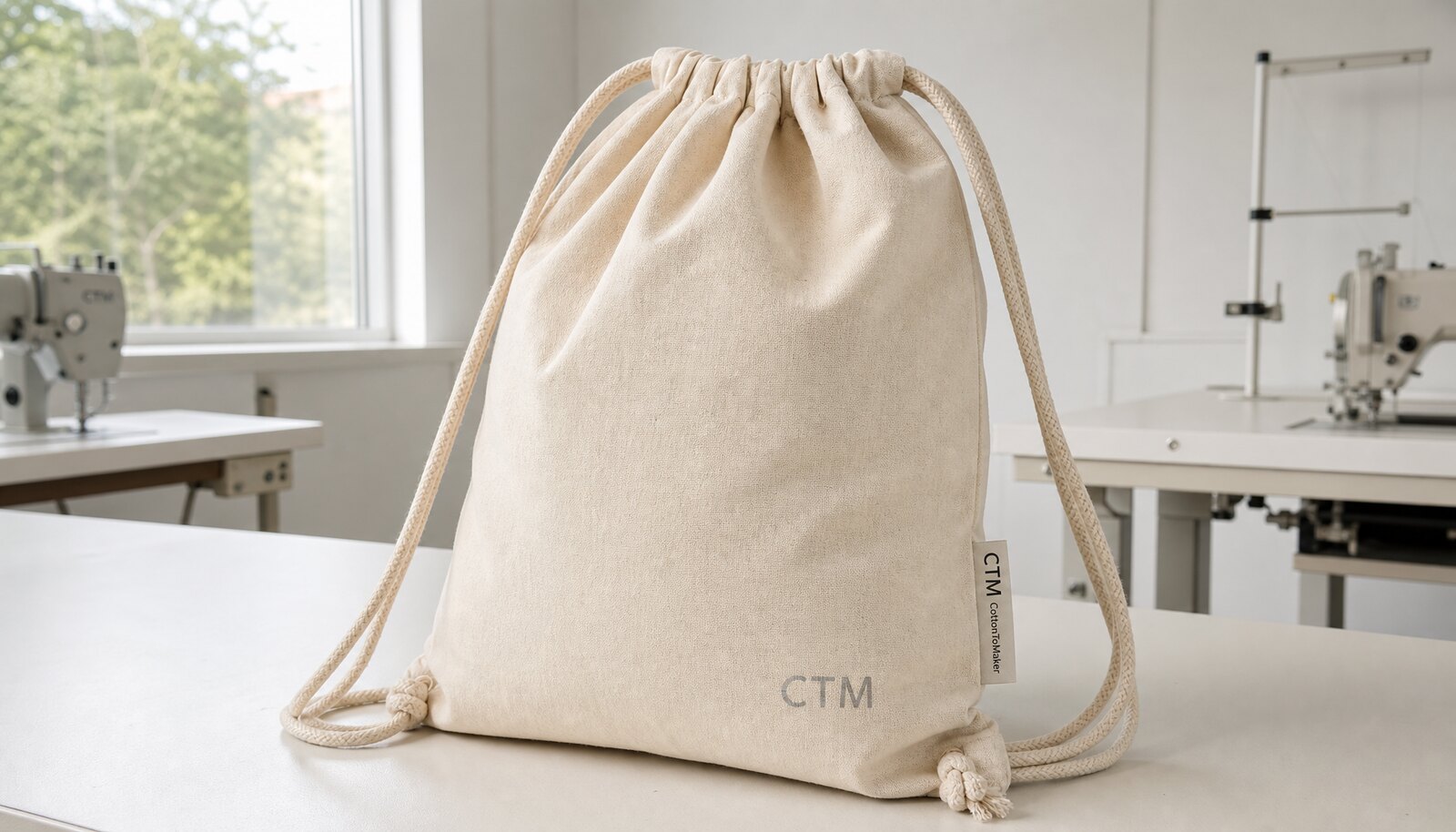
Start With the Retail Job, Not the Fabric Number
Gift shops do not buy cotton drawstring backpacks for the same reason a school buyer does. A souvenir bag has to look clean on a shelf, feel decent in hand, and survive a customer stuffing it with catalogues, small gifts, or a water bottle. That means the right fabric weight is not just a technical choice. It is a merchandising choice that affects perceived value, print clarity, and how the bag behaves after folding, hanging, and repeated handling by shoppers.
For most gift retail programs, the useful starting range is 100-180 GSM, but the buyer should narrow it by sales channel. A museum store usually needs a more polished hand feel and stronger print definition than a street-market souvenir stand. A checkout add-on can tolerate lighter cloth if the retail price stays low and the bag is obviously promotional. If the bag is sold as a souvenir item, however, buyers should expect customers to compare it against canvas totes, not against free event bags.
The simplest way to set the spec is to define what the bag must do in the store and at home. Does it need to hang flat on a peg hook, hold a destination graphic clearly, and survive one season of casual use? Or does it need to feel premium enough to carry a higher ticket and be reused often? Once that job is clear, the GSM range becomes a procurement tool rather than a guessing game.
For most gift shops, 120-140 GSM is the practical middle ground because it offers enough body for shelf presentation without pushing freight and carton weight too high. Lighter cloth can work well for giveaway programs, but it usually needs stronger design discipline to avoid looking thin. Heavier cloth can justify a higher retail price, but only if the assortment, margin, and carton plan support it.
If you are collecting quotes from multiple suppliers, write the intended retail use on the RFQ. A supplier cannot price a gift-shop backpack correctly if they are trying to guess whether the bag is a souvenir SKU, a premium boutique item, or a low-cost event freebie. That one line will save you time later when comparing quotes that look similar but are actually built for different selling models.
- 100-110 GSM: best for giveaways, event packs, and very price-sensitive souvenir programs.
- 120-140 GSM: the most practical range for gift shops, tourist retail, and checkout add-ons.
- 150-180 GSM: better for premium presentation, repeated use, and heavier contents.
- If the bag is sold near checkout, the fabric needs to look intentional, not flimsy.
- State the retail price target before you decide the GSM range, because margin changes the acceptable fabric cost.
What GSM Actually Changes in a Cotton Backpack
GSM tells you fabric mass per square meter, but it does not tell the full story. Two bags with the same GSM can still feel different if one uses a looser weave, shorter staple yarn, or a softer finish. A 120 GSM cotton bag can look more premium than a rough 140 GSM bag if the yarn quality, weave density, and finishing are better controlled. That is why buyers should treat GSM as one input, not the entire spec.
In practice, the weight affects drape, opacity, seam stability, and how sharply a print sits on the surface. Lighter fabric folds smaller and keeps unit shipping weight down, but it can show seam pull and contents shadow through the cloth. Heavier fabric handles structure and print coverage better, but it can feel bulky once packed and may require stronger cords or wider channels to avoid discomfort in use. If your retail customer expects the bag to be reused, the extra fabric weight often pays for itself in shelf perception.
Weave matters as much as the raw weight. A plain weave cotton with a tight construction often gives a cleaner print face, while a looser canvas weave gives more body and a more natural handmade look. Twill can feel smoother and may support a more premium hand feel, but it is less common in low-cost drawstring backpacks because it changes both cost and appearance. If your brand position is rustic or artisanal, the weave texture can be part of the story. If your brand position is clean and graphic, a tighter plain weave is usually easier to sell.
Finish also changes the buyer’s impression. A washed or softened finish can make the bag feel better in hand, but it may introduce more shrinkage risk if the factory does not pre-shrink or control washing conditions well. Brushed finishes may increase softness but can reduce crisp print edges. For gift retail, the safest approach is often a controlled midweight cotton with a consistent finish, then sample the final hand feel before you approve bulk.
Ask suppliers to quote the fabric as a finished construction, not just as a GSM number. You want to know the weave, yarn count, finishing method, and whether the cloth is pre-shrunk. Otherwise two quotes with the same GSM can arrive as very different products on the shelf.
- Lock the finished fabric weight, not just the raw greige fabric spec.
- Ask whether the GSM is measured before or after washing, dyeing, softening, or brushing.
- Compare weave density and yarn quality alongside GSM, especially for natural cotton.
- Check whether the fabric is pre-shrunk if the bag will be folded, printed, or pressed before shipment.
Fabric Composition and Weave Choices Suppliers Often Leave Too Vague
B2B buyers often receive a quote that says only “cotton” and a GSM number. That is not enough detail for procurement. You need to know whether the cloth is 100% cotton, a cotton-poly blend, recycled cotton content, or a dyed-and-washed cotton construction. A 100% cotton backpack will usually give a more natural touch and a stronger gift-shop story, but a blend can reduce wrinkling, speed drying, or improve dimensional stability if the end customer uses the bag frequently.
For destination retail and museum stores, 100% cotton is usually the easiest format to merchandise because it supports the “natural” look customers expect. For lower-cost promotional runs, a cotton blend may be acceptable if the buyer prioritizes price and color consistency. The tradeoff is simple: more synthetic content can make the bag look less artisanal, which matters if the item sits beside other premium souvenirs. If a supplier proposes a blend, ask for the exact fiber ratio and make sure it is printed on the quote, not just mentioned verbally.
Weave structure should be part of the spec sheet. Plain weave is common and economical, and it works well for many printed bags. Canvas or duck-style cotton is heavier, denser, and more durable, and it can improve perceived value for a higher retail price. A twill weave can soften the hand feel and add visual depth, but it can also cost more and is not always necessary for a simple drawstring backpack. For most gift shops, the practical choice is a tightly woven plain or light canvas construction around the target GSM.
Buyers should also ask about fabric finish in procurement language. Common options include raw, pre-washed, softened, enzyme-washed, and pre-shrunk. Each one affects the final bag differently. If the factory does not control shrinkage, the finished dimensions can drift after pressing or after a customer’s first wash. For bags sold in clean retail packaging, that can show up as wrinkling, uneven mouth opening, or a body that looks shorter than the sample.
The best RFQ wording is specific: fiber composition, weave, finished GSM, finish method, and shrinkage allowance. That is more work up front, but it prevents “same-looking” quotes from hiding different fabrics underneath.
- Ask for the exact fiber ratio: 100% cotton or a cotton blend with percentages.
- Request the weave type: plain weave, canvas/duck, or twill.
- State whether the cloth is raw, washed, softened, brushed, or pre-shrunk.
- Require the supplier to declare shrinkage allowance and how it was measured.
- For gift shops, do not approve a fabric spec that only says “cotton” and a GSM number.
Choose the Sourcing Route That Fits Your Buying Model
The same backpack can be sourced through a direct factory, a trading company, a domestic decorator, or a stock blank program. Each route changes what you can control and what you should worry about. Direct factory sourcing gives the best control over fabric, stitching, and packing, but it also requires cleaner specifications and firmer sample approval. Stock blanks move faster, yet they reduce your ability to control shade, hand feel, and exact dimensions.
For gift shop buyers, the wrong route usually causes one of two problems. Either the bag arrives too thin and cheap-looking for shelf display, or the buying team pays for premium customization that the end retail price cannot recover. The decision should follow the assortment plan, not supplier habit. If the bag is a core retail SKU, use the route that protects repeatability. If it is a seasonal add-on, use the route that protects speed and inventory flexibility.
Direct factory sourcing is usually the best option when you need repeat orders, label consistency, and stable print registration across seasons. It is especially useful when the bag will be reordered by multiple stores or through a central warehouse. Trading companies can still be useful if they consolidate multiple services, but the buyer should ask who actually owns the fabric, who runs QC, and whether any part of the bag is subcontracted. If the answer is unclear, treat the quote as less controlled than it looks.
Domestic decoration on imported blanks works best when timing is tight or when the retailer wants a local customization layer. It can reduce risk on artwork changes and final packaging, but you still need to compare true landed cost. Local print, local handling, and possible rework can erase the apparent savings of the blank bag. For a small test order, that may still be the right choice; for repeat programs, it can become expensive if not managed carefully.
The practical rule is this: source the bag from the route that matches the business model. Fast seasonal testing favors blanks or domestic decoration. Stable retail programs favor factory-direct production with fixed specs, sealed samples, and repeatable QC. If a supplier cannot explain where the fabric comes from and who checks it, you should not treat the quote as production-ready.
- Use direct factory sourcing when you need repeat orders and tighter control over spec drift.
- Use stock blanks when the selling season is short and speed matters more than custom detail.
- Use a domestic decorator when delivery windows are compressed and local turnaround has value.
- Use trading companies only if they can show which factory, fabric source, and QC owner is behind the quote.
- Ask whether any customization is done in-house or subcontracted, because that changes accountability.
Match Decoration Method to Fabric Weight and Print Durability
Print method changes the way fabric weight should be selected. A one-color screen print on a 120-140 GSM cotton bag usually sits cleanly and keeps the cost structure sensible for gift retail. Heavy embroidery or a large multi-color transfer can justify thicker fabric, because the decoration itself adds visual value and the buyer can recover the cost in retail price. On very light fabric, the same decoration can distort the body, pucker the seam area, or make the bag feel overworked.
The safest approach is to match the decoration to the fabric, not the other way around. Screen print is usually the most cost-efficient for simple logos and destination graphics. Woven labels or small side labels are strong for branding without overloading the front panel. Embroidery can work, but it needs enough fabric body to support stitch density and avoid a warped face. For dark fabrics, test color coverage early because a weak underbase will disappear once the bag is folded and handled.
For procurement, the important detail is not just the method but the variables behind it. Ask how many print screens are needed, whether the artwork uses spot colors or CMYK, whether the underbase is included, and how the print will behave on the chosen finish. If the supplier proposes heat transfer, ask for wash and rub resistance data or at least the factory’s standard test approach. If they propose embroidery, ask for stitch count, backing type, and whether the bag fabric is dense enough to prevent puckering.
Decoration can also affect weight perception. A bag with a clean woven side label may feel more premium than one with a large printed graphic, even if both use the same GSM. That matters in gift retail because shoppers often judge quality in seconds. If the brand relies on subtlety, a small label and a tidy seam package can outperform a busy front print. If the product depends on destination branding, the artwork needs to be crisp enough to read from a distance.
Before you place a bulk order, approve the decoration on the actual fabric, not a paper proof. Cotton behaves differently from synthetic cloth, and a design that looks strong on screen can soften or bleed when it is printed on a lightly brushed natural fabric.
- Simple logo or museum mark: one-color screen print or woven label usually gives the best cost-to-value ratio.
- Premium boutique program: embroidery or patch can justify 140 GSM or heavier cloth.
- Large graphic print: require sample strike-offs to verify alignment and opacity.
- If the design depends on fine lines, avoid ultra-soft finishes that blur the print edge.
- Ask for a strike-off or decorated pre-production sample on the same fabric lot, not a generic artwork proof.
Read MOQ, Price Breaks, and Hidden Cost Layers Before You Compare Quotes
Cotton drawstring backpack pricing is driven by more than fabric weight. MOQ usually shifts when you change the fabric color, print colors, label type, cord finish, or packing format. A supplier may give one attractive unit price on paper, then add costs for extra screens, custom labels, or separate packing cartons. The buyer who compares only the first number usually misses the real cost structure.
The right quote should split the bag into parts you can evaluate. Ask for fabric composition, GSM, size, cord type, print method, label type, packing unit, carton size, and lead time tied to approved art. That lets you compare one supplier's 120 GSM blank-plus-print route against another supplier's fully custom 140 GSM route without confusion. If a supplier cannot quote those variables clearly, they are not ready for a clean production order.
For procurement buyers, landed cost needs to include the cost of the bag and the cost of making it sale-ready. That means decoration, insert cards, barcode labels, polybags if needed, inner packs, freight from factory to port or warehouse, and any labor you will need after arrival. A lower ex-factory price is not automatically better if the order arrives in a packing format that adds warehouse handling time. Likewise, a premium-looking heavy cloth may be the right choice if it supports a higher shelf price and a lower complaint rate.
When suppliers quote different MOQ structures, ask them to explain whether the MOQ is per design, per color, per size, or per production run. These are not the same thing. A quote can look flexible until the buyer tries to mix colors or add one extra logo position. Then the setup charge changes the economics. That is why the RFQ should state the exact mix plan before the supplier calculates the price.
If you are buying for multiple gift shops, ask for a simple price ladder: sample cost, MOQ cost, next tier cost, and annual repeat order cost. You do not need a complex financial model to see whether the quote is stable. You do need enough detail to tell whether the supplier is giving a real production number or a temporary teaser.
- Separate costs for fabric, printing, labels, packing, and special finishing.
- State whether the MOQ applies per design, per color, or per order line.
- Compare unit price together with carton quantity and gross weight.
- Treat low MOQ offers carefully if the supplier cannot explain where the cost is being recovered.
- Ask for a quoted landed-cost estimate using the same carton size and packing method across suppliers.
Sample Approval Should Lock the Hidden Variables
A sample is not just a visual check. It is the easiest way to lock the fabric behavior that written specs often miss. For a cotton drawstring backpack, the sample should settle the fabric weight, the hand feel, cord smoothness, seam direction, top channel stiffness, and print placement. If those points are not approved before bulk, the order can still meet the written spec and fail in the store because the bag feels wrong.
Use one approved sample as the reference point for the bulk lot. Keep it sealed and label it with the date, GSM, decoration method, and packing format. When the factory sends a pre-production sample, compare it against that reference under the same lighting and with the same hand pressure. Look especially at shrinkage after pressing, how the mouth opens under load, and whether the cord channel stays flat rather than curling.
A useful sample review also includes practical use tests. Fill the bag with a typical gift-shop load: a book, a bottle, a folded scarf, or a mixed souvenir bundle. Check whether the mouth closes evenly and whether the cord bites into the fabric. If the bag is for light retail use only, you may accept a softer body. If it is sold as a reusable everyday bag, the same sample may need thicker cloth or a stronger seam package.
Do not rely on one photograph or one courier sample that happens to look good. Ask the supplier to label the sample as a pre-production sample, not a sales sample, and confirm that it uses the intended fabric lot. That matters because mills often have lot-to-lot variation in hand feel and shade. If the bag is natural cotton, small changes in fiber and finishing can become visible once the goods are folded and stacked in cartons.
The best practice is simple: approve the sample, annotate it, photograph it, and store it with the purchase file. If the bulk shipment arrives different, you need a clear reference for sorting, rework, or rejection. Without that reference, disputes become subjective very quickly.
- Measure width, height, cord drop, and printed area against the approved sample.
- Pull the cord repeatedly to see whether the channel frays or tightens unevenly.
- Check print registration, color density, and edge sharpness after folding.
- Approve shrinkage behavior if the bag will be packed folded or lightly pressed.
- Keep a sealed golden sample and note the exact fabric lot, not just the style code.
Set QC Thresholds Buyers Can Actually Use
A gift shop buyer does not need laboratory language, but they do need clear acceptance criteria. A bag with loose threads at the cord channel, crooked print placement, or a rough seam line may technically be usable and still be wrong for retail. The product has to survive touch testing in store, which means major defects are usually visual or tactile before they are functional. Set those thresholds before bulk so the factory knows what will be rejected.
For this product class, the most important quality checks are stitch integrity, print alignment, cord quality, bulk consistency across cartons, and fabric consistency. AQL-based inspection is useful, but only if the defect definitions are written around what the customer will actually notice. For a retail bag, a visibly twisted cord, an open seam, a missing stitch at the corner, or a print that is clearly off-center should be treated as a major defect because it changes the selling impression immediately.
A practical procurement setup is to define the defects in three groups. Critical defects are anything unsafe or unsalable, such as a hole, missing cord, open seam, or contamination that cannot be cleaned. Major defects are issues that a shopper will notice at arm’s length, such as severe print misalignment, broken stitching, or obvious shade mismatch between cartons. Minor defects are cosmetic issues that do not stop the bag from being sold, such as a loose thread, a tiny label offset, or small press marks within a written limit.
Use a clear inspection plan. A common starting point is AQL 2.5 for major defects and 4.0 for minor defects on standard retail shipments, unless your retailer or marketplace requires something stricter. If the item is premium or branded for a special display program, many buyers tighten the visual limit further and inspect against the sealed sample. The exact AQL should be confirmed in writing with the factory or inspection agency before production starts.
The key is not to use QC as a generic checklist. It should be a buying tool. Tell the factory what happens if a carton fails: sorting, rework, replacement, or full rejection. That makes the standard real instead of symbolic.
- Major defects: broken seams, open stitches, severe print misalignment, and unusable cord channels.
- Minor defects: loose threads, slight label offset, and small cosmetic marks that do not affect saleability.
- Check bulk consistency by opening cartons from multiple positions, not just the top layer.
- If the bag is sold as premium, tighten the visual tolerance on print placement and trimming.
- Use AQL 2.5 for major defects and 4.0 for minor defects unless your retail program requires tighter control.
- Define critical, major, and minor defects in writing before production starts.
Specify the Seams, Cord, and Reinforcement Points, Not Just the Bag Size
A cotton drawstring backpack can look simple and still fail if the construction details are weak. Buyers often focus on width, height, and artwork but forget the stress points. The cord channel, side seams, bottom seam, and top edge determine whether the bag feels neat or sloppy in hand. If the bag is expected to carry a bottle, brochure pack, or souvenir bundle, the reinforcement matters just as much as the outer fabric weight.
Ask the supplier how the top channel is constructed. Is it a folded hem, a separate tunnel, or a reinforced top edge with double stitching? A strong channel helps the drawcord move smoothly and reduces the chance of tearing when the bag is pulled tightly. For heavier bags, ask whether the factory adds bar-tacks or extra stitches at key points such as the bottom corners or cord exits. Those details cost a little more but usually reduce returns and complaints.
Cord construction also deserves a real spec. Cotton cord can look consistent but still vary in twist, thickness, and smoothness. A rough cord may fray quickly or feel scratchy in the hand. A too-thin cord can cut into the top channel when the bag is loaded. Ask for cord diameter or thread count if the supplier can provide it, and check whether the cord ends are heat-sealed, knotted, or finished in another way. If the ends are poorly trimmed, the bag may look unfinished even if the fabric is fine.
For the body seams, the buyer should ask how many stitches per inch or centimeter the factory uses and whether the seam allowance is consistent. This is not over-specifying; it is basic production control. If the seam allowance is too narrow, the bag may fail under load. If it is too wide and uneven, the bag can look homemade in a way that does not suit gift retail. The goal is a clean, repeatable construction that supports the retail price.
If your product must feel premium, ask for a construction drawing or at least a simple factory sketch showing seam lines, channel build, and label position. The bag will be easier to control once the factory knows exactly which stitching matters most.
- Specify the top channel construction and whether it is folded, double-stitched, or reinforced.
- Ask for cord type, diameter, finish on the ends, and whether it is twisted or braided.
- Require reinforcement at stress points if the bag will carry heavier contents.
- Confirm seam allowance and stitch density, not just bag dimensions.
- Request a simple construction sketch for any higher-value retail bag.
Packing Choices Affect Landed Cost More Than Buyers Expect
Packing is where a good product can become inefficient in the warehouse. Flat-packed cotton drawstring backpacks take less carton space, but they can crease heavily if the fabric is heavier or the print needs a clean face. Folded-with-insert packing improves shelf presentation, yet it adds labor and carton volume. Polybagging protects against moisture and dirt, but the extra material and labor matter when the buyer is bringing in large assortments for gift retail.
Think of packing as part of the product spec, not an afterthought. If the store needs barcode-ready units, tell the factory which side the barcode should face and whether the label sits inside the bag or on the outer pack. If the inventory team needs easy count control, define the carton pack and master carton max weight. Heavier fabric also changes the freight calculation because fewer units fit in each carton without exceeding weight limits.
A good packing spec should answer five questions: how the bag is folded, whether it is inserted or stuffed with paper, whether it is polybagged, where the barcode goes, and how many pieces go into each master carton. That makes receiving simpler and keeps the product uniform across stores. It also helps if the bag is part of a multi-SKU display and the retailer needs exact pack counts for replenishment.
You should also ask whether cartons are single-color or mixed assortment. Mixed assortment cartons can help with launches, but they can create count errors if the store staff is not trained to receive them correctly. If the item will move through a central warehouse, a clean outer carton label with style code, color, quantity, and gross weight is usually worth the small extra cost. If the goods are heading straight to a single shop, packing can be simpler.
Do not ignore carton size. A lightweight bag may seem cheap until it is packed in an oversized carton that wastes freight cube. A heavy bag may look manageable until the cartons become too heavy for safe handling. In procurement, the packing plan is part of the margin plan.
- Flat pack is efficient for volume, but verify that the fabric still looks neat after unpacking.
- Insert cards improve retail presentation when the bag is displayed on hooks or pegs.
- Barcode labels should be placed where scanners and store staff can reach them quickly.
- Carton max weight and carton size should match your warehouse handling limits, not just the factory's standard pack.
- Ask for unit weight, carton cube, and gross carton weight in the quote.
Specification comparison for buyers
| Spec decision | Recommended option | When it fits | Buyer risk to check | Cost and landed-cost note |
|---|---|---|---|---|
| Direct factory sourcing | 120-140 GSM cotton with custom print and sewn label | Retail gift shops that need consistent repeat orders and stable branding | Confirm the actual mill source, not just the factory name, and lock the bulk fabric lot before production | Usually best control on unit price and repeatability; freight is moderate if the bag stays in the midweight range |
| Stock blank plus local decoration | 100-120 GSM blank backpack body | Small seasonal runs, fast launches, or test assortments | Color, shrinkage, and print placement can drift between blank lots | Lowest lead time, but landed cost can rise after local print, handling, and rework |
| Trading company bundle | Standard midweight cotton spec with outsourced printing | Buyers who want one quote covering bag, decoration, and packing | Ask who owns QC at each step and whether the bag is made by a subcontractor | Convenient for administration, but often includes margin layers that make the per-unit price look cleaner than the true factory cost |
| Domestic decorator on imported blanks | 120-140 GSM blanks with local print or embroidery | When the delivery window is tight and import risk must be reduced | Compare landed cost after domestic print, local freight, and rework allowances | Can be cost-effective on small runs, though carton cube and domestic labor can push the final unit cost above factory-direct |
| Low-GSM promotional route | 90-110 GSM cotton | Free-with-purchase programs, events, and high-volume giveaways | Thin fabric lowers shelf value and raises seam failure risk if the bag is loaded with samples or souvenirs | Lowest material cost, but often the weakest margin after complaints, replacements, and lower perceived value |
| Midweight retail route | 120-140 GSM cotton | Most gift shops, museum stores, tourist retail, and checkout add-ons | Confirm opacity, hand feel, and whether the body keeps shape after packing | Usually the best balance of shelf value, freight, and acceptable unit cost |
| Premium heavy route | 150-180 GSM cotton or cotton canvas | Higher price points, repeated use, or premium souvenir assortments | Heavier fabric increases freight, carton weight, and unit cost unless the retail price supports it | Best if the retail price can absorb the extra mass; otherwise margin can disappear quickly |
| Rush replenishment route | Best available standard spec from the supplier's stock program | Backfill orders and seasonal restock when timing matters more than custom detail | Expect limited control over exact shade, cord type, and label options | Useful for continuity buys, but landed cost may be higher because stock programs trade flexibility for speed |
Buyer checklist before sampling
- Define the retail job first: gift add-on, souvenir carry bag, premium boutique item, or promotional giveaway.
- Set the target GSM range and acceptable tolerance before requesting quotes.
- Specify fabric composition, weave, finish, and whether the cloth is pre-shrunk or enzyme washed.
- Lock bag dimensions, usable volume, cord length, and whether the top hem needs reinforcement.
- Choose the decoration method and the maximum number of print colors before sampling.
- State the required packing format: flat pack, folded with insert, polybagged, or barcode-ready.
- Set a carton limit and target outer carton weight so the bag can move through your warehouse and store backroom.
- Request a pre-production sample or sealed golden sample before bulk approval.
- Collect full quote data: fabric composition, GSM, weave, MOQ, lead time, incoterm, carton details, and QC standard.
- Ask for proof of origin, compliance documents, and test reports if your retailer or marketplace requires them.
Factory quote questions to send
- What exact fabric composition, weave, and finished GSM will you use, and what tolerance applies to bulk fabric?
- Is the quoted GSM measured before or after washing, dyeing, brushing, or any softening finish?
- What is the expected shrinkage after washing or steam pressing, and will you pre-shrink the fabric?
- What yarn count, weave density, and finish are being quoted: plain weave, twill, canvas, brushed, or washed cotton?
- Which decoration method is included in the quote, and how many print colors, stitches, or label placements are covered?
- What is the MOQ per color, per print design, and per label type, and can sizes or colors be mixed?
- What packing method is included, and how many pieces per inner pack and per master carton?
- What QC standard are you quoting to, and do you use AQL for major and minor defects?
- Can you share the fabric source, mill name or region, and any compliance documents for dye and accessory materials?
- What lead time assumes approved artwork, approved sample, and ready fabric, and what changes the schedule?
Quality-control points to confirm
- Finished fabric weight stays within the approved GSM tolerance and does not feel thinner than the sealed sample.
- Bag dimensions stay within the agreed tolerance for width, height, cord drop, and mouth opening.
- Stitching is even, with reinforced stress points at cord channels, bottom corners, and side seams.
- Cord pulls smoothly without fraying, twisting, or cutting into the fabric channel.
- Print placement is centered and repeatable, with no ghosting, color shift, or bleeding on the fabric surface.
- Loose threads, broken stitches, stains, oil marks, and needle damage stay within the approved defect limit.
- Carton count, barcode, label, and assortment ratio match the packing list and purchase order.
- Bulk cartons hold shape in transit and protect the bags from moisture, compression, and corner crush.
- No single sample should show a hole, open seam, broken drawcord, or misprint that would make it unsalable.
- Define major defects and minor defects in writing before production starts, not after inspection.