Start With the Market Job, Not the Cheapest Weight
A cotton drawstring backpack for farmers market vendors has a specific job. It may carry produce, baked goods, seed packets, small retail items, printed collateral, or a customer's purchases while they walk from booth to booth. Some buyers need a giveaway. Others need a retail item, a CSA add-on, or a reusable bag that still feels credible after repeated handling. Those are not the same sourcing problem, so they should not default to the same spec.
Procurement teams often start with price because that is the easiest number to compare. For this product, that is the wrong starting point. The real question is what the bag must carry, how often it will be reused, and what brand impression it needs to hold. A light bag may work for flyers and coupons. A bag sold as a premium item or used for market purchases needs better structure, cleaner stitching, and a print that still looks acceptable after folding and reuse.
Fabric weight matters, but only as part of the full build. GSM changes drape, opacity, print surface, carton weight, freight cost, and how the drawcord channel behaves. A bag can look substantial in a supplier photo and still feel too flimsy once loaded. It can also feel premium on the bench and become too heavy or too bulky once you multiply the order into cartons and shipping weight. The useful spec is the one that balances use case, price, presentation, and repeatability.
The most effective brief is concrete. Tell the factory whether the bag is for produce, market checkout, wholesale giveaway, or paid retail. Name the likely contents and the approximate carry weight. The more explicit the use case, the harder it is for a supplier to optimize the bag around their cheapest construction instead of your actual requirement.
- Define the role before requesting price: giveaway, resale, CSA kit, event bag, or daily vendor carry.
- Estimate the contents and carry weight instead of asking for a generic backpack quote.
- Treat GSM, construction, print, and packing as linked decisions, because changing one usually changes the others.
- Ask suppliers to recommend a build only after they understand the market use case.
How to Read GSM Without Getting Misled
GSM, or grams per square meter, gives buyers a useful way to compare cotton fabrics. It is more precise than vague descriptions like thick cotton or premium cotton. That said, GSM only works when the supplier is measuring the same thing you think they are measuring. A 150 GSM greige fabric is not the same as a 150 GSM finished fabric after dyeing, washing, or calendaring.
For most farmers market vendor programs, 140 to 160 GSM is the practical middle ground. That range usually gives enough substance for reusable use, small produce loads, and a clean print surface without making the bag feel overly heavy or expensive to ship. It also folds compactly enough for distribution into market kits or seasonal promotions.
A lighter 120 to 130 GSM bag can work for flyers, coupons, seed packets, and very light purchase bundles. It should not be assumed to handle regular produce carry without testing. At the higher end, 180 to 200 GSM is better for premium resale, heavier packaged goods, and programs where the bag itself is part of the brand offer. Once you move into that range, the channel, seam allowance, and cord diameter matter more because the extra body weight adds bulk and stress near the top edge.
Do not compare GSM in isolation from size. A larger bag at 150 GSM can hold more and feel stiffer than a smaller bag at 180 GSM. Ask for the finished dimensions, the usable interior height below the channel, and the expected carry load. That is the only way to tell whether the fabric weight actually fits the use case.
- 120-130 GSM: best for light promotional use, short event cycles, and low carry loads.
- 140-160 GSM: best for most farmers market vendor programs where cost and reusable feel both matter.
- 180-200 GSM: best for premium resale, heavier contents, and brands that want a more substantial hand feel.
- Above 200 GSM: treat it as a light canvas product and review freight, sewing, and channel bulk carefully.
- Always confirm whether GSM refers to finished fabric or pre-finish fabric.
Fabric Type, Weave, Finish, and Shrinkage Change the Real Spec
Two bags with the same GSM can behave very differently if the fiber, weave, yarn count, or finish is different. Plain woven cotton, cotton twill, and cotton canvas do not sew or print the same way even when the nominal weight is similar. A cotton-poly blend may lower cost or improve dimensional stability, but it changes the hand feel and changes how the product should be described in a brand or retail setting. Buyers should not approve a spec on GSM alone if the fabric type is not clearly named.
Finishing changes the number you are actually buying. Some suppliers quote the fabric weight before dyeing, while others quote the final finished fabric weight. Those numbers are not interchangeable. Shrinkage matters too. A fabric that shrinks after first wash can pull the finished dimensions if the factory does not compensate in cutting. That becomes important when the bag needs to fit packaged goods, produce, or inserts with fixed dimensions.
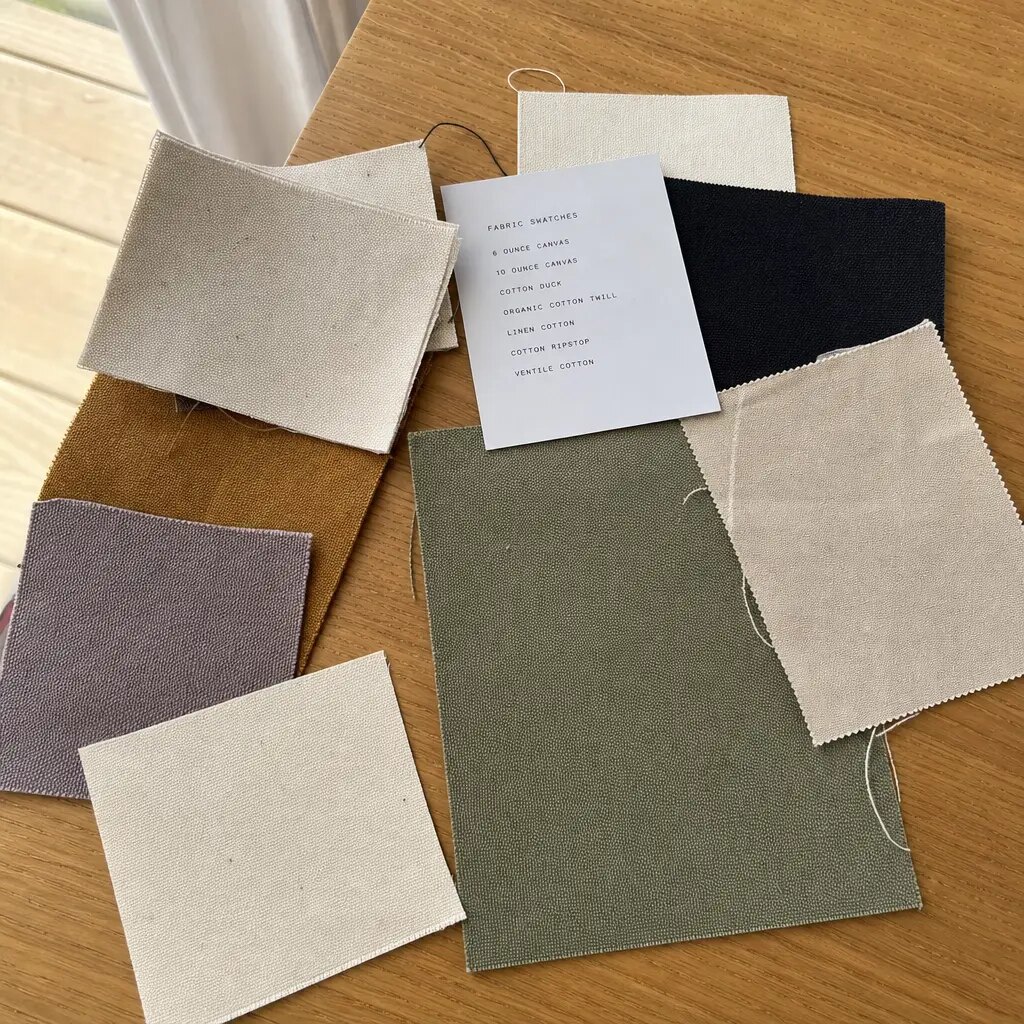
Natural cotton is common in this category because it fits farm, produce, and handmade goods branding. But natural shade is not perfectly uniform. Buyers should approve an acceptable shade band and ask how the supplier controls lot variation. For dyed colors, request lab dips or strike-offs before production. For repeat seasonal orders, keep an approved swatch from the production lot and use that as the reference for reorders.
If the bag will be printed, the surface finish matters. A smoother cotton can hold fine lines more cleanly, while a textured canvas can soften the edge of the print. On thicker fabrics, confirm whether the print needs a different ink system, additional curing, or a different screen count. A complete fabric spec should therefore include GSM, fiber composition, weave style, finish type, shrinkage expectation, and intended print method.
- Ask whether the quoted fabric is plain cotton, cotton twill, cotton canvas, organic cotton, recycled cotton blend, or cotton-poly blend.
- Require the supplier to state whether GSM is measured before or after finishing.
- For natural cotton, approve an acceptable shade range instead of expecting every lot to match exactly.
- For dyed cotton, request lab dip approval or a clear color standard before bulk dyeing.
- For repeat orders, keep a swatch from the approved production lot as a control reference.
Construction Details That Control Durability and Perceived Quality
Durability does not come from fabric weight alone. A heavier bag with weak stitching can fail sooner than a lighter bag with better construction. For farmers market use, the obvious stress points are predictable: the bottom corners, the side seams, the cord exits, and the drawcord channel. Those areas need to be defined in the spec if the bag will carry dense items such as jars, potatoes, candles, bottled sauces, or packaged food.
The drawcord channel deserves special attention. If the channel is too narrow, the cord can snag or move poorly when the user opens the bag. If it is too wide or too soft, the top edge loses shape. Heavier fabric often needs a wider channel, more controlled stitch spacing, and a smoother cord to keep the bag functioning cleanly. Cord diameter and cord material should be specified together, not separately. Cotton cord gives a natural look; polyester cord may run more smoothly and resist fraying differently.
Small construction choices change cost in a real way. A woven side label adds brand value, but it also adds a sewing operation and placement control. Reinforced bottoms, bar tacks, contrast cord, hangtags, and individual polybags all cost more. Those upgrades may be worth it, but they should appear explicitly in the quote. If you do not name them, the supplier may assume the cheapest build and your sample will not reflect the final order.
For higher-reuse cases, ask for seam allowance, stitch density, and reinforcement placement to be written into the spec. A useful spec is one a factory can repeat without guessing. If the product is meant to be retailable, ask for symmetry of the cord exits, channel width consistency, and clean finishing at the top edge. The buyer is not just purchasing a bag; they are buying a controlled production outcome.
- Specify seam allowance and stitch density for side seams and the bottom seam.
- Request reinforcement or bar tacks at cord exits when bags will carry heavier contents.
- Confirm channel width and cord diameter together, not as separate assumptions.
- Define whether the bottom is a simple seam, boxed base, reinforced fold, or double-stitched construction.
- Include labels, hangtags, and extra folding labor in the RFQ instead of adding them after price approval.
Branding and Print Choices by Fabric Weight
Screen printing is usually the most practical branding method for cotton drawstring backpacks used by farmers market vendors. It is cost-effective for one- or two-color logos, works well on natural cotton, and is repeatable for seasonal reorder programs. The key is to test it on the actual fabric weight and body color. A print that looks crisp on a smooth sample can look softer on textured canvas, and a thick ink layer can feel stiff on lighter fabric.
For small or premium branding, a woven label or sewn patch can be cleaner than a large front print. This is especially useful when the brand mark is small, the artwork has fine detail, or the buyer wants the bag to read more like a retail product than a giveaway item. Embroidery can look elevated, but it is not automatically the best answer. On lighter cotton, it can pucker the panel or distort the drape. On heavier cotton, it can work well, but the buyer should check backing, stitch count, and placement before bulk approval.
Heat transfers and digital transfers are useful when the artwork includes gradients, small type, or many colors. They require more durability control, especially if the bags will be folded repeatedly or handled in damp conditions. The transfer should not crack at the fold line, lift at the edges, or feel like a plastic patch that fights the cotton hand feel. If the bag is intended for retail sale, ask the factory to test the print on the same fabric lot that will be used in production, not just on a showroom blank.
Print placement should also be defined in measurable terms. Specify the distance from the top channel, the horizontal centerline tolerance, and the maximum artwork size. That reduces the risk of a logo drifting too high into the channel or too low on the body. The more detail you give on placement, the less room there is for a disputed inspection result later.
- Use screen print for simple logos, bold farm marks, and repeat seasonal orders.
- Use woven labels when the brand mark is small and the buyer wants a cleaner retail presentation.
- Use embroidery only after checking fabric stability, puckering, backing, and final hand feel.
- Use heat transfer for detail-heavy artwork, but require flex, rub, and edge-lift checks.
- Set print placement tolerance in writing, including distance from the top channel and centerline alignment.
How to Write an RFQ That Gets a Real Quote
A strong RFQ makes the supplier's assumptions visible. If you send only a logo and ask for best price, the factory will choose its own GSM, cord quality, fabric finish, packing, and label placement. That creates a quote that may be cheap for the wrong product. The RFQ should describe the end use, target GSM, finished size, fabric type, body color, print method, packing style, order quantity, and any retail or compliance requirements.
The RFQ should also separate the variables that drive cost. Body color, artwork version, print color count, label requirements, and packing format can each change the unit price. If a buyer asks for 5,000 pieces across five body colors and three logos, that is not one production run. It is multiple smaller runs with separate setup time and possibly separate dye lots. That structure needs to be visible before purchase order release, or the supplier may deliver a quote that looks low and then add costs later.
A useful RFQ asks the supplier to recommend a build and explain why. That is not the same as letting the supplier define the spec. It gives the buyer a way to compare technical reasoning. One supplier may recommend 150 GSM because the contents are light and the print area is simple. Another may recommend 180 GSM because the bag will be reused weekly and the bottom load is higher. The better answer is not always the heavier one. The better answer is the one that fits the use case with the least unnecessary cost and risk.
If the order will repeat, ask for the same information in every quote round. Consistency matters. The point of the RFQ is not to admire supplier creativity. It is to lock a repeatable product definition that can be sourced again six months later without rebuilding the spec from scratch.
- Include use case, contents, and expected carry weight in the first RFQ message.
- Request quotes for at least two GSM ranges when the cost-quality balance is uncertain.
- Separate pricing by body color, artwork version, and packing format.
- Ask suppliers to list exclusions and assumptions directly under the unit price.
- Require sample cost, sample lead time, bulk lead time, payment terms, and quote validity date.
- Ask for the supplier's proposed QC checklist with the quotation, not after a defect appears.
Reading Supplier Quotes Without Losing the Real Spec
The lowest unit price is only useful if it refers to the same bag. Cotton drawstring backpack quotes often hide differences in fabric weight, cord quality, print setup, label inclusion, packing, carton strength, and inspection level. If one supplier is quoting 150 GSM finished fabric with sewn labels and another is quoting 130 GSM greige fabric without labels, the comparison is not meaningful. Procurement teams need a way to see what each supplier assumed.
You do not need a forensic cost model for every line item, but you do need clarity on the major cost drivers. Fabric, sewing, printing, accessories, packing, and cartons should be obvious. Setup charges, sample fees, artwork cleanup, screen charges, and special packing fees should also be visible. For seasonal market orders, lead time assumptions matter almost as much as price. A lower quote that depends on a long fabric lead time is risky if the bags must arrive before a fixed market date or CSA launch.
MOQ deserves close attention. A supplier may have one MOQ for natural cotton, another for dyed fabric, another for custom cord, and another for woven labels. Print MOQ may also vary by artwork version. If you need one bag body with multiple vendor names, the order may be more efficient as a shared blank-body run with separate print runs. That can work well, but only if the factory confirms the setup logic and the cost of switching artwork between runs.
When comparing quotes, mark any vague wording. Terms such as standard cotton, normal thickness, or regular packing are not sufficient for procurement. The buyer should know exactly what is included, what is excluded, and what changed if one quote is materially lower than the others.
- Compare quotes on finished size, finished GSM, fabric type, cord, print, label, and packing.
- Ask whether the quoted price is EXW, FOB, CIF, DDP, or another trade term.
- Confirm whether print screens, sample freight, carton marks, and documentation are included.
- Request price breaks at 1,000, 3,000, 5,000, and 10,000 pieces for the same spec.
- Ask what changes if the order is split across multiple body colors or logos.
- Flag any quote that uses vague terms such as regular cotton or standard packing without definitions.
Sample Approval Should Lock the Production Standard
A pre-production sample is not a sales sample. It should become the physical standard for bulk production. For cotton drawstring backpacks, the approved sample should use the final fabric weight, final fabric color, final drawcord, final print method, final label placement, and final packing method whenever possible. If anything is substituted, that substitution should be documented on the sample approval so the buyer does not approve a product that cannot be reproduced at scale.
The sample should be measured and tested in practical ways. Verify finished width, finished height, channel width, and usable internal height. If possible, verify the fabric GSM from the production fabric. Pull the drawcord repeatedly to check for snagging. Inspect cord exits and bottom corners. Fold the print area and rub it with a dry white cloth. If the bag will be washed by end users, run a buyer-side wash test or ask the factory for a wash check before approval.
Photographs help, but they do not replace physical review when the order has meaningful volume or resale risk. Photos can show print placement and overall look, but they cannot fully show hand feel, opacity, odor, stiffness, or the way the channel behaves under tension. Once approved, keep one physical reference sample on the buyer side and ask the factory to retain one signed or tagged control sample. Reorders should be compared against that reference rather than memory.
If the first sample is close but not correct, do not approve it on the assumption that the factory will fix it later. Fix the spec first, then approve the sample again. This avoids the common sourcing problem where the buyer approves something visually acceptable but technically off-spec, then spends the bulk order negotiating about tolerances that were never written down.
- Do not approve bulk production from a sample made with substitute fabric unless the limitation is documented.
- Measure finished dimensions after sewing, not from the supplier's pattern or cut panel.
- Check usable capacity below the drawcord channel, especially if the bag must hold specific retail items.
- Test cord pull, seam strength, print rub, odor, stains, and loose threads before approval.
- Photograph the approved sample from front, back, inside, channel, cord exit, label, and folded packing views.
- Use the approved sample as the reference for final inspection and future reorders.
QC Plan for Bulk Orders
Quality control should be measurable and tied to how the bag will be used. For this product, the most important checks are fabric weight, finished dimensions, seam security, cord function, print quality, label placement, cleanliness, and packing accuracy. A buyer does not need to overcomplicate every order, but they should define what counts as critical, major, and minor defects before production begins. For larger orders, many buyers align inspection to an AQL plan, commonly 2.5 for major defects and 4.0 for minor defects on accessories, but the exact standard should match your own policy and risk tolerance.
Critical defects are issues that make the bag unsafe, unusable, or unacceptable for sale, such as torn seams, broken cords, severe stains, strong chemical odor, missing print on a printed order, or incorrect material. Major defects include visibly crooked print, wrong size outside tolerance, skipped stitches at stress points, poor cord movement, shade mismatch beyond the approved range, or carton counts that do not match the PO. Minor defects may include a small loose thread, a slight fold mark, or a slub within the approved fabric character.
Inspection should happen at more than one stage when possible. Fabric inspection before cutting catches shade and stain issues early. In-line sewing checks catch channel and seam problems before thousands of units are packed. Print checks should happen after curing or drying, not when the ink is still fresh. Final inspection should include random carton opening, measurement checks, print rub checks, cord function checks, and carton mark verification. The supplier should provide clear photos, but for larger or higher-risk orders, a third-party inspection can reduce the risk of shipping an avoidable problem.
Use the QC report to verify the exact defect patterns, not just the number of defects. If the same issue appears on multiple bags, that usually points to a process problem, not random variation. That is the signal you need to stop, correct, and re-inspect before shipment.
- Set written tolerances for GSM, finished width, finished height, print placement, and label placement.
- Classify defects before production so the supplier knows what requires rework or rejection.
- Inspect fabric before cutting for stains, shade variation, holes, odor, and unacceptable slubs.
- Check seams, channel stitching, cord exits, and bottom corners during production, not only at final packing.
- Perform print checks after curing, including dry rub and fold checks on the actual bag.
- Verify carton count, SKU separation, carton labels, gross weight, and packing method before shipment release.
Packing, Freight, and Landed Cost Controls
Packing choices can change landed cost as much as small fabric upgrades. Cotton drawstring backpacks are usually shipped flat in bulk because it is the most efficient way to move volume. That works well when the bags will be unpacked by a vendor, event team, or fulfillment center. The fold method still needs to be consistent, and printed surfaces should not rub against each other if the ink or transfer is sensitive to scuffing.
Retail-ready packing is worth the cost only when the presentation value justifies it. Individual polybags, belly bands, hangtags, barcode labels, and insert cards all improve shelf handling and make retail distribution cleaner, but they add labor, materials, and carton volume. They also create more complexity if the order includes multiple colors or vendor logos. Buyers should decide whether the presentation benefit is worth the added freight and handling before they approve the packing spec.
Landed cost should be reviewed before the PO is released, not after cartons are packed. Ask for carton dimensions, gross weight, net weight, pieces per carton, inner pack count, and estimated total cartons at the quoted order quantity. Compare EXW, FOB, and delivered options if relevant. A heavier GSM can improve perceived quality, but if it also increases carton weight and reduces carton efficiency, the delivered cost may shift more than the unit quote suggests.
The practical rule is simple: do not evaluate the bag only by ex-factory price. For a farmers market program, the real cost includes freight, packing, inspection, and the cost of defects or reorders. If the bag is going directly into resale or a branded member kit, a slightly better spec can be cheaper in practice if it reduces complaint risk and packing problems.
- Choose bulk flat packing for efficient freight and simple vendor distribution.
- Choose individual or retail-ready packing when shelf presentation, barcode control, or gift-kit handling matters.
- Define fold direction and print protection, especially for large prints or transfers.
- Require carton dimensions and gross weight before issuing the PO.
- Specify carton marks, SKU labels, inner pack quantities, and mixed-color packing rules.
- Compare landed cost by specification, not just ex-factory unit price.
Specification comparison for buyers
| Spec decision | Recommended option | When it fits | Buyer risk to check |
|---|---|---|---|
| Fabric weight | 120-130 GSM cotton | Flyers, seed packets, coupons, and very light giveaway use | Can feel thin or semi-disposable; confirm opacity, seam strength, and print show-through |
| Fabric weight | 140-160 GSM cotton | Most farmers market vendor programs with produce, brochures, and small retail items | Supplier may quote greige fabric weight instead of finished fabric weight; lock the measurement basis |
| Fabric weight | 180-200 GSM cotton or light canvas | Premium resale bags, heavier packaged goods, and reuse-focused programs | Higher freight weight and more sewing stress; check channel bulk and cord pull function |
| Fabric type | Plain cotton twill or plain woven cotton | When buyers want a natural hand feel and clean print surface | Ask for weave, yarn count, and shrinkage range instead of relying on the word cotton alone |
| Fabric type | Cotton canvas | When the bag needs a more structured retail feel and better body | Heavier canvas can pucker at the channel if cord and stitch settings are not adjusted |
| Construction | Standard side seams and single bottom seam | Economy orders with light loads and controlled reuse | Can fail early if buyers do not define seam allowance and stitch density |
| Construction | Reinforced bottom and bar-tacked cord exits | Weekly reuse, heavier produce, or paid retail bags | Requires clearer QC on stitch placement and symmetry |
| Supplier route | Direct factory with in-house sewing and printing | Repeat orders where spec control, sample consistency, and QC matter | Verify which steps are truly in-house and which are outsourced |
| Supplier route | Trading company or sourcing agent | Multi-SKU consolidation or buyers needing one coordinator across factories | Clarify who owns QC liability, who approves rework, and whether the factory identity is verifiable |
Buyer checklist before sampling
- Define the real use case first: giveaway, retail resale, CSA pickup, market carry, or packed-in subscription item.
- State the expected contents and typical carry weight. A bag for brochures is not the same spec as one that will hold jars or produce.
- Set a target GSM with a tolerance band and specify whether that GSM refers to finished fabric after dyeing and finishing.
- Write the finished dimensions, usable internal height below the drawcord channel, channel width, cord length, and any reinforcement requirement.
- Identify the exact fabric type: plain cotton, cotton canvas, organic cotton with documentation, recycled cotton blend, or cotton-poly blend.
- Specify color standard for body fabric, including whether natural cotton shade variation is acceptable within a defined range.
- List print method, print size, number of colors, Pantone references, artwork file format, and placement tolerance.
- Confirm whether labels, hangtags, barcode stickers, insert cards, and retail polybags are included in the unit price.
- Ask for pricing at 1,000, 3,000, 5,000, and 10,000 pieces, separated by body color and artwork version if those differ.
- Require a pre-production sample made with final fabric, final cord, final print method, and final label placement before bulk cutting.
Factory quote questions to send
- What is the finished fabric GSM after dyeing, washing, calendaring, or any other finishing step, and what tolerance do you apply in bulk production?
- Is the body fabric plain cotton, cotton canvas, combed cotton, organic cotton with documentation, recycled cotton blend, or a cotton-poly blend?
- What weave style, yarn count, and shrinkage range do you expect for this fabric, and can you share a swatch from the intended production lot?
- What is included in the quoted unit price: fabric, cutting, sewing, drawcord, printing, labels, hangtags, packing, cartons, and inspection?
- What is excluded from the quote: artwork cleanup, Pantone matching, sample freight, screen charges, transfer setup, inner polybags, export cartons, or documentation fees?
- What is the MOQ by body color, by fabric lot, by print version, and by packing version?
- How does pricing change at 1,000, 3,000, 5,000, and 10,000 pieces, and which cost driver creates each price break?
- Which production steps are in-house, and which steps are outsourced to mills, dye houses, printers, label suppliers, or packing subcontractors?
- What print method do you recommend for our artwork and GSM range, and what rub, fold, or wash checks can you perform on the actual bag fabric?
- Can you make the pre-production sample using final bulk fabric, final cord, final print method, and final packing style, or will any element be substituted?
Quality-control points to confirm
- Finished fabric weight should match the agreed GSM range, measured from production fabric rather than only from a mill spec sheet.
- Finished dimensions should be checked after sewing and after the drawcord channel is formed, because cut-panel dimensions are not the same as usable bag size.
- Usable internal height should be measured below the channel so buyers know whether produce, jars, leaflets, or retail items will fit correctly.
- Drawcords should pull evenly from both sides, move without snagging, and remain secure after repeated open-close cycles.
- Cord exits, side seams, and bottom corners should show secure stitching, no skipped stitches, no broken thread, and no loose seam ends.
- Print should be checked for placement, registration, edge sharpness, ink coverage, hand feel, dry rub resistance, and wet rub or wash performance when reuse is expected.
- Labels should be straight, consistently placed, securely sewn, and positioned so they do not distort the side seam or interfere with the channel.
- Fabric should be inspected for shade variation, stains, oil marks, holes, odor, and slubs outside the approved range before cutting and after packing.
- Packing should match the purchase order for fold method, inner pack count, carton count, carton marks, SKU separation, and gross weight.
- Inspection photos should include measurement points, cord function, seam close-ups, print close-ups, carton labels, and one random carton opening, not only finished beauty shots.